A missile commander watched his ten nuclear silos go dark. His own service record shows his signature on a future he's never lived.
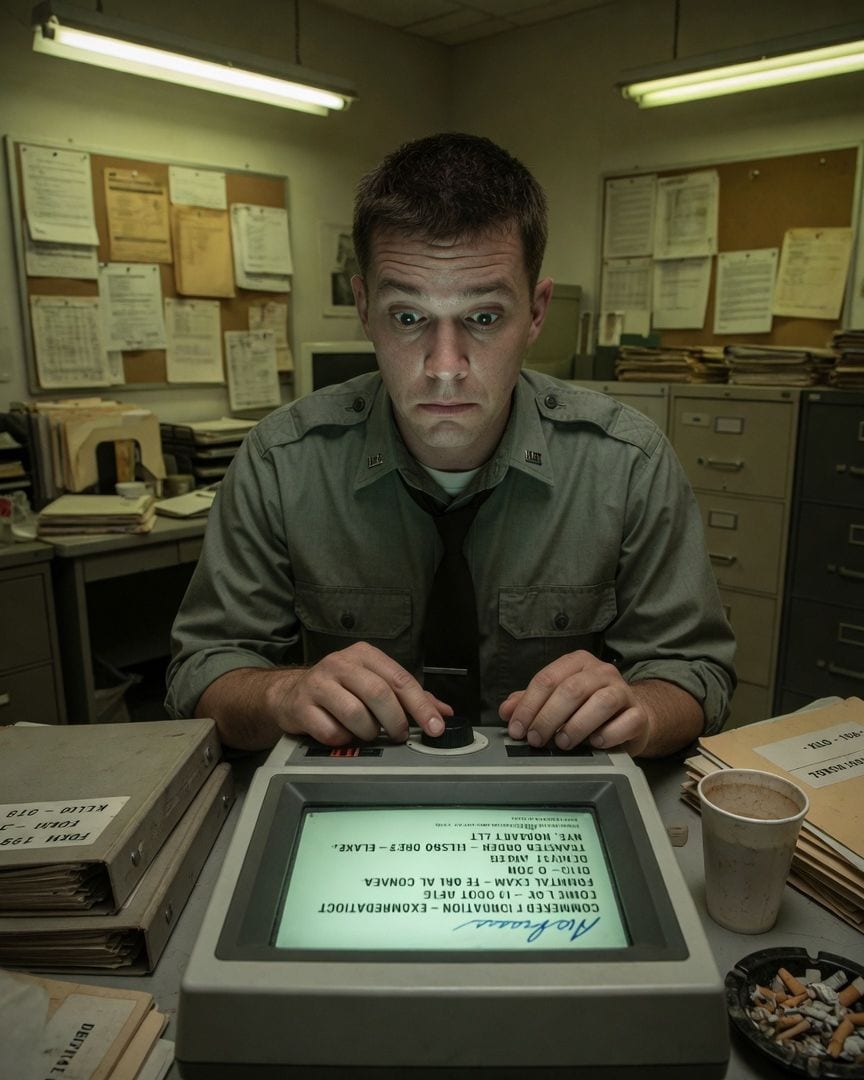
Second Lieutenant Hobart Nye had been a missile combat crew commander for six weeks, and the phone still made him jump. It rang at 0247, a sudden, jarring sound in the deep quiet of the Wyoming capsule.
His hand trembled as he answered, his voice a tight "Nye here." The voice on the other end, Sergeant Marcus Delaney, leader of the topside security alert team, was strained, edged with an unfamiliar awe.
"Lieutenant, you're not going to believe this. We've got... something." Hobart listened, his blood turning cold. Delaney described a silent, black triangular shape, massive, sitting directly over Launch Facility Kilo.
It was close enough, Delaney claimed, to cast a perfect shadow over the fence line, clear in the moonlight. Following protocol, Hobart ordered the team to withdraw to a safe distance and hold, to maintain observation.
Then, the radio went to static, then a hiss of dead noise.
Hobart’s fault panel, a neat row of red lights on the console before him, began to activate. First one bird, then another, then another, mirroring the layout of the launch silos on his map.
Each light signified a missile going dark, offline. He watched his flight, all ten of his charges, extinguish under his hands.
Sixty feet of packed earth and reinforced concrete separated him from the night, but he felt the impossible silence of the object above, a physical pressure against his eardrums. It lingered, even as he stared at the inert panel.
Eleven minutes later, Delaney’s voice crackled back onto the net, laced with confusion. "Lieutenant? What happened? We just... sat here." They had no memory of the radio silence, no recollection of the enormous, impossible craft. Just a blank, eleven-minute void.
Hobart reported the incident, his voice steady despite the tremor in his hands, but the silence he’d felt remained, a weight that settled deep within him.
Days blurred into weeks of debriefings, each one a meticulous dissection of those eleven minutes. Psychologists probed, asking about stress, sleep, personal history.
Hobart recounted his experience with methodical precision, clinging to the exact times, the sequence of lights, the unnerving silence, even as he was quietly sidelined to a desk job, pending official review.
He tried to find a mundane explanation for the missing time, for the silent shutdown of the missiles. He requested the official logs for Launch Facility Kilo, poring over the security team’s records.
The log showed the 11-minute gap, then their return, with a neat, typed notation: "brief radio malfunction." No mention of any UFO, no lost memory. A clerical error, he told himself. A miscommunication, perhaps a technical glitch.
It was easier than accepting what he knew he had seen, what he had felt.
But then, as he sifted through an ancillary binder, he found it: a requisition for "specialized atmospheric sensors," dated after the incident.
The signature on the form belonged to Colonel James Harrison, the base commander, who should have been off-base entirely that week. The form itself was too perfectly filled out, too official, too clean for a simple mistake.
Every field completed with a crisp, precise hand. He tried to reconcile the details, searching for a faulty sensor, a late-filed request, even a prank. Anything that would make sense.
But the signature, with its distinctive flourish on the 'H' and the tight loop of the 'J', looked undeniably genuine. And the requisition was for equipment that could track something invisible, something that left no radar trace.
The air in the quiet office felt suddenly thin.
Frustrated, and driven by a growing unease, Hobart decided to check Colonel Harrison's duty roster, hoping to prove a simple scheduling error.
He navigated the quiet, dusty corridors of the base's records office, the smell of old paper and stale air thick around him. The fluorescent lights hummed with a low, constant drone.
As an afterthought, he requested his own Form 201, his official service record. He was curious how they’d officially documented his 'stress-related' reassignment.
He fed the microfiche into the reader, the machine whirring softly as he scrolled through the tiny, inverted script: his enlistment, his training, his assignment to Kilo. He found the date of the incident.
And then, new entries began to appear. A routine dental check-up, dated a year after his transfer out of the missile command. A commendation for 'exemplary conduct,' stamped months later.
A transfer order to a base in Alaska, for a date still six months in the future. He’d never been to Alaska. He hadn't had a dental check-up since basic training.
The microfiche projection flickered, showing his own signature, perfectly replicated, on a transfer order for a future he didn't recognize.
The impossible entries in his own file sent a cold dread through Hobart, not like the fear of combat, but a deeper, insidious unease that seeped into his bones.
He tried to access the Alaskan base's records mentioned in his 'future' transfer, but his credentials, once sufficient for most routine inquiries, were suddenly insufficient. A polite, automated message simply stated, "Access Denied."
The system, it seemed, was already closing ranks around him. He shifted his focus, began to cross-reference names and dates from the anomalous entries in his file with other base records, looking for any pattern, any shred of an explanation.
He found similar 'irregular' entries: maintenance logs for vehicles officially decommissioned years ago, signed by mechanics long retired or even deceased; supply requisitions for units listed as dissolved in official registries.
Each discovery chipped away at the mundane explanations he desperately clung to. A system error, he'd insist to himself, but the sheer volume made it feel like a deliberate act.
He tried to bring these discrepancies to his temporary superiors, presenting them with neat stacks of photocopied evidence. But he was met with polite dismissal, suggestions of "stress-induced misinterpretations," or simply, "Lieutenant, those are just clerical errors."
No one wanted to see it. He realized he had to dig deeper, more covertly. He sought out the less-digitized archives, the vast, dusty repositories of paper trails and microfiche, the places where information went to be forgotten.
There, he found an unexpected ally in Judith Doyle, an elderly records clerk whose meticulousness bordered on obsession. Judith, initially skeptical, saw the quiet desperation in his eyes, the precision of his findings.
She helped him locate a series of obscure 'Project Nightingale' files, cross-referenced from some of the impossible signatures Hobart had found.
The files were heavily redacted, black bars obscuring most of the text, but they consistently showed a pattern of 'relocation and re-assignment' for personnel involved in 'unexplained incidents,' always with an unnerving lack of follow-up in conventional databases.
The air in the quiet annex where they worked felt heavy, charged with the weight of unseen information.
Hobart's increasing activity in the archives did not go unnoticed. One morning, his access to certain high-level records was revoked without explanation. His computer simply flashed "Insufficient Privileges" for files he had been able to view just the day before.
Later that week, an anonymous, typed memo appeared in his internal mail slot. It was folded once, the paper thick and stiff. 'Some things are best left filed,' it read.
There was no sender, no official stamp, just the stark, impersonal warning. The air in the archives, once a sanctuary of forgotten facts, now felt charged with an unseen presence, a subtle prickle on his skin.
He felt watched, a sensation that made the hairs on his arms stand up, even when he was alone.
One evening, as Hobart was leaving the archives late, the fluorescent lights buzzing above him in an uneven rhythm, he saw a figure in a dark, impeccably tailored uniform watching him from the end of the long corridor.
The man didn't move, just stood there, his face obscured by shadow and distance, observing. Hobart’s heart hammered a frantic beat against his ribs. He tried to approach, to demand answers, to break the unsettling stillness. "Hey!"
he called out, his voice a little hoarse. But as he moved forward, the figure silently ducked into a doorway.
By the time Hobart reached the spot, the corridor was empty, the doorway leading only to a small, locked storage closet. The message was clear: he was being monitored.
He confided partially in Judith, whose initial helpfulness had given way to a palpable nervousness. Her hands would tremble as she sorted files.
She mentioned a retired Colonel, Wayne Fletcher, who had worked in declassification for decades and always had 'odd theories' about certain record anomalies, especially those concerning 'ghost units' – military entities that appeared to exist outside official records.
Hobart tracked down Wayne Fletcher to a quiet, unassuming house in a remote town, miles from any military base. The small home smelled of old paper and brewed coffee.
Fletcher, a man whose eyes held the weary wisdom of someone who’d seen too much paperwork, was initially dismissive.
"Another young man chasing ghosts in the filing cabinets," he grumbled, offering Hobart a lukewarm cup of coffee that tasted faintly metallic. But when Hobart laid out his own Form 201, detailing the impossible entries, Fletcher's demeanor shifted.
He studied the microfiche slides, his gaze narrowing, a faint tremor in his hand. The room, which had seemed merely cozy, now felt heavy, expectant.
"I've seen similar anomalies, Lieutenant," Fletcher admitted, his voice low, almost a whisper, as if afraid the walls had ears. He spoke of 'the machine,' an unofficial term for the vast, unseen system that processed these incidents.
"It's not about covering up what happened," he explained, leaning forward, his voice gaining a strange, quiet intensity. "It's about continuing it."
He pulled a single, declassified document from a drawer in his desk, its paper yellowed with age, a summary report from a 1950s naval incident where a destroyer vanished with all hands.
The report contained a 'crew manifest update' dated five years later, listing specific sailors as 'transferred to classified duty,' despite being officially dead. "The records aren't errors, Lieutenant," Fletcher said, tapping the document with a finger that trembled slightly.
"They're active. The people aren't lost. They're filed. The files keep writing because the assignments continue. Your 'Project Nightingale' files? Just one branch of the tree. A small, carefully pruned branch."
The dread that had been a whisper in Hobart's mind now roared.
Fletcher leaned back, his eyes distant, fixed on some unseen point beyond the window. "Project Nightingale is just a minor cog, Lieutenant. This goes deeper, wider."
He pulled out an old, heavily bound ledger from a hidden compartment in his desk – not an official document, but his own meticulous, decades-long log of anomalies.
It was filled with cryptic notes and cross-references, names and dates scribbled in faded ink: 'Launch Facility Kilo' linked to 'Project Nightingale,' which was in turn linked to 'Operation Deep Water' (naval losses), and 'Sky Sentinel' (aircraft disappearances).
The sheer scope of it was staggering, a vast, interconnected web of the impossible. He pointed to a specific entry, his finger tapping the page. "Look at this," he said, his voice flat.
It was a maintenance log for the USS Vanguard, a submarine lost with all hands in 1958.
A routine engine sign-off, dated 1963, bore the looping, confident signature of Chief Petty Officer Isaac Radcliffe, the boat's chief engineer, who had been declared dead at sea five years prior.
Fletcher then pointed out a tiny, almost imperceptible stamp on the log, a routing code for a facility that officially ceased to exist in 1950. He looked at Hobart, his face grim, the paper rustling softly in his hand.
"They don't just file the people, Lieutenant. They file the places too. And they're still using them."
Fletcher explained that the 'secrecy machine' wasn't merely an institution covering up incidents; it was a vast, patient process that integrated the anomalous into its own structure. The disappeared weren't forgotten; they were integrated.
He showed Hobart entries from his ledger detailing how specific 'lost' facilities, like the one with the 1950 routing code, and even 'lost' personnel, such as Chief Petty Officer Radcliffe, appeared in records pertaining to new incidents, sometimes decades later, performing tasks that seemed impossible.
The UFO over Kilo, Fletcher stated, wasn't an isolated event; it was a 'collection event.' The missiles going dark weren't a failure, but a successful transfer of operational control.
The security team's memory wipe was merely standard procedure, ensuring no loose ends, no lingering questions.
The 'File That Kept Writing' wasn't a post-facto cover-up; it was the ongoing administrative record of personnel and assets that had been transferred to an unseen, parallel operational matrix.
The horror, Hobart realized, was in the sheer bureaucratic patience and coherence of it all. It was a vast, silent, self-sustaining system, processing the impossible as routine.
The air in the room felt impossibly still, as if the silence from Kilo had followed him all these years.
Hobart and Fletcher decided they needed a definitive, undeniable artifact—something concrete that would shatter the official narrative, something that even 'the machine' couldn't explain away. They focused on Isaac Radcliffe's impossible signature.
Fletcher knew of an old, unofficial private collection of naval documents belonging to a deceased former colleague, a man who had also chased these shadows.
They traveled to a remote, dusty house, long abandoned, its windows dark eyes staring out at the wilderness. The floorboards groaned under their weight as they moved through the silent rooms, searching.
Inside, among boxes of forgotten memorabilia and cobwebs, they found a small, personal trunk tucked under a draped sheet.
Within it, meticulously preserved, were Radcliffe's original service record, kept by his family, and a worn, leather-bound journal. Hobart carefully opened the journal, the smell of old paper filling his nostrils.
Radcliffe's handwriting was unmistakable, detailing mundane duties, weather observations, and personal thoughts. They compared it, line by painstaking line, to the signature on the 1963 maintenance log from the submarine lost in 1958.
It was an exact match: the slight, elegant curve on the 'I,' the specific flourish on the 'R,' the confident downward stroke of the 'f', even the subtle hesitation on the final 'e'.
The journal also contained an entry from 1957, describing a strange, silent light seen from the submarine's periscope, followed by "orders from an unknown source," a phrase that seemed impossibly casual given the context.
As they held the journal and the impossible log, the doorbell rang. They froze, the sound a shrill intrusion in the desolate quiet. No one knew they were here. The sound of slow, deliberate footsteps approached the door.
A key turned in the lock, a soft, sickening click echoing in the silent house.
The door swung inward. Standing silhouetted against the afternoon light was Marcus Delaney, the security team leader from the Kilo incident, utterly unchanged, unaged since 1973. His uniform was pristine, an older, slightly different cut than Hobart remembered, but impeccable.
He didn't speak. He simply raised a hand, holding a pristine, official-looking file folder. On its tab, in a steady, official hand, was written: 'NYE, HOBART. Pending Transfer.'
Fletcher shouted at Hobart to run, his voice ragged with fear, but Hobart found he couldn't move. A strange, serene calm washed over him, dulling the fear, replacing it with something cold and inevitable.
He looked at Delaney, then at the file. He understood. The fear was gone, replaced by a quiet, terrible acceptance.
Hobart Nye's last known official record is a transfer order, dated two days after his meeting with Wayne Fletcher, assigning him to 'Project Nightingale, Classified Operations.' His name is neatly typed.
His signature, a perfect replication of his own, is there. His Form 201 continues to accrue entries for routine physicals and training exercises. Wayne Fletcher was found dead in his home a week later, ruled a heart attack.
The ledger he kept was gone. Judith Doyle, the records clerk, now works in a different department, her memories of Hobart Nye vague, as if a minor detail filed away.
Years later, a new Second Lieutenant, fresh from training, opens his first official personnel file.
He sees his name, his service number, and then, beneath it, a transfer order to a remote facility, dated years in the future, bearing a signature that looks exactly like his own.
He closes the file, a faint, wrong little smile on his face.
If this one got to you
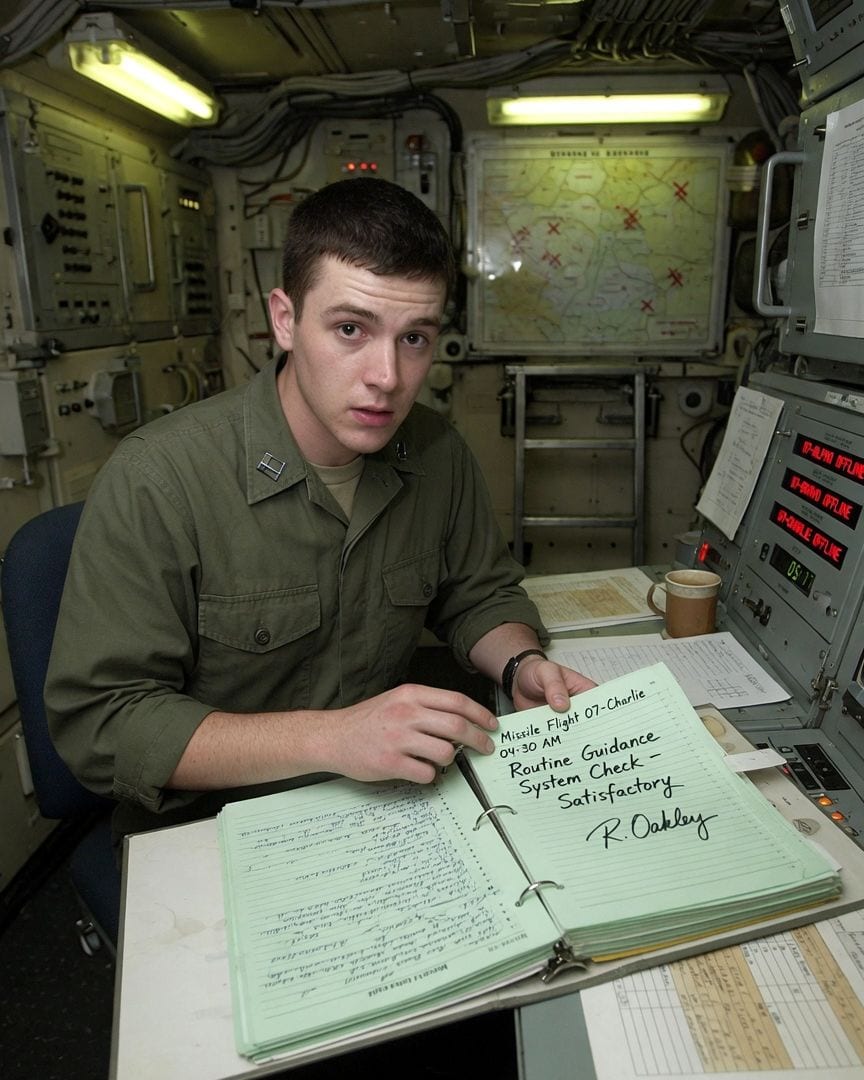
A Cold War missile lieutenant found a dead missile's log signed for a 'routine check' by a crew chief confirmed asleep.
Six weeks into his command, Second Lieutenant Hobart Nye’s Wyoming missile capsule went silent after a 0247 shriek. Topside security reported an unidentified object near the fence, their radio dissolving to static as Hobart watched his missile flight go dark in a precise, terrifying sequence. The official explanation blamed equipment, but the profound eleven minutes of silence and his security team's amnesiac return left him unsettled. Later, reviewing physical launch logs, Hobart found a 'Routine Guidance System Check' for a dead missile, dated hours after the incident and signed by his crew chief, Reginald Oakley – a man confirmed asleep in his bunk. How could a dead missile undergo a check by someone miles away, asleep?
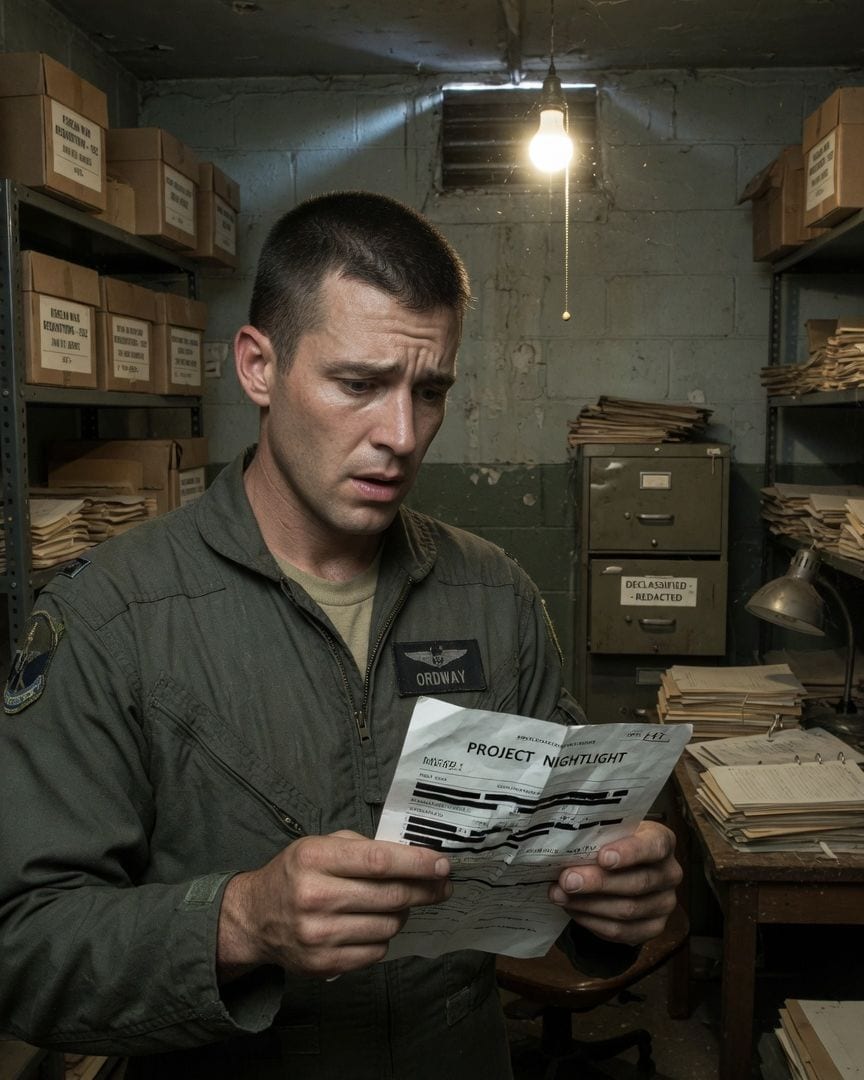
A Cold War pilot's F-104 Starfighter was shadowed by an impossible object. Weeks later, a secret memo referenced his own service number for 'pilot reassignment protocols.'
First Lieutenant Cal Ordway soared over the Mojave in his F-104 Starfighter in 1962, the night sky a familiar canvas. But that night, one 'star' broke formation, pulling alongside his wing and mirroring his every impossible maneuver. His instruments confirmed the silent, unblinking object, defying all known physics. After filing his precise report, Cal found his flight log altered to 'no incidents,' radar tapes corrupted, and a superior advising him to 'let it go.' Driven by his training, he uncovered a heavily redacted memo referencing 'Project NIGHTLIGHT' and, chillingly, his own service number for 'pilot reassignment protocols initiated.' Was he merely a witness, or already a subject in a much deeper secret?
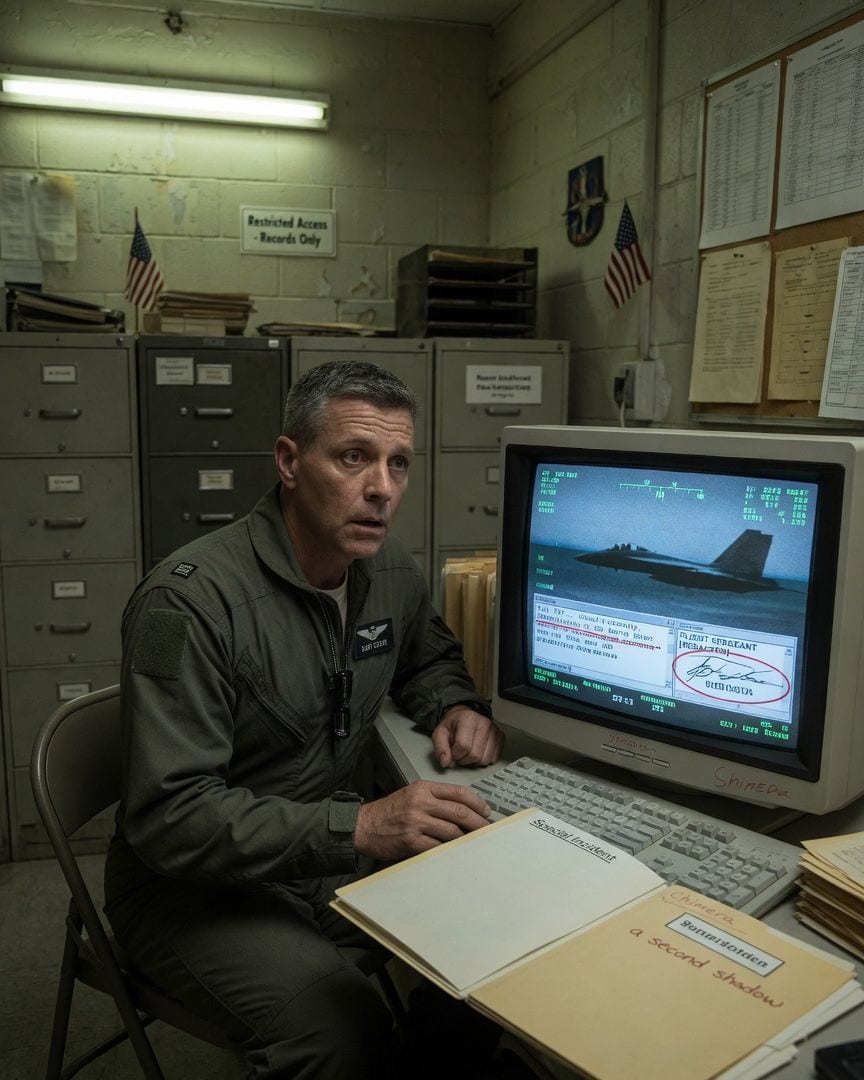
A Chief Warrant Officer's HUD showed a second aircraft watching his plane. He later found a log for *his* tail number reporting the same anomaly weeks ago, but he was grounded for medical leave.
Chief Warrant Officer Gary Estes, a man whose career was built on precision, found his impending Pentagon transfer shadowed by a baffling anomaly. On every flight, at exactly 800 feet, his aircraft's display would briefly show a sleek, dark second plane tucked off his right wing, its canopy subtly angled toward his, watching him. Ground radar never saw it, and his wingmen swore they flew alone. Desperate to maintain his clean record, Estes dug into maintenance logs and uncovered an entry for *his* tail number from weeks prior. It described the exact same 'visual anomaly' during a flight he knew, with chilling certainty, he had never flown.
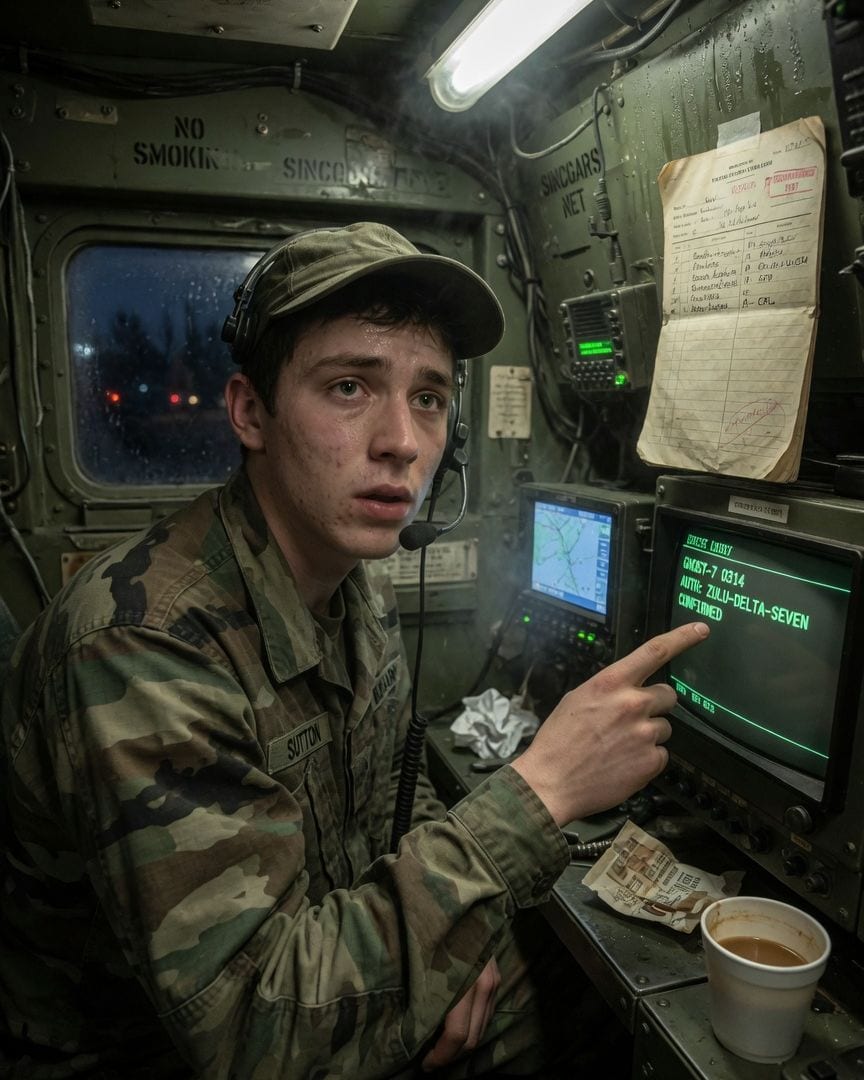
Corporal Aldous Sutton found his own name, rank, and call sign in a 1987 logbook from his exact outpost, decades before he was born.
Corporal Aldous Sutton, 22, was hunched in his cramped comms track, the air thick with stale coffee, monitoring a quiet German night. The division exercise outside was routine, all units accounted for, until an unknown call sign crackled through his headset. 'Ghost-7' requested authentication using a protocol decommissioned years before Aldous was even born. Despite his superior dismissing it as a glitch, Aldous found official logs confirming the impossible exchange, even dating his own hesitant responses. But the real dread landed when he cross-referenced the phantom unit and discovered his own name, rank, and call sign listed in a 1987 logbook, attached to 'Ghost-7' at his exact outpost.
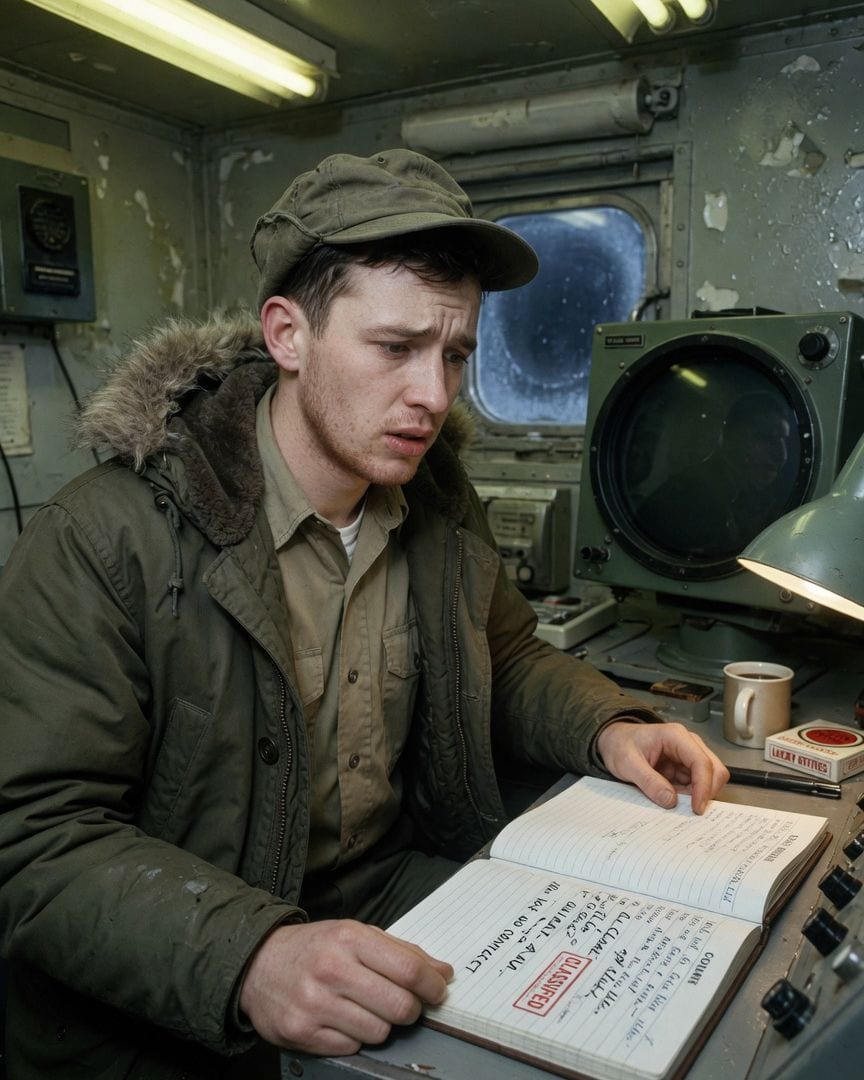
A Cold War airman logs an impossible radar contact on his last sweep. But his official logbook entry is stamped 'CLASSIFIED' and then contradicted by a hastily scrawled 'ALL CLEAR' dated moments before it.
Airman Ordway Vance, 22, manned the radar dome at Site Pellin in the biting North Atlantic dark of January 1962, running the last calibration sweep before its decommissioning. His scope picked up a faint, impossible return, growing closer with each pass, though the ocean remained empty to the eye. When Vance detailed the contact in his official logbook, a 'CLASSIFIED' stamp appeared, followed by a hastily scrawled 'ALL CLEAR' dated moments before his own entry, contradicting his every word. Commander Hartley dismissed it as equipment malfunction, but Vance sensed a chilling, official erasure behind the lie. He soon found a locked cabinet marked 'SITE PELLIN ANOMALIES,' hinting at a deeper truth buried within the base's final days.
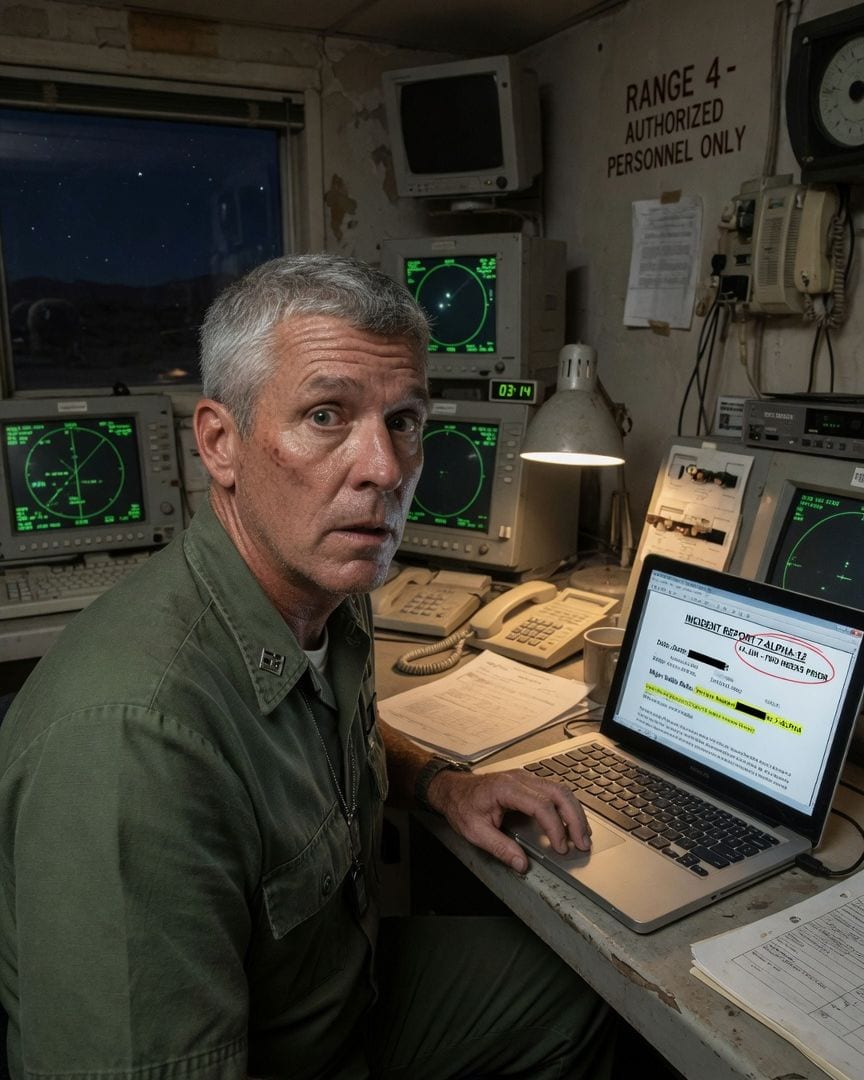
Major Hollis Rake, two weeks from retirement, reported a silent desert disc. His own report was already filed, dated two weeks before it appeared.
Major Hollis Rake, just two weeks from retirement after thirty-five years on a New Mexico desert range, found his predictable world upended. A silent, featureless disc, defying all known phenomena, appeared over the sled rail, its impossible presence confirmed by every instrument on the range. But the true unease began when Major Rake filed his meticulous incident report: it was already in the system, dated two weeks *before* the event even happened. His own name and service number were later found linked to the incident's code in his transfer disposition. Was his retirement just a clerical error, or something far more sinister?