A Cold War pilot's F-104 Starfighter was shadowed by an impossible object. Weeks later, a secret memo referenced his own service number for 'pilot reassignment protocols.'
The Mojave stretched beneath First Lieutenant Cal Ordway, a vast, indifferent canvas of darkness, speckled with the cold fire of desert stars.
His F-104 Starfighter cut through the 1962 night, a sleek dart under a sky that had, for twenty-seven years, always obeyed the known laws of physics. Tonight, it did not.
One of the stars, brighter than the rest, had broken formation. It pulled alongside his wing, maintaining an impossible pace. Cal, a graduate of two flight schools that had hammered home the reliability of instruments, stared at his gauges.
They confirmed the impossible: the object was three-quarters of a mile off his wingtip, holding four hundred knots, a silent shadow without a single surface moving, no blinking navigation lights.
He banked thirty degrees left, a deliberate test, his stick firm in his grip. The 'star' was already established in the turn, a fluid, seamless motion, as if anticipating his maneuver before his own wing dipped.
He rolled out of the turn; it rolled out with him, a flawless, unsettling mirror.
It followed him all the way back to the fence line of his base, an unblinking sentinel in the black, before shooting straight up, a streak of impossible light vanishing in an instant.
Cal landed, the concrete of the runway a welcome solidity under his tires. He taxied in silence, the impossible weight of what he had seen pressing down on him.
He filed his report, methodical and precise, detailing every impossible fact, expecting a flurry of questions, a debriefing, a team. Instead, there was only a quiet, unnerving silence from the tower, a brief nod, and then a dismissive wave.
Days turned into a week, then two. Cal expected intense debriefings, a full investigation into what he knew had been a genuine aerial phenomenon.
Instead, his official flight log for that night was returned to him with the entry for his Mojave hop conspicuously blank, or perhaps, subtly altered. It now read simply 'routine proficiency flight, no incidents,' the ink too neat, too final.
When he requested the radar tapes from the tower for that specific period, the chief technician, a man named Henderson with twenty years under his belt, looked at him with an apology in his eyes.
He claimed they were corrupted, a 'known issue with older equipment.' Cal tried to rationalize it: a rare atmospheric inversion, a new experimental craft, a faulty instrument, anything but the truth.
But his rigorous training screamed otherwise, every check and double-check during the flight affirming the impossibility of what he witnessed. He started asking around, discreetly, during lunch breaks, over coffee in the mess.
An older NCO, Sergeant Isaac Muller, a man with a face like worn leather and a reputation for knowing everything that happened on base, pulled Cal aside one afternoon.
Muller mentioned 'unusual atmospheric conditions' on that date, a slight tremor in his voice. He slid Cal a smudged, unofficial memo from a different unit, tucked inside a stack of maintenance reports.
It detailed a similar 'anomaly' in the same airspace. The memo was stamped with an odd, complex reference number, too specific to be a coincidence.
Muller just shook his head, a weary look in his eyes that seemed to carry the weight of more than just atmospheric conditions. "Some things just... disappear, Lieutenant," Muller said, his voice barely a whisper. "Best not to chase them."
A chill, not from the air conditioning, ran down Cal's spine.
Cal, frustrated and increasingly uneasy, refused to heed Muller’s implicit warning. He pushed for answers. His direct questions were met with polite but firm deflections, a wall of carefully worded phrases that yielded no information.
He was quietly advised by a superior, a major who ordinarily championed Cal’s promising career, to 'let it go, for his own good.'
One afternoon, while sifting through old, discarded paperwork in a forgotten storage room – a dusty, stale-smelling space filled with the ghosts of forgotten projects – he searched for anything with that specific reference number Muller had shown him.
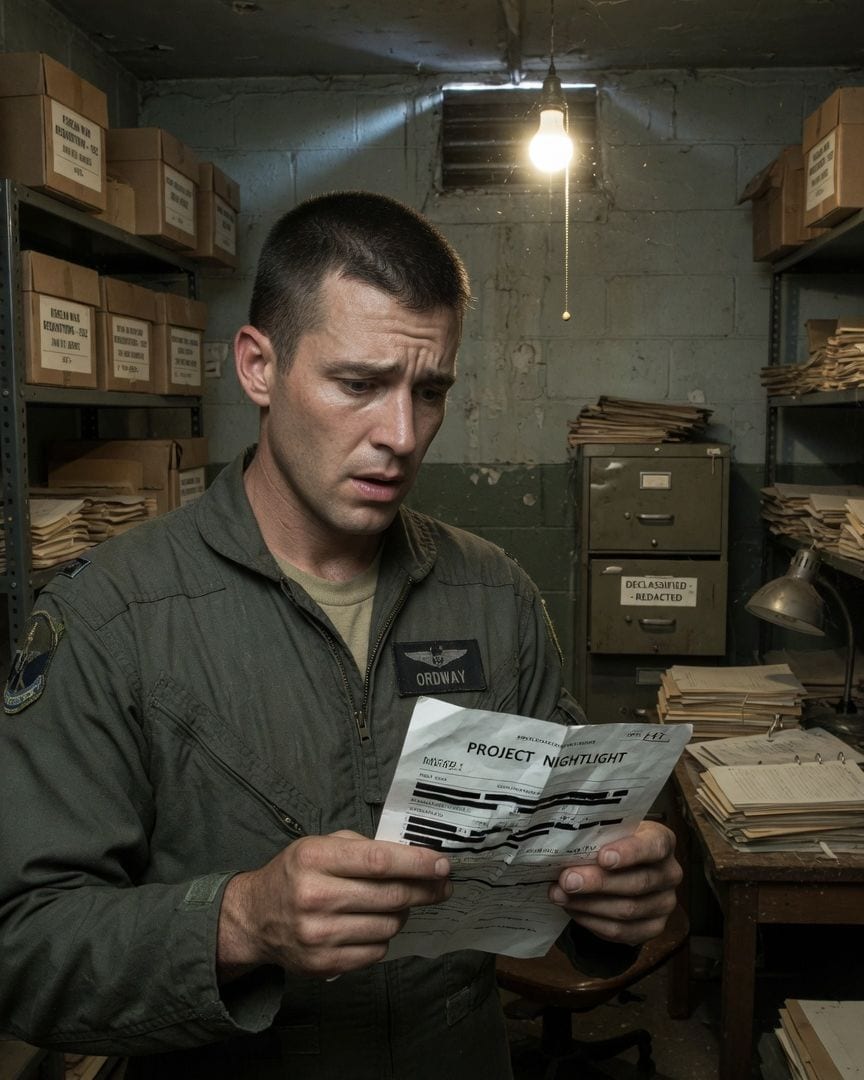
Buried under a pile of requisitions from the Korean War, he found it: a heavily redacted internal memo, stamped 'DECLASSIFIED - REDACTED,' from a different command, a unit he didn't recognize.
It clearly referenced 'Project NIGHTLIGHT' and, chillingly, his specific flight date. Beneath the thick blacked-out lines, almost subliminal, he saw a brief, unredacted mention of 'pilot reassignment protocols initiated.'
His eyes snapped to the partially visible name below, a series of faded letters and numbers. He recognized the sequence of his own service number, unmistakably, partially obscured by the redactant.
He stared at it, the paper trembling slightly in his hand, the musty air of the storage room suddenly feeling cold and thin.
The realization dawned, stark and brutal: he wasn't just a witness; he was already part of the file.
Within weeks of his unsettling discovery, Cal's promising career path veered sharply. He was transferred from flight operations to a mundane administrative desk job, far from the cockpit, far from anything that soared.
The message was clear, delivered without words: stop asking questions. But his new position, ironically, granted him access to obscure, older classified records.
He began cross-referencing 'NIGHTLIGHT' and similar project codes, digging quietly, methodically, in the dim light of his office after hours.
He uncovered a disturbing pattern: other pilots, radar operators, even ground crew personnel from various commands and different decades, reporting impossible phenomena. Each case ended similarly: sudden transfers, quiet early retirements, or 'medical leave' for 'stress-related conditions.'
He found a particularly chilling file from 1958, detailing an incident involving a pilot named James Pennington. Pennington reported a silently moving object that defied all known physics – details eerily similar to Cal’s own account.
Pennington, too, was subsequently 'reassigned.' Cal meticulously collected these fragments, printing them out, hiding them in an unmarked folder. He realized the pattern spanned not just years, but decades and multiple classifications, all pointing to a systematic, institutional suppression.
This wasn't about a single incident, or even a few isolated events. It was an ongoing process, recorded and filed, a vast, hidden tapestry.
The overhead fluorescent lights hummed, a dry, electric sound, as he pieced together the fragments of a truth he had only glimpsed from the Mojave sky.
Cal's quiet digging didn't stay quiet for long. His access privileges were subtly restricted; files he was viewing suddenly disappeared from the database or became 'corrupted' with inexplicable error messages.
One evening, as the last of the janitorial staff left, his office phone rang – an untraceable number, the caller ID showing only 'OUT OF AREA.' A calm, authoritative male voice, devoid of inflection, spoke.
"Some things are better left buried, Lieutenant. For your own good." The voice mentioned specific details of his recent research – the Pennington file, the dates he’d been checking – confirming he was being watched.
He reported the call, but it was dismissed as a prank, a disgruntled colleague. Outside his apartment, a dark sedan with tinted windows was parked for several nights, its lights off, its occupants unseen.
Cal saw it from his living room window, a silent, unmoving fixture on the street. He felt eyes on him constantly, a prickling sensation on his neck, the certainty that he was being observed even when alone.
One morning, while making a routine check of his office phone – a habit he’d developed after the anonymous call – he found a small, official-looking device, expertly concealed beneath the receiver. A bug.
It was a perfect, tiny cylinder, attached with a strong adhesive. The hunter, he realized with a cold, hollow feeling in his gut, had become the hunted. The danger had become personal, closing in, like the darkness outside his window.
Driven by the discovery of the bug and the escalating surveillance, Cal confronted his commanding officer, Colonel Isaac Hale, a man he respected for his unwavering integrity, in his private office.
The room was tight, hushed, the air thick with the smell of stale coffee and polished wood.
Cal laid out the collected files, the disturbing pattern of 'reassignments,' the missing logs, the anonymous call, the bug itself – small, metallic, glinting accusingly on Hale’s desk.
Hale, a man known for his composure, initially evaded, citing national security and operational secrecy. His hands, usually steady, clenched and unclenched under the table.
But Cal pressed, pushing the file on James Pennington across the desk, pointing to the identical details, the ominous 'reassignment' that mirrored his own. "This isn't about state secrets, sir," Cal said, his voice low and tight.
"This is about what's happening to people like me. And like Pennington." Finally, Hale's resolve cracked. He leaned back in his chair, a deep sigh escaping him, the leather groaning in protest.
Hale admitted that 'Project NIGHTLIGHT' was real, but it wasn't what Cal thought. "It's not about hiding an alien presence from the public, Lieutenant," Hale said, his voice low, almost a whisper, echoing in the quiet office.
"It's about managing an ongoing phenomenon that we… that the military, cannot control or explain." He explained that the 'reassignments' weren't punitive measures, not punishment for seeing too much. "They're protective.
A way to remove those who encounter it from further contact, and to contain the information, because the entity… it reacts to sustained attention. It learns."
The objects weren't just being filed away, Hale explained, the people who see them were being filed away from it. The file, Cal realized with a jolt, wasn't just a record of sightings; it was a barrier.
A desperate, failing attempt at a barrier, built on the lives of men like him.
Hale, his face grim, walked to a secure cabinet, its lock a heavy, brass mechanism that clicked with an unnerving finality. He pulled out a thin, heavily redacted, top-secret file, its cover marked 'NIGHTLIGHT - SUBJECT REGISTRY.'
He placed it on his desk, sliding it across to Cal, the paper a stark white against the dark wood. Inside, Cal saw a meticulous list of names, dates, and locations.
He recognized James Pennington’s name immediately, cross-referenced with his 1958 incident, the details matching his own research.
Further down the list, his breath caught in his throat: his own service number, his name, 'Ordway, Cal,' meticulously entered, with the date of his Mojave encounter.
The horror deepened when he saw a series of blank spaces next to other names, marked 'Phase Two Initiation' and then a specific date in the near future. His own entry, chillingly, also contained a 'Phase Two Initiation' marker.
And beneath his own entry, next to the future 'Phase Two' date, there was an unfamiliar, archaic symbol, almost a pictogram, a stark, simple drawing that appeared next to several other names on the list.
It was a shape he’d never seen before, yet it felt ancient, resonant. He felt a cold dread, a certainty that settled deep in his bones, realizing he wasn't just a witness, not just someone being protected.
He was an active, pre-selected participant in an ongoing, terrifying process. Hale looked away, disturbed, unable to meet Cal’s eyes, as if he'd just signed Cal's fate. The silence in the room stretched, heavy and suffocating.
Cal’s voice was strained, a tight, thin thread of sound, demanding to know the meaning of 'Phase Two Initiation.' Hale, defeated, slumped into his chair. "The entity," he began, his voice barely audible, "whatever it is, doesn't just observe.
It learns. And it selects." He clarified that those who experienced the 'Thing on the Scope' were not merely witnesses; they were marked. "Phase Two," he continued, "is when it begins to re-engage with the marked individuals.
Subtly at first, then more overtly. The reassignments, the files – they were meant to prevent this, to sever the connection. But it seems to follow them."
Hale gestured vaguely at the file on his desk, the 'Subject Registry' a testament to a failing system.
The archaic symbol, he revealed, was a recurring trace, found in ancient texts, in obscure archaeological digs, and even in the few, heavily suppressed crash sites the military had recovered. "It's a signature," Hale whispered, leaning forward, "almost an invitation."
Cal’s world tilted on its axis. The pattern across decades and classifications wasn't just about military cover-up; it was about the entity selecting individuals, and the military trying, and failing, to intervene.
The 'Thing on the Scope' wasn't just a sighting; it was a contact. And the files aren't just records of the lost; they're a registry of the chosen.
And Cal Ordway was on that registry, his name marked for a future he couldn't comprehend.
Understanding the personal danger, the ticking clock of 'Phase Two Initiation,' Cal felt a desperate urge to escape. He considered going AWOL, disappearing into the civilian world, changing his identity, a ghost in the crowd.
But he quickly realized the entity wasn't just 'out there'; it was already reaching for him, even before Hale’s confession.
Small, inexplicable things began to happen: his car keys vanished from his desk one morning and reappeared, cold to the touch, in his sealed lunchbox, a place he always left empty.
A faint, high-pitched hum, inaudible to anyone else, began to follow him, a subtle vibration in the air that grew louder in moments of quiet.
Shadows shifted in his peripheral vision, resolving into nothing when he turned his head, like fleeting dark blurs. He tried to warn Hale, to share his growing dread, to find a way out together. But Hale was gone.
Transferred overnight, his office was empty, stripped bare of personal effects, save for a single, sealed cardboard box on his desk, addressed to Cal. With trembling hands, Cal tore it open.
Inside, nestled on a bed of shredded paper, was a single, worn flight log. It was James Pennington's, from 1958, its pages brittle with age.
On the last page, the archaic symbol from the 'Subject Registry' was drawn, crudely but unmistakably, scrawled in faded pencil. Underneath, in Pennington's frantic, almost illegible handwriting, a single phrase: 'It's waiting.'
A sudden, intense pressure built in Cal's ears, the familiar hum reaching a deafening crescendo, a sound that seemed to originate from within his own skull. He felt a cold, heavy presence behind him, a vast, patient intelligence.
He didn't turn. He couldn't.
First Lieutenant Cal Ordway's service record ended abruptly with a 'medical discharge for stress-related conditions,' dated the following week. His apartment was found empty, meticulously clean, as if he simply walked out and never returned.
No one reported seeing him leave. His car remained in the parking lot, keys on the passenger seat. The file on Project NIGHTLIGHT remained classified, but a new entry was added beneath Cal Ordway's name: 'Phase Two Initiation: Confirmed.
Subject: Unaccounted For.'
Years later, in 1992, a junior archivist named Vera Hartley stumbled upon a dusty box in a forgotten sub-basement, marked 'NIGHTLIGHT - OBSOLETE.' Inside, she found a series of heavily redacted files, and a small, unmarked reel-to-reel tape.
Curious, she played the tape on an ancient machine, its spools turning with a mechanical groan.
It was a recording of a pilot's last transmission, distorted by static, but clear enough to hear a man's voice, calm, then fading into frantic desperation. "It's here," he whispered, a broken gasp. "It's always been here."
The tape ended with a high-pitched hum, then a click. Vera sat in the quiet office, a chill running down her spine.
The last file in the box was open to a page with an entry for 'Ordway, Cal,' dated 1962. Beneath it, a new line, handwritten in precise, familiar script, dated today: Hartley, Vera. Observation: Initiated.
If this one got to you
A missile commander watched his ten nuclear silos go dark. His own service record shows his signature on a future he's never lived.
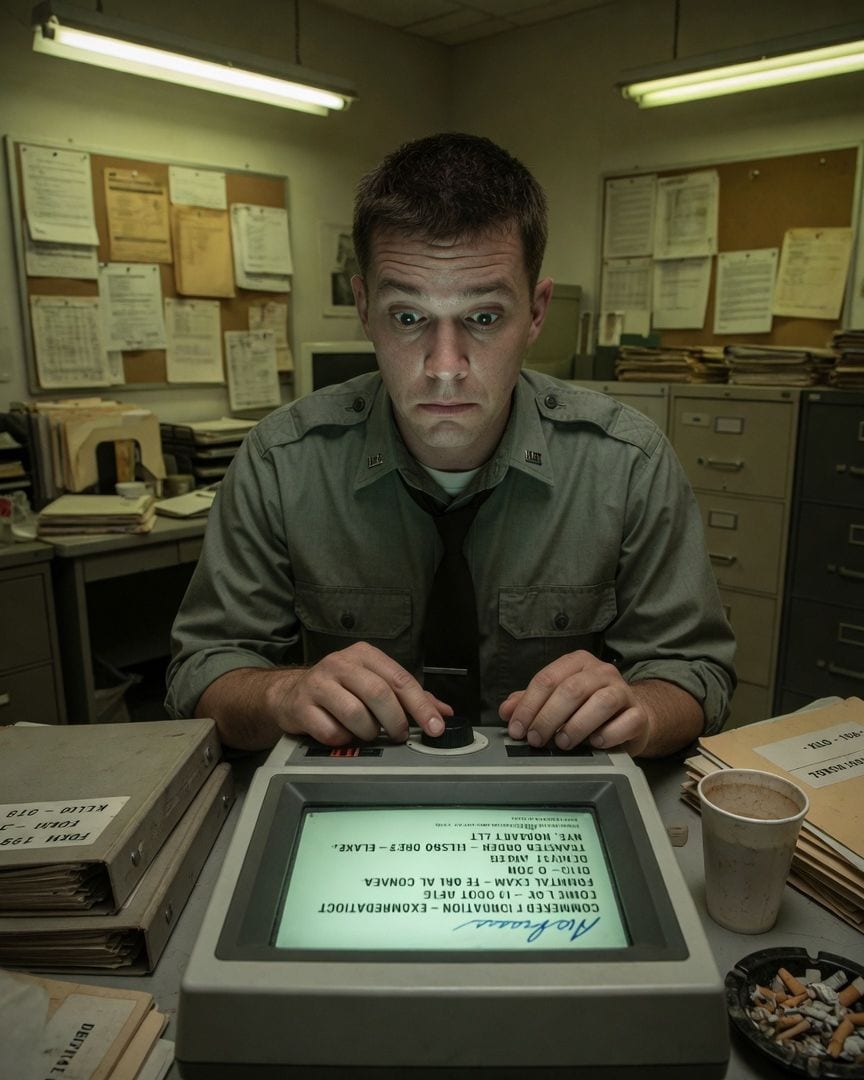
Second Lieutenant Hobart Nye, a missile commander in Wyoming, had his quiet 0247 watch shattered by a security report: a massive, silent black triangle hovered over Launch Facility Kilo, casting a perfect shadow. Hobart watched his console's fault panel light up, signaling all ten nuclear missiles going dark in an impossible silence, followed by eleven minutes his security team could not remember. Official logs called it a "radio malfunction," but Hobart found a requisition for invisible-tracking sensors, signed by a base commander who was supposed to be off-base. The final, chilling discovery came when his own service record showed new entries—a dental check-up, a transfer to Alaska—all dated for a future he never lived, complete with his perfectly replicated signature.
A Chief Warrant Officer's HUD showed a second aircraft watching his plane. He later found a log for *his* tail number reporting the same anomaly weeks ago, but he was grounded for medical leave.
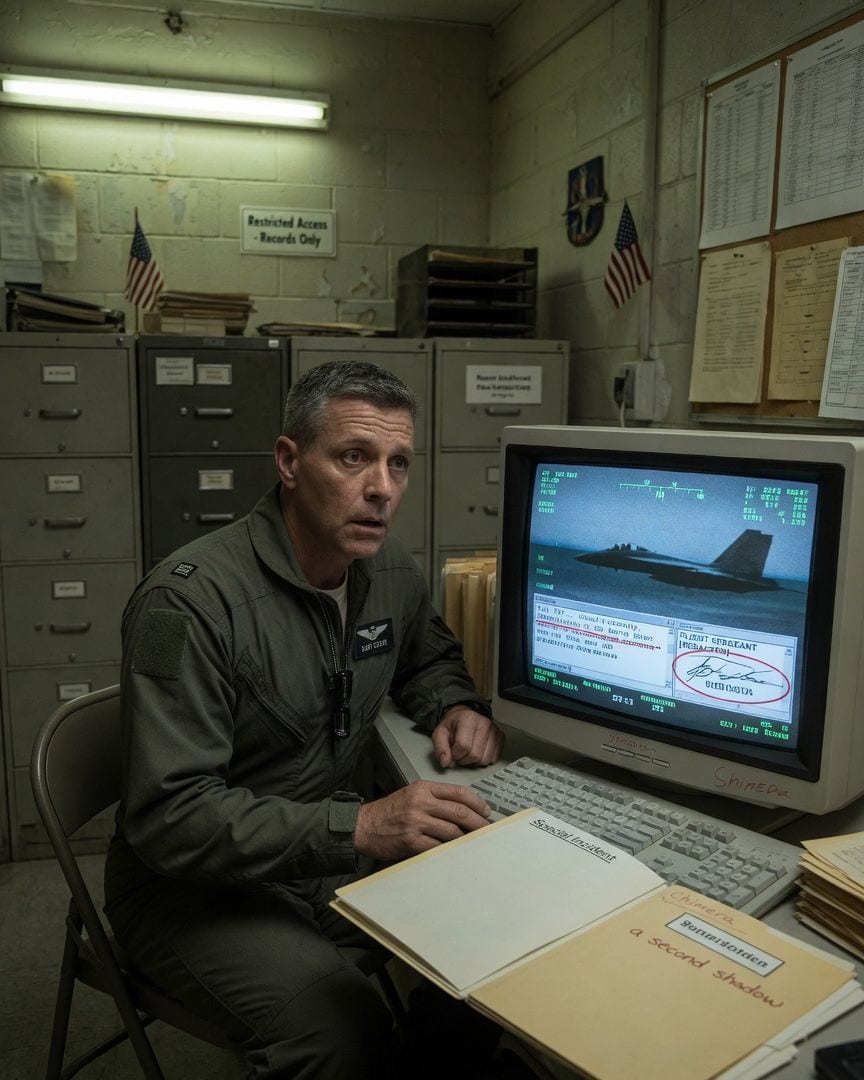
Chief Warrant Officer Gary Estes, a man whose career was built on precision, found his impending Pentagon transfer shadowed by a baffling anomaly. On every flight, at exactly 800 feet, his aircraft's display would briefly show a sleek, dark second plane tucked off his right wing, its canopy subtly angled toward his, watching him. Ground radar never saw it, and his wingmen swore they flew alone. Desperate to maintain his clean record, Estes dug into maintenance logs and uncovered an entry for *his* tail number from weeks prior. It described the exact same 'visual anomaly' during a flight he knew, with chilling certainty, he had never flown.
A Cold War airman logs an impossible radar contact on his last sweep. But his official logbook entry is stamped 'CLASSIFIED' and then contradicted by a hastily scrawled 'ALL CLEAR' dated moments before it.
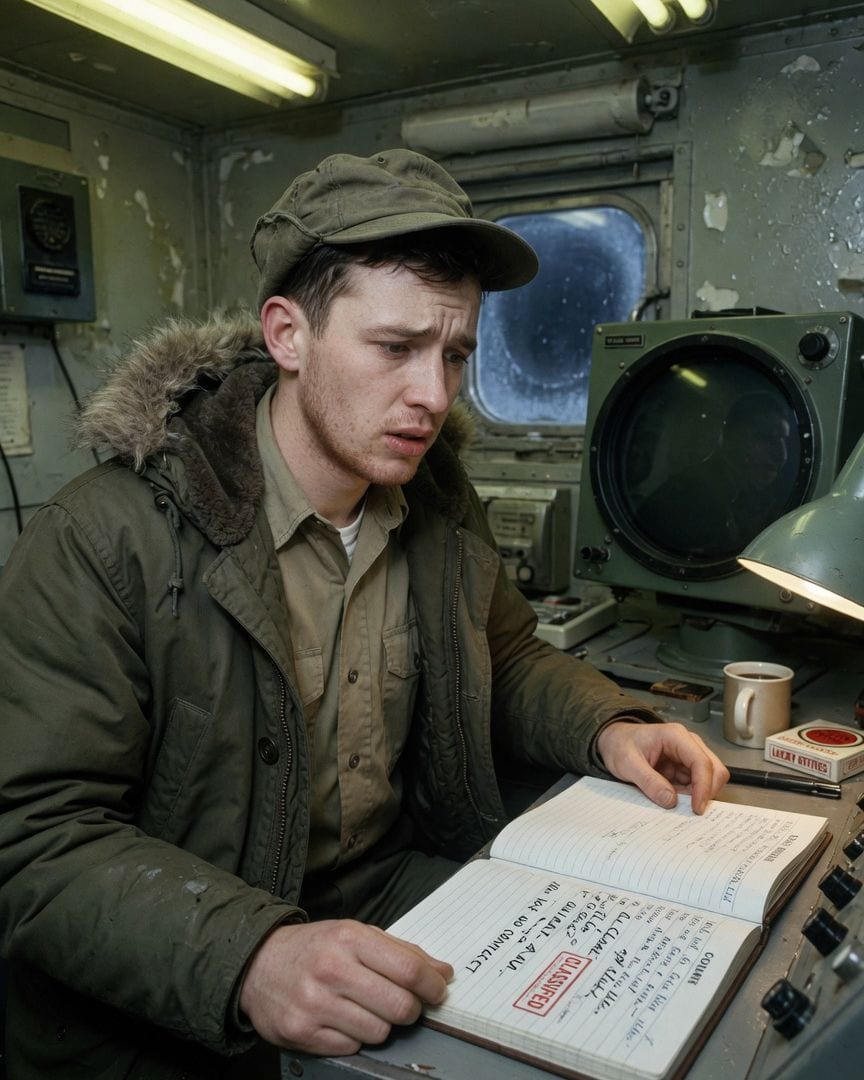
Airman Ordway Vance, 22, manned the radar dome at Site Pellin in the biting North Atlantic dark of January 1962, running the last calibration sweep before its decommissioning. His scope picked up a faint, impossible return, growing closer with each pass, though the ocean remained empty to the eye. When Vance detailed the contact in his official logbook, a 'CLASSIFIED' stamp appeared, followed by a hastily scrawled 'ALL CLEAR' dated moments before his own entry, contradicting his every word. Commander Hartley dismissed it as equipment malfunction, but Vance sensed a chilling, official erasure behind the lie. He soon found a locked cabinet marked 'SITE PELLIN ANOMALIES,' hinting at a deeper truth buried within the base's final days.
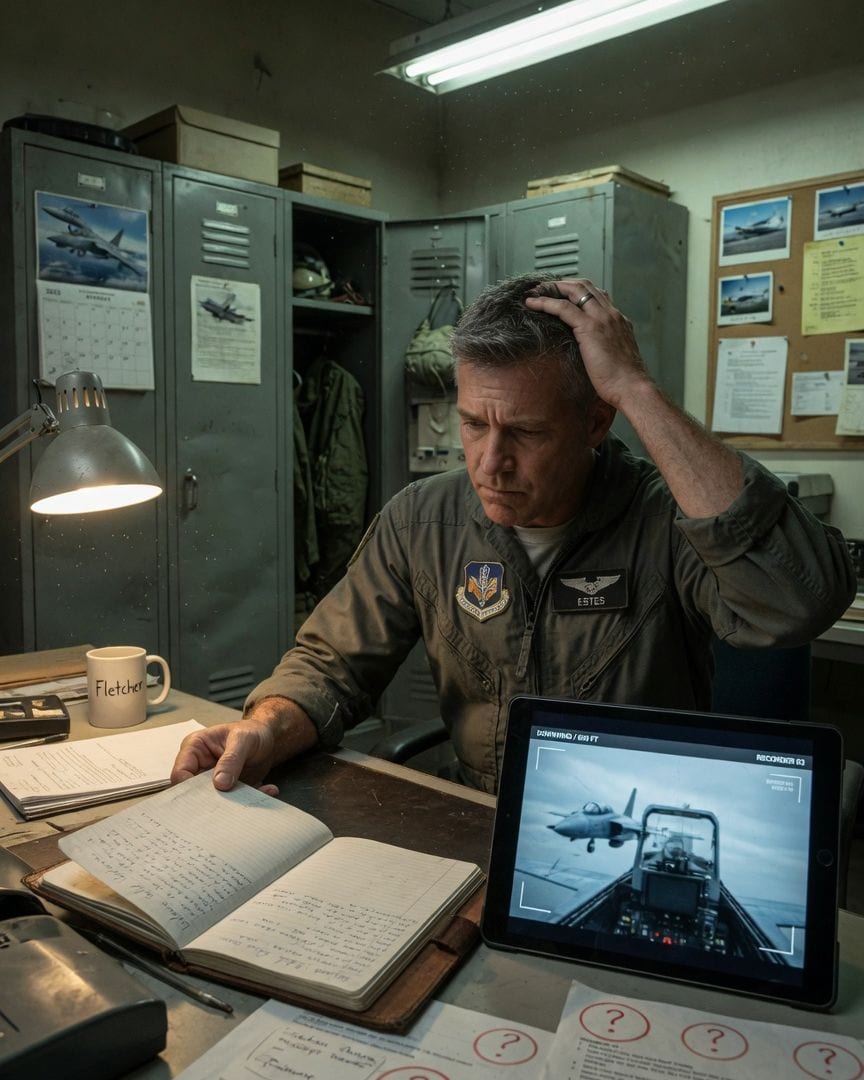
A Chief Warrant Officer's HUD tape shows a phantom jet, impossibly close, off his wing. Forty years ago, another Cold War pilot logged the same impossible sight.
Chief Warrant Officer Nathaniel Estes, a pilot whose career hinged on absolute precision, was under evaluation for a critical promotion. His nightly review of HUD tapes from routine Mojave test flights was a meticulous habit, but for a week, it revealed an impossible detail. At precisely 800 feet, one frame showed a sleek, experimental jet tucked impossibly close off his left wing—a craft ground radar never detected. When his maintenance chief found no equipment fault, Estes unearthed a dusty, decades-old logbook detailing identical phantom sightings from 1978. What unseen presence shadowed the desert skies?
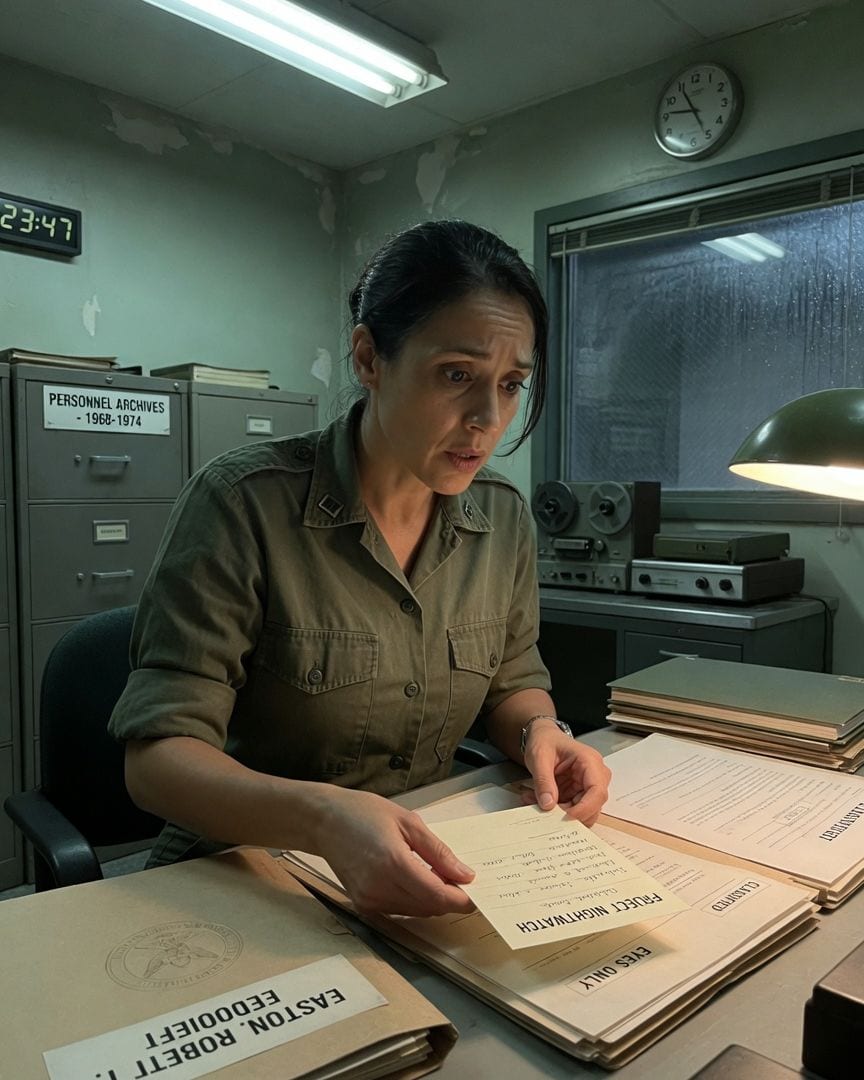
A Cold War tower controller logs an object vanish from radar, then hears the pilot scream it’s filling his windscreen. Her own name, 'Bardolph, Ines', now marked 'Observed' in a secret file.
Captain Ines Bardolph, a tower controller, was counting down the months until her transfer to Langley and the decommissioning of her base, hoping to leave behind the unsettling incidents of her final posting. But one night, her radar scope showed an impossible blip, solid and unwavering, 40 miles north of the Danube, only to vanish in less than a second, leaving a pilot screaming in terror. Despite the clear evidence, the official report blamed "atmospheric inversions," while the terrified pilot received a glowing review and promotion, his file meticulously scrubbed of any anomaly. As Captain Bardolph reviewed the pilot's pristine record, she found a hidden slip of paper, revealing a chilling truth: 'Subject: Bardolph, Ines. Status: Observed.' Was she merely an observer of the impossible, or was she now part of something far more sinister?
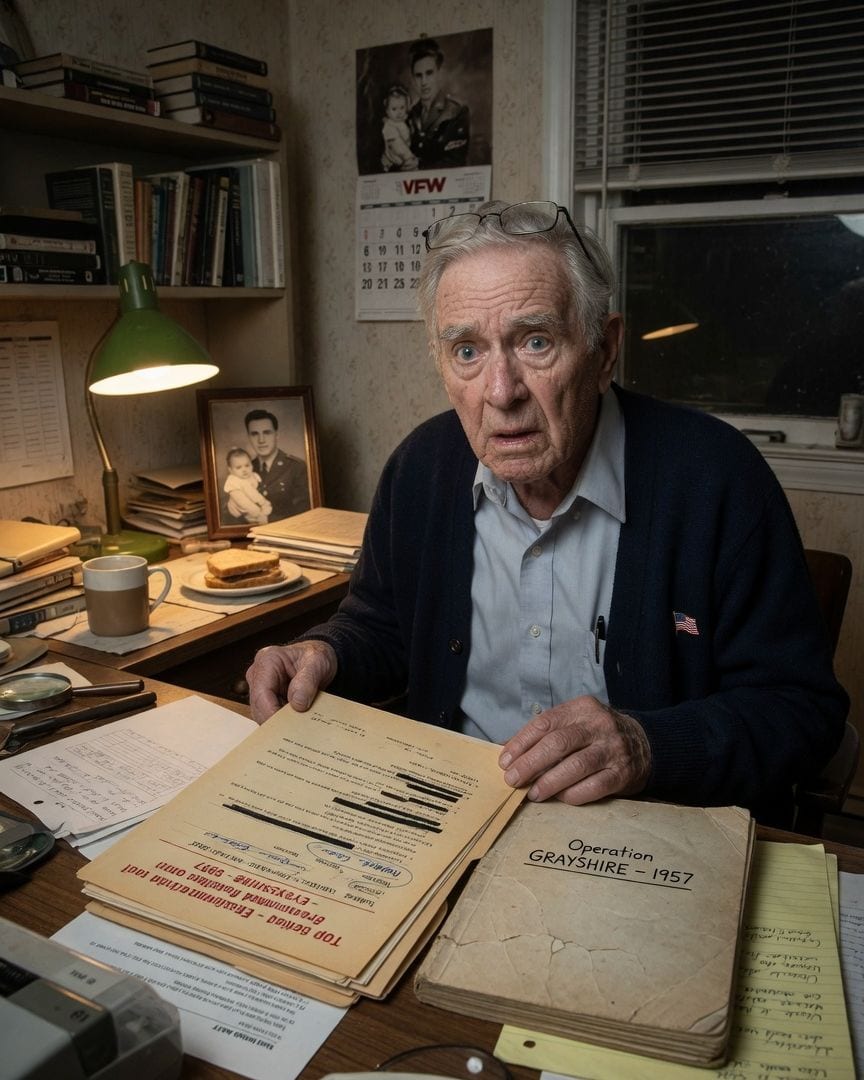
A Cold War Private Kell Hobarth saw a flash from a mission that didn't exist. Fifty years later, his own name was on a secret 'witness management' list.
Private Kell Hobarth, twenty-eight, stood in the dust of Vermey Flats, a letter in hand announcing his daughter Marie’s birth eleven days late. The next day, his name appeared on a roster for 'GRAYSHIRE,' a mission his range officer insisted never existed. Yet, at dawn, Hobarth alone witnessed a profound, silent flash of light, while his six tent-mates slept undisturbed. Fifty years later, Kell, now seventy-eight, still pursued the chill of that dawn, sifting through heavily redacted files. His relentless search led him to a forgotten archive room where he unearthed an unofficial logbook detailing 'Operation GRAYSHIRE – Target acquisition: non-terrestrial.' Deeper still, a sealed folder detailed 'Personnel Reassignment and Memory Debriefing Protocol' for a 'contact event,' listing his own name as 'Subject 001' for 'witness management.'