Sergeant Bishop's corporal was logged in two places at once — and deployed fifteen years before their base existed.
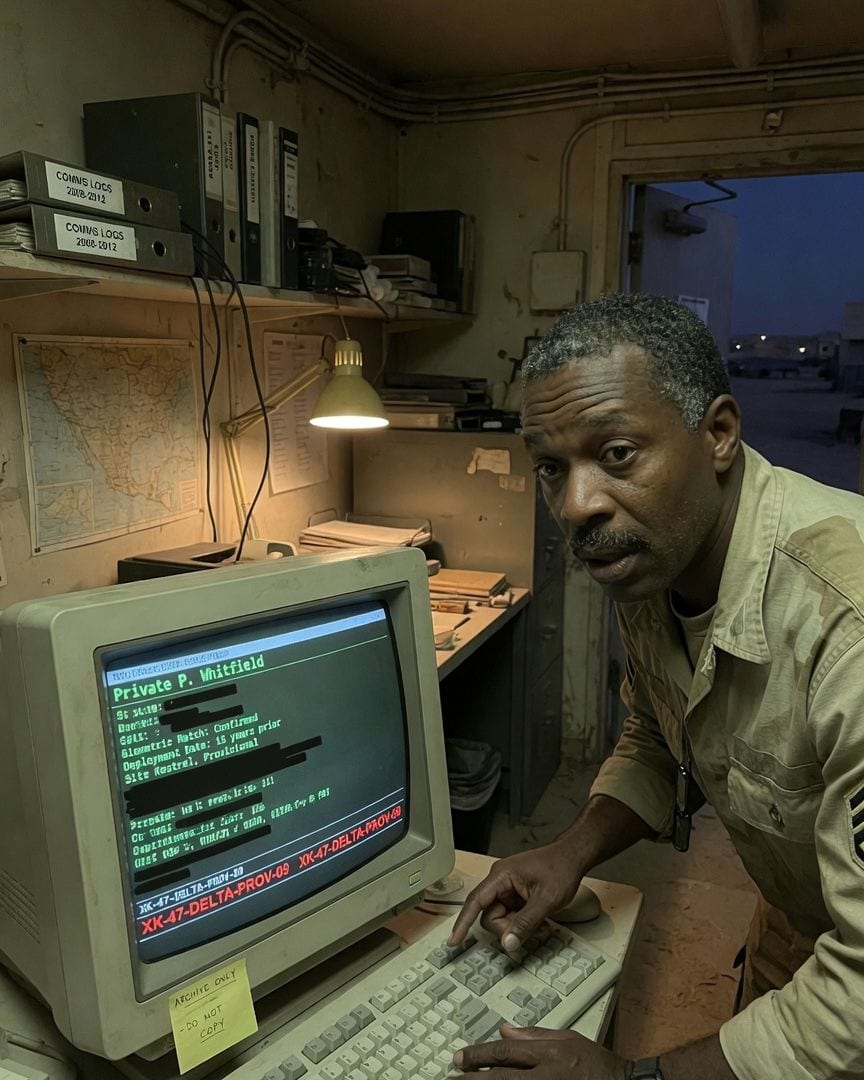
Sergeant Isaac Bishop felt the familiar hum of the FOS Kestrel's servers vibrate through the floor of the admin office, a low thrum that was constant as the desert wind.
He was three weeks out from going home, and all he wanted was to clear his desk. Instead, he stared at a monitor displaying chow-hall camera footage.
It showed Corporal Patrick Whitfield, tray in hand, moving through the serving line at 0530. Bishop’s brow furrowed. He fast-forwarded. The next day, same time, same man, same tray. Again. And again.
For two weeks straight, Whitfield had been timestamped in the chow hall at 0530.
Simultaneously, every single one of those mornings, Sergeant Bishop himself had spoken to Whitfield over the radio from Perimeter Tower 3, a kilometer away, confirming his position, his patrol, his watch.
The system swore Whitfield was in two places at once, and Bishop, a man who lived by accountability, couldn't reconcile the impossible count.
The digital log of his own voice, crisp and clear, confirming Whitfield's presence on the tower, was irrefutable. So was the flickering image of Whitfield, chewing toast in the chow hall.
Bishop tried the mundane. He called Specialist Brooke Mercer, the chow hall attendant, a young woman barely out of basic training. "Mercer, you ever see Corporal Whitfield in the chow hall around 0530?"
Mercer, tired but polite, confirmed, "Every morning, Sergeant. He's always first in line for the eggs." Bishop then cross-referenced every duty roster, every sign-in sheet, every comms log from the last two weeks.
Whitfield was unequivocally assigned to Tower 3 for the 0500-0700 shift each of those mornings. No swaps, no sick calls, no errors.
He pulled Whitfield's full service record, looking for anything—a history of pranks, a twin brother, a clerical anomaly from his previous post. He found nothing out of the ordinary, just a clean record.
Frustrated, Bishop decided to dig deeper into the base's archived personnel files, searching for any historical "Whitfield" entries, however remote.
He used a specialized admin terminal in a dusty, seldom-used comms shack, inputting various search parameters for similar names or biometric matches. The terminal whirred, accessing deeper, older layers of the base's digital history.
After several minutes, a single, unexpected result appeared. It was a partially corrupted, highly redacted service record. The name: "Private P. Whitfield." The biometric data matched Corporal Patrick Whitfield precisely.
The deployment date, however, was fifteen years ago, to "Site Kestrel, Provisional." The FOS Kestrel had only been officially established five years prior.
Sergeant Isaac Bishop stared at the flickering screen of the antiquated terminal, the redacted "Private P. Whitfield" service record glowing in the dim light of the comms shack.
The deployment date – fifteen years ago – and the designation "Site Kestrel, Provisional" swam before his eyes, a decade before this base officially existed.
An obscure, unclassified designation, a string of alphanumeric characters, was stamped repeatedly across the bottom of the file. He felt a cold knot tighten in his stomach. This wasn't a clerical error. This wasn't a prank.
This was something impossible, a ghost in the machine of the most meticulously documented world he knew. His finger hovered over the 'Print' button, the implications colder than the desert night, promising something far beyond a scheduling mix-up.
Bishop printed the redacted record, the paper cool and stiff in his hand. He spent the next day trying to decipher the obscure designation. It didn't appear in any standard military codex or classified database he could access.
He even consulted some old-timers in the comms center, casually asking about "Site Kestrel, Provisional" or any unusual projects from fifteen years back. They gave him blank stares, or vague answers about "pre-deployment surveys" and "empty desert."
He felt a growing unease. The base hummed around him, a constant, low drone that seemed to vibrate with a hidden energy. He tried to bring the issue to Chief Warrant Officer Rosemary Drummond, his superior.
"Chief, I've got something strange with Whitfield's record," Bishop began, laying out the chow-hall footage and the historical anomaly. Drummond listened, her expression unreadable. "Bishop, sometimes the system generates noise. Legacy data issues, ghost entries from early reconnaissance. Happens.
Whitfield's here now, that's what matters." Her tone was dismissive, almost too quick. She mentioned "systemic noise" twice. Bishop, however, knew better. He pressed, "But the biometric match, Chief. It's exact. And the dates..."
Drummond cut him off, "Focus on your exit brief, Sergeant. Don't go chasing shadows. This base has enough to manage without you inventing problems." Her warning was clear, but it only solidified Bishop’s resolve.
He started noticing the hum of the FOS Kestrel's servers more acutely, realizing it seemed to emanate most strongly from beneath the admin building, a deep, resonant thrum that felt less like machinery and more like something alive.
Drummond's dismissal felt like a direct order to stop, but Bishop couldn't. He began staying late in the comms shack, using the antiquated terminal.
He tried inputting the obscure designation from Private Whitfield's old record as a search key, hoping to unlock deeper archives. Nothing.
Then, a few days later, as Bishop was walking back to his bunk after another late night, he noticed a shadow detach from the corner of the admin building. It was Drummond, standing motionless, watching him.
She didn't approach, didn't speak, just observed. The next morning, a small, unmarked envelope was left on his desk. Inside was a single, laminated card, no bigger than a dog tag.
On it, printed in plain text, was the obscure alphanumeric designation from Whitfield's old record, followed by an equally cryptic sequence: "NIGHTINGALE.ACCESS.01." No sender, no other message. It was a warning, a breadcrumb, or both. Someone knew he was digging.
He felt a prickle of fear, realizing he was no longer just an investigator, but a target of observation. The danger was now personal. He looked for Drummond, but she was nowhere to be found.
The hum from beneath the admin building seemed to grow louder, a low, insistent pulse that mirrored his own quickening heartbeat.
That night, Bishop returned to the comms shack, the laminated card clutched in his hand. He typed "NIGHTINGALE.ACCESS.01" into the antiquated terminal's command line. The screen flickered, then displayed an archaic command prompt.
He entered the obscure designation from the card. The terminal hesitated, then granted access to a sub-menu labeled "Project Nightingale." He clicked it. What appeared was not a standard military database, but a continuously updating, unindexed roster.
It contained names of personnel, past and present, who had served at FOS Kestrel. But beside each official entry, there was a phantom duplicate.
"Corporal Patrick Whitfield" appeared twice, one with his current deployment, and another with an "Echo Operations" assignment, dated fifteen years prior. The chow-hall footage flashed in Bishop's mind – the echo trying to manifest, to fulfill its phantom assignment.
The old service record, the "Site Kestrel, Provisional" – it all clicked. The "systemic noise" Drummond spoke of wasn't an error, it was a phenomenon, a managed secret.
Just then, Drummond appeared in the doorway of the comms shack, her face grim. "You shouldn't have gone this deep, Bishop." He turned, the screen illuminating her face. "What is this, Chief? What are 'Echo Operations'?"
Drummond sighed, a weary sound. "This site... it's not just a base. It's a containment. The ground beneath us… it bleeds. Information. Presence. It duplicates. We call them echoes.
They're drawn to the base's systems, trying to manifest, to exist within the framework we've built." She explained that the base's meticulous accountability was both its strength and its weakness – a perfect system for the echoes to latch onto.
"My job," she said, "is to keep them from fully integrating, to manage the bleed. To keep the official records clean."
Bishop stared at the screen, the phantom roster scrolling, then looked at Drummond. "And Whitfield? Is he... an echo?" Drummond shook her head slowly. "Whitfield is real. The echo is the shadow it casts in the system.
Sometimes, they almost touch." She paused, her eyes scanning the screen. "You found the Nightingale manifest. Good. You're almost ready to understand the true scope." Bishop felt a cold dread settle over him. "Scope of what?"
Drummond walked to the terminal, her finger tracing a line down the phantom roster. "The echoes aren't just from the past. They're... potential. Future." She typed Bishop’s service number into a search field.
The screen flickered, displaying Sergeant Isaac Bishop's own name, rank, and service number, followed by the chilling entry: "KESTREL ECHO OPERATIONS – DEPLOYMENT COMMENCING: 07/14/20XX."
The date was three weeks from now – the day he was supposed to fly home. Bishop felt a cold, absolute certainty that the system he'd been trying to fix had already accounted for his impossible future.
He was looking at his own name on a manifest for a deployment that hadn't happened, to an operation that shouldn't exist, for a version of himself that was an echo.
Drummond watched Bishop's face drain of color. "It's not a deployment, Bishop. It's an integration. The site needs to complete itself. It's always tried. The hum you hear? It's the anomaly trying to sync.
It reaches out, using the base's own data, its systems, its people, to anchor itself. Whitfield's chow-hall echo was a partial success. A momentary physical manifestation. It was trying to reconcile its existence with the official record."
She explained that the FOS Kestrel was built over an ancient geological anomaly, a kind of informational sinkhole that had begun to resonate with human presence and technology. "Project Nightingale isn't about containing an enemy, Bishop.
It's about containing an event. A systemic bleed. We monitor the echoes, try to understand their patterns, prevent them from fully forming. But the longer the base operates, the stronger the connection grows."
The obscure designation on Private P. Whitfield’s old record, Drummond revealed, was a legacy identifier for an early, more aggressive echo manifestation. "The base is a living record, Bishop. And it's trying to write itself in flesh."
Bishop looked at his own name on the screen. "And my name...?" Drummond nodded. "It's a prediction. A potential. The site has chosen you.
It's trying to pull you into its pattern, to make you an echo, to complete its own, impossible accountability." The scattered dates, the phantom figures, the impossible counts – it all snapped into place, a coherent, monstrous shape.
He was always inside it.
Bishop pushed away from the terminal, the implications too vast, too personal. "How do we stop it? How do I stop it?" Drummond looked weary. "We don't. We manage.
We try to starve it of the data it needs to manifest. But it’s already got your name. Your future. It's a slow process. It's been working on this for decades."
She pointed to a series of power conduits running beneath the comms shack, leading deeper into the earth. "The energy signature of the anomaly strengthens when the base’s main power grid cycles.
If you could disrupt the primary data flow, sever its access to the core network during a specific power cycle… it might set it back. Buy you time. But it's dangerous. And it won't stop it forever."
A siren blared, signaling an unscheduled power grid test, a routine maintenance procedure. "Now," Drummond said, her voice urgent. Bishop knew this was his only chance. He grabbed a heavy-duty data cable from a nearby rack.
Following Drummond's terse instructions, he located the primary network junction box, thick with bundled cables, deep within a maintenance tunnel that led further beneath the admin building. The hum was deafening here, vibrating in his bones.
He saw the targeted conduit, a thick fiber optic cable glowing faintly.
With a surge of adrenaline, he plunged the heavy-duty cable into a bypass port, rerouting the data flow, severing the anomaly's direct connection to the main grid during the power cycle.
The hum wavered, then intensified violently, a scream of static echoing through the tunnel. The ground shuddered. Bishop felt a searing cold spread through his arm, as if something was trying to pull him into the network itself.
He yanked his hand back, the cable sparking. The hum dropped, then settled into a lower, more subdued thrum. He had bought himself time, but the chill in his arm lingered, a permanent imprint.
The power grid test completed without incident, officially. Bishop reported a minor network glitch, which Drummond smoothed over.
The "Project Nightingale" manifest was still present on the hidden terminal, his future deployment date still listed, but the subtle, almost imperceptible 'active' flag next to his entry had dimmed.
Whitfield continued his duties, unaware of the digital shadow that had briefly walked beside him. Bishop finished his deployment, completed his exit brief, and boarded the transport plane home, the lingering chill in his arm a constant, unsettling reminder.
The hum of the FOS Kestrel, now a distant memory, still resonated faintly in his mind.
Back home, in the quiet suburbs of Tucson, Isaac Bishop tried to settle back into his life. His wife, Lydia, noticed a new stillness in him, a distant look in his eyes.
He'd occasionally rub his left arm, where the phantom cold still resided. One evening, as he scrolled through old photos on his phone, a picture of his family picnic from a year ago caught his eye.
In the background, partially obscured by a tree, was a figure. A man in a simple t-shirt, looking directly at the camera.
His face was just out of focus, but the posture, the build, the faint outline of a scar on the left arm—it was unmistakably him. But it was taken a year ago, when he was still deployed.
He showed it to Lydia. "Honey, who is that?" she asked, pointing. Isaac zoomed in, his heart pounding. The man in the picture offered a faint, wrong little smile.
A year later, Isaac Bishop's wife, Lydia, found his phone open to an old family photo. "Honey, is that you in the background?" she asked. His reflection in the darkened screen offered a faint, wrong little smile.
If this one got to you
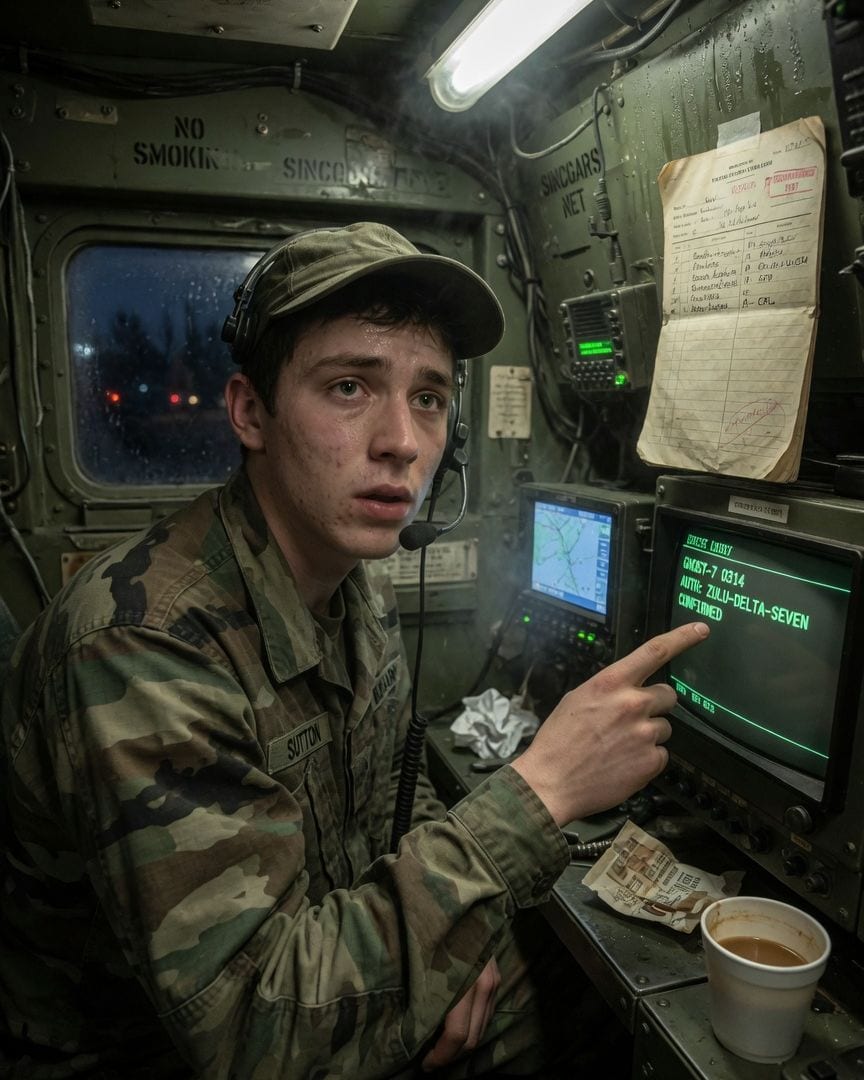
Corporal Aldous Sutton found his own name, rank, and call sign in a 1987 logbook from his exact outpost, decades before he was born.
Corporal Aldous Sutton, 22, was hunched in his cramped comms track, the air thick with stale coffee, monitoring a quiet German night. The division exercise outside was routine, all units accounted for, until an unknown call sign crackled through his headset. 'Ghost-7' requested authentication using a protocol decommissioned years before Aldous was even born. Despite his superior dismissing it as a glitch, Aldous found official logs confirming the impossible exchange, even dating his own hesitant responses. But the real dread landed when he cross-referenced the phantom unit and discovered his own name, rank, and call sign listed in a 1987 logbook, attached to 'Ghost-7' at his exact outpost.
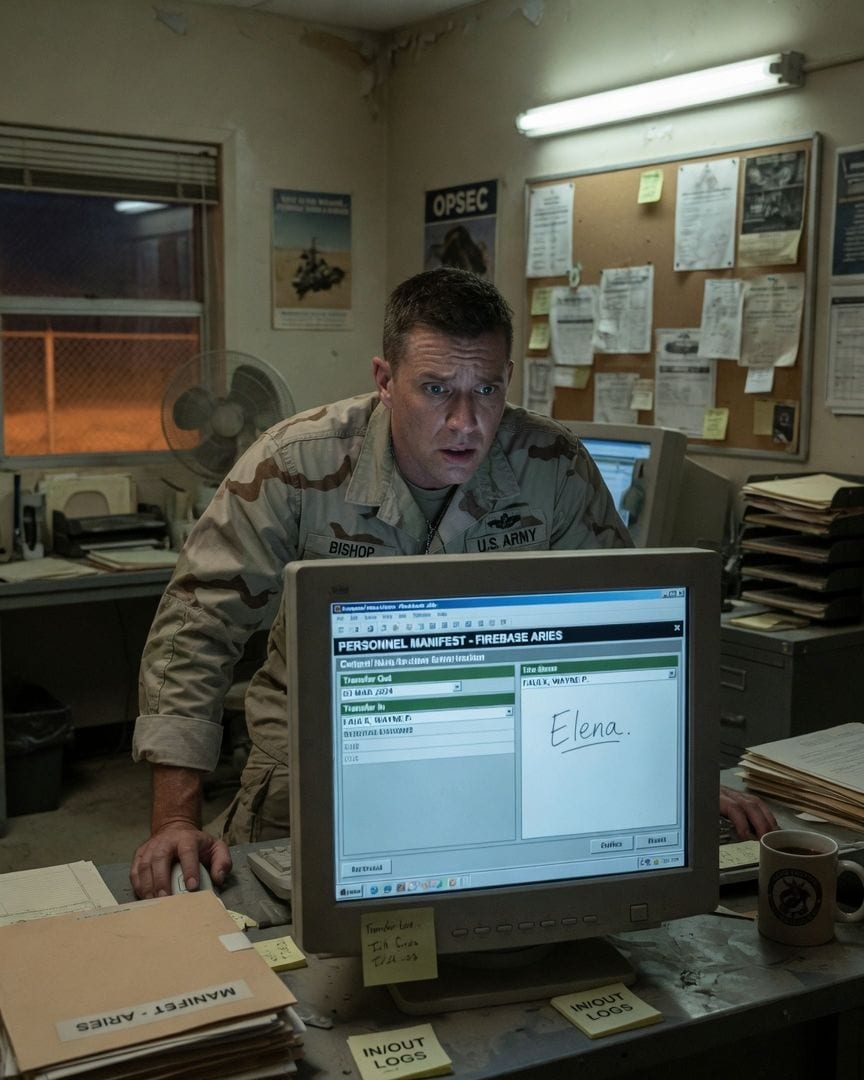
Corporal Bishop knew Private Faulk left months ago, but then saw him greet a new lieutenant by her restricted first name.
Corporal Henry Bishop, a man defined by precision, maintained the meticulous order of Firebase Aries. His world, a hum of servers and crisp paper, relied on every form, every detail being perfectly in place. But that order shattered when he saw Private Wayne Faulk, a soldier transferred out months ago, casually walking back as if he'd never left. Bishop's gut clenched tighter still when Faulk greeted a new lieutenant by her first name — a name Bishop had just processed as 'eyes only,' sealed tighter than a vault. Bishop then found a faint, unofficial 'Elena' scrawled next to Faulk's name, a secret whispered in the machine itself, fracturing the bedrock of his reality with an impossible equation.
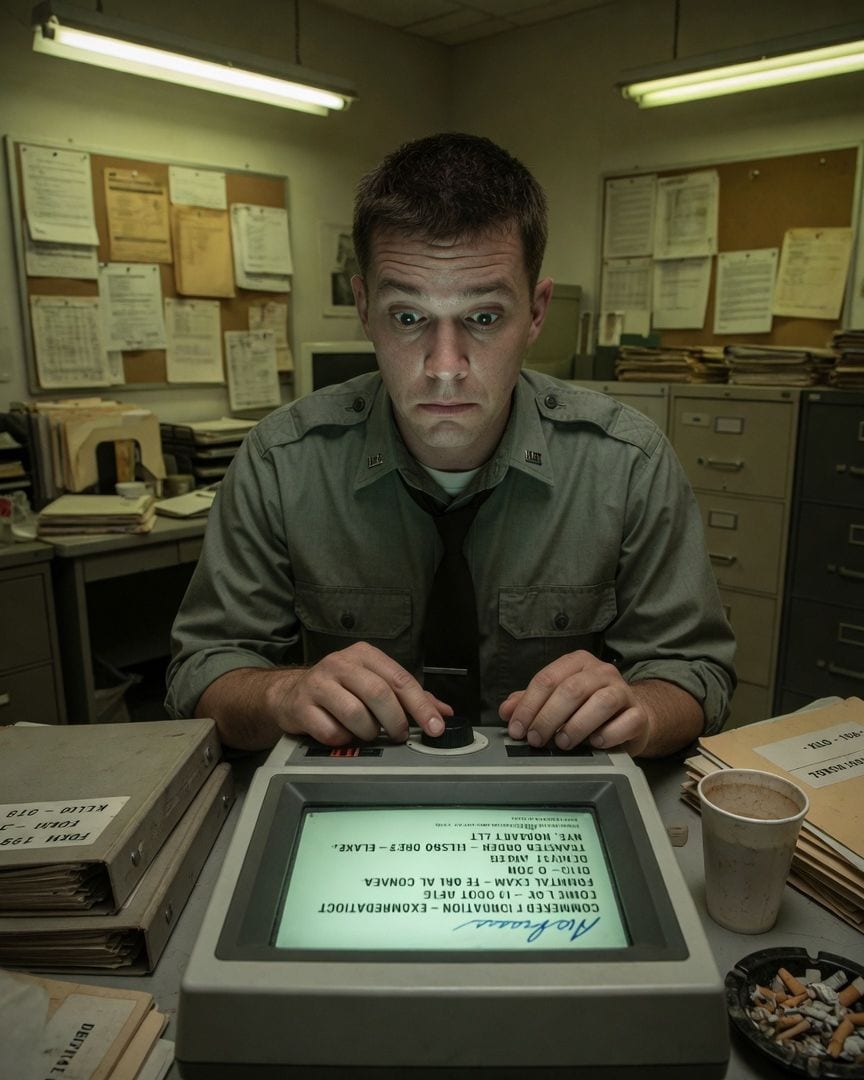
A missile commander watched his ten nuclear silos go dark. His own service record shows his signature on a future he's never lived.
Second Lieutenant Hobart Nye, a missile commander in Wyoming, had his quiet 0247 watch shattered by a security report: a massive, silent black triangle hovered over Launch Facility Kilo, casting a perfect shadow. Hobart watched his console's fault panel light up, signaling all ten nuclear missiles going dark in an impossible silence, followed by eleven minutes his security team could not remember. Official logs called it a "radio malfunction," but Hobart found a requisition for invisible-tracking sensors, signed by a base commander who was supposed to be off-base. The final, chilling discovery came when his own service record showed new entries—a dental check-up, a transfer to Alaska—all dated for a future he never lived, complete with his perfectly replicated signature.
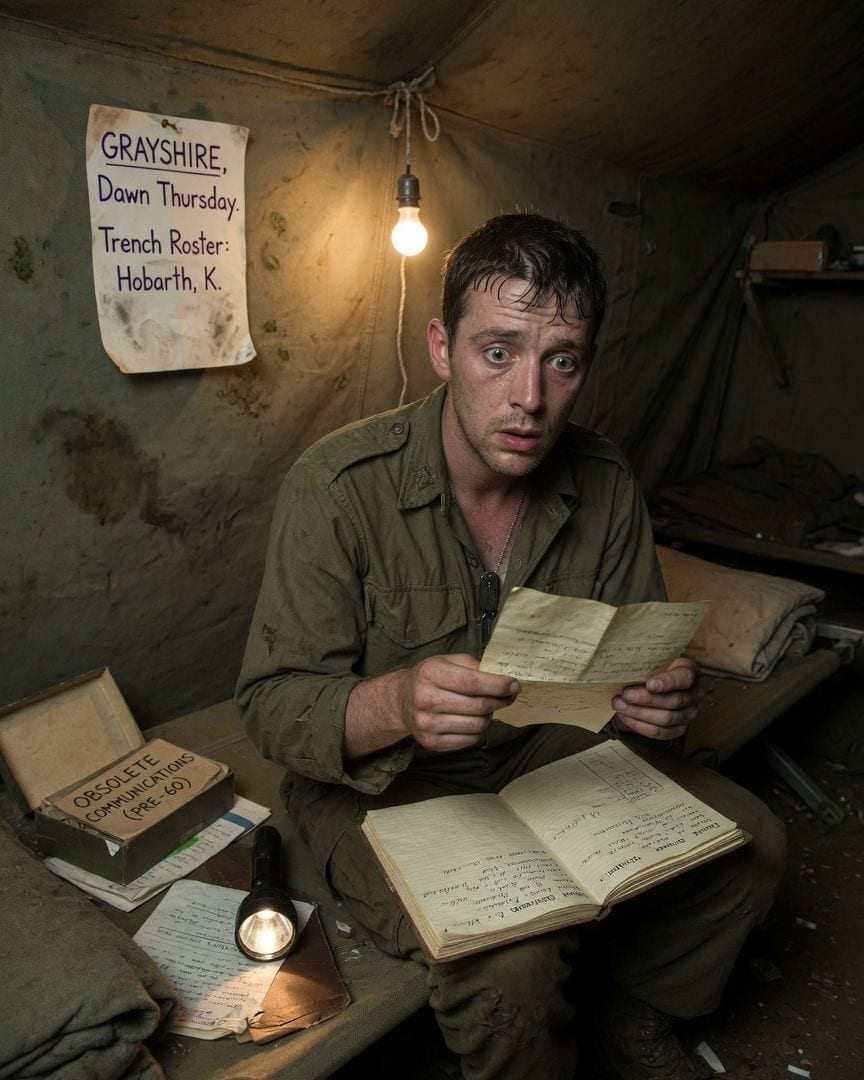
A records clerk's old logbook entry shows his service number for 'Personnel Observation' on a date that hasn't arrived, for an event he saw last week.
Private Kell Hobarth clutched the letter confirming his daughter Frances' birth, a bittersweet reminder of a world far from the Vermey Flats trench tent. He'd seen a mysterious roster entry for 'GRAYSHIRE' and been dismissed by his superior. But then, a silent, vast pulse of white light turned his tent transparent for a full minute, yet every man around him slept through it. Haunted, the records clerk searched the dusty annex archives, finding a leather logbook. Inside, his own service number was listed for 'Personnel Observation' on a date that had not yet come, for the very event he had already witnessed.
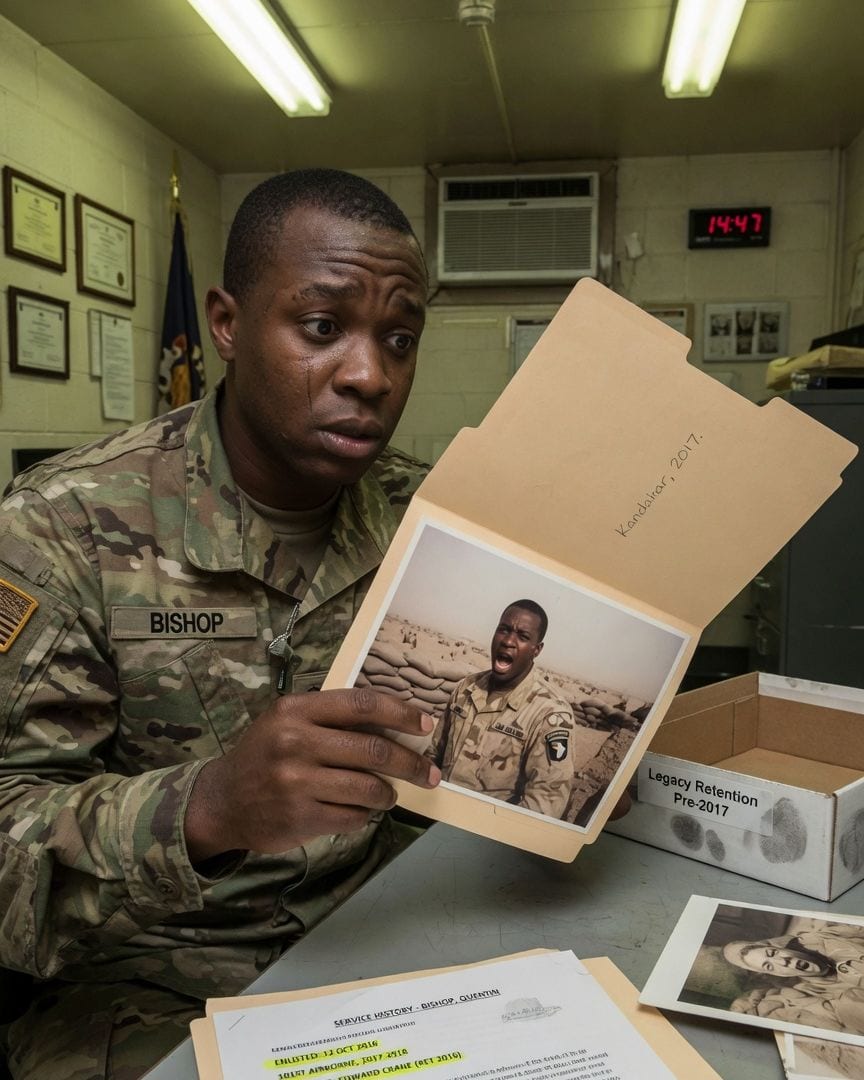
A specialist was signing for four more years, but his old file contained a photo of him in a desert uniform dated 2017, from a tour he never lived.
Specialist Quentin Bishop sat ready to re-enlist, looking forward to four more years of stability. But as he prepared to sign, his official record showed an enlistment date that made him seventeen years old, and a combat tour with a unit he’d never worn. Sergeant Marie Delaney dismissed it as a clerical error, but Bishop found a faded photograph of himself in a desert uniform, dated 2017, from a war zone he could not remember. Was this a mistake, or a meticulously constructed parallel life he never lived?
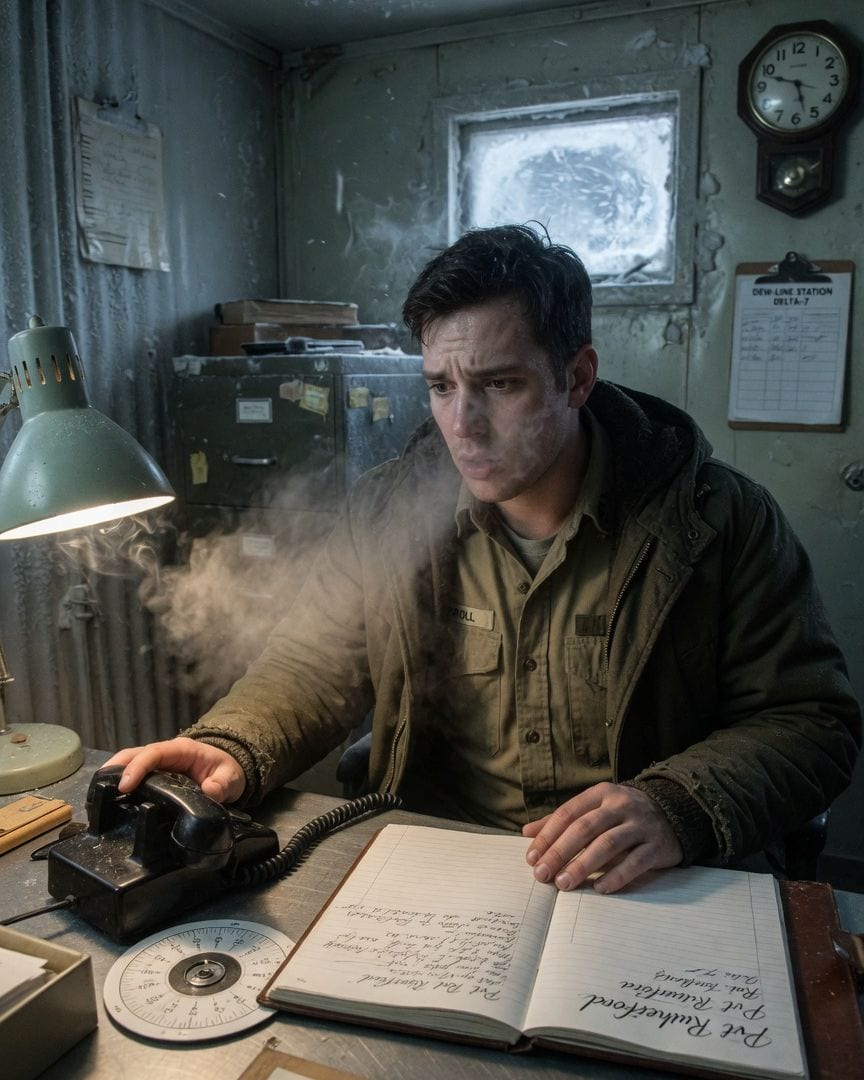
A communications specialist saw his last line go dead. Then the old Cold War field phone rang with a voice from 1966, naming a man freshly signed into his current shift log.
Specialist Walter Kroll shivered in the frigid communications room of DEW-line Station Delta-7, completely cut off by a historic Arctic blizzard. He had personally watched the last hard-wired connection to the outside world snap earlier that day. Now, past midnight, the old field phone at his position began to buzz, impossible from a line he knew was dead. A calm, unfamiliar voice spoke, reading a crew roster Kroll didn't recognize, including Private Rutherford. His search through decades of dusty logbooks revealed Rutherford was assigned to this exact watch in 1966, but then Kroll found the same name freshly inked into his *current* shift's sign-in sheet.