A sergeant's last watch on a forgotten outpost: His own name appeared on an 80-year-old crash manifest.
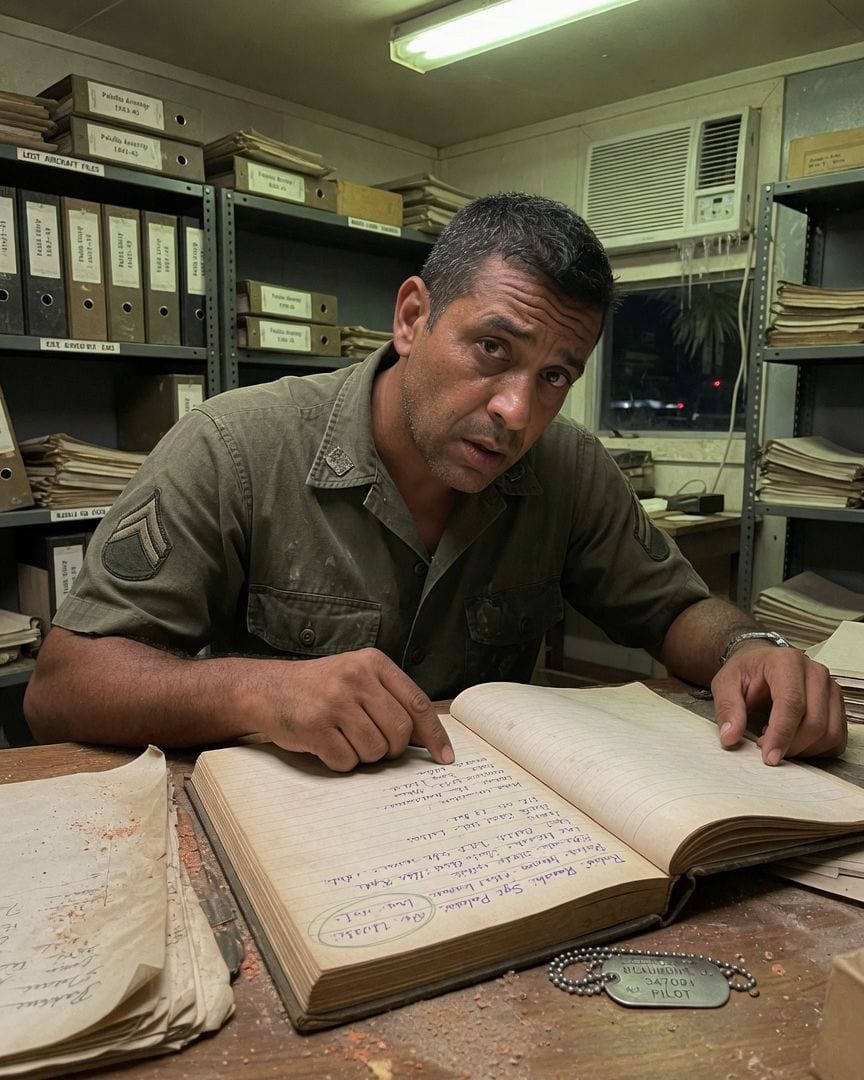
Sergeant Leon Pulaski, 35, sat alone in the radio shack of Peleliu Atoll Airstrip, the silence punctuated only by the low hum of equipment and the distant, rhythmic sigh of the Pacific.
It was his last night before the field was mothballed for good, a forgotten outpost finally shuttered. His shift log lay open, ready for the empty hours between the two milk runs that serviced the skeleton crew.
At 0330, a crackle. Then a voice, garbled but clear enough: a distress call. Engine out, requesting the field, going down at the north end.
The tail number given — 'Ghost Two-Niner-Niner' — was retired since the war, a relic from the Pacific Theater. Pulaski, disciplined and rational, logged it, noted the impossible call sign, and sounded nothing.
He knew the procedure for phantom signals, the fatigue of isolated watches. But at dawn, the crash crew, sent out more from habit than expectation, found a fresh, shallow gouge in the coral off the north overrun.
And there, glinting in the morning sun, was a shard of cockpit glass, still warm to the touch. No wreck. Just the gouge, and the glass, and the overwhelming, quiet wrongness of it all.
Pulaski filed his report with Staff Sergeant Gerald Stratton, 42, his superior. Stratton, a man whose face was perpetually etched with the weight of paperwork, listened patiently. “Bad sensor, Sergeant. Happens. Or maybe a local fishing boat playing games.”
Pulaski nodded, but the image of the warm glass, the impossible tail number, gnawed at him. He knew bad sensors. He knew pranks. This wasn’t it.
The quiet hum of the air conditioner in Stratton’s office seemed to vibrate with his unspoken doubt.
Later that day, after his off-shift, Pulaski returned to the north overrun, driven by a quiet unease. The gouge was still there, stark against the pale coral. The tide had receded further, exposing more of the pockmarked landscape.
He walked the perimeter again, slower this time, eyes sweeping the ground. The sun beat down, turning the atoll into a blinding expanse, but his focus narrowed to the immediate, shifting sands.
Near where the glass had been found, half-buried in a drift of sand and crushed shell, he saw something dark, metallic. He knelt, digging it out. It was a dog tag, tarnished but clearly legible: 'Pilot, Lt.
J. Beaumont, Service No. 347091.' The metal felt cold in his hand, ancient. He recognized the name.
It was on the crew manifest for 'Ghost Two-Niner-Niner,' a plane declared lost, along with its crew, on a reconnaissance mission eighty years ago. The official records were clear: no remains, no wreckage.
Just a ghost on the radio, and a dog tag, impossible and pristine, here on his last watch.
Pulaski took the dog tag to the base's small, dusty archives, a forgotten room filled with ledgers and microfiche. He needed to confirm the manifest, the service number, anything.
Airman First Class Pamela Yates, 24, the archives clerk, raised an eyebrow at the unusual request but helped him pull the brittle WWII-era files. The manifest for Ghost Two-Niner-Niner was there, listing Lt. J. Beaumont.
Pulaski felt a cold knot tighten in his stomach. The air in the archive room seemed to grow heavier, pressing in around him. But as he scanned the page, a faint, almost erased entry at the bottom caught his eye.
It was handwritten, in a different ink, barely visible beneath a smudge. He leaned closer, tracing the faded script with a finger. 'Radio Watch: Sgt. Pulaski, L. Date: [Same date, decades prior].'
His own name, on a manifest from a time he couldn't possibly have been there, for a watch that hadn't happened yet.
The name, his name, on that ancient manifest, was a hook in Pulaski’s mind. He went back to Yates. She was skeptical, even a little amused, her smile not quite reaching her eyes. “Someone’s idea of a joke, Sergeant.
Or a clerical error that never got corrected.” The suggestion felt flimsy, easily brushed aside, like dust on the old records. But Pulaski was insistent, his calm demeanor unyielding.
He showed her his own meticulously kept logbook, then the dog tag. Yates, a stickler for detail, couldn't reconcile the physical evidence with the 'joke' theory.
The weight of the dog tag seemed to make her pause, to really look at him. She agreed to help, navigating the labyrinthine archives with a new, quiet intensity.
They found other 'anomalous incident reports' over the decades, tucked away in obscure files: a remote radar station in the Aleutians reporting a phantom submarine contact, dismissed as 'atmospheric interference'; a desert firebase logging inexplicable boot prints on the wrong side of the wire, attributed to 'fatigue-induced hallucination.'
Each report, from vastly different locations, shared a chilling commonality: a specific, impossible detail, physical evidence, and a subsequent official dismissal. They found a pattern: these events always occurred at isolated, forgotten outposts, usually slated for decommissioning or already abandoned.
Yates, initially detached, grew increasingly unnerved. The sheer volume of similar, discredited reports was too much to ignore. The fluorescent lights of the archive hummed with a new, oppressive weight.
She pulled up old geological surveys of Peleliu Atoll, finding mentions of unique subterranean formations, dismissed as 'unremarkable,' yet locally revered as 'places where the veil thins.'
The mundane explanations were falling away, one by one, leaving a concrete, checkable trail of impossible events.
As Pulaski and Yates delved deeper, the atmosphere on the rapidly emptying base began to shift. Access to certain historical sections of the archives became mysteriously restricted, marked 'Under Review for Decommissioning.'
The once-familiar clatter of equipment being packed became a low, persistent thrum, a backdrop to a growing unease. Stratton, normally focused on the logistical nightmare of closing the base, started making pointed comments during morning briefings.
“Sergeant Pulaski, I trust you’re prioritizing the final equipment inventory over… extracurricular research?” His tone was light, but his eyes held a cold warning. A prickle of unease ran down Pulaski's spine.
During his remaining night watches, the radio static seemed heavier, the silence between transmissions more profound. The red glow of the instrument panel lights pulsed faintly, like a slow, deliberate heartbeat in the dark.
One night, on a frequency long dead, a burst of static cleared, and a voice, distorted but undeniably human, whispered, “Don’t look for what’s already found.” Pulaski froze, his hand hovering over the squelch.
The message repeated, then dissolved into static. He checked his equipment, ran diagnostics. Nothing. No trace. He told Yates, who admitted she’d felt eyes on her in the archives, a chill that had nothing to do with the air conditioning.
The digging was noticed. They were no longer just researchers; they were being observed, their actions subtly curtailed, their investigation a trespass. The base, once a place of routine, now felt like a cage closing in.
The anonymous radio message, coupled with Stratton’s thinly veiled warnings, pushed Pulaski to a confrontation. He found Stratton in his office, surrounded by packing crates. The room smelled of cardboard and stale coffee, the detritus of a slow, inevitable departure.
Pulaski laid out his evidence: his log, the dog tag, the dozens of similar reports Yates had unearthed, the geological survey. He spoke calmly, rationally, letting the sheer coherence of the pattern speak for itself.
Stratton listened, his expression hardening, then slowly softening into something haunted. “You’re not the first to notice, Pulaski,” he admitted, his voice low, almost a whisper.
He gestured to a locked, reinforced cabinet in the corner, a piece of furniture that looked far too sturdy for a temporary office. “This base, like a handful of others, sits on… a nexus.
Local folklore calls it a ‘thin place.’ We call it ‘Anomalous Site Designation Gamma-7.’ Things… return here.”
He unlocked the cabinet, the tumblers clicking with a heavy finality, pulling out a heavy, leather-bound logbook, its pages yellowed with age, the cover devoid of any official markings. “These aren’t ‘incidents,’ Sergeant. They’re cycles.
And they’ve been happening for longer than the Air Force has existed.”
Stratton flipped through the book, showing Pulaski meticulously handwritten entries detailing events eerily similar to his own: phantom signals, impossible physical traces, always tied to lost aircraft or personnel, always at these specific sites.
He explained that the official dismissals were a protocol, a way to maintain operational sanity, to prevent panic, and to keep the truth buried. “The planes aren’t crashing, Pulaski. They’re… materializing. Or trying to.
And sometimes, they take a piece of this world with them. Or leave a piece of theirs.” He pointed to an entry from the 1970s: 'Sentry reported phantom contact, Echo-4. Physical trace: warm metallic fragment. Sentry later transferred without trace.'
The earlier clues — the warm glass, the dog tag, the retired tail number — snapped into horrifying focus. They weren’t isolated events; they were parts of a repeating, ancient mechanism.
Stratton handed Pulaski the logbook. “The official story stops with the dismissals. This… this is what happens next.” Pulaski took the heavy book, its leather cover smooth beneath his fingers.
It felt cold, oddly, despite the humid air of the office. He began to flip through the pages, seeing the meticulous detail, the dates stretching back to the early 20th century, long before the base was built.
Each entry described an impossible event, a watchman’s report, and then, often, a terse note about the watchman’s subsequent ‘transfer’ or ‘disappearance.’ The pattern was undeniable, a horrifying tapestry woven through time.
He saw names he recognized from the dismissed reports, their stories now recontextualized as something far more sinister than fatigue. He reached the most recent entries, his heart pounding. The handwriting on these pages was starkly familiar, precise and disciplined.
He recognized the specific phrasing, the abbreviations, the exact frequencies he used. It was his own radio log, from this very night, word for word, detailing the 0330 distress call, the impossible tail number.
But the date on the page, clear as day, was from 1944. And beneath his eerily familiar handwriting, a different, spidery script, almost like a signature, had added a single, chilling phrase: 'Pulaski. Confirmed.'
The world tilted for Pulaski. 'Confirmed.' Stratton watched his face, grim. “That logbook isn’t just a record, Leon. It’s… a ledger. It predicts. It marks. The 'thin places' open, and sometimes, they need a witness to facilitate the transfer.
To log it. To confirm it.”
He explained that the planes weren't just materializing; they were trying to cross over completely, and the act of a living, rational mind logging their impossible presence seemed to somehow anchor them, or part of them, to this reality.
The 'warm cockpit glass' wasn't from a wreck; it was a fragment that had made it across, still carrying the heat of its impossible journey. The dog tag was another such fragment, a personal anchor.
The 'retired since the war' wasn't just a detail; it was a specific type of lost soul, eternally trying to land. Pulaski’s own name, recorded decades prior, wasn’t a coincidence or a joke.
It meant he had always been marked for this watch, for this specific night, for this specific role in the cycle. The logic of it, the horrifying coherence, was what truly broke him.
Every clue, every impossible detail, every dismissal, now clicked into place, forming a complete, inescapable pattern. The base wasn't just being mothballed; it was being vacated, its human presence removed, making it a purer, more potent nexus.
The distress call wasn't an accident. It was an invitation. And he had answered.
Pulaski looked at Stratton, a desperate question in his eyes. “Yates? What about Yates?” Stratton’s face was a mask of regret. “Pamela was… transferred. Orders came down this morning. Urgent decommissioning tasks. She’s already gone.”
The words hung in the air, heavy and final, like the sealing of a tomb. Stratton explained his attempts to keep Pulaski away, to dismiss his reports, hoping to break the pattern, to keep him from being 'confirmed.'
But the ledger, it seemed, had its own will. The dread solidified. Pulaski knew. He understood the full, terrible truth, and it could not be undone. He couldn’t stop it, couldn’t fight it. But he could, perhaps, send a message.
A final, unencrypted warning. He raced out of Stratton’s office, the heavy logbook clutched in his hand, and ran toward the radio shack.
The twilight was settling, painting the sky in bruised purples and grays. The wind, which had been a gentle whisper all day, began to pick up, carrying the scent of salt and decay.
He could see the faint glow of the radio shack’s instruments through the window, a beacon in the encroaching gloom. He remembered leaving the door ajar when he left for Stratton’s office.
But as he approached, his boots crunching on the gravel, he saw it. The door was closed. Not just closed, but latched from the inside. He reached for the handle, his hand trembling.
The metal was cold beneath his touch, colder than it should have been in the tropical evening. From within, he heard it. The faint, distorted static of the radio. Then, clear as a bell, a voice. His voice.
Reading out a log entry: “0330. Distress call received from Ghost Two-Niner-Niner. Engine out, requesting field, going down north end. Logged.” The voice paused, then continued, calm and precise, “Confirmed.”
Peleliu Atoll Airstrip was fully decommissioned and mothballed a week later, its skeleton crew dispersed. Staff Sergeant Gerald Stratton, citing 'stress-related health issues,' was honorably discharged and quietly retired to the mainland.
Airman First Class Pamela Yates received a commendation for her 'exemplary service during decommissioning' and was transferred to a new, busy posting in Germany. No one mentioned Sergeant Leon Pulaski.
His service record was marked 'transferred to classified duties,' a rarely used designation that effectively meant a quiet, untraceable exit from the system. His personal effects were shipped to a next of kin who never responded.
The dusty archives were sealed, their contents transferred to a secure, off-site facility.
A year later, a new, remote listening post was established on a newly decommissioned island in the Marianas, its purpose vague, its crew minimal.
Its first watchman, a young airman, reported an anomalous distress call at 0330, from an aircraft with a tail number long retired. He logged it, sounding nothing.
The following morning, the post commander found a freshly printed log sheet on the console, detailing the incident, signed in a familiar, precise hand: 'Sgt. L. Pulaski.' It was filed neatly, awaiting review.
The new watchman didn't know what to make of it. He just logged it, like he was supposed to.
If this one got to you
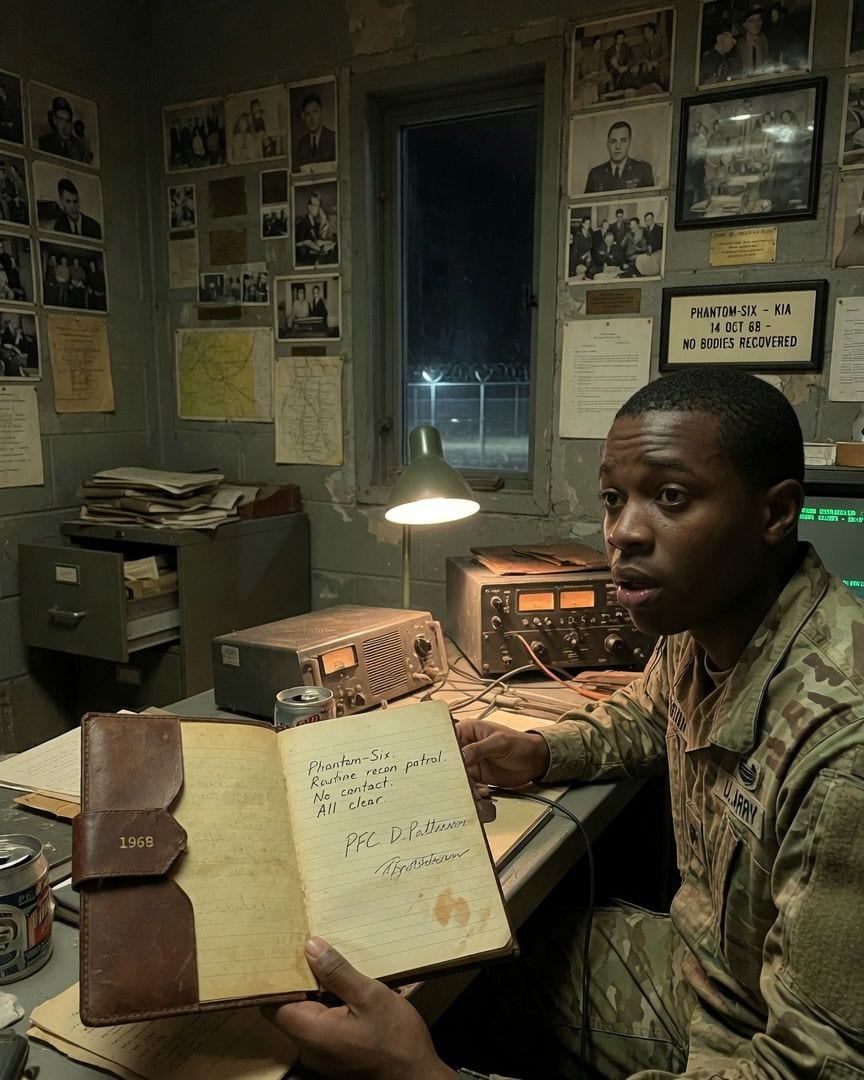
A DMZ specialist finds a 1968 Cold War logbook entry, signed by a lost soldier, its ink shimmering faintly.
Specialist James Farr, on a long night shift at a desolate Korean DMZ outpost, meticulously monitored his console, a squared-away soldier accustomed to the quiet hum of equipment. His focus shattered when a faint, static-laced whisper ghosted from a dead channel, calling out 'Phantom-Six' — a unit lost near this wire in 1968. The urgent voice then specifically mentioned his tower window light, asking him to turn it off before it drew fire. Later, an old logbook from 1968 revealed an entry dated three days *after* Phantom-Six was officially lost, signed by one of the vanished soldiers, its ink subtly shimmering with an unnatural gleam.
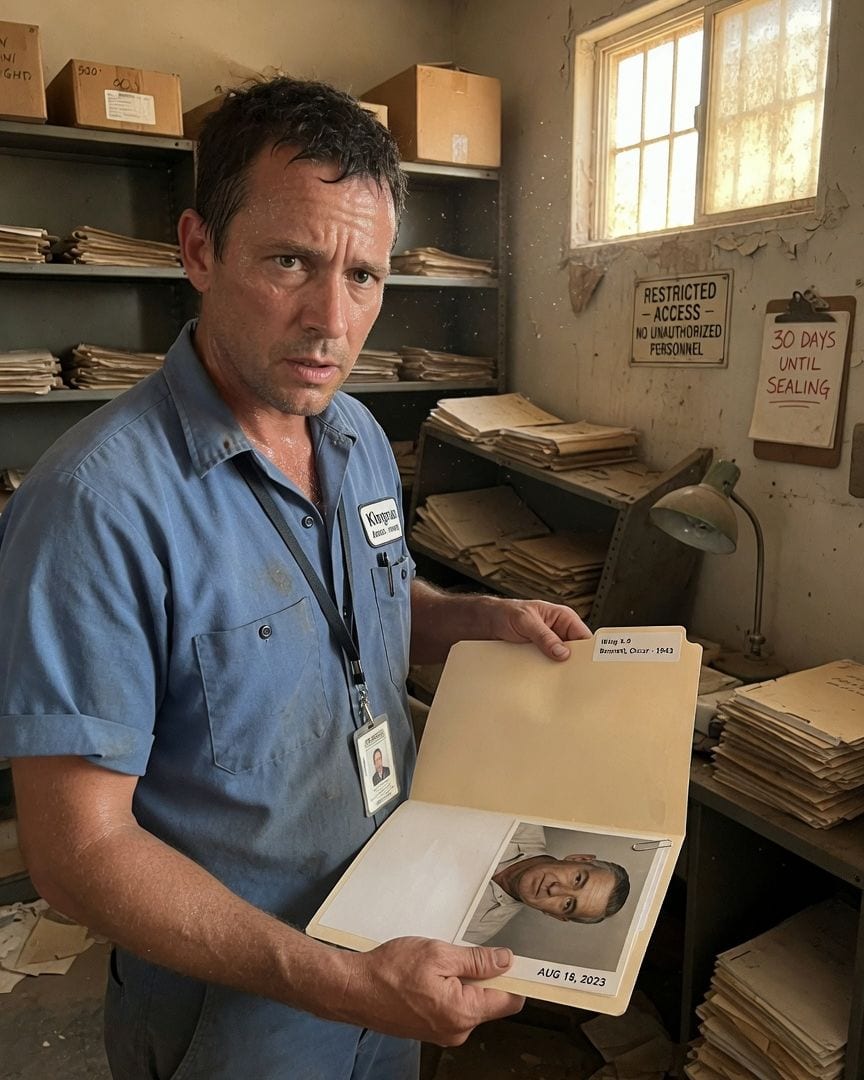
An inventory clerk in a Cold War boneyard finds a pilot declared dead in 1952, alive and photographed just last week.
Inventory clerk Rafe Delahunt toiled under the oppressive Arizona sun, racing against a deadline. He had just one month to catalog the vast Kingman boneyard before its final closure, a task made grueling by the crumbling archives and the suffocating heat. Deep within a forgotten bay, he unearthed eleven folders that defied explanation. Cool and supple to the touch, unlike any other document, they bore a 1943 date but smelled of fresh paper, filed under a designation 'Wing X-9' that shouldn't exist. Inside, the pristine files detailed a P-51 Mustang and its pilot, Oscar Bennett, officially declared 'crashed without trace' in 1952. Yet, tucked into the back, was a photograph of an older Oscar Bennett, clearly alive, with a date stamp from August 18, 2023.
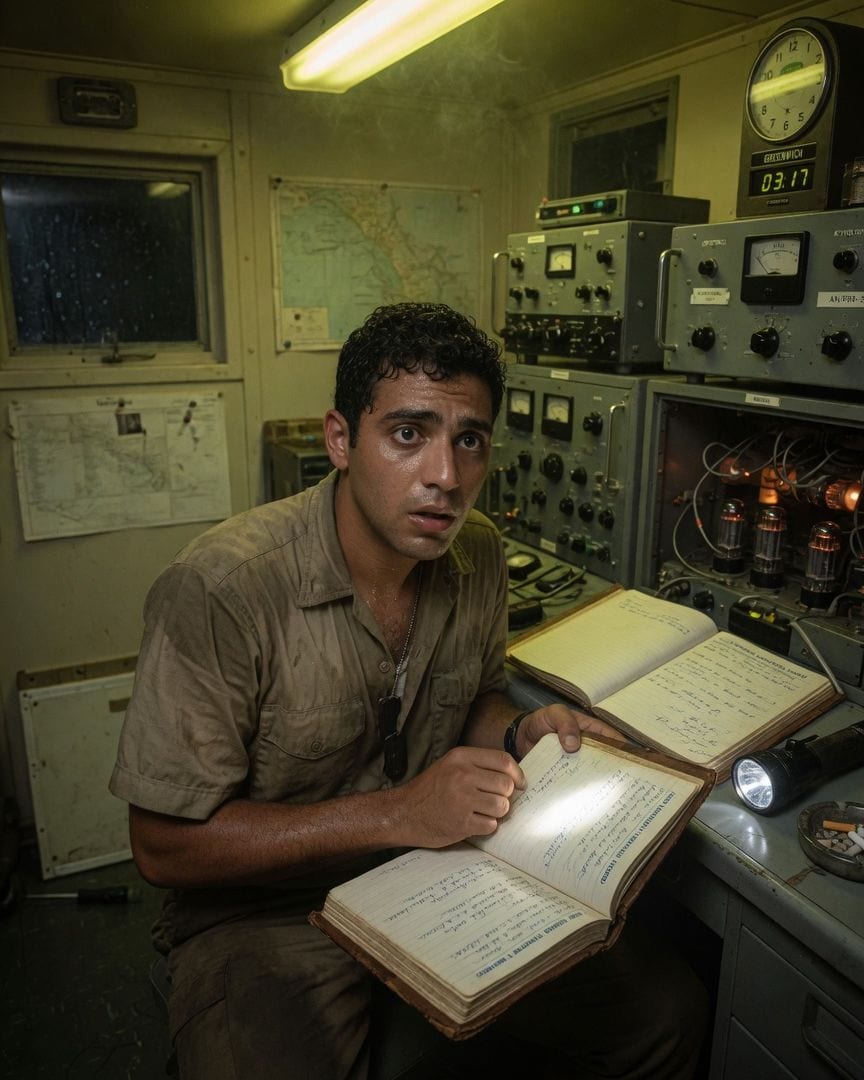
Three weeks from going home, Radioman Petrakis hears his own ship called 'no longer answering' on a broadcast — just like an old logbook describes for other Cold War radiomen.
Radioman Charles Petrakis counted the final weeks of his tour on a humid island station, the constant hiss of the Pacific his only companion as he monitored fleet broadcasts. Then, for ninety seconds, the encrypted stream dissolved into a calm voice listing ships 'no longer answering,' their fates sealed with a date. Petrakis froze as the voice named his own vessel, the USS St. Augustine, for a date three weeks in the future. With official logs showing no anomaly, he later unearthed an old, unofficial logbook detailing similar broadcasts—and the 'tour ending' for other radiomen.
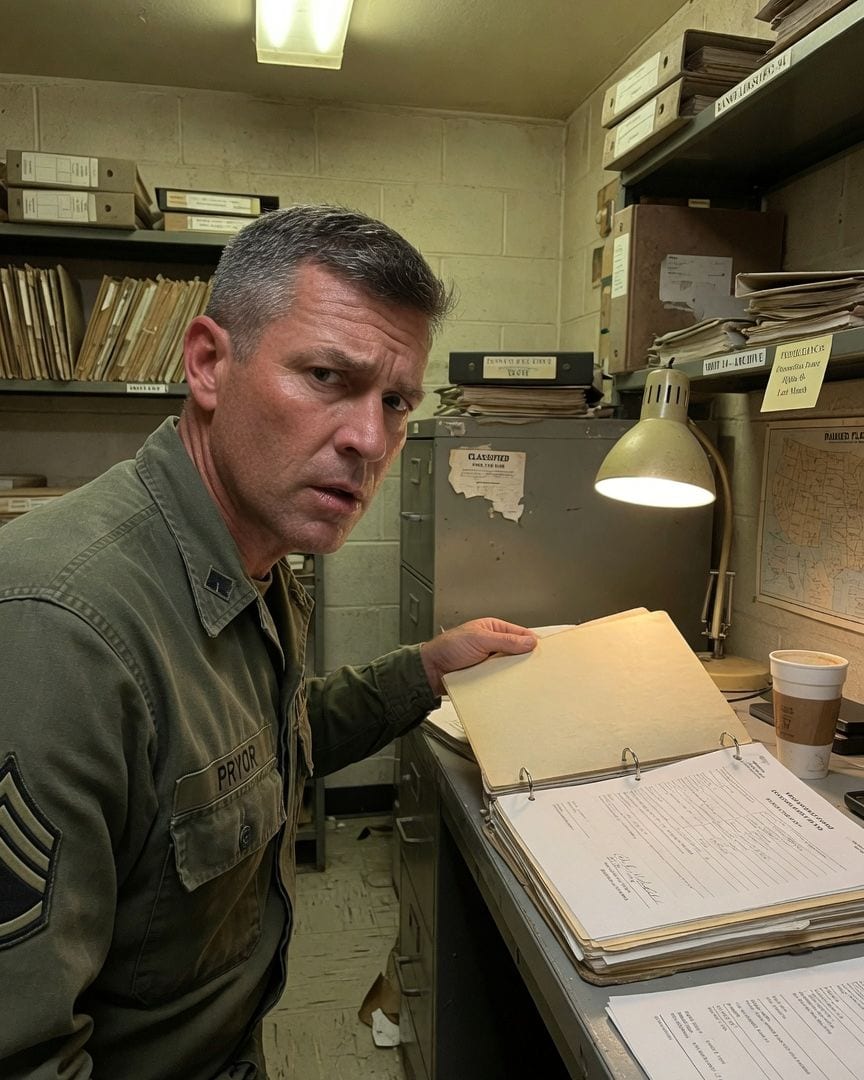
A sergeant with eleven days left finds a warm, glassed crater. Its file shows a captain lost thirty years ago is still signing reports from last week.
Sergeant Alden Pryor was counting down his final eleven days on a twenty-year hitch, expecting to spend them on routine patrols along the Ranier Flats fence line. Instead, his truck stopped at a bizarre sight: a four-hundred-foot glassed crater, miles from anywhere, its sand faintly warm at dawn despite no one recalling a blast. The air above it shimmered with an unnatural distortion, a silent scar of erased violence, and the official file for 'Shot 14' showed recent maintenance sign-offs for a decommissioned tower at the crater site. All these active documents were signed by Captain Everett Caldwell, who had been officially lost in operations thirty years ago, leaving Sergeant Pryor to wonder how a dead man could still be filing reports.
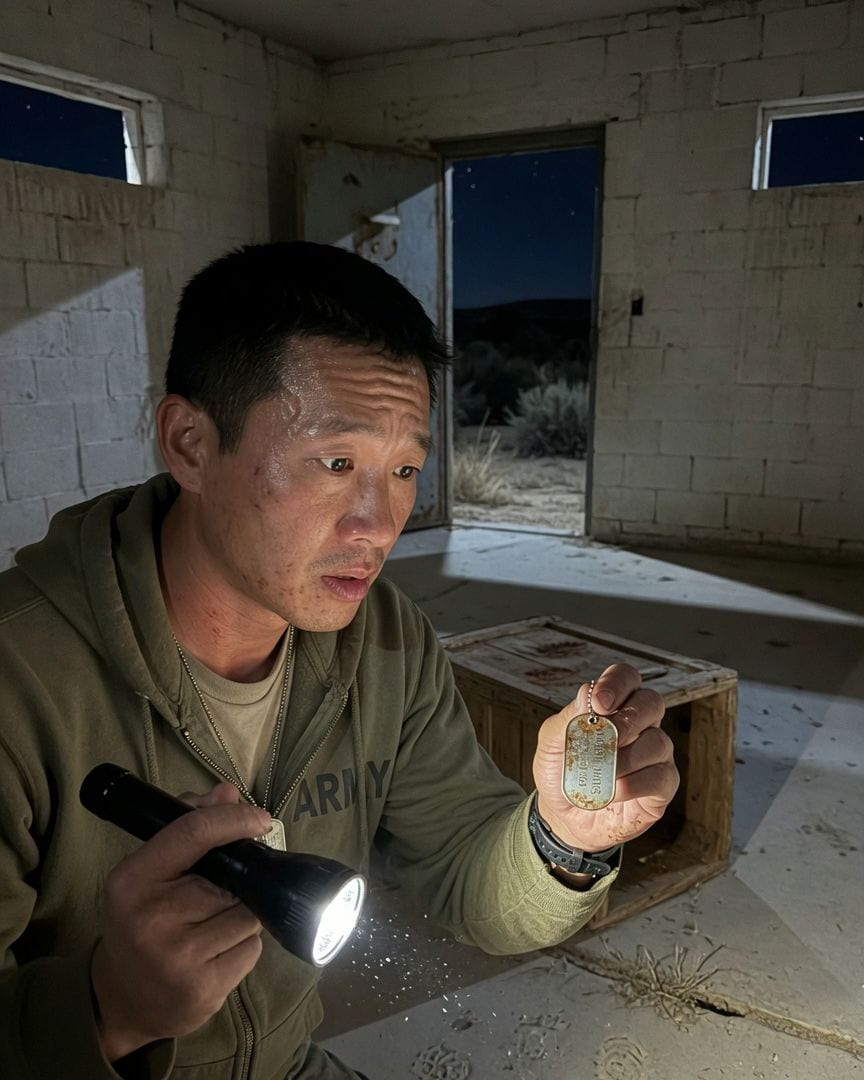
Staff Sergeant Rhee’s squad found a Cold War building not on their map. Range Control confirmed no structure. Minutes later, it vanished, leaving a foundation decades old.
Staff Sergeant Adam Rhee halted his squad at the Yakima Training Center, staring at a cinderblock building that simply wasn't on his map. Range Control confirmed there was no structure at his coordinates, leaving him to wonder what impossible thing stood before them. Moments later, after the range-safety truck arrived, the building vanished, leaving only a rectangular patch of earth with a foundation of decades-old weeds. That night, driven by an unsettling certainty, Rhee returned to find the building reappeared, its door ajar, holding a single, rusted dog tag from 1983. How could a place appear and disappear, leaving behind evidence from forty years ago?
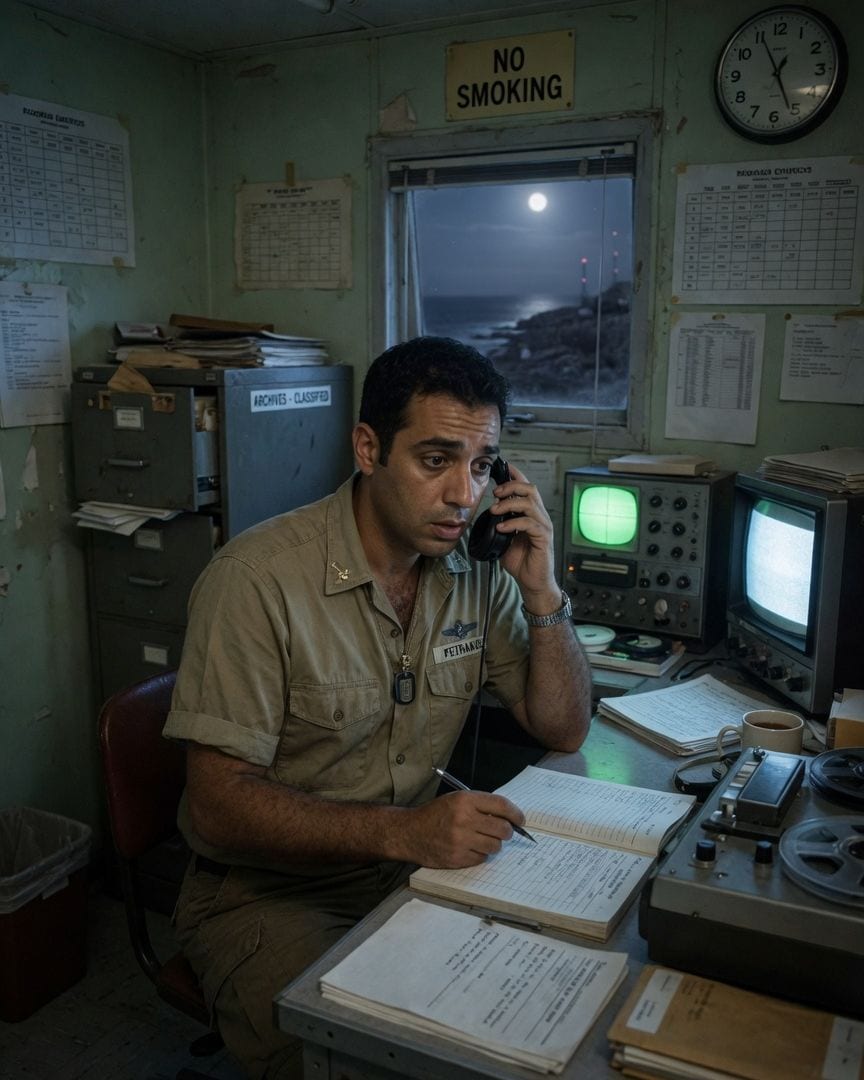
Three weeks from home, Radioman Petrakis found his name on the Cold War USS Vance’s roster for the exact date a voice predicted it 'no longer answering.'
Radioman Samuel Petrakis counted down his final three weeks on a remote island station in 1967, his thoughts already drifting to the home he would soon return to. But the steady hum of his encrypted fleet broadcast suddenly faltered, replaced by a calm voice listing ships, dates, and the chilling phrase: "no longer answering." It named the USS Vance, October 27th, 1967—exactly three weeks from that night—a destroyer currently on routine patrol. Petrakis later discovered his own name on the Vance’s future deployment roster for that precise, impossible date, assigned to a ship already marked for silence.