Three weeks from home, Radioman Petrakis found his name on the Cold War USS Vance’s roster for the exact date a voice predicted it 'no longer answering.'
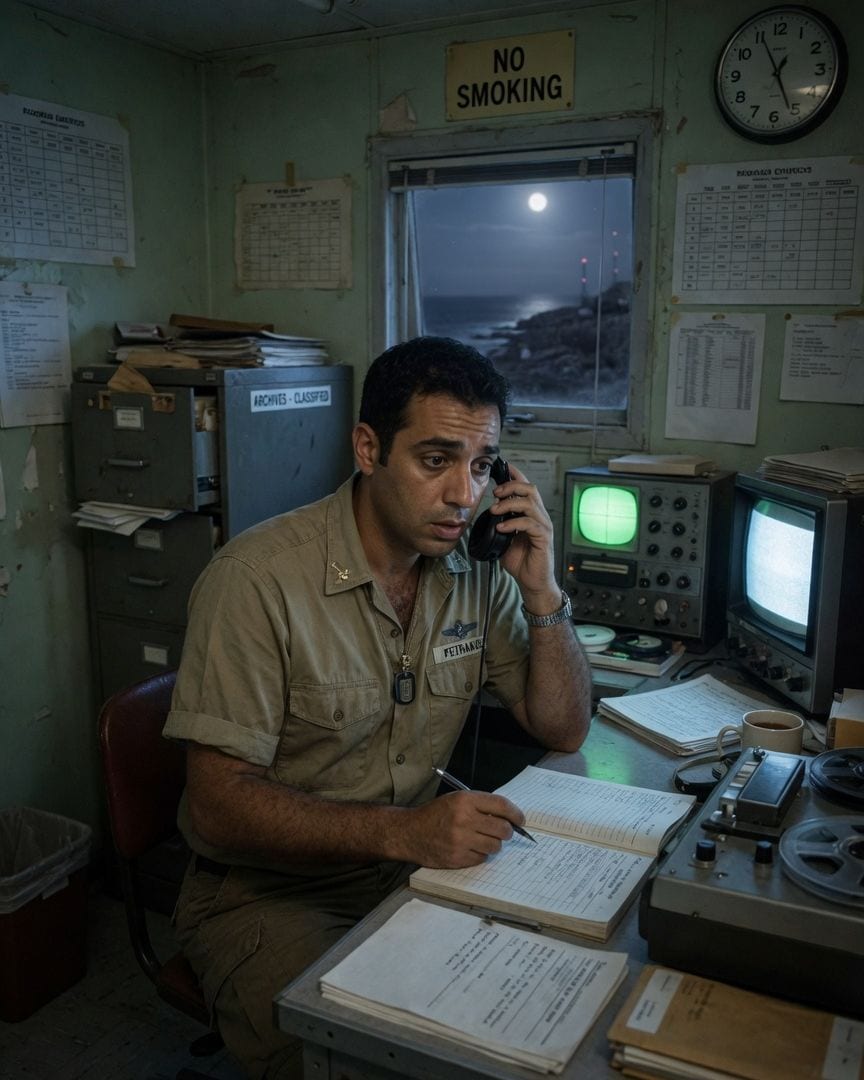
Radioman Samuel Petrakis sat alone in the dim glow of the radio room on the moonlit island station.
The year was 1967, and Petrakis was three weeks from the end of his tour, a fact that hummed in his mind almost as steadily as the encrypted stream of the fleet broadcast in his headphones.
The numbered sequence never stopped, never repeated, a constant digital pulse in the quiet room. He logged the groups mechanically, his thoughts already drifting to the world beyond this remote rock, to home.
Then, the hum faltered. A brief, almost imperceptible static hiss crackled in his ears, and the encrypted groups dissolved. For ninety seconds, the silence of the radio waves was broken by a calm, flat voice, speaking in plain English.
It read names of ships, each followed by a date and the chilling phrase, 'no longer answering.' The list was long, spanning decades, but it ran current, right up to the present.
Petrakis froze, his pen hovering over the logbook, as the voice articulated, clear as a bell, 'USS Vance… October 27th, 1967… no longer answering.' The date was precisely three weeks from that very night.
Then, with another soft hiss, the encrypted stream resumed as if uninterrupted, the numbered groups once again flowing steadily. Petrakis tore off his headphones, his heart hammering against his ribs. He checked the main circuit logs.
They showed no break, no anomaly in the feed. Nothing. He was alone with what he’d heard.
Petrakis spent the rest of his watch trying to rationalize it. Fatigue, a rogue frequency, a prank carried out by one of the junior radiomen. Anything but what it had sounded like.
The next morning, he requested an auxiliary tape from his watch, citing 'minor interference' with the main feed.
He locked himself in a small, rarely used audio bay, the air thick with the smell of stale electronics, and replayed the reel-to-reel. The flat, dispassionate voice was identical, the list of ships and dates chillingly precise.
The entry for the USS Vance was unambiguous: October 27th, 1967. Petrakis grabbed a naval almanac from a dusty shelf.
The USS Vance, a destroyer, was currently on a routine patrol, due back at base in a week, before its next deployment. Everything checked out, except the impossible prediction.
He then focused on a historical entry from the broadcast: 'USS Perseus… May 12th, 1951… no longer answering.' He remembered the Perseus, a destroyer lost with all hands in the Pacific, a footnote in naval history he’d once glanced at.
Petrakis began digging through the station's limited archival records, then submitted requests for more detailed files from the mainland, citing a "historical research project." Weeks passed, his transfer date looming closer.
Finally, a thick, unmarked envelope arrived in the secure mail drop, crammed with microfiche and printed documents.
Buried deep in an auxiliary maintenance log for the USS Perseus, a document so faded it was almost illegible, he found a vague reference to an 'experimental sonar array' installed shortly before its final voyage.
That detail had been scrubbed from every official record Petrakis could find. But the broadcast, he distinctly recalled, had mentioned 'experimental array failure' in its Perseus entry, a detail impossible for any public record to know.
The official story had omitted it entirely. This couldn't be a coincidence.
Petrakis felt a cold dread settle in his stomach, a heavy stone of certainty. The broadcast knew things the Navy itself had forgotten, or deliberately erased.
He pushed the Perseus file aside and pulled up the USS Vance's current crew manifest, then its projected deployment roster for the upcoming weeks.
He scrolled through the list of names, his finger tracing each entry on the flickering green screen. His transfer orders were already cut, confirmed by his superior officer, Lieutenant Commander Drummond, just yesterday.
He was due to rotate out three days before the Vance’s next mission. But then his eyes snagged, his breath catching in his throat.
Not on the current manifest, but on the future deployment roster for October 27th, 1967—the exact date from the broadcast—was an entry: 'Radioman, 2nd Class Samuel Petrakis.' His name. Assigned to the USS Vance.
He looked at the date again, then at his own hand, trembling slightly on the mouse. Three weeks from now.
The next few days were a blur of frantic, covert investigation. Petrakis tried to verify his transfer orders again, even calling the personnel office on the mainland under a pretext, citing a misplaced form.
They were solid, confirmed for October 24th, signed, sealed, and delivered. Yet, the USS Vance's future manifest, which he accessed again through a secure but unofficial backchannel in the dead of night, still listed him for the 27th.
It was an impossible contradiction, a phantom entry that defied all logic. He began to search for more, poring over every document he could get his hands on.
He cross-referenced every 'no longer answering' entry from his auxiliary tape with any available, obscure naval records. He found a chilling pattern: for each lost vessel, there was a subtle, almost imperceptible discrepancy in its official history.
A mis-logged crew member who was never officially on board but appeared in a blurry photo taken on deck just days before its disappearance; a forgotten maintenance report detailing a unique, non-standard piece of equipment that simply ceased to exist in later inventories; or an unusual cargo manifest for an exotic, untraceable material that vanished from all official records.
These details always surfaced in forgotten auxiliary logs, never the pristine, carefully curated official records. The 'accountability that cannot be' seemed to be an active, ongoing process, a deliberate act of omission. His focus narrowed.
He discovered that every ship on the broadcast's list, without exception, had been equipped with an early model of the AN/URC-32 communication relay, a precursor to the system on his own island station.
It was a specific, proprietary piece of hardware, and its presence was the only consistent thread. Petrakis started to suspect these relays were not just sending signals, but somehow receiving something else entirely.
The air in the radio room suddenly felt heavy, thick with unseen currents.
Petrakis’s frantic digging began to raise flags. One afternoon, Lieutenant Commander Drummond called him into his office, a small, meticulously organized space overlooking the moonlit bay.
The glass of the window, normally reflecting the vastness of the ocean, seemed to press in on the room. Drummond, a man whose calm demeanor was almost unsettling, gestured to the single spare chair, his posture unnervingly still.
'Radioman Petrakis,' he began, his voice level, devoid of any inflection that might betray emotion, 'we’ve noticed some… unusual activity in the archival access logs.
Specifically, a deep dive into the historical records of several vessels listed as 'missing in action.' Are you pursuing a particular research interest?' Petrakis’s heart pounded against his ribs, a frantic bird trapped in a cage.
He tried to deflect, mumbling something about a personal interest in naval history, a hobby to pass the time on the remote island. Drummond just smiled faintly, his eyes unblinking, fixed on Petrakis’s face. 'I see.
And have you found what you were looking for, Radioman?' The question hung in the air, heavy and loaded, a velvet-gloved threat that seemed to chill the very air.
Petrakis stammered, denying any specific findings, claiming he was just satisfying a passing curiosity. Drummond simply nodded, his gaze unwavering, before dismissing him with a quiet gesture.
Later that night, Petrakis returned to his bunk, a knot of unease tightening in his stomach. His personal locker, which he always secured with a combination lock, was unlocked.
Nothing was missing, no sign of forced entry, no tell-tale scratch marks.
But his auxiliary tape of the broadcast, which he had left carefully positioned mid-play on the small reel-to-reel recorder hidden beneath his cot, was subtly rewound to the very beginning.
The spools were perfectly aligned, the tape taut, but he knew exactly where he had left it. It was a quiet, undeniable warning. Someone knew. Someone was watching.
The next morning, Petrakis, fueled by a sleepless night and a growing certainty, marched into Drummond's office, the auxiliary tape and his collected files clutched in his hand. The door closed behind him with a soft, final click.
He placed them on the desk, the tape recorder clicking softly as he pressed play, letting the flat, emotionless voice from the broadcast fill the meticulously organized room.
He watched Drummond's face as the ships and dates, including the USS Vance, were announced. Then, he showed Drummond the cross-referenced historical anomalies, the scrubbed records, the impossible details like the Perseus's sonar array.
Drummond listened, unblinking, his gaze fixed on Petrakis, revealing nothing. When the tape finished, he leaned back, the faint creak of his chair the only sound.
'It’s not a glitch, Radioman,' Drummond said, his voice low, devoid of emotion, as if delivering a standard operations report. 'It’s a standing report.'
He explained that this island station, and a few others like it, were built around specific, unique geological anomalies. These anomalies amplified certain electromagnetic frequencies.
When processed through the AN/URC-32 communication relays – the very equipment Petrakis had identified – they picked up a 'pre-echo' of specific events.
The 'no longer answering' broadcast was not a prediction, but a manifest of vessels and their crews that disappeared without a trace, predicted with chilling, absolute accuracy. Drummond’s voice tightened almost imperceptibly, a momentary crack in his composure.
'My own father, John T. Drummond, was on one of those ships. The USS Perseus.' He then slid a classified document across the desk.
It was decades old, the paper brittle and yellowed, stamped 'Top Secret,' outlining something called the 'Echo Protocol.'
It wasn't a system to understand or prevent the disappearances, but to monitor and suppress this broadcast, to ensure official naval records maintained the 'accountability that cannot be' by never reflecting the true, impossible cause or the pre-ordained prediction.
'The system is designed to maintain the illusion, Petrakis,' Drummond finished, his eyes meeting Petrakis’s. 'To ensure the world believes in order, even when it’s confronted with something fundamentally outside of it.'
Petrakis stared at the document, the pieces clicking into place with a horrifying inevitability. The ships, the dates, the impossible details—it all made a terrible, coherent sense.
The dread was no longer abstract; it was a cold, hard fact, solidifying around him. 'Why does the broadcast still run, then?' Petrakis asked, his voice barely a whisper, thin and reedy in the sudden quiet of the room.
'If it’s suppressed, why did I hear it?' Drummond looked at him, a flicker of something close to pity, or perhaps just profound weariness, in his eyes. 'Because it can't be stopped, Radioman. Only ignored.'
He then slid a faded, yellowed piece of paper across the desk, smaller than the classified document. It was a fragment of a much older broadcast log, from the 1940s, brittle at the edges.
Petrakis saw a list of names under the entry for the USS Perseus, dated to its loss. He scanned it, and then his breath caught, held tight in his chest.
Not far from his own name on the Vance’s future manifest, he saw another familiar name, spelled out in full: 'Drummond, John T.'—Drummond’s father, just as he had said.
But beneath it, another entry, for a ship lost even earlier, from the 1920s: 'Petrakis, Elias K.'—his own grandfather, a merchant marine lost at sea, a family story he’d heard a hundred times, always dismissed as a tragic accident, a sudden storm, a rogue wave.
The broadcast wasn't just predicting the future; it was a multi-generational ledger. His family had always been in it.
Petrakis, reeling, demanded to know more, the implications of his grandfather's name on the ancient list crushing him, stealing the air from his lungs. Drummond, his face etched with a profound, inherited weariness that suddenly made sense, explained.
'Generations of our families, Petrakis, and others like us, have been linked to these echoes. Drawn into service at these specific stations, or onto these specific vessels, not by chance.'
The 'Echo Protocol' wasn't just about suppressing the broadcast; it was also a subtle, insidious mechanism for recruitment and assignment.
Those whose families appeared on the lists were often, almost imperceptibly, steered into roles where they would either monitor the phenomenon, or unknowingly, be placed on ships destined to become entries.
The 'accountability that cannot be' was a multi-generational cover-up, a vast, silent conspiracy of omission, maintained by men like Drummond, and now, by men like Petrakis. Their own service records, their very lives, were part of the system's grim accounting.
The broadcast wasn't about what took the ships; the 'what' was irrelevant, unknowable. It was about who was on them, a continuous, pre-emptive manifest of the disappeared, an inescapable roll call.
The anomaly wasn't a glitch in the system; it was the true, hidden operational manual for a specific, ongoing kind of loss that defied all conventional logic, a monstrous shape that now, for Petrakis, snapped into horrifying focus.
Horrified, Petrakis tried to find a way out, his mind racing, scrambling for any logical escape. 'Transfer me,' he pleaded, his voice cracking, raw with desperation. 'Take me off the Vance's manifest.
I can’t—' Drummond shook his head slowly, the movement heavy with an unspoken truth. 'Once a name appears, Radioman, it’s fixed. The system has already accounted for you.'
He pulled up Petrakis's digital service record on a nearby terminal, a small screen glowing in the corner of the office.
Despite all official transfers, all the mainland confirmations, a phantom entry remained, stubbornly resistant to deletion or alteration: 'assigned, future deployment, USS Vance.' The system was absolute.
Desperate, Petrakis lunged for the main communication relay, a bulky, humming console at the center of the room.
He believed if he could disable it, silence the echo at its source, he could break the pattern, sever the thread of fate that now bound his family to the sea.
Drummond, still calm, moved with surprising speed, blocking his path before Petrakis could reach the controls. 'It's not the broadcast, Petrakis,' he said, his voice flat, resonating with a terrible certainty. 'It's the echo.
The broadcast is just the echo of what's already set.' Petrakis, fueled by terror and a desperate will to survive, struggled, pushing against Drummond with all his might.
He managed to yank a cable from a minor auxiliary unit, sparking briefly in the dim room, but the main relay remained untouched, its steady hum unbroken.
Drummond, without resorting to violence, simply restrained him, his grip firm, unyielding, his gaze full of that profound, inherited weariness. 'Some things,' Drummond said, his voice barely a whisper, a resignation in every syllable, 'are simply accounted for.'
Petrakis ceased struggling, defeated, the fight draining out of him, his fate sealed.
Three weeks later, the USS Vance departed the island station, a sleek silhouette against the dawn, cutting through the silver-streaked water.
Samuel Petrakis, despite his official transfer orders, was on board, assigned to the radio room, his presence a quiet, unrecorded contradiction to every piece of paperwork that should have sent him home.
Lieutenant Commander Drummond remained at his post, overseeing the communications, his face impassive, a sentinel to the invisible currents that flowed through the relays. The official logs of the Vance's voyage were pristine, showing no anomalies, no discrepancies.
The paperwork was, as always, perfect. The 'accountability that cannot be' had held firm.
The USS Vance never reached its destination. Its loss was recorded as 'missing, presumed lost at sea,' a standard entry in the naval archives, filed without further explanation.
The incident was investigated, but no trace of the ship or its crew was ever found. On the moonlit island station, months later, a new radioman, Private First Class Adam Merritt, sat on his first watch, monitoring the fleet broadcast.
He noticed a faint, almost imperceptible skip in the encrypted groups, followed by ninety seconds of plain language.
A single, calm voice began to read a list of ships, each followed by a date and the phrase 'no longer answering,' the list running current right up to the USS Vance, dated to its disappearance.
His name, the records would show, was Samuel Petrakis. He was just another entry in a list that never ended.
If this one got to you
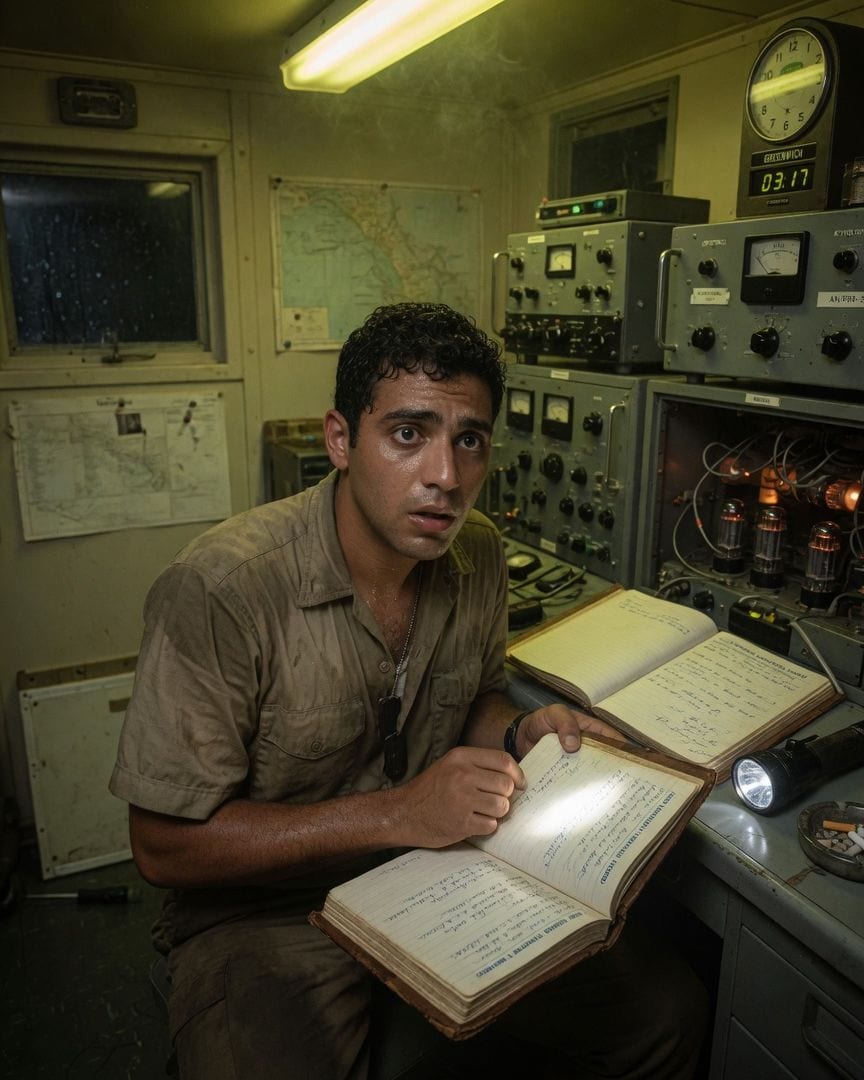
Three weeks from going home, Radioman Petrakis hears his own ship called 'no longer answering' on a broadcast — just like an old logbook describes for other Cold War radiomen.
Radioman Charles Petrakis counted the final weeks of his tour on a humid island station, the constant hiss of the Pacific his only companion as he monitored fleet broadcasts. Then, for ninety seconds, the encrypted stream dissolved into a calm voice listing ships 'no longer answering,' their fates sealed with a date. Petrakis froze as the voice named his own vessel, the USS St. Augustine, for a date three weeks in the future. With official logs showing no anomaly, he later unearthed an old, unofficial logbook detailing similar broadcasts—and the 'tour ending' for other radiomen.
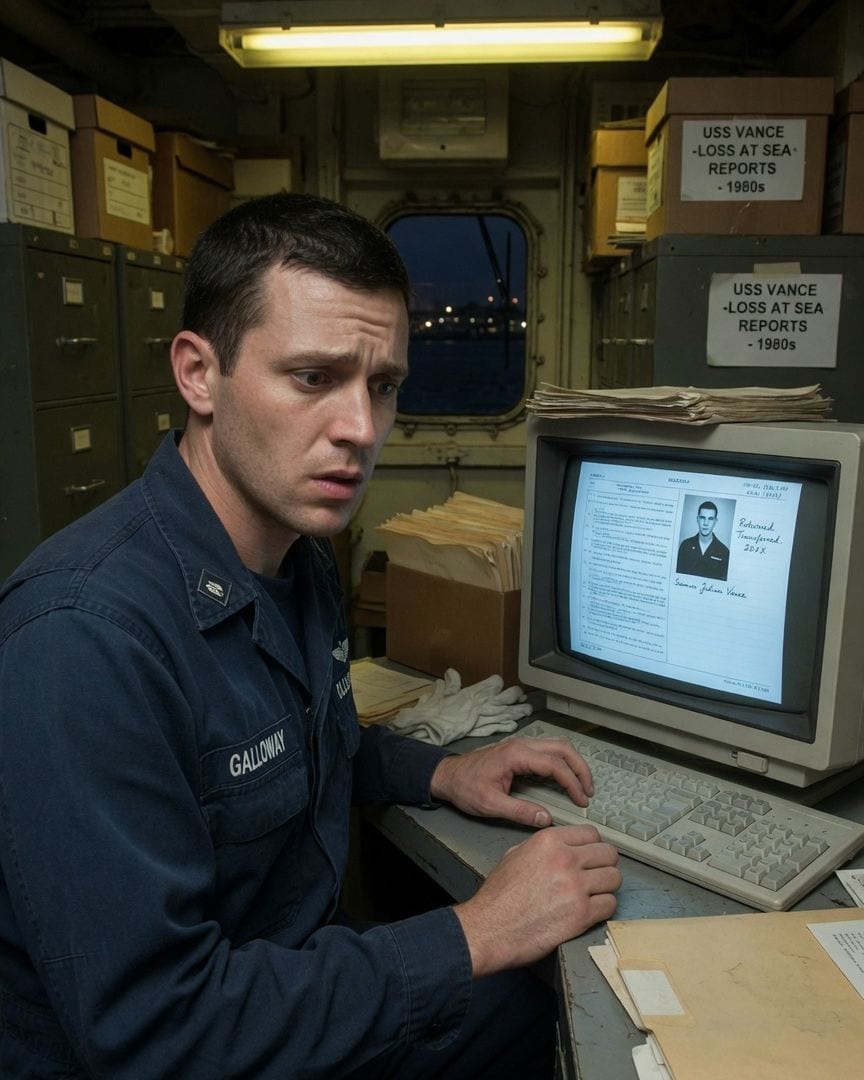
Petty Officer Galloway logged a sailor onto his ship. The man died at sea 40 years ago.
Petty Officer Joel Galloway scanned a sailor's ID on the USS Vance quarterdeck. The man's name, 'Seaman Julian Vance,' and his out-of-date uniform pricked at Galloway's memory. Later, the ship's berthing count came back one over, with an extra entry in the system but no physical body.
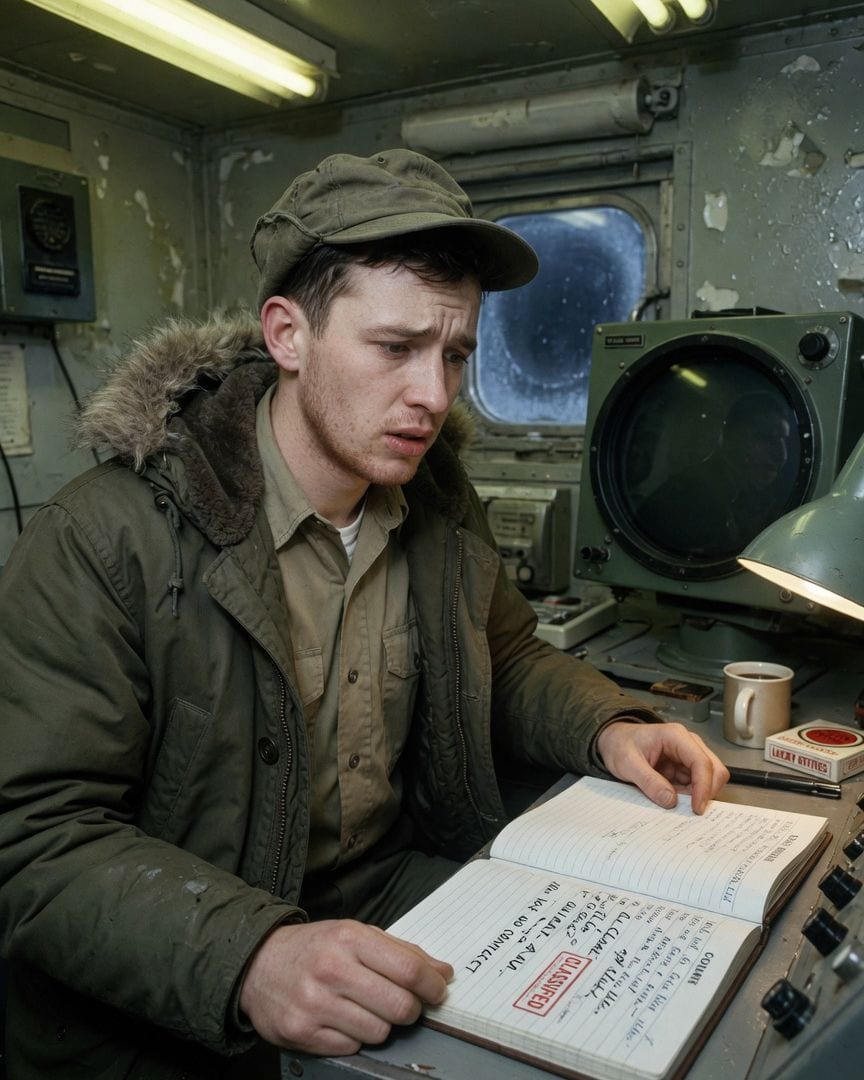
A Cold War airman logs an impossible radar contact on his last sweep. But his official logbook entry is stamped 'CLASSIFIED' and then contradicted by a hastily scrawled 'ALL CLEAR' dated moments before it.
Airman Ordway Vance, 22, manned the radar dome at Site Pellin in the biting North Atlantic dark of January 1962, running the last calibration sweep before its decommissioning. His scope picked up a faint, impossible return, growing closer with each pass, though the ocean remained empty to the eye. When Vance detailed the contact in his official logbook, a 'CLASSIFIED' stamp appeared, followed by a hastily scrawled 'ALL CLEAR' dated moments before his own entry, contradicting his every word. Commander Hartley dismissed it as equipment malfunction, but Vance sensed a chilling, official erasure behind the lie. He soon found a locked cabinet marked 'SITE PELLIN ANOMALIES,' hinting at a deeper truth buried within the base's final days.
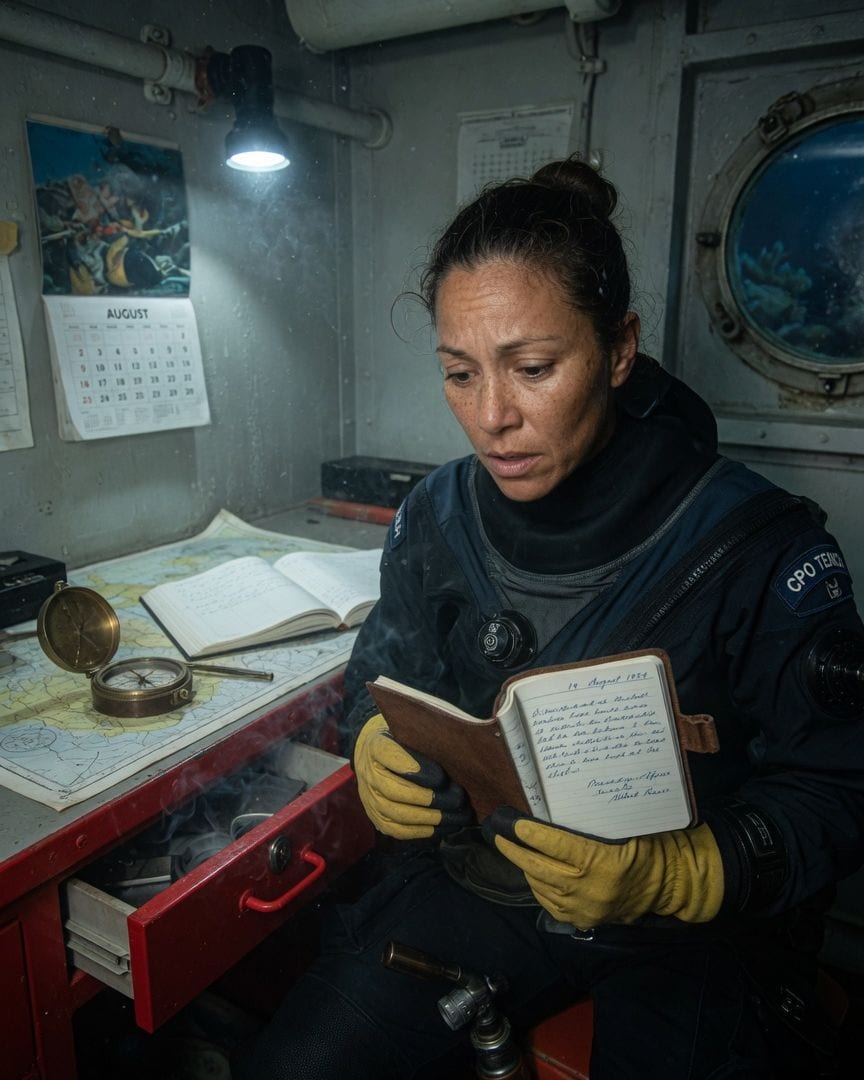
A deep-sea diver found a Cold War target ship's logbook dated months after it was vaporized in 1954.
Chief Petty Officer Marlo Tench, a methodical deep-sea diver, stared in disbelief at the ROV feed. Her team watched with her as the USS Triton, a target ship from the 1954 Castle Bravo nuclear test, appeared pristine and upright ninety feet below. It was supposed to have been vaporized, yet its hull number was unmistakable, its paint unburned, and its internal systems inexplicably active. Descending into the eerie silence, Marlo found a logbook dated five months after the ship’s destruction, and a journal entry naming a crewman officially listed as 'unmanned target.' What impossible force kept the Triton a living ghost decades after its fiery end?
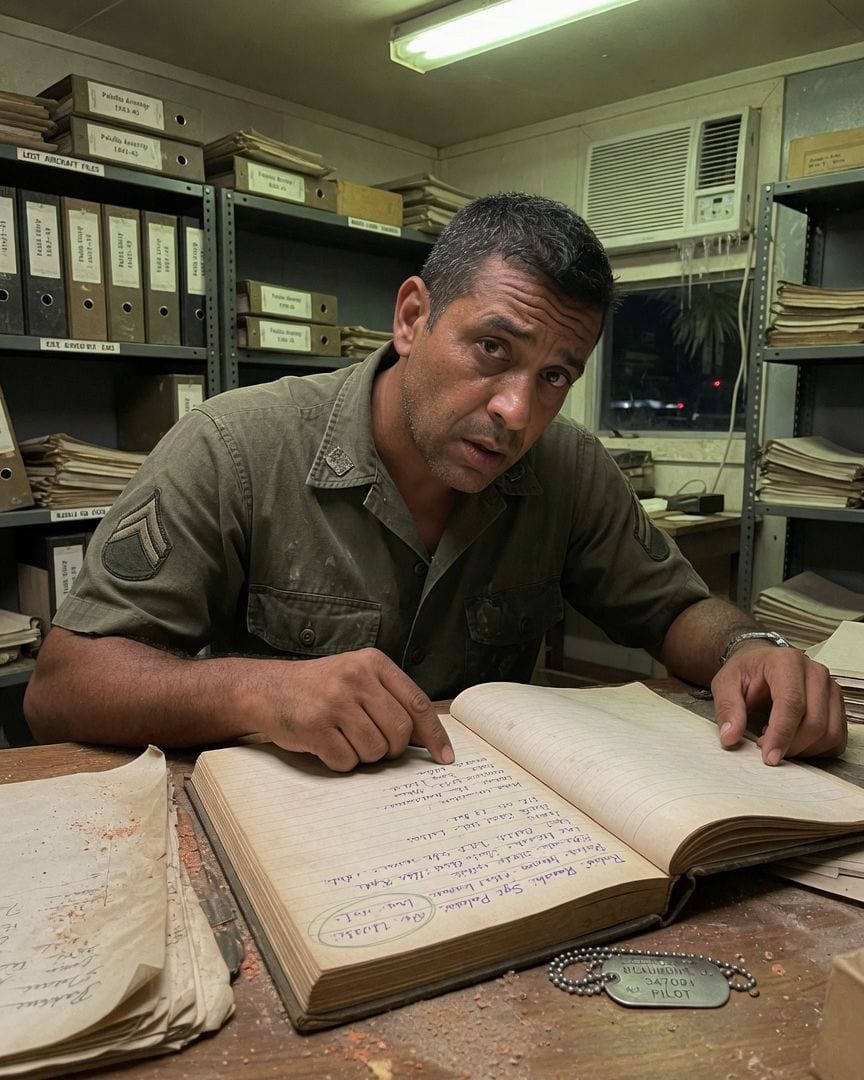
A sergeant's last watch on a forgotten outpost: His own name appeared on an 80-year-old crash manifest.
Sergeant Leon Pulaski spent his last night at the remote Peleliu Atoll Airstrip, its final closure imminent, listening to the rhythmic sigh of the Pacific. Just after 0330, a garbled distress call pierced the silence, requesting the field for a plane with a tail number, 'Ghost Two-Niner-Niner,' retired since World War II. Though Pulaski, disciplined and rational, logged the impossible call as a phantom, the crash crew later found a fresh gouge in the coral and a shard of cockpit glass, still warm, where no wreck existed. His quiet unease only deepened when he discovered a dog tag belonging to a pilot declared lost eighty years prior. But the true chill landed when he found his own name on that same eighty-year-old crash manifest.
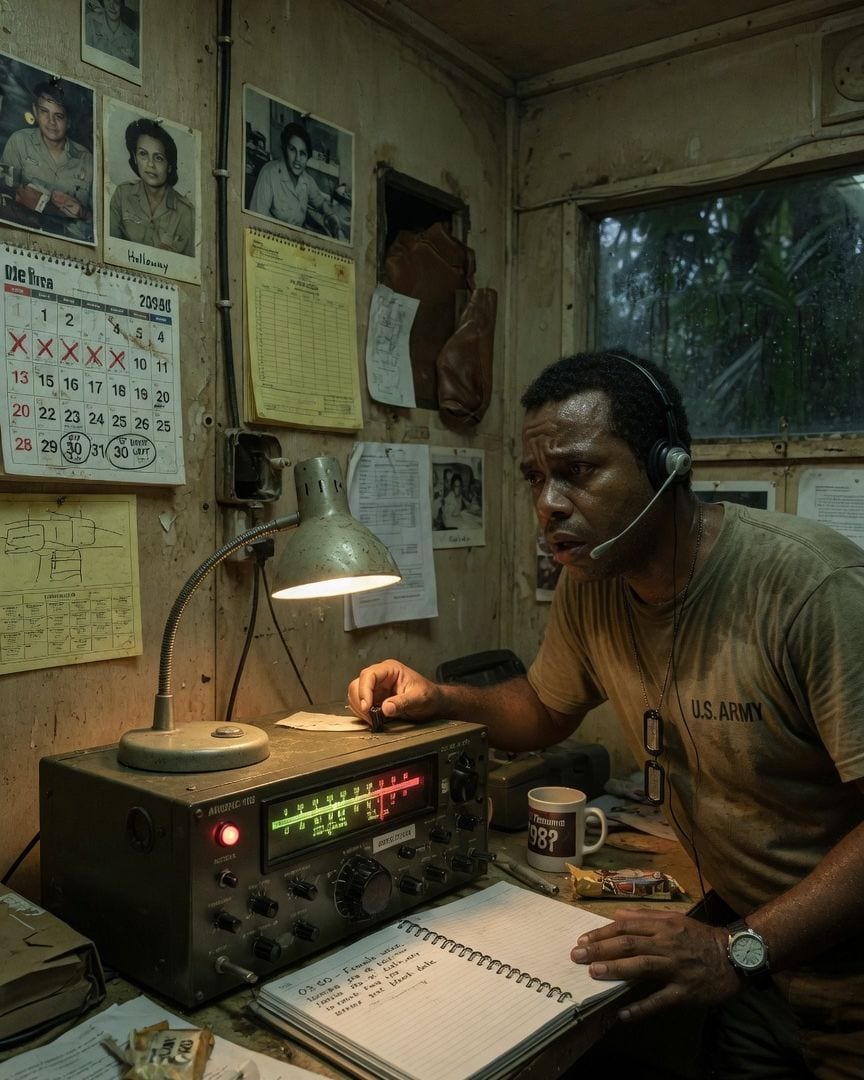
Three months from his tour ending, a sergeant's Cold War radio lists his name with a blank 'ceased answering' date. A hidden logbook warns: 'It knows my name.'
Sergeant Kevin Brooks was three months from finishing his year-long tour at a remote Panamanian jungle station. He meticulously marked each passing day, eager to escape the humid nights and unseen blossoms pressing against the comms shack walls. But at 0300, his old radio crackled to life with a woman's calm voice, listing names of past operators who 'ceased answering.' Then the voice spoke his own name, leaving a chilling blank space where his date should have been. What grim roll call had Sergeant Brooks stumbled upon?