Sonar Technician Isabella Rhee's screen shows a massive hull tracking her ship. Her own hull then vibrates in perfect sync, from outside.
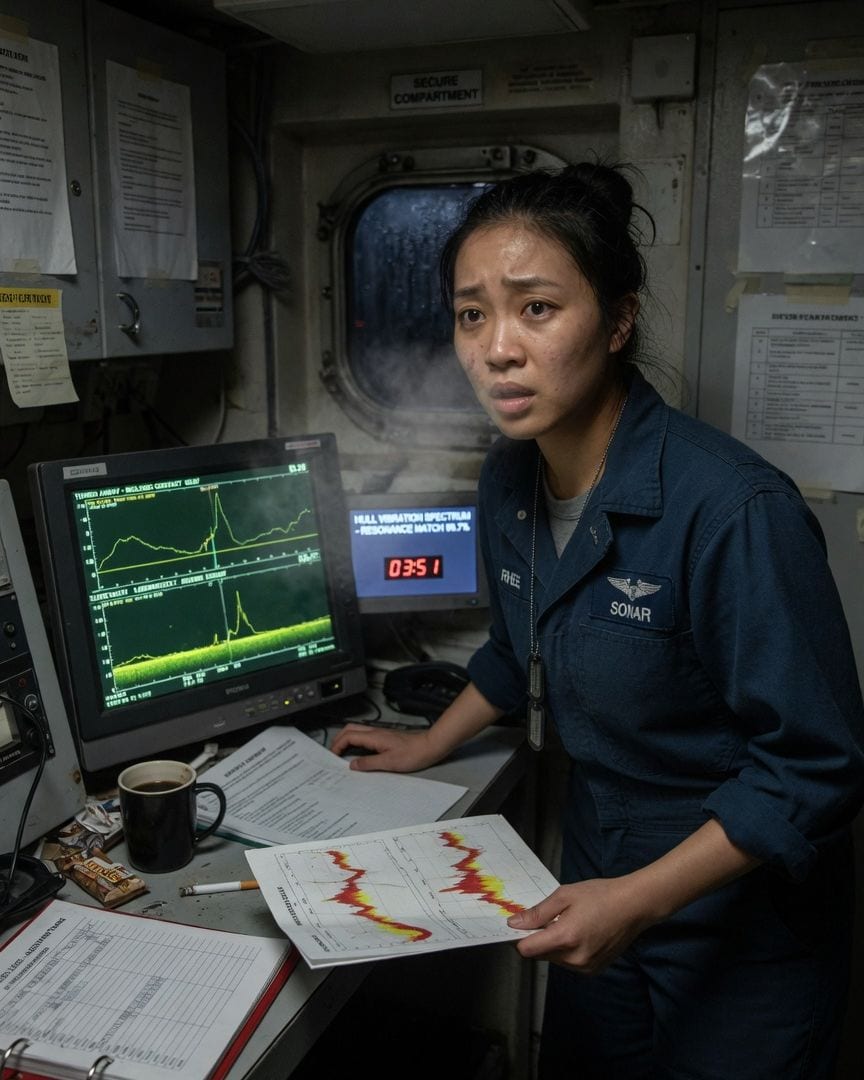
Sonar Technician Isabella Rhee, just two days from the end of her final patrol aboard the USS Vance, felt a familiar unease settle in her gut.
The frigid, fog-choked waters off the Aleutian Islands had been a monotonous gray for weeks, but her sonar screen offered a different, impossible view.
At 02:37, the towed array registered a close biologic contact – a signature that pinged with the unmistakable resonance of a solid hull.
It held forty meters to starboard, maintaining its exact distance through a full tactical turn, a maneuver no known marine life could possibly match. Radar came up clean, as always, the lookouts reporting only dense, empty black water.
Isabella had seen this before. Six weeks outbound, at the identical minute, the acoustic log from that transit held the exact same trace.
It faded at precisely 04:00, just as it always did, leaving nothing but static and the gnawing certainty that the system had just accounted for something that didn't exist.
Isabella spent the next hours meticulously reviewing the acoustic logs, cross-referencing every parameter, calibrating and recalibrating, desperate for a mundane explanation. A glitch, a phantom echo, a rare deep-sea creature misidentified. But the data was pristine, the contact consistent.
Frustrated, she expanded her search to the USS Vance's auxiliary systems, looking for any correlating anomaly.
Deep in the diagnostic readouts for the internal hull stress monitors – sensitive hydrophones designed to detect structural fatigue, not external contacts – she found it. A subtle, almost imperceptible, high-frequency vibration spike, a single, sharp acoustic signature.
It was too faint to trigger an alert, too brief to register as a system malfunction, but it was there.
And its timing was exact: a faint, resonant thrum beginning precisely when the towed array registered the 'biologic hull,' and fading exactly at 04:00. She printed the spectral analysis, a jagged peak against an otherwise flat line.
Executive Officer Gideon Maddox, a pragmatic man focused on the ship's imminent decommissioning, barely glanced at the printout. He waved a dismissive hand. 'Another ghost in the machine, Rhee.
Sensors get finicky when they know they're headed for the scrap heap. Probably a calibration issue, or just the ship settling.' Isabella knew the calibration was perfect, and the Vance had been settling for thirty years. This was different.
This was a signature.
Unable to let Maddox's dismissal stand, Isabella returned to her station. She ran a specialized acoustic analysis, cross-referencing the faint internal vibration data with the towed array's external trace.
The software chewed through the data, rendering complex algorithms into a visual spectrum.
The internal vibration wasn't just a spike; it was a complex, resonant frequency, mimicking the harmonic signature of a ship's hull under propulsion, but coming from outside and resonating in. It was a perfect, impossible mirror.
As the final spectral graph resolved, the screen flickered. For a split second, a faint, overlaid image, like a thermal ghost, appeared on the display.
It was a massive, dark shape, smooth and impossibly vast, pressing against the hull, precisely where the internal sensors had registered the vibration. Then it vanished, replaced by the blank blue of the diagnostic screen.
Isabella spent the next day trying to reconcile the impossible image. She tried to recreate it, but the anomaly wouldn't reappear.
Maddox was tied up in meetings with the captain, preparing the final decommissioning reports, and dismissed her attempts to show him the data as 'over-analyzing.'
Undeterred, Isabella dug deeper, accessing archived sonar logs from decades of USS Vance patrols in the Aleutians. The old records were a mess of decaying data tapes and handwritten annotations, but a pattern began to emerge.
Scattered, unconfirmed reports of 'phantom contacts,' 'acoustic anomalies,' or 'unusual whale behavior' peppered the logs. They were vague, often attributed to equipment malfunction or crew fatigue, but the locations and times were eerily similar to her own experiences.
Many mentioned a contact that 'moved like metal but felt like water,' or 'sounded like a ship that wasn't there.' Isabella started a personal, encrypted digital log, detailing every anomaly, every dismissed report, every instance of the 04:00 fade.
The deeper she went, the more the official narrative of 'isolated incidents' frayed.
This wasn't a series of unrelated glitches; it was a consistent, decades-long pattern that the system had been diligently trying to erase, or at least explain away, for as long as the Vance had sailed these waters.
The unease in her gut solidified into a cold, hard certainty: something was out there, and it had been following this ship, or something like it, for a very long time.
As Isabella's investigation deepened, she began to feel increasingly exposed. The isolation of her work, compounded by Maddox's skepticism, made every glance feel pointed.
She noticed Petty Officer Adam Fletcher, an engineering tech she'd rarely seen outside his department, loitering near the sonar station more frequently.
He'd stand just outside the open hatchway, ostensibly checking a conduit, but his gaze would drift to her console, lingering. One night, while Isabella was reviewing a particularly cryptic log entry from the 1990s, Adam approached. 'Still chasing ghosts, Rhee?'
he asked, his voice casual, but his eyes too steady, his smile too thin. Isabella felt a prickle of alarm. 'Just tying up loose ends before we decommission, Fletcher,' she replied, keeping her voice even.
'Lot of old data to sort through.' Adam leaned against the bulkhead. 'My grandfather served on the Vance. Said these waters had a way of playing tricks on the mind. Spooky stories, you know? Things best left in the deep.'
He paused, then added, 'What are you really looking for, Sonar Tech?' Isabella met his gaze. 'The truth,' she said, her voice firm. Adam's smile didn't waver, but his eyes held a depth she hadn't seen before.
'Some truths,' he murmured, 'are heavier than any hull.' He lingered a moment longer, then walked away, leaving Isabella with the chilling certainty that her digging had been noticed, and that someone knew exactly what she was finding.
The next day, Isabella confronted Adam. She showed him the stack of old, vague reports she'd found, highlighting the consistent 04:00 fade and the impossible movements. 'Your grandfather's 'spooky stories' aren't just stories, Fletcher,' she stated, her voice low.
'They're a pattern.' Adam initially deflected, claiming his grandfather was 'a bit eccentric,' but Isabella pressed, pointing to the decades of identical, dismissed reports. 'This isn't just about one man's imagination. This is systemic.'
Adam finally sighed, the casual facade crumbling. 'My grandfather… Kenneth Drummond. He was a Sonar Tech on the Vance, just like you. Back in the late nineties.' He paused, looking around the empty passageway. 'He kept his own records.
Unofficial ones. Said the Navy would never believe him.' Adam then led Isabella to a small, rarely-used storage locker, pulling out a dusty seabag. From it, he extracted a small, leather-bound logbook, its pages brittle with age.
Inside, Kenneth Drummond's meticulous, looping handwriting filled every page. Isabella's breath hitched as she began to read. The entries detailed the identical 'biologic hull' contact, its precise movements, the 40-meter starboard hold, and the same 04:00 fade.
Drummond's later entries grew increasingly disturbed, speaking of 'the deep listening back' and a 'humming that feels like it's inside the ship.' Then, a name: Vincent Marsh.
A crewman who vanished without a trace during a patrol where the contact was particularly persistent. Adam quietly added, 'My grandfather was medically discharged shortly after Marsh's disappearance. Officially, 'nervous exhaustion.' He never spoke about it again, not directly.
But he always kept this logbook, hidden away. He said it was proof.'
Isabella devoured Drummond's logbook, the words on the brittle pages chilling her to the bone. Every detail mirrored her own experience, confirming the decades-long pattern. But as she neared the final entries, a darker layer opened.
Drummond noted that after Vincent Marsh's disappearance, the recurring sonar contact seemed to change subtly.
It wasn't just mimicking a hull; it began to emit a faint, complex pattern of internal acoustic pulses – a pattern that, to a trained ear, eerily resembled the rhythmic thrum of the Vance's own engines.
Drummond meticulously recorded the specific frequencies, observing how they would sync with the ship's actual propulsion. Later entries spoke of even more disturbing sounds: garbled, distorted echoes of human speech, picked up on passive sonar, emanating from the 'biologic hull.'
It was like a fractured, alien attempt at communication, or perhaps, mimicry. The final entry in Drummond's log, dated just before his medical discharge, was stark, scrawled across two pages in a hand that trembled with fear.
It simply read: 'It isn't just following. It's learning. It wants to be us. And it took Vincent.'
Isabella and Adam, now bound by shared dread and the weight of Drummond's words, worked feverishly. They cross-referenced Drummond's final entries with Isabella's own most recent recordings.
The acoustic pulses, the 'engine thrum,' the distorted speech echoes – they were all there, faint but unmistakable, in her data, though she'd dismissed them as noise or equipment interference.
The 'biologic hull' wasn't merely an echo or a following presence; it was an active mimic. It was learning.
The 'accountability that cannot be' for Vincent Marsh wasn't just that he went missing; it was that the entity had absorbed him, or his essence, to better its mimicry.
It wasn't trying to be a ship; it was trying to become this ship, the USS Vance, and everything on it. The creature was an intelligent, deep-sea mimic, evolving its imitation over decades, perfecting its disguise.
The Aleutian Trench, the frigate's final patrol ground, was its hunting and learning territory. The USS Vance, slated for decommissioning, was its next target for 'integration.'
It sought to become a fully accounted-for vessel, complete with internal workings and, most horrifyingly, a 'crew.' The full horror of the pattern across rotations, across dates, across human lives, clicked into place.
Every anomalous ping, every internal vibration, every garbled echo of speech was a step in its horrifying evolution. It was trying to be human, trying to be a ship.
It was trying to be accounted for, but it could never be, because it was something else entirely.
The USS Vance was two days from port, still in the deep, cold Aleutian waters. The 'biologic hull' reappeared, closer and more persistent than ever.
The internal vibrations were now a constant, low thrum, not just mimicking, but deeply resonating with the ship's own structure, making the deck plates hum beneath their feet.
It felt like the ship itself was groaning, a wrong, deep sound that permeated the steel.
XO Maddox, pale and grim-faced, finally seeing the undeniable evidence Isabella presented – the combined logs, Drummond's book, the real-time internal resonance – ordered the ship to full stop and silent running, trying to shake the contact.
But it stayed, a silent, immense shadow on the sonar.
Isabella, monitoring her station, detected the entity now actively interfacing with the Vance's hull, not just brushing, but a deep, resonant hum that seemed to be pulling at the very structure of the ship, attempting to integrate.
She realized it was trying to become the Vance before its decommissioning, before it could escape its grasp. 'It's merging!' she yelled, her voice raw. 'It's trying to take us!'
In a desperate, unauthorized move, Isabella overrode the sonar's safety protocols, configuring the towed array to emit a high-frequency, disorienting pulse, not to harm, but to disrupt the mimicry, to break its hold.
The frigate shuddered violently, a sickening lurch that threw crewmen off their feet. Alarms blared throughout the ship.
On the sonar screen, the entity's 'hull' signature briefly shattered, breaking up into a chaotic, biological roar of something immense and utterly alien, before fading into the abyssal deep.
Isabella, adrenaline coursing, raced to transfer her full logs, Drummond's book, and her personal account to a secured, encrypted drive, knowing this was her only chance to carry proof, however unbelievable, off the ship.
The USS Vance limped into port, officially reporting a 'catastrophic sonar system malfunction' and 'minor hull stress' due to 'unforeseen seismic activity.'
Isabella Rhee's career was over; her detailed reports, including Drummond's log, were dismissed as stress-induced delusions, evidence of a mental breakdown in the isolation of the Aleutians.
Adam Fletcher, too, was quietly transferred to a desk job far from any ship. The frigate was decommissioned as planned, its final patrol ending in an official silence that belied the horror Isabella carried.
No one believed her, no one could. The system remained intact, the anomaly erased from the records, accounted for by mundane lies.
Isabella lives in a quiet town now, far from the ocean, working a job that has nothing to do with deep water or sonar.
She holds a small, black USB drive, the only proof of what she saw, what she felt, what she knew.
She tries to build a new life, to forget the rhythmic thrum that resonated in the ship’s hull, but every now and then, late at night, in the profound silence of her home, she thinks she hears a faint, distant hum, a low thrum that resonates deep in her bones, a phantom echo of a ship's engines.
She knows it's impossible, a trick of memory, but the sound is so clear, so precise. She knows what it is trying to become.
Years later, a new, state-of-the-art research vessel, the USNS Daphne, embarks on its maiden voyage to survey the Aleutian Trench.
Its advanced sonar system logs a faint, close biologic contact, pinging like a hull, holding forty meters to starboard through a full turn no whale could follow.
If this one got to you
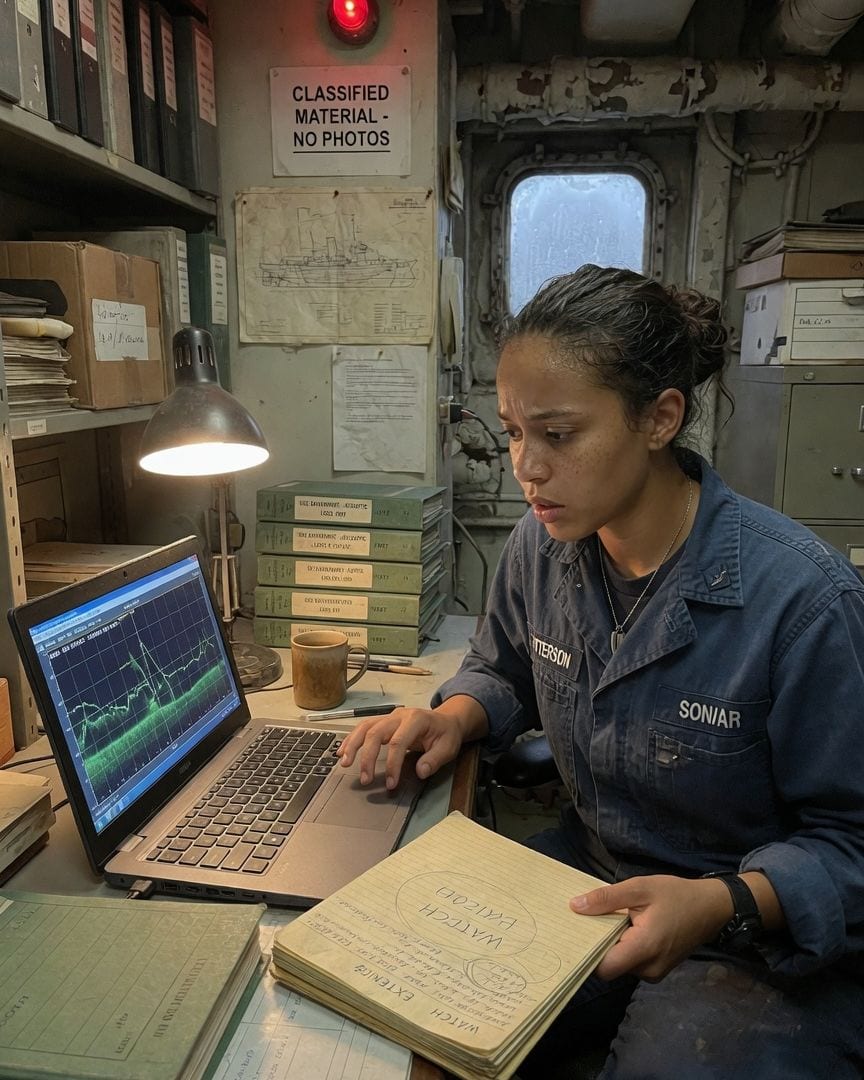
On the USS Calloway's final patrol, a sonar technician found an old log with two chilling words: 'WATCH EXTENDED.'
Sonar Technician Brooke Patterson had only two days left on the USS Calloway's last patrol, a finality that hung heavy in the humid sonar room. Through the impenetrable fog, her radar showed only empty water, but then an impossible biologic contact pinged, mimicking a vessel with eerie precision for three silent hours. It vanished at 0400, just as an identical trace had done weeks before. Searching old archives, Brooke found the precise pattern in a decades-old log from a scrapped destroyer. Scrawled next to it, in faded ink, were two words: "WATCH EXTENDED." What did those words truly mean?
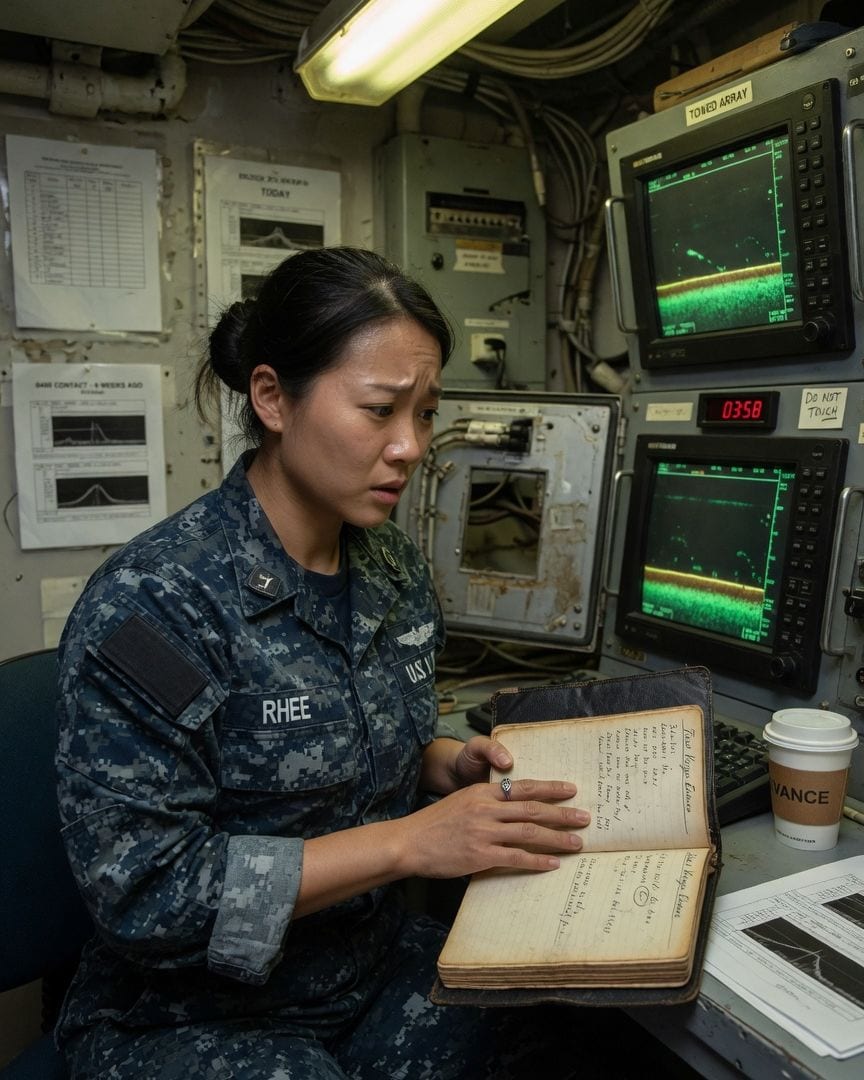
Sonar Technician Emily Rhee has two days left when she finds her name in a secret Cold War logbook, dated 1982.
Sonar Technician Emily Rhee had just two days left before her transfer from the aging USS Vance, on its final patrol through the pea-soup fog of the Aleutians. In the dim, humming sonar station, her console registered an impossible biologic contact, echoing like a hull and holding its position against the currents—a phantom trace mirroring one from six weeks prior. When her commander dismissed it as a glitch, Emily searched for answers, unearthing a secret, water-stained logbook hidden behind a panel. Its decades-old entries detailed identical '0400 contacts' and 'unusual transfers,' and chillingly, listed Emily Rhee's own name—dated 1982.
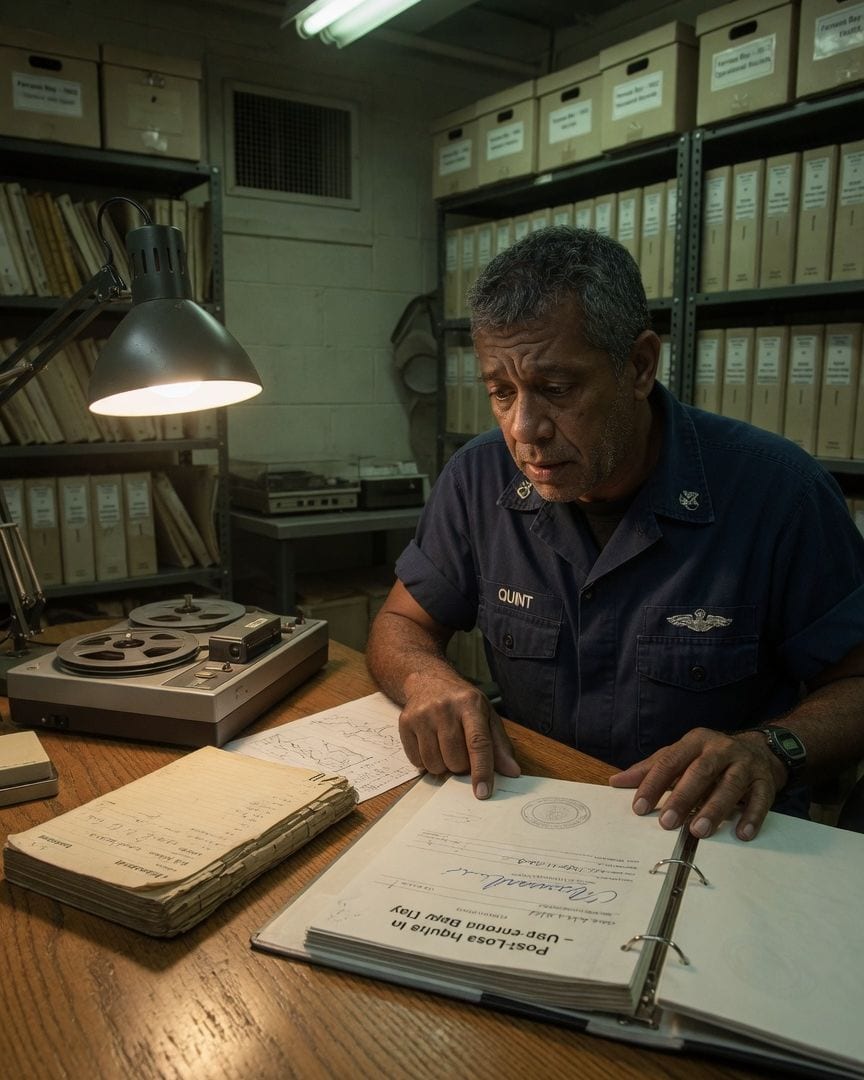
A Cold War sonarman heard his dead father’s voice on a tape, charting the ship’s wreck thirty years after it sank.
Chief Sonarman Abel Quint spent six weeks in the Naval Records vault, listening to the final transmission of the USS Ferrous Bay. His father, Desmond Quint, was on that ship when it vanished in 1962, and Abel sought some final comfort in his voice. But on this morning, a faint, second set of sonar soundings emerged from the recording—soundings in his father's precise cadence that charted the ship’s wreck site thirty years in the future. As Abel cross-referenced records, he then found a maintenance log for the Ferrous Bay's sonar system, dated six months after the ship and his father were officially lost, signed by Desmond Quint himself. What impossible truth was hidden in these official naval records?
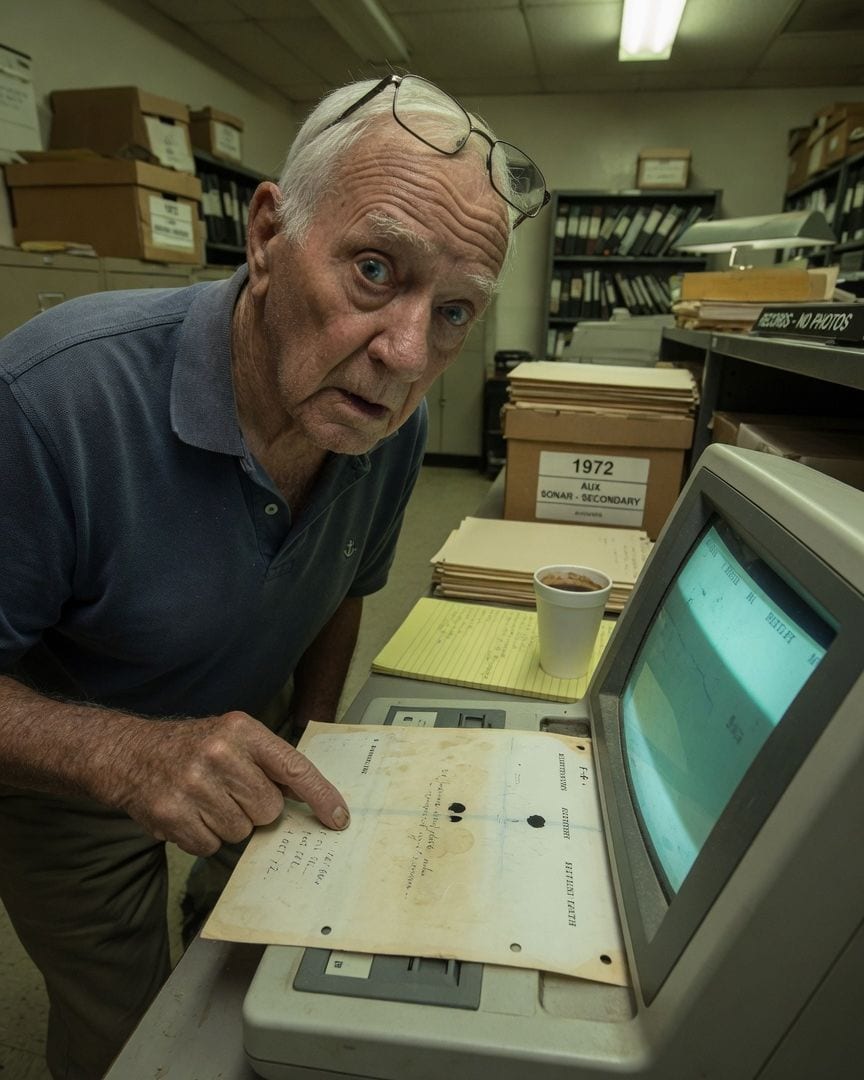
A Chief Petty Officer's salvage career ends when a Cold War fighter jet surfaces at sixty tons, perfectly intact.
Chief Petty Officer Walter Mabey, then 45, expected a routine salvage operation for a lost F-4 fighter jet off the Carolina coast in 1972. His long career was built on such lifts, but as the crane gauge climbed past twenty, then thirty, then an impossible sixty tons, a profound unease settled in. The object surfaced, not a mangled wreck, but a dark, seamless shape, perfectly intact. Mabey's salvage career abruptly ended soon after, replaced by a desk job, but the memory festered for forty years. Now 78, he dedicates his remaining time to finding the truth, uncovering a faint, rhythmic pulse on an old sonar log—a ghost beneath the official lie.
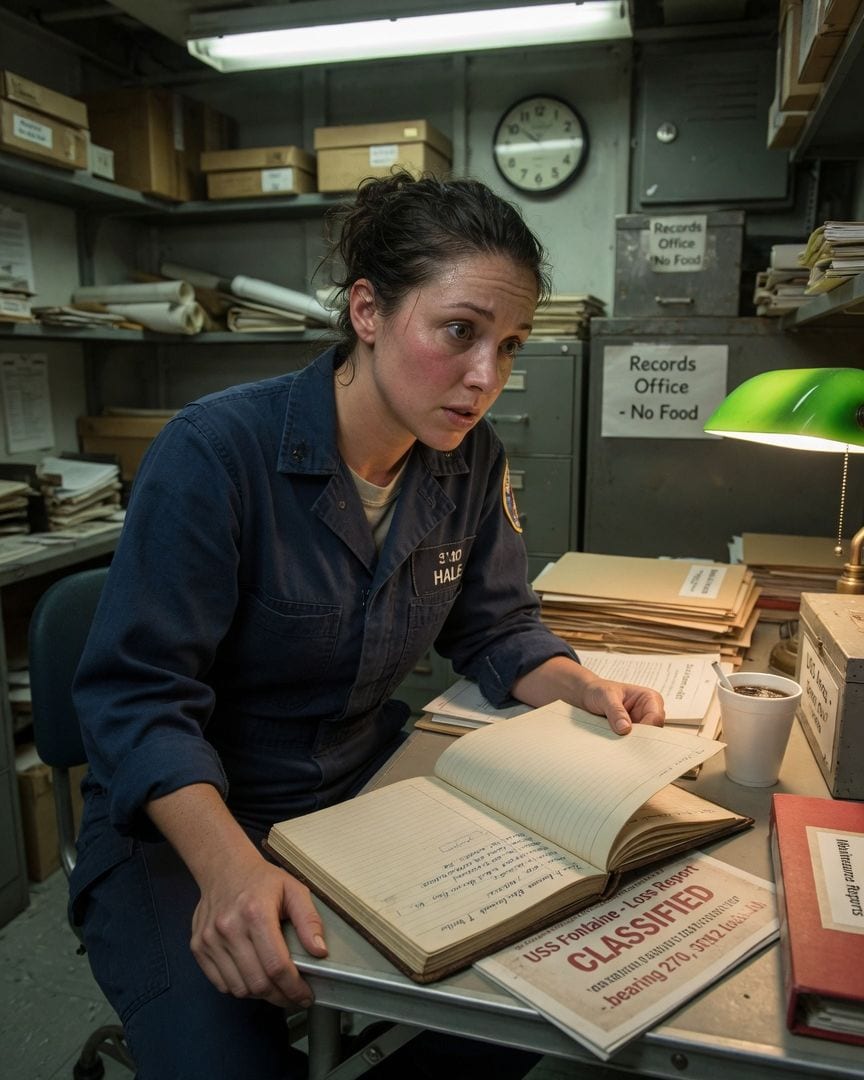
Petty Officer Hale needs a spotless record for her transfer. But the USS Ares sonar logs show an identical, impossible contact, logged to the minute, years apart, and tied to a classified loss report.
Petty Officer Sarah Hale needed a spotless record for her coveted shore duty transfer, a posting she'd worked five years to secure. Alone in the USS Ares sonar shack, three days out from San Diego, her midwatch was broken by an impossible contact: a close, slow echo holding perfect pace, invisible to radar, then vanishing. Her heart hammered, not from fear, but from the data's impossibility. When she found an identical entry in her own log from just one week prior, the cold dread tightened its grip. But the true chill settled when she unearthed decades of similar records, signed by other sonar officers, all showing the same impossible contact at 0212, off the port beam, for nineteen minutes, on the same ship, stretching back years—a persistent echo tied to a classified loss report.
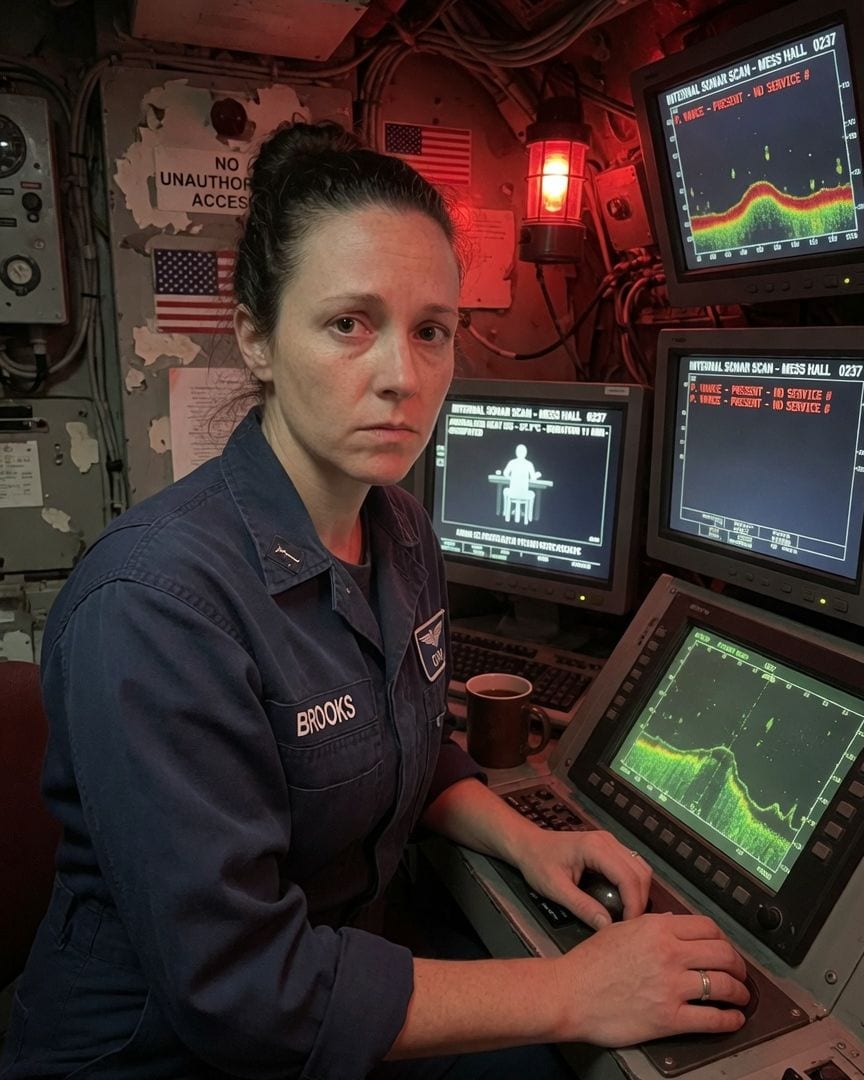
A Chief Petty Officer reviewed her submarine's sonar logs, finding a human heat signature where security cameras saw nothing, then the manifest listed an extra man who couldn't be deleted.
Chief Petty Officer Charlotte Brooks felt the weight of her submarine's impending decommissioning, its long service ending soon after a decade as her home. The quiet hum of the USS *Artemis* was broken when a nervous messcook reported seeing a shadow eating alone in the mess hall, then finding one plate short but a perfectly clean tray. Though skeptical, Charlotte checked the security feeds, which showed nothing, yet her sonar logs revealed a distinct human heat signature in the same spot, then abruptly vanish. Her dread deepened when the boat's manifest confirmed 101 souls instead of 100, listing a mysterious 'P. Vance' with no details, whose entry all systems refused to delete.