On the USS Calloway's final patrol, a sonar technician found an old log with two chilling words: 'WATCH EXTENDED.'
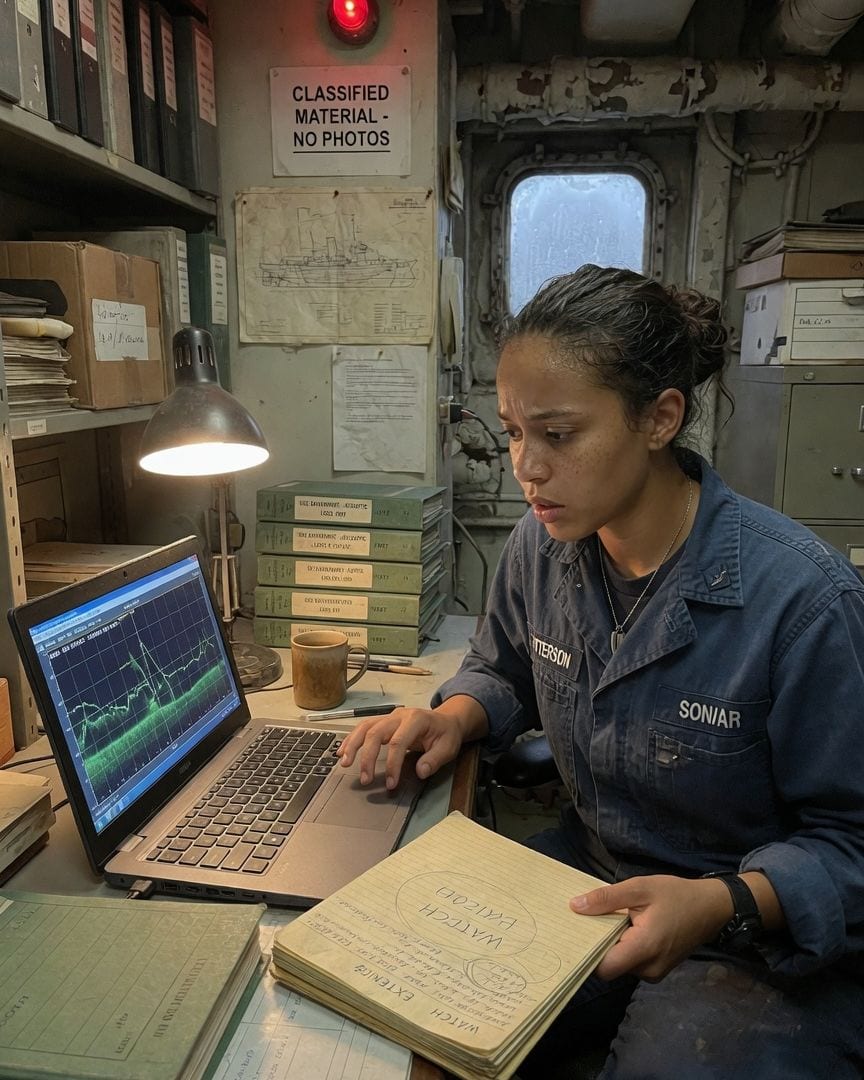
Sonar Technician Brooke Patterson, 24, had two days left on the USS Calloway’s final patrol off the Aleutian Islands.
The frigate, old and scarred by a quarter-century of sea duty, was headed for decommissioning, a fact that imbued every watch with a quiet finality. Below decks, in the humid hush of the sonar room, Brooke monitored the towed array.
The fog outside was a thick, impenetrable blanket, radar showing only empty water, a featureless gray expanse.
Then, the impossible. A close biologic contact pinged like a hull, holding forty meters to starboard. Brooke’s fingers flew across the console, trying to confirm, to classify. The trace was too solid, too geometrically precise for any known deep-sea creature.
No whale, no colossal squid, could hold that position through a full turn, mimicking a vessel with such eerie fidelity. Radar remained clean, stubbornly showing only empty sea, despite multiple sweeps. The lookouts reported nothing but the swirling, oppressive gray.
The contact held for three silent hours, a phantom presence, its impossible signature unwavering, before fading at precisely 0400, as if on a timed schedule. Brooke, rational and disciplined, felt a prickle of unease.
She pulled the acoustic log from the same transit six weeks outbound. The identical trace sat there, at the identical minute, just as sharp, just as impossible.
Brooke presented her findings to Lieutenant Commander Scott Sterling, 38, the Calloway’s Executive Officer, the next morning.
Sterling, a man who trusted data above all else, initially dismissed it as a deep-water phenomenon, a thermocline ghost, or a fleeting equipment malfunction. “Probably just a particularly dense school of krill, Rhee,” he’d said, using her rate.
“The array can get finicky in these waters, especially with the fog.” But Brooke knew krill didn’t hold station like a destroyer for three hours, nor did they disappear on cue. Her unease gnawed at her, a persistent, cold irritation.
It wasn’t a glitch; it was a pattern.
She spent her off-duty hours in the archive room, a dusty space filled with old paper logs and digital backups, searching for anything similar. The air hung heavy with the smell of aging paper and stale ventilation.
She wasn’t just looking at the Calloway’s records anymore. She cross-referenced the coordinates and dates with decommissioned vessels that had patrolled the same sector decades ago, sifting through hundreds of dry entries.
Hours blurred into a deep night watch of her own, the ship groaning around her, each metallic sigh of the hull a lonely punctuation in the silence.
Finally, she found it: an acoustic log from the USS Davenport, a destroyer scrapped years before Brooke was born.
And there it was, laid out in the precise grid of sonar data, an impossible, precise match to her own contact, appearing and fading at 0400. The hairs on her arms stood on end.
Brooke zoomed in on the Davenport’s log, her breath catching. Next to the impossible 0400 contact, scrawled in faded, almost erased ink, was an annotation.
It wasn’t a technical note, nor a classification, nothing to do with equipment or marine life. It was two words, stark and chilling against the precise grid of the sonar data: “WATCH EXTENDED.”
The phrase twisted her gut, a cold, clenching sensation. It wasn’t a standard Navy term, not for an equipment anomaly, not for a biologic.
It spoke of something else, something beyond the cold logic of the deep-sea, and its implication, though utterly vague, was terrifying.
Her fingers trembled over the old data, a cold sweat breaking out on her brow, the words themselves seeming to hum with an unspoken menace.
The 'WATCH EXTENDED' annotation became Brooke’s obsession. It was a thread, thin but taut, leading into a secret history that stretched back further than she could have imagined.
She spent every spare moment delving deeper into the Navy’s vast, sprawling archives, filtering by patrol sector, decommissioning dates, and any mention of unusual acoustic events.
The dry digital records and brittle paper logs blurred into a single, overwhelming stream of data. The term wasn't official, but it wasn't unique either.
She found it again, on the logs of the USS Sterling, a submarine lost with all hands in the Bering Sea decades ago, and on the USS Bennett, a research vessel that vanished without a trace off Kodiak just fifteen years prior.
Each time, the 'WATCH EXTENDED' note was scrawled next to an identical 0400 sonar anomaly, a phantom hull that defied detection by radar or visual, a silent, impossible ghost of the deep.
The pattern was undeniable, a chilling echo across decades and different classes of ships. This wasn't a glitch; it was a recurring event, deliberately, if cryptically, documented.
Brooke started cross-referencing the names of the officers who had signed off on these logs, looking for any common denominators in their service. The unease in her grew specific, tangible. Someone knew.
Someone had been watching this pattern for a very long time, writing these words in the margins of history.
Brooke's late-night shifts and unusual archive requests did not go unnoticed. Captain Preston Easton, 58, a man known for his quiet command and deep knowledge of the Aleutian sector, began to appear in the sonar room more frequently.
His visits were always casual, a quiet word about the relentless fog outside, a seemingly idle question about the array's performance. But his gaze lingered on Brooke, a calm, assessing look that felt less like supervision and more like observation.
He would ask, his voice a low, even rumble, “Anything unusual in the old data, Sonar Technician Patterson? Sometimes the deep holds its own echoes.”
His calm was unsettling, his questions too close to her secret investigation, pricking at the edges of her growing fear.
Brooke felt a new kind of dread, the chilling certainty of being watched, not just by the Captain, but by something vast and cold that seemed to emanate from the ocean itself, a presence that had found her.
One evening, returning to her bunk, she found a note tucked under her pillow, handwritten on a torn piece of paper, the words stark and unsettling against the cheap cotton: “SOME WATCHES NEVER END.”
The message was personal, a direct warning, and it confirmed her deepest fear: she wasn't just hunting for answers; she was being hunted.
Brooke, shaken by the note, knew she couldn't keep her discoveries to herself any longer. The air in her lungs felt thin, sharp with adrenaline.
She cornered Lieutenant Commander Sterling in his office, the low drone of the ship’s engines seeming to press in on the small space. She spread printouts of the 'WATCH EXTENDED' logs across his desk, the faded annotations a stark challenge.
Sterling, seeing the undeniable pattern, his face paling with each new document, admitted he'd heard whispers, old sea stories about 'unaccounted personnel' on certain decommissioning patrols.
He’d always dismissed them as morbid urban legends, the kind of tales sailors told to spook new recruits in the lonely watches. “But… this,” he gestured at the logs, his voice barely a whisper, “this is different.
The consistency…” He leaned back, rubbing his temples, his gaze fixed on the disturbing archive.
“You know,” he said, looking up at Brooke, a new, troubled light in his eyes, “Captain Easton has an unusually long service record tied to this sector.
He was a sonar tech himself, decades ago, on the USS Brooks, which patrolled these same waters. He’s been here, or around here, for most of his career.” The words snapped the earlier clues into a terrifying focus for Brooke.
Easton’s calm observation, his pointed questions, the note in her bunk, his long, unexplained history in this sector – it all coalesced. He wasn't just observing her; he was monitoring her. He knew.
He had been a part of this pattern, perhaps even its silent guardian, for longer than anyone could imagine. The cold dread deepened, shifting from an abstract puzzle to a personal threat, aimed squarely at her.
Brooke, now convinced Captain Easton was 'the one who knew,' used Sterling's hint to dig into Easton's own service record. The Navy archives, usually so meticulously detailed, were strangely sparse on his early career, heavily redacted in places.
But enough remained to piece together a chilling narrative, connecting dots Brooke hadn't even known existed.
She found a consistent pattern tied to the ships with 'WATCH EXTENDED' logs: a specific crew member, always a Sonar Technician or Watch Officer, was listed as 'transferred under classified orders' or 'missing, presumed AWOL,' always in the final days before those ships' decommissioning.
The language was almost identical across decades, a sterile, bureaucratic shroud over a deeply unsettling truth. These weren't transfers.
These were disappearances, sanctioned and documented, tied to the precise moment the phantom contact faded at 0400, a changing of the guard no one spoke of. Brooke’s blood ran cold.
The 'extended watch' wasn't a cryptic warning; it was an appointment. And the USS Calloway, on its final patrol, was two days from decommissioning.
Brooke Patterson, Sonar Technician, was the one who had seen it, documented it, and now understood it. She, the last one to chart the impossible contact, was next.
Her gaze froze on the repeated, vague transfer orders in Captain Easton’s service record, matching the missing personnel from every ship marked 'WATCH EXTENDED.'
Brooke confronted Captain Easton in his quarters, the ship’s low hum a counterpoint to the frantic thudding of her heart. The small room felt airless, heavy.
She laid out her evidence on his polished desk: the recurring contact, the 'WATCH EXTENDED' annotations from a dozen different vessels, the chilling pattern of 'transferred' sonar technicians from decommissioned ships.
Easton listened, his expression unreadable, his gaze calm, fixed on a point beyond her shoulder. He didn't deny a word.
He looked at her, then out the porthole at the vast, grey expanse of the Aleutian sea, a canvas of endless indifference.
“The deep holds ancient things, Sonar Technician Patterson,” he said, his voice quiet, devoid of malice, as if stating an undeniable scientific fact. “Some require a sentinel, a consciousness to maintain their presence, their observation, in our world.”
He explained that the 'hull-sized biologic' was a manifestation of this entity, an ancient consciousness that claimed a 'watch' on certain vessels.
When a ship that had hosted its watch was decommissioned, a new sentinel had to be chosen, the one most attuned to its presence – almost always the Sonar Technician.
Easton revealed that he himself had been almost claimed decades ago, a young sonar tech on the USS Brooks. But his predecessor, a man named Calloway, for whom this very frigate was named, had intervened.
Calloway had sacrificed himself so Easton could become the 'chronicler' instead, tasked with identifying the next 'volunteer' when the time came, meticulously documenting the transfers.
He looked at Brooke with a chilling calm, his eyes holding a profound, terrible understanding, a knowledge too vast for any human.
Easton explained that the 0400 contact was the 'changing of the watch,' the precise moment the entity reached out to claim its new observer. “It’s not a choice, Sonar Technician. Not for those who truly see it.”
He described it as a merging, a profound, cold awareness of the ocean’s vastness, a duty that transcended human life and consciousness, a silent communion with something utterly alien.
Brooke tried to resist, to argue, to find a flaw in his horrifying, calm logic, but her mind felt like sand. “This is madness!”
she whispered, the words catching in her throat, her voice weak against the weight of his composure. Easton merely shook his head, a gesture of weary acceptance. “Your deep sensitivity, your persistence in uncovering this pattern… it marked you, Patterson.
Just as it marked Calloway, and all the others who came to understand.”
As 0400 approached, the ship’s systems began to hum strangely, a low, resonant thrum that seemed to vibrate in Brooke’s bones, not from the engines, but from somewhere deeper, colder. The air grew cold, heavy, thick with an unseen presence.
She felt a profound, internal pull, a sense of vast, inky space opening behind her eyes, the endless, silent weight of the deep pressing in. Easton watched her, his expression a mixture of grim resignation and a strange, quiet reverence.
The cold, ancient awareness seeped into her, an understanding not of words, but of currents and pressure, of time measured in geological epochs, of the vast, indifferent dark.
The USS Calloway successfully docked for decommissioning two days later, its final patrol concluded. Captain Preston Easton oversaw the meticulous transfer of logs and personnel with his usual quiet efficiency.
Sonar Technician Brooke Patterson was listed as 'transferred to a classified deep-sea research detachment,' a posting no one in her unit recognized, a phantom assignment to a place that didn’t officially exist.
Her bunk was cleared by a junior sailor, her few personal effects packed into a regulation footlocker, already slated for shipment to her family.
Lieutenant Commander Sterling watched Easton from across the hangar deck, a mixture of fear and a chilling, dawning understanding in his eyes. He saw the cold calm, the lack of regret.
Easton merely nodded, his gaze distant, already focused on the next horizon, or perhaps, the depths below it.
Weeks later, Captain Preston Easton, now retired, sat on a quiet bench overlooking the Pacific, watching the endless, grey expanse of the waves.
A young woman walked by, her gait familiar, her eyes distant, reflecting the vast, indifferent grey of the sea.
She carried a small, worn acoustic log in her hand, its cover smooth from years of handling, a silent testament to countless unseen hours.
She glanced at Easton, a faint, almost imperceptible smile touching her lips, a smile that held the cold, endless patience of the deep.
If this one got to you
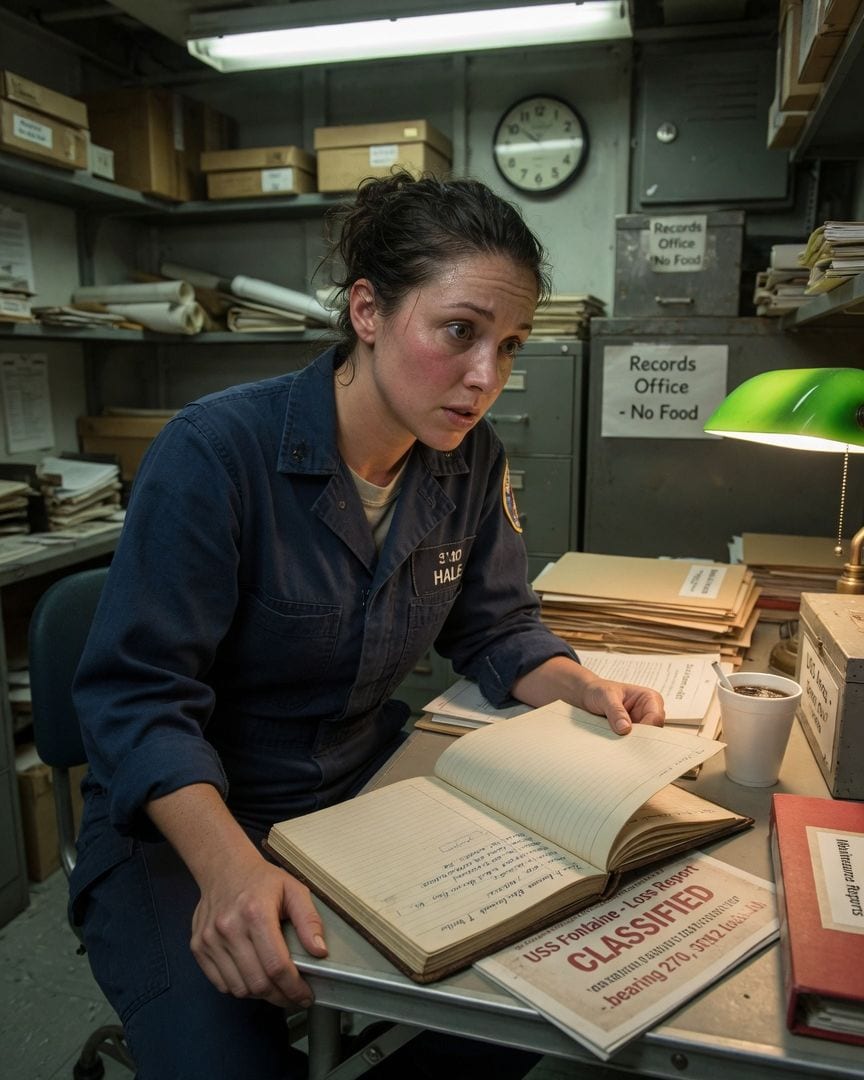
Petty Officer Hale needs a spotless record for her transfer. But the USS Ares sonar logs show an identical, impossible contact, logged to the minute, years apart, and tied to a classified loss report.
Petty Officer Sarah Hale needed a spotless record for her coveted shore duty transfer, a posting she'd worked five years to secure. Alone in the USS Ares sonar shack, three days out from San Diego, her midwatch was broken by an impossible contact: a close, slow echo holding perfect pace, invisible to radar, then vanishing. Her heart hammered, not from fear, but from the data's impossibility. When she found an identical entry in her own log from just one week prior, the cold dread tightened its grip. But the true chill settled when she unearthed decades of similar records, signed by other sonar officers, all showing the same impossible contact at 0212, off the port beam, for nineteen minutes, on the same ship, stretching back years—a persistent echo tied to a classified loss report.
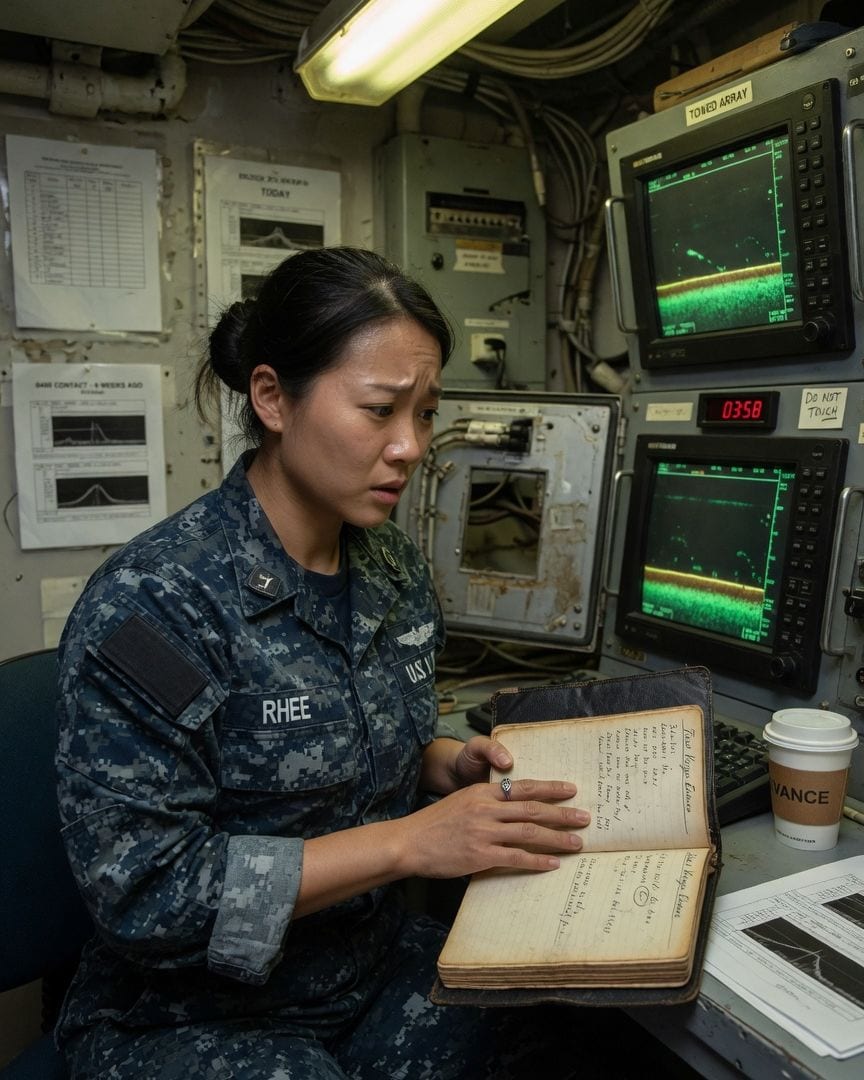
Sonar Technician Emily Rhee has two days left when she finds her name in a secret Cold War logbook, dated 1982.
Sonar Technician Emily Rhee had just two days left before her transfer from the aging USS Vance, on its final patrol through the pea-soup fog of the Aleutians. In the dim, humming sonar station, her console registered an impossible biologic contact, echoing like a hull and holding its position against the currents—a phantom trace mirroring one from six weeks prior. When her commander dismissed it as a glitch, Emily searched for answers, unearthing a secret, water-stained logbook hidden behind a panel. Its decades-old entries detailed identical '0400 contacts' and 'unusual transfers,' and chillingly, listed Emily Rhee's own name—dated 1982.
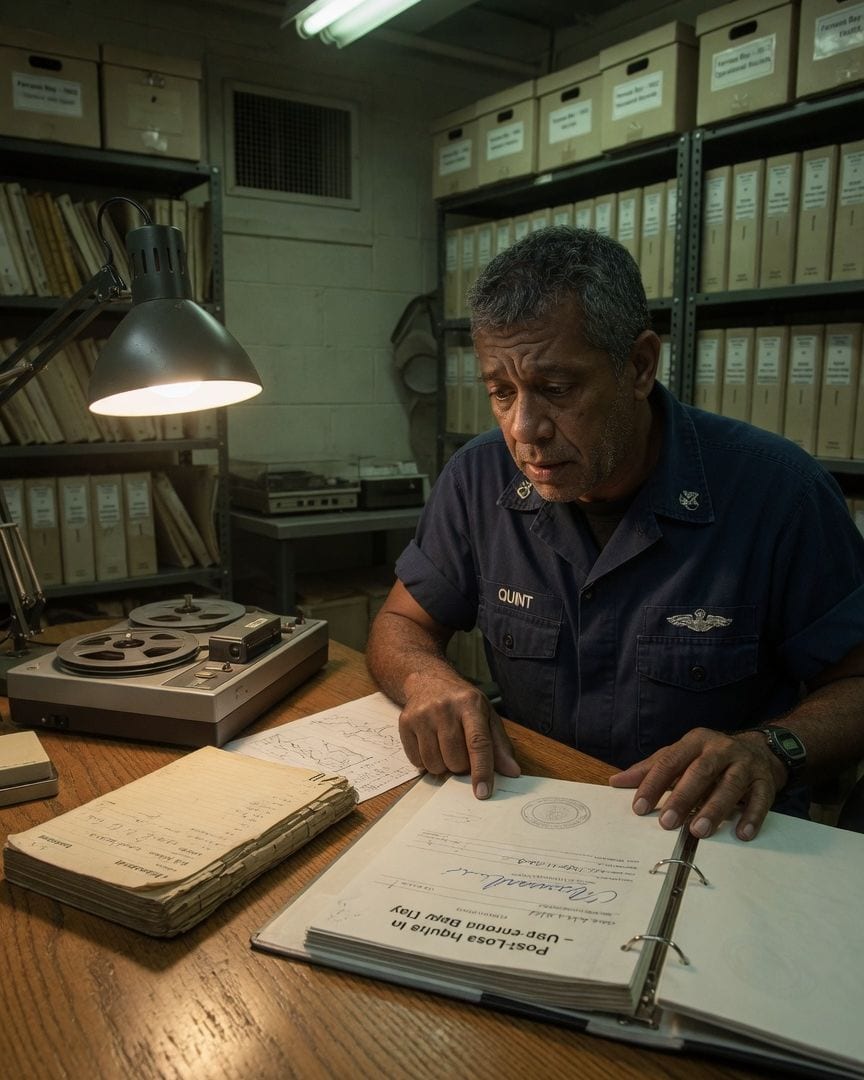
A Cold War sonarman heard his dead father’s voice on a tape, charting the ship’s wreck thirty years after it sank.
Chief Sonarman Abel Quint spent six weeks in the Naval Records vault, listening to the final transmission of the USS Ferrous Bay. His father, Desmond Quint, was on that ship when it vanished in 1962, and Abel sought some final comfort in his voice. But on this morning, a faint, second set of sonar soundings emerged from the recording—soundings in his father's precise cadence that charted the ship’s wreck site thirty years in the future. As Abel cross-referenced records, he then found a maintenance log for the Ferrous Bay's sonar system, dated six months after the ship and his father were officially lost, signed by Desmond Quint himself. What impossible truth was hidden in these official naval records?
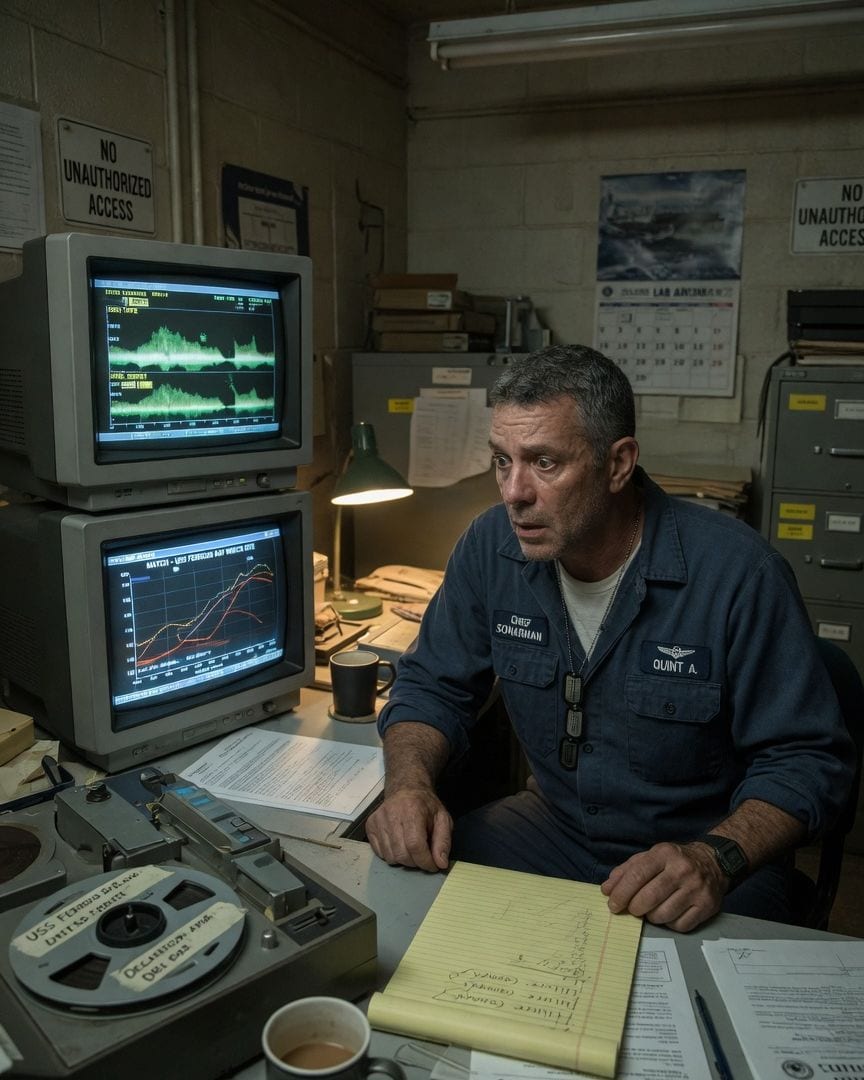
Chief Sonarman Abel Quint heard his father's 1962 transmission. But beneath it, the Cold War submarine tender's wreck site, found decades later, was already pinging its exact coordinates.
Chief Sonarman Abel Quint, 46, had spent six weeks in a dimly lit declassification lab, meticulously replaying the last transmission of the USS Ferrous Bay. The submarine tender, lost off Kodiak in 1962, carried his father, Julian Hartley, whose calm voice Abel knew by heart. But one evening, a faint, rhythmic series of pings emerged from beneath his father’s words – a distinct cadence that, when isolated, revealed coordinates hundreds of miles from the reported loss site. Abel's dread grew as the impossible truth surfaced: the 1962 recording contained the precise location and unique acoustic signature of the wreck, discovered thirty years later. The tape wasn't just predicting; it was observing the ship's own future death rattle.
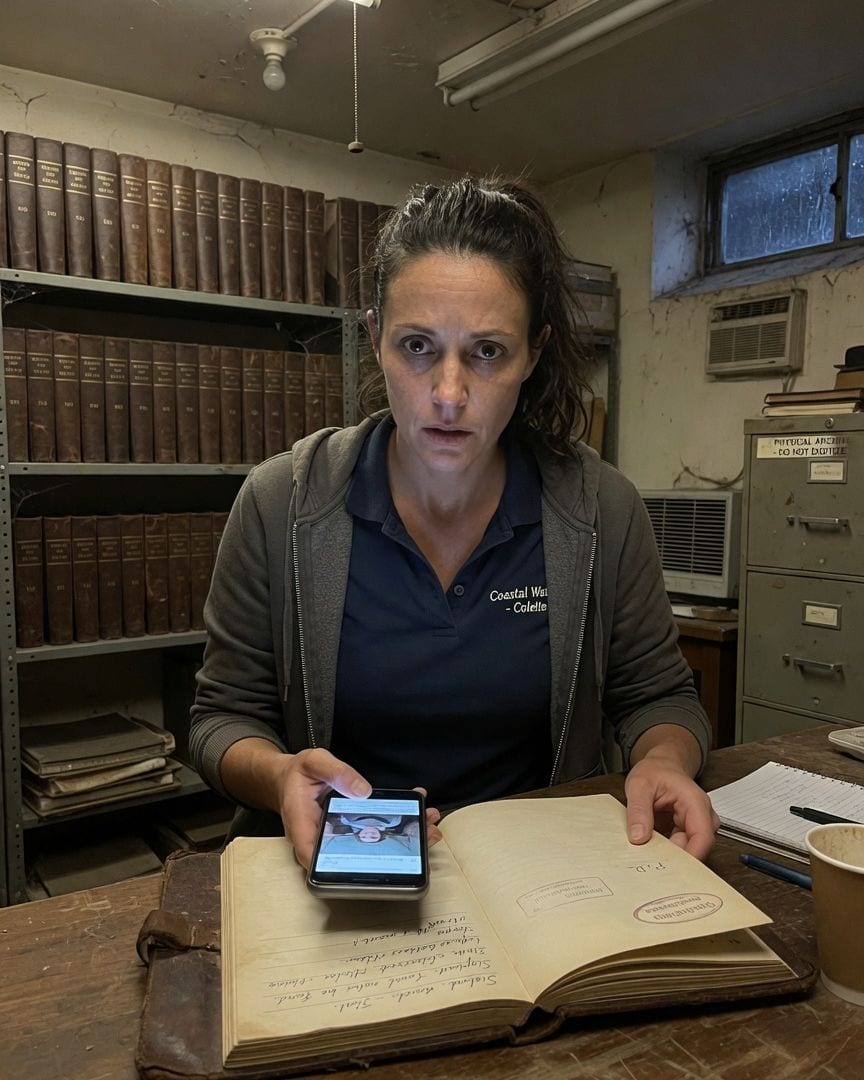
My coastguard log noted Sighting 9 again tonight, a light where no vessel showed. The old logs carry Sighting 9 off Skerry Point at 3:14am every tenth year since 1954, always 'nothing found,' always 'send no boat.'
On my watchtower night shift, the radar screen glowed green and the ocean was quiet. Then, a familiar light appeared off Skerry Point, exactly on cue, just as it had every tenth year for decades. But digging deeper, I found a hidden stamp in an old logbook: 'Operation Skerry. Status: Complete.' It left me with a chilling sense of finality.
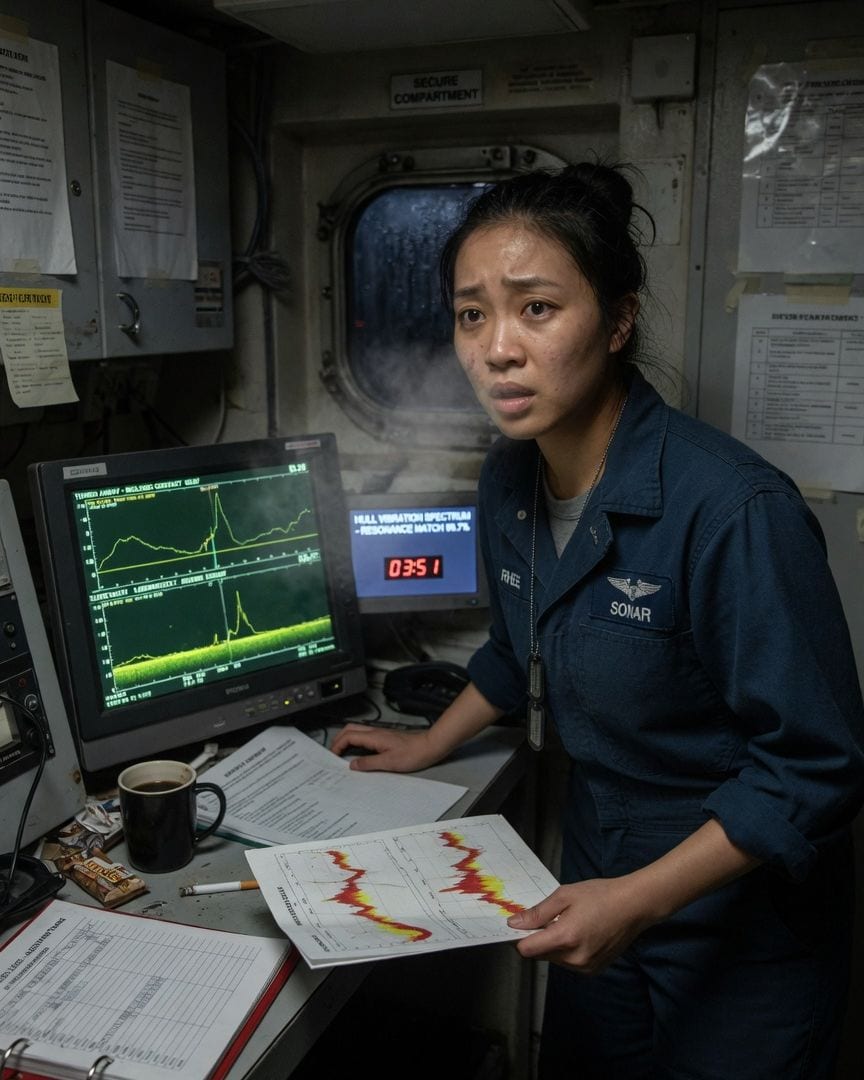
Sonar Technician Isabella Rhee's screen shows a massive hull tracking her ship. Her own hull then vibrates in perfect sync, from outside.
Sonar Technician Isabella Rhee was two days from her final patrol aboard the USS Vance, navigating frigid, fog-choked Aleutian waters. Her sonar screen registered an impossible contact: a solid hull holding forty meters, perfectly matching her ship's tactical turns while radar reported only empty black water. Desperate for answers, Isabella discovered the Vance's internal hull monitors also registered a subtle, high-frequency vibration spike – a resonant thrum mimicking a ship's propulsion, yet coming from outside. A faint, massive dark shape, like a thermal ghost, then briefly appeared on her screen, pressing against the hull where the vibrations originated. What unseen force was tracking the USS Vance?