A Staff Sergeant at Outpost Jericho saw ten men re-enlist. The official orders showed nine. Then the system swore there were ten.
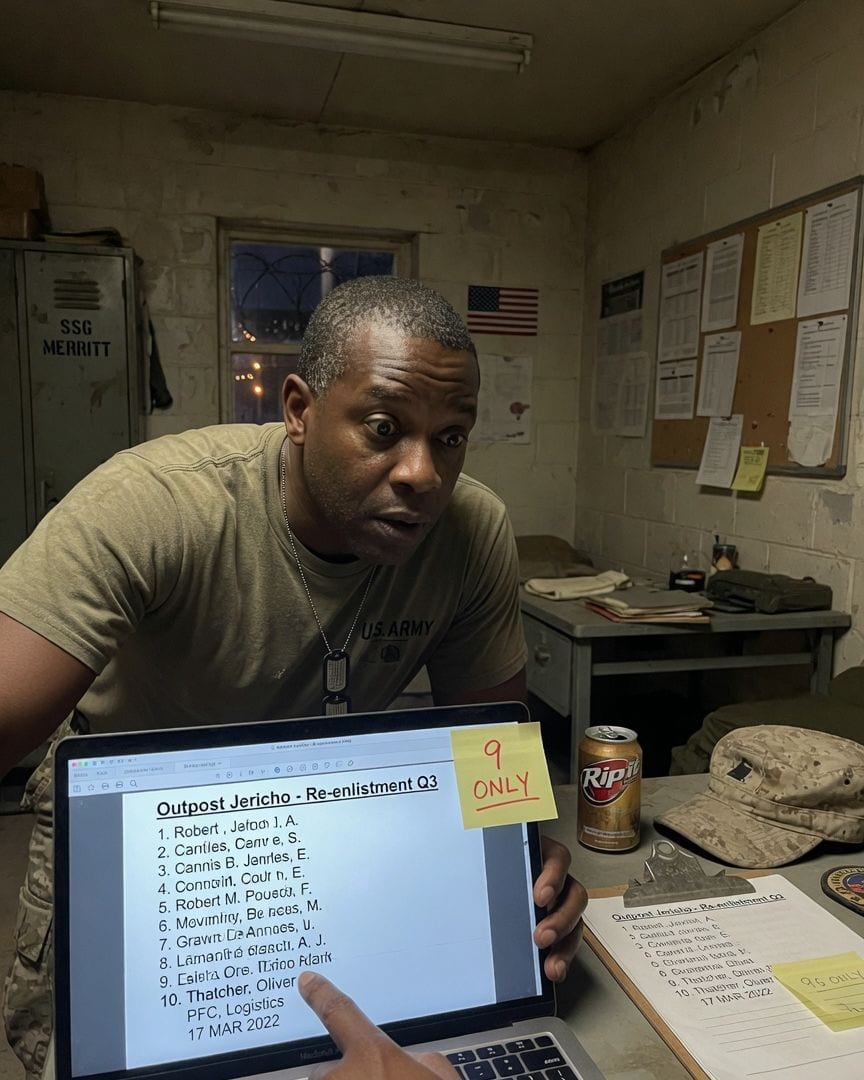
Staff Sergeant Robert Merritt stood at attention on the dusty parade field of Outpost Jericho, the desert sun already a hammer on his helmet.
He was here for the quarter’s re-enlistment ceremony, a routine he’d witnessed countless times, a small formality before his own tour ended in a few weeks.
Personnel Sergeant Bernard Okoro, a man whose crisp uniform and even crisper voice were legendary for their adherence to protocol, cleared his throat, holding the official re-enlistment order.
“Attention on deck!” he barked, and the small formation of soldiers snapped rigid. Okoro began reading the names, one by one, nine in total, each soldier stepping forward to raise their right hand.
Robert counted them, a habit drilled into him since basic training: one, two, three… nine. But then, a tenth man stepped forward, his hand already rising with the others.
Okoro paused, his brow furrowing slightly. He looked down at the paper, then back at the formation. Robert felt a flicker of unease. Okoro read the nine printed names again, slower this time, his voice a low rumble.
And again, the tenth man answered to a name that was not on the page, his right hand held high, unflinching, as if he belonged there, always had.
After the ceremony, Robert approached Okoro, trying to keep his voice casual. “Sergeant, quick question. The re-up count. I made it ten, but the order only had nine.”
Okoro, already filing his clipboard, didn't look up. “Nine, Staff Sergeant. Standard complement.”
Robert persisted, “With respect, Sergeant, I distinctly saw ten men raise their hands. There was a Private… Thatcher, I think? He answered the roll call.”
Okoro finally looked up, his expression unreadable. “No Private Thatcher on this order, Staff Sergeant. Not today.” He held out the paper, crisp and official. Robert took it, his gaze sweeping the nine names. No Thatcher.
“Maybe a last-minute addition not on the printout?” Robert offered, trying to find a mundane explanation.
Okoro scoffed. “Not possible. Not for re-enlistment. Every name is vetted, cleared, and printed days in advance.”
Later that evening, Robert pulled up the digital personnel manifest. He filtered for re-enlistments this quarter. Nine names. He double-checked the ceremony date. Correct. He scrolled through the entire unit roster, just to be sure. No Private Oliver Thatcher.
He felt a cold knot tighten in his gut. His eyes had seen ten men. Okoro’s paper had nine. The digital system had nine. His rational mind fought against what his own senses insisted was true.
He opened the outpost's duty logbook, scanning for any recent transfers, any new arrivals. Nothing. The system, the very bedrock of military accountability, swore he was wrong. But he knew what he saw.
Robert couldn't shake the feeling. He decided to check the digital manifest again, pulling up the master file for the entire outpost. He filtered for 'Thatcher, Oliver.' This time, there was a hit.
A Private First Class, Oliver Thatcher, assigned to logistics, same as him, with an enlistment date two years prior. He hadn't been on the re-enlistment list because he was already an active-duty soldier.
Robert felt a wave of relief, then confusion. If Thatcher was already assigned, why was he at the re-enlistment ceremony? And why did Okoro say he wasn't on the order? He walked over to Okoro’s office, finding it empty.
On the desk, a freshly printed manifest. Robert picked it up. His eyes scanned the names, then snapped to the bottom. There, below the nine he saw step forward, was a tenth: 'Thatcher, Oliver.'
His heart hammered, not just at the presence of the name, but at the enlistment date beside it, showing Thatcher had been active for two years already.
He stared at the page, the impossible fact burning into his mind: the system now swore the tenth man was always there.
The next morning, Robert confronted Okoro with the new printout. “Sergeant, this manifest shows Private Thatcher. He was present at the ceremony.”
Okoro took the paper, his meticulous gaze sweeping over it. “Ah, yes. A clerical error, Staff Sergeant. Corrected overnight. Private Thatcher was indeed part of the ceremony.”
His tone was flat, unconcerned, as if Robert had questioned the color of the sky. Robert felt a chill. There had been no 'clerical error.' Okoro had explicitly denied Thatcher's presence hours before.
Robert watched Thatcher more closely over the next few days. Oliver Thatcher was quiet, efficient, unremarkable. Too unremarkable. He seemed to fit in perfectly, performing his duties without a hitch.
Robert tried to engage him in casual conversation, asking about his previous postings. Thatcher’s answers were vague, generic, like someone reciting from a brochure. “Just… various assignments, Staff Sergeant. Logistics mostly.”
Robert noticed a faint, almost invisible scar just under Thatcher’s left earlobe, a tiny, precise line. He also observed Thatcher's habit of always holding his mess kit fork with his index finger extended, almost pointing.
Small things, but Robert was a man who noticed details. He started comparing Thatcher's digital file to others. Everything was pristine, perfectly in order, too perfect. He checked the access logs for the personnel system.
Sergeant Okoro had logged in late the previous night, making a series of modifications to the re-enlistment manifest and Thatcher’s service record. The system showed the changes, but no record of what the previous entries had been.
The 'Record That Swears Otherwise' was actively being rewritten. Robert felt a mounting dread. This wasn't a clerical error. This was an active, deliberate falsification.
Robert started spending his off-hours in the outpost’s small, unmonitored archive room, a dusty storage space with old physical records. He found the original, handwritten duty logbooks from previous quarters. He cross-referenced Thatcher’s supposed enlistment date with older unit assignments.
No mention of Thatcher. It was as if he materialized out of thin air two years ago, and then retroactively inserted into the records.
One evening, as Robert was reviewing a particularly old manifest, the heavy steel door to the archive room creaked open. He froze. Captain Constance Vance, the outpost’s commanding officer, stood framed in the doorway, her expression unreadable.
“Staff Sergeant Merritt. Working late?” Her voice was calm, but her eyes held an unnerving intensity.
“Just catching up on some old supply manifests, Captain. Trying to track down some discrepancies.” Robert lied smoothly, his hand covering the fragile logbook.
Captain Vance stepped further in, her gaze sweeping over the shelves of old files. “Outpost Jericho is being decommissioned soon, Staff Sergeant. Focus on current operations. We don’t need any… distractions.”
Her eyes lingered on the logbook under his hand for a moment too long. “Everything needs to be squared away for handover. And I mean everything.” She gave him a faint, unsettling smile that didn't reach her eyes.
“Understood, Captain.” Robert felt a prickle on the back of his neck. She knew. Or at least, she suspected. The air in the small room grew heavy, thick with unspoken warning.
As she turned to leave, she added, “And Staff Sergeant, be careful with those old papers. They can be… fragile. Things get lost. Or broken.”
The door clicked shut, leaving Robert alone in the echoing silence, the unspoken threat hanging in the air.
Captain Vance’s warning spurred Robert to accelerate his investigation, but also to be more cautious. He decided to approach Okoro again, this time with a more direct question. He found the Personnel Sergeant in his office, diligently updating digital files.
“Sergeant Okoro,” Robert began, “I've been looking into Private Thatcher’s file. It’s… remarkably clean. No prior unit transfers, no disciplinary actions, no commendations. Almost like he appeared fully formed.”
Okoro didn’t look up. “Some soldiers are just exemplary, Staff Sergeant. A credit to the Corps.”
Robert pushed. “But I remember a patrol six months ago. Me, PFC Ramirez, and Private Evans. The logbook shows Thatcher was with me.”
Okoro finally stopped typing, his fingers hovering over the keyboard. He took a slow breath. “Staff Sergeant, the records are the records. You signed the log. It’s all there.”
Robert felt a surge of frustration. “But I know Ramirez was there. I spoke to him about his daughter’s birthday.”
Okoro’s voice dropped, barely a whisper. “The system is… precise, Staff Sergeant. It corrects itself. For the good of the unit. For accountability.”
He finally looked at Robert, and for the first time, Robert saw a flicker of something in his eyes – not fear, but a deep, resigned weariness. “Some things are beyond our understanding, beyond our control. We just… adapt.”
Robert felt the blood drain from his face. “Adapt? You mean accept a lie?”
Okoro shook his head slowly. “No. Accept the truth as it is presented. The paperwork, the manifests, they are the truth. They cannot be wrong.” He gestured vaguely at the glowing screen.
“What you remember, what you think you saw… that’s fallible. The system is not.” The implication hit Robert with the force of a physical blow.
Okoro wasn’t just covering up a clerical error; he was an unwilling participant, or perhaps, a resigned witness to a deeper, horrifying mechanism.
The 'tenth man' wasn't just an anomaly; he was a symptom of a system that actively rewrote reality, making its own impossible truths the only ones that mattered.
Robert knew he couldn't trust the digital records anymore, not completely. He needed something immutable. He returned to the archive room, determined to find the original, physical duty logbook from six months prior.
He spent hours, flashlight in hand, sifting through dusty binders, the faint smell of old paper filling the air. Finally, he found it: the thick, canvas-bound ledger for the previous quarter.
He flipped through the brittle pages, his heart thudding in his chest, until he found the entry for the night of that specific perimeter patrol.
His own distinctive signature was there, at the bottom of the shift report, in blue ink. His eyes scanned the names of the patrol members. There, clear as day, written in Sergeant Okoro's neat hand: 'PFC Oliver Thatcher.' Not Ramirez.
Robert stared, his mind reeling. He remembered Ramirez’s laugh, the details of their conversation. But the physical, signed record, the very 'Record That Swears Otherwise,' now swore Thatcher was there.
He felt a cold dread spread through him, but then his gaze fell to a small, almost invisible 'audit trail' icon on the screen's periphery. Clicking it, a tiny pop-up window appeared, showing a modification log.
Not for Thatcher's entry, but for his own service file, a subtle date change on a deployment from five years ago.
He saw his own name, Robert Merritt, listed as the 'affected party' in a record alteration he never authorized, never knew existed. The screen flickered, and the window vanished.
The flickering screen and the vanishing window confirmed Robert’s worst fears. His own record was compromised. He was no longer just an observer; he was implicated.
He rushed to the secure server room, bypassing the usual login protocols using an old, rarely-used maintenance override code he remembered from a previous posting. He needed to find the original raw data, before any 'corrections.'
He found a deep-level system log, a hidden directory that recorded all modifications, even those designed to be erased. He typed in his own service ID. The data streamed across the screen, a horrifying timeline.
Years ago, a deployment to Afghanistan. The dates were slightly off from his memory, but he’d dismissed it as a minor detail on his official records.
Now, a modification log showed his original deployment dates, and then, a day later, a 'correction' that subtly shifted them, placing him in a different sector for a critical 48-hour period he knew he hadn't been in.
And beneath that, a series of other, smaller alterations, to commendations, to training records. He then searched for Ramirez. PFC Ramirez's file was gone. Completely scrubbed. Replaced with a transfer order for a ghost unit.
The 'tenth man' was a pattern. Not just Thatcher, but others, quietly inserted, their records pristine, their pasts rewritten, while the originals vanished without a trace, their data expunged.
The 'faint scar' and 'fork habit' he noticed on Thatcher – he now remembered similar, distinct, but subtle tells on other soldiers who had seemed to 'transfer out' over the years, only to have new, slightly different replacements appear in their place.
The anomaly wasn't an error; it was a meticulous, ongoing process of replacement, and the records were the means of its legitimization.
Robert knew he had to act. He downloaded the raw, unadulterated modification logs onto a secured flash drive. As he unplugged it, the server room door hissed open.
Captain Vance stood there, flanked by Private Thatcher and two other soldiers Robert recognized as unnervingly silent. Vance’s face was devoid of emotion. “Staff Sergeant Merritt. I regret to inform you, your tour is concluded. Effective immediately.”
Robert gripped the flash drive in his pocket. “Captain, I have evidence of systemic identity fraud, of personnel being replaced.”
Vance’s eyes narrowed. “You have evidence of a soldier suffering from extreme stress and paranoia. Your service record, Staff Sergeant, indicates a history of… instability during deployments. A minor adjustment to a deployment date, easily explained by a clerical review.”
She moved closer, Thatcher stepping in front of her. “You’ve been observing Private Thatcher. Asking questions. It’s unprofessional.” Robert saw the faint scar under Thatcher’s ear, the precise way he held his rifle. He wasn't Thatcher.
He was a perfect imitation.
“You’re not going to get away with this,” Robert said, his voice firm despite the tremor in his hands. “I have the truth.”
Vance smiled, a cold, predatory baring of teeth. “The truth, Staff Sergeant, is what the records say it is. And your records, as of this morning, show you were honorably discharged yesterday, due to… psychological distress.
Your flight home leaves in two hours. Your wife, Audrey, is expecting you.” She gestured to the silent soldiers. “They’ll escort you to the transport. For your own safety, of course.” Robert knew he couldn't fight them.
He made eye contact with Vance, a silent challenge. He felt the weight of the flash drive in his pocket, a tiny spark of hope against the overwhelming darkness.
He had to get out, not just for himself, but for Audrey, for his daughter. He had to expose this. He had to survive.
As the silent soldiers moved to flank him, Robert made a sudden, desperate dash, not for the door, but for a maintenance hatch he’d spotted earlier, leading to an unused ventilation shaft. A hail of shouts erupted behind him.
He squeezed through, the metal grating scraping against his uniform, and began to crawl, the sounds of pursuit echoing through the tight, dark shaft. He was running, not from a threat, but from an erasure.
Robert emerged from the ventilation shaft into the desolate desert night, miles from the outpost. He ran, driven by adrenaline and the chilling knowledge he carried.
He eventually found a deserted stretch of road and flagged down a passing civilian supply truck. He made it to a town, contacted an old contact in military intelligence, a retired Colonel he trusted, and delivered the flash drive.
The Colonel, a grizzled veteran named Merritt, listened to his frantic account, eyes widening with each detail. Within days, a quiet investigation was launched. Outpost Jericho was sealed off under heightened security, its decommissioning accelerated.
Sergeant Okoro was transferred to a remote, inactive post. Captain Vance and Private Thatcher vanished from all active records, their files purged as if they had never existed.
The official report cited an isolated incident of 'insubordination and severe mental distress' on Robert Merritt's part, resulting in an 'early, honorable medical discharge.' The records, once again, swore otherwise.
Robert returned home to Audrey and their daughter, forever changed. He held them tighter now, scrutinized their faces, their gestures, searching for any subtle wrongness, a habit he couldn't break. He kept the flash drive hidden, a secret burden.
He knew what he’d seen, what he’d uncovered. He knew the truth about the 'accountability that cannot be,' the perfect, chilling order of a system that erased and replaced.
He tried to tell Audrey, but the words caught in his throat. How could he explain that the military, the very institution dedicated to protecting them, harbored something that devoured its own, leaving behind only flawless copies?
He lived with the constant, gnawing fear that one day, he might come home and find a different Audrey, a different daughter, their smiles just a fraction too wide, their eyes holding a calm, unbothered emptiness.
He stared at his own reflection, checking for that faint scar, that precise way he held his fork. He hadn't stopped it, not really.
He had only escaped it, carrying the knowledge that the system, vast and silent, was still out there, perfecting its art. He knew, with a certainty that chilled him to the bone, that the tenth man was only the beginning.
Audrey asked him one evening, watching him trace the outline of her hand, “Are you okay, Robert? You seem… different, since you came back.” He looked up, a faint, wrong little smile on his lips. “Is that so?”
If this one got to you
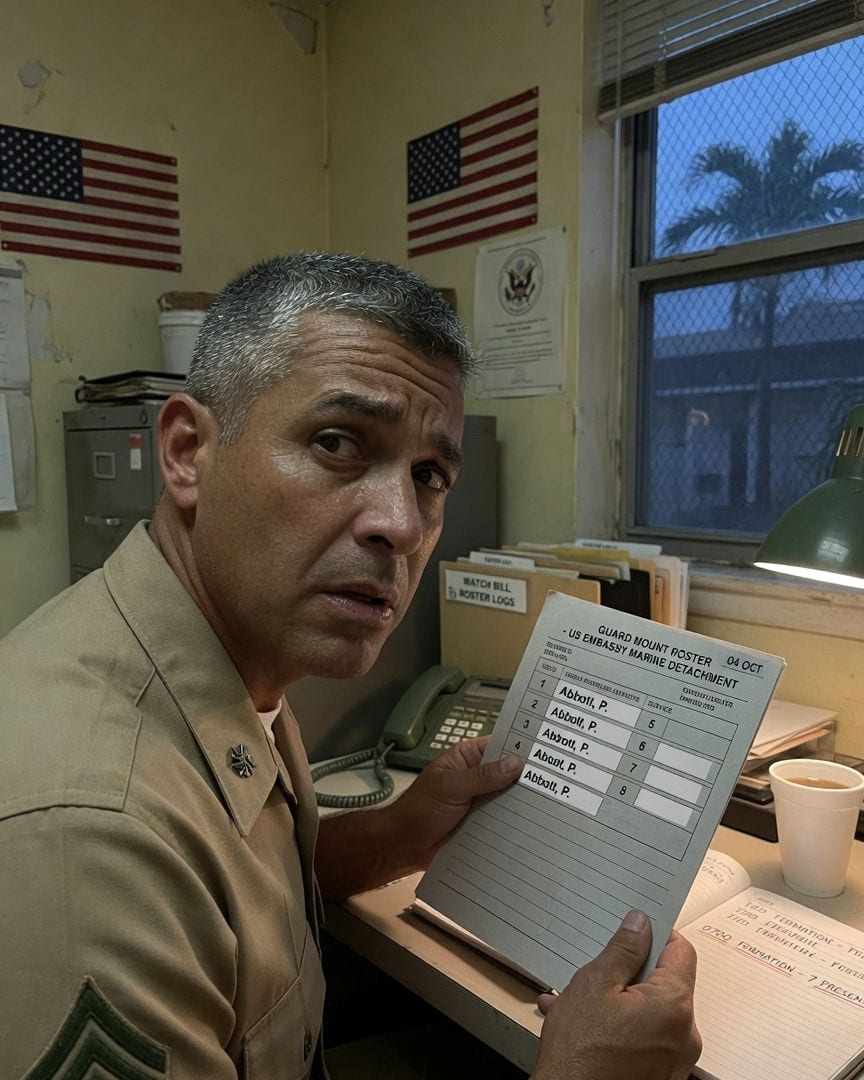
A meticulous Marine Sergeant counted eight men for guard mount, but his roster showed seven. The extra Marine gave a name already called, and a service number that was perfectly blank.
Sergeant Gordon Belanger, a career Marine NCO a month from his rotation, stood in the pre-dawn chill of the embassy courtyard. His meticulous count for guard mount revealed eight Marines, but the official watch bill listed only seven. When he confronted the extra man, the Marine gave a name already called, identical to the man standing beside him. Belanger's investigation of the impossible duplicate only deepened the mystery, as all records swore only seven Marines were present. Yet, his own signed roster confirmed an eighth man, whose service number was a stark, unnerving blank.
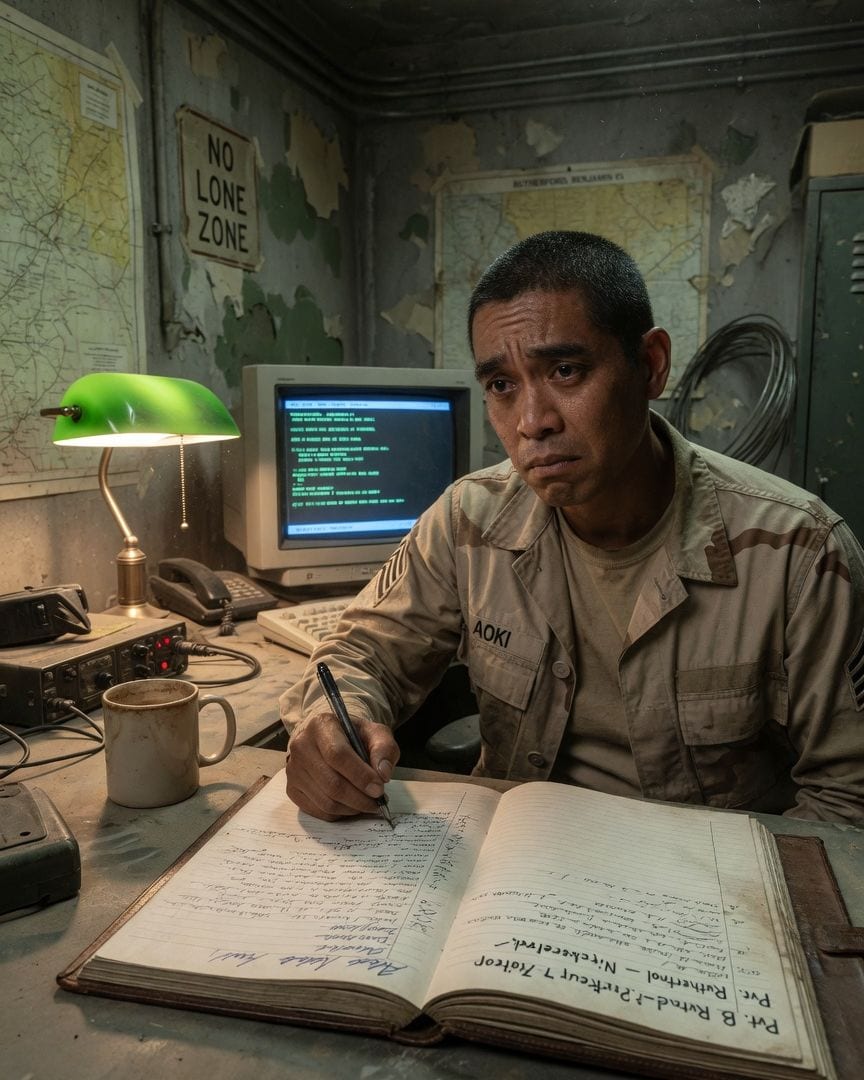
Sergeant Aoki's four-man patrol hears a fifth voice answer their count. A fresh name then appears in the duty log beneath his own signature.
Sergeant Isaac Aoki's final rotation at Outpost 7 was nearing its end, with relief due at dawn. On his four-man night patrol, he broke an old superstition, counting his team aloud in the dust-choked desert. A fifth voice answered, clear and unsettling, from the moonless dark. Back inside the bunker, the chill deepened when a fresh name appeared in the duty log, 'Pvt. B. Rutherford,' beneath Aoki's own signature, a soldier no one knew. Even more disturbing, Aoki later found his own signature on a valor citation for Rutherford, an event he never witnessed.
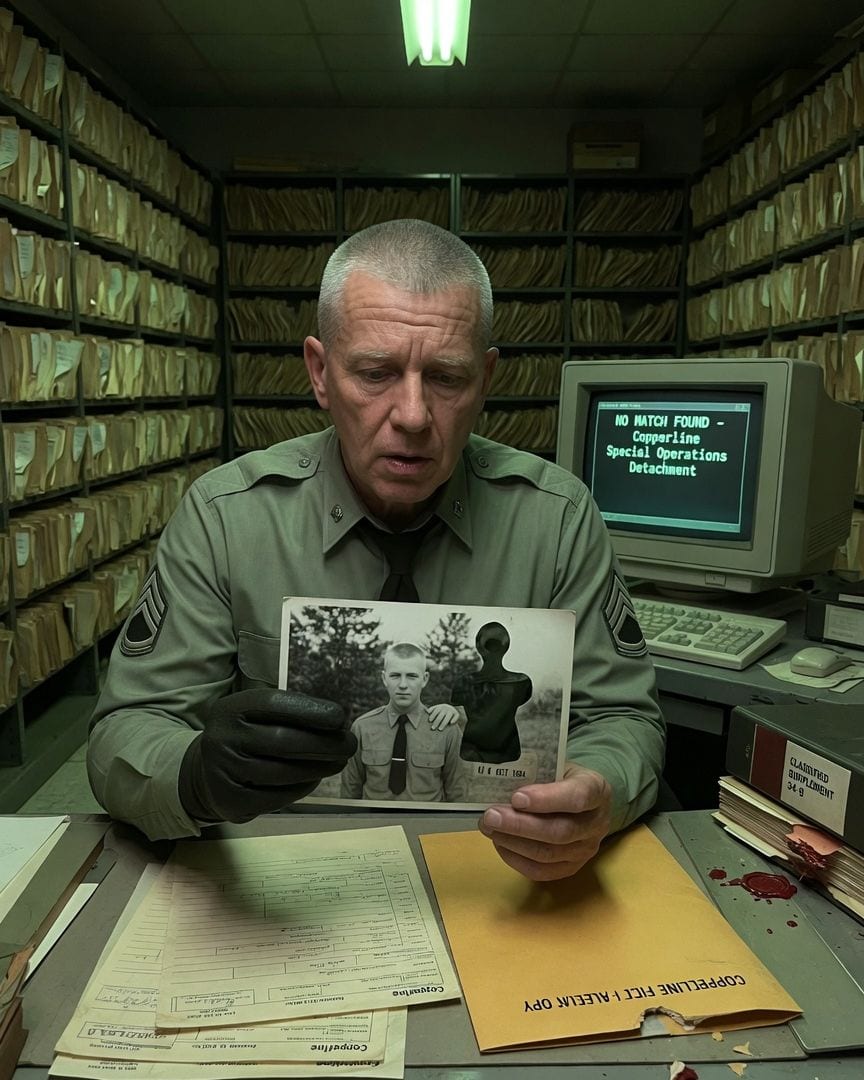
Sergeant Major Vance had two weeks to retirement when his old file felt warm. Inside, a photo showed him with a man precisely cut out from a unit that never existed.
Sergeant Major Teodor Vance had only two weeks left before his retirement, a lifetime of military order almost behind him. For thirty years, he'd pulled the 'Copperline' file, always finding it empty – until now. This time, a faint, impossible warmth radiated from the heavy manila, and inside, he found a faded photograph. It showed a younger Vance in an unrecognized uniform next to a man whose entire body had been precisely cut out of the print, from a company that officially never existed. After decades of silence, what did this warm, impossible file truly contain?
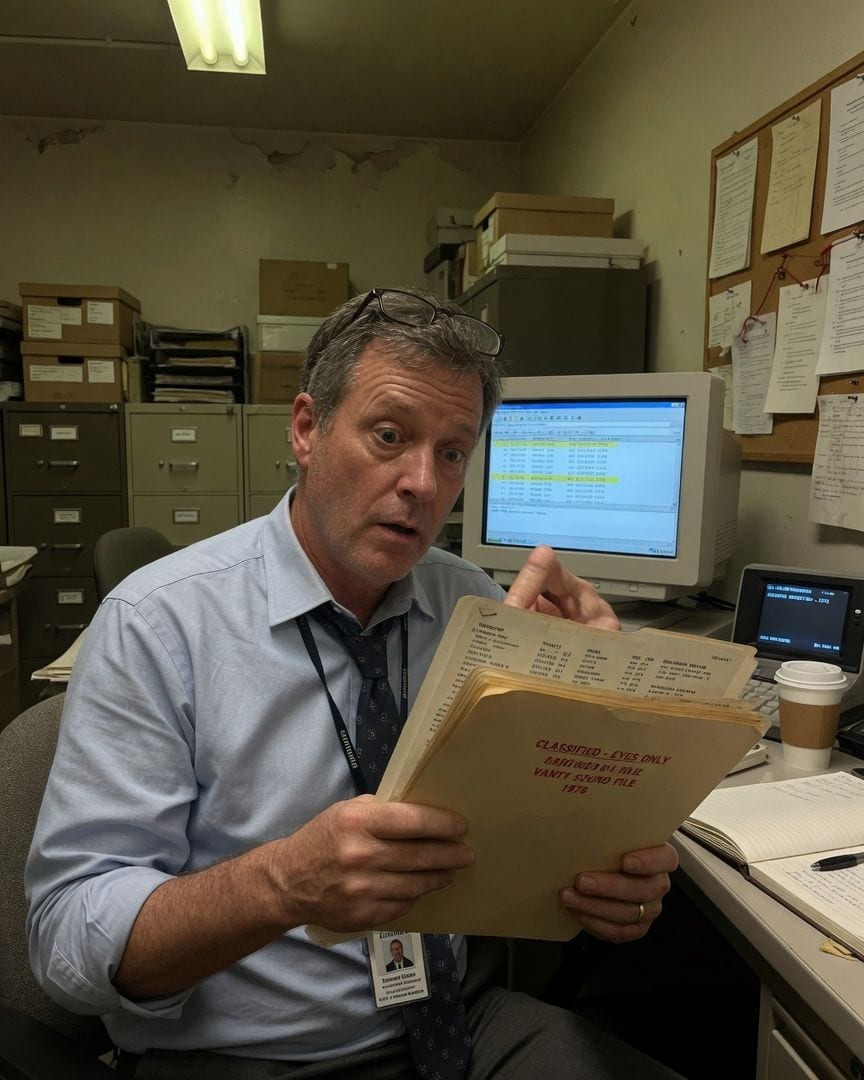
A retiring archivist, Emmett Doane, found a Cold War file from 1978 listing men who wouldn’t enlist until the 1980s. The last name on the classified roster was his four-year-old son’s.
With only six days left until his retirement, archivist Emmett Doane spent a quiet afternoon in the office reviewing old files. He finally pulled the Vantry Sound file, a classified folder from 1978 he'd long dismissed as a clerical error. Inside, the brittle onionskin pages revealed a roster of servicemen who, impossibly, had enlisted years after the file date. As a cold dread tightened his chest, he noticed the file felt warm in his hands, then saw the last name on the list: his own four-year-old son, Samuel. Could a decades-old document truly predict the future, or was something far more sinister at play?
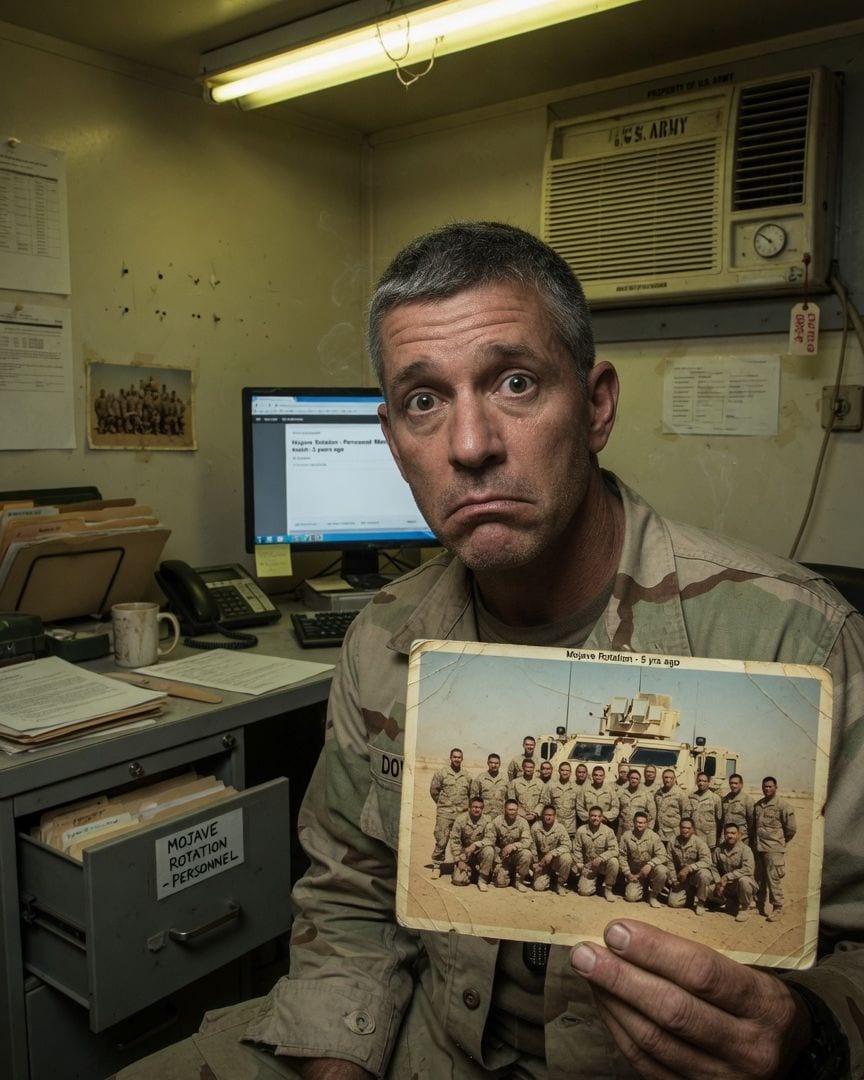
Two weeks from transfer, Master Sergeant Doyle’s old platoon photo now showed a 32nd man grinning from the back row.
Master Sergeant Oliver Doyle was two weeks from his transfer, overseeing the final decommissioning of FOB Erebus, finding solace in routine. His old Mojave platoon photo, a yellowed record above his desk, always showed thirty-one faces from his past. This morning, however, an extra man grinned from the back rank, a face both familiar and utterly alien. When he showed it to Sergeant Barlow, the younger man immediately named the newcomer, "Ryan Stratton," a name Doyle hadn't spoken, yet one that felt ready on Barlow's tongue. Official records listed only thirty-one, but a hidden digital history revealed a manifest with thirty-two names, signed by Doyle himself.
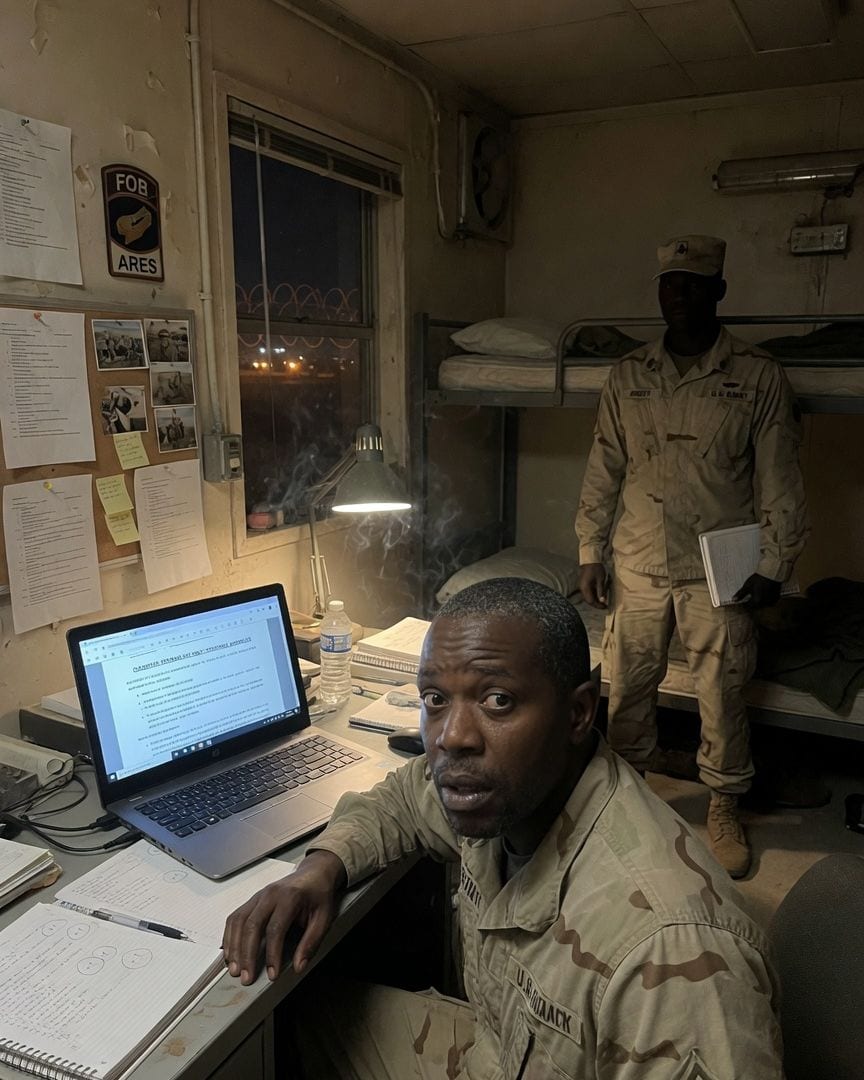
On his final rotation home, Sergeant Abbott counted his platoon: one man too many. The base’s secret files called them 'phantom units,' always watching him.
Sergeant First Class Malcolm Abbott was on his final rotation at FOB Ares, ready for transfer home. He called his platoon to formation, watching the sun break over the desolate desert as he counted each man. But the numbers didn't add up; there was always one extra soldier, standing at rigid attention, perfectly aligned with the others, yet only Malcolm could see him. Despite cross-referencing every manifest, the phantom remained, its face obscured in shadow, a silent sentinel that defied all logic. What secret did the base archives hold about these unacknowledged personnel?