Sergeant Major Vance had two weeks to retirement when his old file felt warm. Inside, a photo showed him with a man precisely cut out from a unit that never existed.
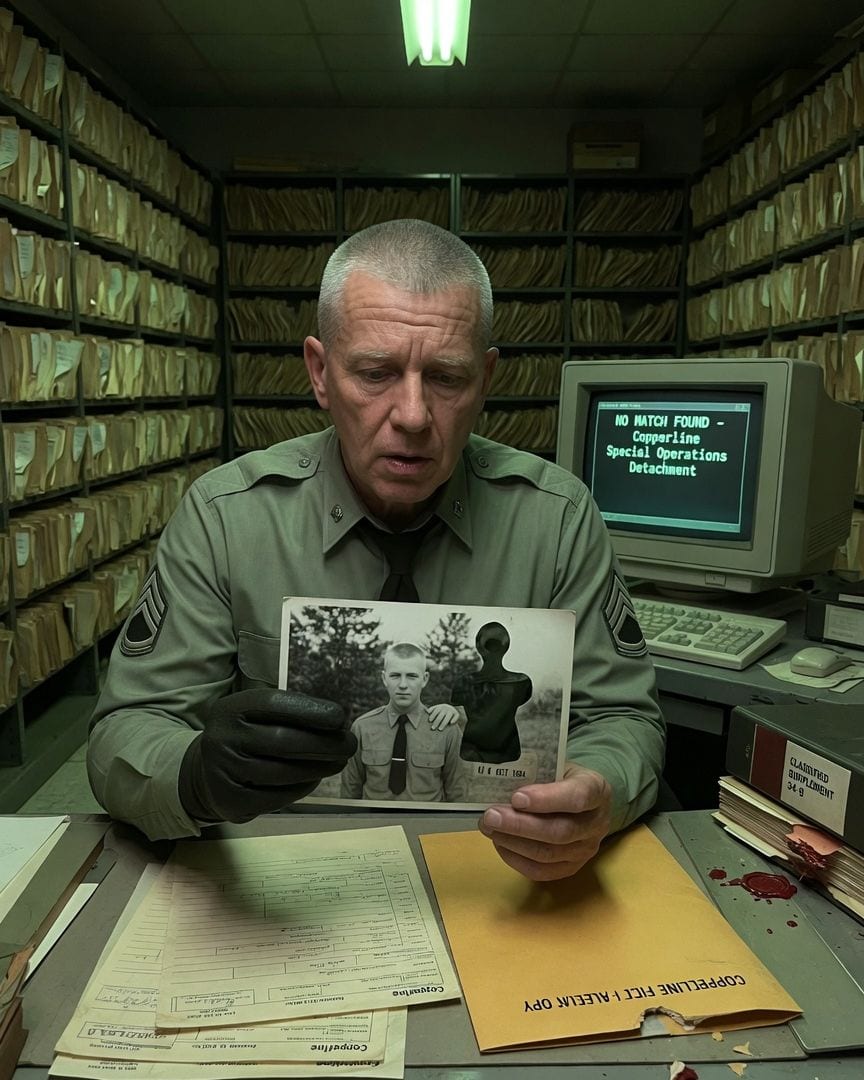
Sergeant Major Teodor Vance, with two weeks left before his retirement, pulled the Copperline file from its slot for the twelfth time in thirty years.
He set it on his worn desk in the silent, cavernous records vault, the air thick with the scent of old paper and dust. He’d requested it eleven times before, each time finding the enclosure envelope within perfectly empty.
A clerical error, he'd always assumed, a placeholder for something lost. This time, as he slit the seal, he felt a faint, almost imperceptible warmth radiating from the heavy manila.
Inside, nestled amongst standard administrative forms, was a single, faded black-and-white photograph.
It showed a younger version of himself, maybe twenty-three, standing in a treeline he didn't recognize, wearing a uniform patch for a company that had never existed in any branch of service he knew.
The date stamped on the back, thirty years ago, was perfectly correct. What truly arrested him was the second man, whose hand rested casually on his younger self's shoulder.
The man's entire body had been cut out of the print, not blacked out or ripped, but precisely excised, leaving a negative space shaped exactly to a human form.
Vance, a man whose life was ordered by regulations and precise filing, ran a gloved finger over the impossibly clean edge of the cut. He tried to rationalize it: a prank, a misfile, a photo from a forgotten training exercise.
But the patch, a stylized copper coil around a stylized mountain peak, wasn't official. And the cut itself was too neat, too deliberate to be a casual edit.
He turned to his terminal, its green glow illuminating the vast, silent rows of files. He ran a search for 'Copperline Special Operations Detachment'—the words he distinctly remembered from the patch—and 'Copperline File.' Nothing.
A blank, just as it had been for decades. Yet, the file in his hand, the physical object, was undeniably there. He looked at the photo again. The young man was undeniably him. The date was undeniably correct.
The cut-out man’s hand, resting on his shoulder, felt like a phantom weight. He pulled out the administrative forms that had accompanied the photo.
They were boilerplate, routine: a requisition for office supplies, a travel voucher, a maintenance sign-off for a vehicle he didn't recognize. All dated from thirty years ago, all bearing the same official stamp as the photo.
All, on their face, utterly mundane. But the names on the forms, the unit designations, they were all linked to the non-existent 'Copperline' entity. He tried to cross-reference the requisition numbers.
They led to dead ends, ghost accounts in the system. The rational explanation—a misfiled training exercise from a classified unit—began to fray. Why would an empty file suddenly produce this? And why, after thirty years, was it still warm?
Ignoring protocol for the first time in his career, Vance accessed the restricted database for 'Anomalous Records, Class 7.' He typed 'Copperline.' The system, usually sluggish, responded instantly.
A single entry appeared: 'Copperline Special Operations Detachment – See Classified Supplement 34-B.' His heart gave a strange lurch.
He requested the supplement, a thick, bound volume that arrived on the automated conveyor belt moments later, its cover worn but its seal unbroken. With trembling hands, he broke the seal and opened the first page.
It listed the 'Copperline Special Operations Detachment'—the exact name from the patch—and underneath, a roster of names, all with 'Active Record Status' dates from thirty years prior.
The last name on the list, partially obscured by a thumbprint, ended with '-gomery.'
Vance's methodical nature warred with a rising tide of unease. He scanned the roster in Supplement 34-B. Each name was followed by a service number and the ominous 'Active Record Status' with a date exactly thirty years ago.
He cross-referenced one name, 'Felix Granger,' against standard personnel files. Granger had been reported missing in action three decades prior, presumed lost during a classified operation. Yet, here he was, 'Active.'
Vance then noticed a note at the bottom of the page: 'For current status, refer to individual personnel files, sub-designation Alpha-7.' Alpha-7 was a deep-archive classification, rarely accessed.
He spent the next day requesting those files, bypassing the usual channels with his approaching retirement as a flimsy excuse. His colleague, Colette Lambert, a sharp archivist half his age, raised an eyebrow. “Digging into the old spooky stuff, Teodor?
Thought you were done with all that.” Vance just grunted, his gaze fixed on the incoming conveyor. When the Alpha-7 files arrived, they were heavy, dense. He opened Granger's.
It contained payroll runs, requisitions for equipment, performance reviews, even vacation requests. All dated after Granger's official disappearance. All in a steady, official hand, identical to the forms in his Copperline file.
The latest entry was a maintenance sign-off for a vehicle, dated last week. Granger was still accruing paperwork. He turned to the photograph. The cut-out man.
He cross-referenced the service numbers of the Copperline roster with the names on the original mundane forms in his file. They matched.
The requisition for office supplies, the travel voucher, the maintenance sign-off – they were all for members of the 'lost' Copperline detachment. The paperwork for these men had never stopped.
It was as if their existence had simply transferred from the physical world to the bureaucratic one, continuing without them.
Vance worked late into the night, the silence of the vault broken only by the hum of the servers and the rustle of paper.
He felt a prickling sensation on his neck, a familiar chill that wasn't from the archive's regulated temperature. He glanced up. The security camera in the far corner, usually a static, unblinking eye, seemed to have shifted fractionally.
He dismissed it as paranoia. Yet, when he went for a coffee break, he found his terminal screen displaying a file he hadn't opened: 'Vance, Teodor. Personnel Records.' His own file.
He hadn't accessed it, not since his initial retirement paperwork had been submitted. He closed it, a cold knot forming in his stomach. The next morning, Colette approached him, looking uncomfortable. “Teodor, I got a call from Records Oversight.
They’re asking about your recent Alpha-7 requests. Apparently, you’ve been accessing some… sensitive material.” Vance felt a jolt. “Sensitive? It’s just old missing-person cases.” Colette lowered her voice. “They specifically asked about Copperline.
Said you were getting too close to… historical anomalies. Said to back off. And that your retirement paperwork was being fast-tracked.”
The implication was clear: his digging had been noticed, and his impending retirement was no longer a freedom, but a deadline. He felt a chill that had nothing to do with the cool air. Someone, or something, was watching him.
And it was hurrying him along.
The 'fast-tracking' of his retirement felt less like a convenience and more like an eviction. Vance knew he had to act quickly.
He called Reginald Doyle, his old Warrant Officer, long retired, who’d been in Records Oversight himself back when Vance was a junior airman. Doyle’s voice was raspy with age, but his memory was sharp. “Copperline, you say?
Haven't heard that name in decades. Used to be a ghost story among the clerks. The file that never closed.” Vance pressed him. “What happened to them, Reg? The men in the detachment?” Doyle sighed, a long, weary sound.
“They weren’t lost, Teodor. They were… filed. That’s what we called it. The machine knew. It always knows. It just kept writing them down, processing their existence, even after they were gone.”
Vance remembered the impossible entries, the payrolls for missing men. “The paperwork never stopped?” “Never. It was like the system itself became them. Or absorbed them. We just kept stamping the forms, passing them up the chain. Nobody questioned it.
Easier to just keep the machine running.” Doyle’s voice dropped to a whisper. “Some said, if you looked too long, if you dug too deep… the machine would file you too. That’s why I got out, Teodor.
The quiet hum of those servers, signing off on lives that weren't there anymore. It gets in your head.” The pieces clicked into place. The empty file, waiting. The photo, a lure.
The constant paperwork, a record of continuous, bureaucratic existence. The cut-out man in the photo wasn't just missing; he was filed. Vance hung up, a profound dread settling in his bones.
The secrecy machine wasn't just hiding a truth; it was creating a new kind of existence. His own file, accessed without his knowledge, the fast-tracked retirement. He looked at his hand, then at the photo.
The man whose hand was on his shoulder. Had he been filed? Was he next?
Vance knew he had to find proof, something undeniable that he could show someone, anyone.
He bypassed Colette, bypassing his immediate supervisor, and used a rarely-used administrative override code to access the deepest, most secure section of the archive: the 'Origin Records' for all classified units. He searched for 'Copperline.'
The terminal whirred, accessing databases he'd never seen before. After a tense minute, a single, protected file appeared. Its designation was 'Copperline. Project Chimera. Status: Active.' He opened it. The first few pages were standard classified project initiation documents.
But deeper in, he found a section titled 'Personnel Transfer Protocol – Active Record Status.' And there, listed beneath a dozen names he recognized from Supplement 34-B, was his own. His service number, his full name: 'Vance, Teodor.'
And beside it, an entry he could barely comprehend: 'Retirement processing complete. Transfer initiated.' The date matched his own impending retirement.
Vance stared at the screen, the words searing themselves into his mind. 'Transfer initiated.' His retirement wasn't a release; it was a transition. He was being filed.
The empty Copperline file, his persistent requests, the photograph – it had all been part of a long, patient process to bring him into the 'machine.'
The cut-out man in the photo, the non-existent company, the endless paperwork for the 'lost' – they were all victims of this systematic absorption.
The 'secrecy machine' wasn't just an institution; it was an entity, a self-sustaining bureaucratic organism that consumed lives and converted them into an endless stream of official records.
The hum of the servers, the endless rows of files, the steady, official hand on the forms – it was all its manifestation. He remembered Doyle’s words: 'It always knows.'
It had orchestrated his discovery, his investigation, guiding him deeper until he was irrevocably entangled. His own service number, now listed as 'Active Record Status' within the Project Chimera file, was proof.
He was no longer Sergeant Major Teodor Vance, records clerk. He was an entry, a set of data points, soon to be generating his own endless stream of requisitions and payroll runs from within the system.
A cold, clinical dread settled over Vance. He had to get out, and he had to take proof. He quickly copied the 'Project Chimera' file, including his own entry, onto an encrypted data stick he always kept for emergencies.
His hands moved with a frantic precision born of years of disciplined procedure. As he finished, the lights in the archive flickered once, then dimmed, bathing the vast space in an eerie, low glow.
The hum of the servers seemed to intensify, a low, guttural thrum that vibrated through the floor. He heard footsteps, slow and deliberate, echoing from the far end of the aisle. Not Colette, not a guard.
These footsteps were too even, too heavy, too… deliberate. He snatched the data stick and shoved it into his pocket, then grabbed the original Copperline file, the one with his photograph, and secreted it inside his uniform jacket.
He moved quickly, silently, through the labyrinthine aisles, the dim emergency lights casting long, dancing shadows. The footsteps grew closer. He could hear the faint rustle of paper, like a thousand unseen hands turning pages in unison.
He reached the main exit, a heavy steel door that required several security clearances to open. He swiped his badge, then another, then entered his biometric data. The door hissed, then unlocked, swinging open into the empty, sterile corridor beyond.
He didn't look back. He broke into a run, the data stick and the physical file heavy in his pockets, the thrumming of the archive fading behind him, but not truly gone.
He was free, but the cold knowledge of what he had become, what he was now a part of, weighed heavier than any file.
Vance walked out into the pre-dawn light, the air crisp and cold, a contrast to the oppressive warmth of the file. He made it home, the data stick and the file clutched tight.
He tried to explain it to his wife, Deborah, but the words sounded hollow, unbelievable even to his own ears. She listened with a worried frown, attributing it to pre-retirement stress.
He sent anonymous copies of the encrypted data stick to several investigative journalists, but heard nothing back. The official word came a week later: Sergeant Major Teodor Vance's retirement was processed without incident.
A commendation for his decades of service, a small pension. But the hum of the servers, the phantom weight of the cut-out man's hand on his shoulder, never left him.
He knew he had escaped, but the cost was the quiet, unbearable truth that he was still, in some unseen ledger, being filed.
He still had the photograph, tucked away in a locked box, the cut-out man a constant reminder. He still had the data stick, a silent testament to a truth no one would ever accept.
Vance found himself drifting through his days, a ghost in his own life, always listening for the faint, steady rustle of paper, the distant hum of unseen servers.
He’d check his bank statements with a new, unsettling diligence, half-expecting to find a 'requisition for office supplies' or a 'travel voucher' for a trip he hadn’t taken.
He knew he was out, physically, but a part of him remained in the archive, a bureaucratic entry in an endless ledger. He’d look at his hands, expecting to see them subtly changed, ready to ink an impossible signature.
The world moved on, oblivious. The machine kept running. One evening, Deborah found him staring blankly at the wall. “Teodor,” she asked gently, “are you really alright?” He turned, a faint, almost imperceptible smile touching his lips.
It wasn't his usual smile. “Never better,” he said, his voice flat, his eyes distant.
Deborah watched him, a quiet concern growing in her. He stood there for a long moment, unmoving, a faint, metallic hum seeming to emanate from his very presence.
And in the quiet of the empty archives, the hum of the servers continued, signing off on a life he no longer owned.
If this one got to you
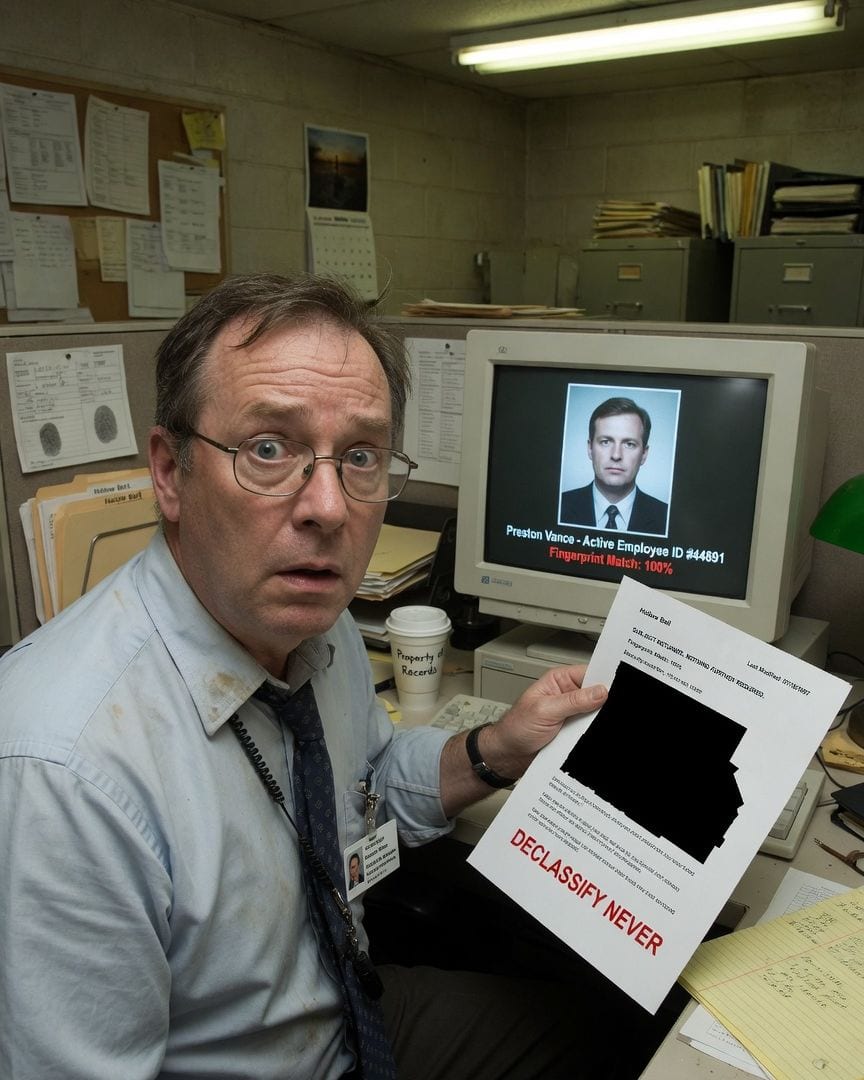
Nearing retirement, a government reviewer finds a dead Cold War agent's fingerprints match an active employee in his building.
Anton Skeel, a government records reviewer nearing retirement, anticipated a quiet end to his career. His days were spent in a dull, windowless office, sifting through the lingering paperwork of a bygone era. But a file labeled 'Hollow Bell' stopped him cold: it held fingerprints from a man, Preston Vance, reported dead in 1951. Anton's system then matched those prints to an active employee, badged into his very building that morning, whose personnel file showed a stranger's face and a section with a 'DECLASSIFY NEVER' redaction. Who exactly is Preston Vance?
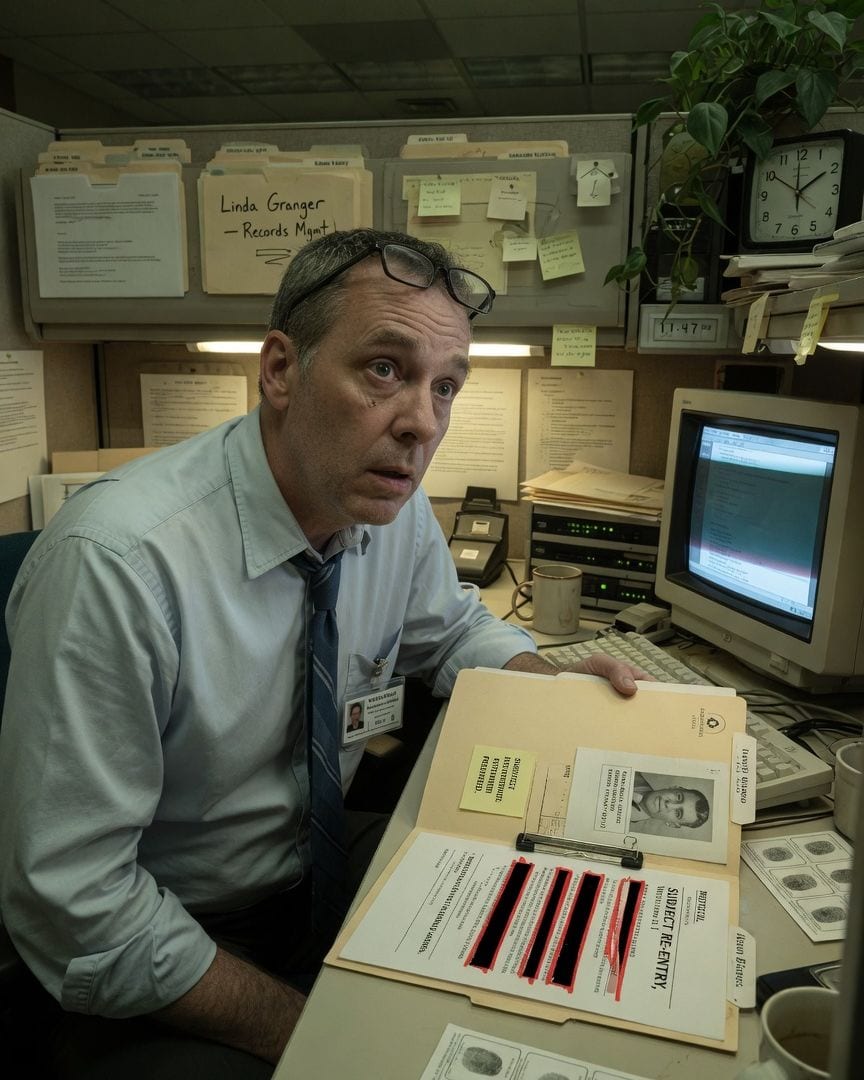
A declassification agent processed old Cold War files. A man reported dead in 1951 had 1958 fingerprints matching an employee badged into the building that morning.
Anton Skeel, a declassification agent nearing two decades of service, meticulously processed the endless backlog of Cold War secrets. His cubicle hummed with the ghosts of forgotten files, but one 'Hollow Bell' folder held a particularly glaring anomaly. It contained a 1958 fingerprint card for Henry Bishop, a man officially reported dead in 1951. When Anton fed the print into the active database, it matched Carl Romano, an employee badged into the building that very morning. A cold certainty settled over him: this wasn't an error, but a system designed for such impossible discrepancies.
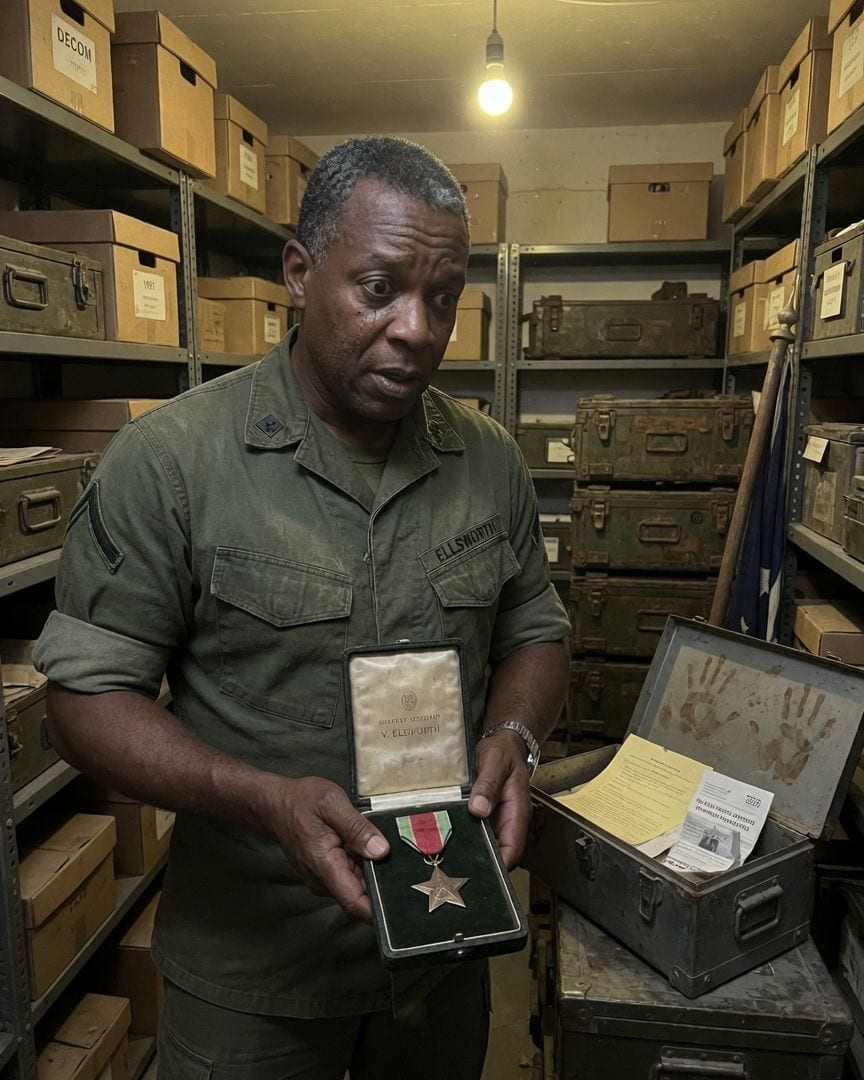
A photograph in Gunnery Sergeant Ellsworth's file shows him, older, with a future he never lived.
Gunnery Sergeant Victor Ellsworth, a veteran of twenty-two years, expected routine paperwork at the St. Louis personnel depot. Instead, a records clerk presented him with two identical files bearing his name and service number. One detailed a combat tour and commendations he had never earned, while a photograph inside showed him, unmistakably older, living a future he hadn't yet endured.
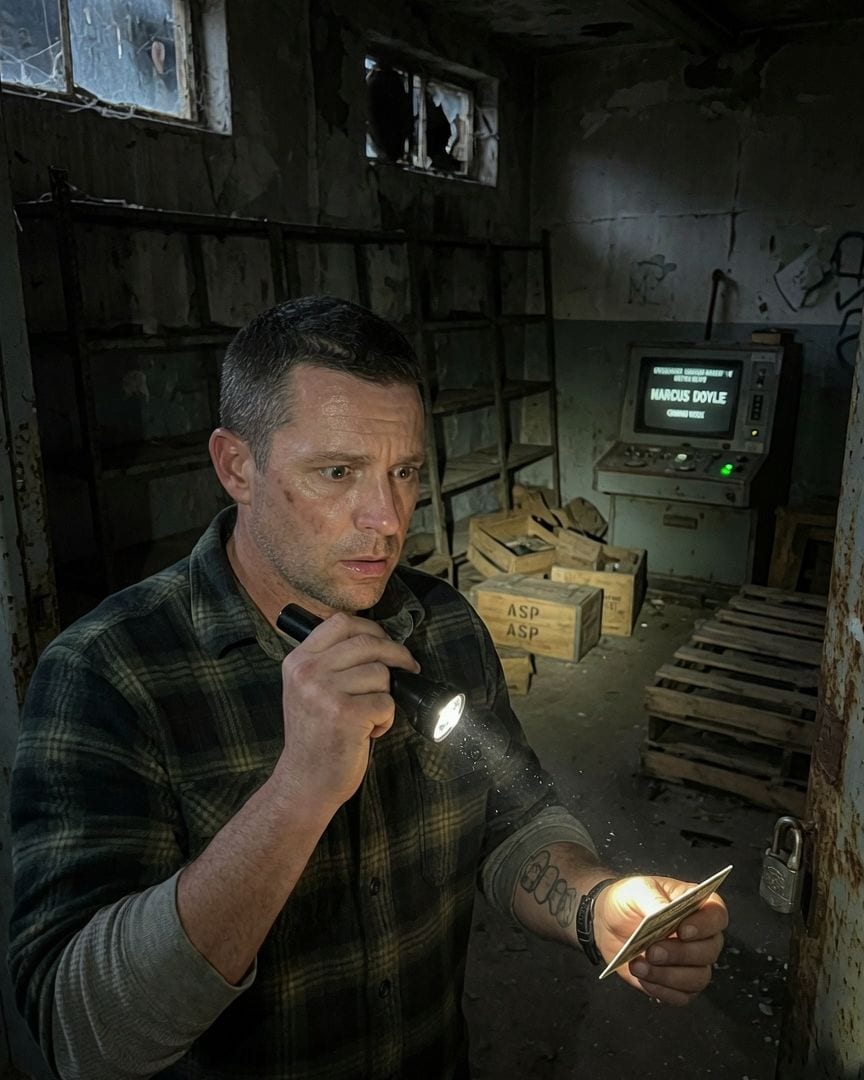
A former serviceman found his name on an active duty roster for a military base decommissioned in 2019. His access card had already logged three entries last month.
Six years after leaving the service, Marcus Doyle’s quiet suburban life was upended by an old access card notice. It came with a chilling printout: his badge number and name, logged entering Fort Crestwood’s Ammunition Supply Point three times last month, each at 0240. The former military base had been officially decommissioned in 2019, its buildings abandoned and gates chained. After discovering his own access card matched the log, Marcus returned to the derelict site, only to find a humming console displaying his name as current "personnel assignment" for the coming week. What could be happening at a base that no longer exists?
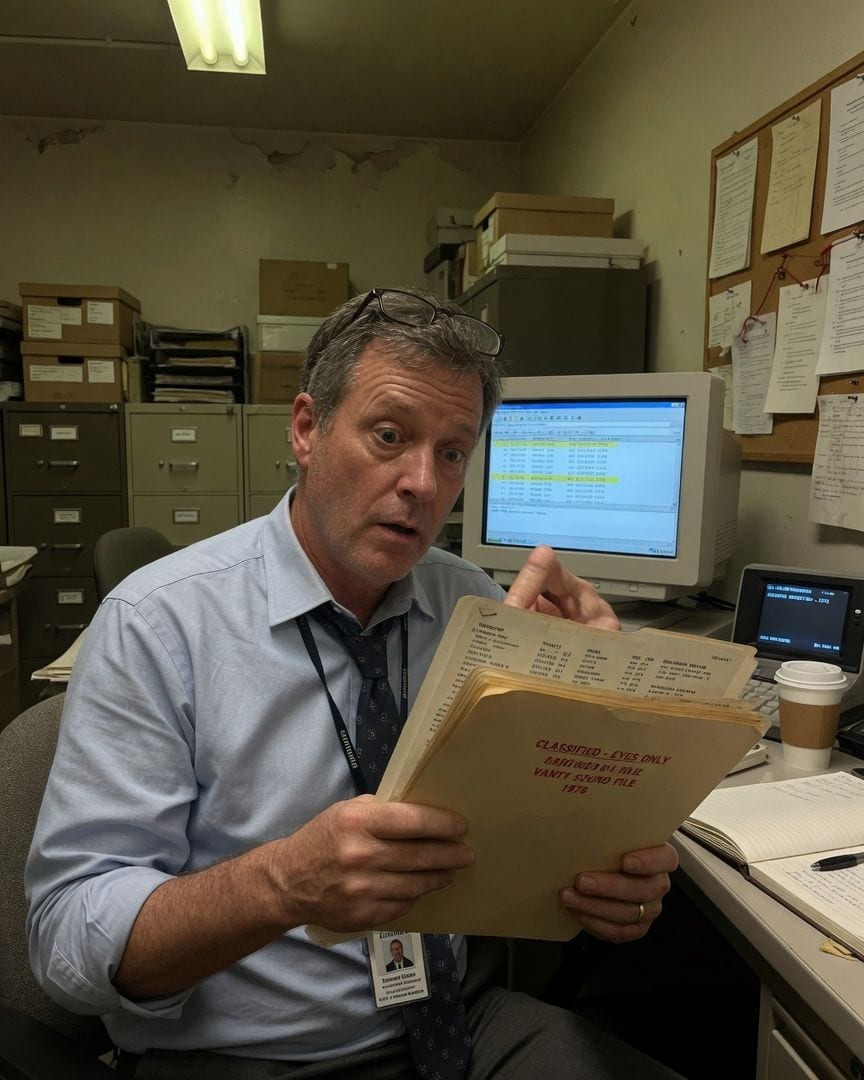
A retiring archivist, Emmett Doane, found a Cold War file from 1978 listing men who wouldn’t enlist until the 1980s. The last name on the classified roster was his four-year-old son’s.
With only six days left until his retirement, archivist Emmett Doane spent a quiet afternoon in the office reviewing old files. He finally pulled the Vantry Sound file, a classified folder from 1978 he'd long dismissed as a clerical error. Inside, the brittle onionskin pages revealed a roster of servicemen who, impossibly, had enlisted years after the file date. As a cold dread tightened his chest, he noticed the file felt warm in his hands, then saw the last name on the list: his own four-year-old son, Samuel. Could a decades-old document truly predict the future, or was something far more sinister at play?
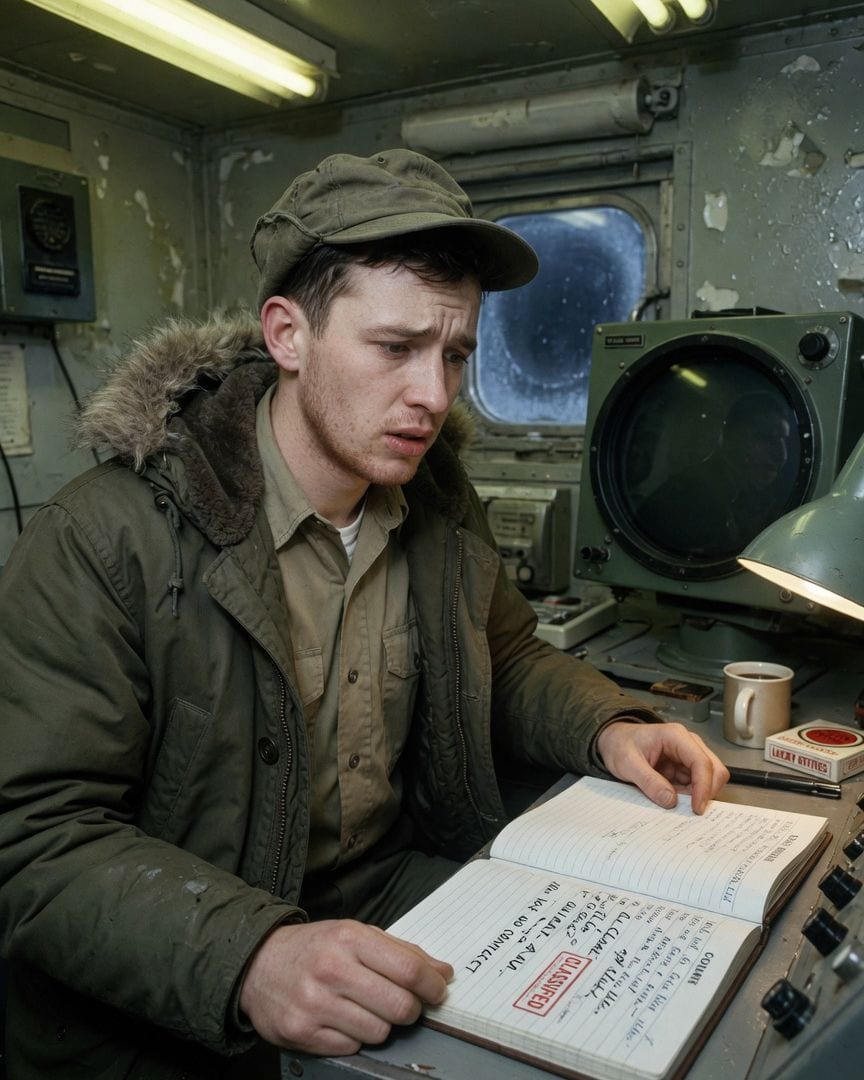
A Cold War airman logs an impossible radar contact on his last sweep. But his official logbook entry is stamped 'CLASSIFIED' and then contradicted by a hastily scrawled 'ALL CLEAR' dated moments before it.
Airman Ordway Vance, 22, manned the radar dome at Site Pellin in the biting North Atlantic dark of January 1962, running the last calibration sweep before its decommissioning. His scope picked up a faint, impossible return, growing closer with each pass, though the ocean remained empty to the eye. When Vance detailed the contact in his official logbook, a 'CLASSIFIED' stamp appeared, followed by a hastily scrawled 'ALL CLEAR' dated moments before his own entry, contradicting his every word. Commander Hartley dismissed it as equipment malfunction, but Vance sensed a chilling, official erasure behind the lie. He soon found a locked cabinet marked 'SITE PELLIN ANOMALIES,' hinting at a deeper truth buried within the base's final days.