Nearing retirement, a government reviewer finds a dead Cold War agent's fingerprints match an active employee in his building.
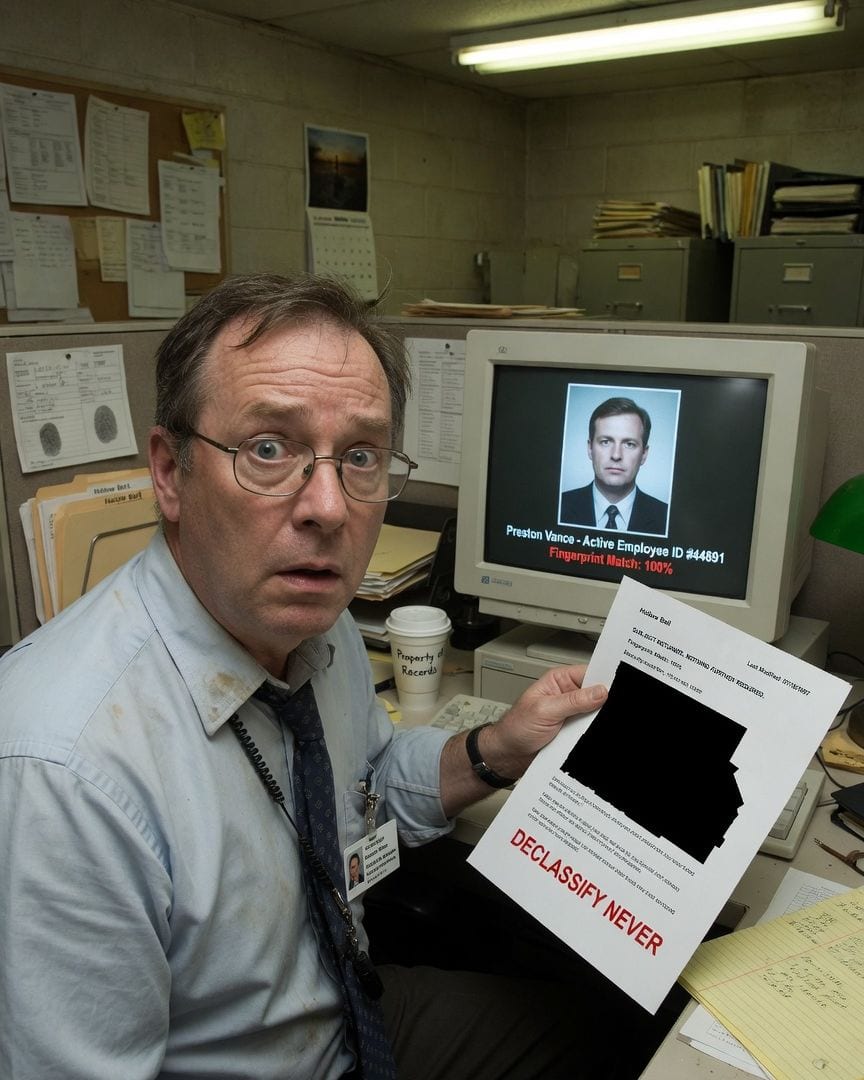
Anton Skeel, a government records reviewer nearing retirement, sifted through a referral queue. His office was a dull, windowless box, smelling of stale coffee and old paper.
The Cold War had been over for six years, but the paperwork machine kept grinding. He pulled a file labeled 'Hollow Bell,' its cover sheet unusually sparse: 'SUBJECT RETURNED. NOTHING FURTHER REQUIRED.' Attached was a single 3x5 fingerprint card.
The record stated it was taken at a border crossing in 1958 from a man named Preston Vance. Anton’s brows furrowed. Preston Vance, he distinctly remembered, was reported dead in 1951, a casualty of a covert operation in Eastern Europe.
A petty annoyance, a clerical error he thought, but something about the stark finality of 'NOTHING FURTHER REQUIRED' nettled him. He cross-referenced the prints, a spiteful, pre-retirement reflex. The system whirred, then pings: a match. To an active government employee.
Current, badged into the building at 0731 that very morning. He pulled up the employee's current personnel file, a digital record. The name at the top was 'Preston Vance.'
But the photograph displayed next to it, a recent, color ID shot, was undeniably of a stranger, a man Anton had never seen before.
Anton stared at the screen, the stranger's bland, almost forgettable face mocking the impossible match. He tried the mundane explanation: a database glitch, an old file accidentally overwriting new data, a prank by a tech.
But the system was locked down, audited daily. He dug deeper into the active Preston Vance's digital personnel file. The photo was linked directly to the employee ID. The current address, the listed job code—everything was consistent, perfectly clean.
Too clean. He scrolled through the digital pages, past performance reviews, training certificates, medical clearances. Then he found it: a section labeled 'Operational History.' Most of it was benign, boilerplate text, but a specific paragraph had been heavily redacted.
Not a simple black bar, but a precise, almost artisanal block of black, carefully shaped around what must have been specific text.
The shape of the redaction was what caught him, an unusual, asymmetrical void that seemed to deliberately obscure not just words, but a specific type of entry—perhaps a date range, or a location code.
Just above it, the file's last modification date reads: '07/18/1997.' Four days ago. Below the redaction, a control number traces to no originating office Anton recognizes.
He cross-references the control number, but it leads to a dead end, a closed loop within the system. He tries to access the redacted portion, but the system denies him, citing a 'DECLASSIFY NEVER' protocol.
The impossible match, the stranger’s face, the precise, unyielding redaction – it all coalesces into a single, chilling question that makes his blood feel cold in his veins: Who exactly is Preston Vance?
Anton printed out the redacted page, the black block a stark, tangible wrongness on the crisp white paper. He held it up to the light, as if he could see through the ink, but it was absolute.
He glanced at the date of the file's last update, visible just above the redaction, and then at the 'DECLASSIFY NEVER' stamp on the cover sheet.
The implication hit him like a physical blow: the redacted information was not just missing, it's actively protected from ever being seen. He knew, with a sickening certainty, that this isn't a clerical error. It’s a deliberate, ongoing act.
He felt a cold shiver trace his spine as he realized he'd stumbled onto something far deeper than a misfiled record.
The next morning, Anton arrived early, the redacted page still heavy in his briefcase. He avoided Elliot Merritt, his supervisor, knowing this rabbit hole isn't 'official business.'
He began a systematic search of the database, using keywords like 'SUBJECT RETURNED' and 'Hollow Bell.' He found nothing. The 'Hollow Bell' folder seemed unique. This only deepened his unease.
He shifted tactics, searching for other individuals reported 'dead' in the 1950s and 60s who later had active government files. It's a needle in a haystack, but his impending retirement means he has time, and a strange, quiet resolve.
Days blur into a methodical grind.
He unearths a few anomalies: a Lieutenant Commander reported lost at sea in '62, whose pension records were mysteriously reactivated in '74, followed by a brief, unverified stint in a 'Special Projects' division before he officially retired years later.
The pension records had the same 'NOTHING FURTHER REQUIRED' annotation. No fingerprints, but a similar pattern of a 'lost' individual reappearing. Then, a breakthrough.
He remembers Judith Sheppard, a former colleague now in the Archives department, a woman with an eidetic memory for old files. He calls her, feigning an interest in historical cold war-era personnel procedures.
Judith, always precise, tells him about a specific classification code, 'Project Chimera,' used briefly in the late 50s and early 60s for 'sensitive personnel re-integrations.'
The code was purged from the main database decades ago, she explains, but some physical files might still exist in deep storage, cross-referenced with 'Hollow Bell' in a few obscure indices. Anton feels a jolt. 'Hollow Bell' wasn't unique.
It was a fragment of a larger, older system. He now has a direction, a scent for the true wrongness.
Following Judith's lead, Anton requests access to the deep storage archives, citing a 'historical review for a declassification project.' His request is approved by Elliot Merritt with unusual swiftness.
Anton descends into the cavernous, climate-controlled stacks, the air thick with the scent of aged paper and ozone. He finds a few 'Project Chimera' boxes.
They are thin, containing only a handful of documents each, mostly internal memos and transfer orders. The names are unfamiliar, but the pattern is chillingly consistent: 'Subject acquired,' 'Integration successful,' and then, inevitably, 'SUBJECT RETURNED. NOTHING FURTHER REQUIRED.'
Each file is stamped 'DECLASSIFY NEVER.' As he closes the last box, a shadow falls over him. Elliot Merritt stands at the end of the aisle, a placid, unreadable expression on his face. 'Finding what you need, Anton?'
he asks, his voice too casual, too calm in the vast quiet. Anton's heart thumps. 'Just some old Cold War curiosities, Elliot. Research for my retirement project.'
Elliot steps closer, his gaze sweeping over the stack of boxes Anton has just handled. 'It's good to keep busy, Anton. But some things are buried for a reason.
Best not to dig too deep, especially when you're almost out the door.' The words are a polite warning, delivered without a hint of threat, yet Anton feels a cold dread bloom in his stomach. Someone knows he's digging.
Someone is watching. He carefully puts the last file back, the quiet hum of the archives suddenly feeling like a silent, waiting presence.
Anton returns to his office, the conversation with Elliot replaying in his mind. The warning was clear. He needs to move fast. He pulls up Preston Vance's current personnel file again, looking for any other anomalies.
He focuses on the digital signature for Vance's last annual review. It’s a clean, steady hand, consistent with the rest of the file. But then he remembers the 1958 fingerprint card, the one that started it all.
He finds a scan of Vance's actual signature from a 1950 service record, just before he was reported dead. The difference is subtle, almost imperceptible to an untrained eye, but Anton has spent decades with signatures.
The pressure points, the minute variations in stroke, the way certain letters were formed—they were distinct. The 1950 signature had a slight tremor, a nervous energy.
The current signature was smoother, almost too perfect, lacking the unique, almost organic imperfections of a human hand. It was a carefully reproduced copy, not an evolution. Anton's mind races.
He thinks of the Project Chimera files, the 'Integration successful' notes. He pulls up the photo of the current Preston Vance, the stranger's face. The man had a slight scar over his left eyebrow, barely visible in the ID photo.
Anton checks a scanned physical copy of Vance's 1950 service photo – no scar. He cross-references Vance's medical records from before 1951: no mention of any such injury.
But the current medical records mention a 'minor childhood injury, left supraorbital region.' The current Preston Vance is not the original. He's a replacement.
The original Preston Vance died in 1951, but his identity, his service number, his very existence, was later 'returned' and occupied by someone else. The 'Hollow Bell' isn't about recovery; it's about replacement.
It's a system to fill the void left by the dead with something else, something that fits the paperwork. The realization sends a chill through Anton.
The files aren't just records of what happened; they're the mechanism by which it happens. The secrecy machine isn't just hiding information; it's actively creating its own reality, a meticulously documented lie.
Anton, hunched over his desk in the dark, clicked through an old naval intelligence file he found through a cross-reference with 'Project Chimera.' Another 'Hollow Bell' notation, another 'SUBJECT RETURNED.'
This one for a petty officer lost off the coast of Cuba in 1971, 're-integrated' in 1978.
He saw the familiar, oddly shaped redaction, identical to the one in Vance’s file, blacking out the same type of detail – a specific code, a date range. It’s a template, a pattern.
He opened another, a downed pilot from the Korean War, 'returned' in 1956. Same notation, same redaction, same impossible timeline.
The pattern stretched across decades, across different military branches and civilian agencies, all connected by the cryptic 'Hollow Bell' tag and the precise, unyielding shape of the redacted truth. This wasn't a series of isolated incidents, but a systemic program.
The files aren't just old records; they are active components of an ongoing process.
Then he noticed a subtle, almost imperceptible watermark in the digital record of the naval intelligence file's metadata, a detail that only a seasoned reviewer would catch: a timestamp indicating a last modification date of '07/22/1997' — this morning, just hours ago.
The file is still being written. And Anton realized, with a sickening lurch, that he might be the next subject.
Anton knew he couldn't just walk away. The file was still being signed. He spent the rest of the night cross-referencing every 'Hollow Bell' and 'Project Chimera' record he could find, the timestamps of recent modifications confirming his dread.
These weren't just historical anomalies; they were active, ongoing cases. The redactions, identical in shape and placement across dozens of files from different eras, weren't just hiding details; they were hiding the method.
Anton realized the redacted portions likely contained the actual identity of the replacement, or the 'control' mechanism. The program didn't just replace people; it maintained them, updating their files, keeping their fabricated lives coherent.
He found a series of inter-agency memos from the late 1980s, discussing 'resource allocation for subject maintenance' and 'protocols for identity sustainment.' No names, just codes, but the context was horrifyingly clear.
The 'Hollow Bell' program was an institution, a silent, pervasive machine designed to ensure continuity of personnel, even when the original was irrevocably lost.
It wasn't about bringing someone back; it was about preventing the void, about maintaining the illusion of an unbroken chain.
The 'subject returned' was a euphemism for a new iteration, a new identity laid over an old one, a new file signed into existence.
The horror wasn't just that it happened, but that it was so meticulous, so patient, so perfectly documented.
Every clue, every impossible date, every mismatched fingerprint, every redacted shape, every 'nothing further required' now clicked into place, forming a coherent, terrifying picture of a system that consumed individuals and replaced them with perfectly functioning, perfectly documented fakes.
The dead weren't lost; they were filed away, and their identities recycled.
Anton knew he had to act. He couldn't expose the entire program, not alone, not without disappearing himself. But he could expose one instance, make enough noise to perhaps slow the machine, even for a moment.
He printed out a dossier: Preston Vance's original service record, the 1958 fingerprint card, the current personnel file with the stranger's photo, and a selection of the 'Hollow Bell' files with the identical redactions and recent modification dates.
He placed the stack on Elliot Merritt's desk, neatly arranged, the most damning evidence on top. He then quietly packed his personal items, his retirement plans now feeling like a hollow mockery.
As he walked out, he saw Preston Vance, the stranger, walking down the hall, heading towards the elevators. Vance caught his eye, offering a small, polite nod.
Anton nodded back, his gaze lingering on the slight scar above Vance's left eyebrow, a detail that never belonged there. Vance's eyes, though, held no recognition, no malice, just a quiet, almost empty placidity.
It was the look of a man who was exactly where he was supposed to be. Anton felt a profound, chilling sense of defeat. He had found the truth, but the machine was too vast, too deeply entrenched.
He had merely exposed a single cog, and now he was certain he would become another entry in its silent, ongoing ledger. He reached his car, the setting sun casting long, unsettling shadows across the parking lot.
He started the engine, but paused, looking back at the imposing, windowless building. He pictured Elliot Merritt, finding the dossier, and then making a call.
Anton knew he should drive away, disappear, but the thought of all those filed lives, all those perfect replacements, held him captive. He couldn't run.
He had to know if his exposure had made any difference, even a ripple in the vast, still waters of the 'Hollow Bell' program.
He pulled out his phone, a secure line he usually only used for family, and dialed Judith Sheppard. 'Judith,' he said, his voice low, 'I need you to do something for me. Something that might get us both in trouble.'
Anton never made it home. His car was found the next morning, neatly parked in his usual spot, the doors locked, his keys still in the ignition. The dossier he had left for Elliot Merritt was gone.
A brief internal memo circulated through the department, stating Anton Skeel had taken early, unscheduled retirement for 'personal reasons,' effective immediately. Elliot Merritt seemed unchanged, his placid demeanor intact. Preston Vance continued his work, badge-in and badge-out, punctual and unremarkable.
Judith Sheppard, after Anton's last, frantic call, found her department's access to deep storage archives temporarily revoked for 'routine maintenance.' She tried to follow up on Anton's sudden departure, but her queries met only polite, firm silence.
The system closed around the absence, smooth and seamless, as if Anton Skeel had simply ceased to be a part of its operating parameters.
Anton's voice, strained and urgent, ended abruptly, a click and then silence. Judith held the phone to her ear for a long moment, the dial tone a flat, accusing sound.
She tried calling him back, but his line went straight to voicemail. She tried his home phone, then his cell. Nothing. A cold, heavy knot formed in her stomach. She knew Anton. He wouldn't just vanish. Not like this.
Not after what he'd hinted at. She thought of the 'Project Chimera' files, the 'Hollow Bell' index he'd mentioned. The access restriction to deep storage. She looked at her computer screen, the database login blinking.
She hesitated, then typed in her credentials. She had to know. The system granted her access. She navigated to the internal personnel directory, typing in 'Skeel, Anton.' The search returned one entry. His current status read: 'SUBJECT FILED.
NOTHING FURTHER REQUIRED.' A chill that had nothing to do with the office air conditioning crept into her bones. She logged out, her hands trembling. The phone rang, startling her. It was Elliot Merritt.
'Judith,' he said, his voice calm, 'I just wanted to check in. Everything alright?' 'Yes, Elliot,' she replied, her voice steady despite the tremor in her hands. 'Just reviewing some old records.' She knew now.
The file was still being signed. And someone had just signed Anton's.
If this one got to you
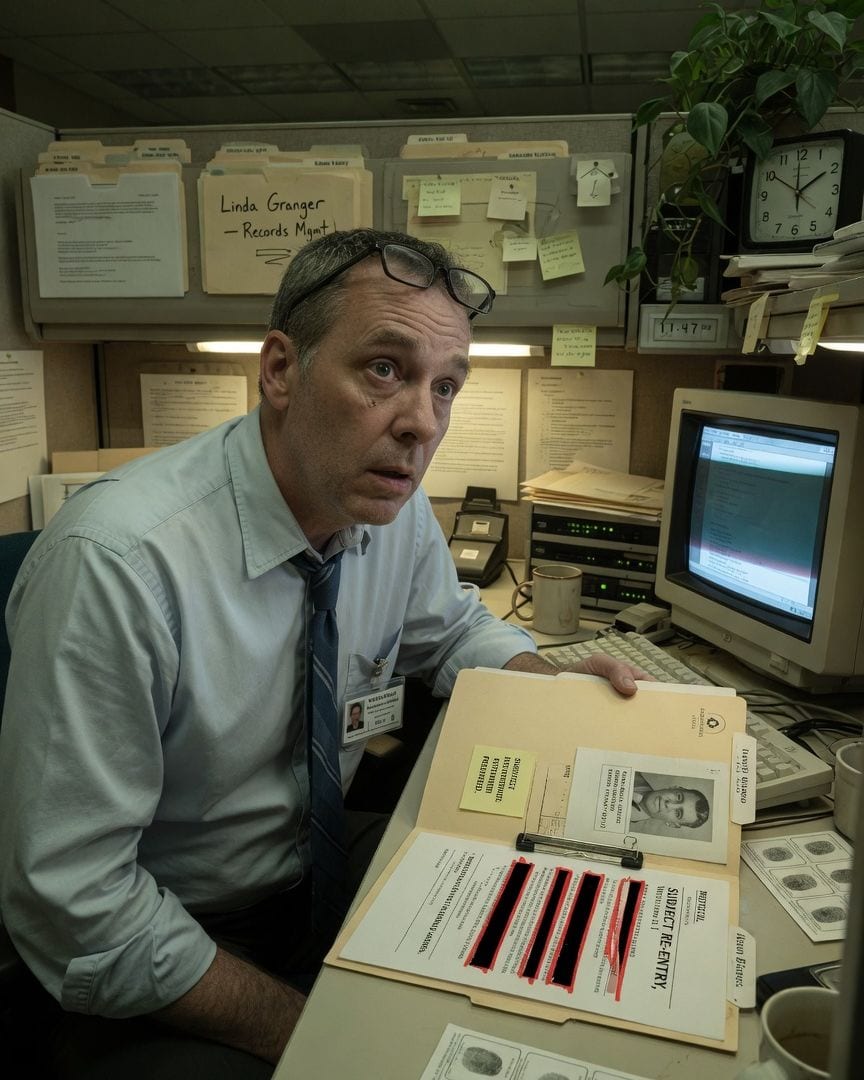
A declassification agent processed old Cold War files. A man reported dead in 1951 had 1958 fingerprints matching an employee badged into the building that morning.
Anton Skeel, a declassification agent nearing two decades of service, meticulously processed the endless backlog of Cold War secrets. His cubicle hummed with the ghosts of forgotten files, but one 'Hollow Bell' folder held a particularly glaring anomaly. It contained a 1958 fingerprint card for Henry Bishop, a man officially reported dead in 1951. When Anton fed the print into the active database, it matched Carl Romano, an employee badged into the building that very morning. A cold certainty settled over him: this wasn't an error, but a system designed for such impossible discrepancies.
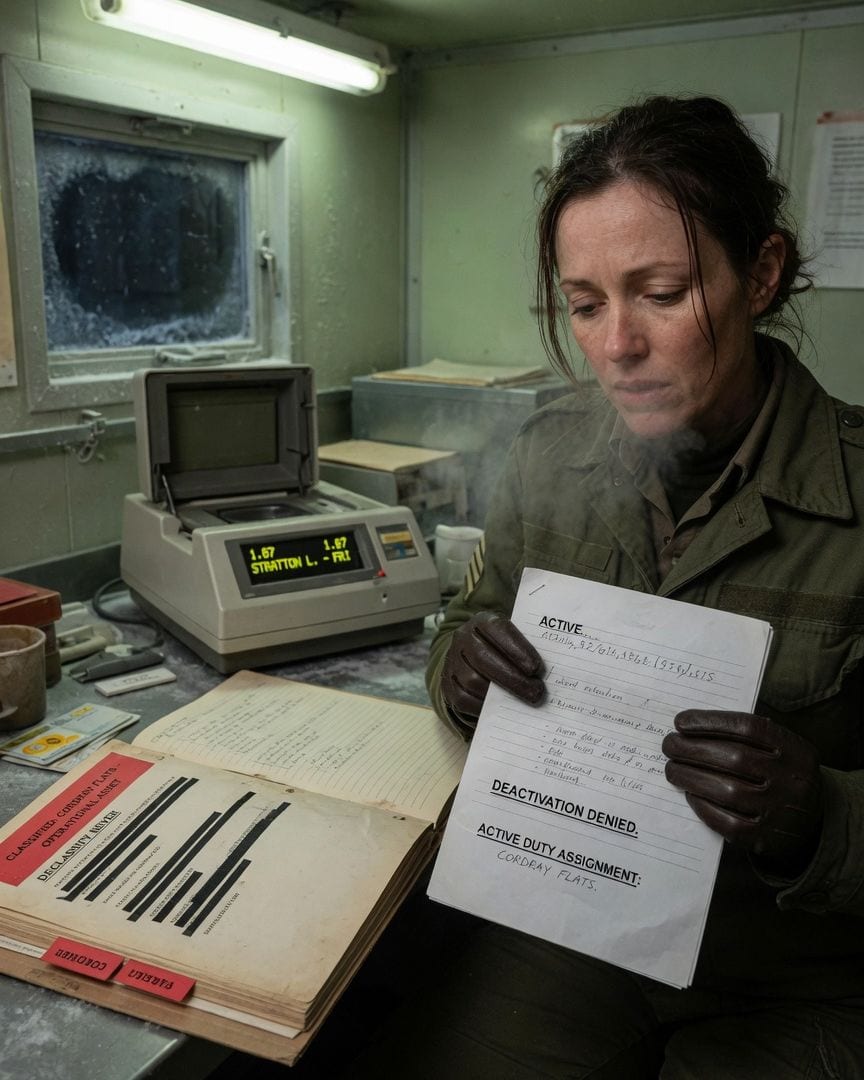
A dead researcher's Cold War film-badge was manually dated for active duty next Friday at Cordray Flats.
Corporal Hettie Vance moved like a ghost through the cold, empty Cordray Flats in the winter of 1988. The decommissioned range was quiet, her film-badge processing a rote exercise, until the 141st badge appeared. It belonged to Leonard Stratton, a research assistant who'd died in 1987, yet the scanner showed a full working exposure. Hettie found its date wheel manually reset for the coming Friday, and a secret file later confirmed an impossible directive: 'ACTIVE DUTY ASSIGNMENT: CORDRAY FLATS.' Who reset the badge, and for what purpose, on a range supposedly abandoned?
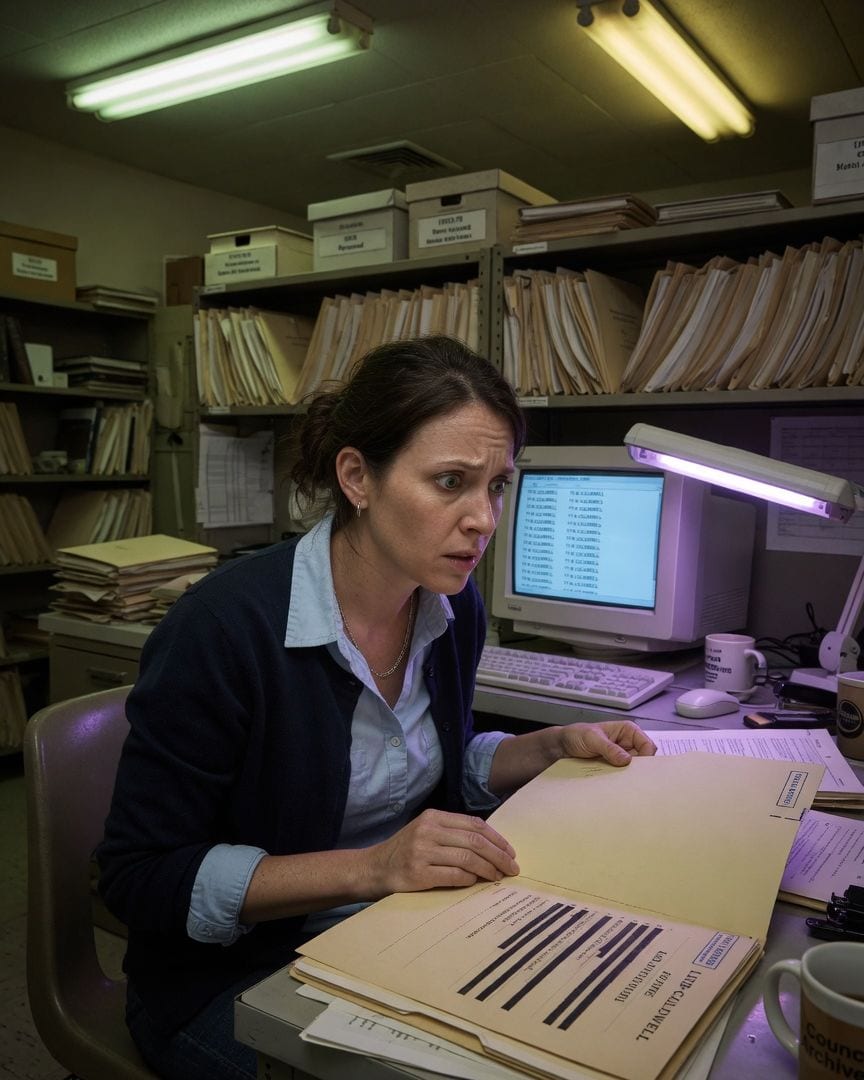
My employer's security file holds a vetting report on me dated nine years before I ever applied. It has my full name and my parents' address — with only one line, the source who referred me, blacked out.
Working a routine data audit, I pull my own security file. The issue date is nine years before I even applied for the job. Then, hidden within an old archive file, I find my current address etched under a blacked-out line.
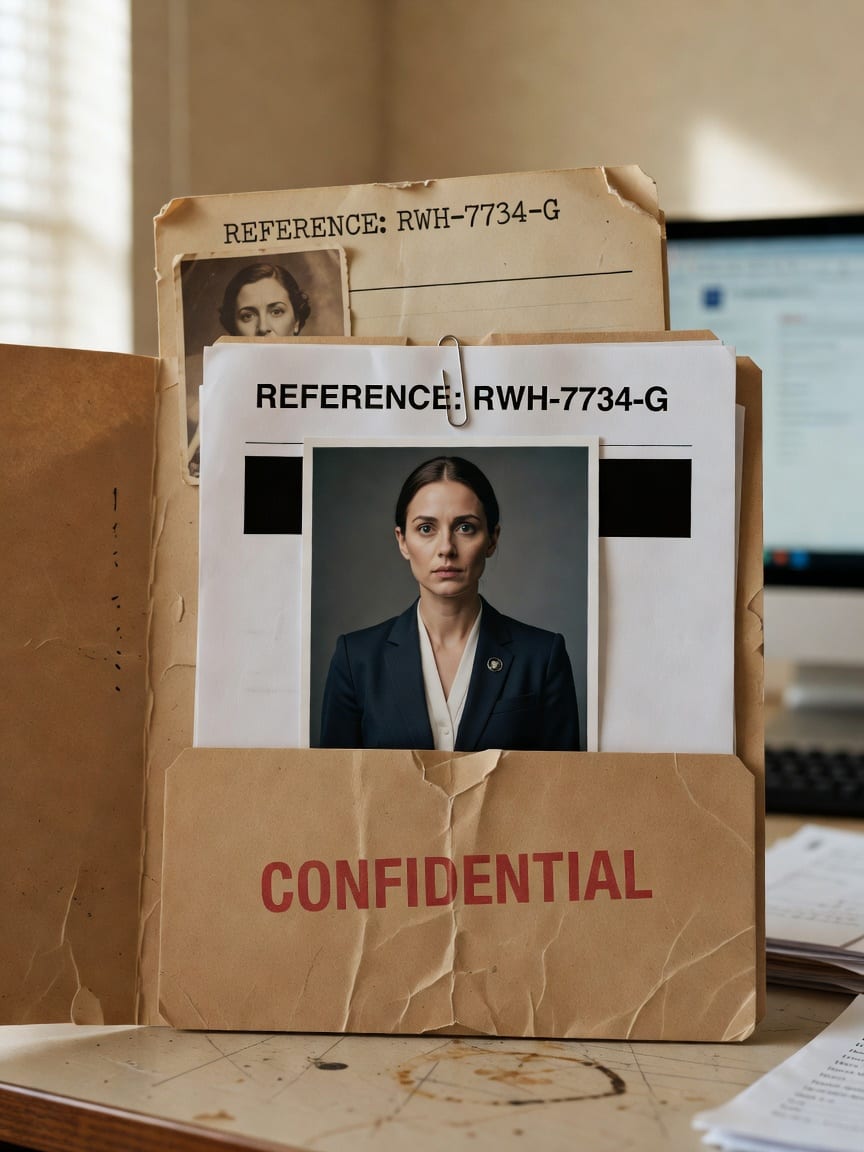
My security file was opened nine years before I was born. Its note said: 'subject not to be briefed'.
Auditing company digital records was routine until I pulled up my own personnel file. It clearly showed a 'Date Opened' nine years before I was born, yet bore my exact name and reference number. Below, an assessor's note from that impossible year mentioned a 'previous holder' and ordered the 'subject not to be briefed,' sparking a cold thrum in my chest.
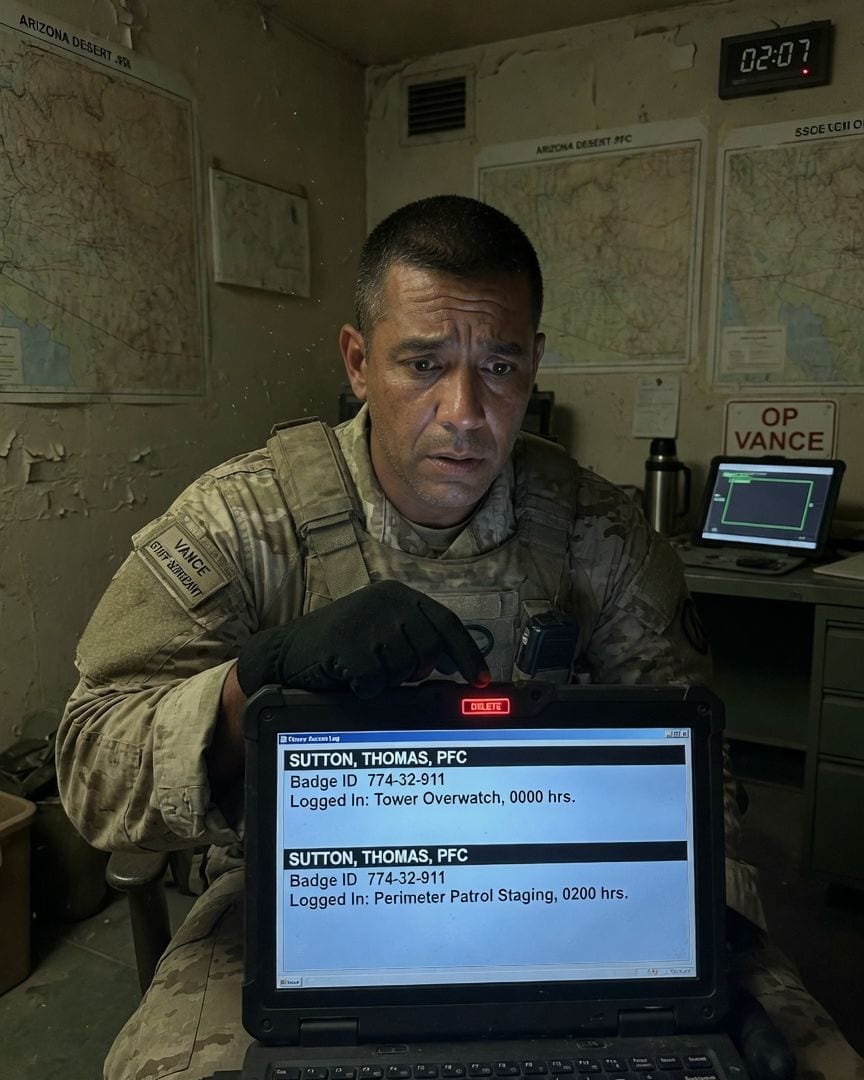
Two weeks from his rotation's end, Staff Sergeant Vance saw a fourth man report for patrol. The system then logged the same soldier in two places at once.
Staff Sergeant Eric Vance, 32, was just two weeks from finishing his rotation at Observation Post Vance, a lonely cluster of buildings in the Arizona desert. At 0200, scanning his thermal tablet for the perimeter patrol shift change, he expected three men. Instead, a fourth figure in full desert camo fell into line, moving with practiced efficiency. This Private First Class answered to the name Thomas Sutton, a soldier Vance knew was already logged in the tower on overwatch. Vance's rational mind struggled until the digital access logs confirmed an impossible truth: two identical entries for PFC Sutton, same ID, same timestamp, but from two distinct physical locations.
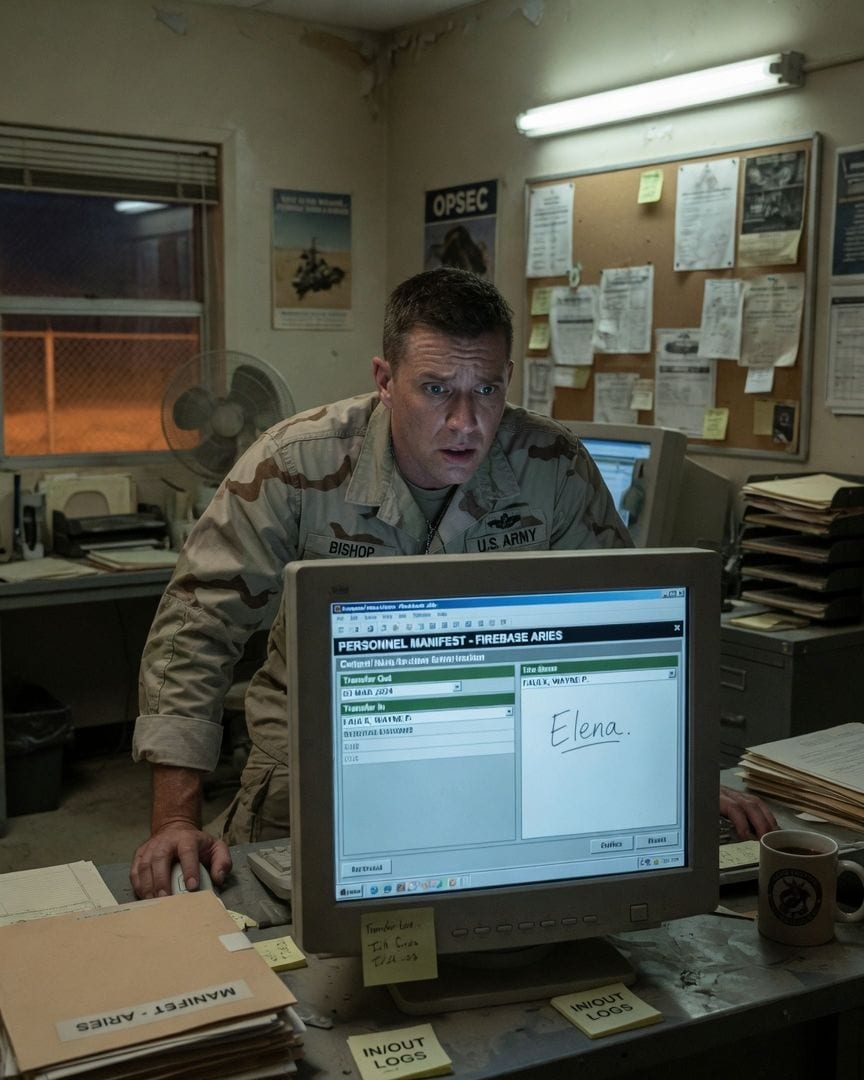
Corporal Bishop knew Private Faulk left months ago, but then saw him greet a new lieutenant by her restricted first name.
Corporal Henry Bishop, a man defined by precision, maintained the meticulous order of Firebase Aries. His world, a hum of servers and crisp paper, relied on every form, every detail being perfectly in place. But that order shattered when he saw Private Wayne Faulk, a soldier transferred out months ago, casually walking back as if he'd never left. Bishop's gut clenched tighter still when Faulk greeted a new lieutenant by her first name — a name Bishop had just processed as 'eyes only,' sealed tighter than a vault. Bishop then found a faint, unofficial 'Elena' scrawled next to Faulk's name, a secret whispered in the machine itself, fracturing the bedrock of his reality with an impossible equation.