Three weeks from leaving, Sergeant Hayes found a soldier in bunk 17. His file read: Pfc. Joel Sinclair, MIA since 1969.
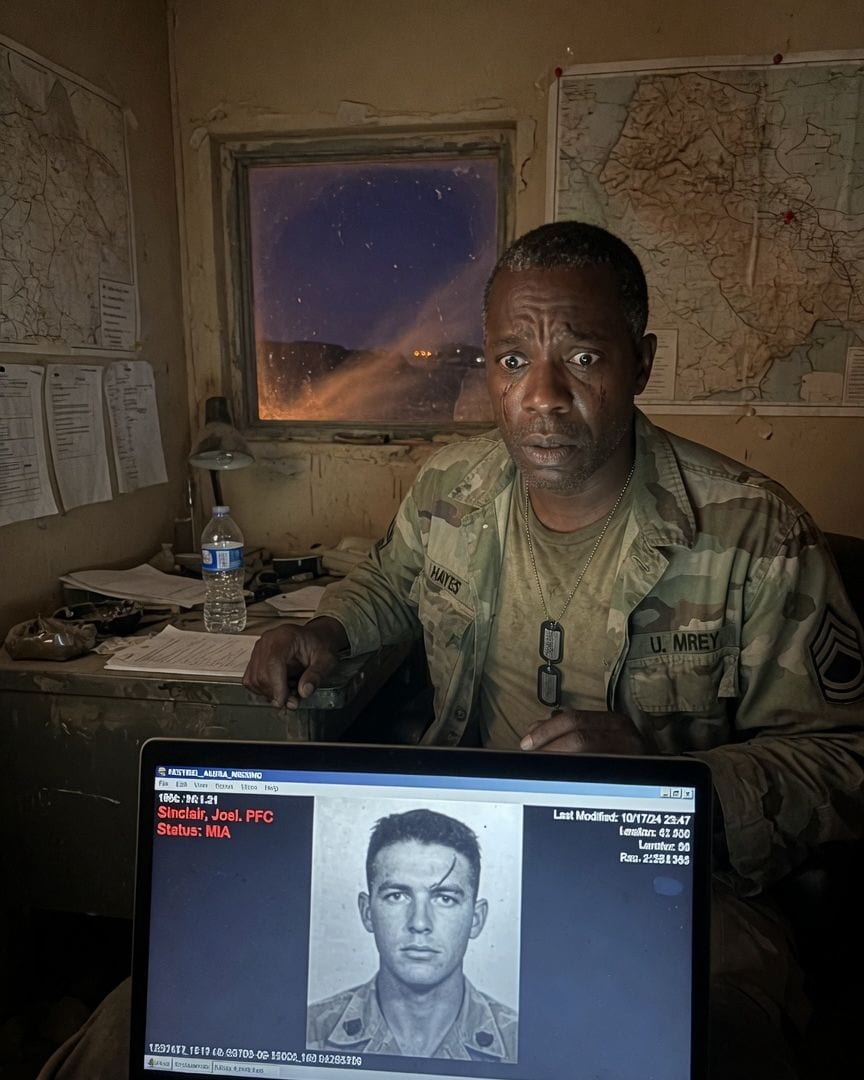
Sergeant Marcus Hayes ran the evening head count at Firebase Kestrel, the worn manifest flapping against his hand.
Three weeks from the end of his eight-month tour, he wanted nothing more than to be done with the endless desert and the grit that seemed to permeate everything.
The wind, a constant, abrasive presence, whipped dust across the parade ground, making his eyes water.
For eight months, every night had been the same: thirty-one men, thirty-one names, thirty-one faces against the purpling ridgeline as the sun dipped below the jagged horizon. Tonight, a Tuesday in October, the numbers didn’t square.
He called out each name, his voice raspy from the dry air. "Specialist Russo!" "Present, Sergeant!" "Corporal Galloway!" "Here, Sergeant!" Each man stepped forward, acknowledged, then fell back into line.
Hayes kept a tally on a small pad, watching their silhouettes. He counted them again, a quick sweep of his gaze down the rank and file. Thirty-two.
A cold knot clenched in his gut, a physical sensation that had nothing to do with the chill already settling over the desert.
Thirty-one bunks, thirty-one rifles in the rack, thirty-one sets of dog tags recorded in the official duty roster. Yet, when he called out the names on his manifest, every single man answered.
Not one name was missing from his official list, but there was one man too many.
Hayes tried to rationalize the impossible count. Had a new transfer arrived he'd somehow missed? A temporary attachment from a neighboring outpost?
He walked the barracks later, long after the men had settled into their bunks, his flashlight beam cutting through the dimness. He counted the bunks, checking names taped above each rack against faces in the sleeping forms.
Every face matched a name on his official manifest. Every man was accounted for, except for the impossible surplus. His gaze snagged on a Private First Class Joel Sinclair, sleeping soundly in bunk 17.
Sinclair had been with their unit since rotation, a quiet, competent soldier. But when Hayes looked at him, really looked, he couldn't quite place him. It was like a face glimpsed in a half-forgotten dream, both familiar and strangely indistinct.
Unable to sleep, the impossible count gnawing at him, Hayes accessed the base’s digital personnel roster from the command center. He cross-referenced every name, every service number against the base's active roster.
All thirty-one authorized personnel were there, correct and accounted for. There was no entry for a thirty-second. He tried searching for "Sinclair, Joel" again, thinking he might have mistyped the name.
This time, after a brief pause in the system, a hidden, corrupted folder appeared, tucked away in the historical archives. It was labeled 'KESTREL_ALPHA_MISSING.' Hayes felt a prickle of unease. Inside, a single file: 'Sinclair, Joel. Pfc.
SVC No. [a string of numbers different from any current designation]. Tour of Duty: 1968-1969. Status: MIA.' The file contained a grainy black-and-white photo. It was Pfc. Joel Sinclair.
The same face, the same distinctive scar above the left eyebrow, but fifty years younger, in an older-model uniform.
Hayes’s breath hitched. He checked the file’s metadata. The creation date was clearly marked 1969. The last modification date, however, was this morning. The timestamp flickered, showing a current time, then solidified, still showing the present day.
Hayes stared at the image of the young Pfc. Sinclair, then at the digital timestamp, then back at the name. The system's cursor blinked, steady and cold, next to 'Status: MIA.'
But the man was here, now, in the barracks, sleeping in bunk 17, just like he had been for months. Hayes slammed the laptop shut. The screen went black, leaving only his own reflection staring back, wide-eyed and terrified.
The next morning, Hayes tried to approach Sinclair, but the man was just… normal. He talked about his shift, complained about the chow. Sinclair’s easy conversation, his utterly unremarkable presence, made Hayes feel like he was going insane.
He decided to escalate, cautiously. He reported the "discrepancy" to Captain Constance Granger, his CO. Granger, a by-the-book officer, listened to his account with a practiced, neutral expression.
She dismissed it as a system glitch or a prank by one of the junior specialists. "You're three weeks out, Sergeant.
Fatigue," she said, but her eyes lingered on him a moment too long, a flash of something he couldn't quite decipher.
Hayes, however, had a lead. He remembered vague rumors from older sergeants about "ghosts in the machine" at Kestrel, old stories of desertions that didn't make sense, never adding up.
Ignoring Granger’s dismissal, he started digging deeper into the base’s physical archives, bypassing digital security. He spent hours in a dusty, forgotten storage room, the air thick with the smell of old paper and mildew.
He found boxes filled with brittle paper manifests, hand-written ledgers dating back to Kestrel’s establishment during the Vietnam War. He cross-referenced names, dates, and units from the old books with the current digital roster.
He found other 'MIA' entries from decades ago, names he'd seen on current rosters.
Specialist Samuel Russo, Corporal Oscar Galloway, even Sergeant Benjamin Fontaine from the ops center – all had older counterparts listed as MIA or "transferred without trace" in the old ledgers.
The faces, the names, the service numbers, eerily similar, sometimes identical. The impossible count wasn't just one man; it was a pattern, a recurring anomaly woven into the very fabric of Firebase Kestrel's history.
As Hayes spent more time in the archives, a subtle shift occurred. He started noticing things. Lights on in the ops center late at night, Captain Granger's shadow silhouetted against the window for hours.
He felt eyes on him during chow, a prickling sensation on the back of his neck that made him turn, only to see men looking away.
One evening, returning to his bunk after another session in the archives, he found his dog tags, which he always kept on his nightstand, placed precisely on his pillow, gleaming faintly in the low light.
A minor detail, yet utterly out of place, a silent message. He confronted Benjamin Fontaine, the ops specialist, whose name and an old 'MIA' entry Hayes had found in the historical files.
Fontaine just smiled, a slow, knowing smile that didn't quite reach his eyes. "Some things just... stay, Sergeant," Fontaine said, his voice flat, devoid of any real emotion. "Kestrel has a long memory."
Later, Hayes heard hushed conversations between Granger and Fontaine, their voices low, urgent, drifting from the partially open door of the command center. He caught fragments: "...the new one's digging..." and "...the count must be maintained..."
The dread tightened its grip, a cold fist around his chest. He was no longer just investigating a glitch; he was uncovering something the base's command knew about, something they were actively concealing, and he had been noticed.
His impending departure date, once a comfort, now felt like a deadline, or a trap being set.
Hayes decided to force a confrontation. The next afternoon, he approached Captain Granger in her office, printouts clutched in his hand.
He laid them on her desk: the current roster, the historical MIA files, the impossible count from Tuesday, and the consistent pattern of "extra" men matching those lost decades ago. Granger's composed facade finally cracked.
She stared at the documents, then at Hayes, her lips pressed into a thin line. "You've been digging where you shouldn't, Sergeant," she said, her voice low and strained.
The air in the small office seemed to thicken, pressing down on them. "Kestrel... it’s different. It keeps its own books." She explained, reluctantly, that Firebase Kestrel had a unique, inexplicable property. It didn't just hold ground; it held personnel.
Soldiers who served there and were lost, particularly those who died or went missing on or near the firebase, were somehow "re-registered" into the current active manifest. They appeared physically present, answered roll call, interacted, but existed outside official accountability.
The base command had known about it for decades, passing down the "truth" through a select few.
They maintained the illusion of a normal count, quietly integrating the "extra" men, because the alternative – trying to remove them, or fighting the phenomenon – had always resulted in worse outcomes, often involving more disappearances.
She pointed to a faded map on her wall, showing the firebase superimposed over an ancient geological fault line, a place of convergence, she explained.
It’s not ghosts, she insisted, but a form of "accountability that cannot be denied," a permanent manifest held by the land itself. The extra men were the firebase’s way of keeping its records straight, its own unshakeable roster.
Granger finished, her face pale, her gaze fixed on the map. "You understand, Sergeant, why this stays here." Hayes nodded, the pieces of the impossible puzzle clicking into place with a terrifying, coherent sense.
The missing files, the knowing smiles, the impossible counts. It all made sense. He was about to leave, his mind reeling, when Granger stopped him. "There’s one more thing. A tradition, of sorts.
When a new CO takes over, they are shown the original manifest. The one that started it all." She led him to a small, heavy safe hidden behind a loose panel in her office wall.
With trembling hands, she retrieved a worn, leather-bound ledger. "This is Kestrel’s true roster," she whispered, her voice barely a breath. "The first names, the ones who laid the foundation."
Hayes took the book, its pages brittle and yellowed with age, the smell of old paper filling his nostrils. The first entry was dated 1965. He scanned the names, a list of sergeants, corporals, privates.
Then, halfway down the first page, he saw it. Handwritten in faded black ink, his own name. "Hayes, Marcus, Sgt. SVC No. [his exact service number]. Assigned to Kestrel. Permanent."
He stared at the page, then at his own dog tags, clutched in his other hand. The cold dread turned to ice, seizing his lungs. He was never just counting them. He was always one of them.
The full truth detonated in Hayes’s mind. Captain Granger watched him, her face etched with a weary resignation that he now understood completely.
"It’s not just about those who died here," she explained, her voice barely audible, as if the words themselves were heavy with years of unspoken horror. "It's about those who were always meant to be here.
Kestrel chose its own long before they were born. The count isn't just a record of the present; it's a prophecy, a fixed destiny."
She revealed that the original manifest wasn't just a list of the first crew; it was the firebase's foundational "accountability" ledger, written by an unknown hand, containing the names of all who would ever serve there, and some who would serve "permanently."
Hayes's service number, issued decades after the manifest was created, was identical to the one beside his name in the old book.
The "extra" men like Sinclair weren't just absorbed from the past; they were manifestations of Kestrel’s unchanging roster, called forth when their "slot" became available or when the base needed to reinforce its numbers.
The initial impossible count of 32 was Kestrel re-asserting its own, ancient claim, adjusting its visible roster to match its true, fixed one. His upcoming departure date was meaningless. He was always "assigned to Kestrel. Permanent."
Hayes felt a profound, terrifying calm settle over him. He didn't fight, didn't rage. He understood. There was no escape.
His entire service, his whole life, had been a meticulously pre-written journey leading him to this desolate spot, to this impossible truth. He looked at Captain Granger, who finally looked away, unable to meet his gaze.
He left her office, the heavy book still clutched in his hand. He walked back to his bunk, past Samuel Russo, past Oscar Galloway, past Joel Sinclair, all of them now revealed as fellow members of Kestrel’s true, eternal complement.
He saw them not as men, but as living entries in an unshakeable ledger. He didn't pack his bag. He didn't call home. The next morning, he joined the head count. Sergeant Marcus Hayes called out the names.
Thirty-two men answered. He stood among them, a part of the count, a part of the impossible. He was no longer counting them. He was being counted.
He felt the desert wind on his face, the familiar dust in his mouth. He was home now, in a way he never expected.
Three weeks later, the day Sergeant Hayes was supposed to leave Firebase Kestrel, his replacement arrived. Captain Granger personally escorted the new sergeant, a young woman named Annika Walsh, through the base. Hayes was present, standing in formation.
He nodded to Walsh, his expression unreadable, then fell back into line. His personal effects had been quietly packed and shipped, his bunk stripped. But he hadn't left. His name was still on the daily manifest.
Walsh, looking at the official roster, noted the count of 31. She ran her first evening head count. Thirty-two men answered. She frowned, then ran it again, her brow furrowed in confusion.
Sergeant Marcus Hayes watched the new sergeant, Annika Walsh, run her count again, a faint, wrong smile on his lips. He was home now. He was always home.
If this one got to you
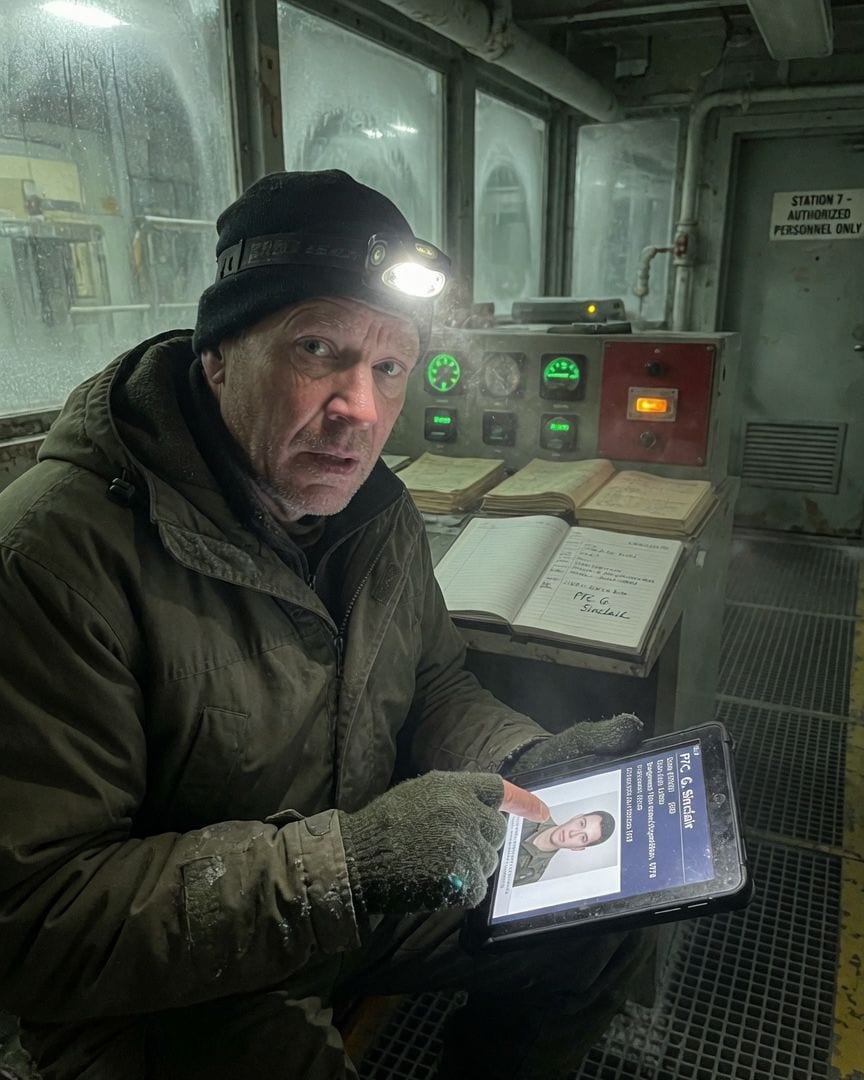
Chief Warrant Officer Ellison found a log signed last week in a Greenland Cold War base decommissioned in 1967, by a soldier MIA since 1978.
Chief Warrant Officer Franklin Ellison was two days from ending his Greenland deployment when his final core probe plunged into an unexpected void. A strange warmth and humid scent rose from the shaft, revealing the long-abandoned Station 7 below, its plant room surprisingly active with glowing gauges and a rhythmic hum. Ellison discovered an open shift log, its last entry, dated for the previous week, signed in fresh ink by PFC. G. Sinclair. Yet, a quick database check revealed Sinclair was reported Missing in Action in 1978, years after the station was officially decommissioned. How could a soldier missing for decades have signed a log last week in a base abandoned for half a century?
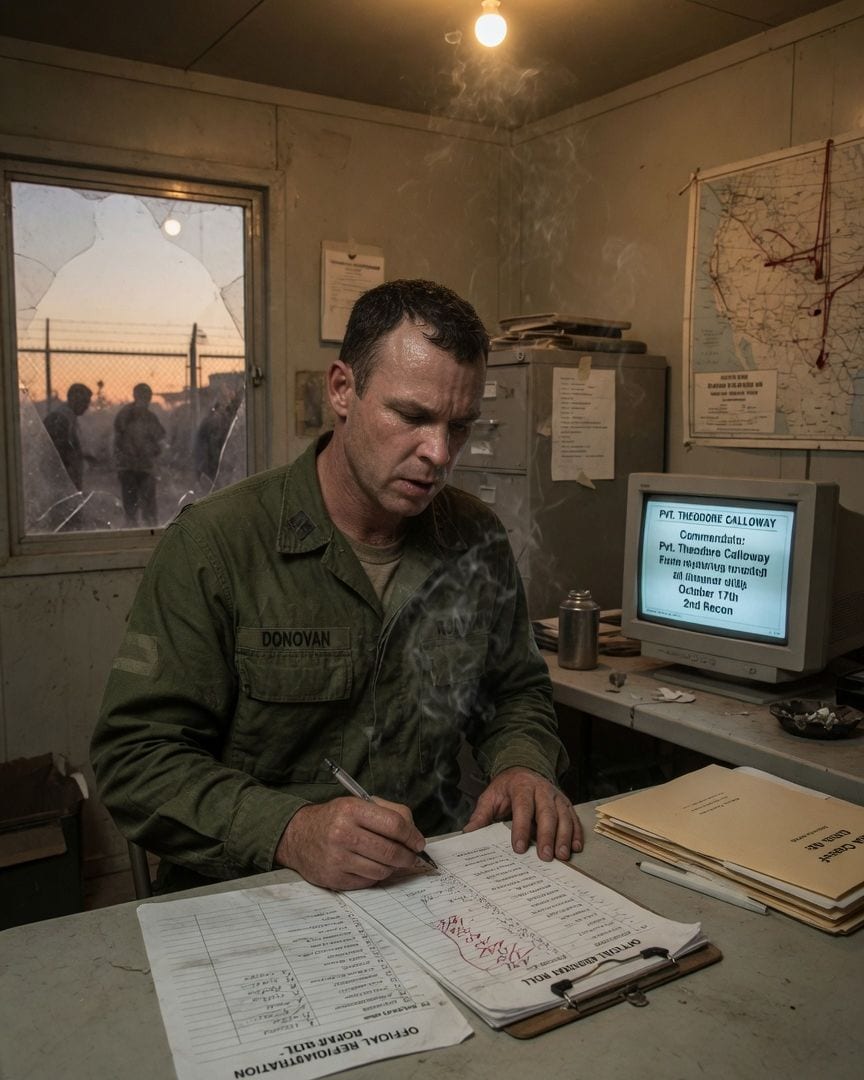
A Corporal counted the returning prisoners, but his tally came out one man too high, a private with no official record.
Corporal Raymond Donovan stood amidst the dust and tired murmurs of the repatriation camp, his duty to verify every returning prisoner. He meticulously tallied names against the official exchange lists, but his physical head count came out one man higher than expected. A Private Theodore Calloway appeared, gaunt and exhausted, yet his name was nowhere on Raymond’s carefully organized records. Sergeant Jennings dismissed it as a forgotten grunt, but Raymond knew better; Calloway's official service record, though pristine, contained an impossible detail: a commendation date for an operation his unit had left a month prior. What impossible timeline had this private stumbled into?
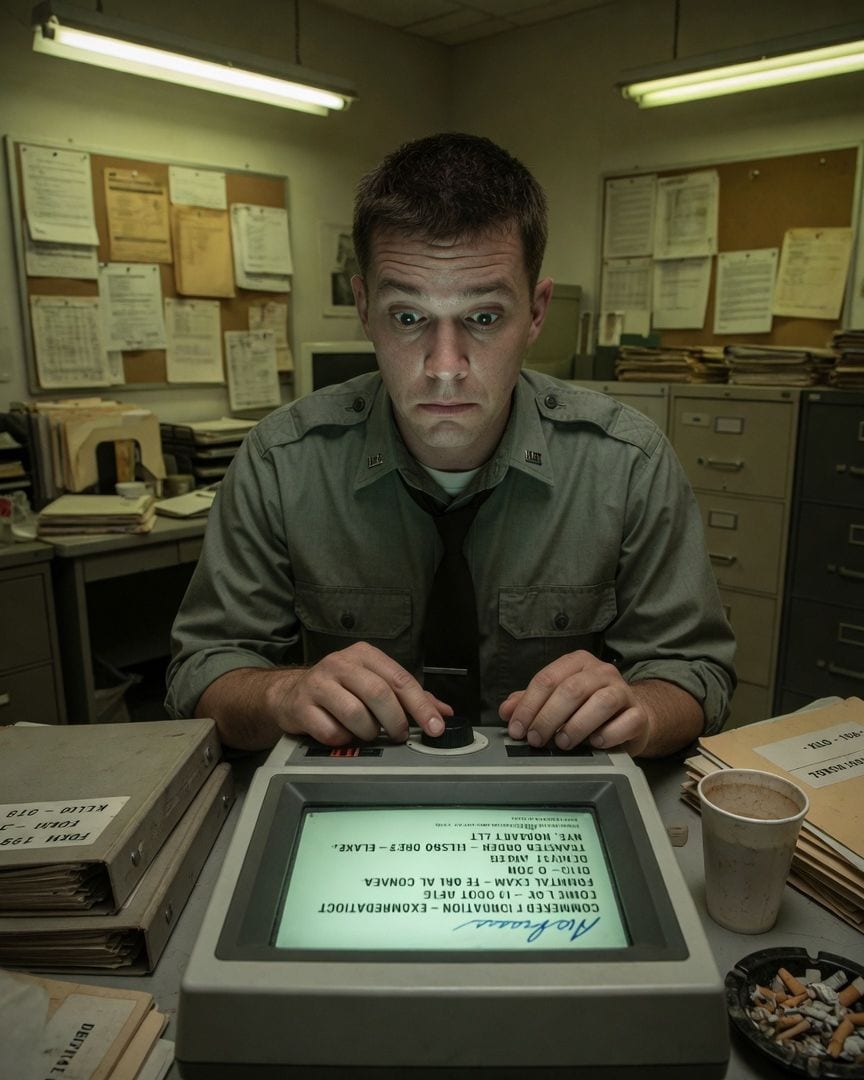
A missile commander watched his ten nuclear silos go dark. His own service record shows his signature on a future he's never lived.
Second Lieutenant Hobart Nye, a missile commander in Wyoming, had his quiet 0247 watch shattered by a security report: a massive, silent black triangle hovered over Launch Facility Kilo, casting a perfect shadow. Hobart watched his console's fault panel light up, signaling all ten nuclear missiles going dark in an impossible silence, followed by eleven minutes his security team could not remember. Official logs called it a "radio malfunction," but Hobart found a requisition for invisible-tracking sensors, signed by a base commander who was supposed to be off-base. The final, chilling discovery came when his own service record showed new entries—a dental check-up, a transfer to Alaska—all dated for a future he never lived, complete with his perfectly replicated signature.
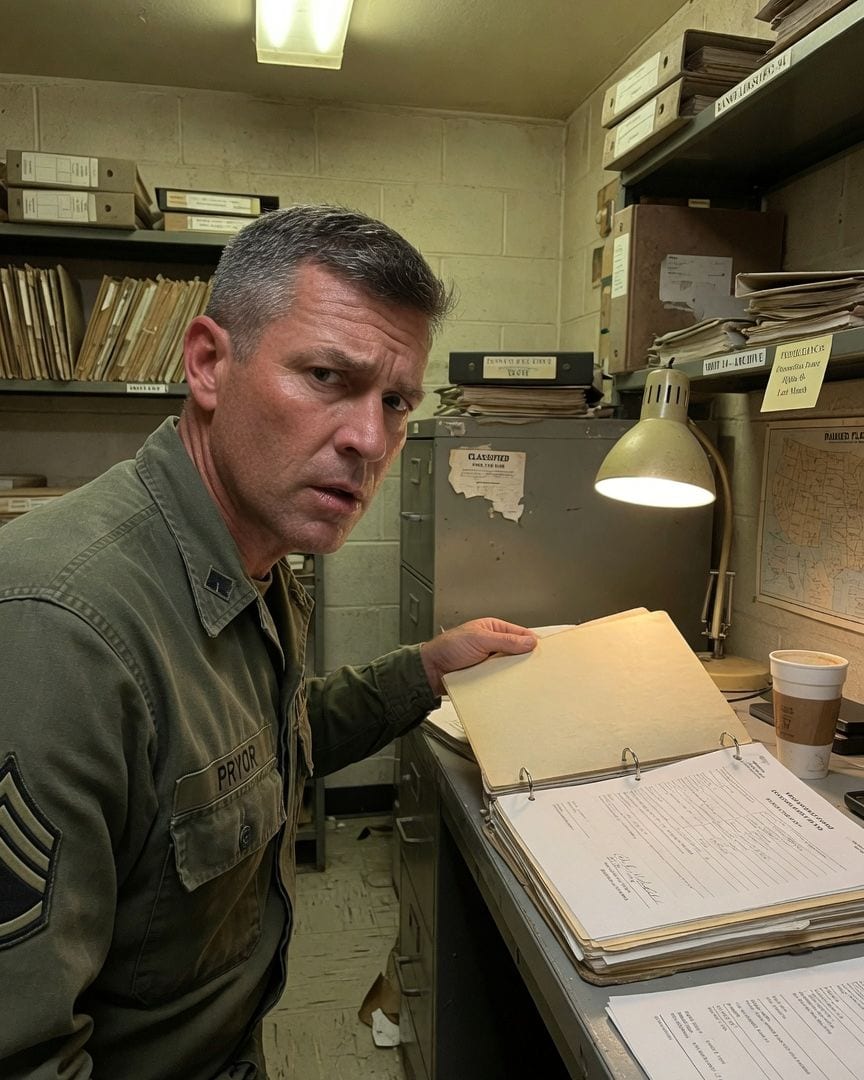
A sergeant with eleven days left finds a warm, glassed crater. Its file shows a captain lost thirty years ago is still signing reports from last week.
Sergeant Alden Pryor was counting down his final eleven days on a twenty-year hitch, expecting to spend them on routine patrols along the Ranier Flats fence line. Instead, his truck stopped at a bizarre sight: a four-hundred-foot glassed crater, miles from anywhere, its sand faintly warm at dawn despite no one recalling a blast. The air above it shimmered with an unnatural distortion, a silent scar of erased violence, and the official file for 'Shot 14' showed recent maintenance sign-offs for a decommissioned tower at the crater site. All these active documents were signed by Captain Everett Caldwell, who had been officially lost in operations thirty years ago, leaving Sergeant Pryor to wonder how a dead man could still be filing reports.
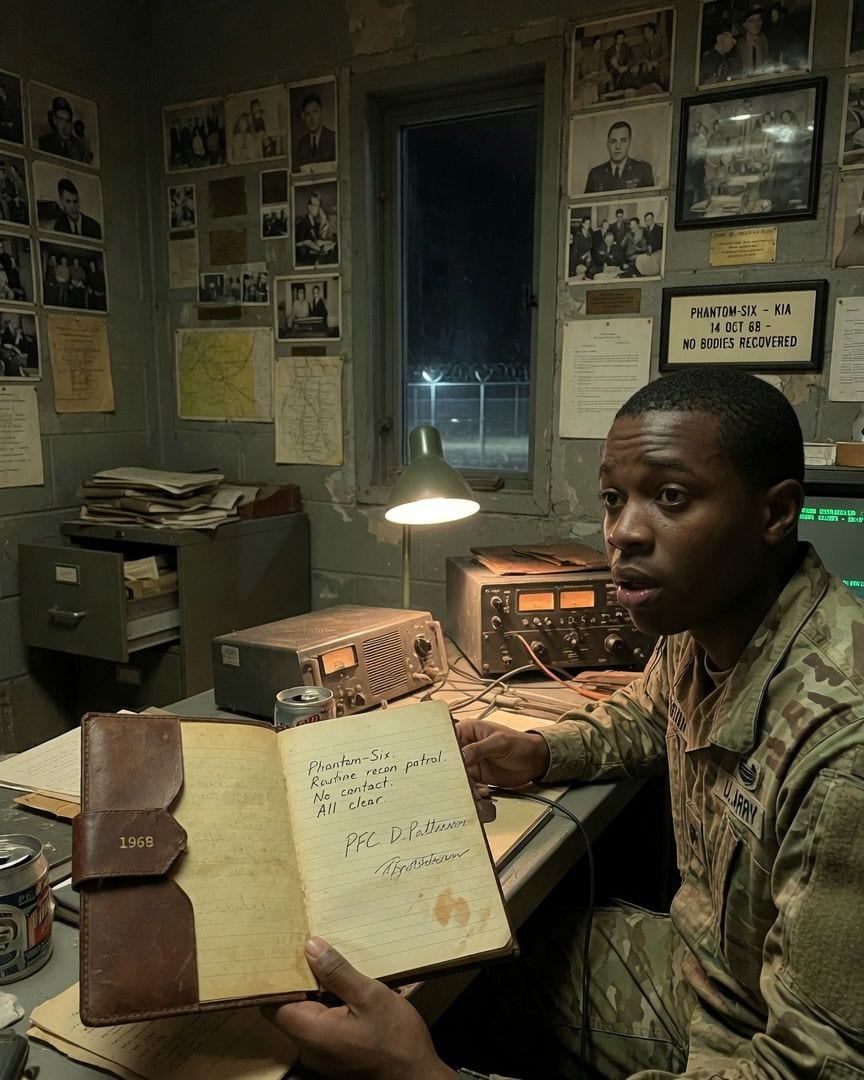
A DMZ specialist finds a 1968 Cold War logbook entry, signed by a lost soldier, its ink shimmering faintly.
Specialist James Farr, on a long night shift at a desolate Korean DMZ outpost, meticulously monitored his console, a squared-away soldier accustomed to the quiet hum of equipment. His focus shattered when a faint, static-laced whisper ghosted from a dead channel, calling out 'Phantom-Six' — a unit lost near this wire in 1968. The urgent voice then specifically mentioned his tower window light, asking him to turn it off before it drew fire. Later, an old logbook from 1968 revealed an entry dated three days *after* Phantom-Six was officially lost, signed by one of the vanished soldiers, its ink subtly shimmering with an unnatural gleam.
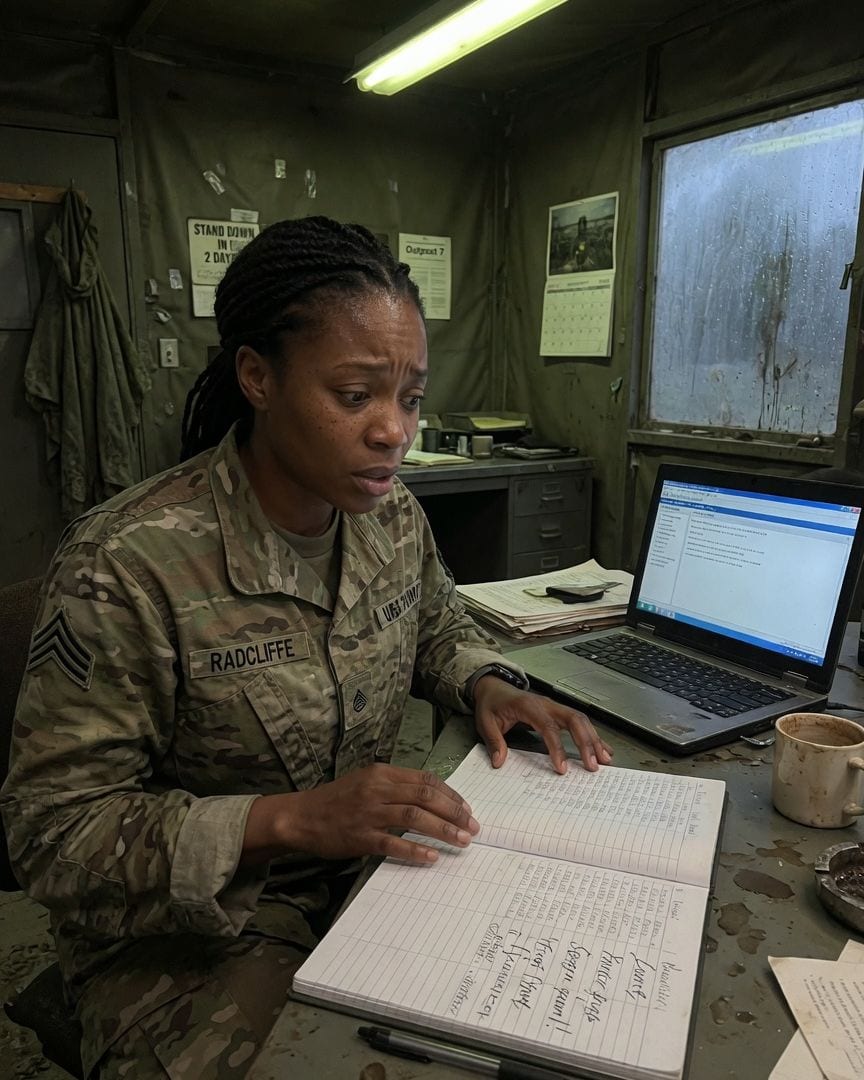
Two days before Outpost 7 closed, Staff Sergeant Radcliffe's roll call counted 42 men, but 43 voices answered.
Two days before Outpost 7 was set to stand down for good, Company First Sergeant Nora Radcliffe conducted her morning roll call. For three years, she had known all forty-two faces and voices by heart, but in the damp dawn air, a forty-third voice answered to a name not on her list. Back in her office, she found that same impossible name, 'Everett Lawson,' added to the official duty log in her own unmistakable handwriting. As the fluorescent lights hummed, her search of the digital personnel system revealed a skeletal record for Lawson, complete with a basic training certificate signed by her training officer—who had retired a decade before the certificate's date. What impossible truth had Nora stumbled upon as her outpost prepared to close?