My webcam feed showed the Maris, lost with all hands in 1974, tied at the Mallaig pier. Then I heard its voice.
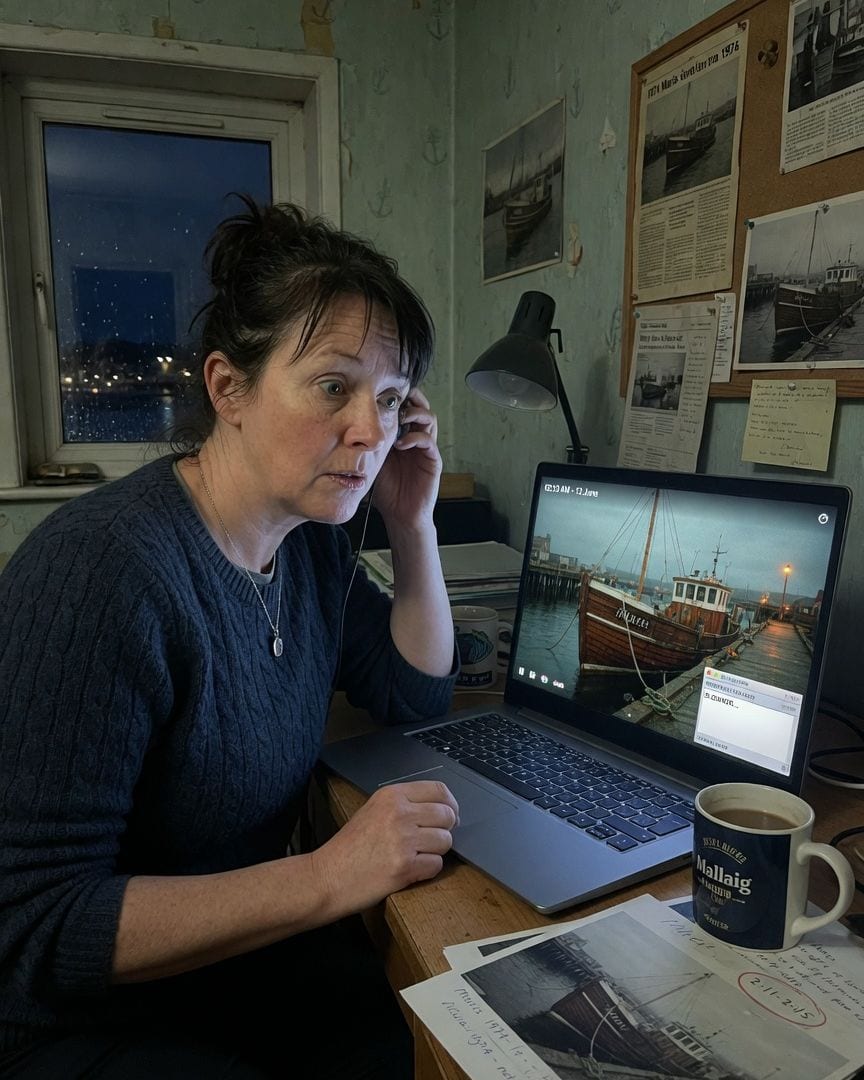
I still start my mornings with coffee and the Mallaig sailing club's public webcam feed. Habit, mostly. It usually shows the same tranquil harbour scenes: gulls on the pilings, a few fishing boats bobbing, sometimes a ferry docking.
But one June morning, a few weeks back, I saw something that just… stopped me.
There was a series of stills, timestamped between 2:11 AM and 2:14 AM. In each one, clear as day, was a fishing trawler tied at the pier. Not just any trawler, either. It was the Maris.
The old wooden hull, the distinct rigging, the name painted on the bow – no mistaking it. I blinked, then refreshed the page. The 2:15 AM frame showed the pier empty again, as it should be.
The harbour was exactly as I’d expect it.
But the Maris… that boat went down with all hands in 1974. Lost at sea, off the Isle of Muck.
Its name, and the names of its four-man crew, are etched into the stone memorial by the slip, a permanent reminder of Mallaig's loss. I'm a local historian, so I know these things.
I’ve catalogued the original reports, the telegrams, the families’ grief.
I tried to rationalize it. A glitch in the upload. A trick of the light, an old photo somehow overlaid onto the live feed, though the timestamps were sequential. Maybe a reflection of something? But the boat was there.
Ropes tied to the cleats on the pier. The specific, aged hull, even the barnacles, looked right for a boat of that era.
The sheer, quiet wrongness of it, a vessel that couldn't possibly be, sitting in plain view, made my stomach clench. It was like seeing a photograph of a dead relative, walking around in your kitchen. Only this wasn't a photo.
It was from a live feed, minutes apart.
Unable to dismiss the images, I leveraged my contacts in the local council – being the town’s de facto archivist has its perks – and got access to the sailing club’s archived server logs.
I didn't want the public stills; I needed the raw data. Specifically, the full minute-by-minute video files from that night in June.
My hands felt a little damp as I downloaded the files to my laptop. The night was overcast, but there was enough ambient light from the town to see the pier. I clicked play on the 2:11 AM clip.
My breath hitched. The Maris wasn't just appearing, like a photo. It was moving. Slowly, silently, it glided toward the pier, a dark shape against the moonless water.
I could just make out faint figures on the deck, though they were indistinct, like shadows moving in shadows. The boat eased into its berth, the bow brushing against the worn fenders. A rope snaked out, secured to a cleat.
Another followed. The 2:14 AM frame, which had been just a still on the public feed, was a frozen moment from this very sequence.
Then, the 2:15 AM clip. The ropes were untied. The Maris pulled away, stern-first, then turned and vanished into the night as silently as it had arrived. It wasn't a glitch, not a reflection. It was a physical event, captured.
The boat had been there.
I rewound the clips, watching it happen again and again. That's when I noticed it. A barely perceptible audio track on the raw video.
Mostly wind and the soft lapping of water against the hull, but beneath it all, something else. A low, rhythmic hum. I isolated the audio for the three minutes the Maris was present, trying to clean the background noise.
My heart started a slow, heavy thrum that matched the hum in the recording.
I leaned closer to my laptop, the amplified audio from the webcam feed crackling through my headphones. The faint, distorted voice from the Maris's deck resolved into a single, chilling word, repeated twice. It wasn’t the wind. It was human.
I pulled the headphones away, my heart hammering, as the sound echoed in my mind: 'Eleanor… Eleanor…'
The word, my own name, vibrated in my head long after I’d ripped the headphones off. Was it a trick of the audio? My mind, desperate to make sense of the impossible, projecting my own fears?
I spent hours cleaning the file, running it through noise reduction, equalization, every audio trick I knew. But the word remained. Faint, distorted, yet clear enough to be unsettling. Eleanor.
I tried to find a connection, any logical thread. I dove back into historical archives, researching the Maris, its crew, and the exact circumstances of its sinking in 1974. I found old newspaper clippings, official maritime reports.
The list of the crew was clear: Captain Thomas Ashford, First Mate Isaac Radcliffe, and two other deckhands, Hamish and Dougal. No one named Eleanor.
Not among the crew, not among their families, not even a casual acquaintance mentioned in any of the countless local histories I'd ever read.
Desperate for any human connection, any explanation beyond the supernatural, I sought out Damien Holloway. Damien is an octogenarian retired fisherman, a Mallaig native whose memory is an encyclopedic map of the town’s seafaring past.
His face is a roadmap of weathered lines, a testament to decades spent battling the North Atlantic.
I found him mending a net down by the old fish market, his movements slow but precise. He remembered the Maris well. "Aye, Captain Ashford," he rasped, his voice gravelly. "Good man, for the most part.
But he had a strange gleam in his eye, in the weeks before… before she went down. Like he'd seen something he shouldn't. Or was looking for it."
Damien spoke of local superstitions, hushed tales of 'the sea claiming its own.' "And sometimes," he added, his gaze drifting out to the dark, restless water, "what's lost isn't always gone forever. Just… elsewhere."
I pressed him about anything unusual on the Maris's final voyage. Anything strange, any unusual cargo, any diversions from their usual fishing grounds.
He fell silent, his eyes darting to the window overlooking the harbour, a sudden, unfamiliar fear in their depths. "Some things," he muttered, "are best left buried." He wouldn’t say another word about it.
The next day, I found a small, folded note tucked under my car's windshield wiper. It was a single, typewritten sentence: 'Some things are better left undisturbed.' There was no sender, no signature. Just that chilling, impersonal message.
My conversation with Damien replayed in my mind, his sudden fear, his abrupt silence. It wasn’t just a random act. Someone knew I was digging.
I called Damien, but his wife, Hazel, answered. "He's not himself, Eleanor," she said, her voice strained. "Been agitated since you spoke to him. Refuses to talk about the Maris with anyone, even me."
A prickle of unease ran down my spine. It felt like I’d opened a door that should have remained shut.
Later that week, while researching old port records at the local library, I noticed a man. He was in a dark, nondescript coat, partially obscured by a stack of old journals on a neighbouring shelf.
He wasn't overtly staring, but I kept catching his gaze on me when I looked up. He didn't approach, just watched.
When I turned to face him directly, he quickly turned away, blending into the shelves, affecting an air of casual browsing.
The incident left me deeply unnerved. The anonymous note, Damien's sudden, pronounced fear, this quiet watcher – it coalesced into something far more sinister than a mere historical oddity. Someone knew she was digging, and they wanted her to stop.
The dread was no longer abstract; it was personal.
I decided I couldn't back down. The fear was a sign I was getting closer to something real.
I found Damien Holloway fishing alone a few days later, on a remote, rocky part of the coast, far from the usual tourist spots and, crucially, away from prying eyes.
He was hunched over a line, staring out at the grey expanse of the sea.
I walked up to him quietly and, without preamble, pulled out my laptop. I showed him the webcam footage of the Maris – the boat moving, mooring, then vanishing. His weathered face went ashen, reflecting the screen's pale light.
"It's real then," he whispered, his voice thick with old fear. "I heard the whispers for years, but never… never thought I'd see it myself."
I pressed him about the voice, the name. "It's not your name, lass," he said, shaking his head. "It's the calling. The deep hum."
He then recounted a local legend, one hushed up for generations, never written down, passed only in frightened whispers among fishermen. The Maris wasn't the first vessel lost to 'the deep hum.'
Every few decades, a ship would disappear without a trace, only to be 'seen' again, briefly, at the pier, sometimes with the crew. "They'd be… different," Damien said, his gaze fixed on some point in the distant past. "Quiet.
Moving like sleepwalkers. And they'd always unload something before they left for good."
He described a specific incident from the early 1900s, a whaling ship, the Audra, that returned briefly after being lost in a storm.
Its crew had been "like empty men," silent, disembarking a "heavy, dark stone" before sailing away into the fog, never to be seen again.
This stone, he explained, was believed to be 'the Heart of Mallaig,' an ancient relic, found in the deepest trench, said to hold the 'whispers of the deep.'
He looked at me, his eyes filled with a weary knowledge. "Captain Ashford, he was obsessed with finding it. Thought it would bring prosperity, endless catches. Not doom. The Maris, Eleanor, she recovered it on her last voyage.
That's why it came back. And that's why it took them."
He revealed that after the Maris sank, and then returned, the town council, terrified by the impossible event, had confiscated and quietly 'disappeared' the 'Heart of Mallaig' and any records of its impossible return.
They didn’t want Mallaig to be known as the place where the dead came home.
Damien, exhausted and visibly relieved to unburden his secret, pointed me towards a forgotten corner of the old municipal archive. "The old Harbour Master, William Underwood," he rasped, "he kept everything. Even the things they tried to erase.
His personal logbooks might still be there."
I thanked him, my mind reeling, then drove straight to the archive. The place was a dusty, neglected labyrinth of shelves and forgotten papers, a bureaucratic graveyard. The air was thick with the scent of old paper and mould.
I navigated the narrow aisles, my flashlight beam cutting through the gloom, past boxes of forgotten tax records and defunct permits.
Finally, tucked away behind a stack of brittle council meeting minutes from the 1950s, I uncovered a thick, leather-bound volume. Its spine, cracked and faded, read: 'Mallaig Harbour Master's Daily Log – 1974.'
My heart pounded against my ribs as I flipped through the brittle, yellowed pages. I found the official entry marking the Maris as 'lost at sea' on June 10th, 1974.
The cold, precise handwriting detailed the date, the last known position, the declaration. It was exactly as I remembered from the newspaper clippings.
Then, my eyes landed on a later page. An entry, dated June 12th – two days after the Maris was officially declared lost.
It detailed its arrival at the pier, the crew — all known dead — disembarking, and the unloading of a specific, heavy, dark stone.
I stared at the impossible record, the mundane, official handwriting a stark contradiction to the known facts, her breath catching in her throat.
I pored over the impossible logbook entry, my fingers tracing the faded ink. It was written in the meticulously neat hand of the late Harbour Master, William Underwood, a man known for his rigid adherence to protocol.
The entry detailed the Maris's "return to port" on June 12th, 1974, at 2:11 AM. It listed Captain Ashford, Isaac Radcliffe, Hamish, and Dougal by name, all described as "unusually quiet, almost dazed, with a peculiar detachment in their eyes."
The entry went on to describe them unloading a "large, smooth, dark stone, humming faintly with a strange inner light." Underwood himself had supervised its transfer, noting its surprising weight and the subtle, rhythmic pulse he felt radiating from it.
He’d had it "secured in the municipal strongroom, as per Captain Ashford's insistence." The log concluded with a chilling detail: Underwood noted that Captain Ashford, before departing again, repeatedly muttered, his voice flat, "It calls to us. It calls."
Every clue clicked into place with a sickening thud. The Maris wasn't a ghost ship; it was a physical echo, drawn back to the pier by a powerful, localized temporal anomaly. This anomaly was centered around 'the Heart of Mallaig.'
The "second voice" I heard on the webcam audio wasn't speaking my name, but "the calling" – the faint, resonating hum of the stone itself, an echo of the doomed crew's final, desperate moments as they succumbed to its influence.
The temporal anomaly wasn't random; it was tied directly to the artifact. The Maris's appearance on the webcam was simply the latest replay of a recurring, impossible event, a ripple from the stone's power, a moment repeated across time.
Armed with the logbook and Damien's harrowing testimony, I knew what I had to do. I confronted the current Mallaig town council. The meeting was initially dismissive.
I was Eleanor Hughes, the historian, known for her obscure finds, not for wild tales of ghost ships and cursed stones. But when I presented the original, hand-written logbook, its official nature undeniable, the room fell silent.
They passed it around, each face growing paler. The dates, the Harbour Master's signature, the precise details – it was impossible to ignore.
After a heated, hushed debate, they grudgingly granted me access to a long-forgotten sub-basement beneath the old municipal building, a place sealed off decades ago, its existence barely remembered.
Descending into the damp, cold darkness, the air thick with the smell of earth and decay, I felt a knot of anticipation and dread tighten in my stomach. My flashlight beam cut through the absolute black.
In the center of the small, vaulted room, stood a single, heavy, lead-lined crate.
I worked at the rusted latches, my tools scraping loudly in the oppressive quiet. Finally, with a groan of metal, I pried it open.
Inside, nestled on what looked like faded, rotting velvet, was the object described in the log: a smooth, dark, ovoid stone, roughly the size of a human head. It absorbed the light, yet seemed to shimmer from within.
It hummed faintly, a low, resonant thrumming vibration I could feel deep in my bones, like a distant engine.
As I gazed at its polished, inscrutable surface, I saw a faint, almost imperceptible image shimmering within the stone's depths. It was the Mallaig pier, seen from the perspective of a boat, the water lapping gently against wood.
It was a live, impossible reflection of the present, captured within the stone, twisting perspective.
I reached out, my fingers trembling, and touched the cool, smooth surface. The hum intensified, vibrating through my fingertips, up my arm.
I felt a profound sense of longing, a whisper of voices, drawing me in, promising something ancient and terrible. It was real, checkable, and terrifyingly active.
The ordinary explanation died for good, not with a bang, but with a low, resonant hum. The artifact was the source, and it was still working.
I ensured the 'Heart of Mallaig' was re-sealed, reinforced with additional lead shielding, and moved to a deep, undisclosed location far from the harbour, a place that would never see the light of day.
The Maris never reappeared on the webcam. The town council, shaken to its core by the undeniable evidence, agreed to quietly remove any remaining memorials to the Maris, hoping to sever the last physical ties to the past.
The incident was officially dismissed as a 'local legend' and a 'misinterpretation of outdated records,' but the quiet, terrified understanding of what truly happened settled over Mallaig like a permanent, cold fog.
I, for my part, kept the original logbook entry, a tangible piece of the impossible truth.
Months later, I walked along the Mallaig pier with my husband, Ronald, the evening air crisp and clean. The harbour was quiet, the webcam feed now showing only empty water and the occasional fishing boat.
I lived with the knowledge, a quiet, heavy burden that sometimes made the world feel thinner, more permeable than it should be.
Nathaniel Holloway, Damien's grandson, passed us, pulling in his lines from a small skiff, his face weathered but young. He nodded a greeting. "Still hear it sometimes," Nathaniel said, casting a glance at the dark, still water. "That deep hum.
Especially on still nights, when the tide's low. Like something calling from down below."
I smiled faintly, a chill running down my spine. The answer is worse than the question. She knows what he means. She knows where it comes from. And she knows it's still there.
If this one got to you
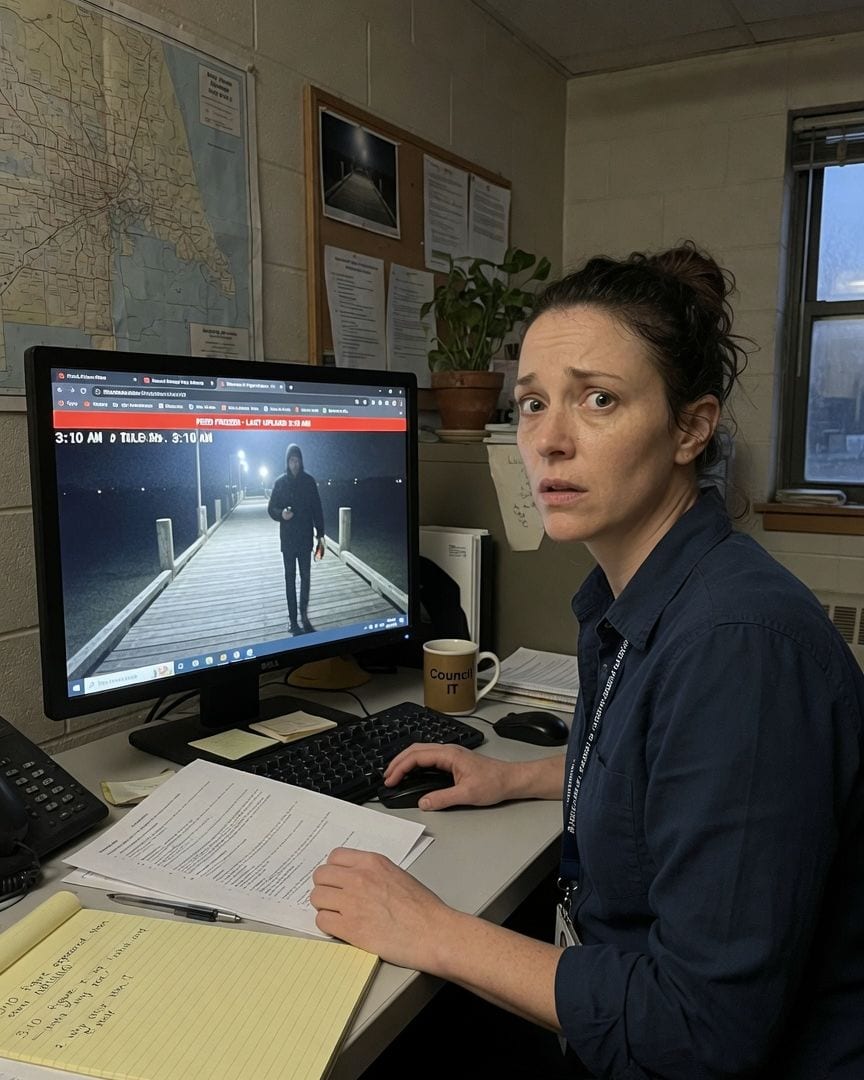
My public pier camera feed stopped dead at 3:10 AM. But its hidden internal logs show it kept recording everything.
As a digital assets manager for the town council, I routinely check our public weather cam feeds. One Tuesday, the pier cam feed was frozen at 3:10 AM, right after a blurry figure appeared. But internal logs showed the camera kept recording, capturing an old woman holding a carved boat and whispering one name: 'Chloe'.
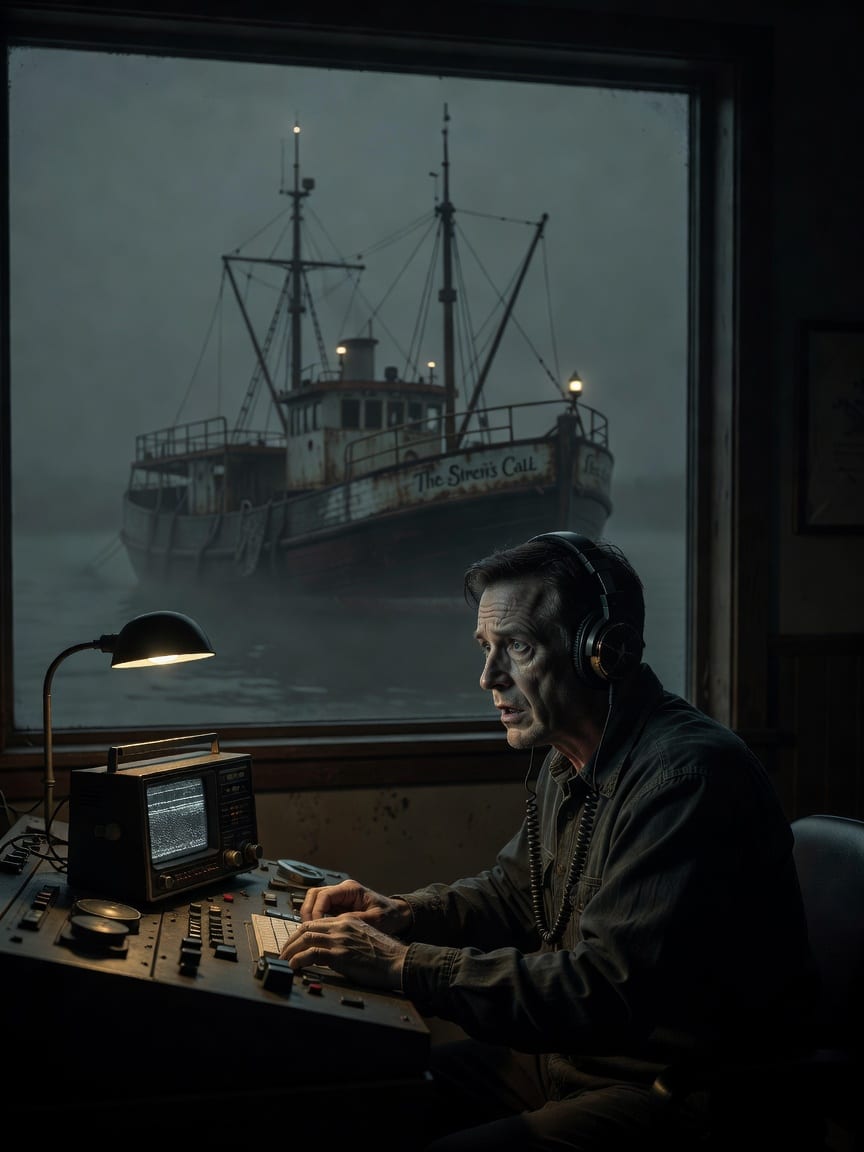
My radio picked up a skipper at 3 AM every night, asking about the bar. The harbourmaster's tapes show no calls, and that boat sank ten years ago.
Every night, as the harbour night watchman, I have a comforting ritual: guiding Tom of 'The Siren's Call' through the channel. But the harbourmaster just reviewed the tapes, and my voice is there, clear as day, while Tom's response is utter silence. And official records show his vessel, 'The Siren's Call,' sank a decade ago with all hands.
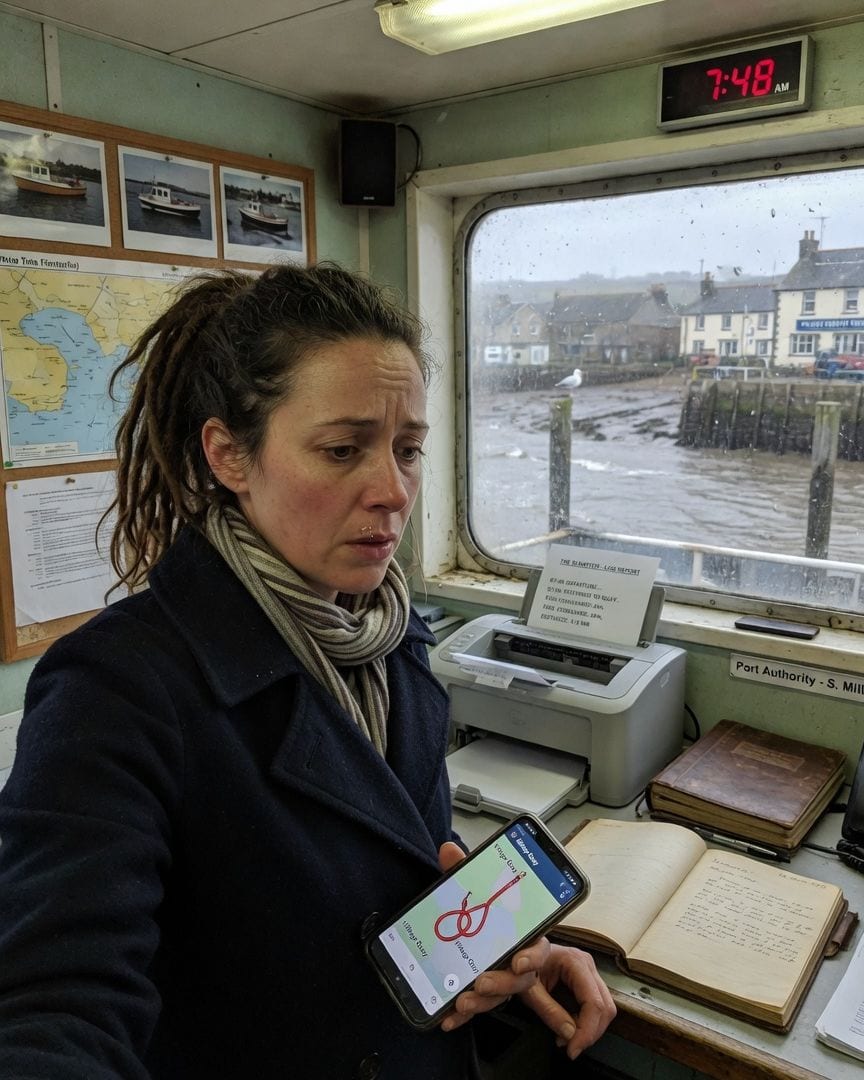
My morning ferry crossed for 40 minutes. The destination town just disappeared.
I board 'The Seawitch' every Tuesday for the familiar eight-minute estuary crossing. But this morning, after making good time, Captain Bernard and I watched the town quay simply fail to appear. Instead, our ferry repeatedly returned to the very same village quay we'd just left, despite burning fuel and advancing the clock.
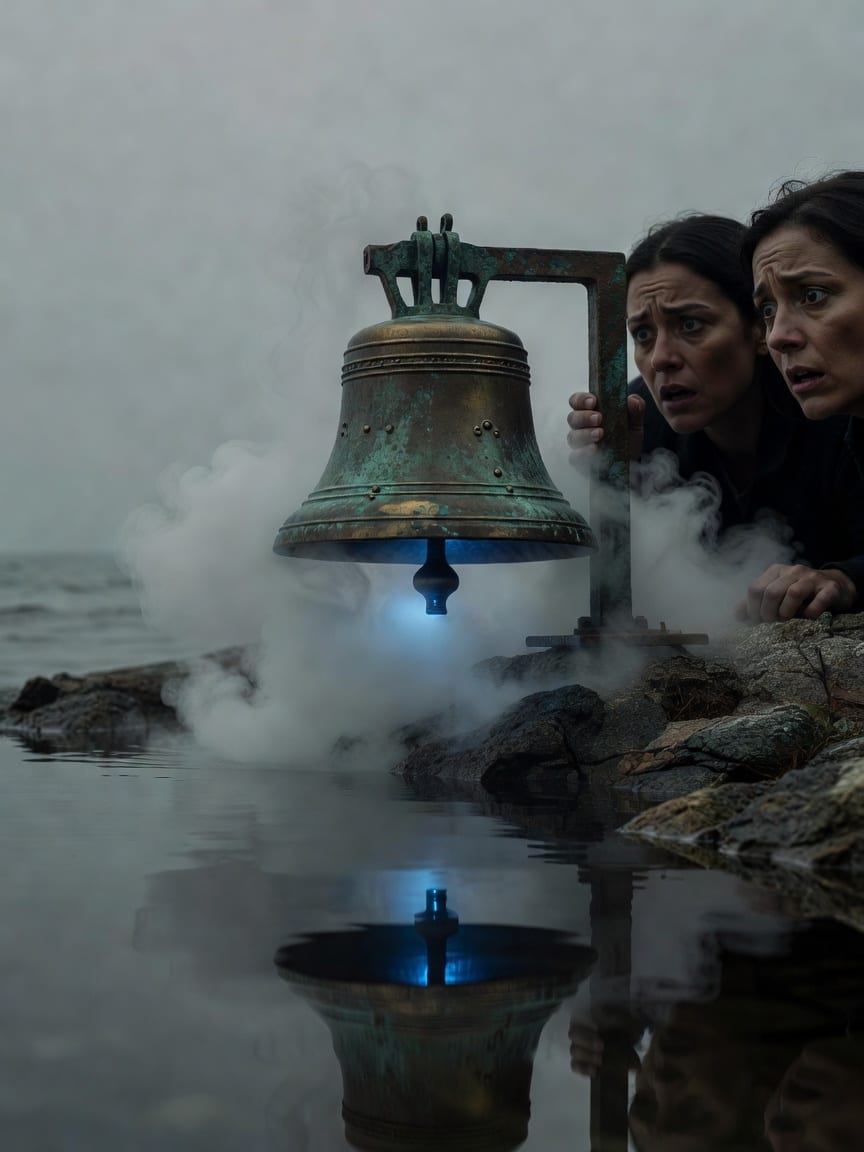
The fog bell on the point rings itself on still nights. The framed log at the yacht club lists eleven calm evenings it rang – each entry beside a boat that never came home.
Moving to a quiet coastal town, I found myself drawn to an old logbook at the yacht club. It recorded the fog bell ringing on flat-calm nights, each instance tied to a boat that simply vanished. Then, I found my own boat's name, 'The Osprey,' penciled at the bottom, marked with an unfinished, cryptic symbol.
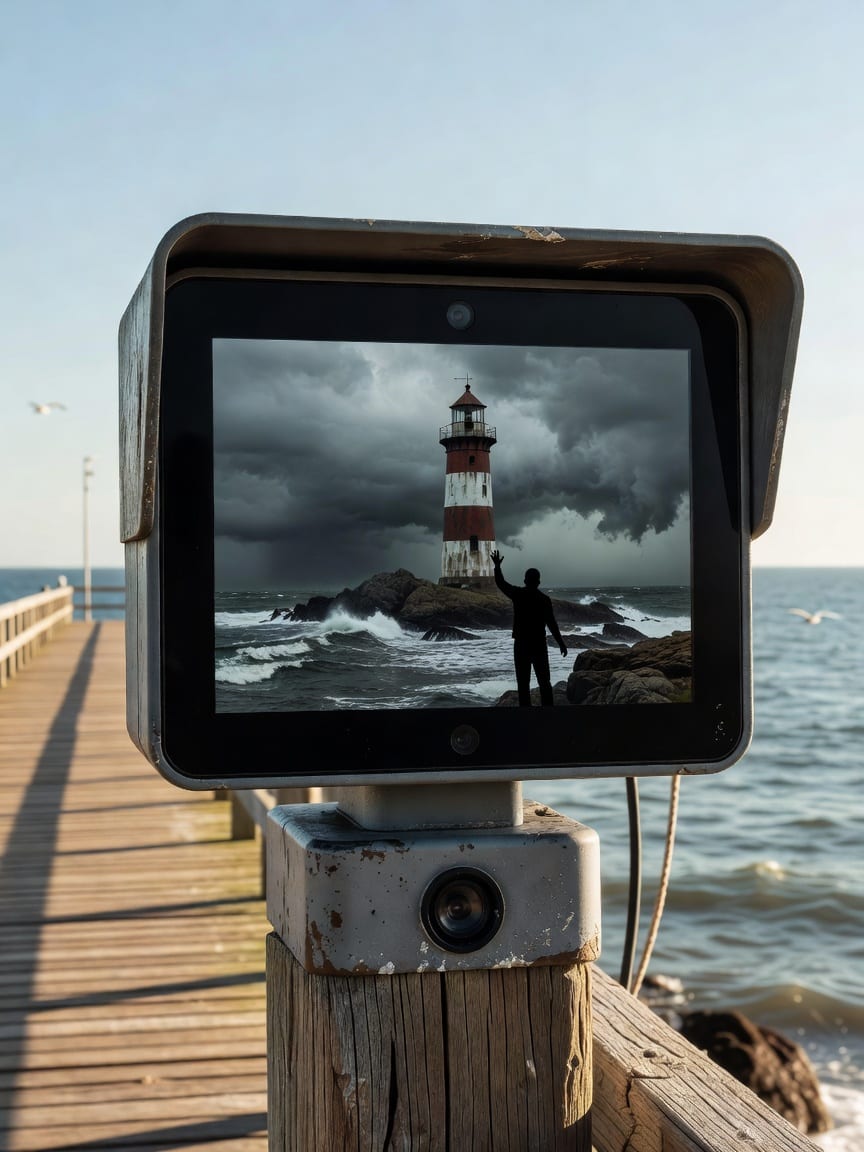
My pier camera snapped a figure walking my empty pier at 3 AM. No frames since.
My morning ritual involves checking the weather camera at the end of our family's pier. But one day, after a mysterious figure appeared in the 3:10 AM photo, the feed died. Yet, the camera's SD card held a video: not of my familiar pier, but a storm-lashed, unknown coastline with a strange lighthouse.
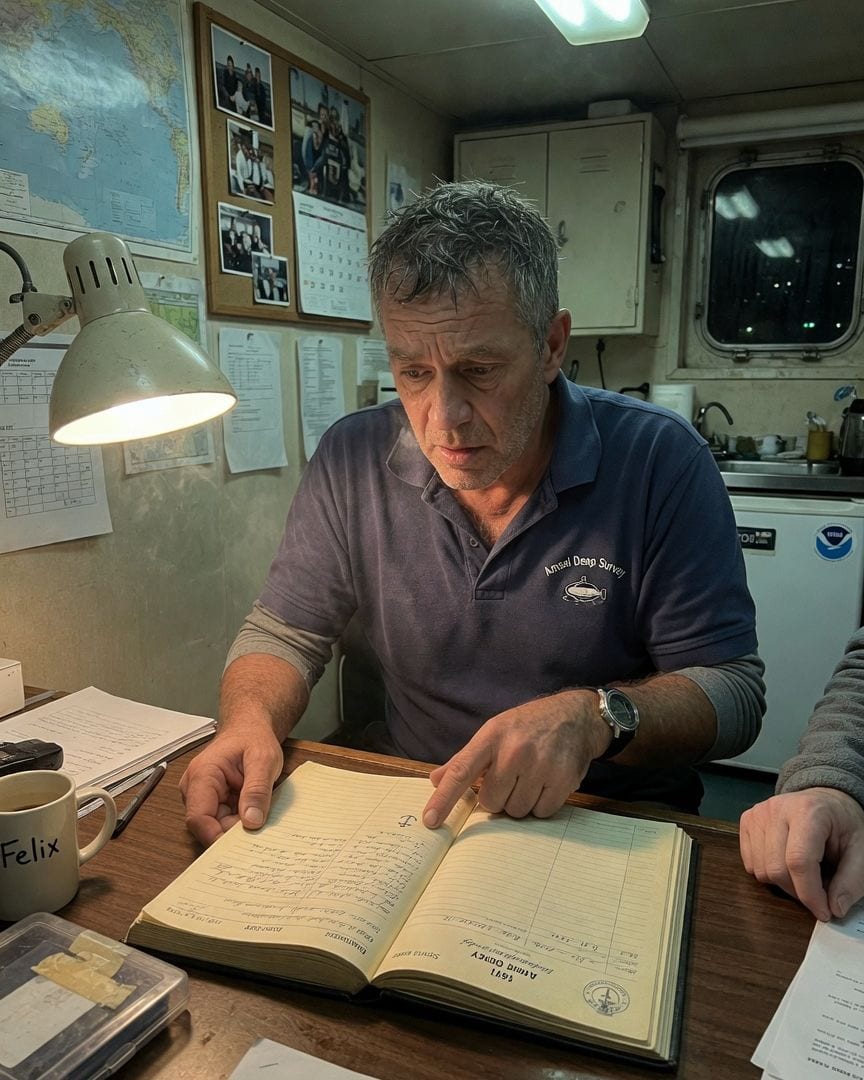
On his final deep-sea survey, a submersible pilot watches a 32-year-old Cold War wreck's rudder shift two degrees.
Deep-sea surveyor Hugo Amsel embarked on his final major dive, anticipating a quiet retirement after decades exploring the crushing pressures of the deep. His submersible's lights cut through the murky green, revealing the *Wynn Portal*, a sealer vanished in 1991, eerily preserved with unnervingly clear windows, free of any marine growth. Then, the inexplicable: the wreck's rudder angle indicator, softly lit, twitched two degrees further to starboard. Later, inside the wheelhouse, Hugo found the ship's official logbook, its final entry dated three days *after* the vessel's recorded disappearance, hundreds of miles north. How could a ship vanish, only to log a journey days later, from a place it never reached?