Airman Ludo Sarrazin found a ladder standing in Arctic snow, warm to the touch. Then the knock came from *inside* his sealed Cold War radar dome.
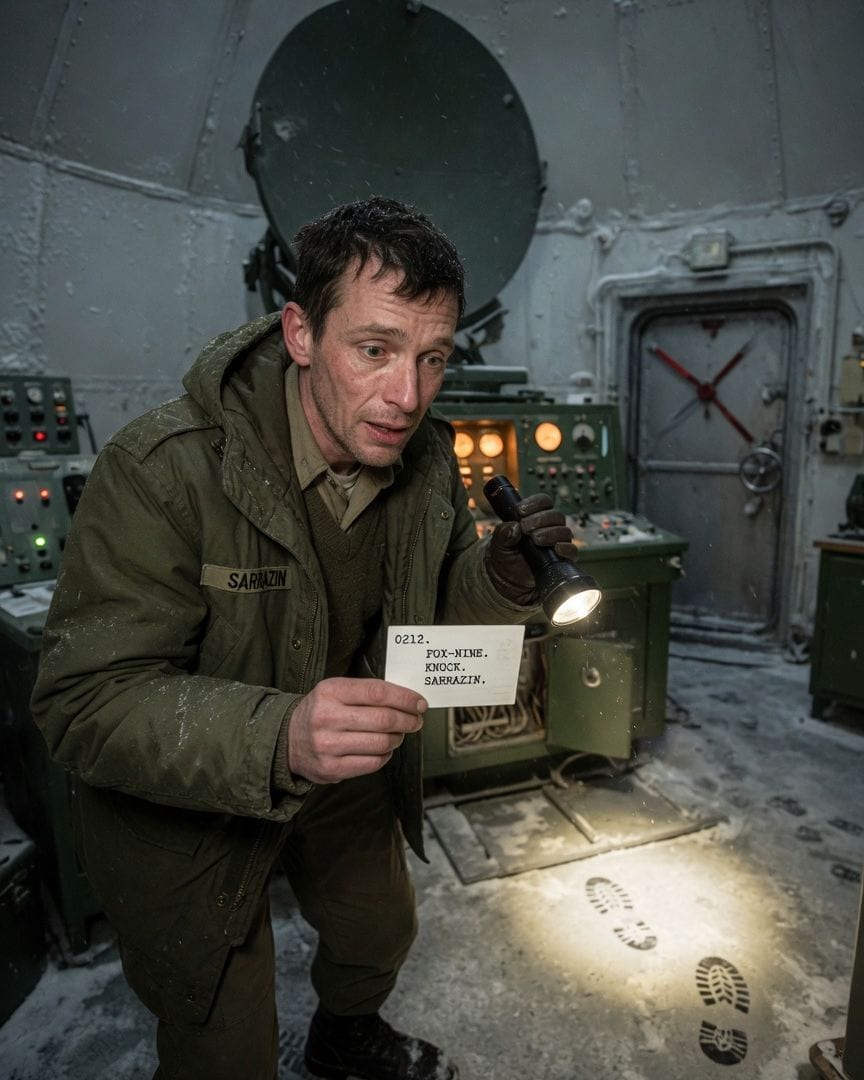
Airman Ludo Sarrazin was nearing the end of his tour at DEW site FOX-Nine in the spring of 1959.
Eleven months of Arctic dark had given him a deep appreciation for the hum of the radar equipment, his constant companion in the vast, silent expanse. But for the last nine nights, the hum had found a rhythm.
Every night, precisely at 0212 UTC, a steady, mechanical knock, sixty seconds long, would rise above the receiver noise. Each night, it came from a fraction of a degree closer along the bearing.
On the ninth night, Ludo had driven his utility tractor out along that invisible line, the lamp cutting a stark tunnel through the swirling snow.
He found it half a mile out: a standard issue service ladder, standing upright in open snow, bolted to nothing. He touched it, and the metal was warm to the hand, a shocking warmth in the sub-zero air.
As he stood there, frozen, the knock that night didn't come from the snow. It came from inside the secure, sealed radar dome, back at the station.
Ludo scrambled back to the dome, the arctic wind biting at his exposed face. The heavy steel door was dogged shut, the security seal unbroken.
Inside, the dome was just as he’d left it: cold, sterile, the radar dish sweeping its slow, rhythmic arc. He checked every panel, every access point. Nothing. No sign of forced entry, no disturbed dust.
Yet the knock had been undeniably from within. As he circled the console, his flashlight beam caught something. On the floor, near the base of a maintenance access panel, was a single, clear boot print in the fine, undisturbed dust.
It was a service boot, like his own, but a size larger, and the tread was subtly different.
It led directly to the panel, but the dust surrounding the panel itself was pristine, as if the boot had materialized from the floor, walked to the panel, and then vanished. Ludo crouched, running a gloved finger over the print.
It was too sharp, too well-defined, to be old. He checked the maintenance logs for the past week. No technicians, no visitors. Just Ludo Sarrazin, alone, for months.
He tried to rationalize it – a stray print from a previous shift, somehow preserved, only now visible in the specific angle of his light. But the dust. The undisturbed dust.
The knock repeated, a faint, rhythmic thrum against the metal housing of the console, the sound resonating through his very teeth.
He pulled open the access panel, half expecting to find a loose wire or a trapped animal. Nothing. Just the clean, humming electronics. He slammed it shut in frustration, the sound echoing in the confined space.
His gaze fell on a narrow, dusty slot on the side of the radar console, a place where old instruction cards or checklists might have been stored. He hadn't noticed it before.
He reached in, his fingers brushing against a stiff piece of paper. He pulled it out. It was a single, pristine, blank white index card, unlike any official form he'd ever seen.
On it, typed in an old-fashioned, perfectly aligned font, were four words. '0212. FOX-NINE. KNOCK. SARRAZIN.' There was no date. Ludo Sarrazin, heart thudding, stared at the card in his hand, a message from nowhere.
Sixty-five years later, in a climate-controlled archive deep beneath a government building, Penelope Vaughn adjusted her spectacles. As a declassification archivist, she was used to sifting through the detritus of forgotten Cold War projects.
Her current assignment: a review of DEW Line incident reports from the late 1950s. She pulled up a file marked 'DEW-9_SARRAZIN_INCIDENT_1959.'
The report detailed Airman Ludo Sarrazin’s account: the inexplicable ladder, the rhythmic knock, the foreign boot print, and finally, the index card. Penelope felt a familiar prickle of unease. The report was heavily redacted.
Entire paragraphs were blacked out, and many sections simply referenced 'Project K-9' without providing a corresponding file number.
Ludo’s description of the index card was meticulously recorded, down to the exact wording, but the card itself was not listed in the evidence inventory.
An official addendum dismissed the incident as 'isolation-induced auditory and visual hallucinations,' a common catch-all for anything inconvenient. Penelope, however, had seen too many 'hallucinations' that neatly aligned with other 'hallucinations' to accept that.
She cross-referenced 'Project K-9' in the archive’s main database. The system returned 'FILE NOT FOUND.' She tried variations: 'K-9 Operations,' 'DEW Line K-9.' Still nothing.
It was as if Project K-9 simply didn't exist, despite being cited multiple times in a declassified report. The absence felt deliberate, a silent stone wall.
She submitted a formal request for information regarding 'Project K-9,' citing the DEW-9 report as justification. She knew it was a long shot, but the feeling that something had been deliberately buried here was too strong to ignore.
The next morning, Penelope found a terse email in her inbox: 'Request for Project K-9 denied. Classification level: Beyond Review.'
A few hours later, her superior, Ralph Sterling, a man whose face seemed permanently etched with the weariness of decades in records management, called her into his office. Ralph didn't mince words. 'Vaughn, I saw your K-9 request.
You need to drop it. Some files are dead ends for a reason. They stay buried.' His voice was low, almost a whisper, but the unspoken threat was clear.
He didn't elaborate, just gave her a long, appraising look that made her skin crawl. Penelope nodded, feigning compliance. But the denial, coupled with Ralph’s warning, only sharpened her resolve.
She went back to her office, determined to find another angle. When she arrived, she noticed her door was slightly ajar, though she distinctly remembered locking it. A subtle chill permeated the air, a scent like old, cold metal.
Her desk, which she had left meticulously organized, had a single item out of place. Lying face down in the center of her blotter was a blank white index card. Her hand trembled as she picked it up.
On the back, handwritten in a shaky, old-fashioned script, were five words: 'Some things are better left filed.' The card was identical in size and feel to the one Ludo Sarrazin described, right down to its stark whiteness.
Penelope’s hands were shaking as she placed the card in a clear evidence bag. This wasn't a warning from Ralph Sterling; the handwriting was too old, too distinct. This was something else.
Using her highest clearance, she began to dig through cross-referenced, tangential files, searching for any mention of 'K-9' that might have slipped through the cracks. She spent days poring over obscure technical reports and inter-agency communications, bypassing the main database.
She eventually found a heavily redacted memo from 1962, buried deep within a file on 'Non-Standard Atmospheric Phenomena.' It was titled 'Interim Report: Pattern K-9 Manifestations.'
The memo described the rhythmic knock, the localized temperature fluctuations, and the brief, inexplicable appearance of physical objects. But what chilled Penelope to the bone was the recommended 'response protocol.' It wasn't 'investigate,' or 'contain,' or 'eliminate.'
It was 'observation and filing.' The memo explicitly stated that 'active intervention has proven counter-productive' and that 'maintaining a comprehensive record of interactions appears to mitigate escalation.'
It implied that the 'filing' itself was a form of containment, or perhaps, something far stranger. The words 'observation' and 'filing' echoed in her mind, connecting to the card on her desk.
The hum, the knock, the ladder, the boot print — they weren't random events. They were 'manifestations,' carefully observed and recorded. And the index cards, she realized, were part of that record, perhaps even a direct communication.
The dread solidified: the institution wasn't fighting this thing; it was documenting it, almost tending to it, as if the record itself was a necessary part of the pattern.
Ludo Sarrazin hadn't just witnessed an anomaly; he had been observed witnessing it, and his experience had been duly 'filed.'
Penelope continued to dig, now specifically looking for personnel records related to 'Project K-9.' If the memo talked about 'observation,' there had to be observers. She found a single, fragile microfiche labeled 'K-9 Personnel Assignments - Classified.'
Her fingers trembled as she loaded it into the reader. The screen flickered to life, displaying a short list.
The first entries were from the late 1950s and early 1960s: 'Observer 1: Donald Pierce, DEW-12,' 'Recorder 2: Janet Harrington, DEW-4,' and then, 'SARRAZIN, Ludo, Airman, DEW-9,' with an assigned 'Observation Period: 1959-1960.'
Penelope felt a cold knot tighten in her stomach. Ludo hadn't just been a witness; he had been assigned. And then she saw it.
Beneath Ludo’s entry, in a noticeably different font, as if added decades later, was a new line. 'VAUGHN, Penelope, Archivist, Records Branch,' and next to it, 'Observation Period: 2024-Present.' The file wasn't just old. It was still being written.
And she was in it.
The realization hit Penelope with the force of a physical blow. Project K-9 wasn't a defunct Cold War operation; it was an ongoing, active system. The 'secrecy machine' itself was the mechanism.
The archives weren't just a place where records were stored; they were the very 'Box That Is Not on Any List,' a living ledger for an entity that manifested, was observed, and whose presence was then documented, almost as if the act of recording it sustained it.
The 0212 knock, the ladder, the boot print, Ludo's index card – all were part of a precise, cyclical process. The cards weren't just warnings; they were confirmations, acknowledgments from the 'filing system' itself.
Ludo Sarrazin had been an unwitting 'observer' in 1959, his experience meticulously recorded. Now, Penelope Vaughn was the next entry.
The horror wasn't in what the entity was, but in how perfectly it had integrated itself into the very fabric of human bureaucracy, using the meticulous act of documentation to ensure its continued existence.
It wasn't a monster to be fought; it was a pattern, a process, a quiet, patient horror that fed on the record itself. The institution, in its efforts to contain or understand, had become its unwitting host.
Penelope knew she couldn't simply walk away. To do so would be to accept her role, to allow the file to continue writing itself. If the entity fed on the record, perhaps the record could be corrupted.
She formulated a desperate plan: create a false, contradictory record. She accessed a secure, unindexed server, a ghost in the system, and began to construct a new file: 'Project K-9-Omega – Decommissioned.'
She filled it with fabricated data: mundane explanations for the knock (faulty wiring, ice buildup), falsified reports of successful 'containment' and 'disposal,' and intentionally misleading 'conclusions' that declared the project closed and the threat neutralized.
She typed frantically, every keystroke an act of defiance. The hum began then, a low vibration that resonated through her chair, under her feet.
It was faint at first, a distant echo of Ludo's Arctic hum, but it steadily grew louder, filling her small office. Then came the knock, soft and rhythmic, a steady thrum against the wall behind her.
The air in the room grew cold, a sharp, metallic chill that raised goosebumps on her arms. She could feel a presence, a distinct weight in the air, just behind her right shoulder. She didn't turn.
Her fingers flew across the keyboard, completing the final entry, 'Project K-9-Omega: All records purged, entity neutralized, archives closed.'
The hum intensified, vibrating through her very bones, and the knock grew louder, closer, now seeming to come from inside the office itself. She felt a breath of icy air on her neck.
The next morning, Ralph Sterling arrived at the Records Branch. He noticed Penelope Vaughn’s office door was slightly ajar, a small breach in the usual institutional order. He pushed it open.
The room was unusually cold, and there was a faint, almost imperceptible smell of ozone in the air. Penelope’s computer screen glowed, displaying a file titled 'Project K-9-Omega – Decommissioned.' The last entry was still visible.
On her desk, centered on her blotter, was a single, pristine, blank white index card, face down. Ralph sighed, a sound of profound weariness, and stepped inside, closing the door behind him. He picked up the card.
On it, typed in the same old-fashioned font as Ludo's card, was a single word: 'FILED.'
If this one got to you
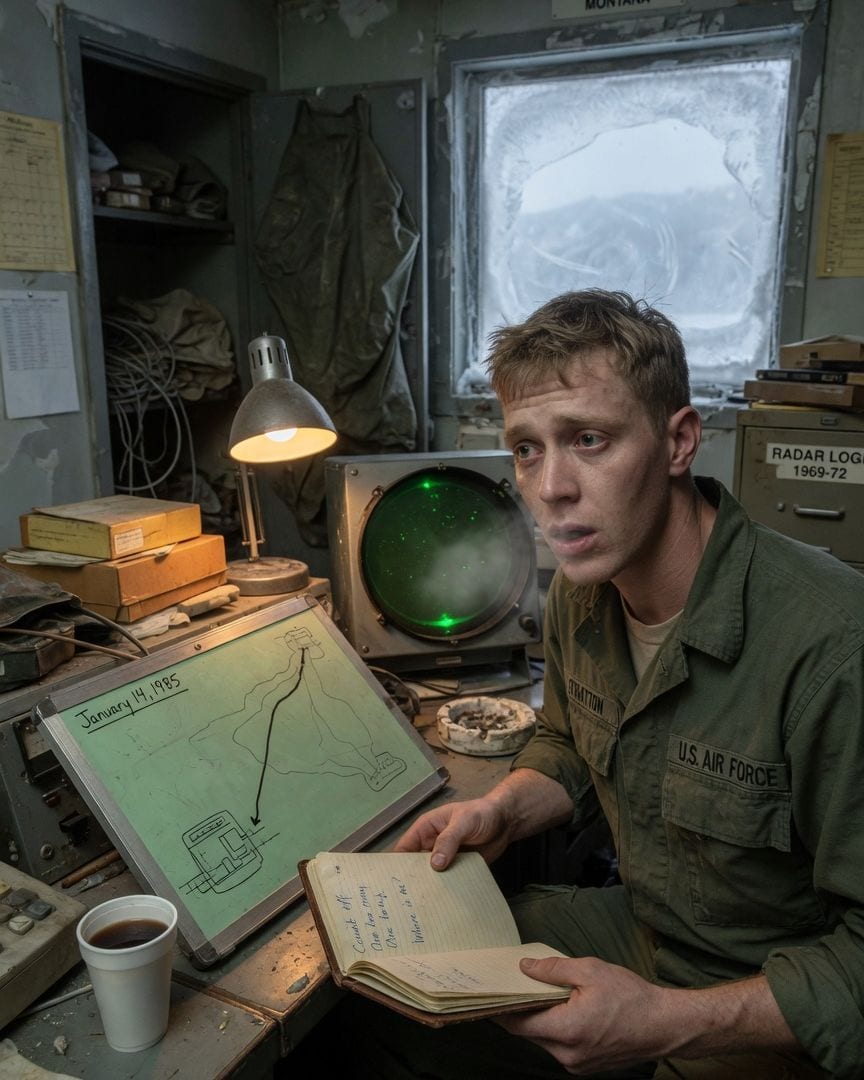
Airman Lars Stratton found an old Cold War manifest listing one name twice: 'Bernard Radcliffe' transferred and 'Bernard Radcliffe' still present.
Airman Second Class Lars Stratton was counting down his final weeks at Echo Station, a desolate Cold War outpost due for mothballing. He longed for home, far from the bitter Montana winds and the constant hum of static. Inside the dim radar shack, he logged the usual nightly ghost blip, a faint contact appearing at 2300, just as it had every winter since 1987. This night, a metallic tang like old blood lingered in the air, raising the hairs on his arms. Seeking distraction, Lars later discovered a leather-bound logbook from 1971, detailing the same 2300 contact, but with chilling notes and a manifest listing one airman's name, Bernard Radcliffe, twice—once transferred, once present. Was he truly alone in the silent, remote station?
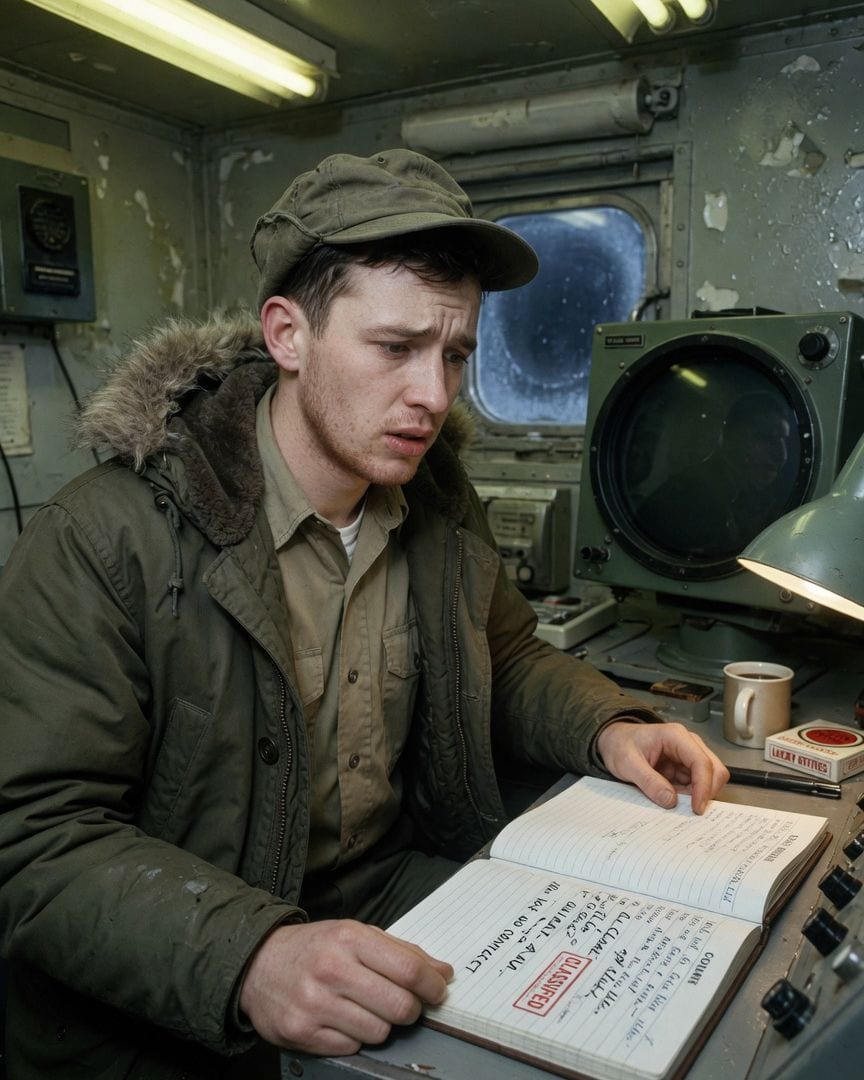
A Cold War airman logs an impossible radar contact on his last sweep. But his official logbook entry is stamped 'CLASSIFIED' and then contradicted by a hastily scrawled 'ALL CLEAR' dated moments before it.
Airman Ordway Vance, 22, manned the radar dome at Site Pellin in the biting North Atlantic dark of January 1962, running the last calibration sweep before its decommissioning. His scope picked up a faint, impossible return, growing closer with each pass, though the ocean remained empty to the eye. When Vance detailed the contact in his official logbook, a 'CLASSIFIED' stamp appeared, followed by a hastily scrawled 'ALL CLEAR' dated moments before his own entry, contradicting his every word. Commander Hartley dismissed it as equipment malfunction, but Vance sensed a chilling, official erasure behind the lie. He soon found a locked cabinet marked 'SITE PELLIN ANOMALIES,' hinting at a deeper truth buried within the base's final days.
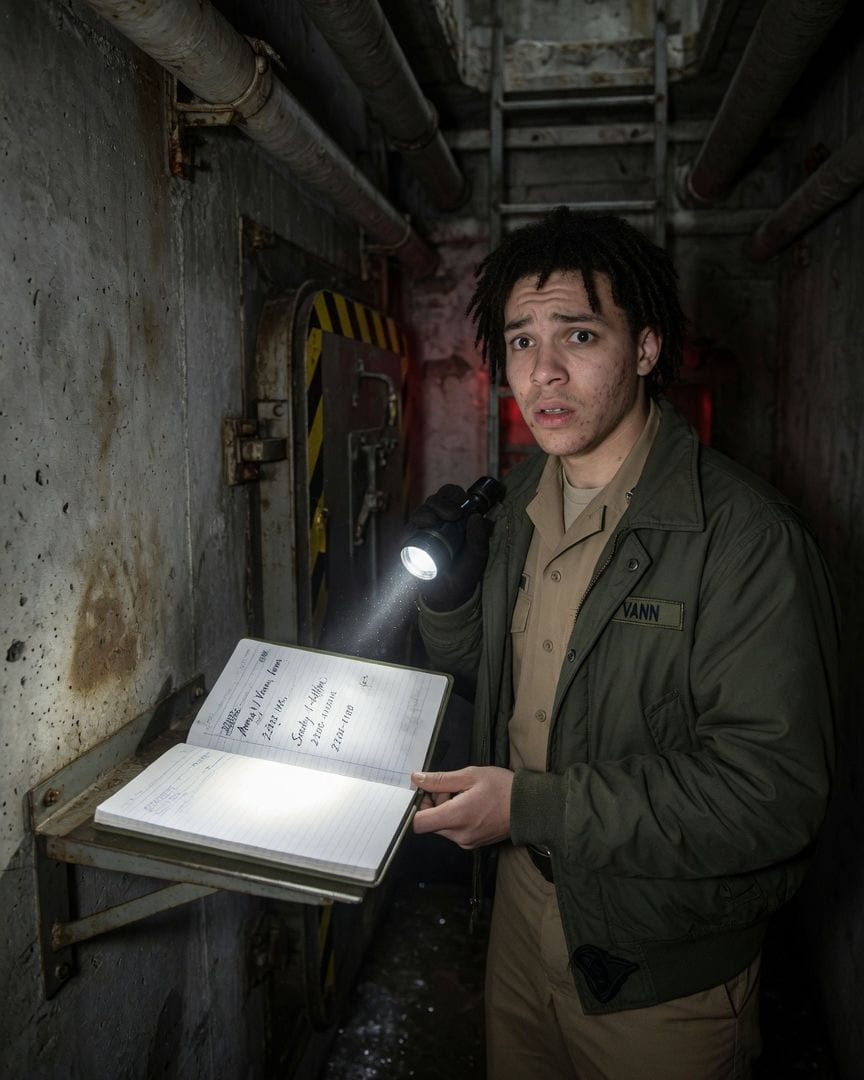
On his last patrol, Airman Vann sees a Cold War silo hatch light up from *inside*—it was welded shut a decade ago.
Airman Vincent Vann was on his last patrol across a vast, desolate Cold War missile field in the Dakotas, the cold, starless sky mirroring the emptiness of the landscape before his transfer. His routine check of eight hardened silo caps was shattered when a red fault light pulsed on Silo 4’s access panel, signaling an impossible breach from *inside* a hatch sealed for a decade. As more silos lit up, ignoring base orders, Vann found the hatch unlocked from within and descended into the dark shaft, where he discovered a pristine logbook bearing his own signature next to a chilling entry from a non-existent sentry, dated for *that very night*. Now, a steady *thump* echoed from deeper within the sealed concrete, leaving the Airman desperate for an explanation that simply wasn't there.
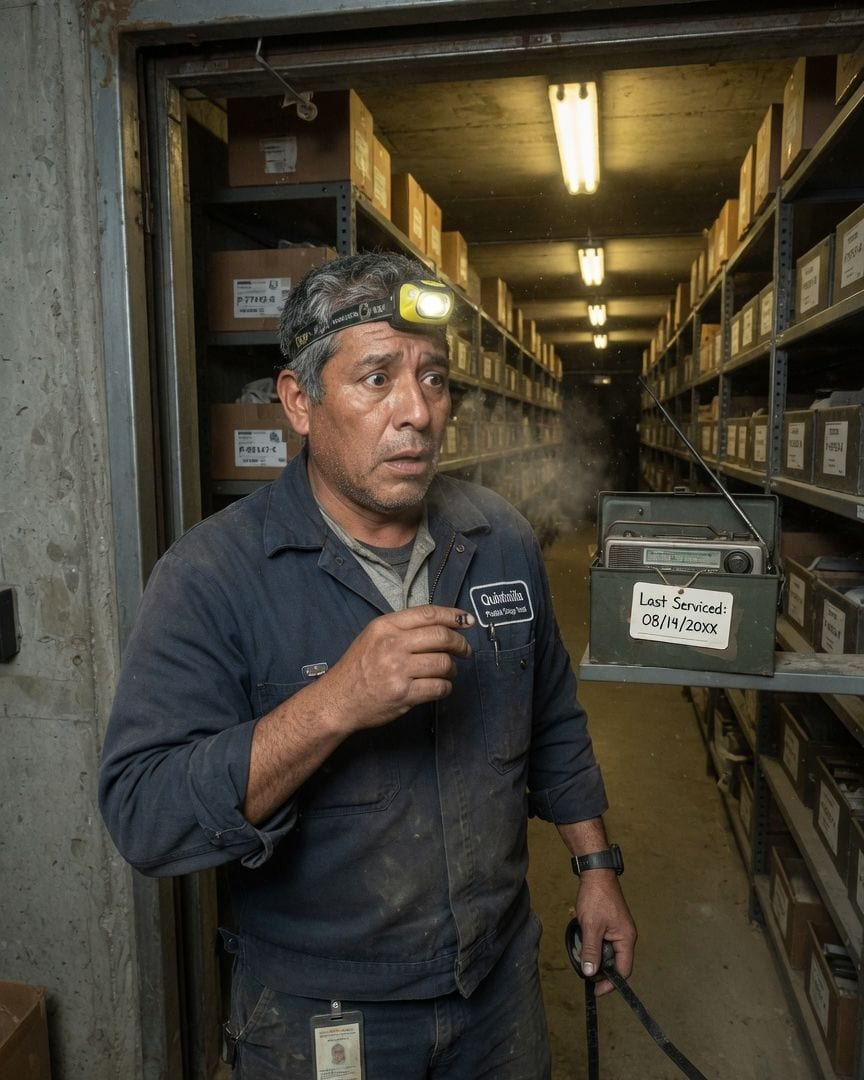
A Cold War bunker worker found a field radio serviced three years in the future, its ink still wet.
Salvador Quintanilla, one of the final two men at the Pueblo storage yard, was tasked with clearing Igloo 7, the last bunker before the facility's imminent closure. As he rolled back the heavy steel door, he discovered not an empty space, but metal racking extending impossibly far past the concrete wall, under the empty prairie, lit by a wan, humming light. Venturing into the profound chill, he found an old field radio with a service tag dated three years in the future, its dark ink still wet to the touch. The radio hummed faintly in his hands, and from deep within the impossible corridor, a metallic click echoed, confirming he was not alone.
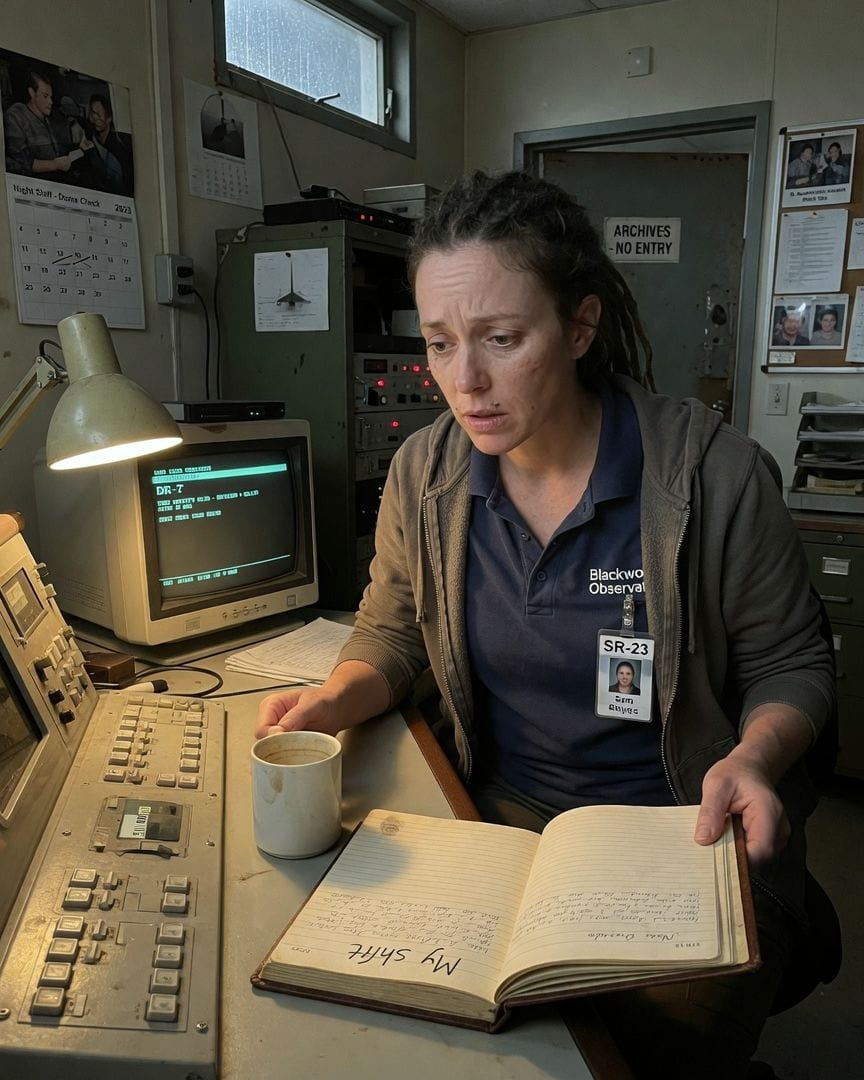
My observatory dome opened itself at 2:30 AM tonight, for twenty minutes, then closed. The log says I did it.
My night shifts at Blackwood Observatory are usually just the hum of distant servers. But the main console log showed the massive dome had rotated and its heavy slit opened at 2:30 AM for twenty minutes. I hadn't touched the controls, and a distinct draft now confirms it wasn't a glitch.
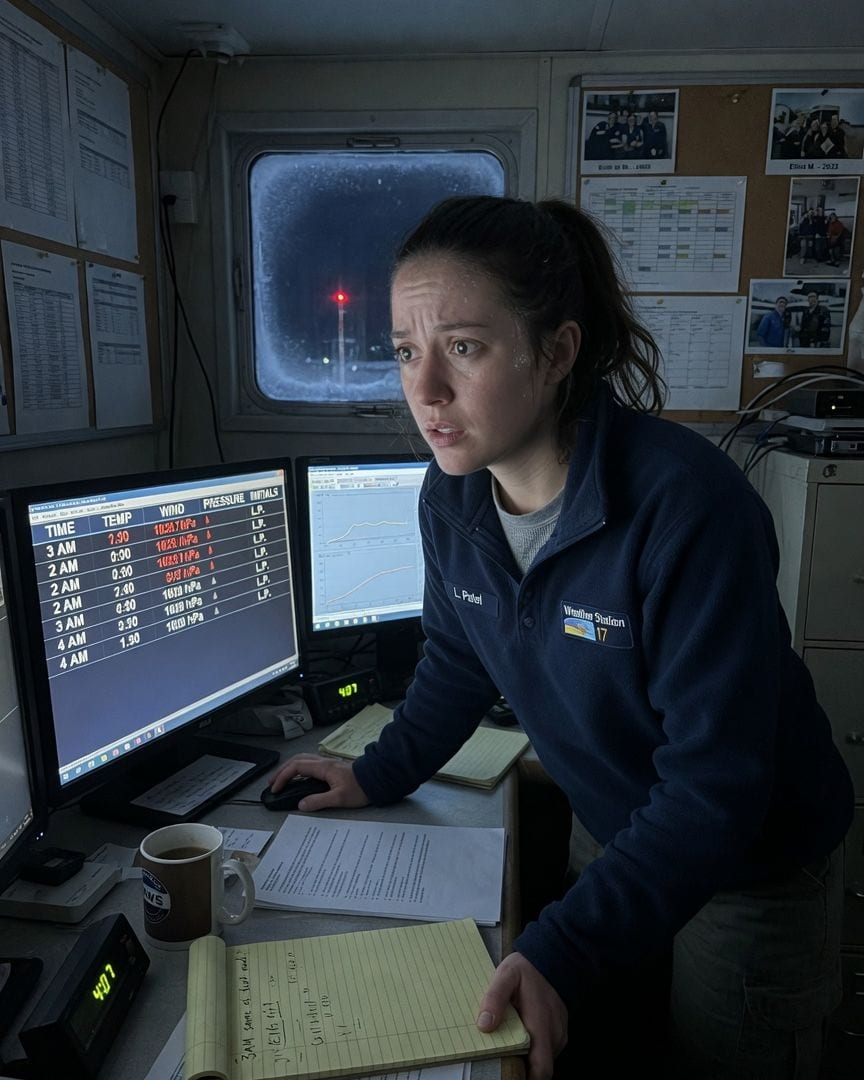
My weather station's 3 AM log shows a pressure reading I never made. My initials are on it, but the dials were dead still.
Working the overnight shift at the remote weather station, I routinely checked the digital logs. The 3 AM entry showed an impossible barometric pressure spike, a hurricane that simply hadn't happened. I distinctly remembered being outside at that time, calibrating a sensor, not making that entry. Yet, my initials, L.P., were clearly logged next to data I never made.