My ancestors' photo shows a letter addressed to me, dated 1972.
The room was warm, hushed by the gentle hum of the ultrasound machine. Eleanor lay on the examination table, her belly exposed, a faint smear of gel already spread across her skin.
I sat beside her, holding her hand, watching the monitor with an almost giddy anticipation. Twelve weeks. A tiny, flickering shape. Our first.
Alice Brooks, the sonographer, was a woman in her forties with kind eyes and a no-nonsense air. She’d greeted us with a smile, then turned to her equipment, her hands moving with practiced efficiency.
She pressed the transducer to Eleanor’s skin, and the monitor flared to life with a swirling gray landscape, full of indistinct blurs and shadows.
That’s when it happened.
Alice went perfectly still. Her shoulders stiffened, her movements ceasing entirely. Her gaze was fixed somewhere beyond the screen, on nothing I could see. She didn't gasp, didn't flinch. She just seemed to… halt.
Then, softly, almost a whisper, she said, "I'm so sorry, Mr. Kessell."
She turned, her hand reaching out, finding mine and squeezing it firmly. Her eyes, when they met mine, were wide and strangely sympathetic. All of this before she had even glanced at the actual sonogram image.
Before she could have seen anything at all.
Eleanor stirred beside me. "Alice? What's wrong? Is the baby okay?"
Alice blinked, pulling her hand away from mine as if she’d been burned. Her gaze snapped to the monitor, where our baby was indeed perfectly fine, a healthy, beating flicker. She adjusted the transducer, moved the image around.
"Oh, no, Mrs. Kessell, everything looks wonderful. Heartbeat strong, growth on track. Just perfect." She sounded completely normal, professional again.
"But... you just said something," I prompted, my voice a little tight. "To me. You said you were sorry."
Alice frowned, her brow furrowing in genuine confusion. "Sorry? Mr. Kessell, I didn't say anything. Not a word. I never apologize to fathers before I even see the screen, unless there's... well, unless there's something to apologize for.
And there's nothing here." She gestured to the screen, her smile returning, strained at the edges. "See? Perfect."
I tried to shake it off. Maybe I’d misheard. Maybe she’d been talking to herself. The room was quiet. Perhaps the hum of the machine had made me imagine it, a trick of sound.
But the memory of her hand, warm and firm on mine, and the profound, unprompted sorrow in her eyes, stuck with me. It was like a cold, unsettling knot in my gut, tightening as the day wore on.
An apology, just for me, for something that hadn't even happened yet. The quiet dread settled in, a passenger I couldn’t dislodge.
A week later, a Tuesday, I found a birthday card in our mailbox. It wasn’t a usual card from family or friends. The envelope was plain white, cheap stock, no return address printed anywhere on it.
The postmark was faded, but I could make out the name of a small, rural town an hour north of us. Not where anyone we knew lived. Not a place I’d visited in years, if ever.
Inside, the card was generic, a picture of a smiling golden retriever. But the message, written in an elegant, unfamiliar script that looked almost calligraphic, held me still. It read, simply: "Happy Birthday, Robert. The Field remembers." No signature.
Nothing else.
My birthday had been yesterday.
The chill that had been lingering since the sonogram visit now sharpened into a cold spike. The Field remembers. I knew what field.
The postmark’s town was small enough that the address on the stamp, even faded, instantly clicked with a specific, well-known landmark: the site of the old Kessell homestead. My ancestors’ land.
It had been demolished in '68, long before I was born, and was now just an overgrown field on the edge of an industrial park. An empty lot, mostly forgotten.
Why would a birthday card be postmarked from there? And how could it know my birthday, let alone address me so directly, so cryptically?
I couldn't just leave it. The image of Alice's face, the squeeze of her hand, the words "I'm so sorry, Mr. Kessell"—it all felt connected somehow.
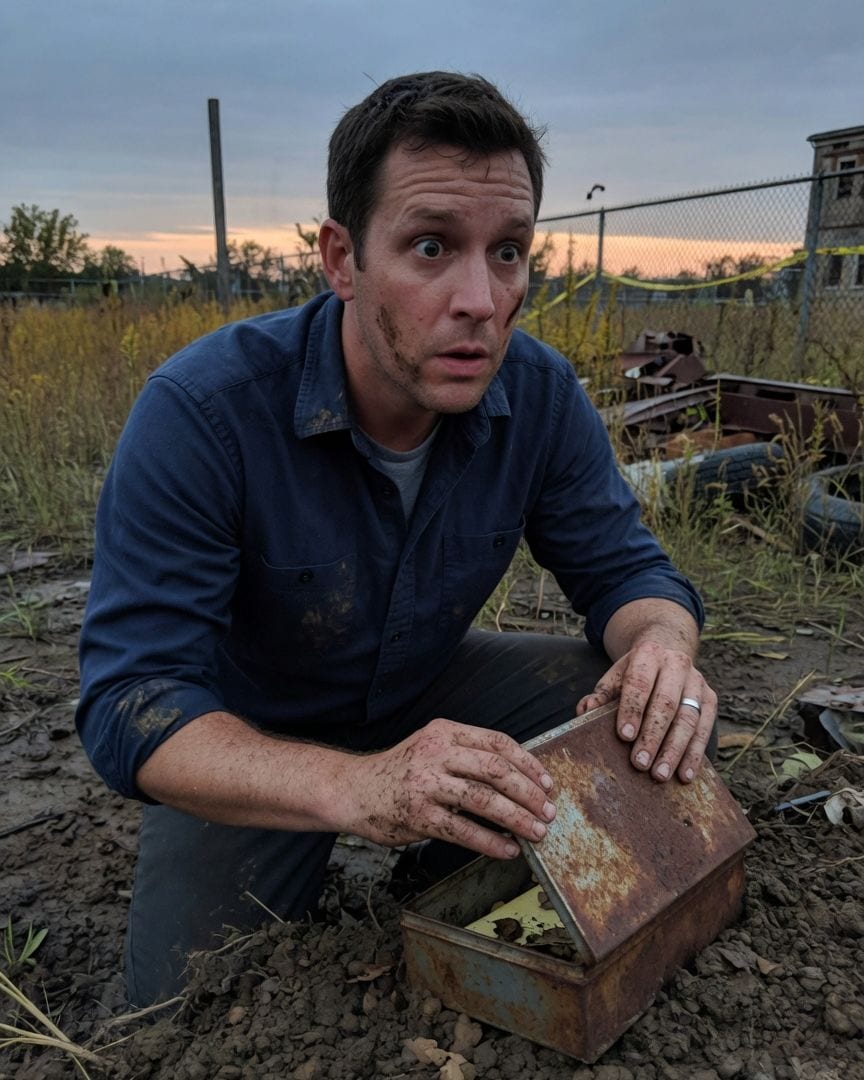
An hour later, I was pulling my truck onto the gravel shoulder beside the chain-link fence that bordered the field. It was exactly as I remembered: tall weeds, rusted industrial debris, a few discarded tires half-buried in the soil. Nothing.
Just an empty, forgotten space.
I walked the perimeter, my boots crunching on dry grass and loose stones. The air was still, oppressive. I felt ridiculous, kicking at clumps of earth, looking for... what? A hidden message? A prankster's stash?
But the unease that had been growing since the scan was now a cold, solid weight in my chest, pulling me forward.
Then my boot struck something hard. Not a rock. It gave a hollow thud. I kicked again, clearing away the packed earth. A dark, rusted edge appeared.
Adrenaline surged. I dropped to my knees, digging frantically with my bare hands, tearing at the damp soil, ignoring the mud and the sharp edges of hidden roots.
The metal box was small, about the size of a shoebox, and heavily rusted, but it looked sealed, watertight. A faint metallic smell, like old blood and damp earth, clung to it. My heart was hammering.
The dread tightened its grip, pulling me into something I couldn't comprehend.
I knelt there in the damp earth, my hands trembling as I pried at the rusted lid. It screeched, groaning on ancient hinges, then slowly gave way. Inside, nestled among dried leaves and soil, lay a single, yellowed photograph.
It was a man, his face a haunting echo of my own, perhaps a distant relative, staring out from the past.
He was standing in front of what was unmistakably the old Kessell homestead before its demolition, the familiar porch and gabled roof clear despite the faded print.
And in his hands, clutched almost protectively, was a plain white envelope. Identical in every detail to the birthday card I had just put in my pocket.
The most chilling detail, clear even in the faded image: the visible address on the envelope in the photograph read, in elegant script, 'Mr. Robert Kessell,' and a date stamped next to it, 'October 14, 1972.'
I showed the photograph and my own birthday card to Vivienne Rutherford, my great-aunt, two days later. She was 82, sharp as a tack, and the unofficial keeper of our family’s sprawling, convoluted history.
We sat in her sunroom, the air thick with the scent of dried potpourri and old paper.
She took the yellowed photo from my trembling hand, her thin fingers tracing the image. "My goodness," she murmured, her voice soft. Her eyes, usually so bright with recollection, grew distant. "That's Robert. Robert Kessell. Your grandfather's cousin, once removed.
Vanished in the early seventies, just like that." She snapped her fingers, a dry, brittle sound. "No note, no forwarding address. Just… gone. Everyone always said he was called home by the field."
"Called home by the field?" I repeated, the phrase catching in my throat. It mirrored the card. "What does that mean?"
Vivienne’s gaze was unsettlingly calm, yet a shadow crossed her face. "Old family stories. Nonsense, really. Just people trying to make sense of things they couldn't explain. He'd started getting strange letters, too, before he left.
Postmarked from the old homestead, even after it was gone. We all just assumed he'd finally snapped." She looked from the photo to my card, then back again. Her expression grew visibly uneasy. "But this...
this is too much of a coincidence, Robert."
The next day, I drove to the local history society. Samuel Ingram, the archivist, was a meticulous man in his early sixties, spectacles perched on his nose, surrounded by towering stacks of dusty boxes.
I explained my unusual findings, showed him the photograph and the card. He listened patiently, then dismissed it with a wave of his hand.
"Ah, the old Kessell homestead. Lots of stories about that place, mostly local folklore. And disappearances? People moved, Mr. Kessell. Always have. Headed west, off to the cities for work. Records weren't always as thorough back then. Just forgotten history."
His tone was polite, but firm. Yet, as he spoke, I caught a flicker in his eyes, a brief hesitation, a tightening around his mouth that suggested he knew more than he was letting on.
I spent the next few hours in his archives, cross-referencing old town records, census reports, and property deeds. And slowly, chillingly, the pattern began to emerge. 'Moved without trace,' 'fate unknown,' 'relocated indefinitely'—entries next to Kessell names, across generations.
Not every Kessell, but specific ones. And they often clustered around a similar age, usually their mid-thirties, and occurred at roughly 30 to 40-year intervals. Just like the Robert Kessell in the photograph. Just like me.
Days after my visit to the history society, another letter arrived. This one was even plainer, a simple white card in an unmarked envelope, postmarked from that same empty field.
The elegant, unfamiliar script inside simply stated: "You seek what is already known." Below the message, a small, intricate symbol was drawn.
It was a perfect, precise rendering of a symbol I distinctly remembered seeing on a faded, half-crumpled map Samuel Ingram had briefly pulled out during my visit—an old property survey for the Kessell land.
I hadn't mentioned it to him, or anyone else.
A prickle started on the back of my neck. A cold, crawling sensation that wasn’t just dread, but a growing sense of being actively observed.
For two consecutive evenings, I noticed the same dark sedan parked two blocks from my house. It wasn’t just a neighbor; I’d never seen it before, and it was always empty.
On the third evening, I made a point of taking a different route home from work, walking an extra two blocks. I could feel eyes on my back, a cold prickle, like a phantom touch.
Every time I glanced over my shoulder, the street was empty, but the feeling persisted, an insistent pressure.
One morning, as I walked out to my truck, my breath hitched. On the rear window, covered in a thin layer of dew and road dust, was the distinctive symbol from the warning card.
It wasn’t a smudge or an accident. It was perfectly rendered, clearly drawn by a finger, as if someone had etched it there in the night. It felt like a violation.
I wiped it away frantically, my heart hammering against my ribs, the cold prickle now a full-body shiver. My investigation wasn't private anymore.
Someone, or something, was aware of my every move, and was now sending me messages that were directly targeted at my actions. This wasn't a random occurrence. This was personal. This was a watch.
I drove straight to Vivienne’s. I didn’t even knock, just let myself in, holding the warning card out to her. "Vivienne. This symbol. Samuel had it on an old map. I never told anyone about it." My voice was hoarse.
Her composure, which had been so brittle before, finally shattered. Her eyes welled with tears, reflecting the sunlight in the sunroom as it streamed through the window. "Oh, Robert," she whispered, her voice cracking.
"I tried to hide it from you. I hoped you'd be spared."
She began to explain, the words tumbling out, laced with a generations-old sorrow. The 'letters from the field,' the 'vanishings'—they were a recurring pattern, a curse tied to the Kessell name and the land the homestead occupied.
"It's a claiming," she said, almost too softly to hear. "It calls them home. And the sonographer's apology... that was the 'mark.' It means a new Kessell generation has been recognized by the pattern."
She got up, her movements stiff with age and emotion, and pulled a heavy, leather-bound Kessell family bible from a hidden compartment in an old chest. Its pages were brittle, yellowed, and smelled of dust and time.
Inside, beside certain Kessell names, were cryptic annotations: 'Gone to the Field,' 'Claimed by the Letter.' Dates, names, sparse chilling notes.
Simultaneously, I called Samuel Ingram. I skipped the pleasantries. "Samuel, the symbol on the map. The one I saw in your archives. I have a card with that symbol on it."
There was a long silence on the other end, then a sigh. "I see." His voice was low, devoid of its usual academic dryness. "Come in, Mr. Kessell. I think it’s time we talk properly."
When I arrived, Samuel didn't offer coffee or pleasantries. He led me straight to a back room, pulling out an archived local property ledger from the 1800s. Its pages were thick, the ink faded, but the detail was astonishing.
"This symbol," he explained, pointing to a small, hand-drawn mark on one of the entries, "is an old, obscure marker. It denoted a specific piece of the Kessell land, yes.
But more than that, in some older records, it was used to signify... unrecorded transfers." He turned pages, revealing not only the homestead's boundaries but also several Kessell names with unusual, unexplained 'vacated' entries.
These entries coincided with the 'Gone to the Field' annotations Vivienne had shown me. The pieces began to click into place, forming a terrifyingly coherent picture of a generational terror, far older and more organized than I could have imagined.
Back at Vivienne’s house, the afternoon sun was long gone, replaced by the pale glow of a single lamp. I sat at her heavy dining table, the Kessell family bible open before me, its brittle pages spread wide.
Beside it, Samuel’s property ledger, photocopied pages in neat stacks. The pattern was undeniable. Kessells, always around the same age, always marked by strange letters and unsettling premonitions, always vanishing.
The names on the property ledger, marked 'vacated' or 'unrecorded transfer,' aligned perfectly with Vivienne’s family bible entries of 'Gone to the Field' or 'Claimed by the Letter.'
I flipped through the bible, past generations of my ancestors. Names I knew, names I’d only vaguely heard of. Until I found my own entry.
Meticulously recorded by Vivienne years ago, a neat line for my birth date, a space left for future milestones. My breath hitched. Below my birth date, in Vivienne's shaky hand, was a specific date circled in red.
It was just weeks from now. Beside it, the chilling, familiar annotation: 'Claimed by the Field.'
My heart hammered against my ribs, a panicked drum against the silence of the room. My own name. My own date.
Then, my eyes fell to the next entry. A blank space, reserved for my unborn child. A new life, not yet here. Below it, faintly penciled in, was a distant future date. A date decades from now.
And already, in the same unsettling hand, it bore the same, terrible mark. A future that was not mine to control, not mine to protect.
The circled date from the Kessell family bible loomed, an inevitable judgment. Two days away. I couldn't eat, couldn't sleep. Eleanor watched me with worried eyes, asking what was wrong, and I couldn't tell her. How could I?
Desperate, driven by an almost instinctual pull, I returned to the empty field. This time, I had a shovel in the back of my truck. The air was cold, damp, heavy with the promise of rain.
I walked past the weeds, past the discarded debris, my eyes scanning the ground. I paused over a subtle depression in the earth, barely noticeable, where the old homestead’s foundation would have been. It felt... different. A cold spot.
A resonance.
I plunged the shovel into the soil. It struck something hard after only a few inches. Brick. I dug frantically, throwing clods of earth behind me, following the line of what felt like a wall.
Soon, a hidden, brick-lined cellar entrance began to emerge. It was small, capped with a thick slab of stone that had been cunningly disguised with earth and vegetation.
I levered the stone aside, and a gust of air, cold and still, smelling of damp earth and something ancient, rose to meet me.
I dropped into the darkness, my flashlight beam cutting through the gloom. The small, square room was crudely finished, but perfectly preserved. Not a cellar for storage, but for something else.
In the center, on a rough-hewn stone pedestal, lay a single, object. A perfectly preserved, ancient leather-bound ledger.
This was it. The impossible record. My hands trembled as I reached for it, the leather cool and dry against my fingertips. I opened it. The pages were filled with precise, elegant script, the same hand as the letters.
Every Kessell 'claiming' across centuries. Each entry meticulously recorded: the receipt of letters, the specific premonitions—even an 'unprompted apology' was listed for one entry in the late 1700s—and the exact date of their 'departure.'
I scanned the pages, my breath catching in my throat, until I found it. My own entry. Robert Kessell. Unnervingly complete. It listed the sonographer's apology, the birthday card, the warning.
And then, the date circled in red from the family bible. Now, just hours away. The coherence was absolute. The horror, undeniable.
I stared at my own entry in the ledger, the current date and time now matching the precise hour of my 'claiming.'
My heart was a frantic drum against my ribs, but a strange, unsettling calm began to settle over me.
I fumbled for my phone, my fingers numb, desperate to call Eleanor one last time, to hear her voice, but the screen remained stubbornly dark, the battery dead. Of course.
A deep, resonant hum began to rise from the earthen floor beneath me. It wasn't loud, but it vibrated through my bones, a low, insistent thrum that filled the small space.
The air in the cellar grew impossibly icy, smelling sharply of damp soil and something impossibly old, like untouched history given form.
Then, the pages of the ledger began to turn on their own. Slowly at first, a whisper of dry paper, then faster and faster, a blurring flutter that seemed to accelerate with the hum.
They stopped on a completely blank page, waiting. The script on the page was not yet written, but the space was ready.
I felt a profound, irresistible pull from deeper within the cellar, from the very earth beneath me. A sense of belonging, an inevitability that silenced my fear, replacing it with a strange, quiet acceptance.
My last conscious thought was a fleeting image of Eleanor's face, her smile, and the unborn child. I dropped the phone, the sound muffled by the rising hum.
My feet, no longer my own, carried me forward, step by deliberate step, toward the waiting, cold darkness that promised to claim my name.
Eleanor Kessell reported Robert missing two days later. The police found his car parked near the field, his dead cell phone on the passenger seat, but no other trace.
The field and surrounding area were thoroughly searched, but nothing, not even the hidden cellar, was ever found. Days stretched into weeks, then months, and the case went cold.
Eleanor, shattered by the loss, eventually moved in with her sister, trying to piece together a life for herself and her unborn child, but the hollow space Robert left behind remained, a silent, aching void.
Eleanor gave birth to a healthy baby boy. She named him Robert, after his father. Weeks later, she was home alone, the baby sleeping peacefully in his bassinet. The doorbell rang.
She opened the door to find a plain, unmarked envelope lying on the porch floor. Inside was a small, pristine white card. It was a congratulations card for the baby's birth, postmarked from the empty field.
The elegant, unfamiliar handwriting was eerily familiar from the letters Robert had shown her.
She looked at the familiar, elegant script, then down at the baby sleeping peacefully in his bassinet, and wondered how long it would be until it knew his name too.
If this one got to you
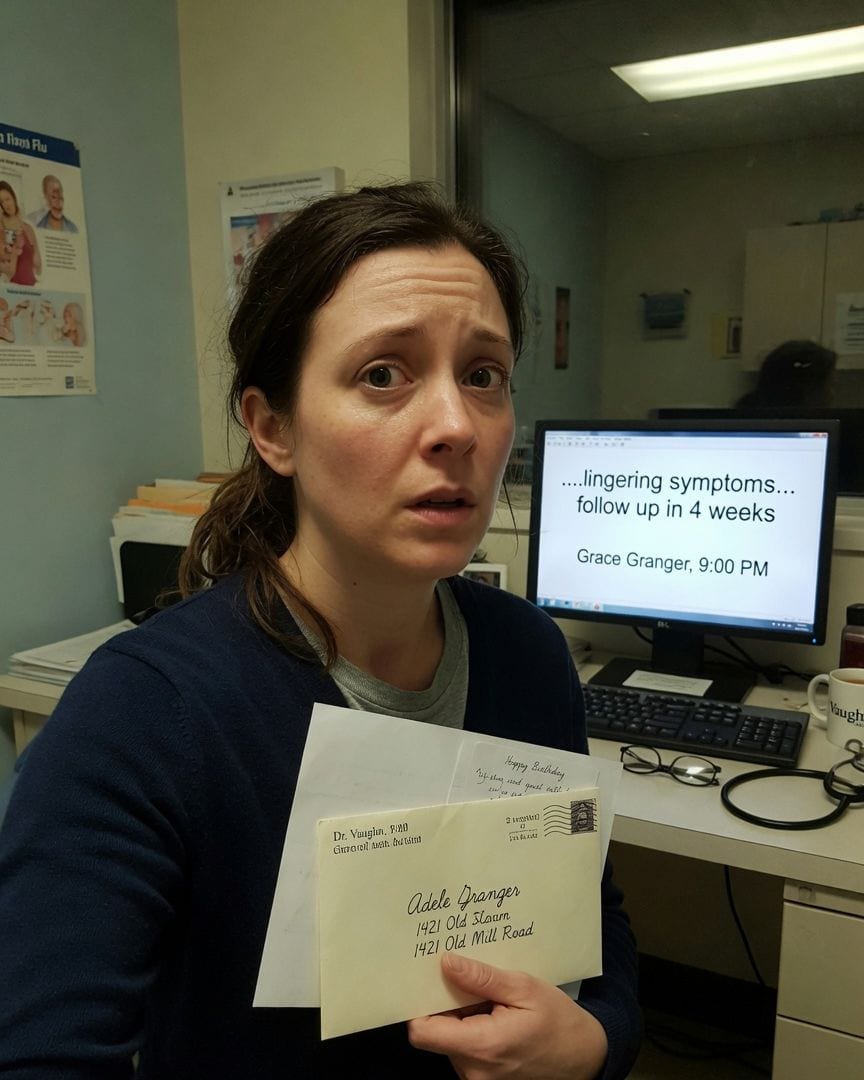
Mid-appointment about my cough, my doctor told me to call my estranged sister tonight — a sister I'd never mentioned to him. The note on his screen ended with her name and a time.
My doctor dismissed my cough as a lingering virus, but then he said something impossible: "You should call your sister tonight." I hadn't spoken to Grace in years, and I'd never mentioned her to him. When I saw her name on his screen with a specific time, a cold dread began to claw at me.
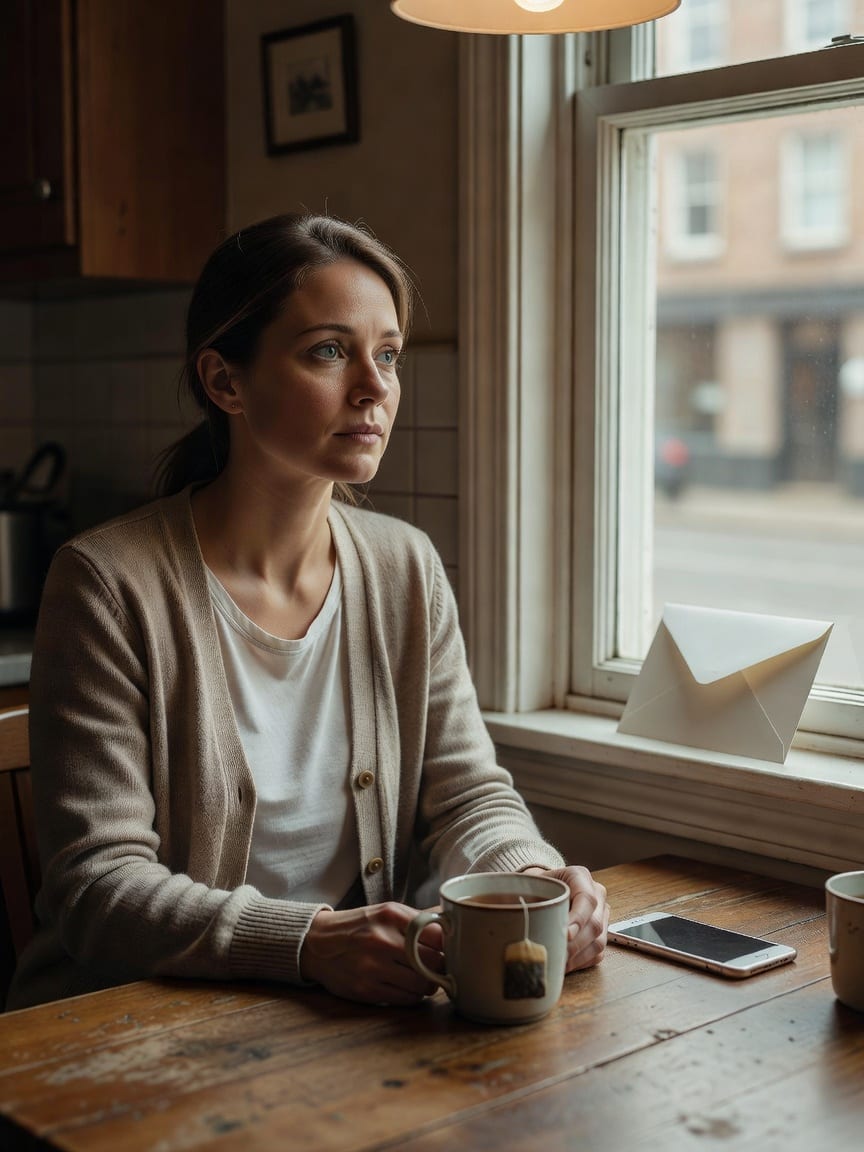
My taxi driver knew my name before I spoke, then apologized for the flight I was going to miss. I was arriving. The cab's plate was scrapped four years ago.
After a strange taxi ride, I received an unsettling birthday card addressed to me. Its return address listed 'Old Mill Road Field,' an empty lot where a mill once stood, and it was postmarked locally. The card arrived four months before my actual birthday, sparking a cold dread I couldn't ignore.
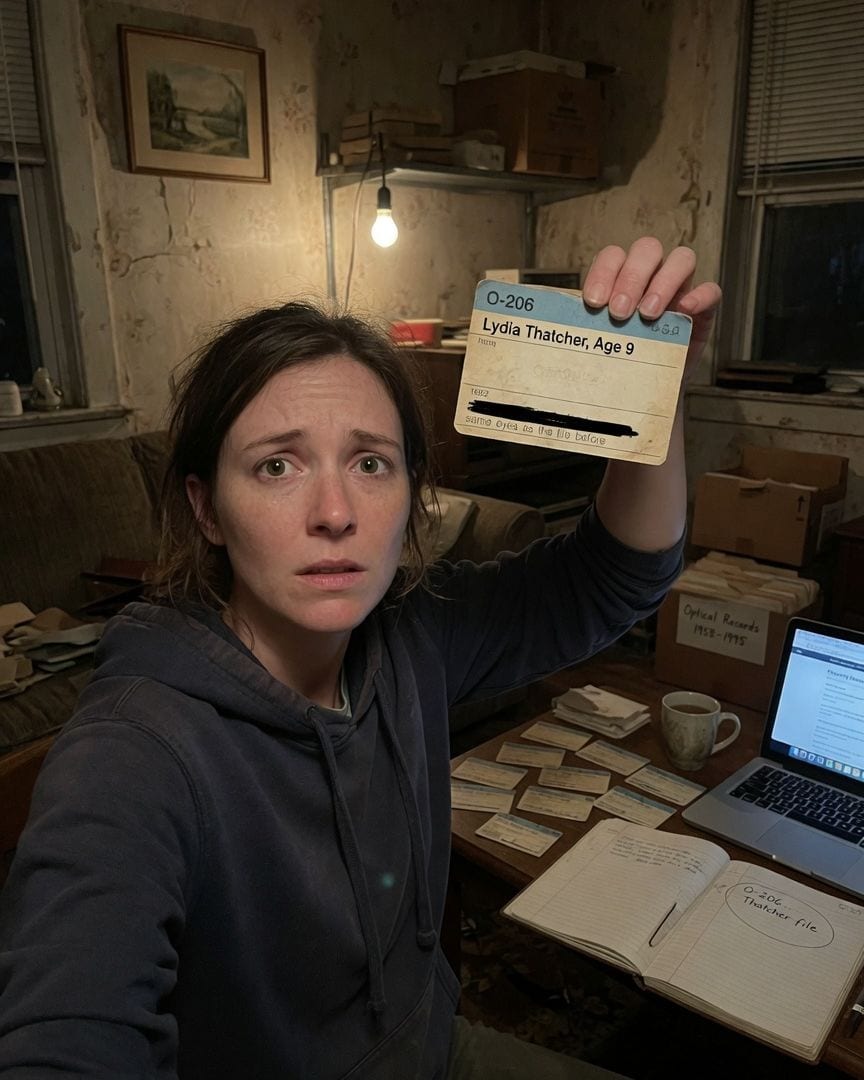
My own optical card is dated 1962, with my name on it. I wasn't born until 1993.
Sifting through old patient files from my former optical practice, I found my own O-206 card. It had my name, Lydia Thatcher, and my current home address printed on it. But the card was dated 1962, decades before I was even born, and a redacted note mentioned 'same eyes.'
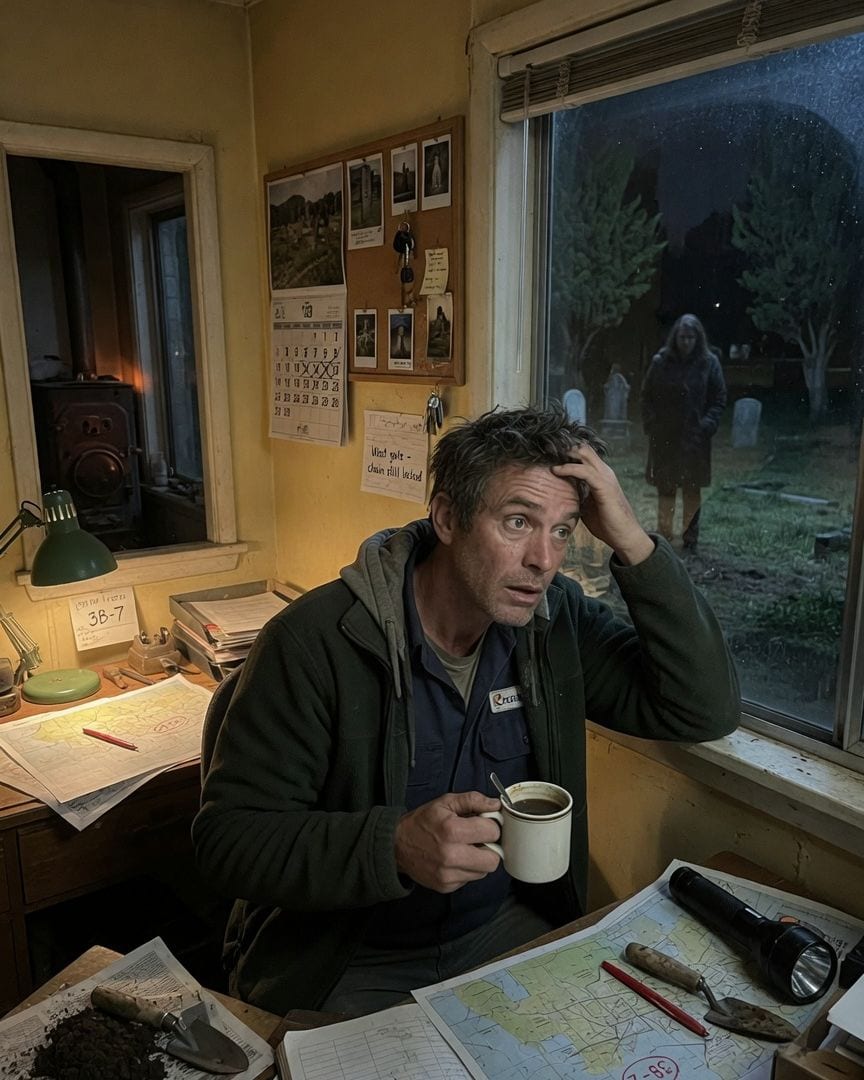
My cemetery lodge overlooks a woman visiting an empty grave near 3 AM most nights. The west gate she uses has been chained shut since autumn, its lock untouched.
As the cemetery's night caretaker, I'm used to the quiet hum of the lodge. But for three weeks, a woman has appeared nightly at plot 3B-7, a silent mourner in the deep night. What chills me is how she leaves: walking straight through the west gate that's been chained and padlocked shut for eight months.
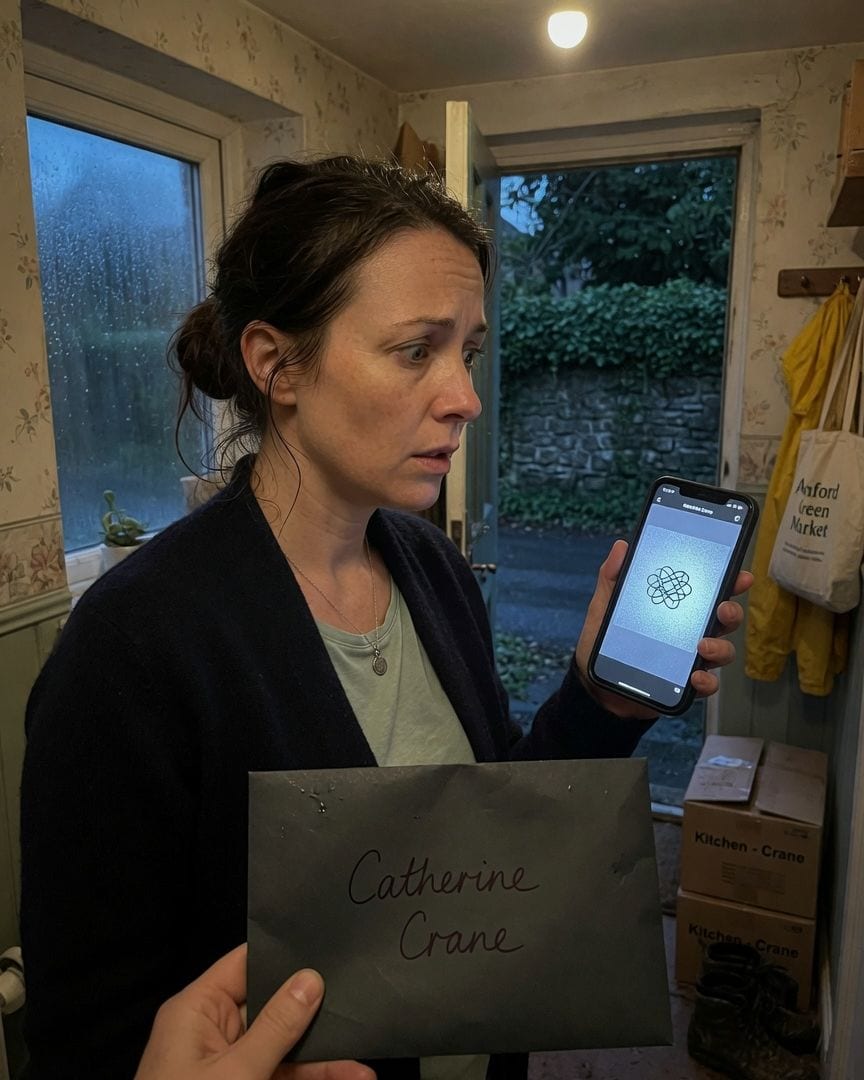
My postman warned me: never use the old pillar box. Royal Mail logs a collection every day, one item, signed by no one.
Moving to Ashford Green, I dismissed my postman's strange warning about the old pillar box by the ford. But after my own letter vanished inside it, I returned at midnight. Then, a dark, unstamped envelope slowly slid *out* of the slot, addressed to me.
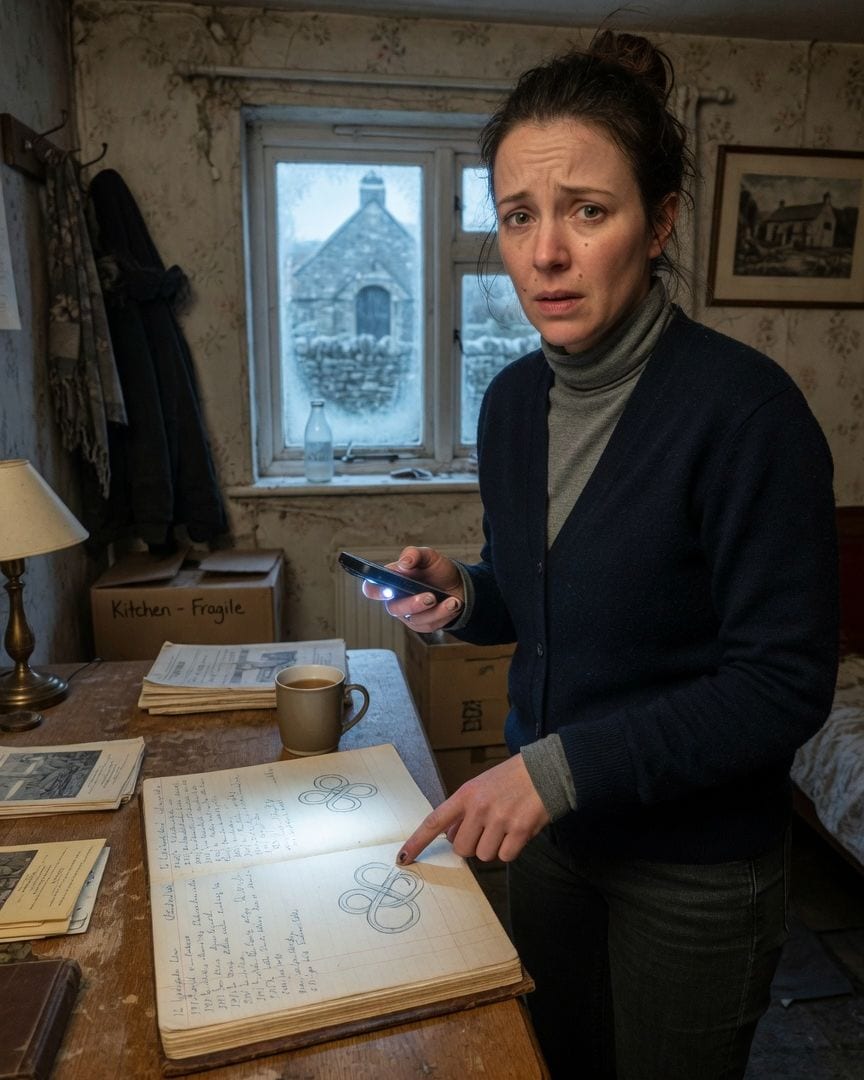
Milk appears daily by my lychgate. The dairy closed in '79. My address is handwritten into their old delivery book, starting the day we moved in.
Moving to Blackwood Creek, I loved the quaint charm, especially the unexpected morning milk delivery to my lychgate. But when I mentioned it to Eleanor at the village shop, her smile froze. She told me Willow Creek Dairy closed decades ago, in '79.