An archivist clears his father's garage, finding a Cold War photo. The object under the tarp has impossible corners, defying his father's own notes.
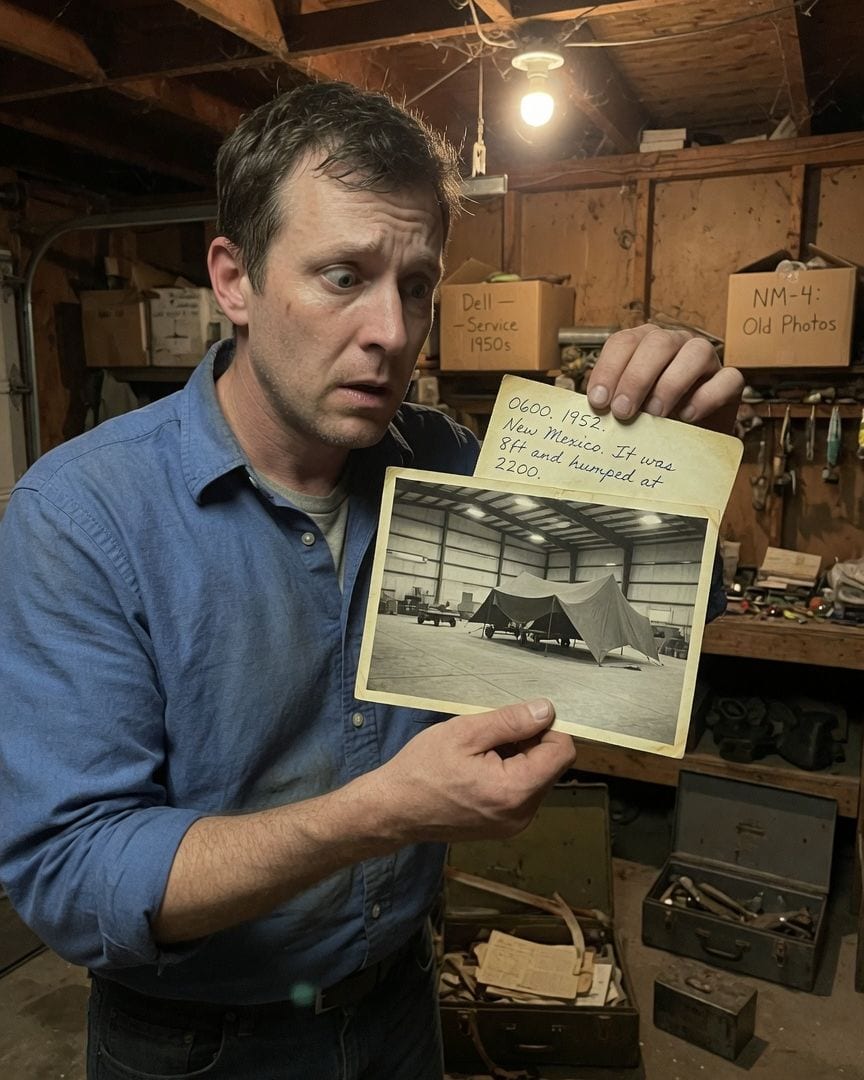
Franklin Fontaine moved slowly through his father’s garage, the air thick with dust and the faint, sweet scent of old lumber.
Dell had been gone a month now, and Franklin, an archivist by trade, was finally tackling the mountain of a life well-lived.
He pulled a box labeled ‘NM-4: Old Photos’ from a high shelf, the label in Dell’s neat, careful hand. Inside, nestled beneath a tangle of forgotten fishing lures and spare buttons, was a small, yellowed photograph.
It was grainy, slightly overexposed, but instantly arresting. The image depicted a military hangar interior from 1952, a vast, echoing space. In the center, a large object lay under a tarp, resting on a lowboy cart.
The tarp was stretched taut, not like fabric draped over a form, but like a skin pulled tight over something solid, defining stark, impossible corners. It rose too high, far too tall for the low-slung cart it sat upon.
Franklin turned the photo over. On the back, in Dell’s familiar script, were three lines: '0600. 1952. New Mexico. It was 8ft and humped at 2200.' He stared at the words, then back at the image. A trick of light?
A mislabeled date? A different object altogether? But the tarp’s precise lines, the sharp angles, the sheer height in the photograph stubbornly defied the plain description of an '8ft and humped' form.
The image was a physical impossibility, frozen in time.
Intrigued and profoundly disturbed, Franklin set the photograph aside, its impossible angles clinging to the periphery of his vision. As an archivist, he lived for detail, for the way disparate facts could coalesce into a coherent narrative.
He began to research his father’s military service, focusing on his time in New Mexico in 1952. Dell had rarely spoken of that period, only vague anecdotes about desert heat and sand.
Franklin accessed Dell’s official service records: commendations for diligent service, an unremarkable career path, and then, a seemingly innocuous transfer order. It was dated July 18, 1952, dispatching Dell Fontaine to a remote weather station in Alaska.
He cross-referenced this date with declassified military documents from the same period, trawling through public archives, digital and physical. Weeks blurred into evenings spent hunched over his laptop.
Finally, he unearthed it: a heavily redacted report, thick with black ink, titled 'Atmospheric Anomaly, Site NM-4, 1952.' The date on the report was July 17, 1952 – the day before Dell’s transfer.
Despite the extensive blackouts, the report detailed a 'localized meteorological event' and mentioned 'containment protocols' and 'witness debriefings.'
A brief, tantalizingly unredacted line, almost hidden in plain sight, described the 'phenomenon' as having 'estimated dimensions of 8 feet at apex, low profile.' A cold chill snaked its way up Franklin’s spine.
This description perfectly matched his father's initial observation at 2200, as noted on the back of the photograph. It did not, however, match the impossible, cornered object captured in the photo at 0600.
The official record, Franklin realized, was already a deliberate distortion.
Franklin’s heart hammered a frantic rhythm against his ribs. He cross-referenced the report’s date, July 17, 1952, with his father’s transfer order: July 18. A rapid, unscheduled transfer to a remote station, dated the very next day after the 'anomaly.'
It was too quick, too neat, a thread pulled too tightly. His investigation into Dell’s personal effects deepened, driven by a growing, unsettling certainty.
He returned to his father’s old footlocker, a battered metal trunk Dell had kept at the foot of his bed for decades.
He remembered the faint squeak it made when his father had opened it, a sound that now echoed in the quiet room. Franklin felt along the bottom, searching for what his father might have hidden away.
His fingers brushed against a faint seam, a false bottom. He worked at it, prying it open with a screwdriver. Inside, beneath layers of forgotten memorabilia—faded ribbons, a pocket watch that no longer ticked—he found a small, heavy metal box.
The lock was old, stiff with disuse. He forced it, the metal groaning softly as it gave way.
Inside, nestled amongst old coins and a tarnished medal, was a single, unmarked audiocassette tape, its surface smooth and dark, a silent witness.
Franklin felt the weight of the unmarked cassette in his palm, a tangible piece of his father’s untold story. He located an antique cassette player Dell had kept in the study, its playback quality surprisingly crisp.
He inserted the tape, pressed play, and waited, the whir of the reels filling the quiet room. His father’s voice, hushed and strained, filled the space, recorded years later, edged with a weariness Franklin had never heard in life.
Dell recounted the terrifying night in 1952, confirming every detail in the photograph. He described the initial object, 8 feet and humped, under a tarp secured with military-grade straps, the guard posted unchanged through the night.
Dell spoke of his growing unease as dawn approached, the impossible transformation he witnessed at 0600.
He emphasized a specific, chilling detail: the tarp, when it changed shape, seemed to have corners that were too sharp, too defined, almost like a geometrically perfect solid, rather than a natural drape.
It stood, he said, like a monument, eleven feet tall, yet the straps remained sealed, undisturbed. Then came the 'debriefing,' where he was calmly told he had 'misremembered' the details, that the object was merely a meteorological balloon, quickly deflated.
Dell mentioned a Captain Brooks, who oversaw the debriefing, calm and unsettlingly unbothered by the impossible. Franklin’s mind raced. He paused the tape, the silence in the room suddenly deafening.
He opened his laptop, the glowing screen a contrast to the analog mystery in his hand. He typed 'Captain Brooks, New Mexico, 1952,' hoping to find a lead, a corroborating witness, anything to anchor this impossible narrative.
Franklin’s online searches for Captain Brooks, now likely General Brooks (retired), began to yield unsettling anomalies. His home internet connection became sluggish, buffering endlessly on mundane sites, while search results for 'Brooks, NM-4' occasionally cleared themselves without his input.
Once, a blank email with a single, cryptic subject line — 'NM-4' — appeared in his inbox before vanishing, leaving no trace in his sent or trash folders.
He initially dismissed these as technical glitches or coincidences, the frustrations of an aging router or an overloaded server. He tried clearing his browser cache, rebooting his modem.
But the digital disruptions persisted, a subtle hum beneath the surface of his daily routine. Then, the physical anomalies started.
He noticed a dark, unmarked sedan parked on his street for several days, always a block or two away, its tinted windows obscuring the occupants. He told himself it was a neighbor, a visitor.
But then he saw it again, later, following him discreetly to the library, pulling away just as he parked. The casual facade of his investigation shattered. He was no longer just uncovering history. He was being observed, his digging noticed.
A chilling sense of a watchful, patient presence settled over him, the hum of the cooling laptop fan suddenly feeling like a low, mechanical growl.
Unnerved by the surveillance, the silent, omnipresent dark sedan, Franklin decided to accelerate his search. He noted the sedan's license plate, committing the characters to memory, a small defiance against the unseen eyes.
Using his research skills, he cross-referenced military archives, intelligence reports, and obscure academic journals, pushing deeper into the shadows of the internet. His persistence paid off. He found a recently declassified, but still heavily redacted, Department of Defense memo.
This document, dated 1953, bore the chilling title 'Project Cornerstone: Anomaly Containment and Perception Management.' The language was dense, bureaucratic, yet profoundly disturbing.
It discussed 'adaptive concealment technologies,' 'memory re-calibration protocols,' and outlined a 'filing system for anomalous events' where 'physical evidence is re-contextualized to fit established parameters.' Franklin felt a rising nausea. This was not about denial; it was about active control.
The document spoke of objects existing in a state of controlled non-existence, their reality managed. A critical footnote, barely visible beneath a heavy redaction, seemed to glow in the dim light of his study.
It described a 'successful field test' at 'Site NM-4, 1952,' noting that the 'object exhibited full dimensional autonomy, presenting as 11-foot tetrahedral at 0600 hours.' The words resonated with a terrifying clarity.
The specific detail of the 11-foot, perfectly cornered, geometrically solid shape from his father's tape and photograph snapped into terrifying focus. The 'unhappening' wasn't mere denial; it was an active, technological alteration of reality itself.
Dell wasn't misremembering; his memory was being re-calibrated by a system designed not just to control information, but to control truth itself. The room felt cold, the air still, as if holding its breath.
Franklin, connecting these horrifying pieces, felt a profound chill seep into his bones. The implications were far wider than a single UFO incident from 1952. This 'secrecy machine,' Project Cornerstone, was a living, evolving entity, not a historical footnote.
It actively altered reality, re-calibrated memories, and filed away the impossible. He returned to the digital archives, searching for any further mention of Project Cornerstone, driven by a desperate need to understand the scope of this silent dominion.
He found another Project Cornerstone document, a roster of personnel involved from the 1970s, long after his father’s incident. It was a mundane list of names, ranks, and assignments.
As he scanned the list, his eyes traced the names, some familiar from other redacted reports, others entirely new. Then, a name caught his eye, a sudden, sharp intake of breath. Not his father’s. His own.
'Fontaine, Franklin, M, b. [his birth year], designated 'Legacy Asset, NM-4'.' His heart pounded, a cold dread washing over him, deeper than anything he had felt before. He wasn't just a researcher; he was part of the file.
He wasn't looking at the truth; he was in it. He glanced out his window, his hand shaking slightly.
The unmarked sedan he had been observing for days pulled up to his curb, its headlights cutting through the night, twin beams impaling his living room wall.
The front door of his house began to open slowly, silently, a dark figure silhouetted in the frame.
Franklin scrambled back from the window, but it was too late. The front door of his house swung inward, a silent, smooth motion. Two men in plain clothes entered first, their faces unreadable, their movements economical.
They were followed by an older man, his silver hair neatly combed, his dark suit impeccably tailored. He had an unbothered, almost serene demeanor, his eyes calm and patient as they met Franklin’s.
"Mr. Fontaine," the older man said, his voice quiet, measured. "I am General Brooks, retired, of Project Cornerstone." Franklin's breath hitched. Brooks. The man his father had mentioned.
Brooks explained, without a hint of apology or menace, that Franklin’s father, Dell, had been a 'witness,' and his subsequent 'filing' was for his own protection, a subtle redirection of his life path, carefully managed.
"He never truly left us," Brooks said, a faint smile playing on his lips. Franklin, as a 'Legacy Asset,' had now 'activated' his file by his investigations.
Brooks continued, his voice never rising above a conversational tone, explaining that the 'object' from 1952 wasn't gone. It was simply 'filed'—existing in a state of controlled non-existence, its reality managed by Project Cornerstone.
The changing shape wasn't just a physical alteration; it was a demonstration of its ability to defy perception and record, and the project's ability to 're-contextualize' that reality into something comprehensible, something manageable.
The 'file' wasn't just an archive of past events; it was a dynamic record of ongoing operations, a living system. And Franklin, through his lineage, was now inextricably linked to it, a new data point in an eternal equation.
General Brooks held Franklin’s gaze, his placid eyes betraying nothing. He produced a laminated card from his inner jacket pocket, identical in style to the old roster Franklin had found, but updated.
It bore Franklin’s own photo, taken perhaps from a government ID, and the designation 'Legacy Asset, Active.' The card felt like a brand. Brooks offered Franklin a choice, the word hollow in the quiet room.
"You can continue your research, attempt to expose the truth," he said, "and become a 'subject.' Meaning you would be 'filed' away, your life and reality erased or profoundly altered beyond recognition." His tone was matter-of-fact, a professional outlining options.
"Or," Brooks continued, "you can accept a new identity, a new life, and become a 'resource' for Project Cornerstone."
His role, Brooks explained, would be to manage 'anomalies' and help maintain the veil of secrecy, always on the periphery, never touching the core truth directly, never asking the unanswerable questions.
Franklin stared into Brooks' unnervingly calm eyes, seeing not cruelty, but the cold, patient machinery of an institution that had long ago transcended human ethics.
He understood that 'escape' was a concept that didn't apply here, not in a world where reality itself was a managed construct. He could fight, but against what? A system that could make things 'unhappen'?
He saw his father’s hushed voice on the tape, the impossible corners of the object in the photo, the name ‘NM-4’ haunting his own birthright.
He understood that he must become part of the system that had already claimed his father and now him. He accepted, the word catching in his throat, a faint whisper swallowed by the silent room.
Franklin’s old life dissolved with quiet efficiency, like dust motes caught in a sunbeam. His apartment was cleared out within days, his research files meticulously cataloged and handed over to Brooks’ silent operatives.
He was given a new name, a new address in a nondescript town nestled in the heartland, and a new 'job' in a remote government records department, processing mundane data entries.
The dark, unmarked sedan, once a symbol of surveillance, was now his daily transport, picking him up at precisely 7:45 AM.
He was close to the 'filing' process, but always kept at a distance from the 'anomalies' themselves, a carefully managed cog in the vast, silent machine.
He learned the protocols, the language of re-contextualization, the subtle art of making the impossible disappear from official records.
Franklin sat at a sterile desk, surrounded by rows of grey filing cabinets that stretched to the ceiling, inputting data into a secure terminal. The fluorescent lights hummed with a flat, unwavering pitch.
A new physical file landed on his desk, marked 'URGENT - Review and Classify.' He opened it with a methodical, practiced hand. Inside, it detailed an impossible disappearance from a remote research station in the Pacific Northwest.
The date was yesterday. He scanned the names of the missing personnel. One of them was a young woman, a junior researcher. Her name was Nina Mitchell.
He looked at her photo, a bright, eager face, then at his own reflection in the darkened monitor, a faint, unreadable expression on his face. He knows this file, like his father's, is still being signed.
If this one got to you
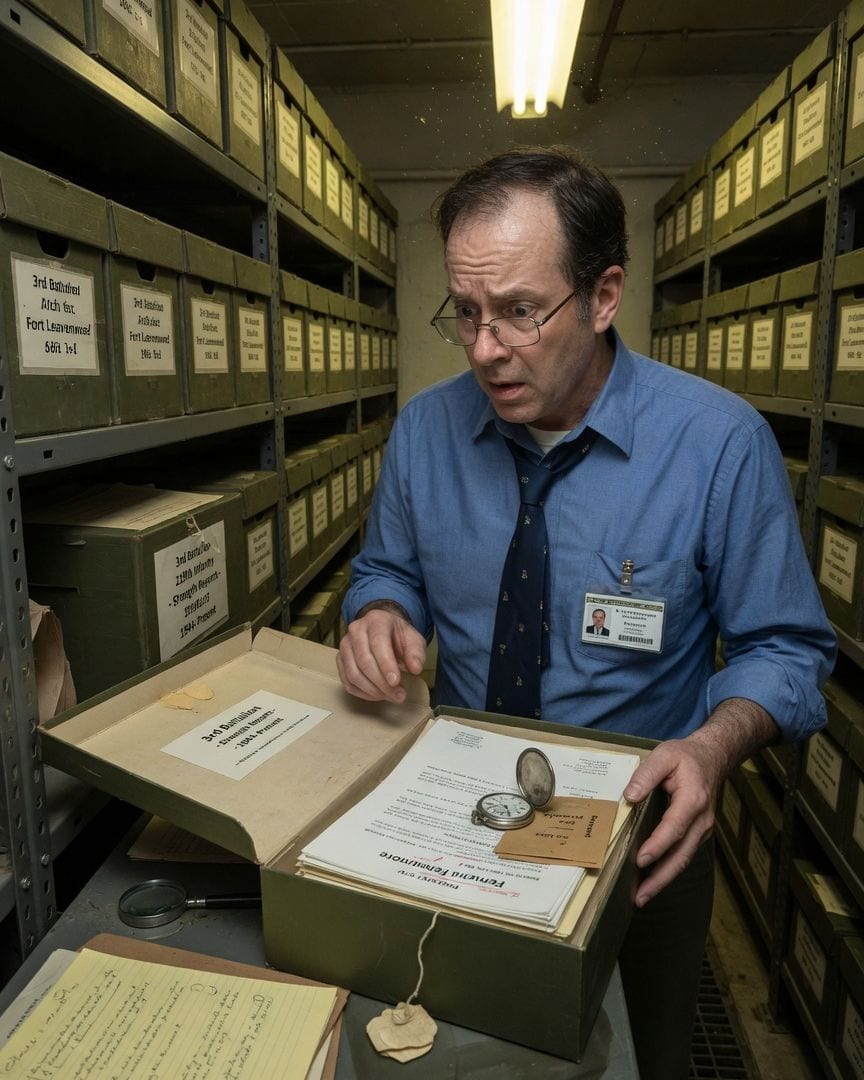
On his last Friday, an archivist finds his dead father's pocket watch in a Cold War ghost unit's file, ticking and warm.
Marcus Fennimore, a meticulous archivist, was on his final Friday at Fort Leavenwood's lineage vault, a place he knew intimately after thirty-one years. He stumbled upon twenty-two dust-sealed boxes for '3rd Battalion, 219th Infantry'—a unit that, according to every official record, simply did not exist. Inside, reports ran from 1944 to just last month, with the most recent listing his long-dead father, Kenneth Fennimore, as 'absent.' Marcus’s own father. Then, from a 1944 folder, he pulled his father's actual dog tags and a silver pocket watch, inexplicably warm and steadily ticking, freshly engraved with 'K.F. - Present for Duty.'
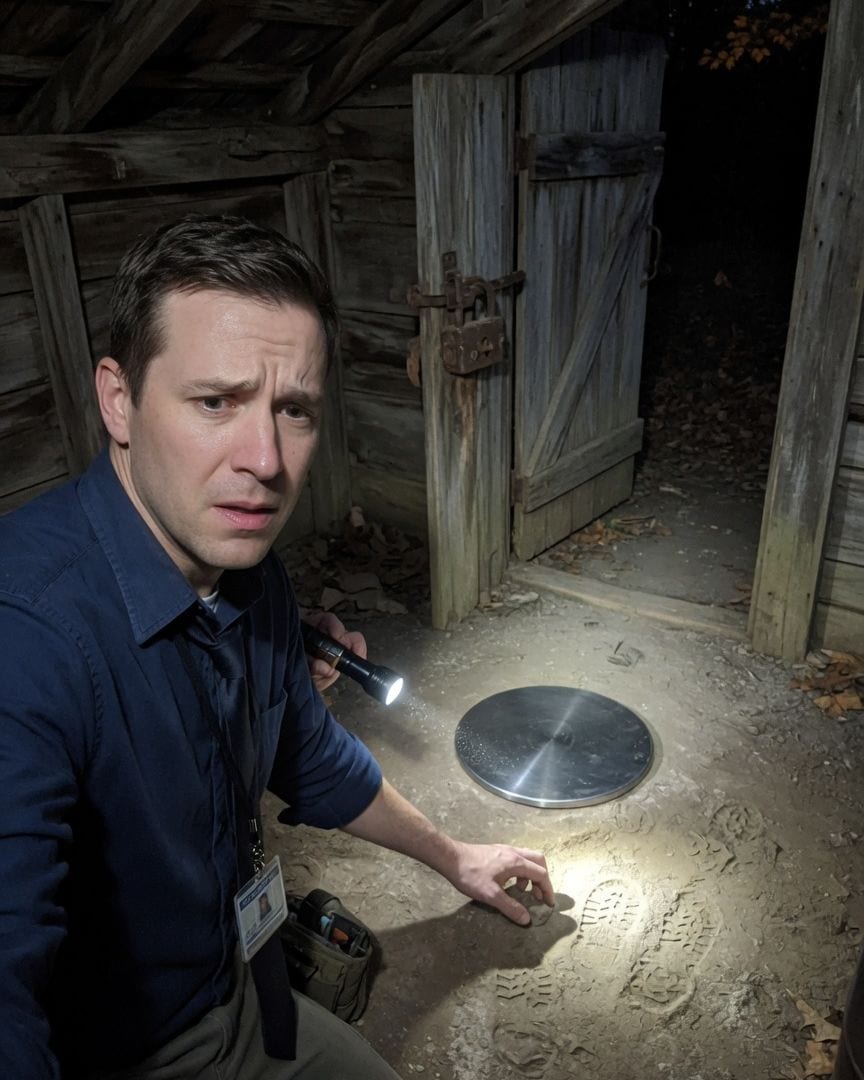
A meticulous archivist found a Cold War file showing a weathered shed with boot prints walking in, but none ever walking out, and a custody log signed for eighty-one years.
Devin Mauch, a methodical archivist at Fort Loran, was meticulously preparing the last of the WWII bundles for transfer, relishing the quiet order of declassification in the hushed, climate-controlled vault. His calm was shattered when he discovered the Ashfield Barn file, a slim folder containing a single grainy photograph of a small, weather-beaten wooden shed. In the dust before its slightly ajar door, a clear set of boot prints led directly inside, but none led out. The chilling caption read: 'SUBJECT REMAINS INSIDE, IN CUSTODY, INDEFINITE,' with the entry re-signed quarterly for eighty-one years, the last signature just six days ago. The shed, he knew, stood less than four miles from his home, its ancient, medieval lock hinting at a secret far deeper than any rural incident. What, or who, had been kept in that shed for over eight decades, and why did its custody continue to this day?
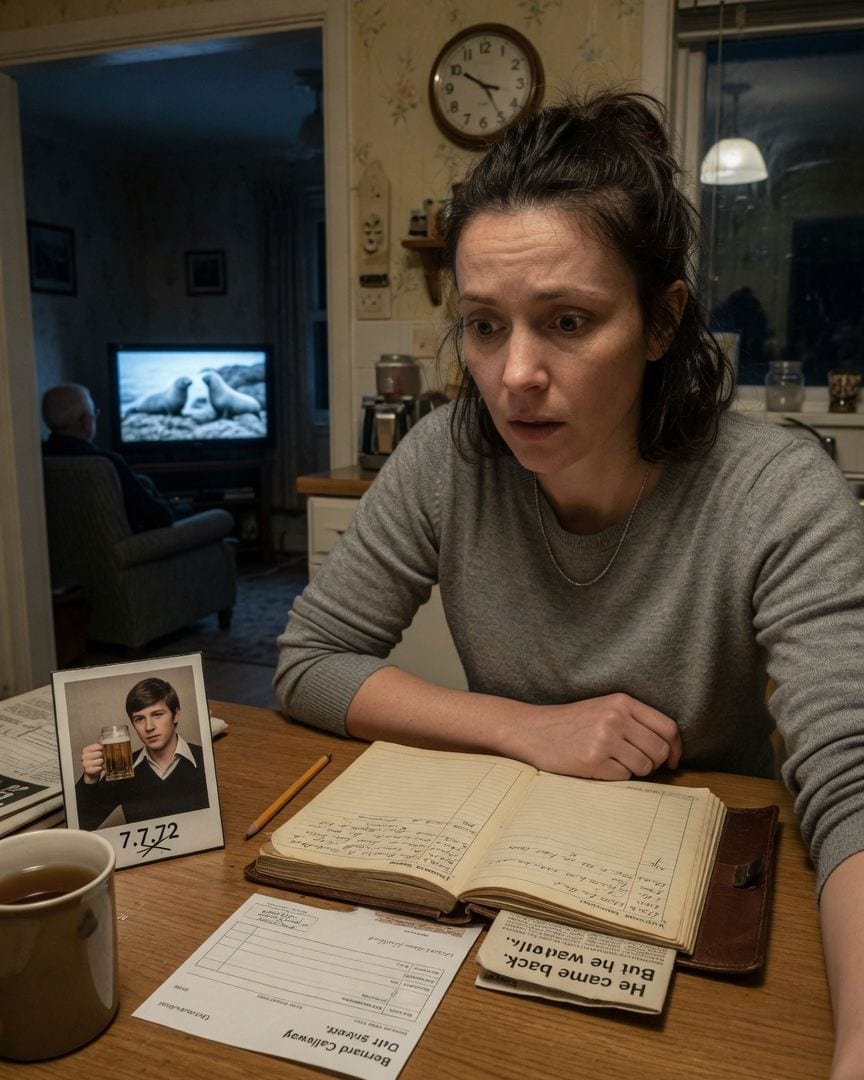
My father's bank slip had uncrossed '7's. He swore he never had that habit.
My father, Bernard, returned three months ago, a miracle after being presumed lost at sea. But a bank statement revealed a disturbing detail: the '7's in his signature were uncrossed. For decades, he'd meticulously crossed every '7', yet now he denied ever having the habit.
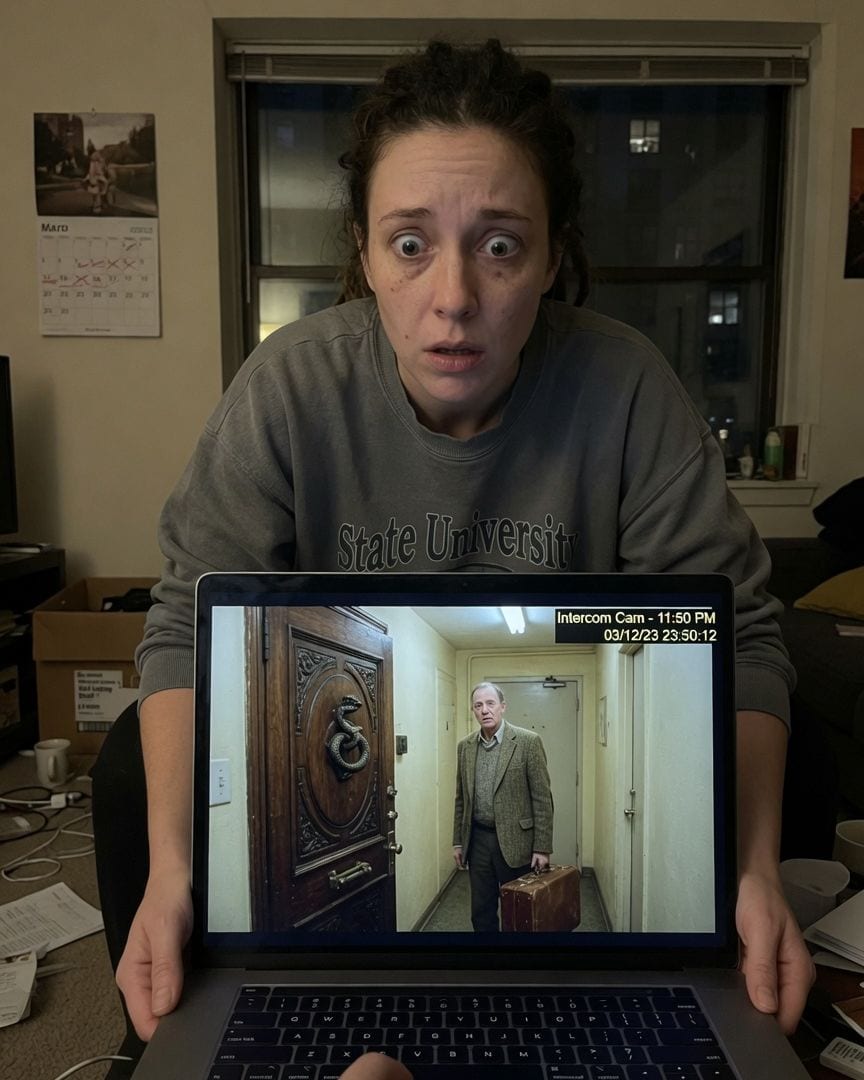
My dead father stood at my apartment door at 11:50pm, two hundred miles from where he died, and the old intercom caught him.
Clearing my old laptop, I found a folder of intercom snapshots from my former apartment building. One photo showed my father, Robert Easton, standing directly at my door, timestamped three months ago. The impossible truth was he had died that exact night, 200 miles away in his own bed, never once visiting my city.
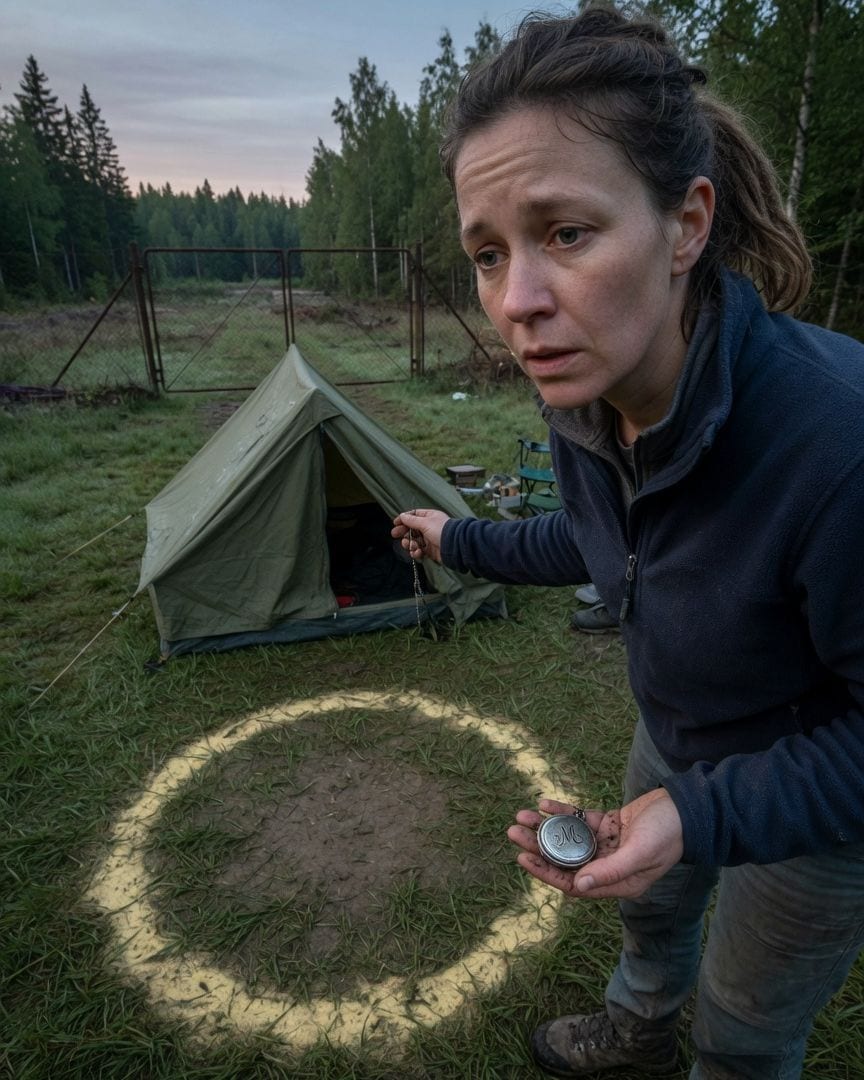
My tent left a flattened ring in the grass, but an older one was already there, worn into the turf, exactly tent-sized, for thirty years.
As the new camp host, I ignored the warden's odd rule about pitching my tent on a particular flat spot. That night, something enormous walked in slow, methodical circles around my tent. The next morning, I found a deeply worn, old ring in the earth beneath my tent, and later, a tarnished silver locket buried there.
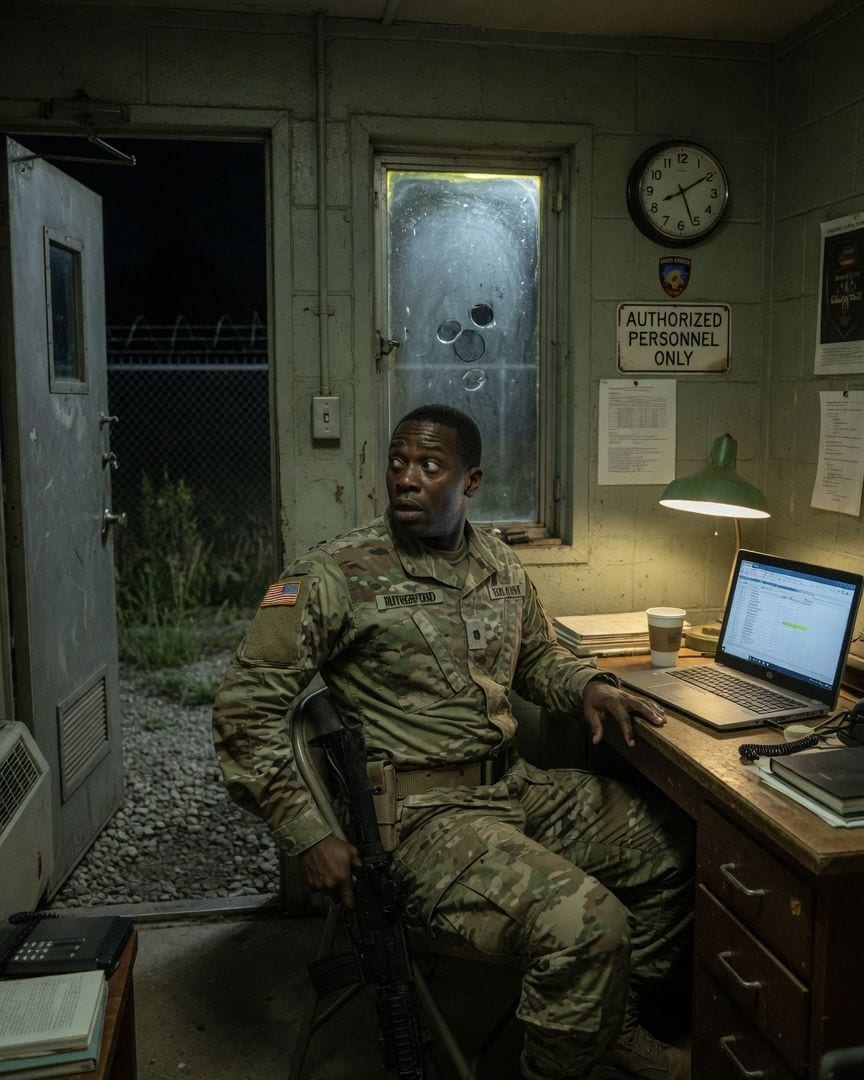
Fort Vashon's lone guard heard precise knocks on her window, then felt them from *inside* the locked shack.
Staff Sergeant Julian Rutherford felt an unsettling quiet at Fort Vashon's back gate, replacing a guard who reported strange knocks. He discovered an extra name on the digital duty roster that kept reappearing after deletion, a cold digital ghost. His search through decades of archived logs revealed a persistent anomaly: an unassigned slot, always present on short-staffed shifts. Then, in a forgotten supply shed, he unearthed an old journal detailing similar knocks and shadows, and one entry describing a guard hearing his own name called from the dark. What invisible presence haunted the fort's lonely gate?