An assistant archivist's Cold War file held a photo of her grandmother's empty 1988 apartment. A figure stood in the window, stamped 'UNIT 701'.
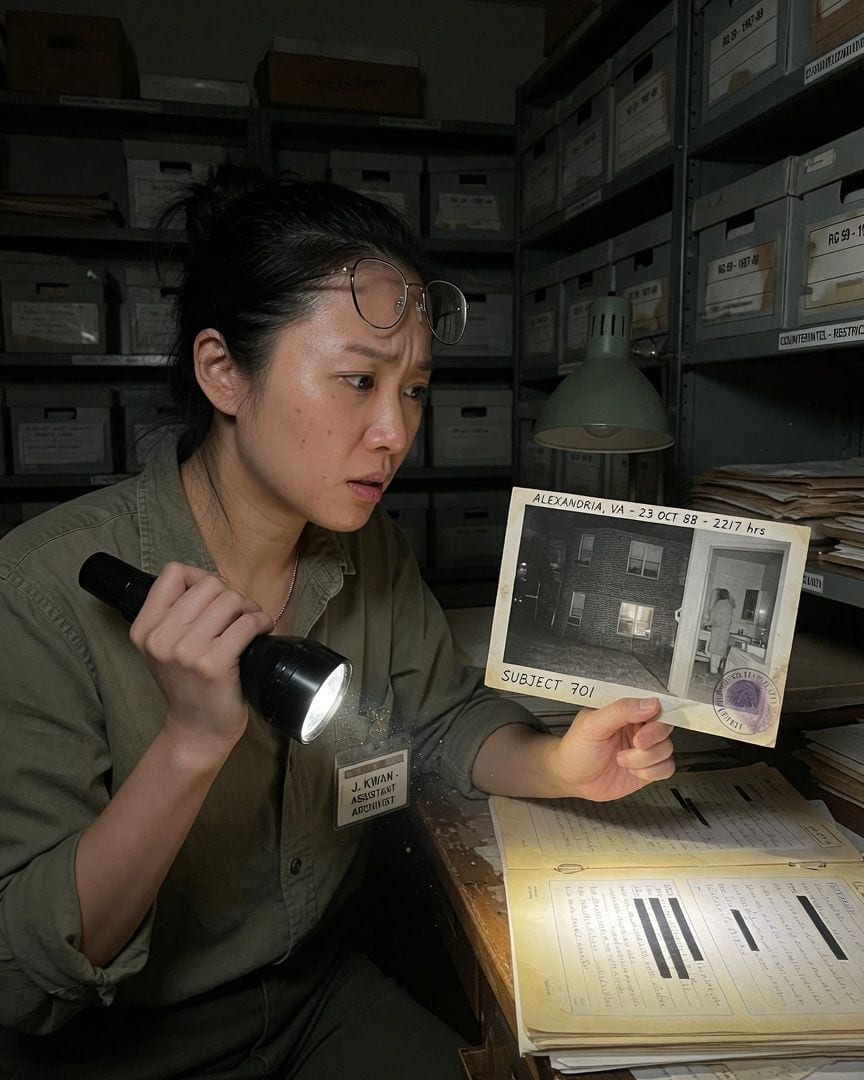
Junie Kwan, twenty-eight and an assistant archivist, hunched over a heavy 1988 counterintelligence dossier.
The silent, cavernous stacks of the National Archives pressed in around her, swallowed by the gloom save for the single beam of her flashlight cutting through it. Yellowed pages lay open on her desk.
It was eleven PM, an hour before a standing court order mandated the file reseal, and she was alone. The dossier detailed a "defector who never existed" and an "apartment in Alexandria that was never leased."
But for Junie, the file held a far more personal horror. Tucked inside was a grainy surveillance photograph, dated the night of her grandmother, Florence Kwan’s, funeral in 1988. It showed the very apartment where Florence had lived and died.
In the frame, behind the grimy glass of the kitchen window, a faint, almost translucent figure stood at the sink.
Junie remembered that night with aching clarity: the apartment had been empty, meticulously cleared out, locked tight by her mother and aunts. There had been no one there.
Her mind raced, adrenaline cutting through her fatigue. Junie cross-referenced the photo’s metadata with city property records, searching for any trace of a lease or tenant in 1988 beyond her grandmother. Nothing.
The official record confirmed the apartment had been vacant, a probate hold until the estate settled. Yet the figure remained, undeniably present in the faded image.
She flipped through the dossier, past redacted names and coded intercepts, searching for any internal reference to the apartment, or the defector it supposedly documented.
Instead, she found a series of cryptic marginalia—handwritten notes in an unfamiliar, looping script, referencing "Subject 701" and "re-routing protocols." One note, barely legible and written in faded blue ink, stated: "The window watches, even when the room is empty."
The dread deepened, a cold knot in her stomach. This wasn't a clerical error; it was a deliberate obfuscation. The apartment was a specific site, not just a random location caught in a spy's lens.
She remembered Chief Archivist Bernard Winslow, sixty-five, an inscrutable man with an encyclopedic memory, cautioning her weeks ago about a section of "no-list" boxes in the deepest sub-basement, hinting at files that "didn't want to be found."
Driven by a chilling intuition, Junie carefully removed the surveillance photograph from its brittle archival sleeve. On its reverse, almost entirely obscured by age and handling, she felt a subtle raised texture.
She angled her flashlight, and there, barely visible beneath a faint, smudged fingerprint, was a small, circular stamp. It wasn't the standard National Archives accession mark, with its neat typography and series number.
This one was crude, almost hand-carved, depicting a stylized, interlocking set of gears and a number: 'UNIT 701.' Her blood ran cold. She’d seen that exact stamp before, weeks ago.
It had been on the side of a reinforced, unmarked metal box in a forgotten, dust-choked corner of the restricted sub-basement, a box Bernard Winslow had curtly dismissed as 'un-accessioned material, leave it alone.'
The same box that, she now recalled, had a faint, almost imperceptible hum, like a distant, grinding mechanism.
The 'UNIT 701' stamp was a physical anchor in the rising tide of dread. Ignoring the reseal deadline for a moment, Junie pulled the dossier's index cards, cross-referencing 'Subject 701' with every available internal database. The system returned nothing.
No active files, no previous records, no defunct programs. It was as if 'UNIT 701' simply didn't exist in the official ledger. Yet the stamp was real, tangible, pressed into the back of a photograph from her grandmother's apartment.
Junie then accessed older, digitized administrative logs, searching for any mention of 'un-accessioned material' or 'sub-basement transfers' from the late 80s.
She found a single, heavily redacted internal memo from 1987, authorized by a 'B.W.,' detailing the 'relocation of sensitive processing equipment' to 'Sub-level Gamma.' The initial 'B.W.' could only be Bernard Winslow. The memo mentioned 'containment protocols' and 'temporal synchronization.'
This wasn't about archiving; it was about operating. The apartment, the defector, the figure in the window—they were all pieces of an active mechanism.
She felt a prickle on the back of her neck, a sense of being watched, not by a person, but by the silent, towering shelves around her, holding their secrets in the dark like waiting sentinels.
As Junie worked, the silence of the archives began to press in, thick and heavy. A faint, rhythmic click-whirr sound, almost imperceptible at first, seemed to emanate from the floor directly below her, from the direction of Sub-level Gamma.
It was the same hum she’d vaguely recalled from the 'UNIT 701' box, now distinct, like an antique clock winding down. She checked her phone; no signal.
The archive's internal network was also unreachable, the screen on her laptop frozen on a 'connection lost' message. Then, a shadow detached itself from the far end of the aisle. Bernard Winslow.
He moved with a quiet, measured pace, his silhouette elongated by the distant emergency lights that cast long, accusing fingers across the stacks. He stopped several aisles away, not looking at her directly, but his presence was a cold weight.
“Still at it, Miss Kwan?” his voice was calm, almost conversational, but it carried an undeniable edge. “Midnight is less than thirty minutes. Wouldn’t want to be locked in with the past, would we?”
He didn’t wait for an answer, turning and disappearing as silently as he’d appeared. His words were a direct warning, a confirmation that he knew exactly what she was doing, and perhaps, what she was close to finding.
The hum from below intensified slightly, a barely audible vibration underfoot.
Bernard's warning solidified Junie's resolve. She knew the 'no-list' boxes in Sub-level Gamma were key. With renewed urgency, she slipped down to the sub-basement, using a master key she wasn't authorized to have, its cold metal heavy in her hand.
The air grew colder here, drier, carrying the faint, sterile scent of old paper and something metallic. The clicking hum was louder, a steady, mechanical pulse that seemed to beat against the concrete walls.
She found the reinforced metal box bearing the 'UNIT 701' stamp. It was partially open, as if someone had recently been there, or left it that way deliberately.
Inside, nestled among what looked like antiquated recording equipment—spools of magnetic tape, vacuum tubes—was a small, leather-bound ledger. No accession number. No date. She opened it.
The pages were filled with meticulously handwritten entries, not of documents, but of names, dates, and 'disposition codes.' She recognized some of the names from other 'cold cases' of missing persons, cases officially filed as 'unexplained' disappearances.
One entry, dated 1988, caught her eye: 'Kwan, Florence. Subject 701. Processing complete. Re-routed.' Her grandmother. The ledger wasn't a record of the missing; it was a log of people who had been processed out of conventional existence.
The 'defector who never existed' was simply another entry in this chilling ledger. The Alexandria apartment, she now understood, was a 'processing node.'
The faint figure in the surveillance photo wasn't a ghost; it was a 'trace,' a momentary echo of someone being actively 're-routed' by this chilling mechanism.
The hum from the open box intensified, a low thrum that vibrated through the floor, up through her shoes.
Junie's hands shook as she scrolled through the ledger, past entries spanning decades, each name a person erased. She reached the end of the last filled page. The next page was utterly blank.
But as she watched, a faint, almost invisible shimmer passed over the paper. Then, slowly, as if written by an unseen hand, fresh ink began to bleed onto the page. A new entry began to form, the date first: 'Current.
Subject 701-' Her heart hammered against her ribs, a frantic bird trapped in her chest. The ledger was live. It was actively writing. She leaned closer, horrified, as the next words materialized, stark and chilling: 'Kwan, J. Location: Sub-level Gamma.
Status: Observing.' The hum from the open box swelled, filling the sub-basement with a low, guttural growl, and the air around her grew heavy, charged, prickling her skin.
A faint, almost imperceptible chill touched her neck, as if a presence had just materialized directly behind her.
Junie didn't dare turn around. The new entry in the ledger, detailing her own presence, pulsed with a faint, internal light that seemed to glow in the oppressive dark.
The hum of the 'UNIT 701' box vibrated through her bones, a low, resonant thrum that seemed to align with her own frantic heartbeat.
The 'secrecy machine' wasn't just an institution; it was a living, active system, the archive itself functioning as its central nervous system. The 'no-list' boxes were its organs, the leather-bound ledger its consciousness.
People like her grandmother, like the 'defector who never existed,' weren't just lost; they were 're-routed,' their conventional existence filed away, their essence transferred to another state, another dimension, another 'file.'
The faint figure in her grandmother's window was a momentary bleed-through, a visual echo from the processing, a ripple in the fabric of what they called reality.
The archive wasn't just storing secrets; it was creating them, maintaining them, and absorbing anyone who threatened its coherence.
Bernard Winslow wasn't merely an archivist; he was its keeper, perhaps even a part of it, ensuring the 'filing' process continued smoothly. The chill behind her intensified, a cold breath on her hair, raising gooseflesh.
She understood now: the file wasn't just being signed; it was signing her.
A voice, calm and deep, broke the silence, making her jump. “You found it, Miss Kwan.” Bernard Winslow stood at the entrance to the sub-basement, his face impassive, illuminated by the distant emergency lights from the upper floors.
He held no weapon, only a small, leather-bound book identical to the one in Junie’s trembling hands. “The mechanism is quite elegant, isn’t it? Clean. Efficient.” Junie spun, clutching the ledger to her chest. “My grandmother… you filed her?”
Bernard nodded slowly, his gaze unsettlingly serene. “A necessary re-routing. She was becoming… an anomaly. Discrepancies create instability.” He took a step forward, his shadow stretching across the concrete floor towards her. “The archive demands coherence.
Your investigation, Miss Kwan, is creating a new discrepancy.” The hum from the box swelled into a low roar, filling the sub-basement with a grinding sound that grated on her teeth. Junie knew she couldn't fight him, couldn't explain.
Her only chance was to escape with proof, however impossible that seemed. She made a desperate dash for the sub-basement stairs, clutching the ledger. Bernard didn't pursue, but his voice echoed, calm and chilling even over the roar.
“The system is self-correcting, Junie. The file is always signed.”
As she scrambled up the stairs, her breath burning, the pages of the ledger in her hand began to shimmer, the ink on the 'Kwan, J.' entry glowing brighter, then fading, as if struggling to complete itself against an unseen force.
She burst through the main archive doors, the cold night air a shock against her face, the sound of the hum still vibrating in her ears, the ledger pages now utterly blank, the 'Kwan, J.' entry completely gone.
Junie Kwan never returned to the National Archives. She carried no physical proof—the ledger had gone blank in her hands, its pages smooth and pristine—but she carried the chilling, coherent truth of the secrecy machine.
She tried to tell her story, to anyone who would listen, but without evidence, it sounded like a breakdown, the ramblings of a sleep-deprived conspiracy theorist. Her professional reputation was quietly dismantled.
She found herself unable to hold a steady job, haunted by the quiet hum that sometimes seemed to follow her, a phantom vibration in the air, and the indelible image of her grandmother at the sink.
The Alexandria apartment was eventually sold, its history meticulously scrubbed, listed as 'vacant since 1988' in all public records.
Bernard Winslow continued his work, an immovable fixture in the archives, his calm demeanor undisturbed, an unblinking eye in the heart of the machine.
Years later, Junie found herself in a small, cramped apartment, far from Washington D.C., working a string of odd jobs that barely paid the rent.
She often found herself staring at windows, half-expecting to see a faint figure, a ripple in the glass, a temporal echo.
The dread hadn't faded; it had simply settled into a quiet, constant hum beneath her life, an unnerving undercurrent to every day.
One evening, scrolling through old news feeds, she saw an online news article about a rare book collector who had acquired a peculiar, anachronistic ledger from a defunct auction house, a book with no listed provenance, no discernible author.
The article included a photo of a page. It was blank. Yet, a single comment beneath the article, posted anonymously beneath the headline, simply read: 'The file is still being signed.'
Her name, of course, was never mentioned in the article. But Junie Kwan knew. She knew the blank page, and the comment, were for her. She knew the hum had never truly left her.
And she knew that somewhere, in the deep, cold heart of the archive, her own file was still open, waiting for its final entry. The world was full of windows, and they were always watching.
If this one got to you
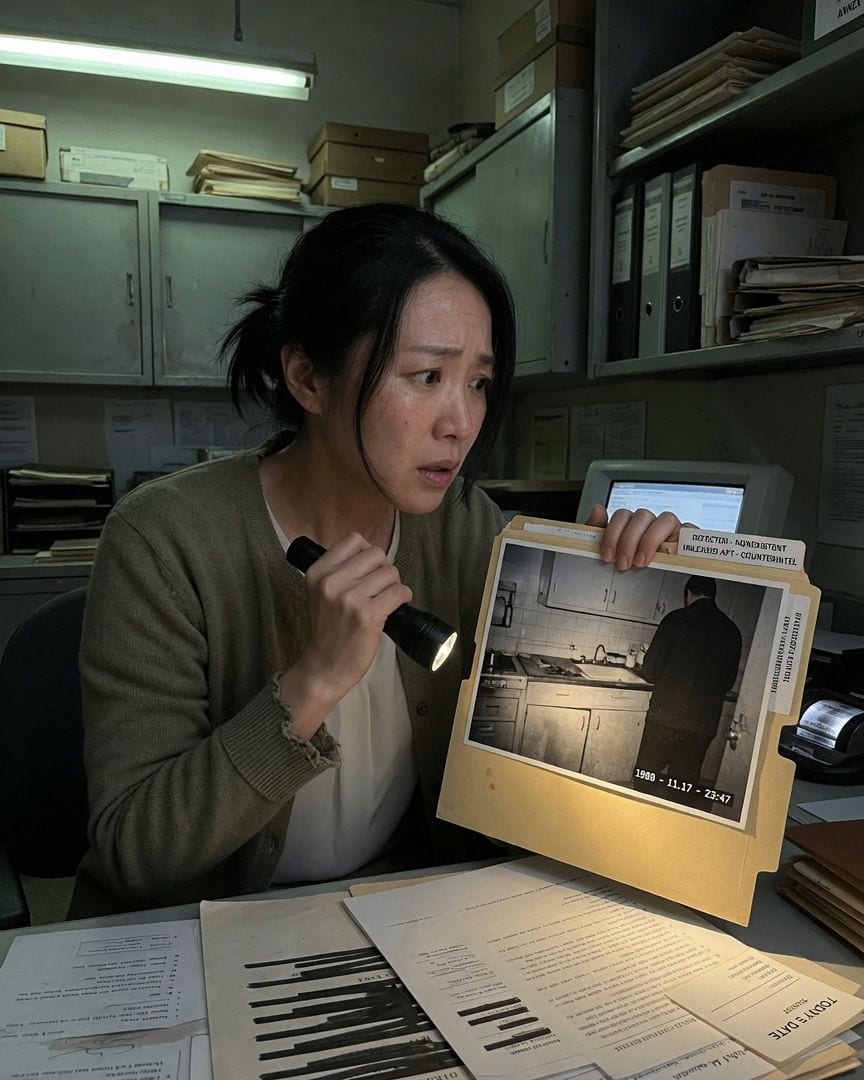
Against a midnight deadline, archivist Junie Kwan finds a Cold War dossier with a photo of her grandmother's kitchen, empty the night of the funeral, with an unknown figure standing inside.
Archivist Junie Kwan huddled in the hushed, cool Alexandria archives, working against a midnight court order to reseal a strange counterintelligence dossier. The file, dense with blanked sections, concerned a 'defector who never existed' and an 'unleased apartment.' As she scanned a grainy surveillance photo, a prickle of unease turned to dread: it was her grandmother's kitchen, dated 1988, the night of the funeral. A tall, rigid figure stood at the sink, yet Junie knew with certainty the apartment had been empty and locked that night. How could an impossible presence appear in a locked, empty room, tied to a phantom Cold War case?
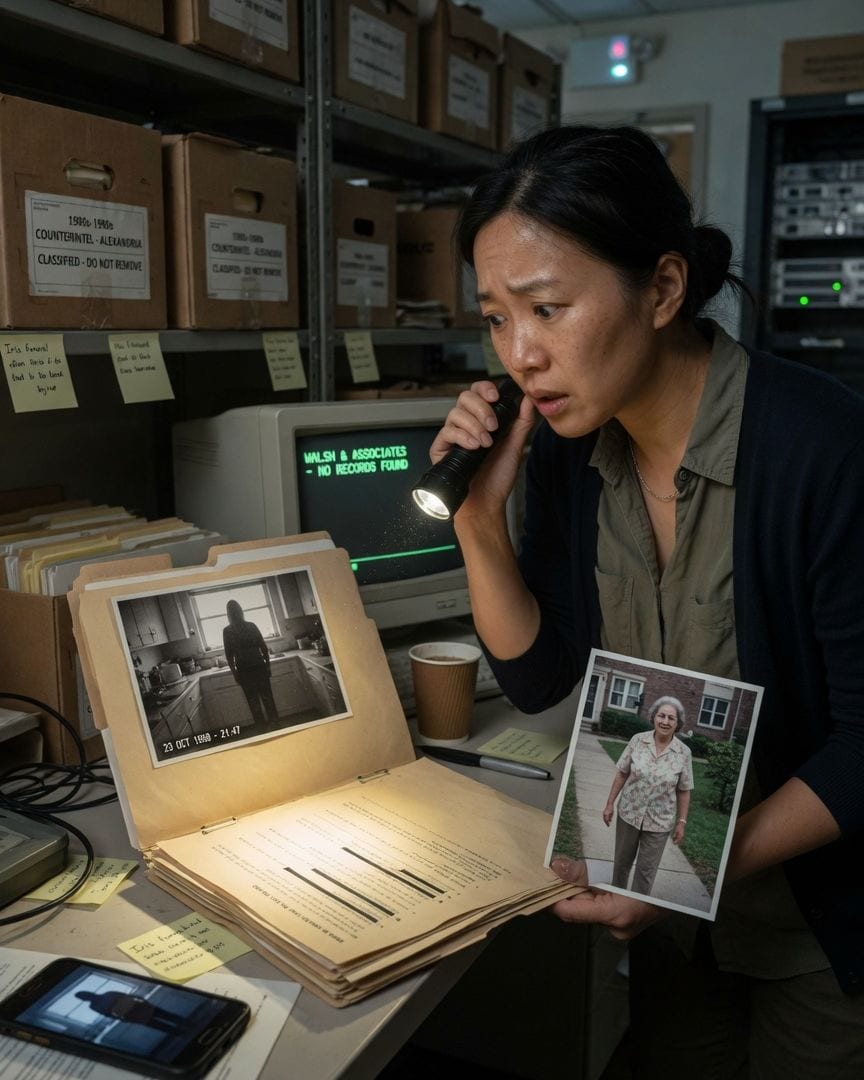
An archivist finds her grandmother's photo in a Cold War dossier. Iris smiles, vacant-eyed, with a face her granddaughter never saw.
At eleven PM, archivist Junie Kwan, 32, had just one hour before a 1988 counterintelligence dossier on a non-existent defector resealed. In the dusty, silent Alexandria archives, the hum of ancient HVAC was the only sound as she adjusted her flashlight beam over the stacks. Her heart seized when she found a grainy surveillance photograph inside: it was taken through a window of her grandmother Iris Sinclair’s flat, dated the night of Iris’s funeral. The photograph showed someone standing at the kitchen sink, even though Junie knew the flat had been empty and locked that night. As her search deepened, a loose photo of Iris herself slipped out, showing her grandmother months before her death with a vacant-eyed, unnatural smile Junie had never seen. Could her own grandmother have been part of this chilling Cold War mystery?
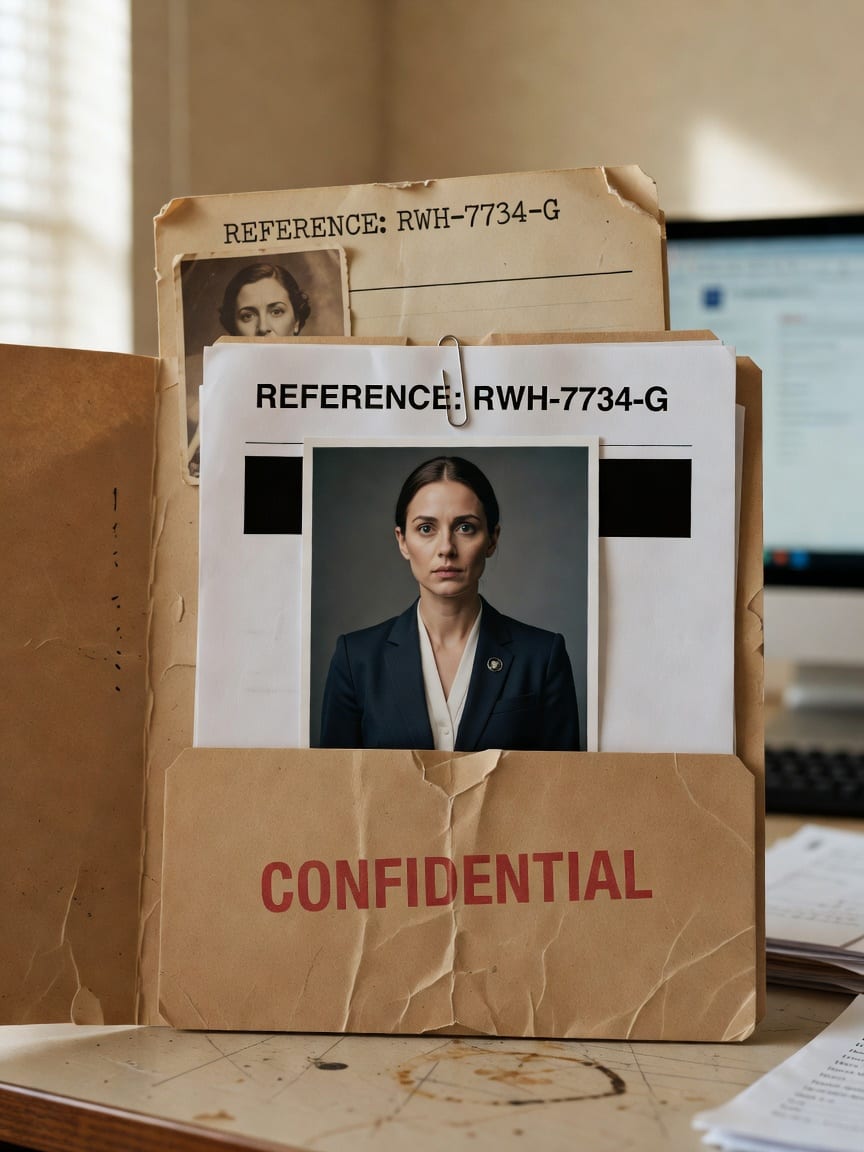
My security file was opened nine years before I was born. Its note said: 'subject not to be briefed'.
Auditing company digital records was routine until I pulled up my own personnel file. It clearly showed a 'Date Opened' nine years before I was born, yet bore my exact name and reference number. Below, an assessor's note from that impossible year mentioned a 'previous holder' and ordered the 'subject not to be briefed,' sparking a cold thrum in my chest.
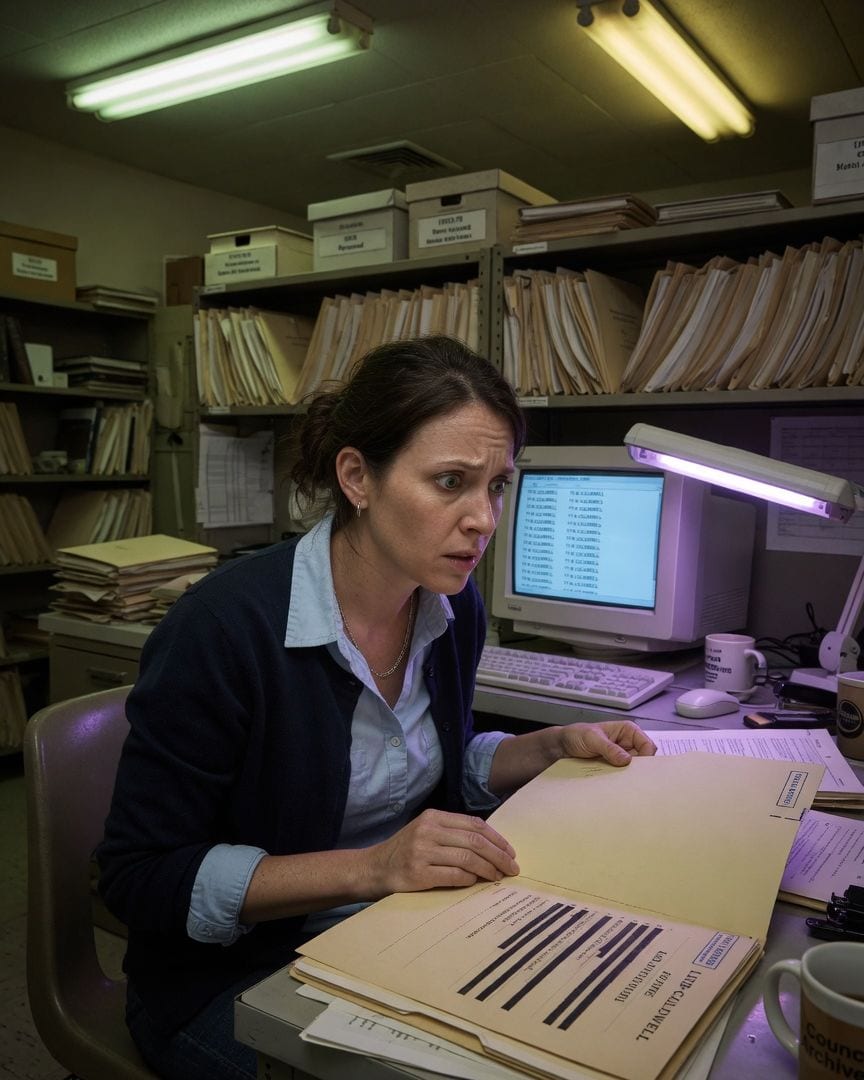
My employer's security file holds a vetting report on me dated nine years before I ever applied. It has my full name and my parents' address — with only one line, the source who referred me, blacked out.
Working a routine data audit, I pull my own security file. The issue date is nine years before I even applied for the job. Then, hidden within an old archive file, I find my current address etched under a blacked-out line.
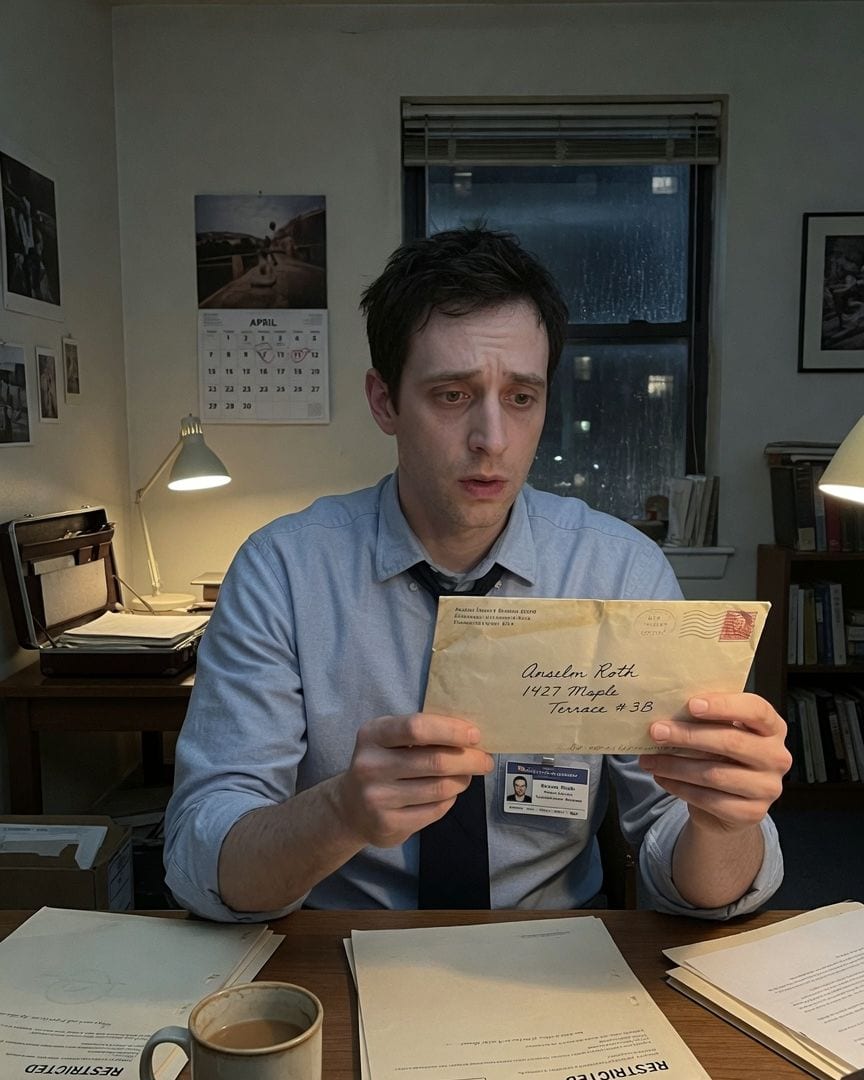
A Cold War declassification reviewer finds his dead grandmother's letter, postmarked 1974, addressed to him years before he was born, and radiating heat.
Declassification reviewer Anselm Roth meticulously sorted through a Cold War-era file on impossible disappearances at the National Archives, a routine 'thirty-year clock' review in 2014. Among the countless records of vanished ships and military units, he found an unscheduled addendum: a thick, sealed envelope addressed to him in his dead grandmother Eleanor Vance’s unmistakable hand. The postmark read 1974, years before he was born, and the paper itself was faintly, inexplicably warm against his fingers, defying every archival principle. Later, a photograph inside revealed his grandmother in an unknown uniform with a stark warning: 'They file us, Anselm. Don't let them finish.' This wasn't just a record of the lost; it was still active.
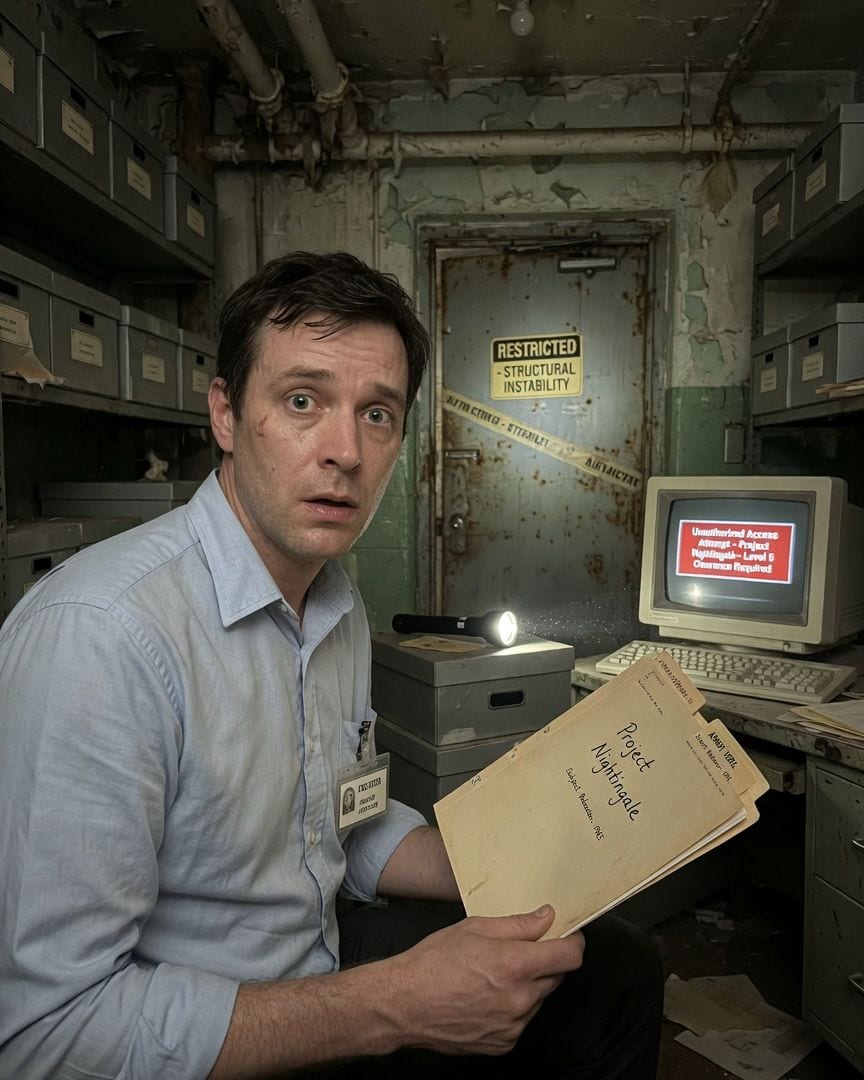
A FOIA officer found his dead mother's photo in a government Cold War file, dated 1983 — two years after her burial. Then he found her new file: 'Relocation - 1985.'
Devon Ashby, a routine FOIA officer, clicked 'release' on a 1983 file he'd seen dozens of times. Inside was a grainy photo of a woman, calmly staring from a logging road. His breath caught: it was his mother, Vera Ashby, dated two years after her 1981 burial. The file jacket, marked "Project Nightingale," led him to a forgotten, sealed sub-basement filled with unmarked metal boxes. There, he found a file for "ASHBY, VERA. Subject: Relocation - 1985," four years after her death. What hidden mechanism was meant to provoke him?