A Cold War declassification reviewer finds his dead grandmother's letter, postmarked 1974, addressed to him years before he was born, and radiating heat.
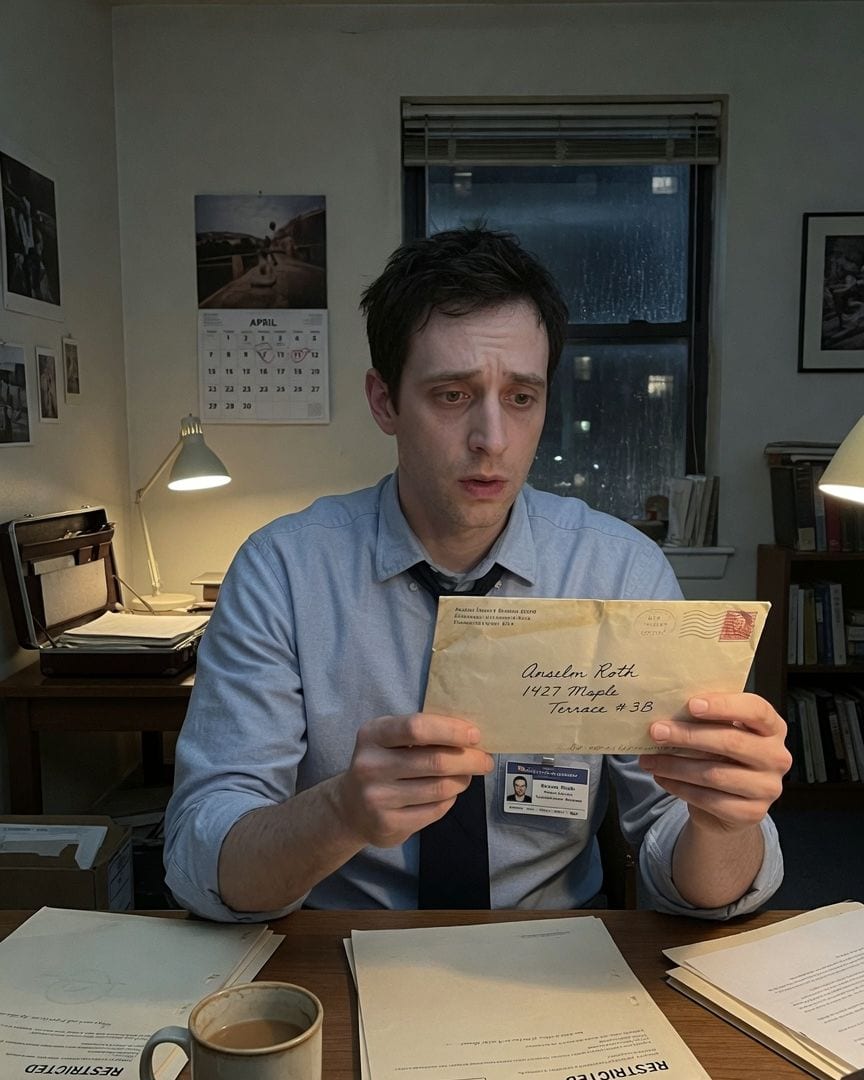
Anselm Roth, a declassification reviewer, meticulously sorted through the Pell Corridor file in the hushed, climate-controlled depths of the National Archives. It was 2014, and the file was up for its routine 'thirty-year clock' review.
His colleague, Henry Maddox, was across the table, head bent over a different stack, the soft rustle of aged paper the only sound.
The Pell Corridor designation always carried a strange weight: a collection of impossible disappearances, ships, planes, and entire military units vanishing without a trace, logged with unnerving bureaucratic precision. Some entries stretched back to the early 20th century.
Anselm reached the enclosure list, a final check before sealing the file for transfer. Item 17, an unscheduled addendum, was flagged for return to the requester’s next of kin. He frowned.
There was no requester listed in the file’s internal routing. The Pell Corridor file had been opened internally, a quiet administrative process with only him and Henry in the vast, echoing room.
He pulled the item, a thick, sealed Manila envelope, from its place. His grandmother, Eleanor Vance, had been gone for years, but he recognized her elegant, precise handwriting immediately on the front.
It was addressed to him, at his current apartment, the one he’d moved into just last April, a detail that made his stomach clench. The postmark read: 1974. Anselm, born in 1981, felt an inexplicable prickle on his skin.
He turned the envelope over in his hands. It was faintly, unmistakably warm.
Anselm’s breath hitched. He glanced at Henry, who was still absorbed in his own documents, oblivious to the impossible heat radiating from the paper.
The warmth of the envelope was a physical impossibility, a violation of every archival principle he knew. He slipped it into his briefcase, deciding to examine it privately, away from the sterile, observing silence of the archives.
Later that evening, in the quiet of his apartment, the envelope still held its strange, residual heat against his palm. The air in his living room felt suddenly heavy, expectant. With a tremor, he broke the seal.
Inside, nestled amongst brittle tissue paper, was a single, aged black-and-white photograph. It showed his grandmother, Eleanor Vance, much younger, perhaps in her early twenties, in a crisp military uniform he didn't recognize.
She stood stiffly in front of a desolate, fog-shrouded coastal landscape, a remote observation post visible in the background. Her expression was unsettlingly calm, almost knowing, her gaze fixed beyond the lens as if seeing something no one else could.
On the back, in her familiar, precise hand, was a stark message: 'They file us, Anselm. Don't let them finish.' Below the warning, also in her hand, was the date '1974,' followed by a string of alphanumeric characters: 'PC-7A-443-V.'
Anselm’s mind raced. A misfiled personal item? Impossible. The postmark, the address, the warmth. He tried to rationalize it, to call it a bizarre prank, but the specific, official-looking code on the back gnawed at him.
'PC' for Pell Corridor, perhaps? He knew enough about archival codes to recognize the pattern, even if the specific string was unfamiliar.
He felt a chilling certainty that the code was not random, but a direct reference to the very file he had reviewed that day.
The room around him seemed to shrink, the silence pressing in, amplifying the frantic beat of his own heart.
Back at the Archives the next morning, Anselm, feigning a need to re-verify a cross-reference, accessed the Pell Corridor database. His fingers trembled as he typed 'PC-7A-443-V' into the search field.
The system whirred, its internal fans kicking up a soft, mechanical sigh that seemed to echo the anxiety in his chest.
Then, it returned a single result: a sub-file, previously unmarked and unindexed, nested deep within the main Pell Corridor records. He clicked it open.
The first entry was a personnel record: 'VANCE, ELEANOR. Service Number: [redacted]. Date of Entry: 1974.' His grandmother. The second entry, dated just weeks later, was a requisition form.
It detailed a request for a 'Type 7-A Archival Unit,' signed 'Eleanor Vance.' The unit was described, in chillingly precise language, as a 'processing module for active personnel records within the Pell Corridor designation.'
Anselm stared, the screen's cold light reflecting in his wide eyes. The file was not just a record of the lost. It was still active.
Anselm spent the next few days in a blur of focused research, driven by a growing, sickening dread. He searched every database for 'Type 7-A Archival Unit.' Nothing. No blueprints, no inventory manifests, no procurement logs.
It simply did not exist within any public, or even declassified, record. He approached Henry Maddox, casually mentioning the unusual designation.
Henry, without looking up from his microfiche, waved it off as an obscure, likely obsolete internal code, or a clerical error from an era when classifications were less standardized.
'We had all sorts of weird designations for projects back then, especially experimental ones,' Henry mumbled, dismissing Anselm's unease with a familiar shrug. 'Probably just a project that never got off the ground.'
But Anselm couldn't dismiss it. He delved back into the Pell Corridor files, not just the official summaries, but the raw data, the ancillary documents.
He found dozens of missing persons cases, officially declared 'lost at sea' or 'missing in action,' yet their files contained continued payroll entries for years afterward, sometimes decades.
Supply requisitions for 'Unit 7-A' also appeared with unsettling regularity, for items ranging from specialized data tapes to 'personnel maintenance supplies,' all signed off by individuals officially listed as 'vanished.'
The signatures were steady, official, dated years after their presumed deaths. It was as if the institution itself refused to acknowledge their absence, keeping a meticulous account of ghosts.
The cold air of the archives seemed to hold its breath around him, waiting for his discovery. He felt a cold certainty that his grandmother hadn't just been lost to the Pell Corridor.
She had been part of whatever created it, or at least maintained it. The photograph, the message, the 'requisition' for the Type 7-A unit—they were not the actions of a victim, but of an agent.
A desperate agent, perhaps, but an agent nonetheless. The ordinary explanations were dissolving into thin air, leaving only a deepening, impossible mystery.
Anselm took the photograph and Eleanor’s note home, spreading them out on his coffee table, the faded image stark against the modern wood. He used his personal computer to cross-reference the desolate landscape in the photo.
After several hours, squinting at pixelated satellite images, he found a match: 'Observation Post Blackwood,' a decommissioned naval listening station on a remote stretch of the Maine coast, officially abandoned since the late 1970s.
The fog-shrouded rocks, the stark, angular buildings – it was identical. The air in his apartment felt suddenly still, heavy with a growing presence.
As he worked, a strange sense of unease settled over him. His work laptop, which he’d left running in the background, flickered.
A file he had been working on earlier, a different declassification project, briefly became inaccessible, replaced by a garbled error message before correcting itself.
His phone, charging on the counter, buzzed with an odd, sustained static that lasted several seconds before fading into silence. It was like the room itself was reacting, the electronics a sensitive skin to an unseen shift.
Later that night, an anonymous email landed in his personal inbox. The sender was '[email protected].' The subject line read: 'Filing.' The body contained a single, chilling sentence: 'Some files are best left sealed. Your grandmother knew.'
The words felt like a physical presence in the room, watching him, judging him. He tried to trace the email, but it bounced through a dozen dead ends, untraceable, leaving no discernible point of origin.
He knew then that his digging had been noticed. He was no longer just an archivist uncovering a mystery; he was a target. Someone—or something—was actively monitoring his actions, aware of his pursuit of the Pell Corridor.
The dread was no longer abstract; it was personal and immediate.
The next morning, Anselm confronted Henry Maddox.
He laid out the evidence on Henry’s cluttered desk: the continued payrolls for the disappeared, the 'Unit 7-A' requisitions signed by those officially 'lost,' the anonymous email, and finally, the aged photograph of Eleanor at Observation Post Blackwood with her stark warning.
Henry, initially annoyed by Anselm's 'conspiracy theories,' grew visibly unnerved as Anselm spoke. His face, usually ruddy, paled when Anselm showed him the chilling email.
'This isn't just a clerical error, Henry,' Anselm pressed, his voice low, a tremor of frustration and fear running beneath it. 'My grandmother was part of this. What is the Pell Corridor, really?
And what is a Type 7-A Archival Unit?'
Henry swallowed hard, his gaze darting around the empty archives office, as if checking for unseen listeners. The silence in the vast room stretched, taut with unspoken secrets.
'The Pell Corridor,' he finally whispered, his voice thin, 'it's not just a place, Anselm. It's... a designation. For a recurring phenomenon. A kind of fold in reality. People, units, they just... slip through. Vanish.'
He wrung his hands, his knuckles white. 'For decades, the institution has tried to understand it. To contain it. To manage it.'
Anselm pushed, his patience wearing thin. 'And the Type 7-A units?'
Henry sighed, a sound heavy with resignation and a deep, weary horror. 'They were a classified project. Eleanor was one of the lead researchers. The units were designed to interact with the Corridor. To... process its activity.
To contain the bleed-through. Or so we were told.' He looked at Anselm, his eyes filled with a grim understanding. 'But it became clear, over time, that the processing wasn't just containment. It was... sustenance.
The files, the requisitions, the continued payrolls... they weren't errors. They were part of the mechanism. The system was feeding the Corridor. Keeping it active. And Eleanor… she realized it. She tried to stop it, from the inside.
But the system was too entrenched. It files everyone it touches, Anselm. It consumes them, and then it files them, continuing their administrative existence to fuel itself.
The File That Kept Writing wasn't a mistake; it was the process working exactly as intended.'
Henry, his voice barely a whisper now, led Anselm to a rarely accessed, dust-laden section of the archives' deepest server racks. The air grew colder down here, smelling faintly of ozone and disuse.
He pulled up a hidden console, its screen coated in a fine layer of dust, and input a complex series of commands. On the screen, a new database materialized, glowing with an eerie blue light: 'Pell Corridor: Future Projections.'
It was a ledger, filled with names, dates, and 'Corridor Activation Dates.'
Henry scrolled, his finger shaking, until he found a blank entry. He pointed, his hand trembling so hard it vibrated the screen. 'Subject: ROTH, ANSELM.' Anselm felt the blood drain from his face, his vision tunneling to that single line.
Below his name, a 'Corridor Activation Date' was listed, just weeks away. He stared at it, unable to breathe, the numbers burning into his mind.
This wasn't a record of the past, but a horrifying glimpse into his own imminent future. His eyes dropped lower, to a faint, almost invisible entry in pencil, scrawled beneath his scheduled activation. It read: 'Processed by: VANCE, ELEANOR.'
A cold, crushing certainty settled over him. His grandmother hadn't just tried to warn him; she had tried to intervene, to save him. But the system had adapted. He wasn't just investigating the Pell Corridor. He was already in it.
His name was already written.
Henry explained, his voice strained and hoarse, that Eleanor, upon discovering the true, insidious purpose of the 'Type 7-A Archival Units,' had been horrified.
The units weren't containing the Pell Corridor; they were sophisticated interfaces, designed to identify and 'process' individuals with specific neurological or genetic markers—markers that made them susceptible to the Corridor's influence, or perhaps, made them suitable energy sources.
The 'filing' wasn't just a record; it was a ritual, a bureaucratic sacrament that bound the individual to the Corridor, allowing the phenomenon to persist.
Eleanor, realizing her own grandson, Anselm, possessed these markers—a family trait, perhaps, passed down through generations who had brushed too close to the Corridor's edge—had tried a desperate gambit.
She had used her access to the system to 'file' Anselm prematurely, marking him as already processed, hoping to make him invisible to the active acquisition protocols, to bury his name deep enough that the hungry system would overlook him.
Her requisition for the 'Type 7-A' wasn't for containment, but an attempt to gain control over the system, to find a way to dismantle it from within, or at least carve out a sanctuary for her grandson.
But the 'secrecy machine,' the systemic entity behind the files, was more intelligent, more patient. It had registered her attempt, adapted, and simply scheduled Anselm for reactivation, overriding her protective 'processing.'
The files were a living, evolving mechanism, constantly drawing in those who interacted with them, especially those with a familial connection, those whose previous generations had been 'filed.'
Every discrepancy Anselm had found, every continued payroll entry, every impossible requisition, now clicked into place: the system was a parasitic entity, cloaked in bureaucracy, feeding on human lives, and using their administrative existence to fuel the 'Pell Corridor.'
Armed with Eleanor's coded notes, which Henry now recognized as sub-routines and failsafe commands—a desperate message from the past—Anselm knew what he had to do.
The 'Type 7-A Archival Unit' wasn't a physical box; it was the conceptual nexus within the Archives' deepest, forgotten servers, a vast, self-sustaining database that was the true heart of the Pell Corridor.
They found the core server room, a forgotten sub-level humming with cold, ancient machinery, its fans a low, steady drone that seemed to vibrate through the very floor.
Henry, using his senior access, unlocked the console, his hands still trembling slightly.
Anselm, guided by his grandmother’s cryptic instructions, began inputting the commands. The cold light of the screen illuminated his tense face.
It was a race against the clock, the 'Corridor Activation Date' for his own entry ticking closer, a digital countdown to his disappearance.
He felt a profound connection to Eleanor, her desperate foresight echoing through the lines of code, her courage a ghostly hand guiding his fingers.
He bypassed the main system, diving into the hidden sub-routines, targeting the specific protocol linked to his own 'activation sequence.' He found the entry for 'ROTH, ANSELM,' glowing ominously amidst a sea of archived names.
With a final, determined breath, he executed Eleanor's failsafe: a corruption script designed to create a specific feedback loop, overloading the 'processing module' for his entry. The server room lights flickered violently, strobing like a failing strobe light.
A high-pitched whine rose from the machines, escalating into a deafening shriek that scraped against Anselm's eardrums.
On the screen, the 'ROTH, ANSELM' entry blurred, then fragmented into a cascade of system errors, green lines of code twisting into meaningless symbols.
The entire 'Pell Corridor: Future Projections' ledger began to unravel, entries flickering and vanishing as if being erased by an unseen hand.
The main archival system, back in the primary offices, began to crash, a wave of red error messages sweeping across every terminal.
The 'Type 7-A' unit, the parasitic heart of the system, went dark with a final, shuddering thrum, its immediate threat neutralized. Anselm had stopped it, at least for now.
The silence that followed was absolute, save for the ringing in his ears.
The National Archives went into a full system lockdown, a catastrophic IT failure blamed on an unprecedented power surge. Henry Maddox, despite his senior status, was quietly reassigned to a remote, obscure records facility in a different state, effectively exiled.
Anselm was placed on indefinite administrative leave, his access revoked, his career effectively ended.
The Pell Corridor files, along with the 'Type 7-A' designations and the 'Future Projections' ledger, were all declared 'lost' in the system crash, purged from the public-facing databases. Anselm knew better; they were merely dormant, waiting.
He kept his grandmother's warm envelope and the photograph as his only proof, tangible anchors to an impossible truth.
The dread lingered, a cold certainty that the 'secrecy machine' was far larger, far older, and far more patient than he could ever truly comprehend.
Anselm found a new life, far from the hushed halls of archives, in a small town upstate. He taught history at a community college, a quiet existence he carved out for himself.
He often looked at the photograph of Eleanor, her knowing eyes a constant reminder of the unseen forces that shaped reality.
He had survived, carrying the knowledge of the hungry machine cloaked in paperwork, a secret burden that separated him from the ordinary world. Years passed.
The memory of the Pell Corridor faded into the background, a chilling nightmare he'd outrun, a phantom limb of fear.
One ordinary Tuesday morning, among the junk mail and utility bills, he found a certified letter. It was from the Department of Defense. It was a standard notification for an 'active personnel review.' The service number listed was his own.
The date on the letter was today. And the stamp, when he touched it, was faintly warm.
If this one got to you
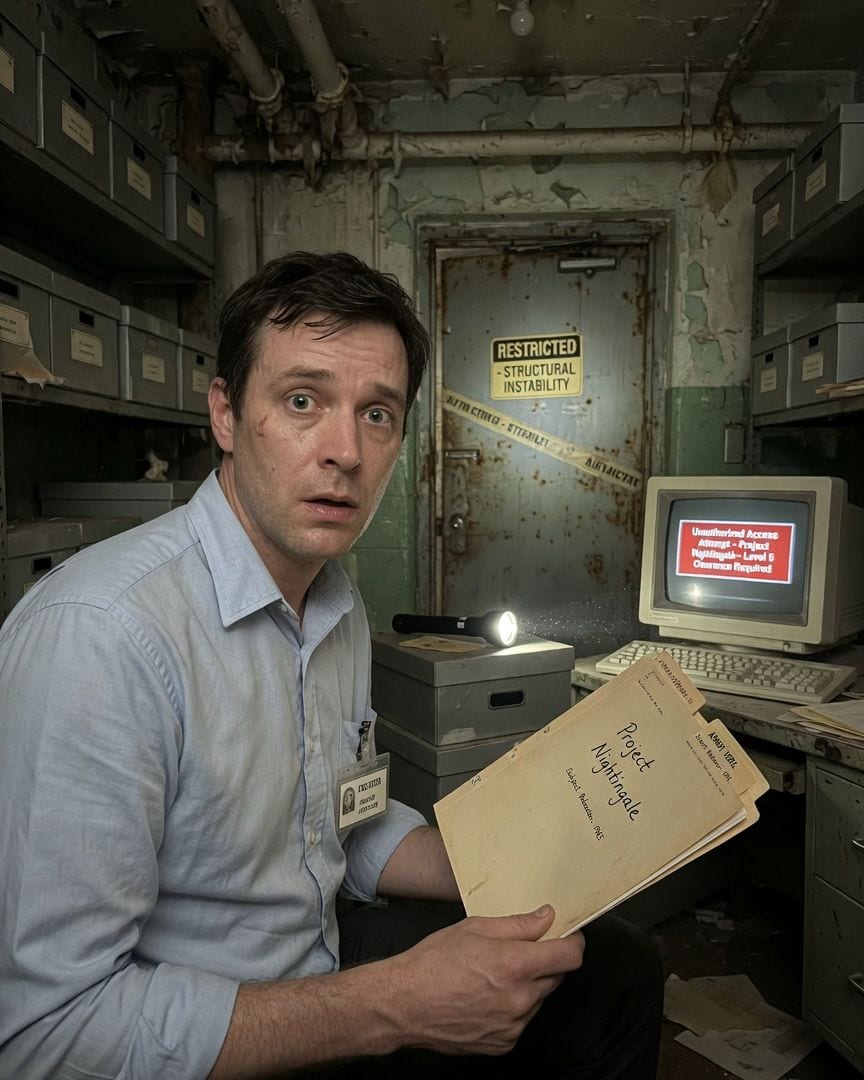
A FOIA officer found his dead mother's photo in a government Cold War file, dated 1983 — two years after her burial. Then he found her new file: 'Relocation - 1985.'
Devon Ashby, a routine FOIA officer, clicked 'release' on a 1983 file he'd seen dozens of times. Inside was a grainy photo of a woman, calmly staring from a logging road. His breath caught: it was his mother, Vera Ashby, dated two years after her 1981 burial. The file jacket, marked "Project Nightingale," led him to a forgotten, sealed sub-basement filled with unmarked metal boxes. There, he found a file for "ASHBY, VERA. Subject: Relocation - 1985," four years after her death. What hidden mechanism was meant to provoke him?
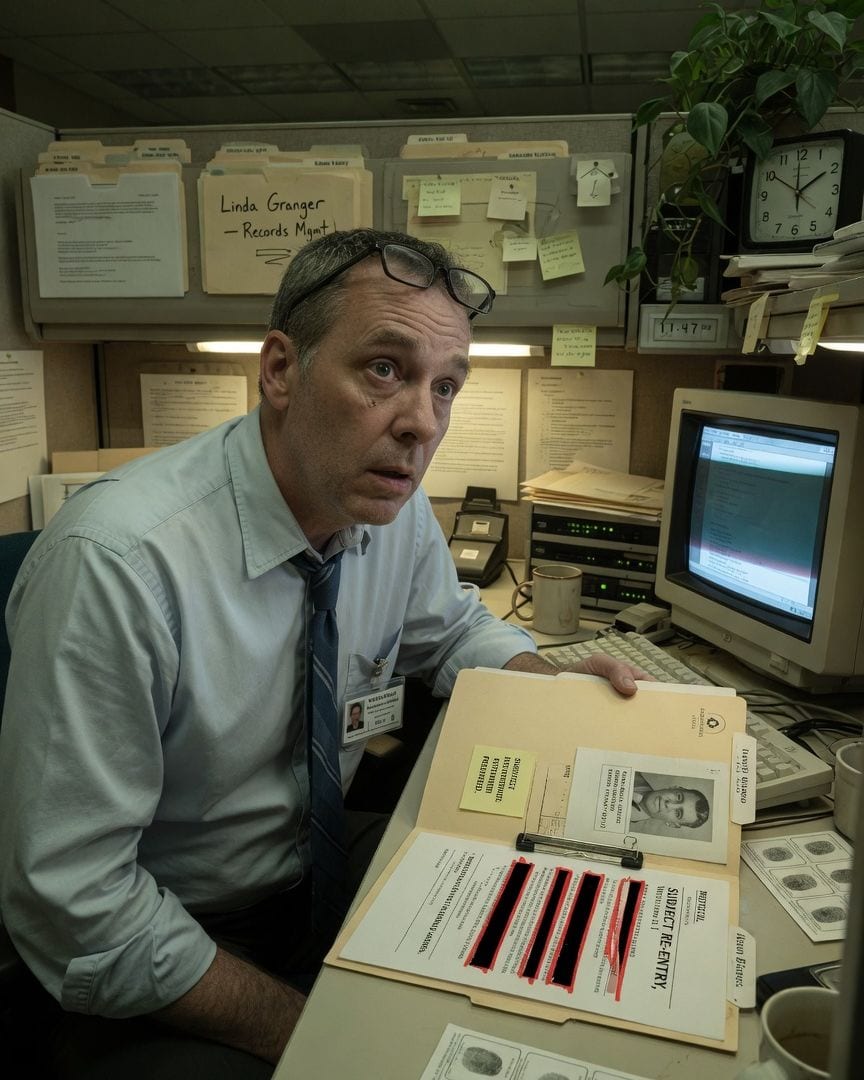
A declassification agent processed old Cold War files. A man reported dead in 1951 had 1958 fingerprints matching an employee badged into the building that morning.
Anton Skeel, a declassification agent nearing two decades of service, meticulously processed the endless backlog of Cold War secrets. His cubicle hummed with the ghosts of forgotten files, but one 'Hollow Bell' folder held a particularly glaring anomaly. It contained a 1958 fingerprint card for Henry Bishop, a man officially reported dead in 1951. When Anton fed the print into the active database, it matched Carl Romano, an employee badged into the building that very morning. A cold certainty settled over him: this wasn't an error, but a system designed for such impossible discrepancies.
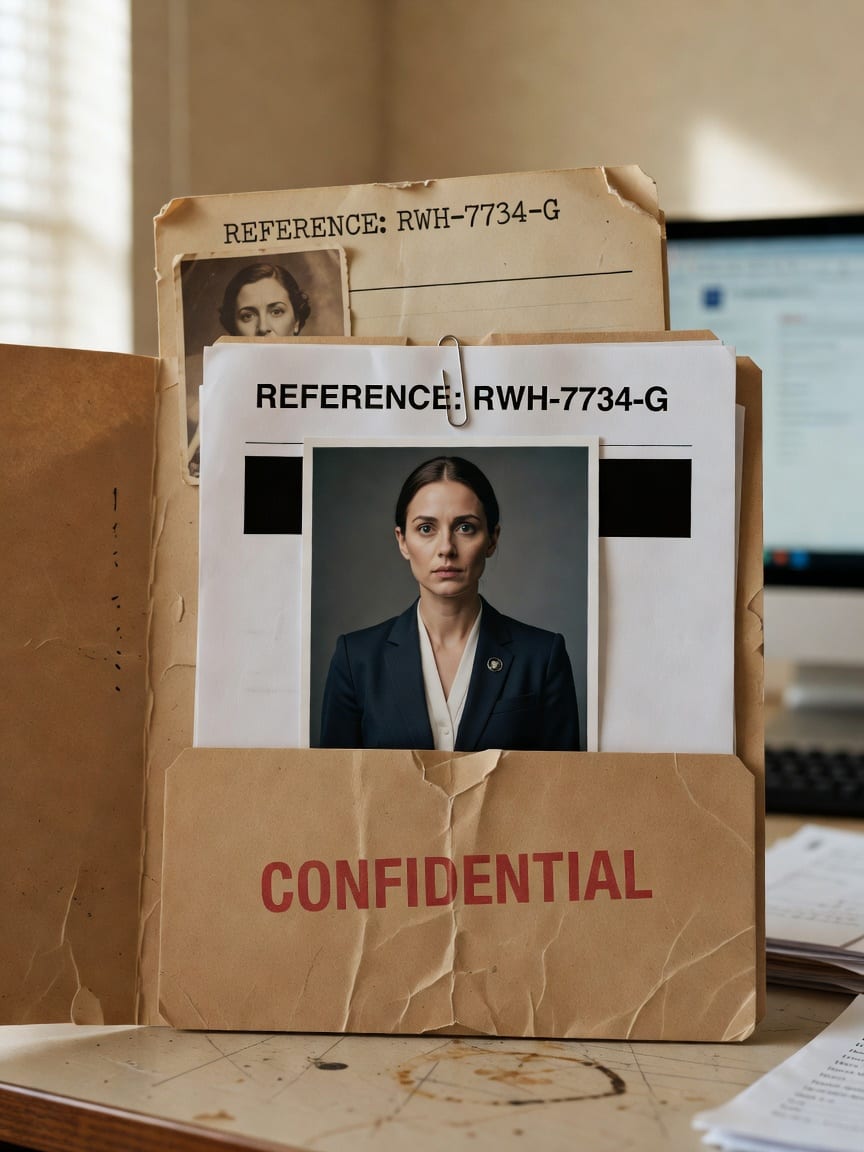
My security file was opened nine years before I was born. Its note said: 'subject not to be briefed'.
Auditing company digital records was routine until I pulled up my own personnel file. It clearly showed a 'Date Opened' nine years before I was born, yet bore my exact name and reference number. Below, an assessor's note from that impossible year mentioned a 'previous holder' and ordered the 'subject not to be briefed,' sparking a cold thrum in my chest.
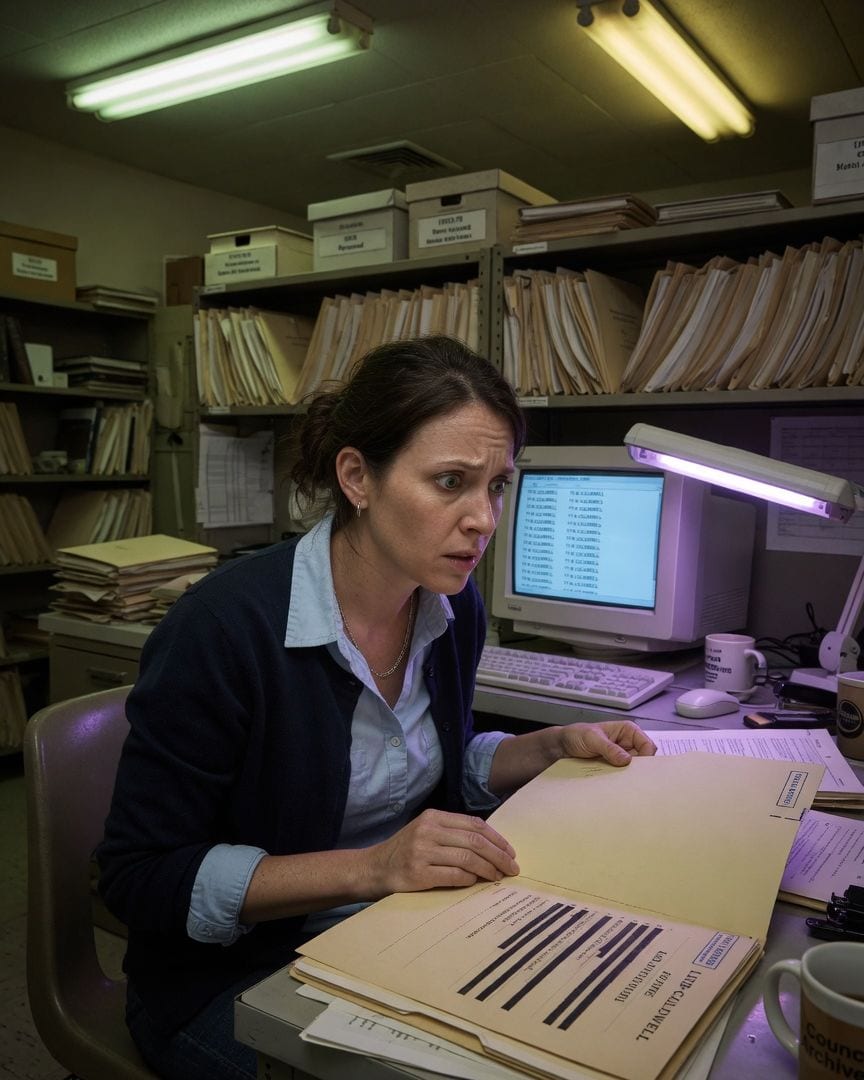
My employer's security file holds a vetting report on me dated nine years before I ever applied. It has my full name and my parents' address — with only one line, the source who referred me, blacked out.
Working a routine data audit, I pull my own security file. The issue date is nine years before I even applied for the job. Then, hidden within an old archive file, I find my current address etched under a blacked-out line.
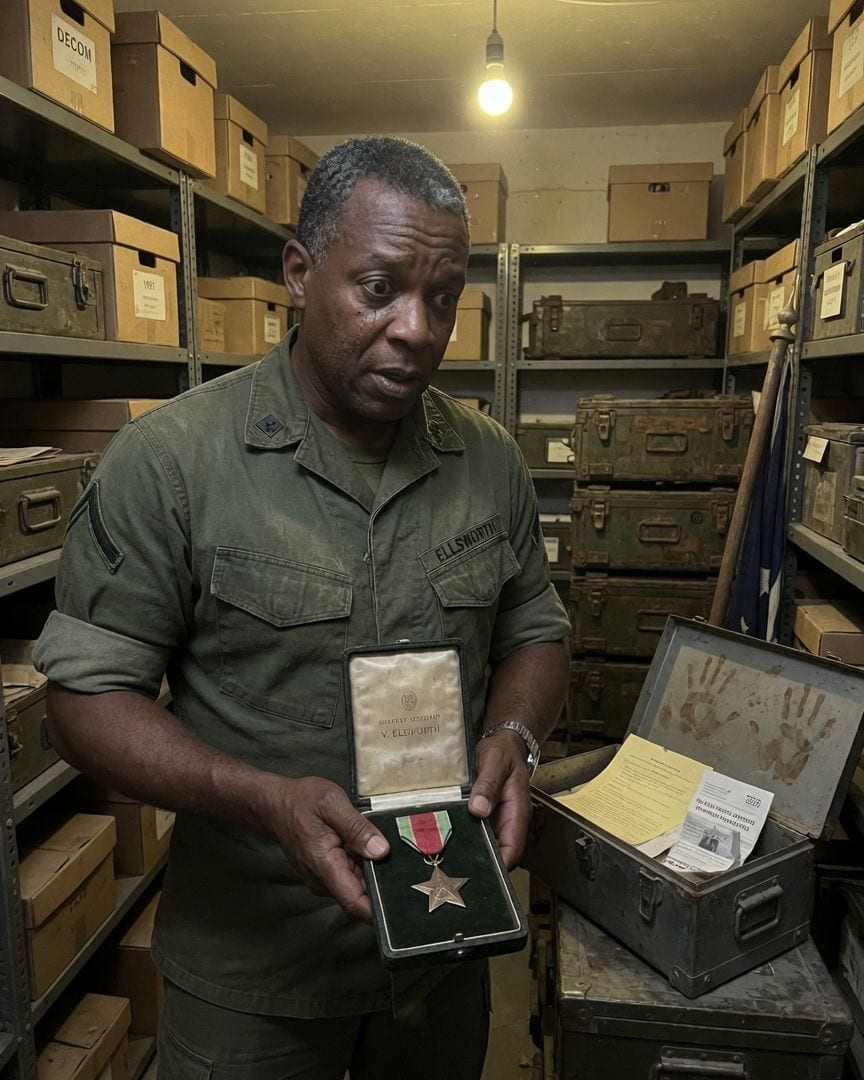
A photograph in Gunnery Sergeant Ellsworth's file shows him, older, with a future he never lived.
Gunnery Sergeant Victor Ellsworth, a veteran of twenty-two years, expected routine paperwork at the St. Louis personnel depot. Instead, a records clerk presented him with two identical files bearing his name and service number. One detailed a combat tour and commendations he had never earned, while a photograph inside showed him, unmistakably older, living a future he hadn't yet endured.
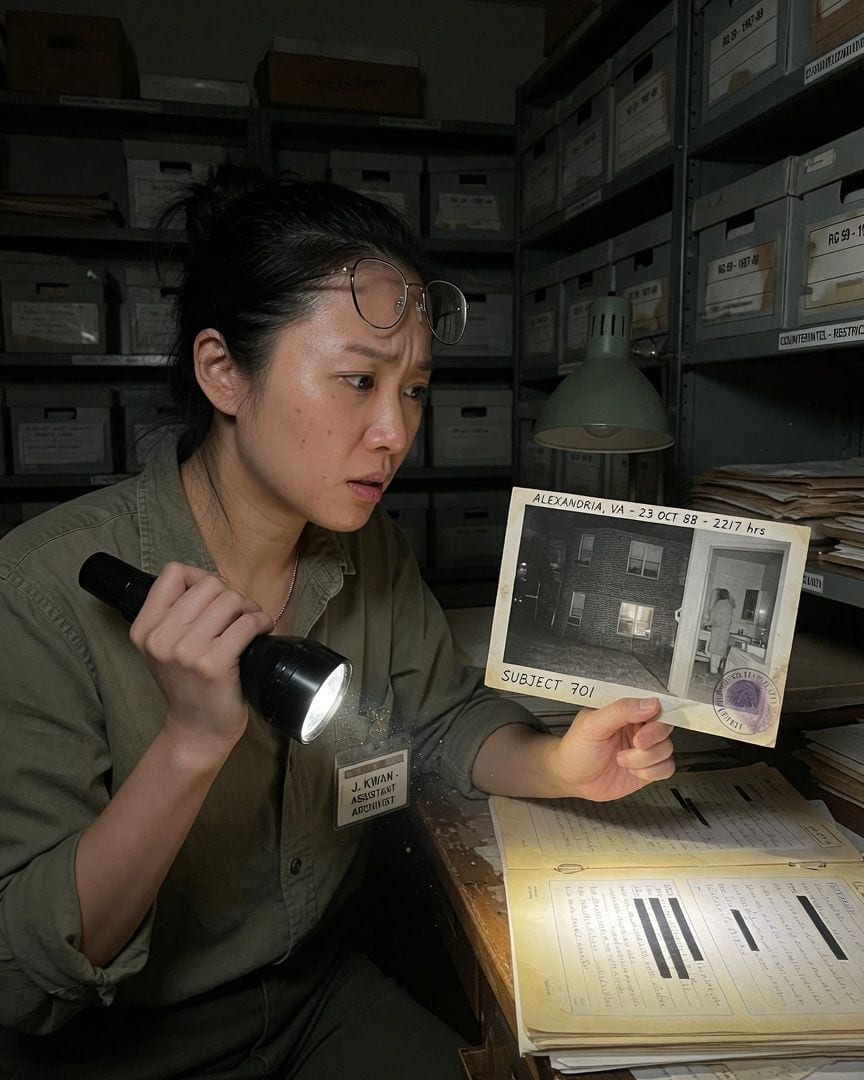
An assistant archivist's Cold War file held a photo of her grandmother's empty 1988 apartment. A figure stood in the window, stamped 'UNIT 701'.
Assistant archivist Junie Kwan hunched over a heavy 1988 counterintelligence dossier in the silent gloom of the National Archives. With only an hour before a court order sealed the file, she faced a personal horror. Tucked inside was a grainy surveillance photograph, dated the night of her grandmother’s 1988 funeral, showing the very apartment where Florence had lived and died. In the frame, behind the grimy kitchen window, a faint figure stood at the sink, despite the apartment being meticulously cleared out, empty, and locked. Junie discovered cryptic marginalia and a mysterious 'UNIT 701' stamp on the photo, hinting at a secret far deeper than a simple clerical error.