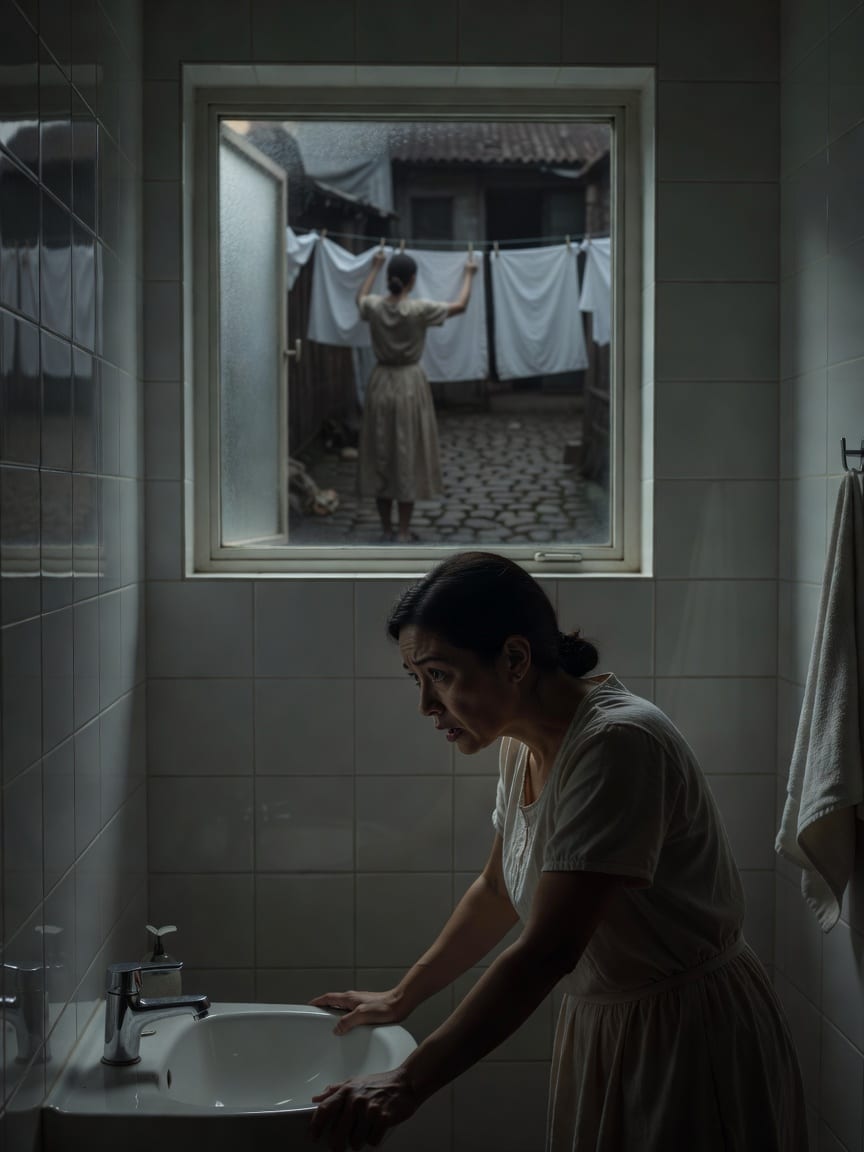
My bathroom window shows a cobbled yard three floors down, a woman hanging sheets. I live on the fourth floor, and there's no yard.
I still wake up at exactly 4:58 AM. It started shortly after I moved into the flat, this building on what everyone just calls The High Street. They said it was built in '88, solid, no issues.
I bought it because the light was good, and the rent was reasonable for the city. My bathroom, like the kitchen, has one of those old frosted windows, the kind where you can just make out shapes, not details.
Good for privacy, right? Except at 5 AM.
The first time, I told myself I was tired, still adjusting to the new job, new city. I’d padded into the bathroom, half-asleep, and caught a glimpse. Not a shape, but a vivid, impossible scene.
A cobbled yard, three floors below, where a woman with her back to me, in an old-fashioned apron, was methodically pegging out sheets. White sheets, billowing softly.
The air in the bathroom, usually warm, felt suddenly cool, and I could swear I smelled something faint, like damp linen and lye soap. I blinked, rubbed my eyes. The yard was gone.
Just the familiar, milky frost of the glass. I convinced myself it was a dream bleeding into reality.
Then it happened again, three nights later. Exactly 5 AM. I was up, making coffee, and the compulsion hit me. Walked into the bathroom. Stood there. And again, the window cleared, or rather, it showed me something that wasn't there.
The same cobbled yard. The same woman, her movements precise, unhurried, hanging the same damn white sheets. She never turned. Never acknowledged me. Just… did her thing. Down there.
Three floors down, where nothing but concrete and a busy street should be. My building, I knew, sat directly on the pavement. There was no yard. No open space at all. Just the impossible, scheduled routine playing out.
It wasn't a trick of light. It was a projection. And it was happening in my flat.
The next week was a blur of frantic online searches. I wasn’t looking for ghosts – not yet – but for anything, anything, that could explain a forgotten yard. Building plans, old city maps, historical photos.
I ended up at the local archives, sifting through microfiche until my eyes burned.
And there it was: an article, faint but legible, confirming that this entire block, built in 1988, stood on the former site of the Whitfield Laundry Yard. Closed down in 1961.
The headline mentioned an owner, a Mr. Whitfield, and a ‘redevelopment project’ that paved over the yard entirely. The knowledge hit me like a physical blow. The yard was real. It just hadn't existed for over sixty years.
Back in my flat, the impossible smell of old lye soap and damp linen seemed stronger, clinging to the air around the bathroom window. I breathed it in, a cold certainty prickling my skin. It wasn't my imagination.
It was there. I walked around the bathroom, scrutinizing every inch. The frosted glass felt colder than the surrounding wall.
My fingers traced the damp patch on the wall under the window, where a faint, persistent draft always seemed to be. I pushed on the old skirting board panel beneath it. It was loose, rattling.
I got a screwdriver from the kitchen and carefully pried it open.
Dust, cobwebs, old plaster – and something else. Tucked deep inside the cavity, nestled in a web of ancient dust, was a small, oblong piece of metal. Rusted heavy, almost fused with the grime.
I pulled it out, my fingers scraping against the rough edges. It was a laundry tag, the kind they used to clip onto garments. I wiped it on my jeans, trying to make out the etchings.
Through the rust, two initials emerged, stark and clear: ‘C.R.’ Below them, a number: ‘28.’ I tried to tell myself it was just a relic, a forgotten piece of history from the old laundry yard, a random coincidence.
But the cold metal in my palm, the specific initials, the impossible yard, the 5 AM visions… the pieces were too specific. They were starting to fit.
I scrubbed the tag under the tap, the rust flaking away in gritty streaks, until the initials ‘C.R.’ and the number ‘28’ stood out stark and undeniable. My hands were shaking.
I typed 'laundry tags C.R. 1960s missing person' into the search bar, my heart thudding against my ribs. It was a frantic, desperate impulse. The internet churned, and then, a result.
A digitized local newspaper article from the Chronicle, dated late October 1961. The headline screamed: 'LOCAL LAUNDRY WORKER MISSING.'
My eyes flew to the smaller print, the details: "Catherine Rutherford, age 28, last seen working at the Whitfield Laundry Yard at approximately 5 AM on October 14, 1961."
Catherine Rutherford. Age 28. Whitfield Laundry Yard. 5 AM. October 14, 1961. The name. The age. The year. The exact time. The location. It all matched. Every single detail.
I stared at the screen, the rusted tag cold and heavy in my hand, the impossible vision now inextricably linked to a real, vanished person.
The newspaper article was a punch to the gut. It wasn't a hallucination. It wasn't a trick of the light.
Catherine Rutherford was real, and she had vanished from the very spot my building now stood, at the exact time I saw her. I returned to the archives, obsessed, my laptop a lifeline.
I found follow-up articles: Catherine was a young, unmarried woman, living in a small apartment above the laundry. No body was ever found. No leads. Just a blank, cold disappearance.
Back in my fourth-floor flat, my home felt… different. Haunted. Every shadow seemed to hold a memory.
The faint smell of old lye soap and damp linen wasn’t just around the window now; it permeated the bathroom, a constant, cloying presence. I noticed other things.
A worn patch on the floorboards just outside the bathroom door, like someone had stood there, habitually, for years, wearing a groove into the wood. It wasn't a wear pattern from me. Or the previous tenant, whose habits I knew.
It was older, deeper.
Then there was the kettle. Sometimes, I’d walk into the kitchen and find the electric kettle clicked on, the element warm, but no water boiling, no tea made. Just a click, a phantom power draw, then off again.
I tried to blame the faulty wiring, the old building. But it happened more and more often, always around the same time of day. These were not random occurrences. These were pieces of a routine. Catherine’s routine.
The Routine That Continues.
I started waking up before 5 AM, a cold dread twisting in my stomach. I’d lie there, listening to the silence of the building, dreading, yet anticipating, the moment I’d be drawn to the bathroom window.
I tried to capture it, to prove it. I took my phone, camera ready, and stood by the window at 5 AM. I saw her. The woman, pegging sheets, just as before. I snapped a photo.
But when I looked at the screen, it showed only the frosted glass, milky and opaque. My phone couldn’t see what I saw. The dread deepened, evolving from an anomaly into a terrifying, personal invasion.
Leaving the library, head buzzing with dates and names, I felt a shadow fall over me. A man was standing by the entrance, older, maybe seventy, with unsettlingly calm eyes. He was neatly dressed, holding a single, folded newspaper.
“Hannah Foster, isn’t it?” he said, his voice quiet, smooth. Not a question, a statement. “I’m Julian Whitfield. The building superintendent.”
My heart hammered. He knew my name. I’d seen him once or twice, distant, always tinkering with something. “Mr. Whitfield,” I managed, trying to sound casual. “Can I help you?”
He gave me a faint, knowing smile. “I believe you’re researching Catherine Rutherford.”
The air left my lungs. How the hell did he know? I hadn’t spoken to anyone about my obsessive digging. “I… I don’t know what you mean,” I lied, badly. “Just, you know, looking into the history of the area.
Local interest.”
Julian chuckled, a dry, rustling sound. His eyes held mine, and there was an unsettling depth to them, like looking into a very still, very old well.
“Some things are best left to sleep, Hannah,” he said, his voice dropping slightly. “The past has a way of repeating itself if you stir it too much. Especially that one.” He paused, letting the words hang.
“You’re in the fourth-floor flat, aren’t you? That particular flat has always been… sensitive.”
My skin prickled. He was talking about Catherine. He knew. His calm was far more unsettling than any threat.
I tried to ask how he knew, but he merely nodded, turned, and walked away, disappearing around the corner of the library. I felt watched, exposed. That night, I barely slept.
The next morning, a meticulously folded, old-fashioned linen handkerchief, smelling faintly of lye soap, was tucked under my flat door. A silent, potent warning.
I had to know. The handkerchief, the way Julian Whitfield had looked at me – it was too much. I found his flat in the basement, knocked, my heart thumping. The door opened instantly, as if he’d been expecting me.
“Hannah,” he said, his expression completely impassive. He invited me in, a gesture so normal it felt deeply wrong.
His flat was a museum. Heavy, dark wood furniture, faded photographs in ornate frames, curios on every shelf. The air was thick with the scent of old paper and something else, something familiar.
I spotted it on a small side table: a tarnished silver frame, holding a black-and-white photo of a young woman, smiling, in a simple apron, standing in what was clearly a cobbled yard, sheets hanging in the background. Catherine Rutherford.
Julian, without asking, poured two cups of tea from a china pot. “You’re here about Catherine,” he stated, handing me a cup.
“You know about her,” I said, my voice barely a whisper. “You know what’s happening in my flat.”
He sat opposite me, his hands resting calmly on his knees. “My grandfather owned the Whitfield Laundry Yard,” he began, his voice flat, devoid of emotion. “He built this block over it in ’88. Said he wanted to forget.
To bury the past, literally.” He gestured vaguely at the floor. “But some things… they just stick. Even if you cover them with concrete and steel.”
He looked at the photograph of Catherine. “She worked for him. Lived upstairs, in what’s now your flat. A good girl. Came in early, before dawn, to get the first loads out. She was waiting, you see. For her fiancé.
He was fighting in the war, never came back. She had this routine. Every morning, 5 AM, she’d be out there, pegging sheets, waiting.”
He took a slow sip of his tea. “The house… it kept her. It remembered. Even after the building was gone, replaced by this. The routine just… runs. I’ve heard it, you know. The kettle. That faint smell of lye.
And sometimes, if I’m in the right place, I even catch a glimpse of the yard, just for a second. My grandfather… he always said she was just doing what she always did. Waiting.”
The calm, simple explanation of the house, of the building, remembering and replaying Catherine’s desperate, unchanging loop – the window, the lye smell, the worn floorboard, the phantom kettle click – it all clicked into place for me with terrifying clarity.
It wasn't a ghost. It was something worse. A permanent, ingrained echo.
“But why… why 5 AM?” I pressed, my voice hoarse, the tea growing cold in my hands. “And why did she disappear? The papers said no trace.”
Julian took another slow sip of tea, his gaze distant, fixed on some point beyond me. The composure was almost inhuman. “The police reports were… incomplete,” he said. “My grandfather kept his own records.
A ledger of accounts, but he tucked other things within its pages. Personal notes. He suspected something more.”
He leaned forward, his voice barely above a whisper, but it filled the silent room. “Catherine was meeting someone else that morning. Not her fiancé. A man from the next street over. A married man.
My grandfather, he saw them arguing. Heard a splash, near the old well that was in the yard. It was later filled in for construction, of course.”
He paused, letting the silence stretch, letting my mind race. “He found Catherine’s laundry tag, the one you have, by the well. And, chillingly, a single, unique button from a man’s coat. He never told the police.
He chose to protect his family, his business. Buried the truth under the new foundations, along with the well. And the body, I suppose.”
My breath hitched. The ledger. The tag. The well.
“And the ledger,” Julian concluded, his eyes, those unnervingly calm eyes, finally meeting mine, “was hidden in the wall of your flat, Hannah. In the old service conduit, right behind the bathroom mirror.
He said she needed someone to find her, eventually. To know. He was trying to give her a voice. And the ledger, it doesn’t just record her habits. It records what he saw that night. What happened at 5 AM.
And it names the man who was there with her.”
I fled Julian’s flat, his words echoing in my skull, a frantic drumbeat against the certainty of what I needed to do.
Back in my bathroom, I clawed at the mirror, my fingers raw against the cold glass, until I found the loose panel Julian had mentioned. Behind it, wrapped in oilcloth, was a heavy, leather-bound book. Julian’s grandfather’s ledger.
My hands trembled as I opened it. It smelled of mildew and old paper, a smell of secrets. Interspersed with meticulous laundry accounts were cramped, personal notes, scrawled in an old-fashioned hand. I found the date: October 14, 1961.
“Catherine saw Mr. Barlow again, 4 AM. Heated words. Said he would ‘settle things’ at 5 AM. Saw him near the well. Heard a splash. No cry.”
Subsequent entries detailed finding Catherine’s tag and a man’s button, and the agonizing decision to bury the truth under the well, protect the family name, the business. The name: Barlow. The well.
The cold, hard truth slammed into me: Catherine hadn't vanished; she had been murdered, her body likely disposed of in the old well, which was then sealed and built over.
The 5 AM routine wasn't just waiting for a fiancé who never returned; it was the final, desperate moments of her life, forever replaying. The button, the well, the name – it all clicked into a horrifying, coherent pattern.
The house wasn't just remembering a routine; it was remembering a crime, a cover-up, a victim. Julian's grandfather, 'the one who knew,' had literally and figuratively buried it all.
I returned to Julian’s flat, the ledger clutched tight in my hand. He opened the door before I could even knock, his face impassive. “You found it,” he stated, not asking.
He invited me in again, but I stood in the doorway, unable to cross the threshold into his quiet, knowing space. He explained, patiently, almost academically, that his grandfather had tried to protect his family and business.
He knew no one would believe him against ‘Mr. Barlow,’ a respected man in town. He chose silence. “And the house, it just… kept the memory,” Julian finished, shrugging slightly.
I stared at him, repulsed by his calm acceptance. “You knew all of this,” I accused, my voice tight. “You let her routine continue, you let her be forgotten, her murder buried beneath concrete!”
Julian merely shrugged again, a faint, almost imperceptible movement. “What was I to do, Hannah? Dig up the foundations? Accuse a dead man from a respectable family? The past is done. But the house, it still holds her. Always will.
She’s not alone, you see. She has her routine. And now, she has someone who knows. That’s all she ever wanted.”
His words were like ice, devoid of empathy, yet entirely rational from his perspective. The horror wasn't his villainy, but his chilling detachment, his quiet conviction that this was simply the way things are. He was an archivist of dread.
“You’re living with her now, Hannah. You’re part of her loop.” The quiet finality of his statement settled over me, a chilling prediction.
I couldn't stay in the flat. The ledger, the knowledge, the constant, looping presence of Catherine – it was too much. I moved out within weeks, selling the flat at a significant loss, offering no explanation to anyone.
I never spoke of the ledger or Julian Whitfield's chilling admission to anyone. The police, I knew, would dismiss it as an old man's ramblings, a fevered imagination.
The physical evidence was long gone, buried under concrete and decades of silence. The flat, I knew, would find a new occupant.
And Catherine's 5 AM routine would continue, an eternal, silent loop playing out in the frosted window of the fourth floor, a memory the house refused to relinquish.
Years later, I still wake at 5 AM, a cold dread in my stomach, checking my own windows, half-expecting to see the impossible yard, the woman, the sheets.
The knowledge of Catherine's endless wait, of the house's silent, unblinking memory, had permanently imprinted itself upon me. I carry the routine now, a ghost within myself. I never forget to look.
A new tenant, Eleanor Merritt, moved into Hannah's old flat on the fourth floor.
She complained, occasionally, to the building superintendent, Julian Whitfield, about a faint, persistent smell of old lye soap in the bathroom, and a strange clicking sound from the kitchen kettle at odd hours.
Julian would just nod, a faint, knowing smile on his face. 'Some things,' he'd say, 'just have a way of continuing.'
Eleanor Merritt found herself waking at 5 AM, every morning, compelled to stand by the bathroom window, though she couldn't say why.
If this one got to you
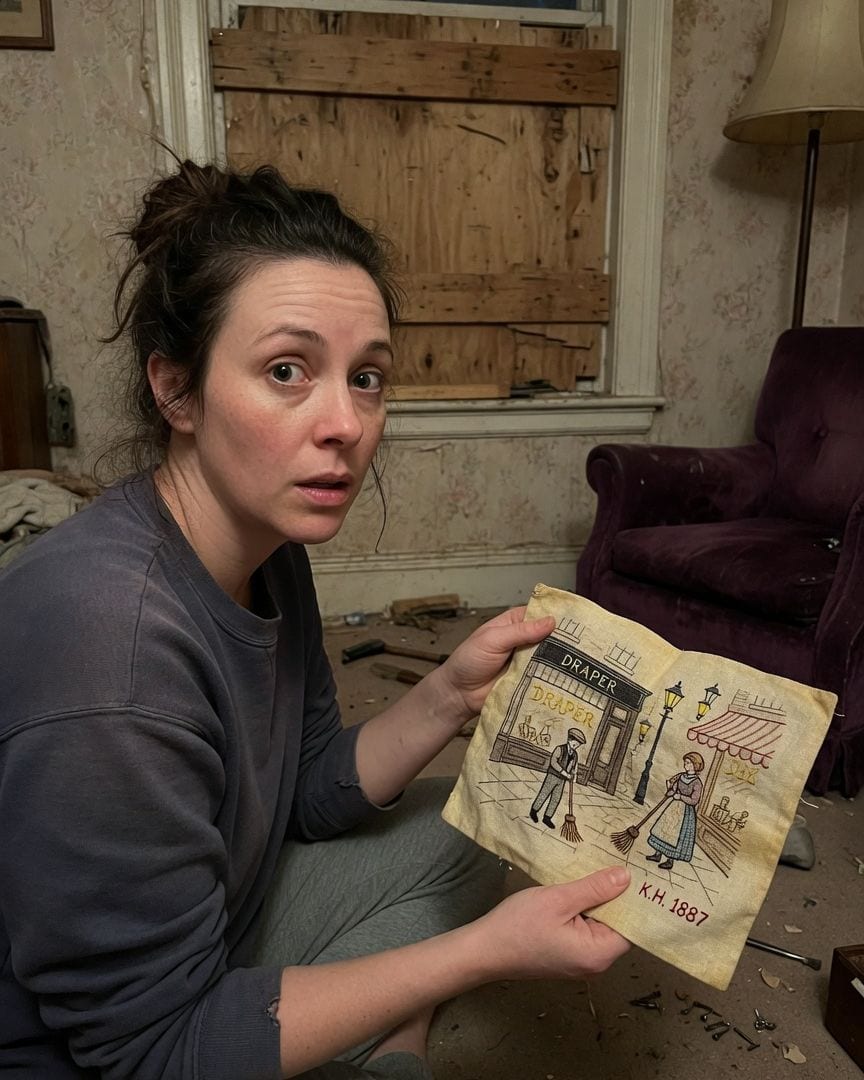
My flat's window shows a gaslit Victorian street across a brick shaft. The nails I hammered back into its frame went into wood soft and new.
My new flat came with a boarded-up window, which the agent dismissed as just an old lightwell. Driven by curiosity, I removed the boards, expecting brick or darkness. Instead, my window opened directly onto a bustling, gaslit street from 1887, a vision that defied all sense.
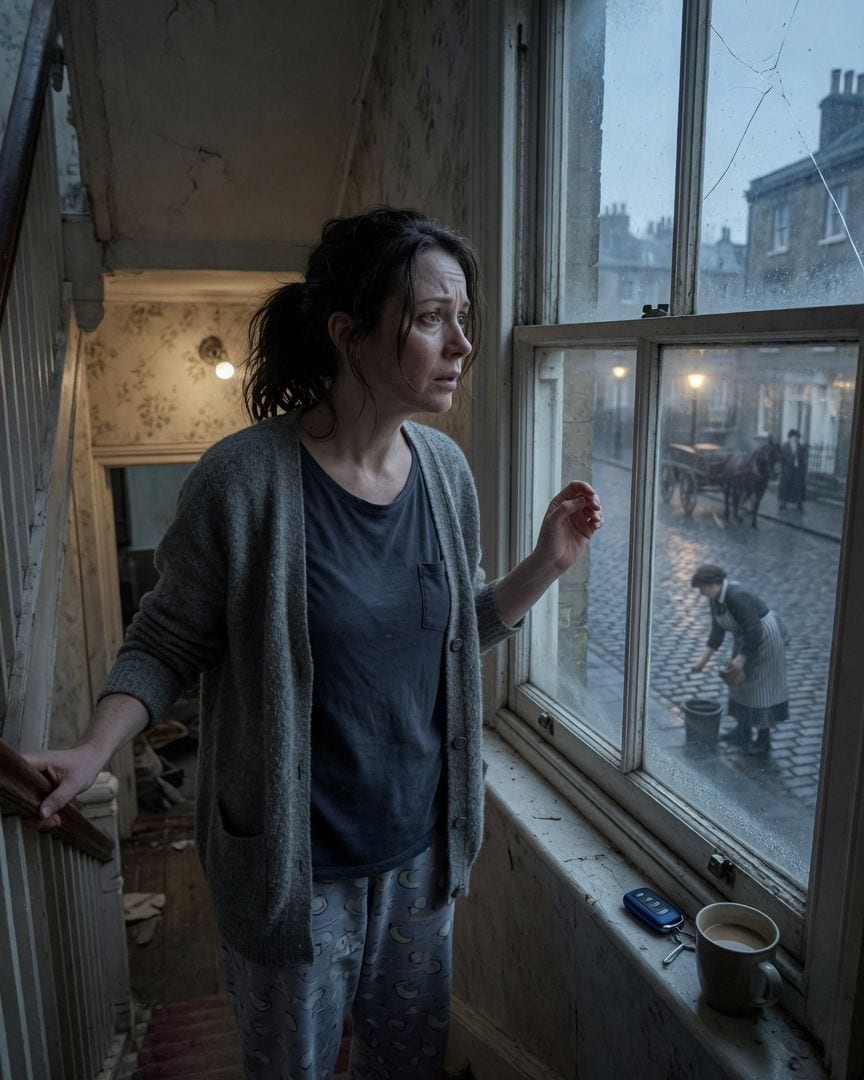
My half-landing window looks down on a cobbled street and a lamplighter. The same panes, the same crack in the corner, but below, only my bins.
I found my dream home, a Victorian terrace, perfect in every way. But a month later, through my half-landing window, a cobbled street appears with a horse-drawn cart and a gas lamp where my own paved street should be. It happens again, every detail identical, making my stomach knot with cold dread.
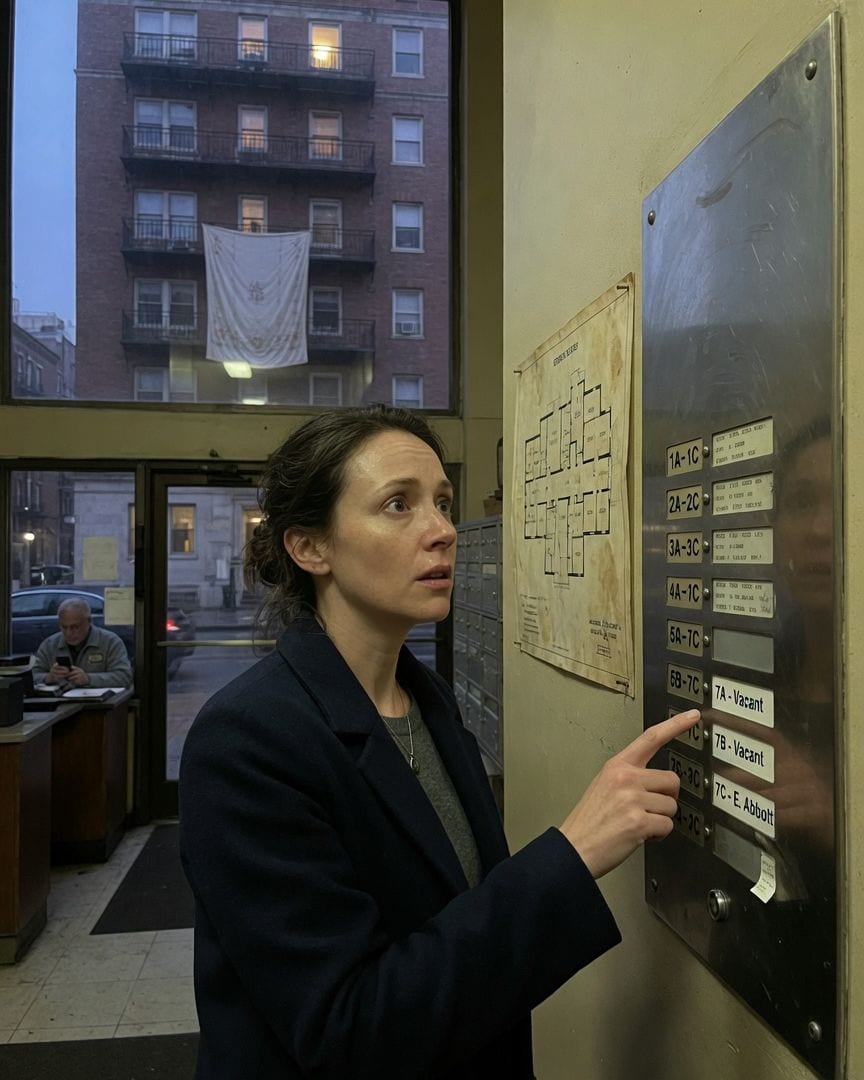
My building grew a seventh floor today, where only sky should be. On its darkest door, a nameplate reads 'E. Abbott'.
For three years, I've lived in apartment 3B of The Sterling Arms, a familiar six-story building. Every morning, I glance up at my window from the parking garage, a routine check. But this morning, my breath caught: a seventh floor, complete with balconies and a soft yellow light, now sat impossibly above the familiar roofline where only sky should have been.
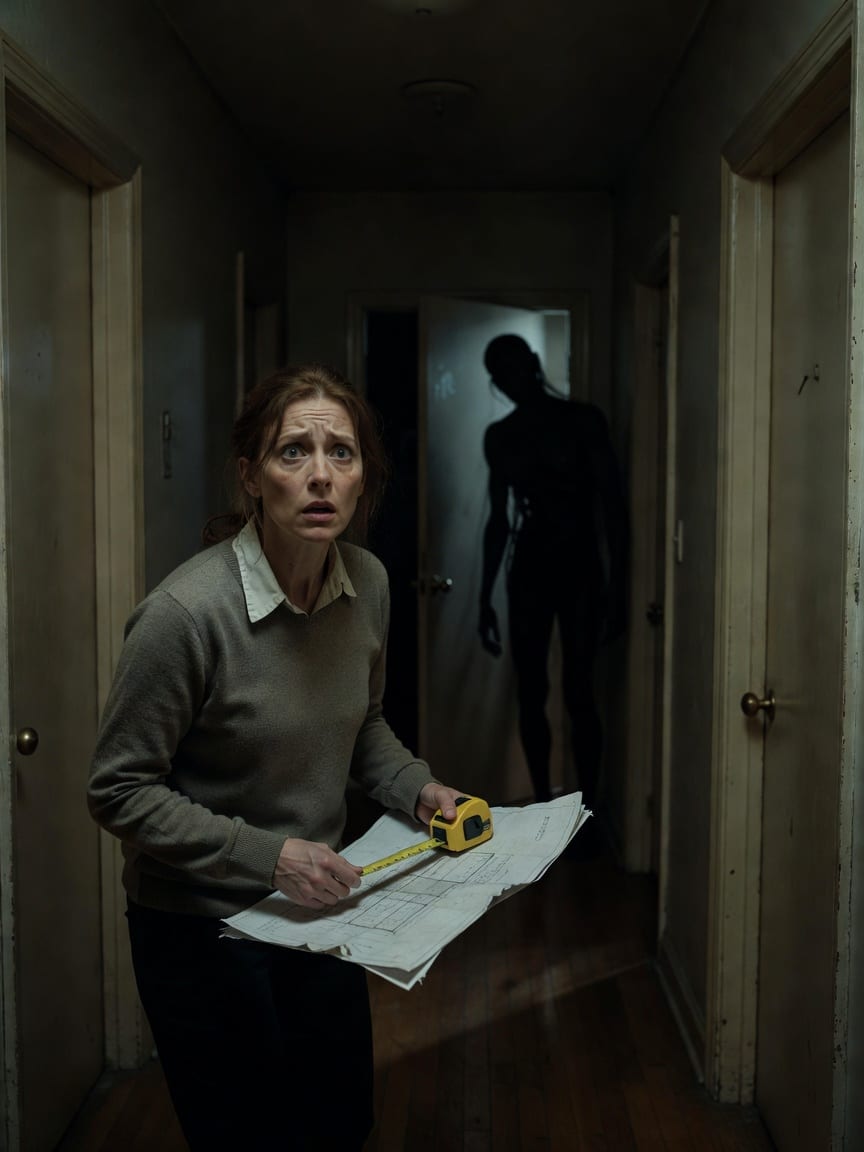
My front door has a dented gate and a dead hydrangea. I walked past it six times, trying to reach the corner shop just a hundred yards away. The pavement kept bringing me back to my own porch, and the shop's light never moved.
My morning started like any other, a quick walk to the corner shop from my home at Number 14, Elm Terrace. But after walking what felt like two minutes, I found myself back at my own front door, the shop no closer. I tried six times, faster and slower, but my street kept compressing, refusing to let me leave.
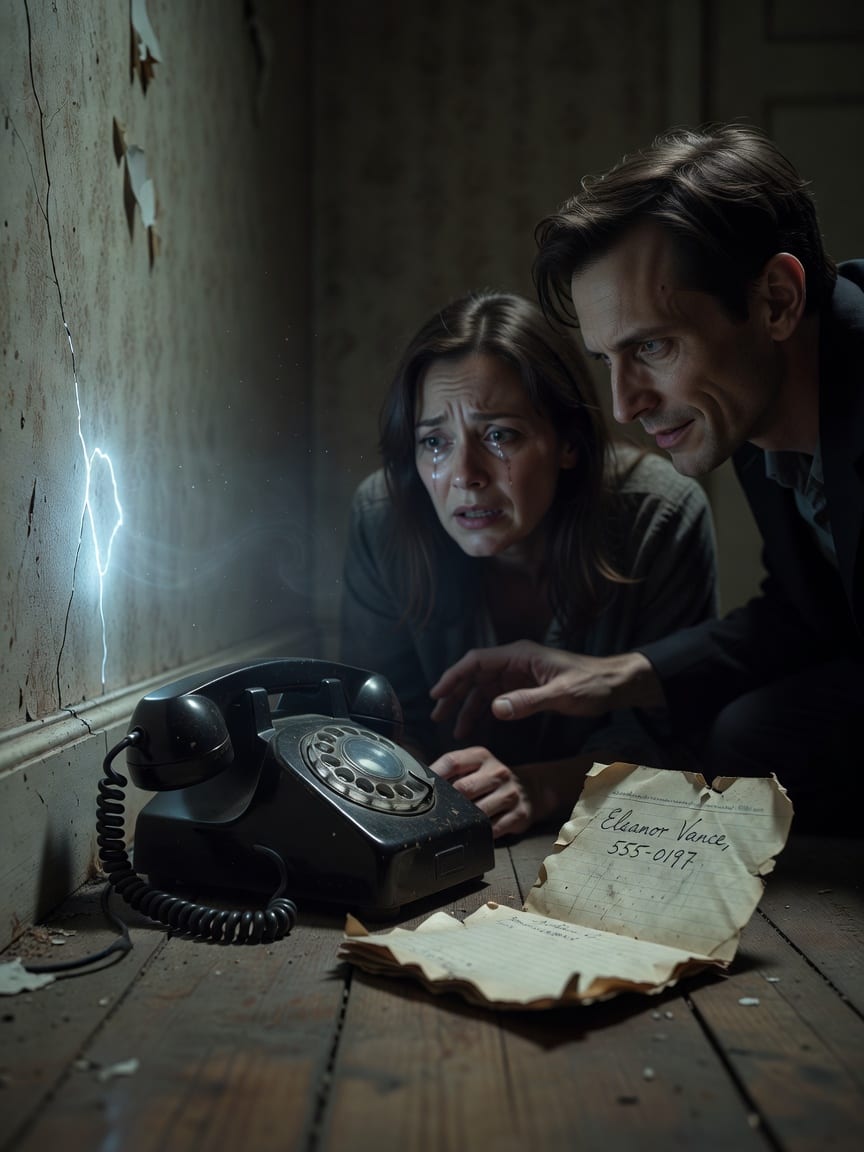
My house's walls ring when I dial a phone number from a 1974 directory. My neighbors said that directory was trash.
I was sifting boxes in my new house when I found an old 1974 telephone directory for my street. It listed my address, 12 Elm Street, under the name "Mr. & Mrs. Sheppard." On a whim, I called the faded seven-digit number. My cell phone rang, but a low, muffled sound also vibrated from the wall beside me.
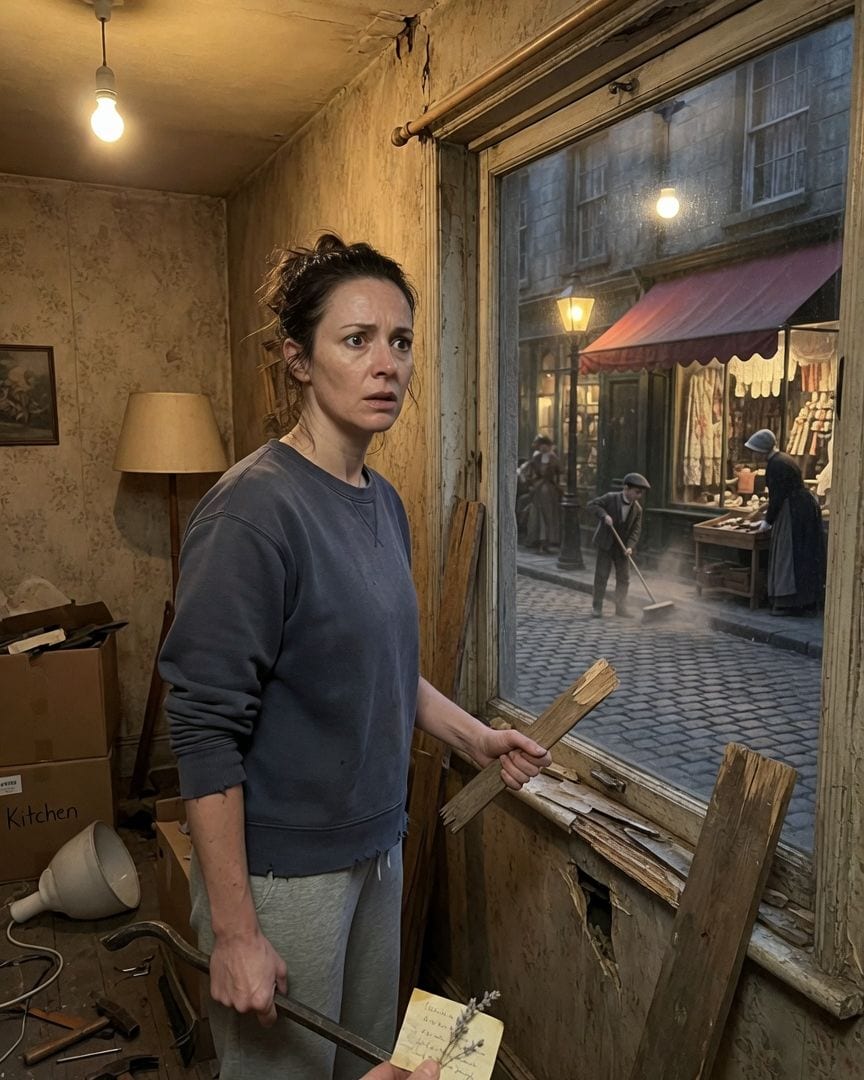
My boarded window showed a gaslit Victorian street. Across my flat, only a brick shaft. The wood felt soft, new when I nailed it back.
Moving into my new flat, I expected to find a grimy brick lightwell behind the boarded-up window. But as the last plank came free, my view wasn't a shaft at all. Instead, a bustling Victorian street, complete with gaslight and a boy sweeping, stretched out before me – a vibrant, living scene that simply shouldn't exist.