Boatswain's Mate Okoro finds her own name on a decades-old watch log, listed with a phantom crew reporting for duty on the decommissioning USS Vance.
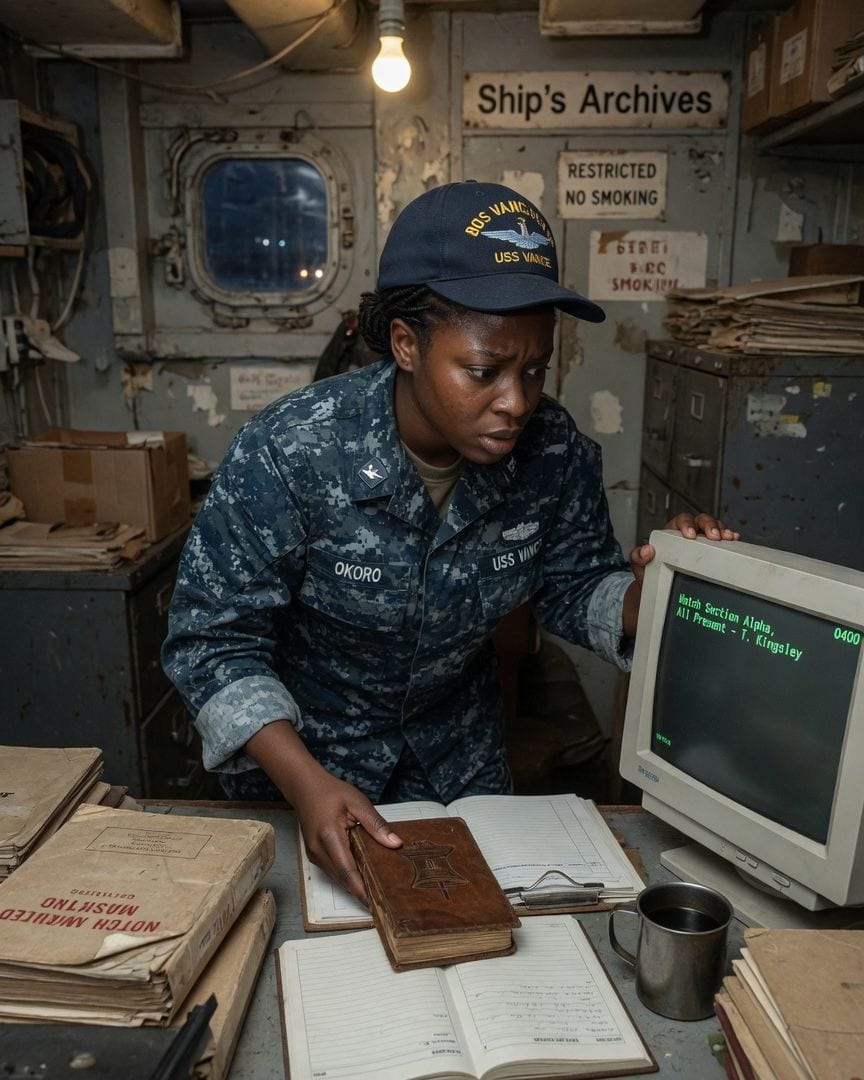
Boatswain's Mate Third Class Catherine Okoro stood alone on the quarterdeck of the USS Vance, the ship moored in port, awaiting decommissioning. It was 0400, the small hours before dawn.
Her relief was due, but technically, no one was on watch for this period; it was an unmanned watch, a holdover from the ship’s active life, observed out of tradition. Still, tradition called.
Okoro raised the striker, and the ship’s bell tolled eight measured beats, echoing through the silent vessel, the sound seeming to hang in the damp, cold air.
As the final note faded, she heard it: the distinct, rhythmic tread of heavy boots on the accommodation ladder, a full watch section reporting aboard.
Her eyes darted to the topside security monitor, which displayed a blank feed of quiet steel and dark water – the brow, the gangway, the entire entry point to the ship, utterly empty. No one was there.
Yet the footsteps continued, growing closer, the sound of a dozen men marching across the quarterdeck toward her.
Okoro’s heart hammered against her ribs, but she stood her ground, straining to see beyond the dim deck lights, into the absolute nothingness where the sound originated. No one was there.
Okoro tried to rationalize it. Fatigue, the constant hum of the ship’s auxiliary power, the echo of her own steps bouncing back from the still bulkheads.
She went to the quarterdeck console and logged her watch as 'unmanned,' noting the time and the traditional bell strike.
But when she checked the digital system’s display, an additional entry had appeared, overriding her own, timestamped for exactly 0400: 'Watch Section Alpha, All Present,' signed by a name she didn't recognize, 'T. Kingsley.'
Okoro stared, a cold knot forming in her stomach. She selected the entry and tried to delete it, but it reappeared instantly, stubbornly persistent, mocking her efforts.
Later that morning, she sought out Petty Officer First Class Leonard Kowalski, a shipmate known for his cynical pragmatism and long service aboard the Vance. He was hunched over a coffee mug in the mess hall.
'Kowalski,' she began, 'did you log anything unusual on your last watch? Or see any extra personnel?' He grunted, stirring his coffee with a spoon. 'Just the usual. Why? Got a ghost in the machine?'
Okoro described the phantom entry and the footsteps she’d heard. Kowalski chuckled, a dry, rattling sound. 'Just a glitch, kid. Or some bored tech trying to mess with you. Happens on these old buckets when they're getting stripped down.
Don't sweat it.' He advised her to ignore it, suggesting it would likely clear itself from the system.
Determined, Okoro checked the hard-copy logbook for that watch period, expecting to find a matching, official entry for 'T. Kingsley.' The physical book, a thick, bound ledger, was blank for the unmanned period, confirming her original log.
But the digital system still insisted, flashing 'Watch Section Alpha, All Present – T. Kingsley' on the quarterdeck screen. She tried to reconcile the two, but the gap between the tangible and the digital widened, becoming a chasm.
The ship's own records were contradicting each other, and one of them was lying.
Frustrated, Okoro decided to dig deeper. If 'T. Kingsley' was logging watches, there had to be some record of him. He wasn’t in the current crew manifest, nor in any recent transfer orders.
She made her way to a rarely used storage area, officially designated as 'Ship's Archives' but mostly a dusty collection of forgotten files, decommissioned equipment, and ancient manuals.
The air in the room was stale, thick with the smell of old paper and rust, and the only light came from a single, bare bulb overhead.
She searched for any manifest, any official document that might list a 'T. Kingsley' assigned to the USS Vance.
Instead, tucked away behind a stack of faded damage control manuals, she found a small, leather-bound book. It was clearly unofficial, handmade, its cover bearing a crudely carved ship's bell.
It felt strangely heavy in her hands, its leather worn smooth by countless turns of pages. It was a watch log, filled with meticulous, handwritten entries. Her heart pounded, a frantic rhythm against her ribs, as she flipped it open.
The handwriting was neat, precise, almost calligraphic. She scanned the dates, her eyes landing on an entry from decades ago, long before the digital system, long before her own birth.
And there it was, under 'Watch Section Alpha, All Present,' the name: 'T. Kingsley.' Beneath it, a list of other unknown names, 'A. Vance,' 'L. Bishop,' 'P. Holloway.'
Then, her gaze dropped to another line, a name in the same impossible list, and her breath hitched. 'Boatswain's Mate C. Okoro.'
The name, her own name, meticulously listed in a logbook from before she was born, sent a jolt of disbelief through Okoro that momentarily froze her. She carefully leafed through the unofficial log, her fingers tracing the faded ink.
Each entry meticulously recorded watch sections, times, and duties, just like a real logbook. The dates stretched back to the Vance’s commissioning, some faded almost to illegibility.
But the names, 'T. Kingsley,' 'A. Vance,' 'L. Bishop,' 'P. Holloway'—none of them appeared in any official USS Vance crew manifest she could find, no matter how far back she searched in the dusty archives.
She spent hours cross-referencing, her rational mind fighting against the growing unease. She pulled out boxes of old microfiche, scrolled through digitized records from the Navy’s earliest databases.
She noticed a chilling pattern: the dates in the unofficial log consistently corresponded to periods when the USS Vance was officially listed as 'unmanned,' 'in drydock,' 'undergoing extensive overhaul,' or 'lightly manned for maintenance'—times when no full watch section would have been stood, when the ship was ostensibly quiet and empty.
It was as if this phantom crew only reported for duty when the physical crew was absent, filling a void.
The ship's operational history, a meticulous record of accountability, was riddled with these gaps, and this leather book filled every single one with impossible precision.
She tried to bring this to Petty Officer Novak, her direct superior, the man in charge of her division for the decommissioning. She found him in the cramped administrative office, sorting through files.
'Petty Officer,' she began, holding out the logbook, 'I think I've found something disturbing about the Vance's history. Something that explains the phantom entries.' Novak, a gruff, by-the-book man, barely glanced at the worn leather. He waved a dismissive hand.
'What is this, some old salt's joke book? A relic? We’re decommissioning, Okoro, not starting a ghost hunt. Don’t you have real work to do? File it, or toss it, I don't care, just get it out of my sight.'
His dismissive tone did little to calm her; it only amplified the isolation she felt with her discovery.
Okoro couldn't let it go. Novak’s indifference felt like a dismissal not just of the logbook, but of her own sanity. She hid the unofficial logbook in her locker, secured beneath a pile of spare uniforms.
But every time she returned to her bunk, she felt a subtle shift, as if it had been moved, or opened, though her padlock remained intact.
She began to feel a pervasive sense of being watched, a prickling on the back of her neck even in empty corridors, an awareness that made her turn sharply, only to find nothing there.
When she tried to access older, restricted ship's history files using her credentials, hoping to find records of the unofficial names, her login would inexplicably fail, or her access would be temporarily revoked, only to mysteriously restore itself hours later.
It was as if the ship itself was pushing back, a silent, digital hand batting her away from its secrets.
One night, while reviewing the logbook again on the quarterdeck, the silence of the ship was absolute, broken only by the distant lapping of water against the hull.
Suddenly, a faint, rhythmic clanking from the lower decks began, like tools on metal, or a heavy chain being dragged across a steel plate. It was impossible; those decks were secured, locked down, and empty.
She froze, listening, her breath held tight in her chest. The sounds grew closer, echoing up the ship's internal structure, amplifying as they resonated through the steel bones of the vessel.
Then, a distinct, heavy tread, like the footsteps from her first watch, approached her position, slow and deliberate, not the hurried pace of a living crewman.
Okoro spun around, her flashlight beam cutting a sharp arc through the darkness. Nothing. The quarterdeck stretched empty before her, the shadows clinging to the bulkheads like silent sentinels.
But the air around her was suddenly heavy with the unmistakable scent of old salt, ozone, and cold steel—the smell of the ship itself, concentrated and ancient, pressing in on her.
The footsteps faded, retreating back into the lower decks, leaving her alone with the oppressive silence and the undeniable feeling that something had been standing right behind her, observing her, and then chosen to retreat, its purpose briefly satisfied.
The unsettling encounter pushed Okoro to confront Novak again, this time with more force. She waited for him in his office after he returned from an inspection, the unofficial logbook clutched in her hand.
She presented him with the evidence, pointing out the meticulous pattern of 'ghost' watches coinciding with officially unmanned periods. 'Petty Officer,' she insisted, her voice tight with a mixture of fear and defiance, 'this isn't a joke.
My name is in here, for a watch before I was even born. And I heard things, saw things. I felt something behind me last night.'
Novak's face tightened. He snatched the logbook from her, his earlier dismissiveness replaced by a flicker of genuine alarm, a look she hadn't seen before. 'This is classified, Okoro,' he hissed, his voice low and urgent.
'This is not for you to see, and certainly not for you to go around talking about.' He tried to confiscate it, but Okoro held firm, pulling the book back against her chest. 'What is it, then?'
she demanded, 'Tell me what's going on!'
Novak sighed, running a hand over his face, looking suddenly much older. 'Look, Okoro, every ship has its stories. And the Vance… she's got a reputation. Some ships, they just don't like being alone. They get restless.
It’s an old Navy saying.' He admitted that similar phantom entries, strange noises from locked compartments, and even the ship's bell 'ringing on its own' during unmanned watches had been reported occasionally throughout the Vance's history.
Always dismissed, always swept under the rug. 'Command wants a clean decommissioning, Okoro. No weirdness. No rumors. It's bad for morale, bad for the record.'
He glanced at the logbook in her hand, his eyes lingering on the crudely carved bell. 'This… this just proves it. Some old salts, they started this book, trying to make sense of what they couldn't explain.
A way to keep the ship 'manned' even when she wasn't. A psychological thing, probably. A coping mechanism for the isolation.' But his eyes betrayed a deeper unease, a fear that contradicted his casual explanation.
He mentioned a previous Boatswain's Mate, decades ago, who became 'obsessed' with the Vance, talking about a 'crew that never left' and was eventually transferred for 'unsuitable conduct.'
The dread solidified in Okoro. It wasn't just a glitch or a prank; it was a phenomenon, a persistent anomaly that the system had been trying to account for, or ignore, for the ship's entire life.
And now, she was part of its log.
Okoro refused to surrender the logbook. Novak, frustrated and visibly unnerved by her persistence, finally relented, giving her a stern warning. 'You're asking for trouble, Okoro. Don't go looking for things you can't unsee.'
She returned to her bunk, the leather logbook clutched tight, the scent of old paper and salt filling her nostrils. Novak’s words echoed in her mind, a dark promise.
She needed to understand the pattern, to find an end to it, to understand why her name was in that book, and what it truly meant.
She opened the book again, flipping past the decades of meticulous entries, all the way to the very last page, a fresh, blank sheet that had no writing on it at all.
But it wasn't blank. There was an entry, written in the same neat, precise hand as the others. The date was far in the future, years after the scheduled decommissioning of the USS Vance.
And next to 'Watch Section Alpha, All Present,' was her own name: 'Boatswain's Mate C. Okoro.'
Beside her name, instead of a signature, was a strange, almost illegible symbol she'd never seen in any naval record—a stylized drawing of the ship's bell, its clapper a faint, almost invisible line, as if it were a memory or a ghost of a sound.
The implication slammed into her with the force of a physical blow: she wasn't just an observer of a past pattern.
She was written into its future, destined to stand an impossible watch on a ship that wouldn't exist, as part of a crew that never left.
The stylized bell symbol next to her name in the logbook was a chilling revelation. Okoro realized it represented the very bell on the quarterdeck, the one she had struck and heard chime on its own during unmanned watches.
The ship itself, or an entity inextricably tied to its operational life and naval traditions, was generating these 'phantom' watches.
It was a self-sustaining system, a continuous duty roster for a crew that existed outside of physical reality, but adhered perfectly to the strictures of naval accountability.
The names in the unofficial log weren't just random; they were those who had, in some way, been acknowledged or 'recruited' by this persistent entity over the decades.
It was as if the ship, a vessel designed for purpose and order, had developed its own internal, non-physical crew, and it would continue its duty long after its steel shell was gone.
Her own name, appearing in the past and the impossible future, meant she had been identified, marked for inclusion in this eternal watch.
The dread was in the coherence: every strange log entry, every phantom footstep, every inexplicable sound now clicked into place, forming a horrifyingly logical pattern.
The military's system, designed to prevent anomalies, had, in its meticulous accounting, created a perfect vessel for one. The ship's bell wasn't just a tradition; it was the mechanism, the call to duty for a crew that never truly left.
Okoro knew she had to leave. Not just the ship, but this entire impossible duty. Her transfer orders were already cut; she was due to disembark the next morning.
She clutched the unofficial logbook, intending to return it to the dusty archive, to sever her connection to it, hoping that if she gave it back, it would release her.
She walked swiftly towards the brow, her heart pounding a frantic rhythm against her ribs.
At the gangway, the brow officer, Petty Officer Bishop, a young man she barely knew, looked up from his console. Okoro handed him her ID.
He swiped it, but the screen flickered, displaying an error message: 'ACCESS DENIED – UNIT UNAUTHORIZED.' He tried again, then a third time, a line of frustration forming between his brows.
'System's being finicky tonight, BM3,' Bishop grumbled, punching keys on the keyboard. 'Hold on.'
As he rebooted, Okoro heard it: the faint, rhythmic clang of metal from deep within the ship, like a phantom crew performing maintenance. It was closer, louder than before, resonating through the deck plating beneath her feet.
She felt a subtle, almost imperceptible resistance as she tried to step onto the gangway, as if the very air around her was thicker, heavier, the ship itself reluctant to release her.
She spun around, her eyes darting towards the quarterdeck. The ship's bell, large and brass, hung silent, a monument to the traditions it upheld. Then, without warning, it began to toll.
Eight slow, deliberate beats, echoing through the empty decks, the same eight bells she had struck for an unmanned watch weeks ago. The sound was not from her; it was from the bell itself, chiming on its own.
She turned back to the brow, panic rising, a cold wave washing over her.
For a fleeting instant, by the empty accommodation ladder, where the phantom footsteps had come from, she saw it: a shimmering, indistinct form, tall and lean, standing at attention, a hand raised in a crisp salute.
The shape was vaguely masculine, a shadow against the dim light, but she knew. T. Kingsley. Bishop's console finally came online, beeping cheerily. 'Alright, you're good, Okoro. System glitch cleared.' She didn't wait.
She slammed the unofficial logbook onto Bishop's console, not caring if it opened, not caring if he saw her name.
She bolted, rushing down the gangway, her boots clattering on the metal, the sound swallowed by the vastness of the empty pier.
She didn't look back, not even when she heard the faint, distant clang of the bell tolling a ninth, impossible time.
Catherine Okoro managed to get off the USS Vance.
Her report to higher command, a desperate attempt to explain what she had found, was met with polite skepticism, filed away as an 'isolated incident' and attributed to 'stress and fatigue' during the demanding decommissioning period.
She was granted an early transfer to a shore-based logistics assignment, far from any active ships. The unofficial logbook was never found on Bishop's console or anywhere else in the Vance's archives.
'T. Kingsley' remained an unidentified name in an inexplicable digital log entry, a ghost in the machine that no one else cared to chase.
The USS Vance was eventually decommissioned, towed away, and its steel melted down, erased from the fleet's roster. But not from Okoro’s memory.
Years later, Catherine Okoro, now a civilian and a veteran, found herself on a quiet, New England coast, watching the waves crash against the shore.
The distant, mournful sound of a foghorn carried on the wind, followed by the rhythmic clang of a buoy bell, a sound that pierced her with a familiar, chilling precision.
She instinctively checked her wrist, though she hadn't worn a watch in years, her left hand raising without conscious thought, as if to confirm the time.
She looked out at the empty, dark ocean, a chill running down her spine, a profound sense of an endless, unseen duty settling over her like a heavy cloak.
She thought of the USS Vance, long gone, long melted down, yet somehow, still standing watch.
Her husband, Dean Holloway, found her staring out at the waves, a distant look in her eyes. 'Everything alright, Cath?' he asked, gently touching her arm.
She turned, a faint, wrong little smile playing on her lips, her gaze still fixed on something far beyond the horizon. “Eight bells, Dean,” she whispered. “Watch relieved.”
If this one got to you
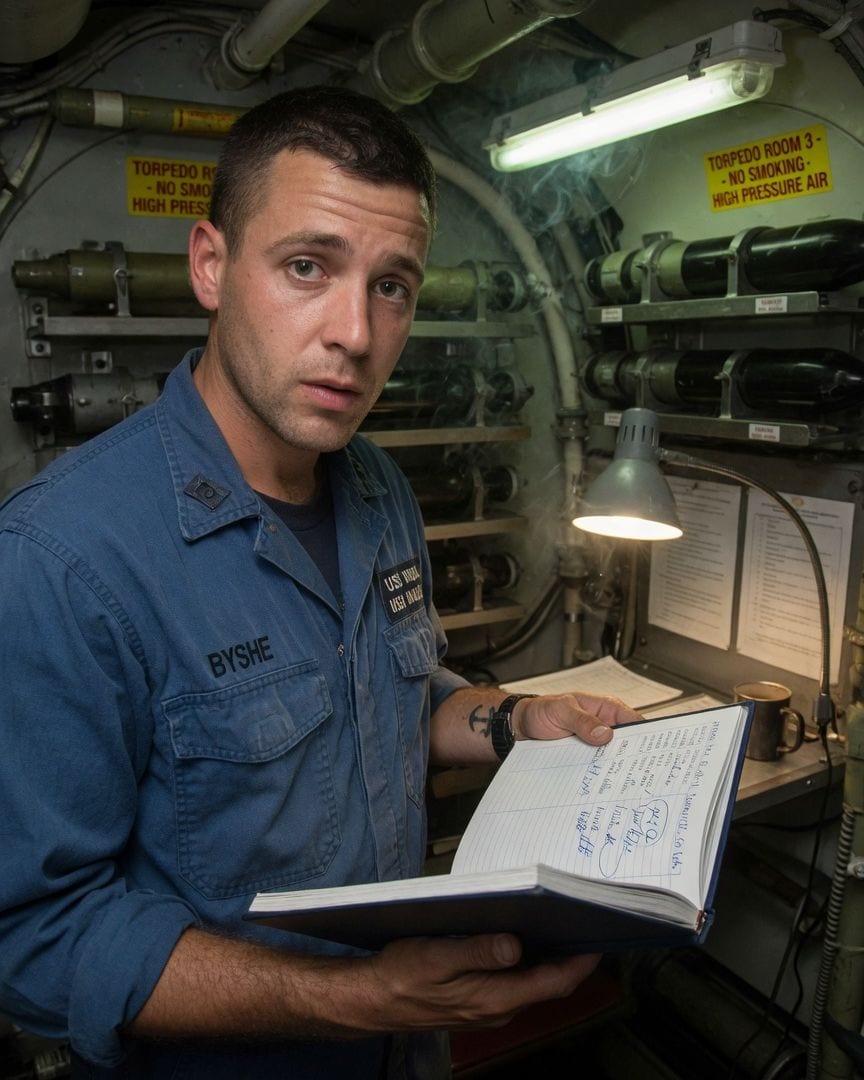
A torpedoman found his own signature in the USS Vanguard's duty log for a watch he never stood, beside a name not on the master crew manifest.
Torpedoman Oscar Bysshe, a rational sailor on his first deep patrol aboard the USS Vanguard, dismissed the messcook's nervous claim of an extra man at the table. He attributed the perfectly clean, untouched tray left behind to a prank. But later, during a routine systems check, Bysshe discovered his own familiar signature in the official duty logbook, for a watch he had been asleep through. Beside it was a name he didn't recognize, a name that shouldn't be there. A frantic check of the master crew manifest confirmed the impossible: the name appeared in the 'temporary assignments' section, dated just yesterday, scrawled in a hand eerily similar to his own.
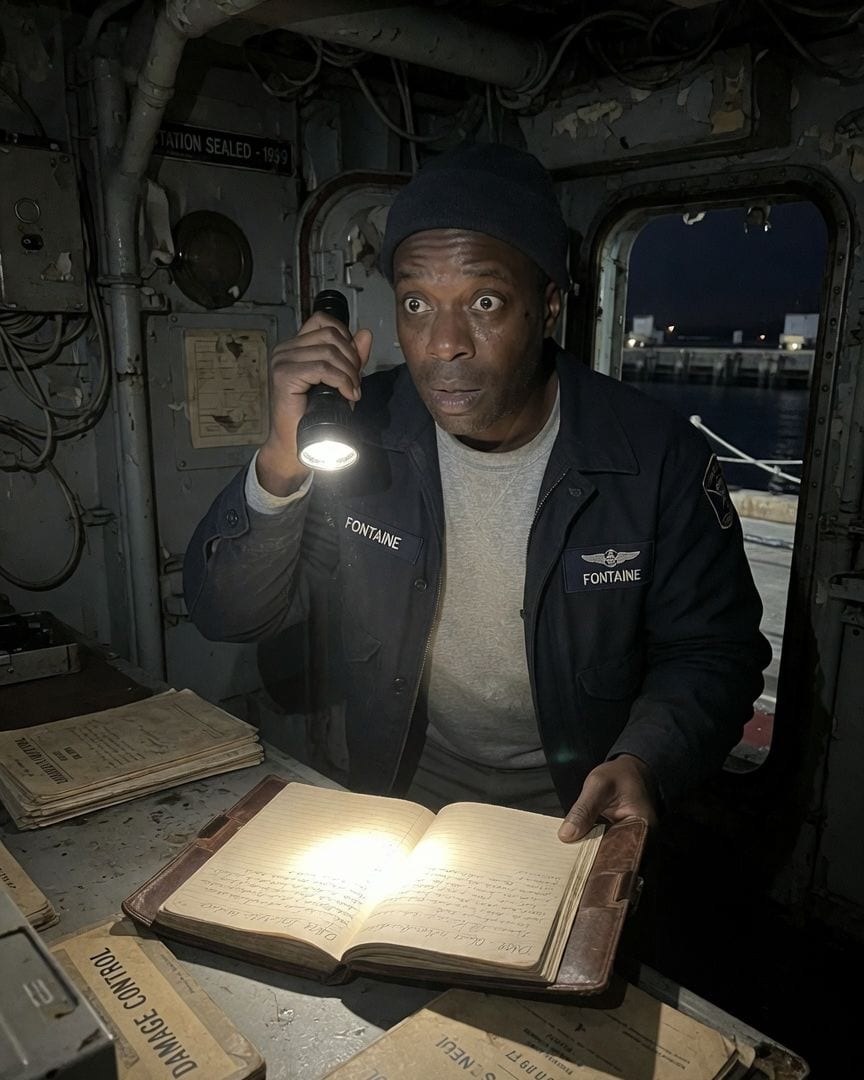
Boatswain's Mate Fontaine stood his last watch before the USS Vance was scrapped. He found a Cold War logbook with 1987 entries on a ship commissioned in 2000.
Boatswain's Mate Maxwell Fontaine stood his last watch on the USS Vance, a destroyer just three days from being scrapped before his transfer to shore duty. In the predawn chill, the distinct tread of a full watch section ascended the accommodation ladder, heavy boots vibrating the deck, even as topside cameras confirmed the gangway was empty. Investigating the silent ship, he found an old damage control station, supposedly sealed, with an unexpected metallic tang and an unlocked hatch. Inside, a worn logbook revealed precise entries from 1987, including a watch relief at 0400, on a ship commissioned in 2000.
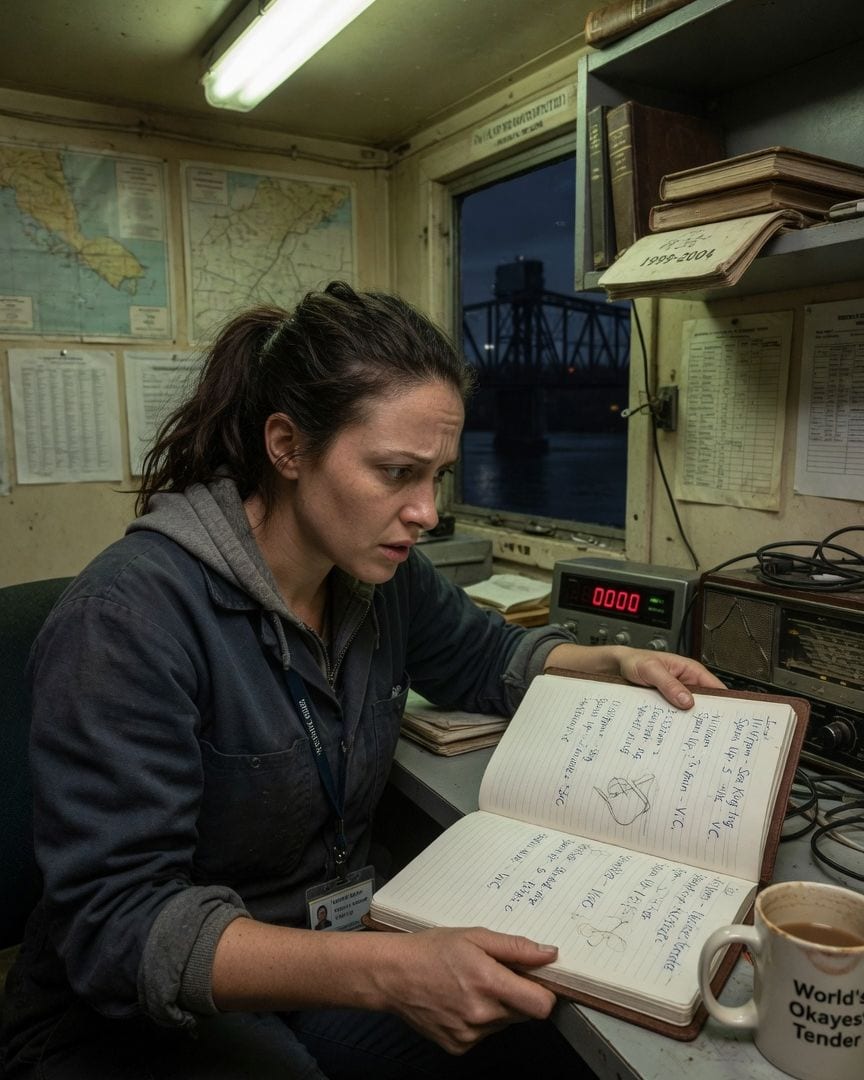
My drawbridge log shows a 2:33am lift I didn't make. The span counter never moved.
As a drawbridge tender, my midnight to dawn shift is usually quiet, a routine of monitoring traffic and logging lifts. But tonight, my own logbook shows an impossible entry for a bridge lift I have no memory of making. My initials and handwriting are there, yet the span counter above my panel reads a steady zero. No boat called, no span ever went up.
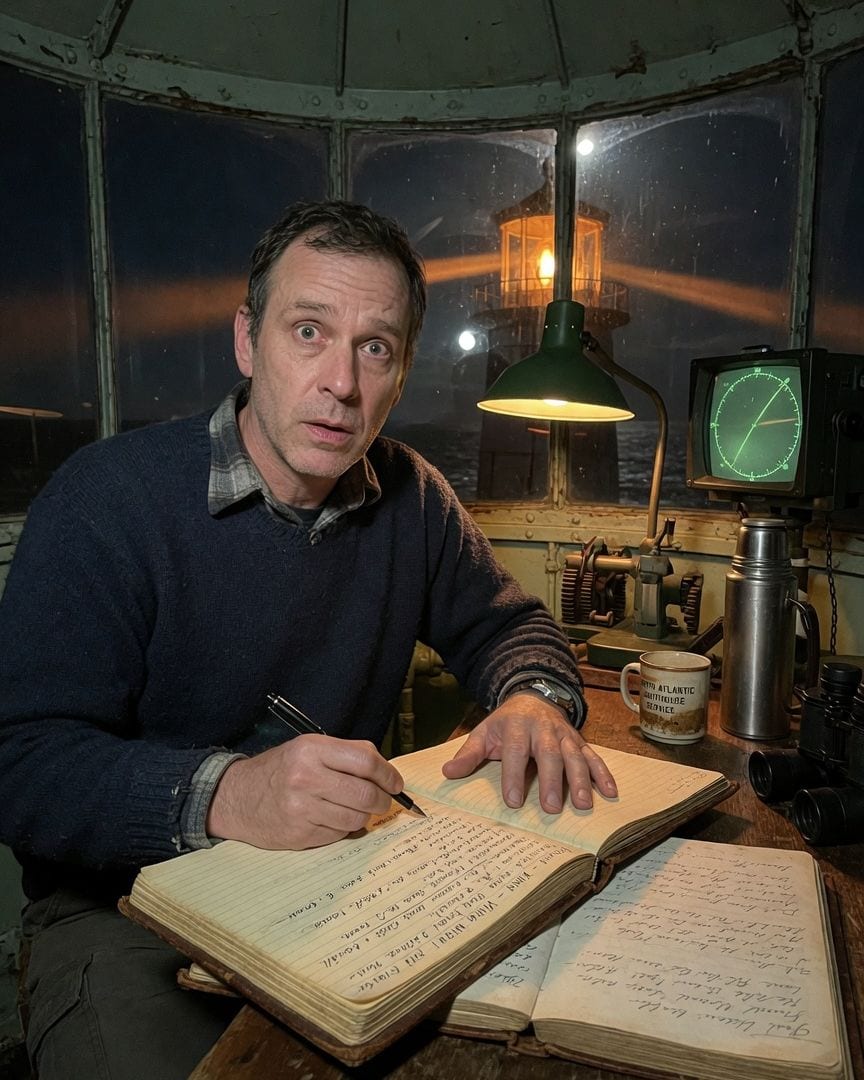
My lighthouse log has my own 3 AM entry for a phantom ship. I was alone in the tower, and I wrote no such thing.
Perched in the lantern room for my usual 2-6 AM watch, I reached for the thick logbook. But the 3:00 AM entry, under my own name, detailed a vessel I never saw. The words were in my own ink, yet I had never written them.
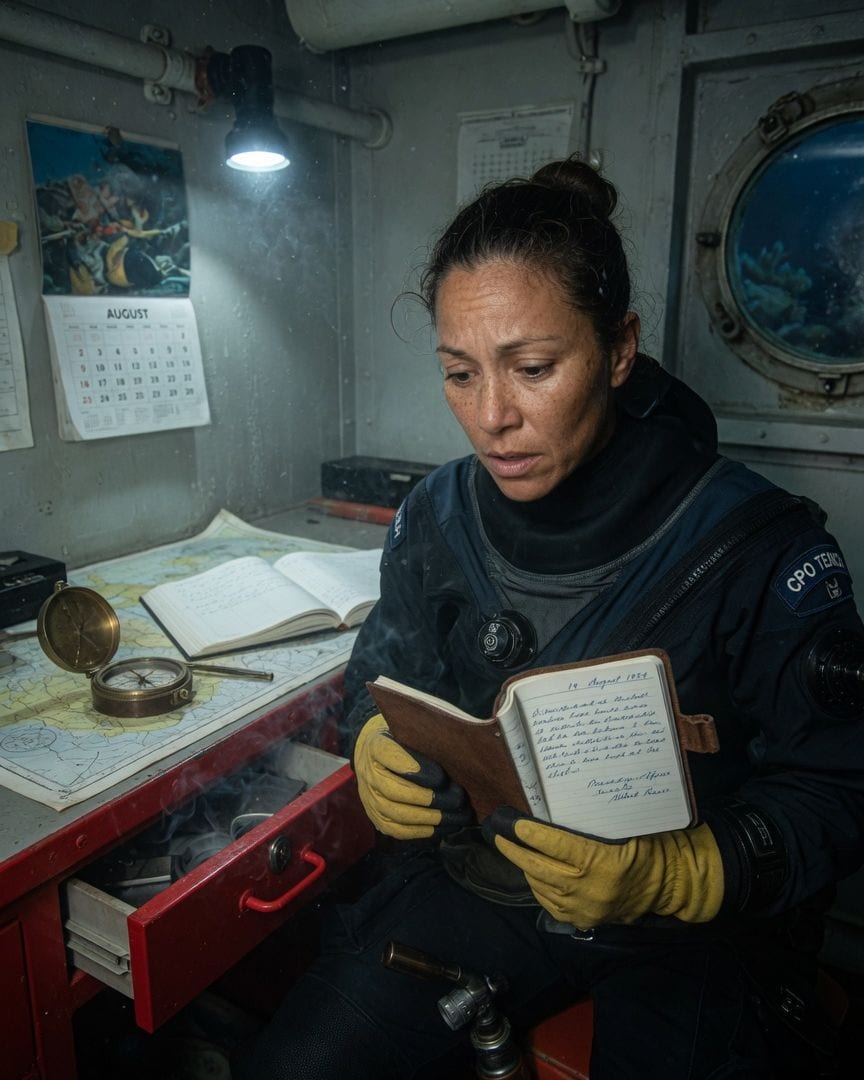
A deep-sea diver found a Cold War target ship's logbook dated months after it was vaporized in 1954.
Chief Petty Officer Marlo Tench, a methodical deep-sea diver, stared in disbelief at the ROV feed. Her team watched with her as the USS Triton, a target ship from the 1954 Castle Bravo nuclear test, appeared pristine and upright ninety feet below. It was supposed to have been vaporized, yet its hull number was unmistakable, its paint unburned, and its internal systems inexplicably active. Descending into the eerie silence, Marlo found a logbook dated five months after the ship’s destruction, and a journal entry naming a crewman officially listed as 'unmanned target.' What impossible force kept the Triton a living ghost decades after its fiery end?
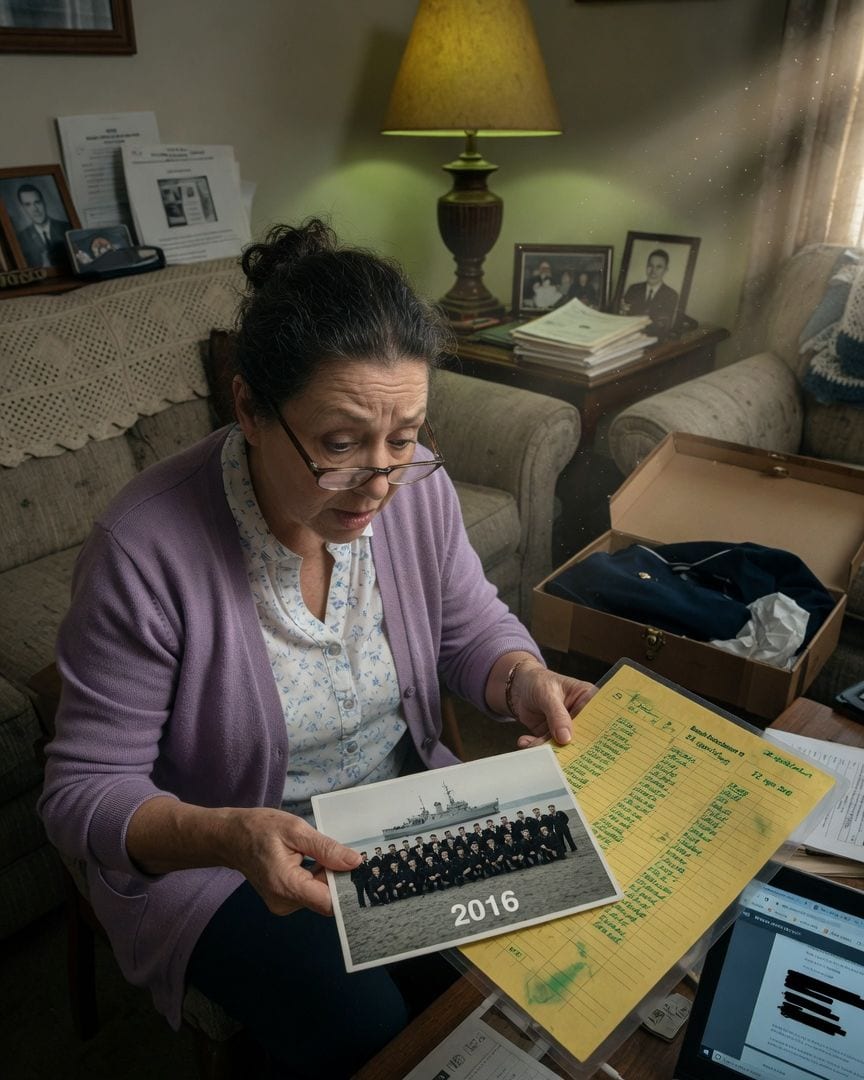
Marisol Frayne unlatched her husband's old footlocker. A photo inside showed his ship, pristine in 2016, three years after the Navy declared it lost.
Marisol Frayne, 62, finally unlatched her husband’s old footlocker in 2024, eleven years after the Navy declared his ship, the Kaskillan, lost at sea. Dust motes danced in the afternoon light as she lifted the lid, releasing the scent of old canvas and cedar. Inside, beneath his perfectly folded dress blues, she found a photograph of David and his crew standing before a pristine Kaskillan. Her breath caught: the photo was dated 2016, three years after the official reports claimed the ship vanished with all hands. Marisol's methodical search then revealed official logs showing a K-class vessel designation active in 2016, leaving a chilling void where her husband's fate should have been.