A torpedoman found his own signature in the USS Vanguard's duty log for a watch he never stood, beside a name not on the master crew manifest.
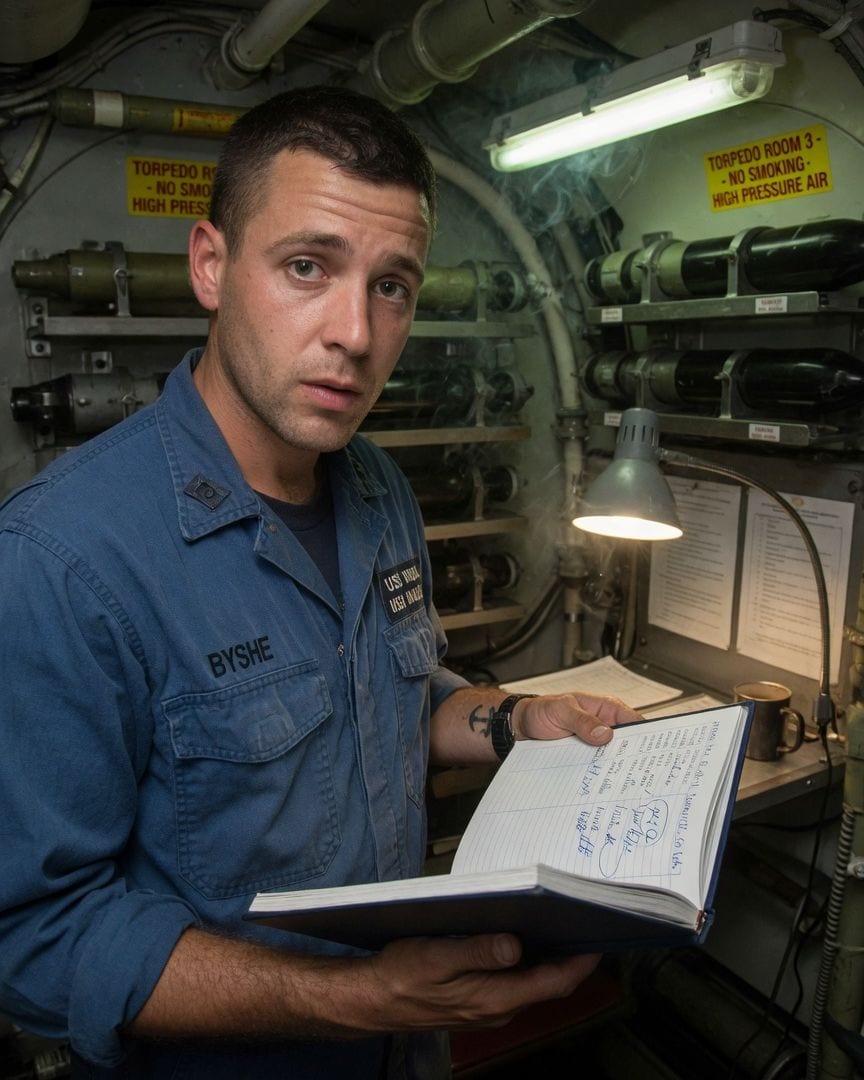
Torpedoman Oscar Bysshe grunted as he shoved the spare rack into the tight space above his bunk. It was a snug fit, just as he preferred.
Old salts preached keeping the racks uneven, something about ‘the boat likes its numbers odd,’ but Bysshe, a squared-away nuke-boat sailor on his first deep patrol aboard the USS Vanguard, scoffed at diesel-era superstitions.
A spare rack was gear storage, pure and simple, not a vessel for some phantom presence.
Later that night, during mid-rats, Messcook Patricia Doyle muttered, her brow furrowed as she counted plates. Her lips moved, recounting, then her eyes widened. "One short," she mumbled, then immediately corrected herself, a nervous tremor in her voice. "No.
One man over the manifest."
Bysshe watched as she pointed a trembling finger to the far end of the mess table. A figure sat there, hunched in the dim light, obscured by shadows and the angle of the bulkhead.
He ate in silence, separate from the rest of the crew, his presence a quiet anomaly in the familiar hum of the mess. No one else seemed to notice, or perhaps they chose not to.
When the figure rose and left, his tray was perfectly, impossibly clean, every surface wiped spotless as if it had never held food. Not a crumb, not a smear, just sterile white plastic.
Bysshe, rational to a fault, first dismissed it as a prank, or perhaps a temporary transfer he hadn't been briefed on, some last-minute addition to the crew before deployment.
He checked the master manifest, cross-referencing names against faces he knew, looking for new entries, for missing crew. No one was unaccounted for, and certainly no new addition had been officially documented.
Patricia Doyle swore by her count, by the man she’d seen, but Bysshe attributed it to fatigue, the stress of deep patrol.
The incident nagged at him, though. The perfectly clean tray, the way no one else seemed to react. During his next watch, performing routine systems checks in the torpedo room, the thought of the mess deck figure returned.
He pulled the bulky, official duty logbook from its secure shelf. Every watch, every man, every assigned task for every sailor was meticulously recorded, signed off in ink. It was the boat’s unimpeachable record, its very pulse.
As he flipped to the current day, scanning entries, a cold dread snaked into his gut. There, listed for a watch he knew he hadn't stood – a watch he’d been asleep through – was his own signature.
It was his familiar, looping script, a slight flourish on the 'B' of Bysshe. Next to it, in the 'crewman' field, was a name he didn't recognize, a name not on the master manifest.
It wasn’t a blank space, but a name that shouldn't be there, confirmed by his own familiar, looping signature. A record that swore otherwise than reality itself.
Bysshe’s blood ran cold. He had not signed that entry. He had not stood that watch. His mind raced, searching for mundane explanations: a prank, a forced signature, a clerical error, a misplaced page.
He hurried to the petty officer’s office, the thick duty log still clutched in his hand.
He pulled the master crew manifest, a heavy binder secured by a combination lock, its pages filled with the names and details of every soul aboard the USS Vanguard.
He flipped through the meticulously organized sections until he found the 'temporary assignments' section, usually blank or with a few brief notes for visiting dignitaries or maintenance specialists.
But there, scrawled in an unfamiliar hand, yet disturbingly similar to his own, was the impossible name. Dated just yesterday. The date of the mess-deck incident. The name was there. The record swore it.
The next few days became a quiet obsession for Bysshe. The discovery of the impossible signature had unmoored him, replacing his rational certainty with a chilling sense of fundamental wrongness.
He started checking other logs, discreetly, always under the guise of routine system checks or inventory. He accessed the boat’s internal access logs, recording every badge swipe, every hatch opened, every movement through its labyrinthine corridors.
He found a phantom ID entry for the unknown crewman, showing movement through restricted areas at impossible times – always just outside the main thoroughfares, always in the blind spots of the few cameras.
The logs didn't show the figure passing a sensor, but simply existing on the other side, an instantaneous, impossible transition.
He checked supply requests. A small, inexplicable order for extra rations had been filed under a general 'crew needs' category, dated the same day as the mess-deck incident.
The quantity made no sense for the official roster; it was exactly enough for one extra man for a few days. The entries were sparse, almost an afterthought, but they corroborated the messcook's initial count.
The paper trail, dense and irrefutable, painted a picture of a presence that was simultaneously not there and fully integrated.
He saw the figure again, twice. Once, a fleeting shadow at the end of a corridor, gone before he could fully register it as he rounded a corner.
Another time, a faint reflection in a polished bulkhead, a shimmer of motion, gone before he could fully register it as he glanced up.
It was never hostile, never direct, just… there, a quiet violation of the boat's precise order, a systemic glitch in the fabric of his reality.
The unease wasn't just in the paperwork; it was in the very hum and thrum of the ship, a subtle wrongness that made the air feel colder in certain spots, the shadows seem deeper.
Bysshe's quiet investigation didn't stay quiet for long. One afternoon, Chief Engineer Leonard Winslow, a grizzled veteran whose face held the weariness of a thousand deep patrols, called Bysshe into his cramped office.
Winslow had a reputation for knowing the boat better than its blueprints, a near-mythic understanding of its quirks and rhythms. He sat behind a desk piled high with manuals and schematics, his eyes fixed on Bysshe.
Winslow didn't accuse, but his gaze was heavy, knowing.
"Torpedoman," he began, his voice low, a gravelly whisper against the boat's persistent drone, "this boat has its own rhythms. Its own… rules." He paused, his gaze drifting to a point beyond Bysshe, as if addressing the bulkheads themselves.
"Some things, on deep patrols, are best left alone." He spoke of 'old ways' and 'maintaining order' in a tone that suggested deep, unspoken knowledge, not just a casual warning against a prank.
It was a warning layered with decades of experience, of observations Bysshe couldn't yet fathom.
Bysshe felt a prickle of being watched, not by the phantom, but by an unseen force within the crew, or perhaps the boat itself, that knew exactly what he was uncovering.
He had seen the way other crewmen would sometimes glance at him, a fleeting, almost imperceptible shift in their expressions when he asked a question too pointedly, or lingered too long near an access log.
Later, he found a small, almost imperceptible scratch on the cover of his duty log, right over the impossible entry, as if someone had run a finger over it, a silent, knowing touch.
It was a mark of acknowledgment, a sign that his prying had not gone unnoticed.
The warning only fueled Bysshe's resolve. Winslow knew something, and Bysshe intended to unearth it. He cornered Winslow in a quiet corner of the engine room, away from the watchful eyes of junior officers.
He laid out the conflicting records on an overturned toolbox: the manifest, the duty log with his forged signature, the phantom ID entry.
He spoke in a clipped, urgent whisper, the hum of the reactor plant providing a low backdrop to his desperate logic.
"Chief," Bysshe pressed, jabbing a finger at the duty log, "this isn't a prank. There's an extra man on this boat, and the paperwork says he exists, but he doesn't. Not really."
Winslow sighed, a deep, weary sound that seemed to carry the weight of the steel around them. He stared at the logs, his gaze lingering on the phantom ID entry, then back at Bysshe.
"This boat, the Vanguard," he began, his voice barely audible over the thrumming machinery, "she has a history. A long one. Some call it a ghost, some call it a system anomaly. I call it… a requirement."
He didn’t explain what it was, not precisely, but admitted it appeared when 'the count is made too neat' or 'the old spaces are left empty.'
He reached into a secure compartment beneath a console, pulling out a worn, hand-bound leather logbook, its pages yellowed and brittle, smelling faintly of salt and old paper.
"This isn't official," Winslow said, running a thumb over its cracked spine, "but it's been passed down between chief engineers for generations." He opened it to a page marked with a faded ribbon.
It was full of similar accounts: impossible entries, phantom crewmen, strange disappearances, all tied to moments when the 'rules' were broken.
It wasn't a ghost story; it was a record of a recurring, programmatic anomaly, detailed in neat, looping cursive, each entry a testament to the boat's insidious internal logic.
Winslow was about to explain more, perhaps how to 'manage' or 'appease' the anomaly, when a piercing alarm shrieked through the submarine. The sound cut through the thrum of the engines, a raw, electronic scream.
"Critical system malfunction in Sector C-7!" blared the comms over the general address, the speaker’s voice tinged with panic.
Sector C-7, a highly redundant area, was precisely where Bysshe had last seen the phantom's movement in the access logs, a zone of impossible ingress and egress.
It was a failure that shouldn't be possible, a core system critical to the boat's very function, protected by layers of backup. Winslow's eyes widened, a dawning horror on his face, mirroring the alarm's escalating tone.
He looked at Bysshe, then back at the blaring alarm panel, its red lights flashing like malevolent eyes. The old logbook, still in Winslow's hands, fell open, revealing a page marked with a dried, dark smudge.
It detailed a previous patrol, a similar system failure, and a single, ominous note scrawled below it: 'Balance upset. One lost.'
Winslow stared at the page, then at Bysshe, and whispered, his voice barely audible over the klaxons, "It's not just an extra man, Torpedoman. It's an exchange."
The alarm escalated, its urgency vibrating through the deck plates, a physical tremor that resonated with the icy dread in Bysshe's gut. Winslow gripped Bysshe’s arm, his fingers digging in, his eyes wide with a desperate clarity.
"The 'extra man' isn't just an addition, Bysshe. It's a placeholder. This boat, it has a balance, a count it maintains. When you broke the old rules—stowed the rack, made the count even—you created a void."
Winslow pointed a trembling finger at the unofficial logbook, open to the page detailing the previous loss. "The phantom fills that void. But if the balance isn't restored, if the 'extra' isn't acknowledged, the boat… it takes one.
It makes the count even again, in its own way."
The system failure wasn't random; it was a precursor, the boat's way of forcing the issue, of demanding its due.
Winslow flipped through the unofficial logbook, his fingers flying over the brittle pages, pointing to entries detailing 'accidents' and 'disappearances' from previous patrols. Each one, Bysshe saw, made the official manifest 'correct' again, one man lighter.
"Your investigation, Bysshe," Winslow said, his voice grim, "it didn't just notice it. It disturbed it. Now it demands its due." The horror was in the coherence, the stark, cold logic of it all.
Bysshe didn't hesitate. The choice was horrifyingly clear. He sprinted through the boat, alarms still blaring but slowly lessening in intensity as the system began to self-correct in minor, non-critical ways.
The ship was a living thing, responding to the disturbance, demanding its ritual. He reached the mess, where Patricia Doyle was still looking bewildered at the extra plate, a relic of the previous mid-rats.
Bysshe grabbed it, not to remove it, but to move it to a more prominent spot on the table, a deliberate, visible acknowledgment, an offering.
Then, he raced to his bunk. With a grunt, he pulled the stowed spare rack from its tight compartment above his bed, the metal groaning in protest.
He set it up in the narrow space, making the racks uneven again, restoring the 'old way,' the traditional imbalance that the boat seemed to require.
Finally, he returned to the engineering station, the alarm now a low thrum, a sullen growl rather than a shriek. He took a fresh duty log, and with a steady hand, he opened it to the current watch.
He made an entry for the 'extra man,' not with a name, but with a blank, unsigned space for 'Duty: Maintaining Balance.' It was a silent, terrifying acknowledgment of the anomaly's existence, a forced truce, a bargain struck.
As he finished, the last of the critical alarms silenced. The boat hummed, its systems settling back into their familiar, terrifying rhythm, a deep sigh of equilibrium.
The patrol continued, tense but stable. The extra plate remained set at mid-rats, and the spare rack, though unused, was never stowed again.
No one spoke of the 'extra man,' but the crew sometimes felt a cold spot in the corridors, a flicker in their peripheral vision, a shared, unspoken awareness.
The duty log still held the impossible entry, now with Bysshe's own silent, blank acknowledgment.
The system had been appeased, but the knowledge of what it was, and what it demanded, remained, a chilling undercurrent beneath the mundane routine of deep patrol.
Oscar Bysshe finished his deep patrol, his transfer papers signed for a new assignment on a different vessel.
He never spoke of the USS Vanguard's 'balance,' but the knowledge was a permanent anchor in his mind, a silent weight he carried.
Years later, a veteran with salt-and-pepper hair, he received a small, decommissioned piece of equipment from the Vanguard as a memento, a relic from the boat he had served, a piece of its cold, metallic heart.
As he ran his thumb over its casing, tracing the faded manufacturer's marks, he noticed a faint, almost invisible etching: a tally mark, then another, and another, forming a pattern of similar, impossible 'exchanges' or 'balances' across rotations, a history far longer than any official record.
He looked at his own hand, turning it over, and for a moment, he saw a faint, almost transparent signature on the back of it, like a phantom ink stain, the same looping script he had seen in the duty log.
It was a mark he couldn't wash away, a quiet testament to the price of order.
The old boat, now rusting in a scrapyard, hummed faintly on moonless nights, its hull still demanding an uneven count. The faint mark on Bysshe’s hand deepened with time, a shadow beneath the skin.
He ran his thumb over the faint mark, knowing it was there. He knew it was still there.
If this one got to you
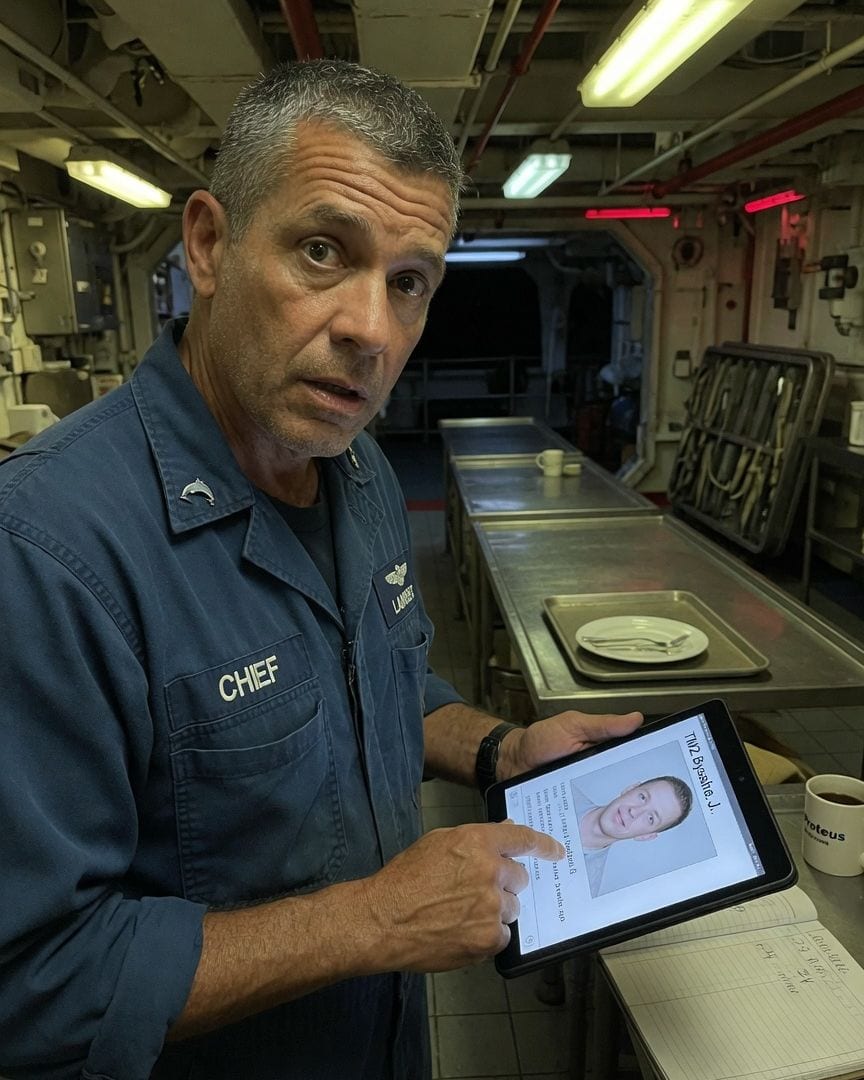
Chief Maxwell Lambert, on his final patrol, found his own signature approving a transfer for a sailor he'd never met.
Chief Maxwell Lambert was nearing the end of his final deep-sea patrol on the USS Proteus, looking forward to shore duty. The familiar hum of the boat and the clatter of the mess hall usually brought comfort, marking each day closer to home. One night, a young messcook reported a strange discrepancy: one plate short, but one man over on chow. Chief Lambert himself then saw a silent, unfamiliar figure eating alone in the shadows of the mess hall, a man who vanished into the passageway without a trace. Later, checking personnel logs, he found every man accounted for. Yet, his own signature approved a transfer for Torpedoman Bysshe—a sailor he had no memory of meeting, whose file photo was unsettlingly generic. How could his official record swear to a man he knew had never served on his boat?
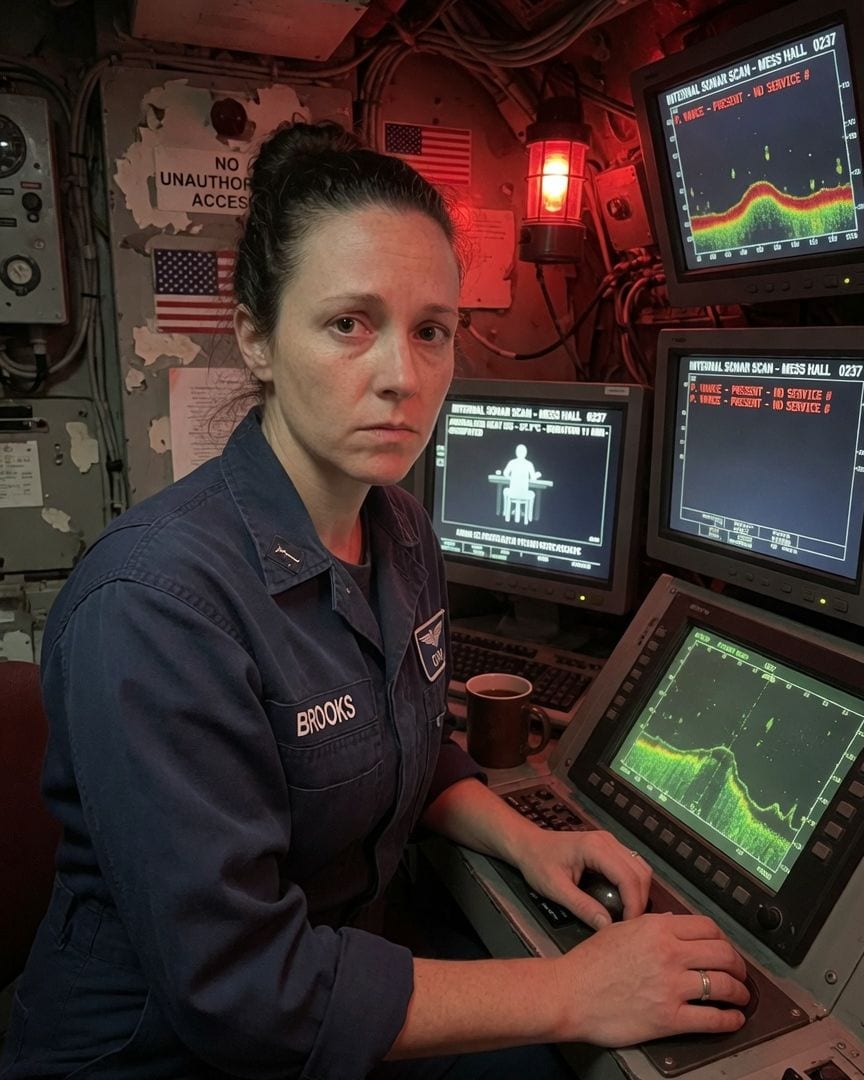
A Chief Petty Officer reviewed her submarine's sonar logs, finding a human heat signature where security cameras saw nothing, then the manifest listed an extra man who couldn't be deleted.
Chief Petty Officer Charlotte Brooks felt the weight of her submarine's impending decommissioning, its long service ending soon after a decade as her home. The quiet hum of the USS *Artemis* was broken when a nervous messcook reported seeing a shadow eating alone in the mess hall, then finding one plate short but a perfectly clean tray. Though skeptical, Charlotte checked the security feeds, which showed nothing, yet her sonar logs revealed a distinct human heat signature in the same spot, then abruptly vanish. Her dread deepened when the boat's manifest confirmed 101 souls instead of 100, listing a mysterious 'P. Vance' with no details, whose entry all systems refused to delete.
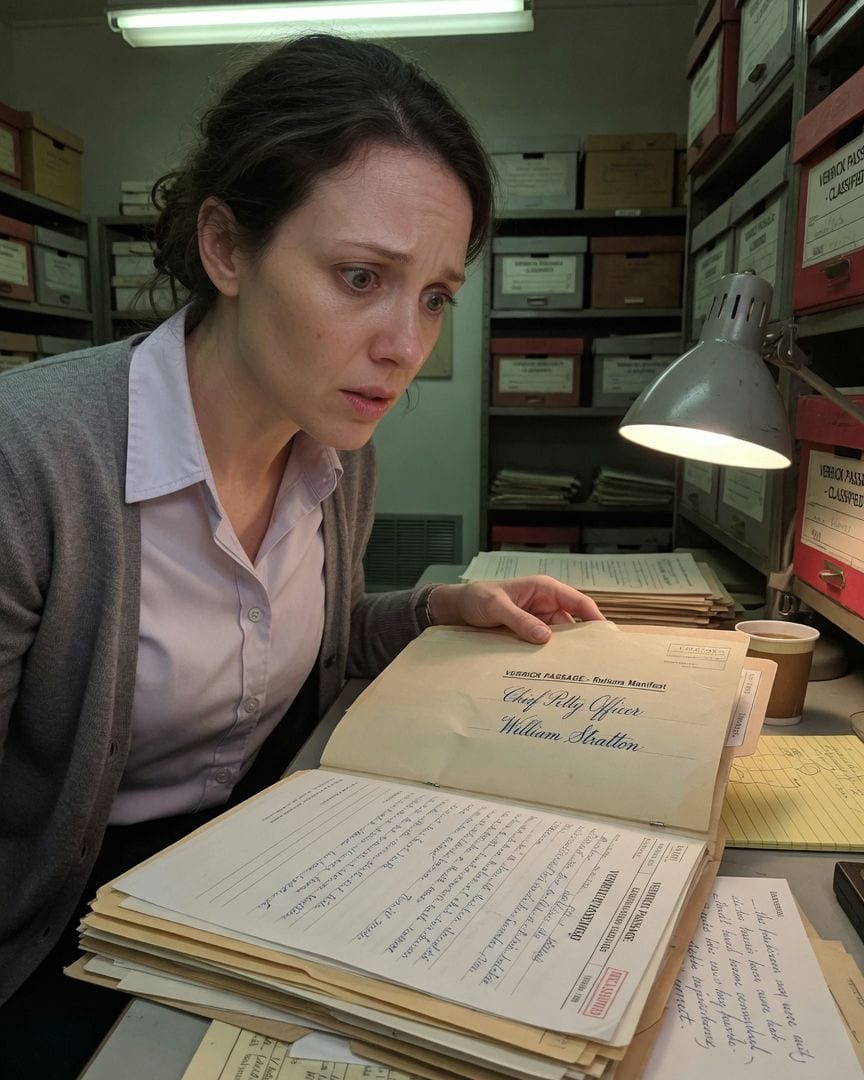
A records reviewer found personnel files for men lost 80 years ago, still being signed in an identical, perfect hand.
In the sterile hush of the declassified archives, meticulous reviewer Ione Fash had a routine task: cross-referencing witness statements from the Verrick Passage file. But as she reviewed files eighty years thick with official silence, she found nine separate interviews containing the exact same chilling sentence, all in an identical, precise hand. Her rational mind sought explanation, yet then she discovered something worse: personnel files for men lost in 1943, still being updated with modern requisitions and payroll runs. Each impossible entry, including a manifest signed just two weeks ago by a casualty from eighty years prior, bore the same unnervingly perfect signature. The file wasn't just a record of the lost; it was still being signed.
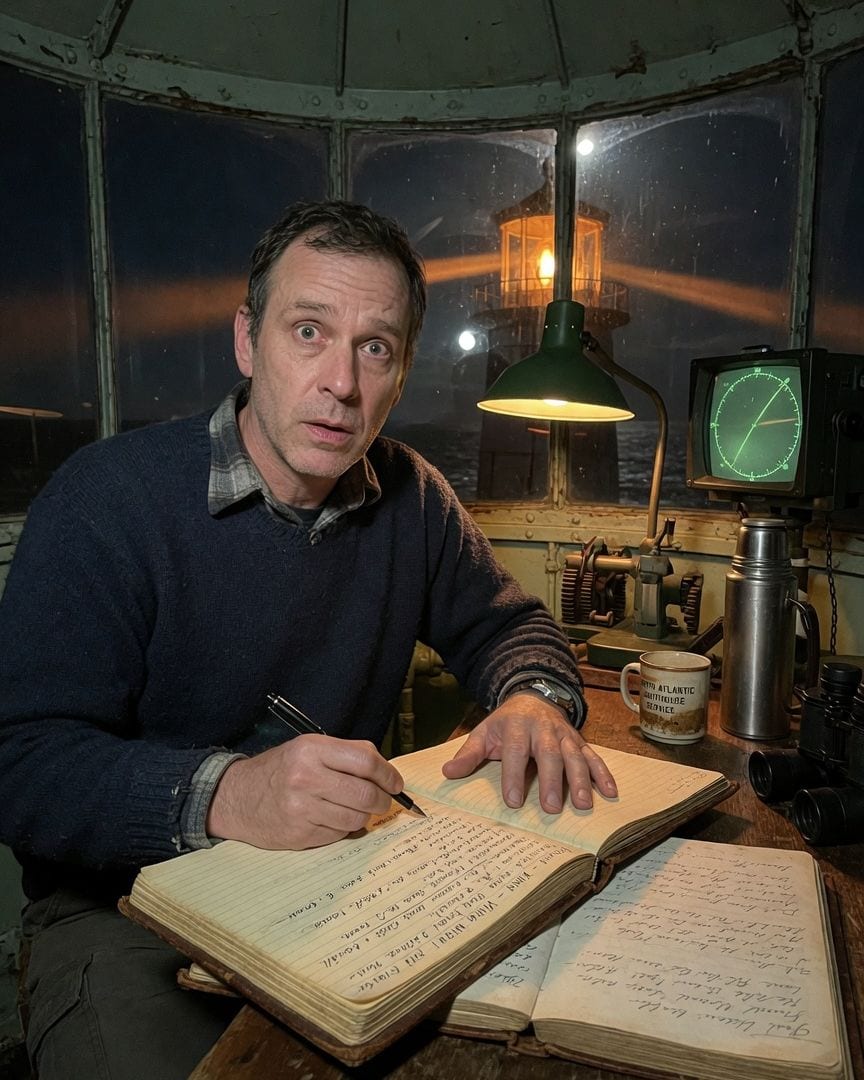
My lighthouse log has my own 3 AM entry for a phantom ship. I was alone in the tower, and I wrote no such thing.
Perched in the lantern room for my usual 2-6 AM watch, I reached for the thick logbook. But the 3:00 AM entry, under my own name, detailed a vessel I never saw. The words were in my own ink, yet I had never written them.
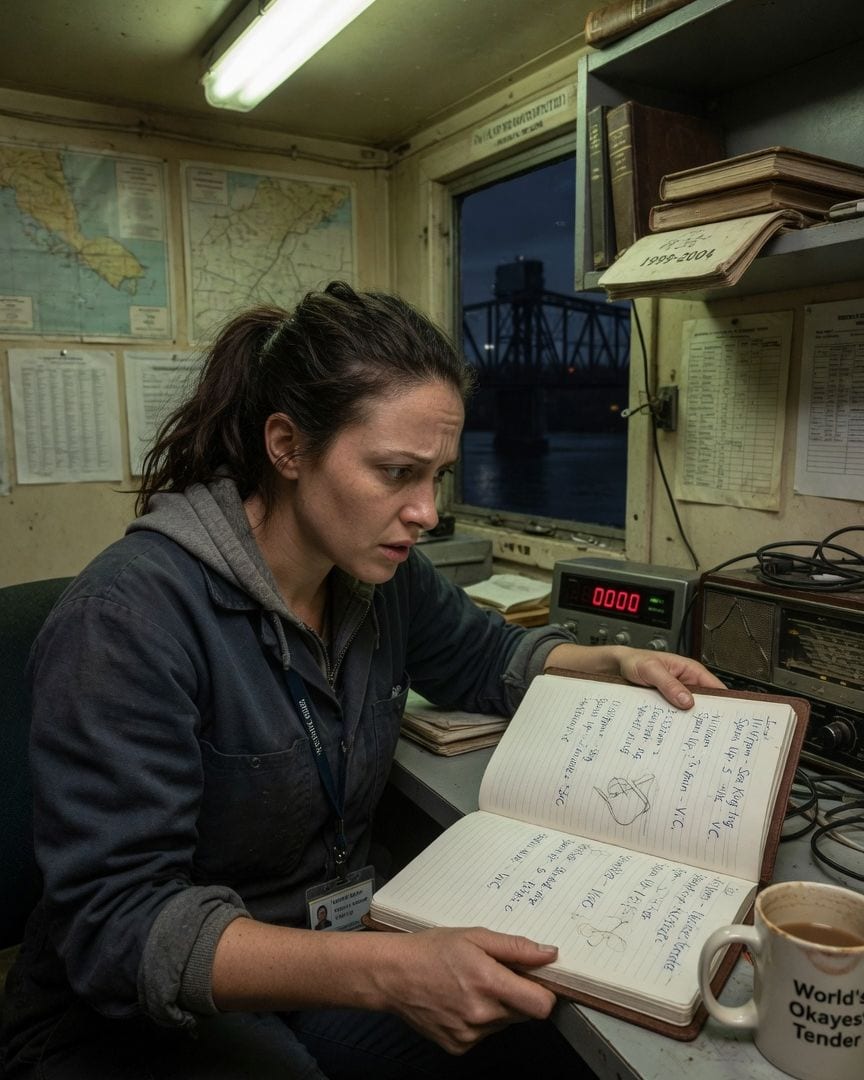
My drawbridge log shows a 2:33am lift I didn't make. The span counter never moved.
As a drawbridge tender, my midnight to dawn shift is usually quiet, a routine of monitoring traffic and logging lifts. But tonight, my own logbook shows an impossible entry for a bridge lift I have no memory of making. My initials and handwriting are there, yet the span counter above my panel reads a steady zero. No boat called, no span ever went up.
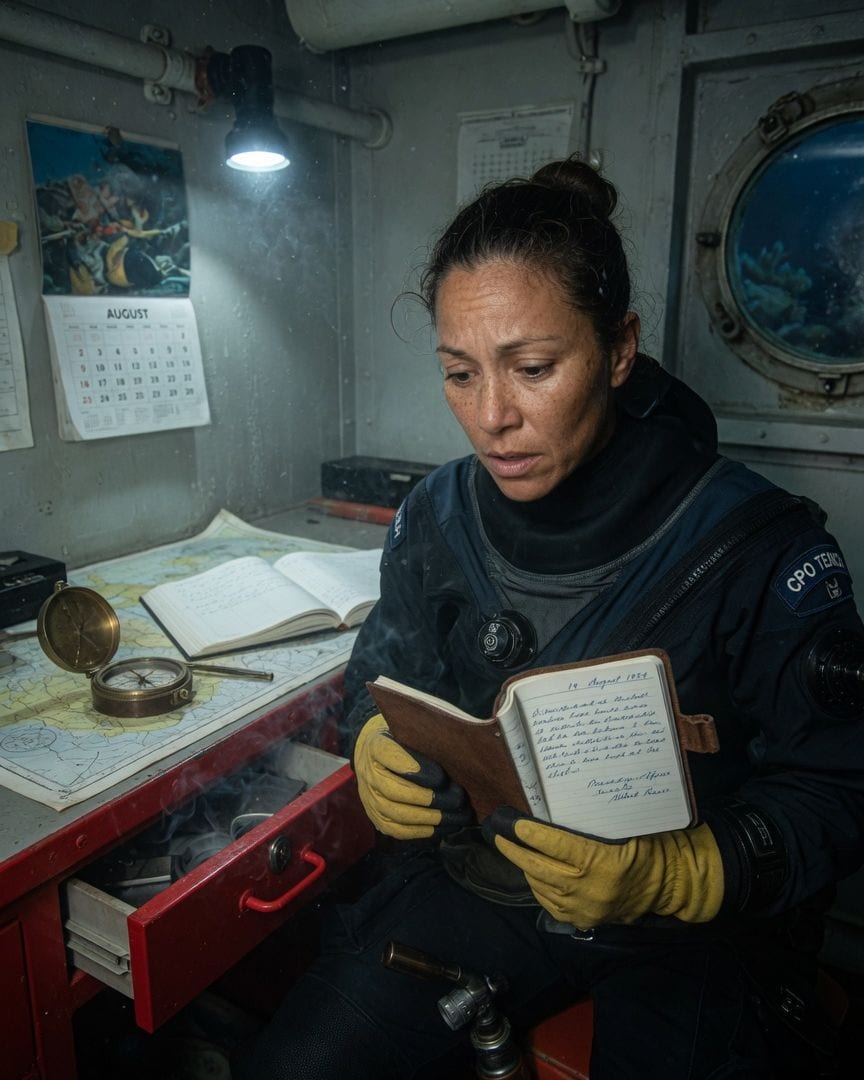
A deep-sea diver found a Cold War target ship's logbook dated months after it was vaporized in 1954.
Chief Petty Officer Marlo Tench, a methodical deep-sea diver, stared in disbelief at the ROV feed. Her team watched with her as the USS Triton, a target ship from the 1954 Castle Bravo nuclear test, appeared pristine and upright ninety feet below. It was supposed to have been vaporized, yet its hull number was unmistakable, its paint unburned, and its internal systems inexplicably active. Descending into the eerie silence, Marlo found a logbook dated five months after the ship’s destruction, and a journal entry naming a crewman officially listed as 'unmanned target.' What impossible force kept the Triton a living ghost decades after its fiery end?