Chief Maxwell Lambert, on his final patrol, found his own signature approving a transfer for a sailor he'd never met.
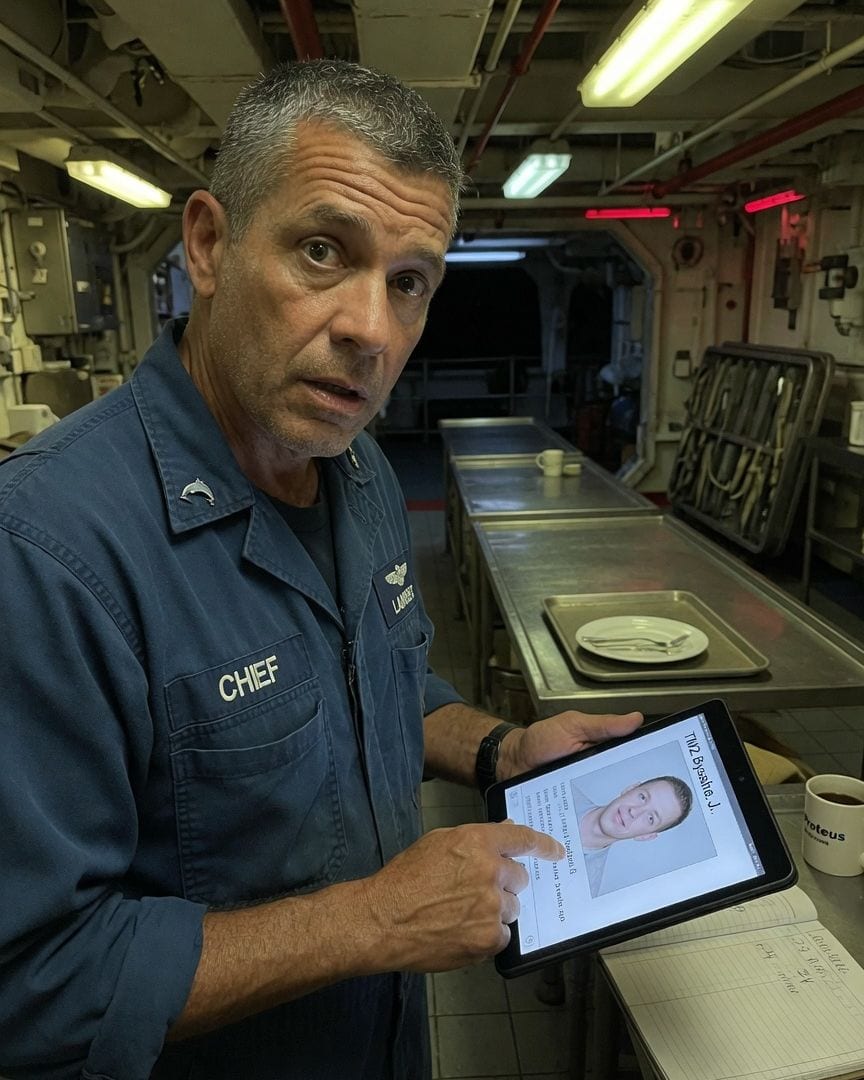
The clatter of trays in the USS Proteus mess hall was a familiar comfort to Chief Maxwell Lambert, especially during mid-rats.
He was nearing the end of his final deep-sea patrol, looking forward to shore duty, and every routine felt like a step closer to home. Tonight, however, the routine fractured.
Messcook James Walsh, a young sailor on his first deep patrol, stood rigid by the serving line, eyes wide.
“Chief, the count’s off. One short on plates, but one man over on chow.”
Lambert, a stickler for order, checked the digital manifest on his pad: a perfect twenty-three, no discrepancies. He glanced at the mess hall. Most seats were empty or occupied by familiar faces.
But at the far end of a stainless-steel table, partially obscured by shadow near a stowed spare rack, a lone figure sat, head bowed over a tray. Lambert hadn’t seen him get in line, nor recognized his posture.
The figure ate in silence, the only sound the faint hum of the boat’s systems.
Lambert watched as the man slowly raised his tray, perfectly clean, and set it aside, before rising and disappearing into the passageway, a ghost in the hum of the boat.
Lambert dismissed Walsh with a quiet word, attributing the discrepancy to a rookie’s nerves or a momentary lapse in attention. Yet, the image of the silent figure lingered. He decided to do a quick, unofficial check.
Heading to the Master-at-Arms office, he pulled up the full personnel manifest, cross-referencing watch bills and berthing assignments. Every single man was accounted for, every rack assigned. There was no 'extra.'
He even pulled the logs for the past three mid-rats, finding no anomalies. The logical explanation was simple: Walsh miscounted, or the man was a legitimate crewman who just slipped past his notice.
But Lambert prided himself on knowing every face on his boat.
He knew the old diesel-boat superstition about setting an extra plate and keeping an odd number of racks, a tradition Torpedoman Bysshe, a past crewman, had reportedly scoffed at years ago by stowing his assigned spare rack for gear.
Lambert decided to check the mess hall’s physical logs for the day, the old paper ones that still existed for redundancy. He found the entry for mid-rats, initialed by Walsh, noting '23 served.'
Then, beneath it, a smaller, almost imperceptible correction in a different ink, a '24' faintly visible under the scratch-out. His unease ratcheted up. He pulled the service jacket for Torpedoman Bysshe from the electronic records.
The file was complete, commendations, training, even a recent transfer approval. His own signature, clean and bold, was stamped on the transfer order, dated just three weeks prior.
Lambert stared at the official service record for Torpedoman Bysshe, a man he had no memory of ever meeting, yet his own signature, clear and undeniable, approved Bysshe’s transfer out of the Proteus just weeks ago.
The file was meticulously kept, every detail precise. He scrolled to the photo: a face that was subtly, unnervingly generic, like a composite of a dozen different sailors, lacking any distinct feature to latch onto.
It was a face that could belong to anyone, and therefore, to no one. He knew he hadn't signed this. He knew this man hadn't served on his boat. But the record, his own signature, swore otherwise.
The hum of the boat systems suddenly felt louder, more insistent, a low thrum against his teeth.
The next morning, Lambert confronted Walsh. The messcook swore again, his voice cracking, that he’d counted twenty-four men. He even described the figure: “Looked like a new guy, Chief, quiet. Didn't say a word.”
Lambert dismissed him, feigning reassurance, but the seed of doubt had taken root. He spent his off-watch hours poring over the ship’s digital manifests, comparing them against the physical logbooks stored in a locked cabinet.
He found no other discrepancies, no other 'Torpedoman Bysshe' entries. He discreetly questioned other crew members, asking if they’d seen a new face, a quiet torpedoman. Everyone drew a blank. Captain Daphne Underwood, a no-nonsense commander, noticed his distraction.
“Everything squared away, Chief?” she asked, her gaze sharp. Lambert offered a vague assurance, knowing she'd expect a full report if he pursued an official inquiry without hard evidence.
He then remembered the old 'ghost' logbook, a collection of unofficial entries and anecdotes passed down by crewmen on older boats, often hidden in the ship’s library or a forgotten crawlspace. It was full of superstitions and strange happenings.
After several hours of searching, he found it tucked behind a loose panel in the torpedo room, bound in worn canvas.
Inside, scrawled entries detailed similar 'extra men' incidents on the Proteus, always linked to the breaking of the 'extra plate/odd racks' rule.
One entry, dated 1983, mentioned a 'Quartermaster Finch' who appeared after a new CO ordered all 'superstitious' practices ceased. Another, from 1999, spoke of 'Seaman Blackwood' after a new recruit famously mocked the tradition.
Each entry ended with a chilling note: 'The records caught up.'
He found a specific entry about Torpedoman Bysshe, detailing how he stowed his spare rack, dismissing the rule, and then, a week later, an entry about 'Torpedoman Bysshe' being seen in the mess, quiet, leaving a clean tray.
The log then detailed how the official records for another crewman, a young QM named Elliot Ellsworth, inexplicably began to show 'Bysshe' as his legal name.
Lambert’s investigation became a solitary, almost obsessive pursuit. He started noticing things. The faint, metallic tang of disinfectant in his office that wasn't there before.
The subtle shift of his personal gear in his rack, as if someone had tidied it.
During a night watch, while reviewing surveillance feeds from the mess hall, he saw a momentary flicker, a distortion, just as the 'extra man' had appeared. He rewinded, played it frame by frame.
Nothing conclusive, just a blur that could be attributed to a faulty camera. But the feeling of being watched intensified.
One evening, as he slipped back to his rack, he found a small, folded piece of paper tucked under his pillow.
It was a single sheet from a mess hall logbook, the same page where Walsh had made his '24' correction. Scrawled across the top, in a precise, almost elegant hand, were two words: 'LEAVE IT.' The ink was fresh.
Lambert’s heart hammered. Someone knew what he was doing. Someone on the boat, someone who had access to his private space. He immediately suspected Captain Underwood. Her questions had been too pointed, her gaze too knowing.
He sought her out in her quarters, the note crumpled in his hand. He found her at her desk, reviewing schematics. He laid the note before her. Captain Underwood picked it up, her expression unreadable.
She looked at the handwriting, then back at Lambert. “A prank, Chief?” she asked, her voice calm, almost bored. “Or perhaps a warning from a concerned superior?”
Her eyes held his, and in their depths, Lambert saw not boredom, but a deep, weary understanding. He realized her calm was not indifference, but a practiced control. She knew, and she was subtly warning him off.
The danger was no longer just an anomaly; it was personal, and it was sanctioned.
Lambert refused to 'leave it.' He returned to the ghost logbook, cross-referencing names and dates with official records.
He found a pattern: each time the superstition was broken, an 'extra man' appeared, and a short time later, a legitimate crewman's records would subtly shift, their name or details morphing into those of the anomaly.
The original crewman would then vanish from all other unofficial records, but their official service jacket, now bearing the new, impossible identity, remained. The system absorbed them. He needed more.
He contacted Nathaniel Delaney, a retired Navy archivist he knew from a previous assignment, a man rumored to have an encyclopedic memory for personnel files and a penchant for 'unusual' cases.
Delaney, initially hesitant, agreed to meet Lambert via secure satellite link, his face grave. Lambert laid out his findings: the extra man, the altered records, the ghost logbook. Delaney listened, nodding slowly.
“The Proteus Man,” he finally said, his voice a low rumble. “He’s been around for decades. Not just on the Proteus, but on other boats, too, when the old ways were forgotten.”
He explained that the entity wasn’t an addition, but a replacement. “It takes one. It always takes one. And the records… the records just make it so.”
He described how the Navy's own meticulous bureaucracy, designed for absolute accountability, became its greatest weakness. “Once it’s in the system, with a signature… it’s real. It becomes real.”
Delaney then revealed that the original Torpedoman Bysshe, the one who scoffed at the superstition, had indeed gone missing decades ago, officially listed as 'lost at sea' during an unscheduled dive.
But his service record, Delaney confirmed, was later updated with details that didn't match the timeline, and an impossible transfer to the Proteus. Lambert felt a cold dread settle.
The 'Torpedoman Bysshe' whose record he’d found, the one with his signature, wasn’t the original. It was the entity, having assumed Bysshe’s name and part of his history, now cycling through the system.
The perfectly clean tray, the generic face, the impossible transfer—it all clicked into place. The first 'extra man' was a new manifestation of an old, old problem.
Lambert felt a profound sense of horror, not just at the entity, but at the sheer, unthinking power of the system that sustained it.
He realized that the name 'Torpedoman Bysshe' was just the latest iteration, a mask worn by 'The Proteus Man.' He remembered Captain Underwood’s warning.
She wasn't just aware of the entity; she was part of the mechanism that allowed it to persist. He needed to find out how deep this went, how many others knew, how many had been… replaced.
He went back to his own duty log, a physical book he kept for every shift, every inspection, every formal interaction. He flipped through the pages, his fingers trembling.
He found the date of Bysshe’s transfer, the same one he’d 'signed off' on in the digital record. He’d recorded no such interaction.
His own log was blank for that day, save for a notation about a severe head cold that had kept him in his rack. Then, his eyes fell on an entry from two weeks prior to the transfer date.
In his own unmistakable hand, initialed and dated, was a brief note: 'Routine sound gear check with Torpedoman Bysshe. All green.' But he remembered that day vividly.
He had been ashore, visiting his ailing father, a memory as solid as the steel hull around him. He looked up, his gaze meeting Captain Underwood's, who had silently entered his office.
She offered a faint, almost imperceptible nod, a quiet acknowledgement of a shared, terrible secret. He saw then, in the calm depths of her eyes, that she wasn't just warning him. She was confirming his complicity.
His own log, his own hand, had written 'The Proteus Man' onto his boat, onto his watch. He had always been named in it.
The realization hit Lambert like a depth charge. His own records, his own memory, were being overwritten. Captain Underwood stepped fully into the small office, her face devoid of emotion.
“It’s been happening for a long time, Chief,” she said, her voice low. “Since the boat’s commissioning, in one form or another. The official history of the Proteus is a palimpsest. Every time a superstition is broken, a gap opens.
And something fills it.” She explained that 'The Proteus Man' isn't a ghost but an institutional parasite. It latches onto a crewman’s identity, then uses the very system designed for accountability to make its presence undeniable.
“The records become the truth,” she stated. “And anyone who sees the gap, who questions the truth, eventually finds their own records, their own memories, subtly rewritten to accommodate it.”
She recounted the story of Torpedoman Bysshe, the original one, who vanished after scoffing at the superstition.
His service record, initially documenting his disappearance, was then quietly amended over months, slowly transforming him into 'The Proteus Man,' complete with new commendations and transfers that never happened.
The mess logs, the duty rosters, even the transfer orders—they all clicked into place, showing how the system, like a self-correcting organism, always brought the count back to 'perfect,' always made the anomaly official.
Lambert’s own entry about the sound gear check, his signature on Bysshe’s transfer, were not errors or forgeries. They were the system's way of incorporating him, making him a link in the chain.
He had become an unwitting witness, then a participant, and now, he realized, he was becoming part of the 'truth' that sustained 'The Proteus Man.'
The horror wasn’t just that the entity existed, but that the entire institution was designed, perhaps unknowingly, to ensure its continued existence.
Lambert, reeling, confronted Captain Underwood. “Why? Why let it continue?” he demanded. “Why not report it? Why not break the cycle?” Underwood sighed, a sound of profound weariness. “We tried. Generations of us. The records fight back.
The very act of documenting its existence, trying to expose it, makes it more real, more entrenched. It rewrites the past, Chief. It makes it impossible to prove it was ever otherwise.”
She revealed that the USS Proteus was being decommissioned not because of its age, but because the command structure, at its highest levels, had finally recognized a pattern they couldn't explain or contain.
The decommissioning was an attempt to 'cleanse' the system, to sever the entity’s connection. But she doubted it would work. “It’s not just the boat, Chief. It's the records. And those records will be transferred, archived, digitized.
It will just find a new vessel.” She looked at him with an expression of grim resignation. “You’ve seen too much, Maxwell. You’ve questioned too loudly. The system will correct itself, with or without your consent.” Lambert understood.
His own transfer to shore duty, which he had eagerly anticipated, was now not a reward, but a trap.
He would be transferred to an archiving department, to a quiet desk job, where he would be responsible for processing old service records, for ensuring their 'accuracy.'
He would become the keeper of 'The Proteus Man's' history, an unwitting perpetuator of its existence, signing off on impossible transfers and anachronistic commendations. His mind raced, searching for an escape, a way to break free.
But the submarine, deep beneath the waves, felt like a sealed tomb. Every door, every hatch, every system was under the purview of the very institution that was now, subtly, consuming him.
He thought of his ailing father, waiting for him ashore, and a profound, hollow ache settled in his chest. He was trapped, not by a physical monster, but by the relentless, bureaucratic logic of the military itself.
The USS Proteus returned to port three months later, ahead of its scheduled decommissioning. Chief Maxwell Lambert was among the first to disembark, his face unreadable.
He completed his transfer paperwork with meticulous efficiency, his signature firm and clear on every document. The shore duty assignment materialized as promised: a quiet office in a naval archives facility, processing old personnel files.
Captain Underwood retired quietly, her service record impeccable. James Walsh, the messcook, finished his tour without further incident, eventually transferring to another boat, apparently none the wiser. The 'ghost logbook' was never officially found.
The 'Torpedoman Bysshe' service record, still bearing Lambert's signature, was digitally archived, just another entry in the vast military database, waiting to be cross-referenced, waiting to be accessed.
In the quiet hum of the archives, Maxwell Lambert sat at his desk, surrounded by the meticulously organized history of countless sailors.
He stamped a final approval on a transfer order for a long-retired Chief Petty Officer, his hand moving with practiced ease. The name on the order was 'Torpedoman Bysshe.'
He paused for a fraction of a second, a flicker in his eyes, then resumed. He was good at his job. He ensured every record was squared away, every count perfect.
He knew, with a chilling clarity, that the records were the truth, and his role was to maintain it.
He would ensure that 'The Proteus Man' continued to exist, perfectly accounted for, in the vast, unblinking eye of the Navy’s historical record. He was part of the system now, a cog in the machine that made the impossible, real.
Sometimes, late at night, when the archive was empty, he'd find himself humming an old sea shanty, a tune he didn't remember ever learning.
He would gaze at the endless rows of files, each one a life, a story, a truth. And somewhere among them, he knew, a perfectly clean tray waited. He had always been named in it.
Years later, a junior archivist, pulling a file for a decommissioned submarine, found a discrepancy: an impossible transfer, signed by a Chief Lambert.
She mentioned it to her colleague, a quiet man with a meticulous hand and a faint, unplaceable smile. 'Is that so?' he replied, his gaze returning to the endless files.
If this one got to you
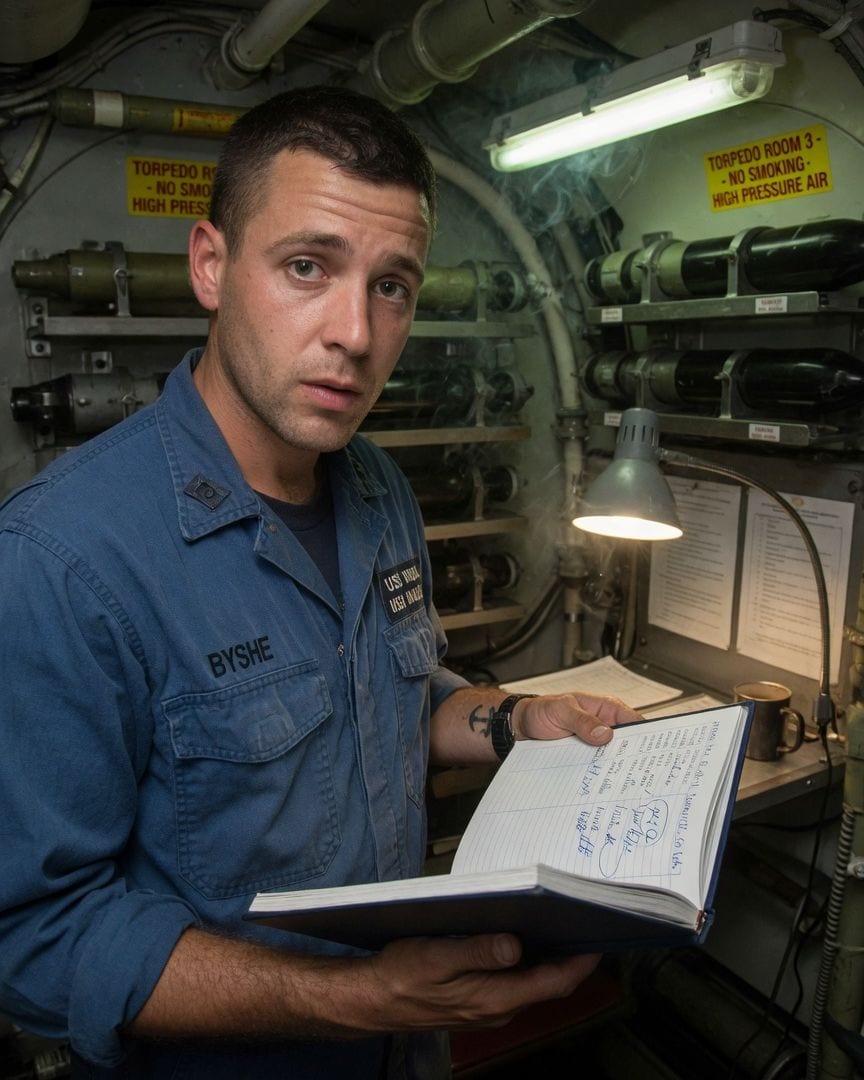
A torpedoman found his own signature in the USS Vanguard's duty log for a watch he never stood, beside a name not on the master crew manifest.
Torpedoman Oscar Bysshe, a rational sailor on his first deep patrol aboard the USS Vanguard, dismissed the messcook's nervous claim of an extra man at the table. He attributed the perfectly clean, untouched tray left behind to a prank. But later, during a routine systems check, Bysshe discovered his own familiar signature in the official duty logbook, for a watch he had been asleep through. Beside it was a name he didn't recognize, a name that shouldn't be there. A frantic check of the master crew manifest confirmed the impossible: the name appeared in the 'temporary assignments' section, dated just yesterday, scrawled in a hand eerily similar to his own.
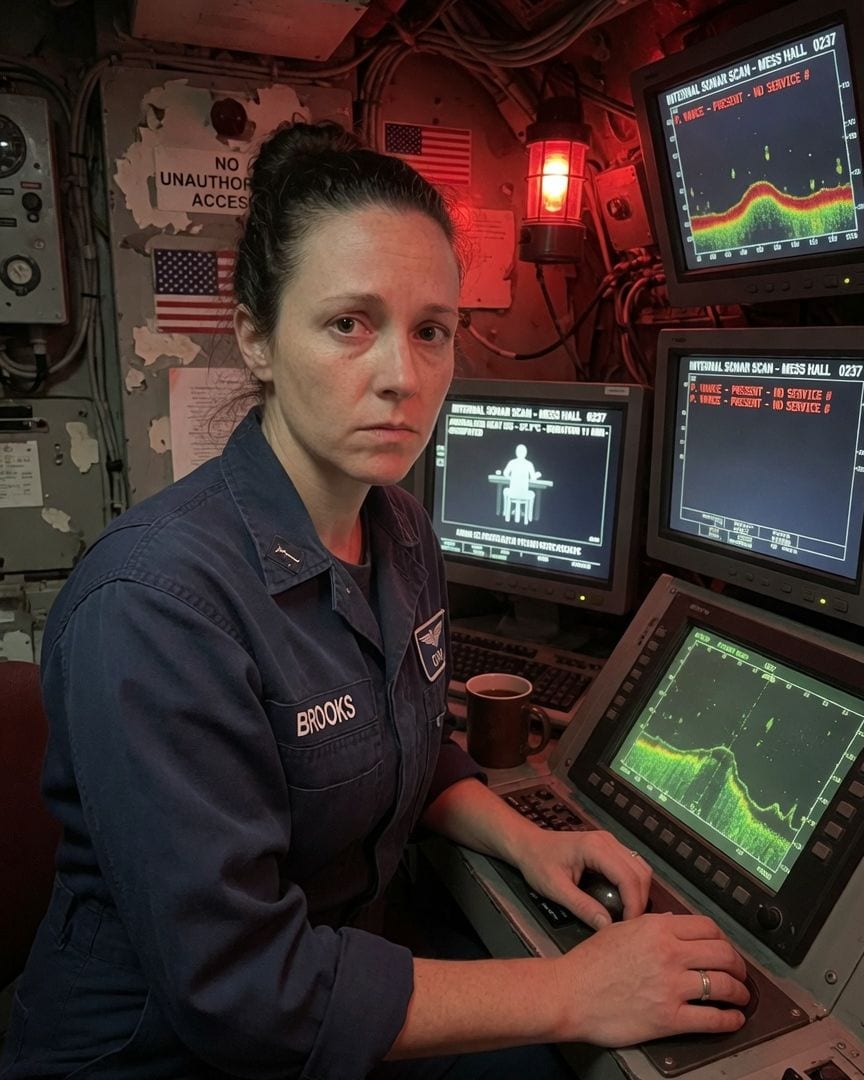
A Chief Petty Officer reviewed her submarine's sonar logs, finding a human heat signature where security cameras saw nothing, then the manifest listed an extra man who couldn't be deleted.
Chief Petty Officer Charlotte Brooks felt the weight of her submarine's impending decommissioning, its long service ending soon after a decade as her home. The quiet hum of the USS *Artemis* was broken when a nervous messcook reported seeing a shadow eating alone in the mess hall, then finding one plate short but a perfectly clean tray. Though skeptical, Charlotte checked the security feeds, which showed nothing, yet her sonar logs revealed a distinct human heat signature in the same spot, then abruptly vanish. Her dread deepened when the boat's manifest confirmed 101 souls instead of 100, listing a mysterious 'P. Vance' with no details, whose entry all systems refused to delete.
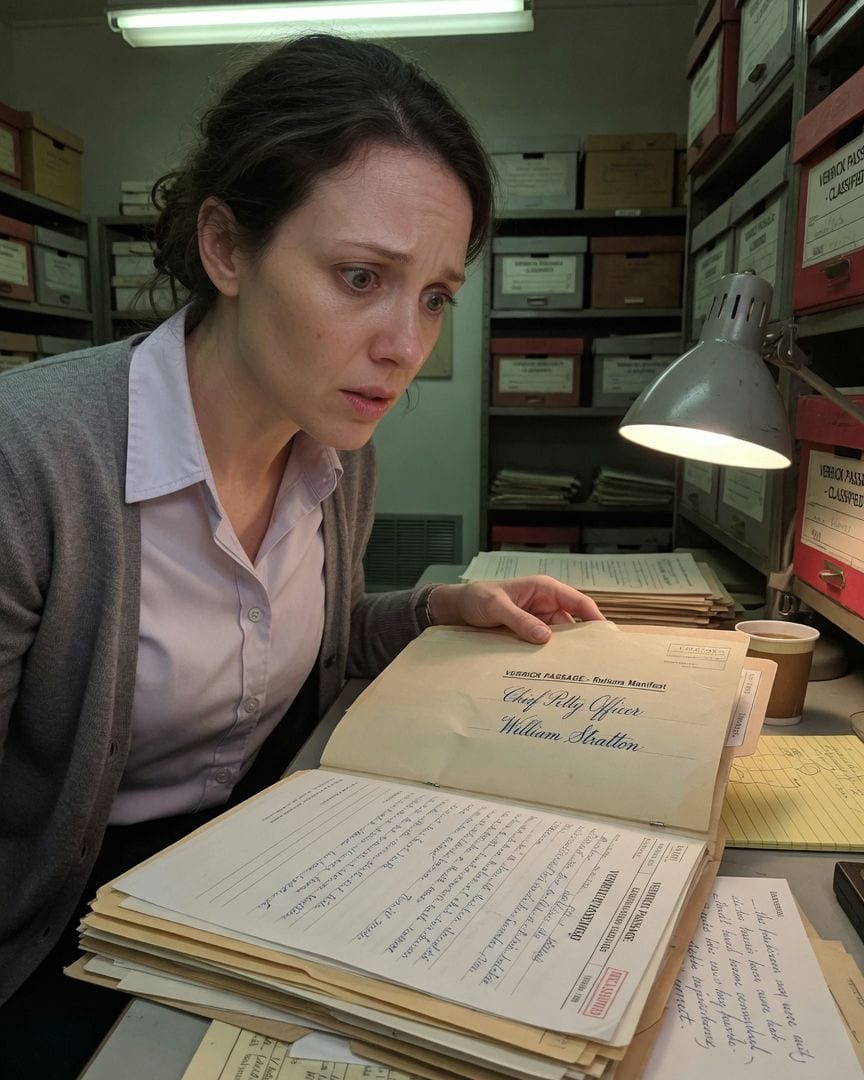
A records reviewer found personnel files for men lost 80 years ago, still being signed in an identical, perfect hand.
In the sterile hush of the declassified archives, meticulous reviewer Ione Fash had a routine task: cross-referencing witness statements from the Verrick Passage file. But as she reviewed files eighty years thick with official silence, she found nine separate interviews containing the exact same chilling sentence, all in an identical, precise hand. Her rational mind sought explanation, yet then she discovered something worse: personnel files for men lost in 1943, still being updated with modern requisitions and payroll runs. Each impossible entry, including a manifest signed just two weeks ago by a casualty from eighty years prior, bore the same unnervingly perfect signature. The file wasn't just a record of the lost; it was still being signed.
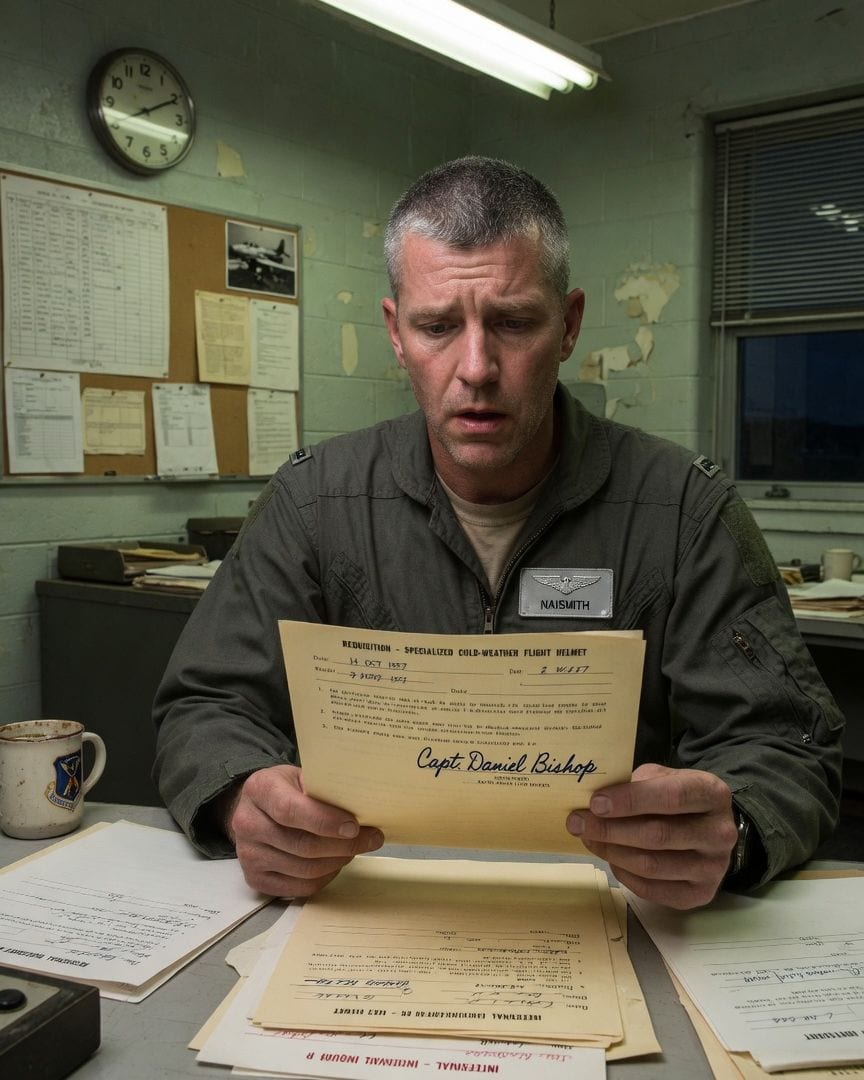
A Cold War Colonel reviews a missing pilot's file and finds Captain Bishop's signature on a form dated weeks after he vanished.
Colonel Ward Naismith faced the grim task of reviewing Captain Daniel Bishop’s personnel file, a routine chore for a man listed as Missing in Action. Bishop had vanished days after he and Naismith chased an impossible, silent disc over Lake Superior, leaving only an empty patch of air and a knot of unease in Ward's gut. Sifting through commendations, Ward found a requisition for flight gear and a maintenance sign-off, both dated *after* Bishop’s disappearance. The true chill came with the requisition for a specialized flight helmet, bearing Captain Bishop’s unmistakable signature, weeks after he was presumed lost. How could a man presumed lost have signed anything?
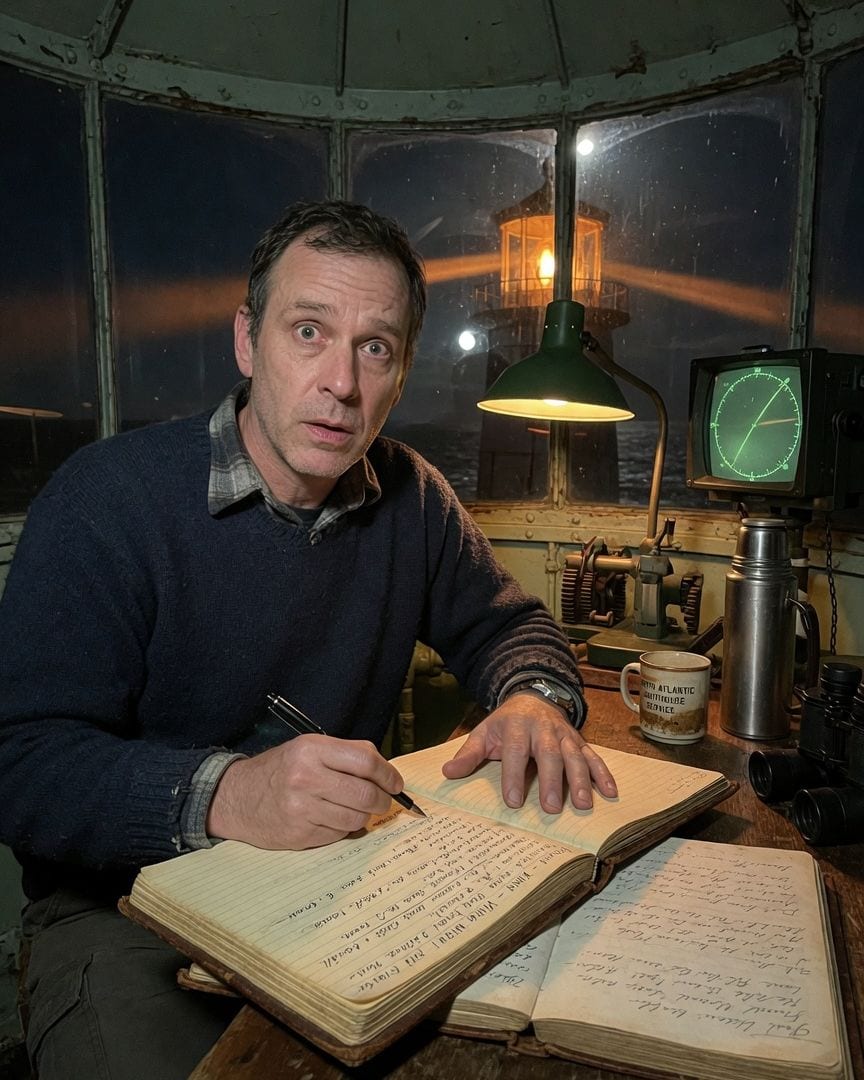
My lighthouse log has my own 3 AM entry for a phantom ship. I was alone in the tower, and I wrote no such thing.
Perched in the lantern room for my usual 2-6 AM watch, I reached for the thick logbook. But the 3:00 AM entry, under my own name, detailed a vessel I never saw. The words were in my own ink, yet I had never written them.
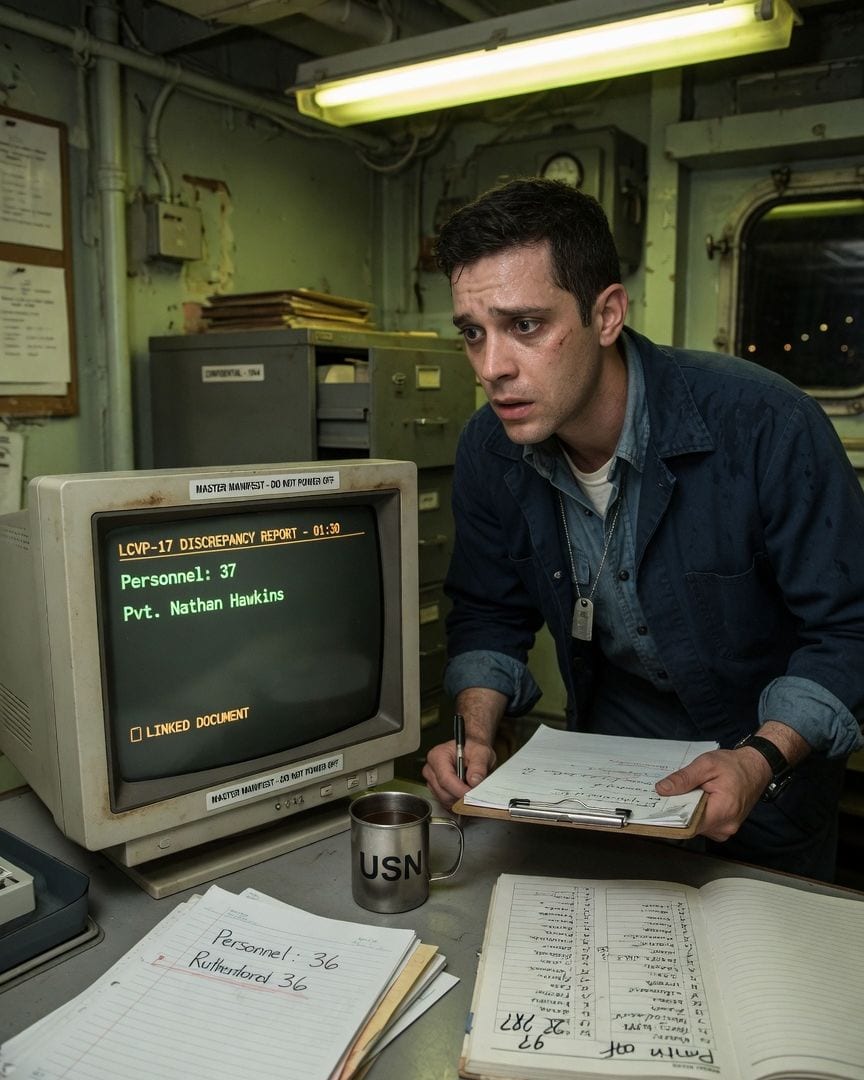
Coxswain's Mate Rutherford counted thirty-seven men in his landing craft, but the manifest logged only thirty-six. A hidden report, filed hours before, named Private Nathan Hawkins.
Coxswain's Mate Donald Rutherford, 28, began his final count for a standard load of thirty-six men in LCVP-17, the salty spray stinging his eyes. Halfway to the beach, a violent wave slammed the craft, throwing the men against each other. When the vessel settled, Rutherford instinctively recounted, his heart knocking against his ribs. This time, his count came back thirty-seven bodies crowded into the small boat. Official logs confirmed only thirty-six men, yet a hidden report, dated hours before his deployment, listed an extra man by name: Private Nathan Hawkins.