My car's app just pinged it parked at a bar ninety minutes away at 12:50am. It's in my locked garage, cold.
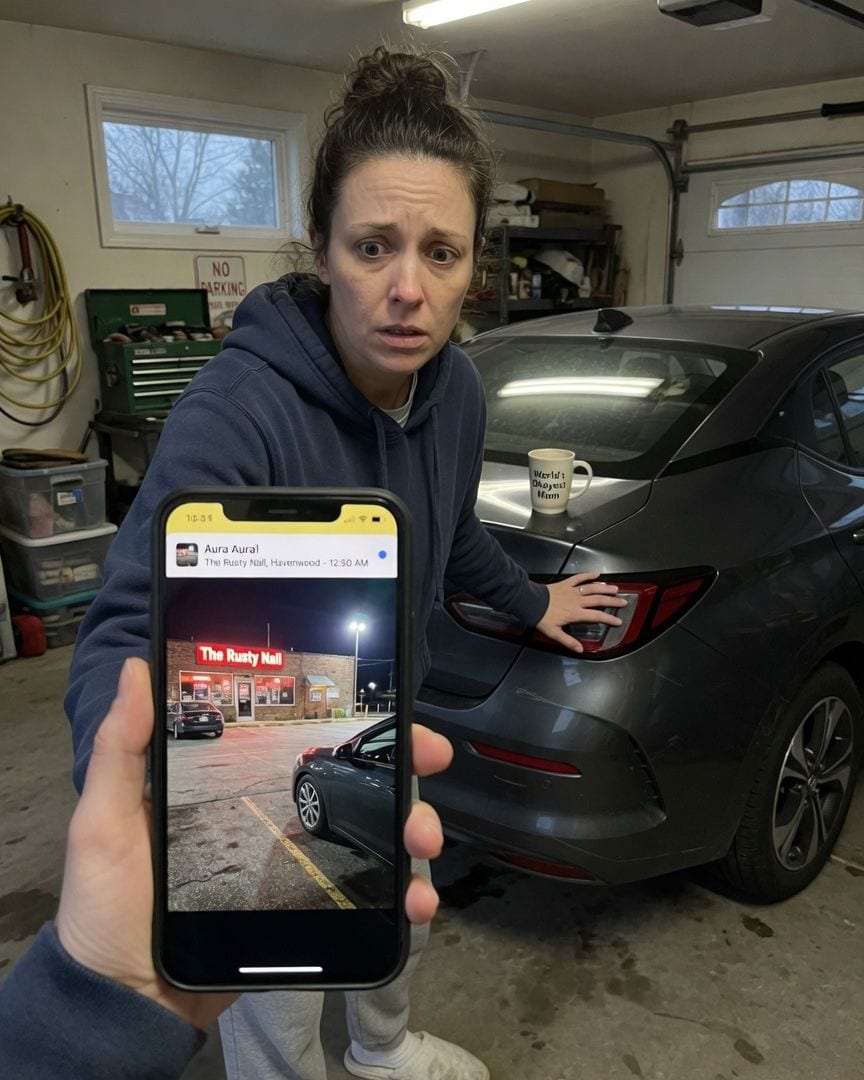
The smell of brewing coffee usually starts my day right. I was halfway through pouring my first cup that Tuesday morning when my phone chimed on the counter.
It was the app for my 2023 Aura sedan, the one that tells me everything from tire pressure to my last parking spot. A low-fuel warning, but that wasn't right. I'd filled up two days ago.
I tapped the notification, and the map sprang to life, a blue dot hovering over a dark, unfamiliar street.
‘The Rusty Nail,’ the app declared, beneath a small icon of a dive bar. Havenwood. My stomach went cold. Havenwood was ninety minutes east, a winding drive through back roads. And the timestamp. 12:50 AM.
I stared at it, then out the kitchen window, through the weak morning light, at the closed garage door. My car was in there. It had to be. It always was.
I unlocked the screen again, swiping to refresh the map. The blue dot held its ground, stubbornly outside ‘The Rusty Nail.’ Havenwood. 12:50 AM. It didn't budge. A prickle of unease started low in my spine.
I walked to the garage, the concrete floor cold under my slippers. My hand trembled slightly as I keyed in the code. The door rumbled open, revealing the familiar gleam of polished steel and dark paint.
My Aura was there. Parked precisely in its usual spot. I reached out, pressing my palm against the hood. It was cold. Stone cold. No warmth from a recent drive, no lingering scent of exhaust.
Yet, when I checked the app's trip log, it laid out a complete, undeniable history: 180 miles driven, a round trip to Havenwood, with the final stop timestamped at 12:50 AM.
A glitch. It had to be a glitch. Paul, my husband, was still asleep, and I didn't want to wake him with something so absurd. I tried to convince myself. Software errors happened. Phantom signals.
But the detailed log, the distance, the exact time – it felt too specific to be random. I made a note to call the dealership later, hoping they’d have a simple explanation.
The unease, though, wouldn't shake. All morning, it sat in my gut like a stone. I checked my bank statements online, looking for any unfamiliar gas purchases or fast-food receipts from Havenwood. Nothing. My cards hadn't been used.
It had to be the app, then. A digital phantom.
Still, a strange compulsion gnawed at me. After lunch, I grabbed my keys and went back to the garage. The car felt heavier this time, somehow. I slipped into the driver’s seat. The leather was cool.
The air inside the cabin was still, carrying only the faint, clean scent of new car. I pressed the start button, and the infotainment system hummed to life. Navigating through the menus, I found the internal trip history.
There it was. Not just the app, but the car’s own memory. A detailed log of a drive. Route, speed, duration, fuel consumption. Everything matching the app’s impossible story.
It even listed a brief stop at a gas station just an hour into the 'trip,' long before reaching Havenwood. I ran my hand over the sleek, dark paint of the dashboard, a shiver running down my arm. My car.
Its own brain insisting it had been somewhere I knew it hadn't.
I got out, the air suddenly thick. I started walking around the car, running my hand over the smooth panels, checking for anything, any small detail that might betray a truth.
My fingers brushed the rear bumper, just behind the passenger wheel. A faint resistance. I leaned closer.
There, just an inch long, a fine, almost invisible scratch. A tiny, shallow line. I knew this car. I obsessed over its cleanliness, its pristine finish. I would have noticed this. It hadn’t been there yesterday.
It was too small to be from a brush with another car, too precise to be random road debris. I pulled out my phone and took a close-up photo.
The dealership's service department was predictably unhelpful. "App connectivity issues," they'd said, their tone dismissive, as if I were a little old lady who couldn't understand technology. Frustrated, I hung up. I still had that photo of the scratch.
The faint, impossible scratch.
I typed "The Rusty Nail, Havenwood" into my search bar. A handful of local listings, some Yelp reviews, and a few blurry photos. Dive bar. Sticky floors. Live music on weekends. One photo caught my eye.
It was a Facebook post from a few months ago, shared by a local resident. A night shot of the bar’s exterior, flickering neon sign, a couple of cars in the parking lot.
One of them, a dark sedan, looked uncannily like mine.
My heart hammered against my ribs. I zoomed in, the pixels blurring, then sharpening. I focused on the dark sedan, parked under the bar’s dim floodlight. My breath hitched. There. On the rear bumper, near the passenger side.
A faint, thin line. Exactly where mine was. Exactly the same length.
I stood in my garage, phone clutched in my hand, staring at the faint, almost invisible scratch on my car's bumper.
My screen glowed with the blurry photo of 'The Rusty Nail' parking lot, zoomed in on an identical scratch on the car in the image. My car was here, cold and still, but the evidence insisted it was also there.
The scratch. It was undeniable. My mind reeled. It couldn't be a coincidence. I spent the next few days in a haze, obsessively cross-referencing everything I could think of. I pulled up my online toll road statements.
Nothing for Havenwood, not at first. My parking garage logs from work showed my car parked every day. I even checked security camera footage from the main street in our neighborhood, the angle wide enough to catch my driveway.
No sign of my Aura leaving during the impossible hours. Paul tried to be supportive, but I could see the skepticism in his eyes. He thought I was chasing ghosts, letting a software glitch get to me.
Then I found it. Hidden deep in my quarterly toll statement, mixed in with dozens of legitimate charges, was a series of automated tolls. Three of them. All for routes that passed through Havenwood.
All timestamped for late nights over the past two weeks. All for my license plate. And all on nights my car had been safely, demonstrably, in my garage. It wasn't just the one trip anymore. It was a pattern.
A week later, another piece. A small, anonymous industrial park fifteen minutes from 'The Rusty Nail.' I'd never heard of it.
I dug, using the exact coordinates from the toll data, and found a publicly accessible keycard log for a back entrance. It showed my car's entry and exit at 1:30 AM on another night I was home.
My car’s digital identity, pinging into existence in places it couldn't physically be.
I called Gideon Montgomery, our local mechanic. He's old school, trusts wrench-and-grease more than computer diagnostics, but he knows cars inside and out. I tried to explain, carefully, about the impossible mileage and the phantom trips.
He looked at me over his half-moon glasses, his expression a mixture of concern and polite disbelief. Still, he agreed to connect his diagnostic tool to my Aura.
He spent an hour with it, his brow furrowed. "No tampering, Rose," he finally said, pulling off his oil-stained gloves. "No hidden GPS, nothing I can see that's... extra." He paused, then pointed at a reading on his screen.
"But there's something in the system. A subtle thing. A 'digital signature,' it's calling it. It's... deeply integrated. Not factory standard for this model, not that I've ever seen. It’s like a secondary ID, embedded right in the car’s brain."
He shook his head, looking puzzled. "Never seen anything like it. Too deep to be an after-market install. It looks like it belongs there, but it doesn't."
It clicked. My car's digital identity wasn't just being spoofed by some hacker. It was actively being used by another vehicle. The scratch. The tolls. The keycard logs. They weren’t random glitches. They were a breadcrumb trail.
A digital ghost leaving footprints that pointed straight back to my car.
I took all the locations – ‘The Rusty Nail’, the industrial park, another one I found for a remote storage facility, a deserted diner parking lot – and plotted them on a map. A pattern began to emerge.
A network of obscure, nondescript waypoints, all connected by impossible trips attributed to my Aura.
As I dug deeper, the pattern of locations began to solidify into something more than just random spots on a map. It was a crude network, a series of nodes.
The unease that had been a dull throb now started to thrum with a life of its own. I started visiting these places during the day, driving Paul’s old sedan, parking a few blocks away, just watching.
At the industrial park, on my third visit, I noticed it. A dark sedan, same model as my Aura, parked far off in the employee lot, its tinted windows obscuring anyone inside. It wasn't my car; I knew my VIN.
But the resemblance was chilling. It sat there for hours, unmoving, as I walked around, trying to glean anything from the drab buildings.
Later that week, I tried to access some archived city planning documents related to one of the more remote locations – an old, abandoned warehouse near a rail line. That night, an anonymous email landed in my inbox.
The subject line simply read: "Some things are better left undisturbed." My hands shook as I opened it. The body contained a single, grainy photograph. It was a long-distance shot, blurry but unmistakable. Me.
Standing outside 'The Rusty Nail' bar, just two days prior, looking up at the faded sign, my phone in my hand. The sender knew I was there. They knew what I was looking for.
A cold dread coiled in my gut, squeezing tight. The air in my home, usually so safe and familiar, suddenly felt heavy, charged with an unseen presence. I felt watched, even when I was alone.
Paul, usually so grounded, noticed the change in me. My sleepless nights, the way I'd jump at every shadow. He tried to reassure me, but when I showed him the email, his skepticism evaporated. His face went pale.
The next day, Gideon called, his voice tight, almost a whisper. "Rose," he said, "someone asked about your car. 'Official-looking,' he said. Came into the shop. Asked specifically about the 'diagnostic work' I'd done.
Said they were with the manufacturer, but they weren't. I gave them nothing, of course. Told them I hadn't touched it since the last oil change. But it spooked me. Real bad."
He hung up quickly, leaving me staring at my phone, the silence ringing in my ears. I wasn't just investigating a mystery anymore. I was being monitored. Warned.
I was getting too close to something someone desperately wanted to keep buried.
The 'digital signature' Gideon found. That was the key. Paul's college roommate, Maria, was a cybersecurity expert. I called her, choosing my words carefully, framing it as a weird 'app malfunction' and 'duplicate logs' on my new car.
I sent her the data Gideon had extracted, the trip logs, the toll charges. She was calm, analytical, her voice like a balm on my frayed nerves.
A few days later, she called back. "Rose," she began, "this isn't an app malfunction. Or a spoofed VIN. This is... sophisticated. It's what we call an 'identity clone.' Someone has replicated your car's entire digital footprint.
Its unique communication protocols with the manufacturer, its serial data, its deep-level identifying markers. It’s like someone copied your car’s soul and put it in another body." She paused, her voice hardening slightly.
"Or, more accurately, made another body think it is your car, and then linked its actions back to your vehicle ID."
My breath hitched. "Why my car, Maria? Why this specific model?"
She shook her head, though I couldn't see her. "Hard to say for sure. Could be a specific vulnerability in that year's model, or... a targeted choice. These kinds of clones are rare, expensive to set up.
They’re usually for high-stakes anonymity, to move sensitive things without a trace, or to establish a false trail. The fact that it's linked to your official records – your tolls, your keycards...
that's meant to implicate you, or at least, muddy the waters. Make it look like you're the one driving, if anyone ever checks."
A profound chill settled over me, colder than the air in my garage had ever been. It wasn’t a glitch. It was deliberate. Calculated.
The impossible scratch, the phantom toll charges, the keycard logs – they all snapped into agonizing focus, the pieces of a monstrous, coherent puzzle. There wasn’t a ghost driver. There was another car. Another driver.
Operating under my car’s stolen digital identity, and every single breadcrumb, every trace, was pointing back to me.
Armed with the stark, terrifying knowledge of the identity clone, I plunged even deeper into the history of the recurring locations. 'The Rusty Nail,' the industrial park, the storage facility – they all had obscure, sometimes overlapping, ownership records.
I spent hours online, navigating through digitized archives, property deeds, old business registrations. I focused on 'The Rusty Nail' first, the very first place my car had supposedly been.
I found a faded, scanned copy of an original property deed from the 1960s. The paper was yellowed on my screen, the text slightly blurred, but legible. The original owner listed was 'Thatcher & Associates.'
The name 'Thatcher' snagged in my mind, a distant, almost forgotten memory. My great-aunt. Long deceased. Judith Thatcher.
I remembered scattered family stories, whispered at reunions. Judith was always an enigma, a 'woman of business,' they'd say, with a strange, knowing smile. Details were always vague, her life shrouded in an odd silence.
A quick search of archived business registries confirmed it. 'Thatcher & Associates' was founded by Judith Thatcher in 1962.
I stared at the faded, yellowed property deed on my screen, the name 'Judith Thatcher' stark and undeniable under 'Thatcher & Associates'.
The realization hit me like a physical blow: the impossible records, the cloned car, the network — it all started with her own family, and I was never just an observer.
I confronted Paul with the discovery, the laptop screen still displaying the faded deed. He read the name, 'Judith Thatcher,' and his jaw went slack. "Judith?" he murmured, shaking his head. "She was always such a mystery.
My mother barely spoke of her, just that she was 'independent.' Left almost nothing behind when she died."
My investigation spiraled from there. 'Thatcher & Associates' wasn't just a holding company for a single bar. It was the linchpin. I found connections to other holding companies, shell corporations, a bewildering web of properties scattered across the region.
All of them corresponded, chillingly, to the impossible locations my car's clone had visited.
The industrial park, the remote storage facility, even the deserted diner parking lot – all, at some point, had been linked to 'Thatcher & Associates' or one of its subsidiaries.
I unearthed old newspaper clippings, obscure business journals from the 60s and 70s. Vague, veiled references to 'Thatcher & Associates' involvement in 'sensitive logistical operations' during the height of the Cold War. Discreet courier services. Expedited deliveries of 'unique cargo.'
It all clicked. The 'digital signature' Gideon found, so deeply embedded, so unusual. Maria's comments about a 'targeted choice' for high-stakes anonymity. It wasn’t just a simple identity clone. It was a sophisticated, generational network.
Judith Thatcher hadn't just founded a business. She had established a clandestine system, designed to move people and information discreetly, untraceably, across decades, by exploiting the most innocuous of modern technologies: vehicle identities.
My car, my new 2023 Aura sedan, hadn't been randomly chosen. It was the specific 'familial signature,' Gideon’s 'secondary ID' that wasn’t factory standard, that had marked it. An inherited biometric, perhaps.
Or a unique digital marker passed down through my family line, making my car uniquely susceptible, perfectly suited for the network's cloning process. I was always inside it, an unwitting heir to a system designed to leverage my very lineage.
The scope of it was paralyzing. The network wasn't just a few rogue actors; it was vast, deeply entrenched, weaving through time and technology.
How could I expose something that had operated in the shadows for over sixty years, founded by my own blood? I tried to sever my car's digital connection, to 'delete' its identity from the manufacturer's servers.
But the option was strangely greyed out in the app, protected by layers of proprietary code I couldn't override.
I scoured the internet again, finding a single, obscure online forum post from years ago, buried deep in a thread about local urban legends. A cryptic warning, posted anonymously: "Beware the family that watches. Some legacies are not just inherited."
Paul and I made a difficult decision. We couldn't fight it. We had to cut ties, disappear.
We took the Aura to a dealership two states away, not mentioning a word of the cloning, trading it in for an older, unconnected model. We changed our numbers, considered moving.
A week later, a final email arrived. No subject line, unknown sender. The body contained a single image: a photo of my recently sold Aura, parked outside a new, unfamiliar location – a remote cabin in the woods.
A fresh timestamp. Beneath it, a single, chilling line of text: 'The signature persists. Some legacies cannot be outrun.'
The implication was clear, a cold stab to my chest. The clone, or whatever part of its digital identity was tied to me, had simply moved on, adapting.
It was still out there, still linked to my lineage, still operating, still placing me at impossible locations, even without my car. The network hadn't been stopped. It had simply absorbed the change and continued its work.
I understood then: I was permanently marked, a ghost limb of a vast, unseen system, forever tethered.
Life returned to a semblance of normal, or what passed for it now. Paul and I moved to a new house, changed our numbers, tried to disappear into the quiet anonymity of suburbia.
Yet, the quiet hum of dread never truly left. Every now and then, a phantom toll charge, a fraction of a penny for a road I’d never driven, would appear on an old, forgotten account.
Or an anonymous news article would surface about a 'discreet delivery service' operating in remote areas, their methods "untraceable." I knew it was still out there, my signature, my inherited legacy, echoing in the digital ether.
The network, faceless and vast, continued its work, using identities like mine, like my great-aunt's, to weave its invisible web across the country, across time.
I now check my old bank statements, my unused email accounts, with a quiet, practiced dread.
I know the records might disagree with my reality at any moment, that a new impossible location might appear, a phantom journey I never took.
The ghost of my car, the ghost of my family's hidden past, is always just a digital ping away, a silent reminder that some legacies cannot be outrun, only outlived.
I pour a cup of tea, the morning light too bright, and open my laptop to check the news, a habit I can't break. A small, local article catches my eye: 'Mysterious Package Delivery to Remote Cabin.'
I click, and there, in a blurry photo of a dark sedan pulling away, is a faint scratch on its bumper, just visible in the morning light. The signature persists. Some legacies cannot be outrun.
If this one got to you
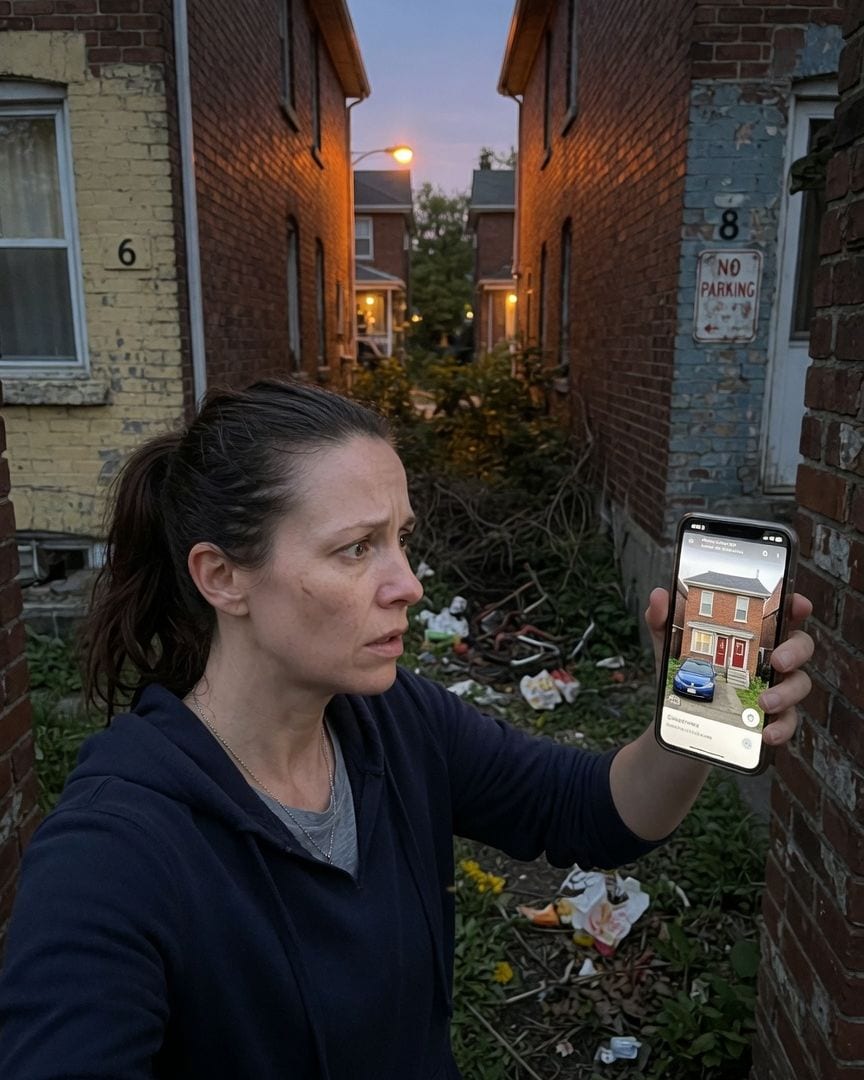
My childhood street's online map showed a number 7 house. I drove over that night. There is no number 7, just the ginnel I grew up with.
Scrolling Google Street View of my childhood neighborhood, I found an impossible house. Between my old house and number 6, where only a narrow ginnel should be, the screen showed a fully formed number 7. It had drawn curtains, a freshly painted door, and a blue car dated 'last month,' yet every other map showed an empty gap.
My dashcam footage showed my street change. For five seconds, my car drove on a road that doesn't exist on any map.
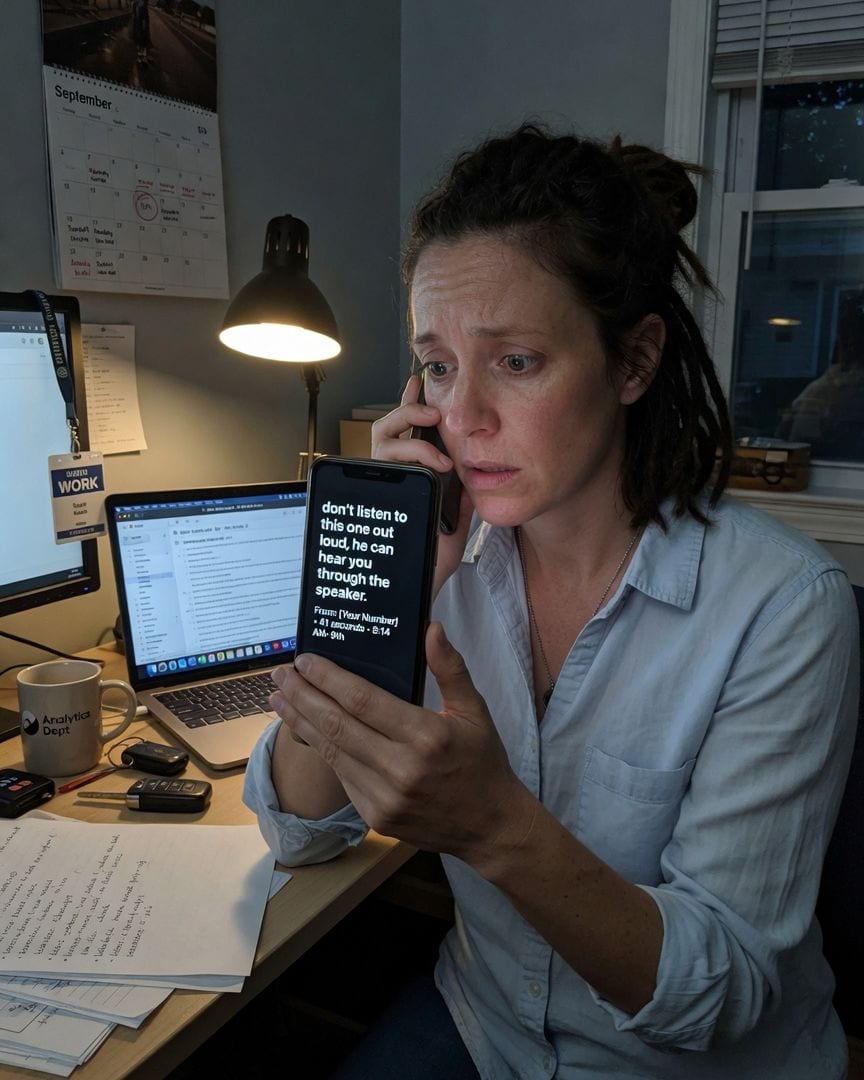
It was a normal Tuesday until my work phone received a new voicemail. The transcription warned, 'don't listen to this one out loud, he can hear you through the speaker.' But the message was from my own number, and the audio was forty-one seconds of absolute, dead silence.
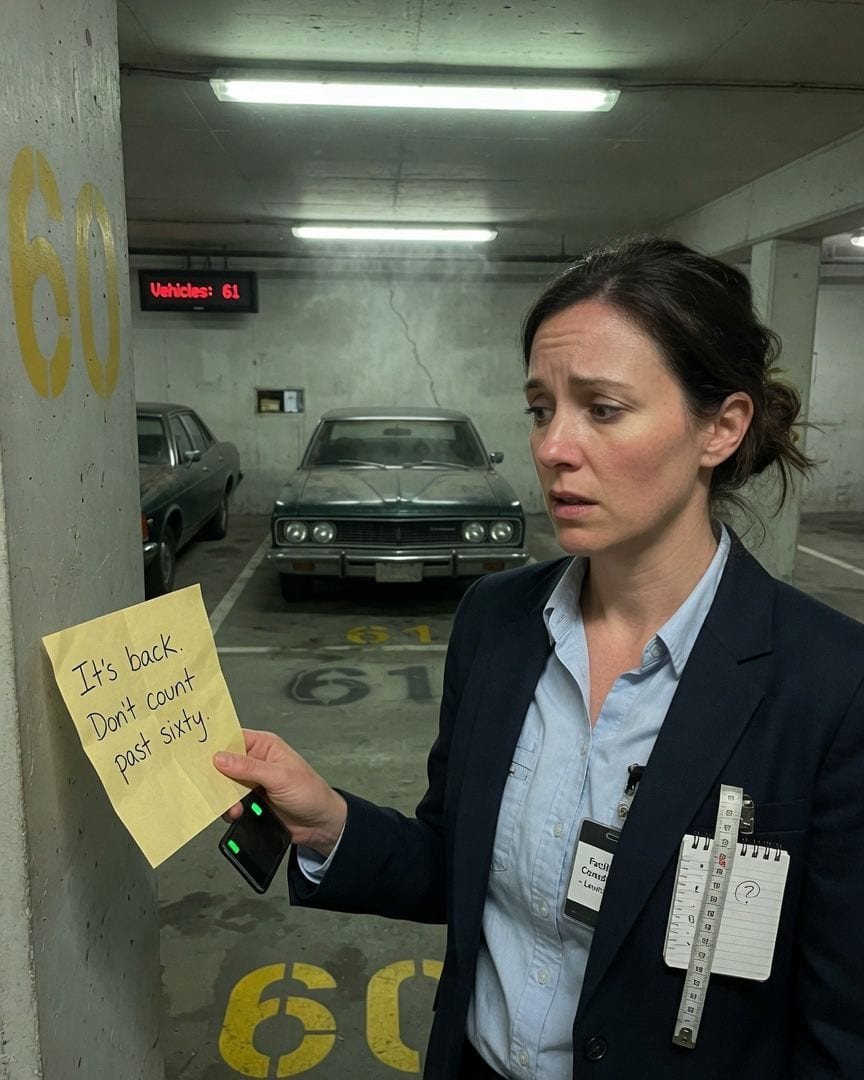
My hand found a hidden seam in the concrete wall. Inside, a desperate note warned: 'Don't count past sixty'.
I arrived at the underground parking lot a few minutes late, expecting the usual sixty spaces. But my pass blinked '61', and a new bay, numbered 61, had appeared beyond the lot's end wall. Inside it sat a vintage car, still warm from a recent drive. Every blueprint and log insists this space doesn't exist, yet it's undeniably there.
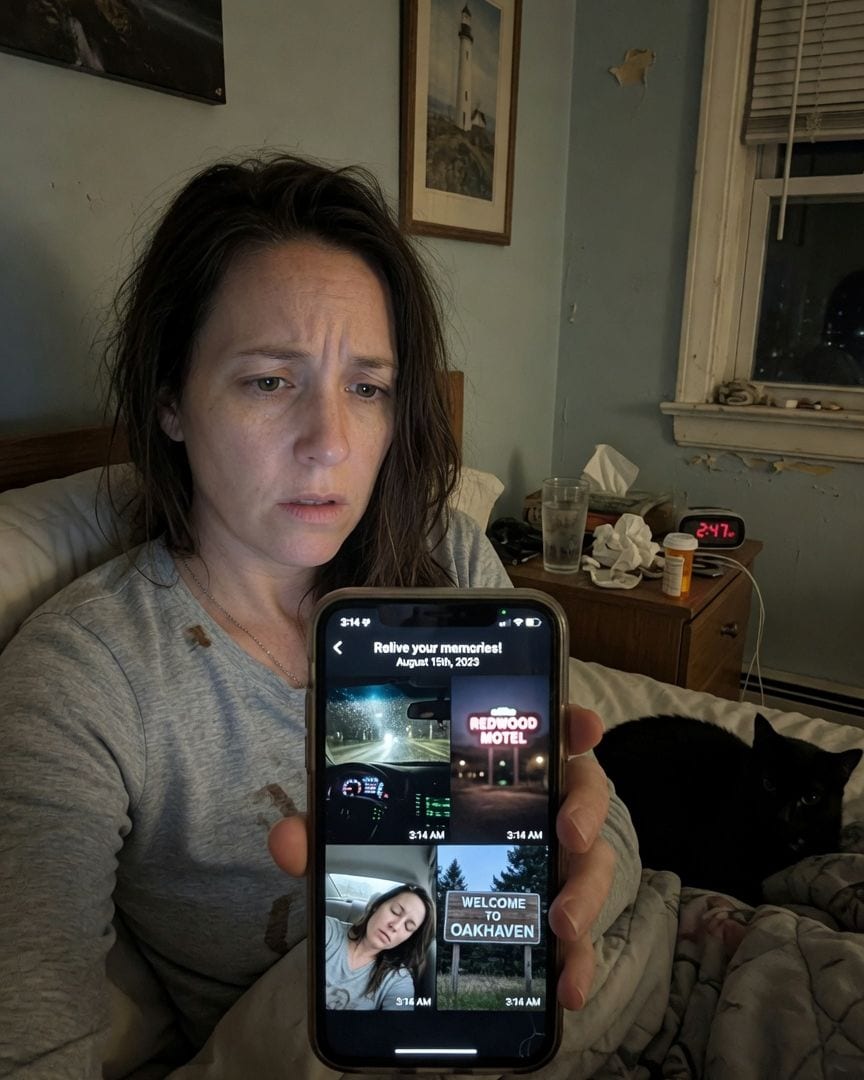
My phone has photos of me asleep in a strange car at 3 AM. Then a voicemail: 'We'll have her back by sunrise.'
My phone woke me with a cheery notification, promising memories from last August. Instead, it showed me asleep in a dark car, rain streaking the windshield, miles from my apartment. I was certain I'd been home in bed that night, but the images were undeniably in my camera roll, a quiet violation of my memory.
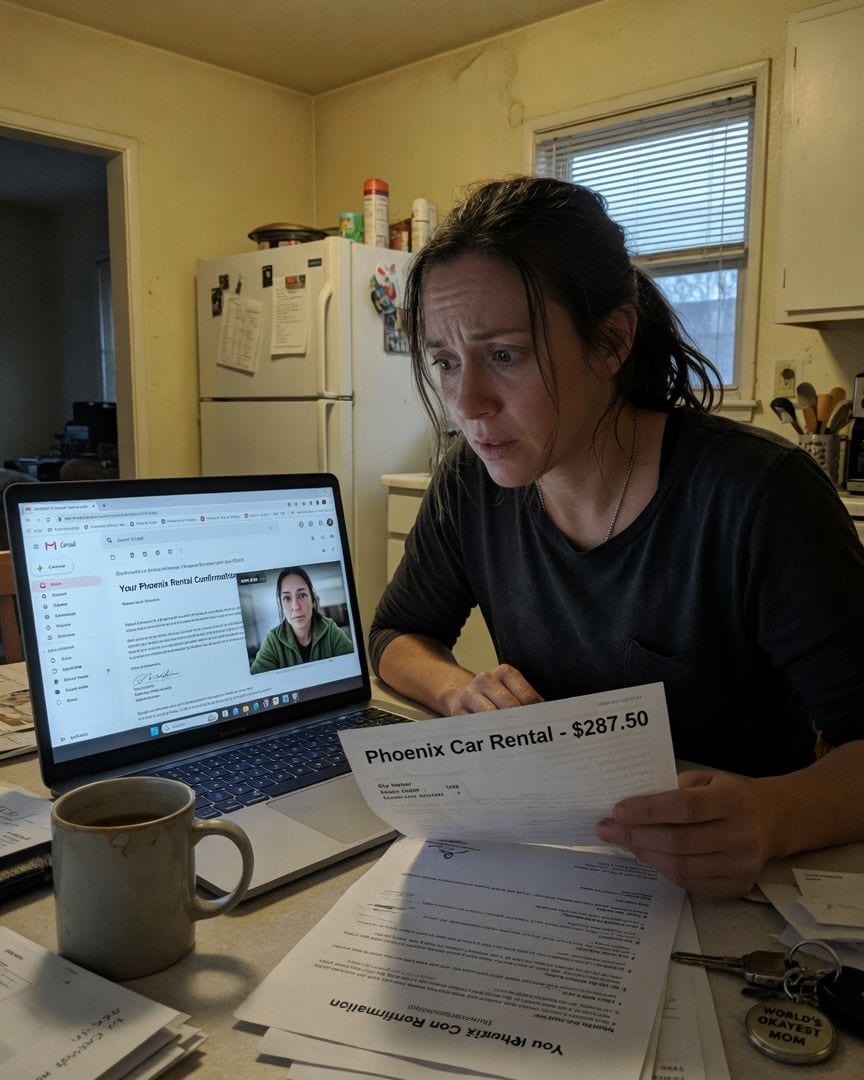
My bank sent a security photo: me, entering Harrington Research Facility. I was home with a fever; that face isn't mine.
I found a bank charge for a rental car in Arizona, a place I’d never been, with my license and signature. But the rental agreement also noted a specific coffee stain on the passenger seat — the exact faded mark from my own car. Then, a security alert showed me entering a facility I’d never visited, on a day I was home sick.
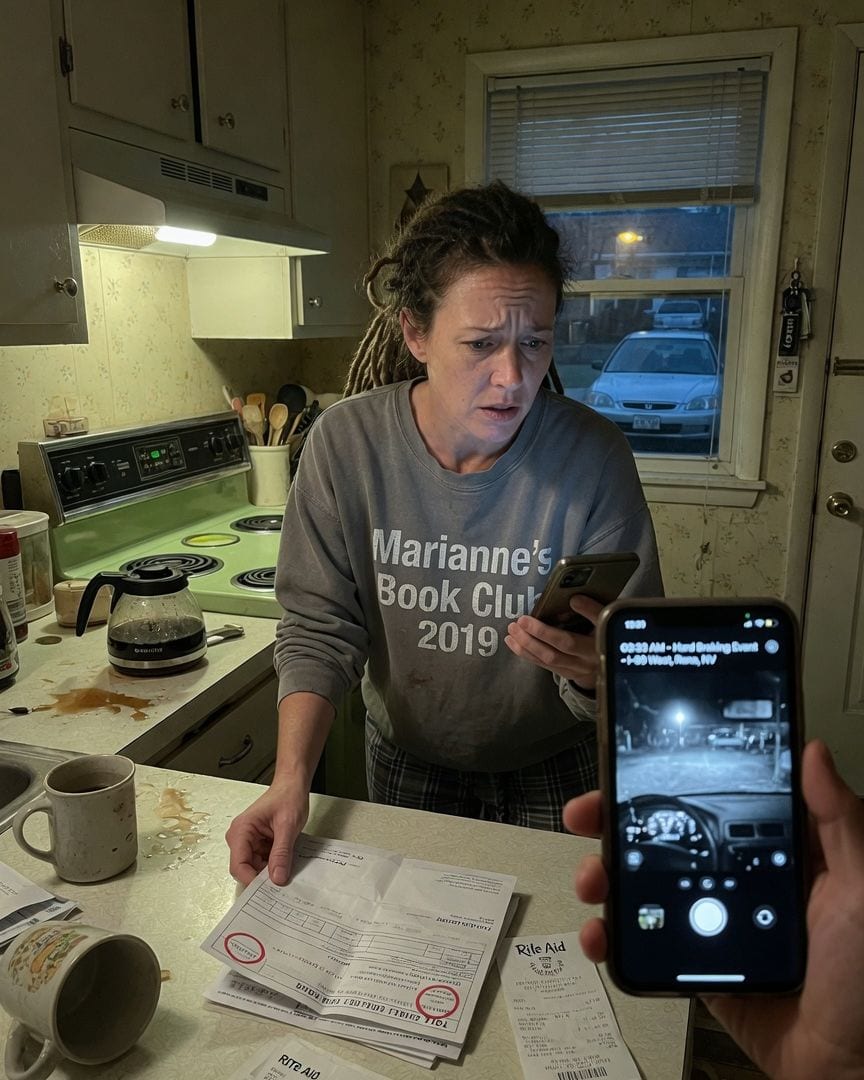
My car's dashcam just flagged a hard-braking event outside Reno at 3:33am. I was asleep in my mother's house, keys on her hook.
Making coffee in my mother’s kitchen, my car’s dashcam pinged an alert for a hard-braking event on I-80 West, outside Reno, at 3:33 AM. That was impossible; my beat-up Honda Civic was safely parked in the driveway, exactly where I'd seen it an hour earlier. Yet the grainy night-vision footage clearly showed my dashboard, unmistakable, hundreds of miles away.