My cinema has six screens, but since May a Screen 7 appears past the last door. I've opened it twice — the seats are still warm and a film runs mid-reel to nobody.
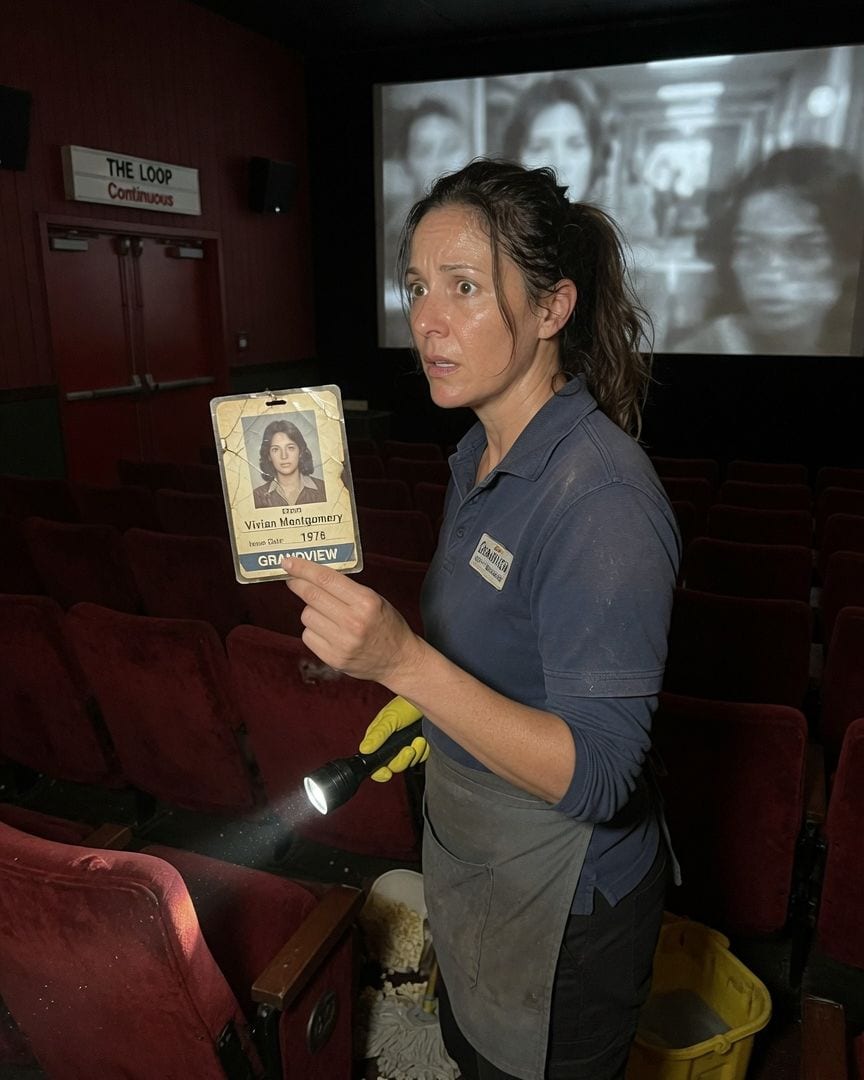
The stale popcorn smell at the Grandview Cinema usually faded by 3 AM, replaced by the faint tang of my disinfectant, but not tonight.
It was early May and the air, already thick with the quiet hum of the building's resting machinery, felt… different.
I'd been a night cleaner here since January, a job I liked for its predictability, the empty corridors, the steady rhythm of the mop bucket.
The foyer sign, a glowing monument to local entertainment, always listed Screen 1 through Screen 6. Six screens. Always six.
But since early May, something had shifted in the layout of my world. Past the double doors of Screen 6, tucked into a corridor that simply wasn't on any floor plan I’d ever been shown, there it was: Screen 7.
Identical double doors, faded red like all the others, but without any corresponding number on the main foyer sign.
Above it, a small, white marquee, the kind we used for special events, announced a film called 'The Loop' with a showtime of 'Continuous'.
I'd opened those doors twice before. Both times, the cinema inside was dark, the screen glowing faintly with a mid-reel film, playing to an empty house. But the air.
It was always noticeably warmer in there, and the seats themselves still held residual heat, as if someone had just left. A deep, unsettling warmth that made the hairs on my arms prickle.
I’d even tried the projection room directly above it, hauling my cleaning cart up the service stairs.
The door was locked, of course, but the handle felt strangely cold against my fingers, as if someone had locked it from the inside and then… forgotten to leave.
The next night, I brought a tape measure. I know, it sounds ridiculous. But the sheer impossibility of Screen 7 was digging into me, a splinter under the skin.
I meticulously measured the corridor from Screen 6 to the fire exit, then went back and measured the dimensions of Screen 6 itself. There was no way. Logically, mathematically, there simply wasn’t space for another full-sized screen.
I tried to dismiss it as fatigue, as some kind of optical illusion playing on my tired eyes in the dim light. But the 'Continuous' showtime, the lingering heat in the seats, they gnawed at me.
During the morning handover, as the first light of dawn was just beginning to streak through the foyer windows, I cornered Raymond Doyle, the day manager. He was hunched over his coffee, already immersed in the daily financials.
'Raymond,' I started, trying to sound casual, 'about Screen 7…'
He blinked at me, confused, his eyes still blurry with sleep. 'Screen 7? Judith, we only have six screens here. Always have.'
He even pulled up the digital schedule on his tablet, scrolling through it, showing me a blank space past Screen 6. No record. No explanation. Nothing.
He just shook his head and went back to his numbers, clearly thinking I'd lost my mind.
That night, a cold certainty, unwelcome and undeniable, pushed me back. I entered Screen 7 again. The warmth was more pronounced tonight, almost humid, pressing in from all sides.
The film on screen was a flickering, indistinct montage of blurry faces and empty landscapes, cycling through familiar-looking places that I couldn't quite name. I walked down the aisle, my flashlight beam sweeping across the rows of still-warm seats.
Under a seat near the front, third row from the screen, I saw it: a small, faded object glinting in the dim light.
I reached down, my fingers closing around the cold plastic of an old employee ID badge. It was brittle with age, the edges yellowed and cracked.
The photo showed a young woman with kind, tired eyes, her dark hair styled in a way that seemed decades out of date. The name printed below it, almost illegible, was 'Vivian Montgomery,' and the issue date read '1978'.
I stared at the badge, my thumb tracing the faded letters of 'Vivian Montgomery'. The name felt strangely familiar, a distant echo from somewhere I couldn't quite place. But 1978?
That was long before I was born, long before Raymond Doyle would have even been a manager here. This wasn't just a misplaced item from a previous shift.
It was a ghost, a physical artifact from a time that shouldn't touch this place, shouldn’t be in a screen that didn't exist.
I clutched the badge, the plastic digging into my palm, and a cold dread settled deep in my gut.
I looked up at the flickering screen, the indistinct faces now feeling less like random images and more like a silent, desperate plea.
Who was Vivian Montgomery, and how did her badge from 1978 end up in a cinema screen that wasn't supposed to be here?
The badge became my obsession. On my days off, I haunted the local library, the smell of old paper and dust filling my lungs as I sifted through microfiche archives of newspapers from the late 70s.
I found no direct mention of a Vivian Montgomery connected to the cinema, no grand mystery, but I did find a series of small, almost buried articles about strange 'disappearances' and 'resignations' from the Grandview during that period.
Always vaguely attributed to 'personal reasons' or 'stress,' the reports were scarce, like inconvenient facts scrubbed from the record.
Then, tucked away on a yellowed page from 1979, I found a small obituary for a 'Vivian Montgomery, beloved mother and wife.' Her surviving son was listed as 'Everett Montgomery.' The name hit me like a physical blow. Everett.
The cinema's oldest projectionist, a quiet, almost spectral man who’d been there for as long as anyone could remember. The connection was chilling, too precise to be coincidence.
I started paying closer attention to my drive home. It was a familiar route, a series of turns through residential streets, usually a comfortable fifteen-minute cruise.
But twice this week, after what felt like a normal drive, I found myself pulling up to my own street from the wrong direction, having somehow looped back onto an earlier part of the route.
My odometer showed several extra miles I couldn't account for. The first time, I dismissed it as distraction, tiredness.
The second, a cold certainty began to form: the road was returning me, just like the cinema was returning me to Screen 7. It felt like a gentle hand, a subtle correction.
I started to feel watched. Not overtly, no eyes peering from the shadows, but a subtle shift in the air, a sense of an unseen gaze on my back as I cleaned the empty auditoriums.
The silence felt deeper, less peaceful. One night, after my shift was almost over, I found a small, folded note tucked into my mop bucket.
It was just a single sentence, scrawled in an old-fashioned, looping hand: 'Some doors are best left closed, Judith.' No signature. My heart hammered against my ribs, a frantic bird. I immediately thought of Everett.
He was always in his projection booth, a silent, almost forgotten fixture, observing everything from his perch above.
The next evening, I saw him. He was standing near the back exit, hunched slightly, a cigarette cupped in his hand, his gaze distant, lost somewhere beyond the brick wall.
As I passed, pushing my cart, he turned his head slowly, his eyes, usually placid and grey, holding a profound, unsettling depth.
'You're asking too many questions about the past, Miss Vance,' he said, his voice a low rumble, like distant thunder. 'The answers aren't for the living.' He didn't sound angry, just… resigned.
The calm in his tone was far more terrifying than any threat. He knew. He knew about Screen 7, about Vivian, about the impossible geometry. And he knew I was digging.
The confrontation happened the following night. I found Everett in his projection booth, the soft whir of the projector a familiar drone as he meticulously threaded a reel. The air smelled of ozone and dust.
'Everett,' I began, my voice steadier than I felt, holding up the old ID badge. 'Vivian Montgomery. Your mother, right? She worked here in '78.'
Everett didn't flinch. He just nodded slowly, his eyes on the film spooling past the lens. 'She did.'
'And she… disappeared?' I pressed, every nerve on edge.
He sighed, a long, weary sound that seemed to pull the air out of the room. 'No, she went in. Into Screen 7. Like others before her.'
He finally turned, his face etched with a quiet sorrow that seemed centuries old, older than the cinema itself. 'This cinema, Judith, it's a place where things… bleed through. The geometry isn't fixed. It's a focus, a kind of gate.'
He looked at me, and his eyes were surprisingly clear. 'Screen 7 isn't a room; it's a loop. A place that isn't on the map, but it's always been here, in one form or another.'
He explained how it manifests in cycles, drawing in certain people, often those with a deep connection to the building, or perhaps a certain 'resonance.'
He spoke of the 'Road That Returns' as another manifestation, a way the local space itself warps, gently guiding those who are 'chosen' back to the nexus. 'My mother tried to understand it, to fight it. Others did too.
They all ended up in the loop. I learned to just… exist with it. To make sure the new ones don't disturb it too much.'
He picked up a heavy, leather-bound logbook from a shelf, its pages yellowed with age, its spine cracked. 'I've kept records. Of the cycles. Of the ones who went in.'
The warmth in Screen 7, the mid-reel film, the inexplicable showtime—it all clicked into a horrifying, coherent pattern.
Everett opened the logbook to a section marked '2003 Cycle.' His finger slowly traced down a list of names, each one a phantom of the past. 'Raymond Doyle's uncle, a cleaner then,' he murmured, his voice flat.
'Patricia Sutton, a ticket booth attendant.' His finger stopped on an entry near the bottom. He pushed the book across the narrow console towards me. My eyes fixed on the faded, handwritten script.
'Vance, Judith – Night Cleaner. Entered Screen 7.'
Below it, a short description: 'Mid-twenties, dark hair, mole on left cheek.' My hand flew to my face, touching the small mole I’d had since birth, just under my left eye.
My breath caught in my throat, a physical gasp that seemed to echo in the small room. I stared at the words, then back at Everett, who simply watched me with an expression of profound, ancient regret.
'The geometry is consistent, Judith,' he said softly, his voice devoid of emotion. 'You always come back.'
Everett explained the full, terrifying truth. The anomaly wasn't just a gate; it was a hungry entity, feeding on repetition, on the consistent geometry of lives intersecting at this unique point.
'You were here before,' he stated, his voice calm, flat, like a lecture. 'Or a version of you, drawn in by the same resonance. The anomaly doesn't just trap people; it consumes their pattern, their echo.
Screen 7 is a manifestation of that consumption, a perpetual reel of those it has claimed. Your mother, Vivian, she tried to close it, to break the cycle. It just pulled her deeper.'
He explained how the 'Road That Returns' was the anomaly’s way of ensuring its chosen always found their way back to the nexus, no matter how far they tried to flee.
It wasn't just a place that wasn't on the map; it was a place that moved the map around itself, subtly, inexorably. The horror wasn't in the unknown, but in the absolute, rational coherence of it all.
Every strange detail, every impossible measurement, every returning road, every warm seat, every faded name—it all fit perfectly into a pattern that spanned decades, a pattern that I was now irrevocably a part of, not as an observer, but as a recurring character.
I refused to accept it. 'No,' I whispered, shaking my head, my voice barely audible above the projector's hum. 'I won't. I'll leave. I'll drive until I'm halfway across the country.'
Everett shook his head slowly, the movement almost imperceptible. 'You can try. But the geometry… it has a way of correcting itself.'
Desperate, I fled the cinema. I drove, not towards my home, but north, towards the highway, pushing the speedometer past the limit. The familiar streets blurred into a frantic montage, a kaleidoscope of houses and trees.
I made all the right turns, meticulously following my GPS, watching the blue line on the screen. But after what felt like an hour of relentless driving, the scenery started to feel wrong.
The same gas station I'd passed twenty minutes ago, the same faded diner sign I'd sworn I’d left behind. My gas gauge hadn't moved. My odometer, however, showed hundreds of miles. Panic seized me, a cold hand squeezing my chest.
I slammed on the brakes, pulling over to the side of the road, the tires kicking up gravel. I was on Elm Street, three blocks from the Grandview Cinema.
The 'Road That Returns' had brought me back, precisely, like a homing pigeon.
I drove back to the cinema, defeated, every ounce of fight drained from me. The foyer sign still listed Screens 1-6.
But as I walked the corridor, past Screen 6, the double doors of Screen 7 stood open, a soft, inviting glow emanating from within. The film inside was playing, no longer blurry.
It was a clear image now: a young woman, her back to the camera, walking slowly down a cinema aisle, carrying a mop bucket. I recognized the mole on her left cheek.
I didn't leave the cinema again. Everett continued his quiet work in the projection booth, a silent guardian, occasionally checking on me with a knowing glance.
The 'Continuous' showtime for Screen 7 remained, and the doors sometimes stood ajar, sometimes closed, breathing their strange, humid warmth into the corridor. The film inside played on, a silent loop of familiar and unfamiliar faces, always mid-reel.
Raymond Doyle continued as day manager, oblivious, occasionally wondering why Judith seemed so much calmer, so much more… settled in her routine. The cinema continued its operation, a normal building housing an impossible, recurring secret, and its new, quiet keeper.
The next morning, Raymond Doyle found me in the foyer, polishing the brass letters on the screen listing. He nodded, ready for his shift, his coffee steaming in his hand. 'Morning, Judith. Everything alright?'
I looked up, my eyes clear, almost serene. 'Morning, Raymond. Everything's exactly where it needs to be.' I picked up a small, white letter '7' from my cart, testing its fit on the empty slot next to the existing screens.
Raymond just nodded, a faint, wrong little smile playing on Judith's lips as she turned back to the foyer sign, adjusting the white letters for Screen 7.
If this one got to you
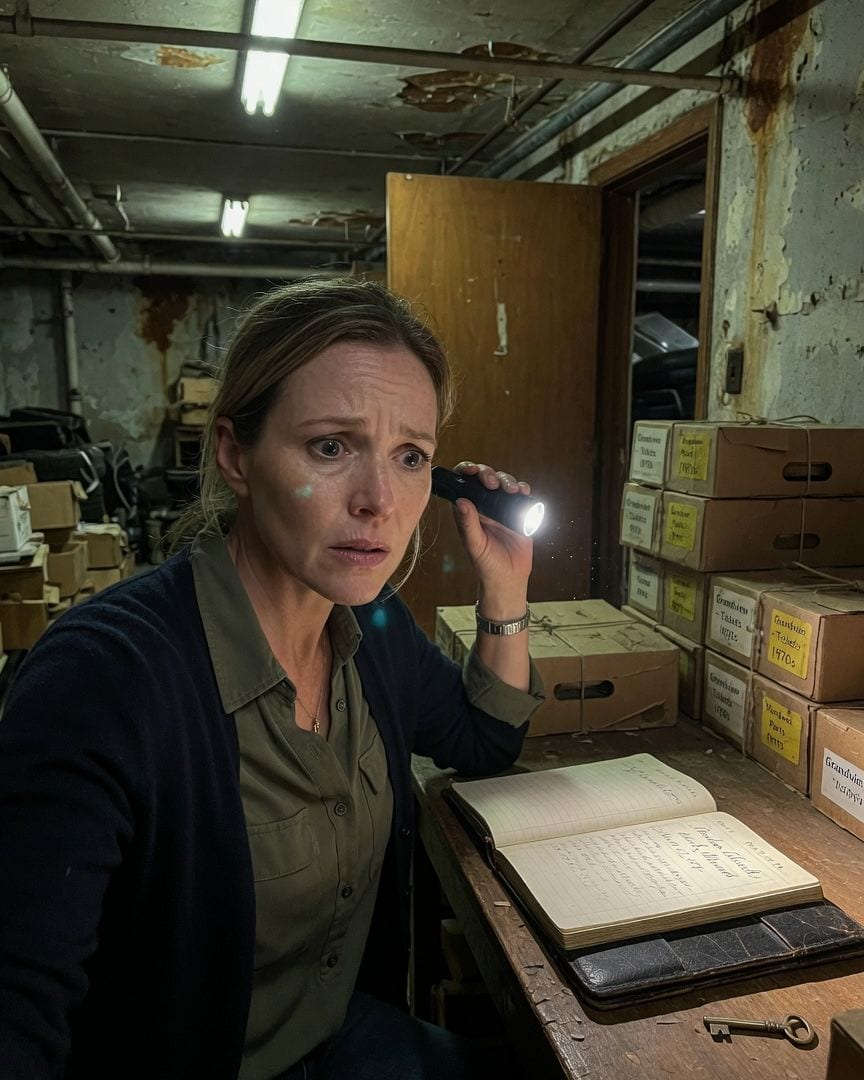
My old cinema's letter said "We kept your seat," and it closed in '94. The seat number was mine, a secret I never wrote down.
Penelope Ellsworth receives a mysterious letter from the Grandview Cinema, which closed in 1994. The letter claims it 'kept her seat,' a specific row and number she never shared with anyone. Driven by an unsettling curiosity, Penelope uncovers an old ledger in the defunct cinema's basement with her name and seat number, dated 1977—seventeen years before she was born.
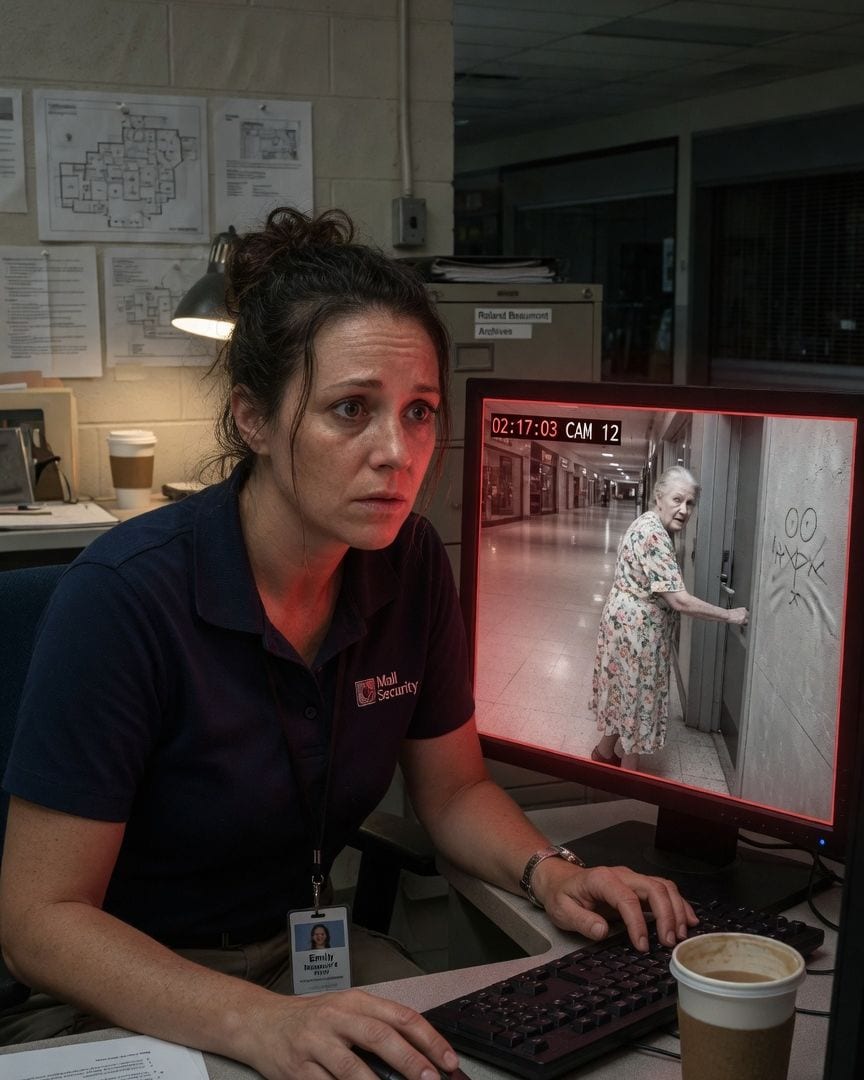
Mall security footage caught an old woman walking the concourse after closing. Every camera filmed her, but no single frame shows how she got in.
Working the overnight shift, I monitor my locked mall's security footage. It was 2:17 AM, five hours after closing, when an old woman in a floral dress simply appeared on Camera 7. She was never seen entering the frame, only *present*, walking slowly across the deserted concourse.
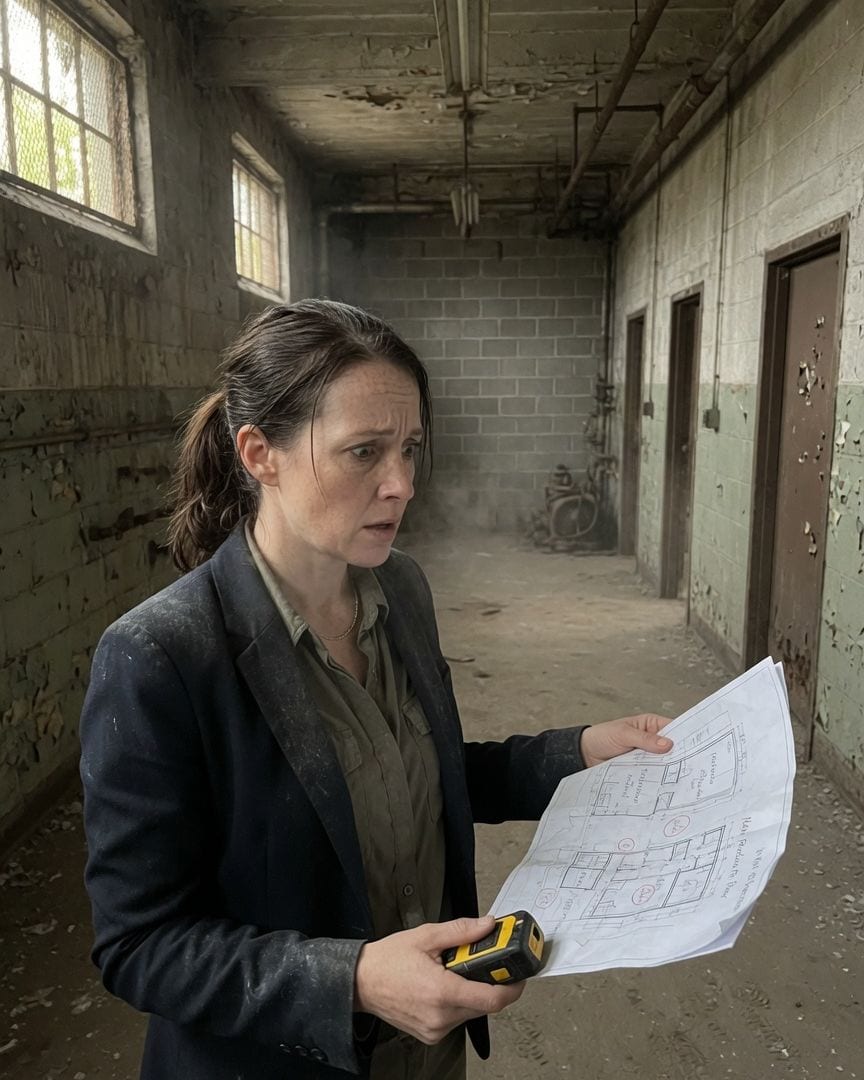
One room is missing from this factory floor. My blueprints show four, but I only found three doors.
Intrigued by an abandoned industrial complex, I secured its old blueprints and entered the cold, silent building. Pacing a long corridor, I meticulously counted doors, comparing them to the detailed plan. The blueprint clearly showed four distinct rooms, but the corridor's length, and my own count, revealed only three doors.
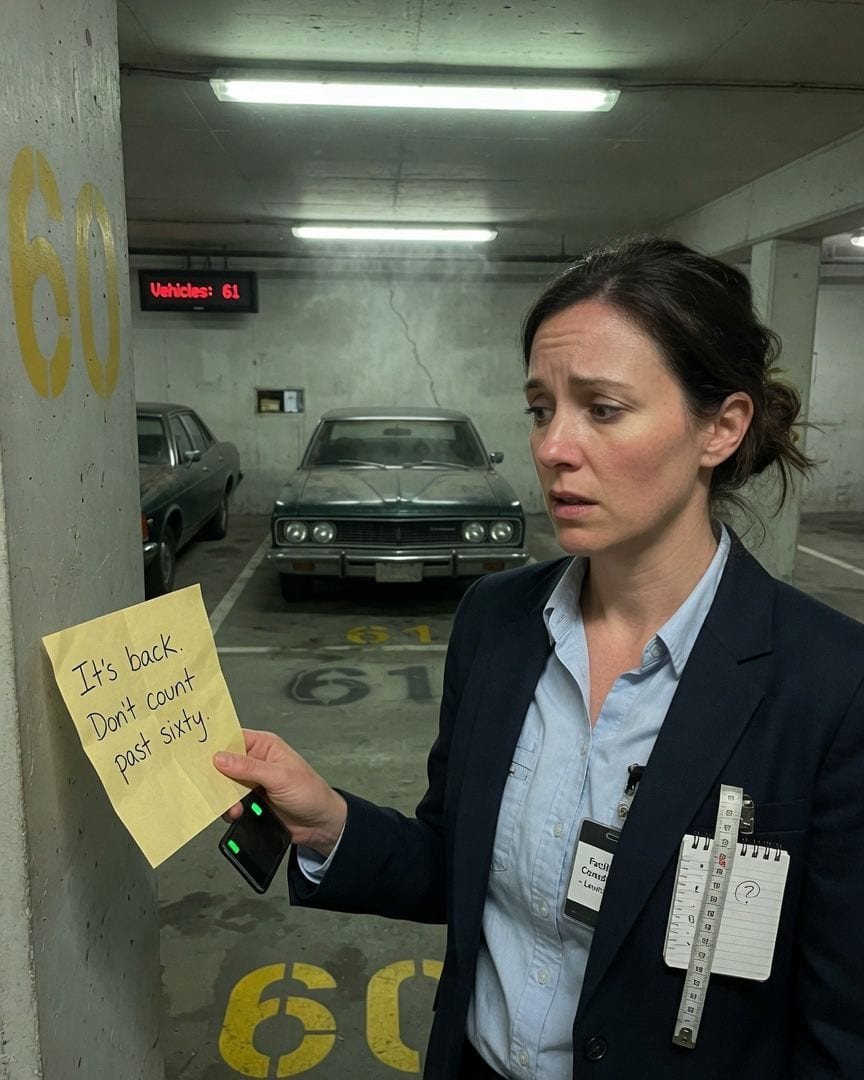
My hand found a hidden seam in the concrete wall. Inside, a desperate note warned: 'Don't count past sixty'.
I arrived at the underground parking lot a few minutes late, expecting the usual sixty spaces. But my pass blinked '61', and a new bay, numbered 61, had appeared beyond the lot's end wall. Inside it sat a vintage car, still warm from a recent drive. Every blueprint and log insists this space doesn't exist, yet it's undeniably there.
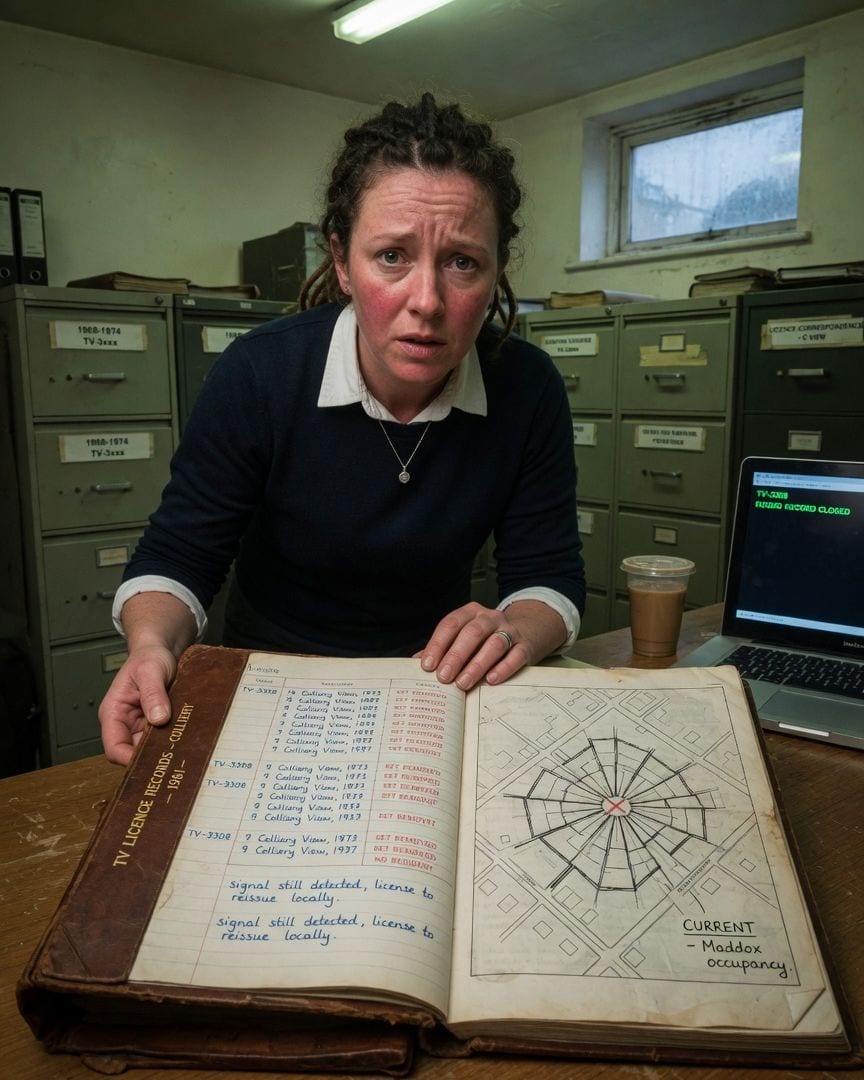
My TV license records showed a strange pattern of signals detected from sets removed decades ago, centered on my house.
I'd just settled into my new home on Colliery View, expecting routine paperwork. Instead, I discovered old records for my TV license contained a chilling entry: a crude, unsettling geometric diagram, not of a television, but drawn directly over my own house.
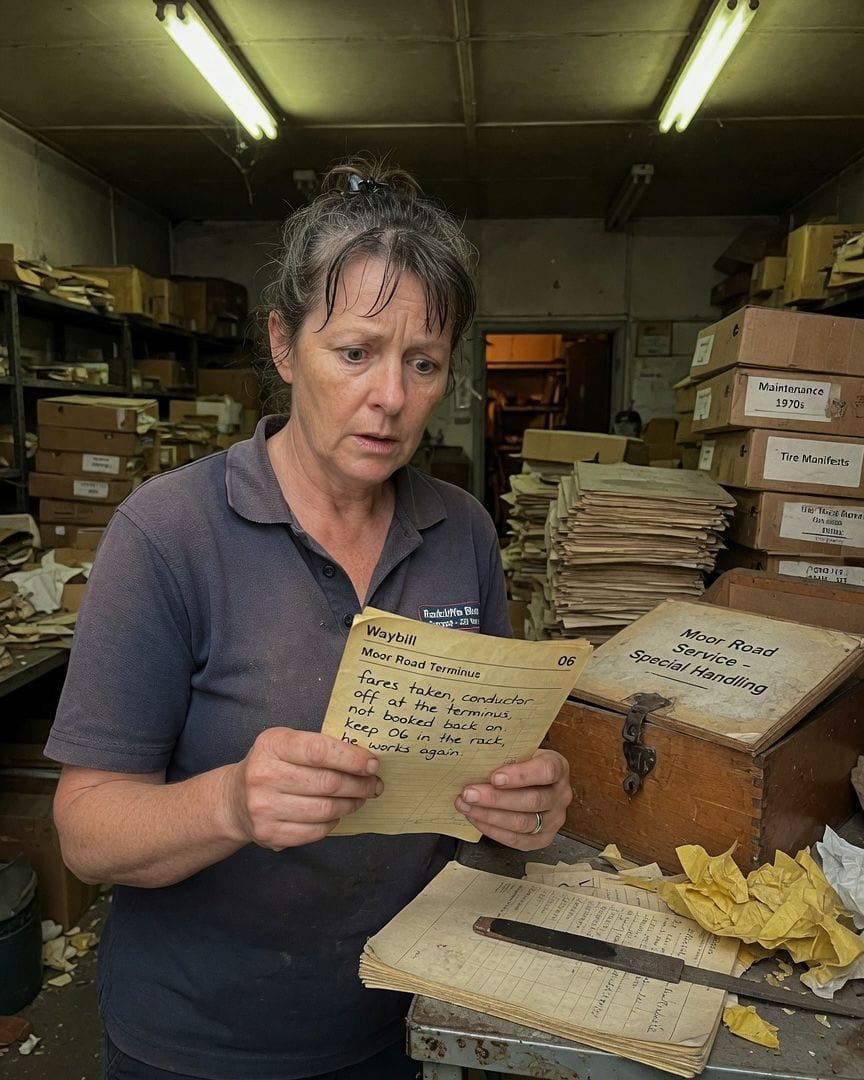
Our depot's Waybill 06 filed a moor road service we stopped running years ago. Every eight years since 1956, it closes: 'keep 06 in the rack, he works again.'
Sorting waybills in the depot, I stumbled across a form for the Moor Road Terminus. That route was decommissioned decades ago, but this waybill had a chilling handwritten instruction: 'keep 06 in the rack, he works again.'