A Cold War carrier radar operator's first solo watch tracked a craft dropping 60,000 feet in four seconds. The next morning, her tape reel was gone.
The green glow of the radar scope painted Peggy Vance’s face in the dim, humming Combat Information Center aboard the USS Enterprise. It was late, her first night alone, the massive carrier a dark hulk steaming silently off San Diego.
At forty miles, a contact appeared, doing nothing a target should. It dropped from 'angels sixty' — sixty thousand feet — to the deck in under four seconds, a descent rate the manual offered no column for.
Peggy’s eyes tracked it, her breath held tight in her chest. Then, the impossible craft simply held station, a bright, solid blip two hundred yards off the bow, a stone's throw from the ship itself.
Carl Fontaine, the plane guard helo pilot, was live on the net, his voice tight, laced with a raw disbelief Peggy recognized.
He described a shape he couldn't name, a silent, dark mass that didn't belong in the air or on the water. Peggy marked the time, the bearing, the impossible speed, logging every detail with a hand that barely trembled.
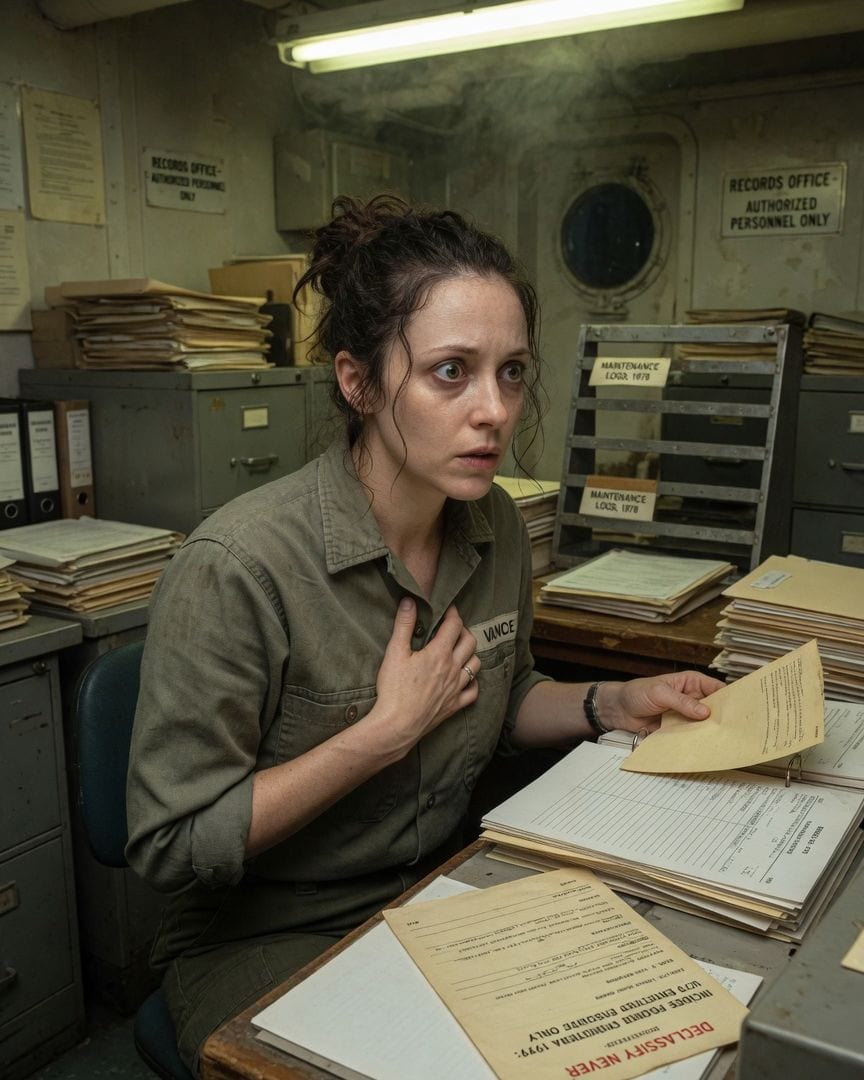
Her shift ended, the dread a cold, tight knot in her stomach, twisting with every silent hum of the ship. When she returned for her next watch, the tape reel she’d used the previous night was gone from its rack.
The rack itself had been relabeled, its new tag reading 'MAINTENANCE LOGS, 1978'.
Peggy’s first stop was the communications watch supervisor, a burly chief whose face was as impassive as the bulkhead. 'Tape reels get recycled, Vance. Happens all the time.' He didn't even look up from his clipboard. But the relabeled rack?
She gestured to the empty slot, the fresh label stark against the old, faded paint. He just grunted, 'Probably a clerical error, kid. Someone in supply messing up the inventory again.' Peggy wasn’t convinced.
The cold knot in her stomach tightened. She spent her off-duty hours haunting the ship's records office, a cramped, dusty space below decks that smelled of stale paper and ozone.
She asked for her watch logs from the previous night, then the master tape registry, then any incident reports from the bridge.
Donald Novak, the records officer, a man with thin, graying hair combed flat against his scalp and an unblinking gaze that seemed to see right through her, politely informed her there was 'no record of any unusual aerial phenomena' for that date.
He even produced a copy of the official bridge log for her review, its pages crisp and clean, bound in an official binder. But as Peggy scanned it, her stomach dropped.
The entry for her shift, the one that should have corroborated her radar contact and Fontaine’s visual, was simply absent. Not redacted, not marked, just… gone.
A blank space where the log numbers skipped, making the page count incorrect in a way that wouldn’t be obvious to a casual glance. It wasn't a clerical error; it was a deliberate excision.
The ship's official record had been tampered with.
The missing log entry made Peggy's blood run cold. She knew she wasn't crazy. She started digging deeper, asking questions to anyone who would listen, subtly at first, then with a growing urgency that she struggled to mask.
Days later, while sifting through a stack of old, misfiled administrative memos in a forgotten corner of the records office—a task Novak had assigned her, perhaps to keep her busy, perhaps to keep her close—she found it.
A single sheet of brittle, yellowish paper, tucked beneath a stack of quartermaster requisitions from 1977. It was an internal memo from her carrier's command, dated the day after her incident.
The header was stark, almost defiant: 'INCIDENT REPORT: USS Enterprise, 1979. NO RECORD OF UNIDENTIFIED AERIAL PHENOMENA.'
But then, a paragraph below, a single, precise sentence, unredacted, described a craft 'maintaining station at two hundred yards off the bow, displaying zero-velocity hover capabilities.' Her hands trembled, the thin paper rustling like a dead leaf.
She traced a control number printed faintly beneath the line, 'OP-SEC-79-ALPHA,' to an office that didn't exist in any directory she could find. The memo's footer was stamped, starkly, 'DECLASSIFY NEVER.'
The 'DECLASSIFY NEVER' stamp was a punch to the gut. Peggy knew it wasn't a mistake; it was a warning, sharp and clear. The control number, OP-SEC-79-ALPHA, became her anchor in a sea of official denials.
She started cross-referencing, using her limited access to classified message traffic logs for codes that matched 'OP-SEC.' It was slow, tedious work, mostly dead ends and irrelevant operational security directives about troop movements or equipment upgrades.
But then, a few weeks later, deep in the digital archives, she found a cryptic reference in a low-level, partially declassified report from 1971, detailing an 'unusual radar signature' off the coast of California. It carried a matching 'OP-SEC' prefix.
The description of the signature, while vague, hinted at similar impossible maneuvers – sudden appearances, then stationary holds. Peggy realized this wasn't an isolated event, a unique glitch in her first solo watch. This was a pattern.
She sought out Carl Fontaine, the helo pilot. They met discreetly in a rarely used corner of the ship’s library, surrounded by forgotten binders. Fontaine, looking gaunt, his eyes circled with sleepless worry, confirmed everything he’d seen.
'They told me it was an equipment malfunction, a thermal inversion,' he said, his voice low, almost a whisper. 'But I know what I saw. And I know what I was told to say.'
He confessed that his own flight recorder had been taken for 'maintenance' immediately after the incident, and returned wiped clean. His unease was palpable, a mirror of her own.
Peggy then traced the 'OP-SEC' prefix through older, more obscure naval archives, finding a pattern of similar, impossible sightings, always followed by immediate official denial and the disappearance of primary records.
The dates stretched back to the early 1960s, a quiet, consistent hum of impossible events, all filed away under similar, untraceable control numbers.
Peggy's inquiries, though careful, hadn't gone unnoticed. Donald Novak, the records officer, seemed to be everywhere she went.
She’d catch his gaze across the mess hall, his fork paused halfway to his mouth, or find him standing silently near the entrance to the classified archives as she left, a stack of files under his arm.
He never spoke, just watched, his unblinking stare a cold knot in her stomach, a constant, unsettling presence.
One afternoon, she returned to her bunk to find a small, unmarked envelope tucked beneath her pillow, a stark white rectangle against the drab gray of her blanket. Inside was a single, photocopied page.
It was a fragment of a naval regulation, highlighted in yellow. It detailed, in stark, unforgiving language, the severe penalties for 'unauthorized access to classified materials' and 'dissemination of sensitive information.' There was no note, no sender.
Just the implied threat, as clear as if it had been shouted in her ear. The air in her small bunk felt suddenly heavy, watched, the silence amplifying the thud of her own heartbeat. She knew it was Novak.
He wasn't just observing her; he was actively warning her off. The message was clear: someone knew exactly what she was looking for, and they wanted her to stop. The hunt had turned.
She was no longer just a seeker; she was now the sought.
The warning only hardened Peggy's resolve. She cornered Novak in his office, the air thick with the smell of old paper and dust motes dancing in the shaft of light from a high porthole.
'I know about OP-SEC-79-ALPHA,' she stated, holding up the brittle memo she’d found. Novak's face remained impassive, betraying nothing. 'That's a classified document, Radarman Vance. You shouldn't have it.' His voice was flat, even.
Peggy pushed, her voice tight with a mixture of fear and determination. 'Why does it deny the incident while describing it? Why is the tape rack relabeled? Why was my tape gone?'
Novak sighed, a slow, deliberate sound that seemed to carry the weight of years. 'The Navy has protocols, Radarman. For certain… anomalies.'
He leaned forward, his voice dropping to a near whisper, though there was no one else in the office to hear. 'Things that don't fit the established framework. Things that create… public confusion. We don't lose them, Vance.
We simply… file them.' He explained, not with malice, but with a weary, practiced detachment that sent a shiver down Peggy’s spine. A specific, highly compartmentalized unit was responsible for 'managing' such events.
They ensured all primary records were scrubbed, witness accounts discredited, and the incidents transferred to a deeper, unsearchable archive. It was a systematic process, a patient machine designed to maintain institutional calm.
'Your tape,' he continued, looking directly at her, 'was cataloged, copied, and then destroyed. The original log entry was transferred to a higher classification. Standard procedure.' Peggy finally understood.
It wasn't a cover-up of a single event; it was a vast, decades-old system of information control, quiet and omnipresent.
Her incident, the impossible craft, Carl Fontaine's wiped recorder—it all clicked into place, not as isolated errors, but as perfectly executed steps in an established protocol.
The horror wasn't the craft itself, but the calm, methodical institution that had known about it for so long, and simply filed it away.
Novak's admission, chilling in its placid indifference, confirmed Peggy's worst fears: the institution knew, and it was actively hiding a vast, consistent truth. She pressed him, demanding to know where these 'filed' incidents went, where the true records were kept.
With a final, reluctant sigh, Novak granted her limited, supervised access to a secure terminal in a back room, warning her that 'some things are better left unread.'
He logged her into a system she'd never seen, its interface stark and archaic, green text on a black screen. On the screen, a single directory glowed: 'PROJECT NIGHTINGALE - CNO SPECIAL OPERATIONS.' Hesitantly, Peggy clicked.
A vast index of files unfolded before her, stretching back to the 1950s, each entry a cryptic code and a date.
She scrolled rapidly, her fingers flying over the keys, seeing hundreds of incidents, all coded with the familiar 'OP-SEC' prefix, all describing 'unidentified aerial phenomena' with impossible flight characteristics.
Her own incident, 79-ALPHA, was there, a single line in a sea of similar events. But as she continued to scroll, her breath hitched in her throat, catching in a sudden, icy grip.
A recent entry, dated just last week, glowed on the screen, brighter than the others: 'OBSERVER VANCE, P. — Increased query activity regarding Event 79-Alpha. Monitoring initiated.'
Her name was in the file, not as a witness, but as a subject.
The words 'OBSERVER VANCE, P. — Monitoring initiated' burned into Peggy's vision, searing themselves onto her mind. She felt a cold dread spread through her, far worse than any fear the impossible craft had inspired.
This wasn't a historical archive; it was a living document, a surveillance log. She was no longer just an investigator; she was now part of the phenomenon the institution tracked, another data point in their quiet, unending ledger.
Novak, observing her from across the room, finally spoke, his voice low and even. 'Project Nightingale isn't just about what's out there, Radarman. It's also about maintaining… internal stability.'
He explained that anyone who became too aware, who pushed too hard, was integrated into the project's 'observer' files. They weren't punished, not overtly. They were simply watched. Their inquiries, their movements, their contacts—all recorded, all filed.
The system was designed to contain information, and that included containing the people who sought it. Peggy scrolled back through the Project Nightingale entries, the names and dates blurring together.
The craft's impossible descent, its zero-velocity hover, its silent presence—these weren't unique to her experience. They were consistent across every single incident, spanning decades, a testament to an unchanging, unknowable presence.
The institution had known this for generations, had observed and cataloged it with chilling precision.
The horror was the sheer scale of the knowledge, the calm acceptance of the impossible, and the methodical, patient way it had all been buried, not just from the public, but from its own personnel.
And now, she was part of the record, too.
Novak gestured towards the screen with an open hand. 'You see now, Radarman. We don't hide the truth because we're afraid of it. We file it because it changes nothing.'
He explained that the craft, whatever it was, had been observed for over fifty years. It appeared, performed its impossible maneuvers, and then vanished, always without interaction, always without explanation.
The institution had learned to simply record, contain, and manage the information. It was an exercise in bureaucracy, not a battle.
'There's no escape from what you know now,' Novak said, his voice devoid of threat, sounding more like a weary professor than a jailer, 'but there's also nothing to fight. It simply is.'
Peggy felt a profound hollowness, a crushing sense of insignificance. The vastness of the system, its endless patience, its quiet, unbothered acceptance of the impossible, was overwhelming.
She had expected a conspiracy, a hidden evil, something she could expose or fight with righteous indignation. Instead, she found an bureaucracy, calm and immovable, stretching back further than she could imagine.
She was not in danger of being killed or imprisoned; she was in danger of being assimilated, her knowledge rendered inert by the sheer weight of institutional indifference.
She could shout the truth from the rooftops, but the institution had already filed her, and her shouts would simply be another entry in Project Nightingale, another data point proving the system worked.
She closed the file on the screen, the glowing text 'Observer Vance, P.' a brand on her mind, an indelible mark. There was no escape. She was filed.
Peggy finished her tour of duty aboard the Enterprise. The carrier, the green glow of the radar scope, the endless ocean – all faded into memory, replaced by the quiet hum of civilian life.
She moved to a small town in the Midwest, got a job in an accounting firm, tried to forget the impossible things she had seen and learned. But the knowledge never left her.
She'd catch herself glancing at the sky, scrutinizing news reports for anything out of place, any anomaly that might hint at the vast, hidden reality.
She noticed subtle changes in her everyday life: her mail sometimes arrived opened, the flap resealed slightly crooked; her phone would occasionally make an odd clicking sound during calls, like a distant recording device.
Nothing overt, nothing she could prove, just faint, persistent traces that suggested she was still, quietly, being observed. The institution hadn't pursued her, hadn't threatened her further. It hadn't needed to.
It had simply absorbed her into its quiet, ongoing record, and the world moved on, oblivious.
Years passed. Peggy built a quiet life, but the phantom presence of 'Project Nightingale' never truly faded. It was a background hum, a faint chill that lingered at the edges of her perception.
One crisp autumn morning, an unmarked envelope arrived in her mailbox. No return address, no postmark, just her name and address typed in a clean, impersonal font.
Inside, a single sheet of paper: a recent printout of a redacted file entry. The blacked-out lines were familiar, precise and unyielding, the 'DECLASSIFY NEVER' stamp at the bottom a stark, chilling reminder.
Beneath one of the redactions, a single, unblacked line read: 'OBSERVER VANCE, P. — Last noted activity: 2023. Status: Awaiting further data.'
Peggy Vance set the paper down on her kitchen table. The coffee was still warm, the morning sun streaming through the window, painting stripes on the worn linoleum.
She picked up her mug, her gaze distant, fixed on nothing in particular. The file was still being signed.
If this one got to you
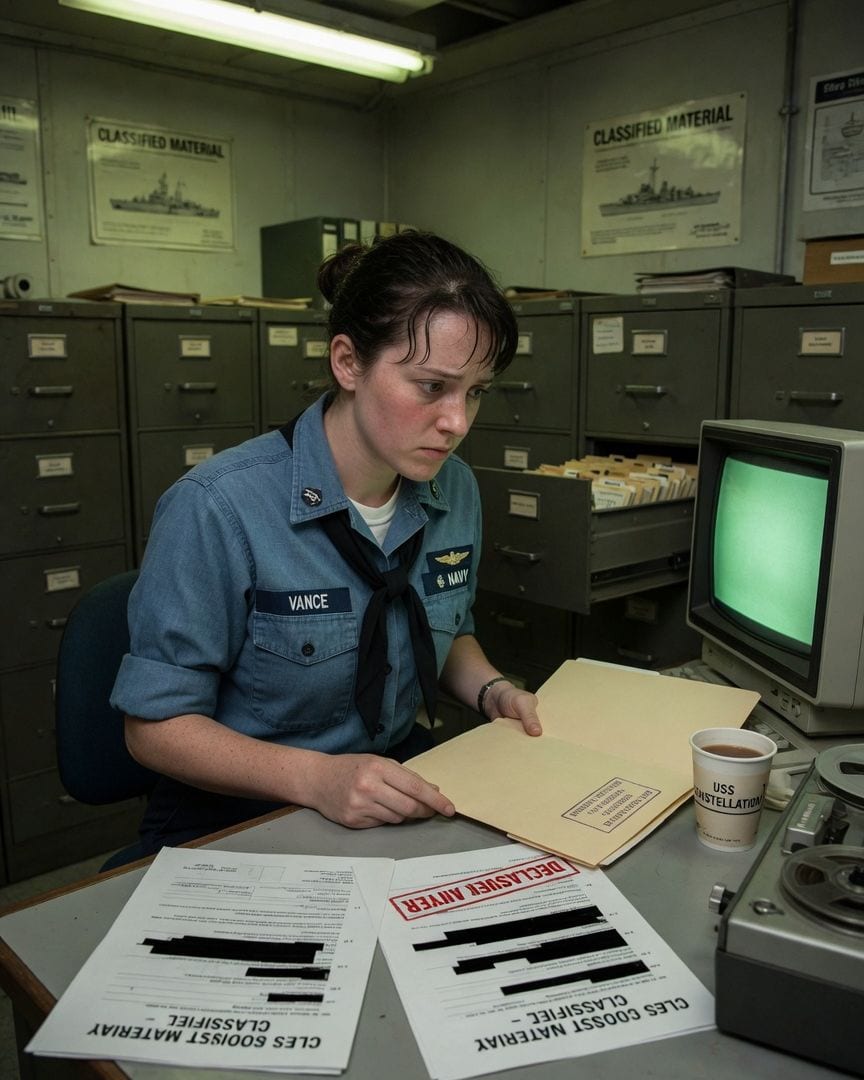
A radarman tracked an object from 60,000 feet to the deck in four seconds. The next night, her tape was gone, replaced by a lie.
Radarman Second Class Peggy Vance, 22, began her first night alone in the carrier's dim green radar room off San Diego, the ship gently rolling. She tracked an impossible contact: a shape without wings, falling from sixty thousand feet to the deck in under four seconds, baffling the pilot. The next night, her incident tape was gone, the slot relabeled, and the official log dismissed the event as a "weather balloon" that couldn't be found. Peggy soon uncovered a deliberate pattern: conflicting, heavily redacted reports, each copy hiding what the other revealed, confirming a layered deception. What secret was so vital it required such an intricate, impossible lie?
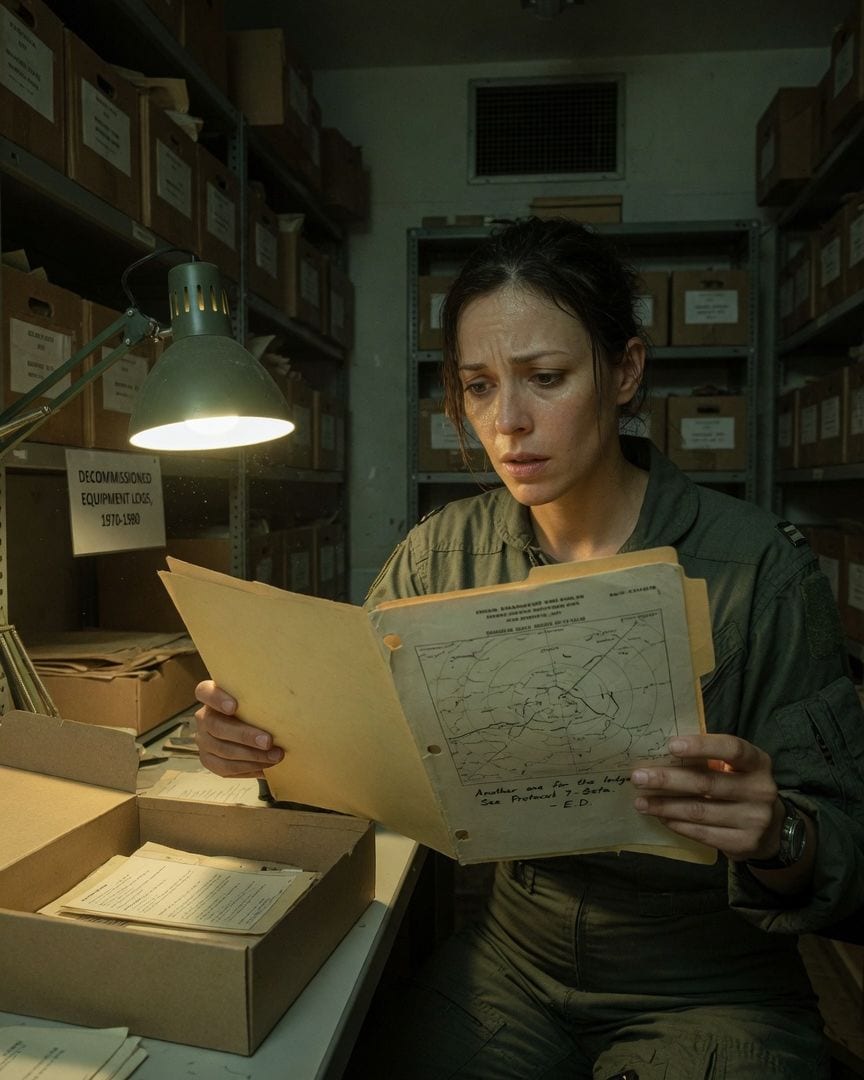
A radar captain's scope went clean, but the pilot swore a mile-wide UFO still filled his windscreen. Then she found a Cold War ledger of impossible sightings.
Captain Ines Bardolph, a 34-year-old radar operator in Bavaria, lived by the precise hum of her console. One quiet night, an impossible contact appeared over the Danube, then vanished from her scope just as a pilot swore it filled his windscreen. Replays showed the object had crossed the Alps in a single blink, defying all known physics. When bureaucracy sought to bury the incident, Captain Bardolph sought answers, leading her to a forgotten archive where a brittle folder revealed a chilling pattern: 'Another one for the ledger.'
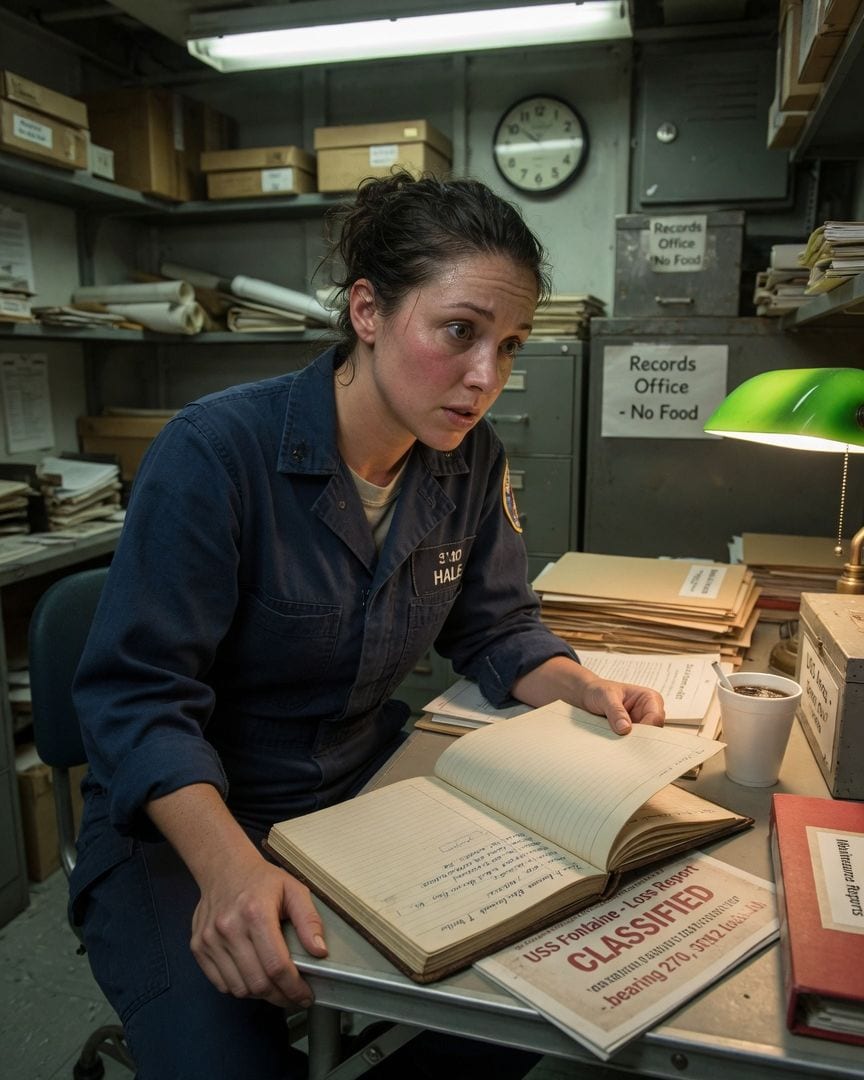
Petty Officer Hale needs a spotless record for her transfer. But the USS Ares sonar logs show an identical, impossible contact, logged to the minute, years apart, and tied to a classified loss report.
Petty Officer Sarah Hale needed a spotless record for her coveted shore duty transfer, a posting she'd worked five years to secure. Alone in the USS Ares sonar shack, three days out from San Diego, her midwatch was broken by an impossible contact: a close, slow echo holding perfect pace, invisible to radar, then vanishing. Her heart hammered, not from fear, but from the data's impossibility. When she found an identical entry in her own log from just one week prior, the cold dread tightened its grip. But the true chill settled when she unearthed decades of similar records, signed by other sonar officers, all showing the same impossible contact at 0212, off the port beam, for nineteen minutes, on the same ship, stretching back years—a persistent echo tied to a classified loss report.
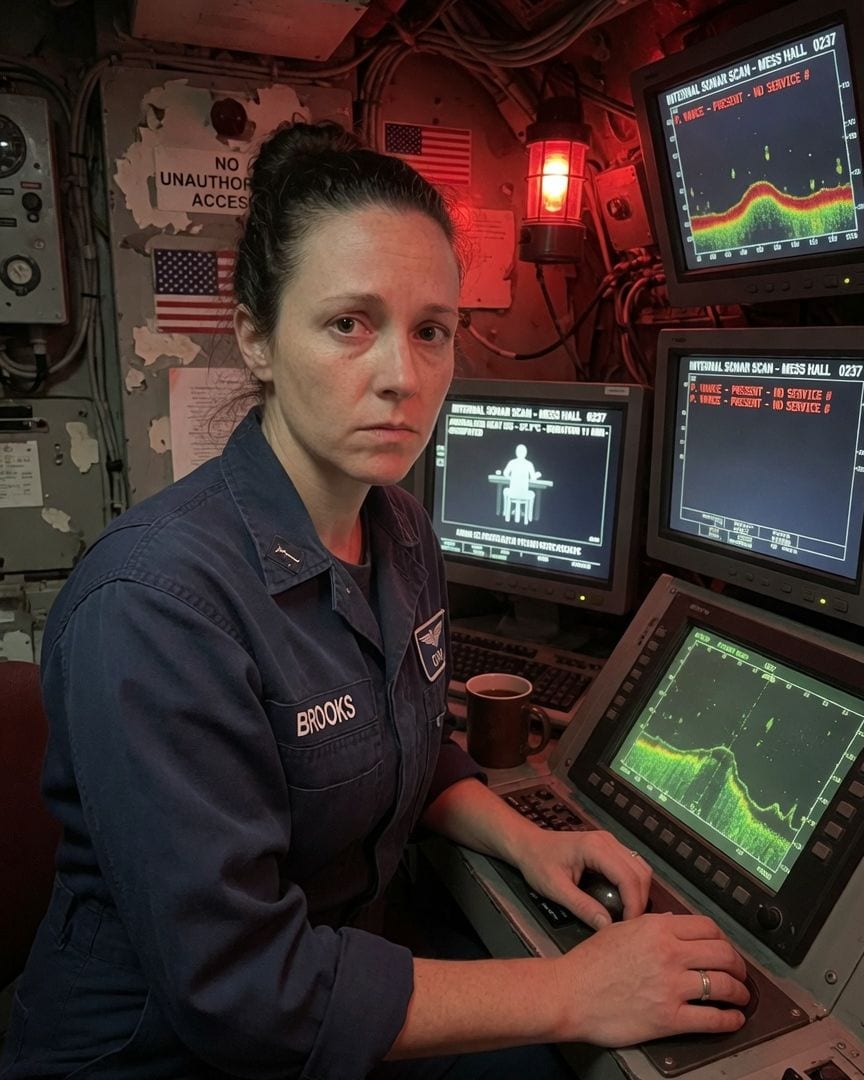
A Chief Petty Officer reviewed her submarine's sonar logs, finding a human heat signature where security cameras saw nothing, then the manifest listed an extra man who couldn't be deleted.
Chief Petty Officer Charlotte Brooks felt the weight of her submarine's impending decommissioning, its long service ending soon after a decade as her home. The quiet hum of the USS *Artemis* was broken when a nervous messcook reported seeing a shadow eating alone in the mess hall, then finding one plate short but a perfectly clean tray. Though skeptical, Charlotte checked the security feeds, which showed nothing, yet her sonar logs revealed a distinct human heat signature in the same spot, then abruptly vanish. Her dread deepened when the boat's manifest confirmed 101 souls instead of 100, listing a mysterious 'P. Vance' with no details, whose entry all systems refused to delete.
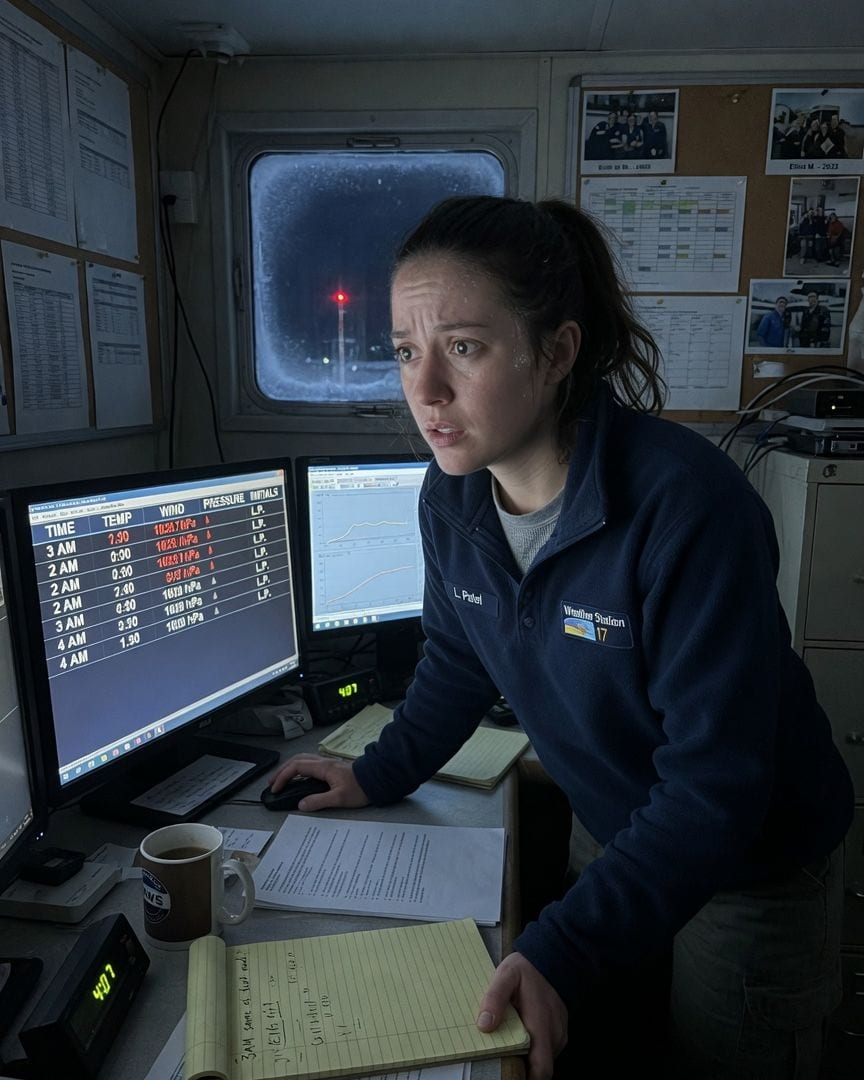
My weather station's 3 AM log shows a pressure reading I never made. My initials are on it, but the dials were dead still.
Working the overnight shift at the remote weather station, I routinely checked the digital logs. The 3 AM entry showed an impossible barometric pressure spike, a hurricane that simply hadn't happened. I distinctly remembered being outside at that time, calibrating a sensor, not making that entry. Yet, my initials, L.P., were clearly logged next to data I never made.
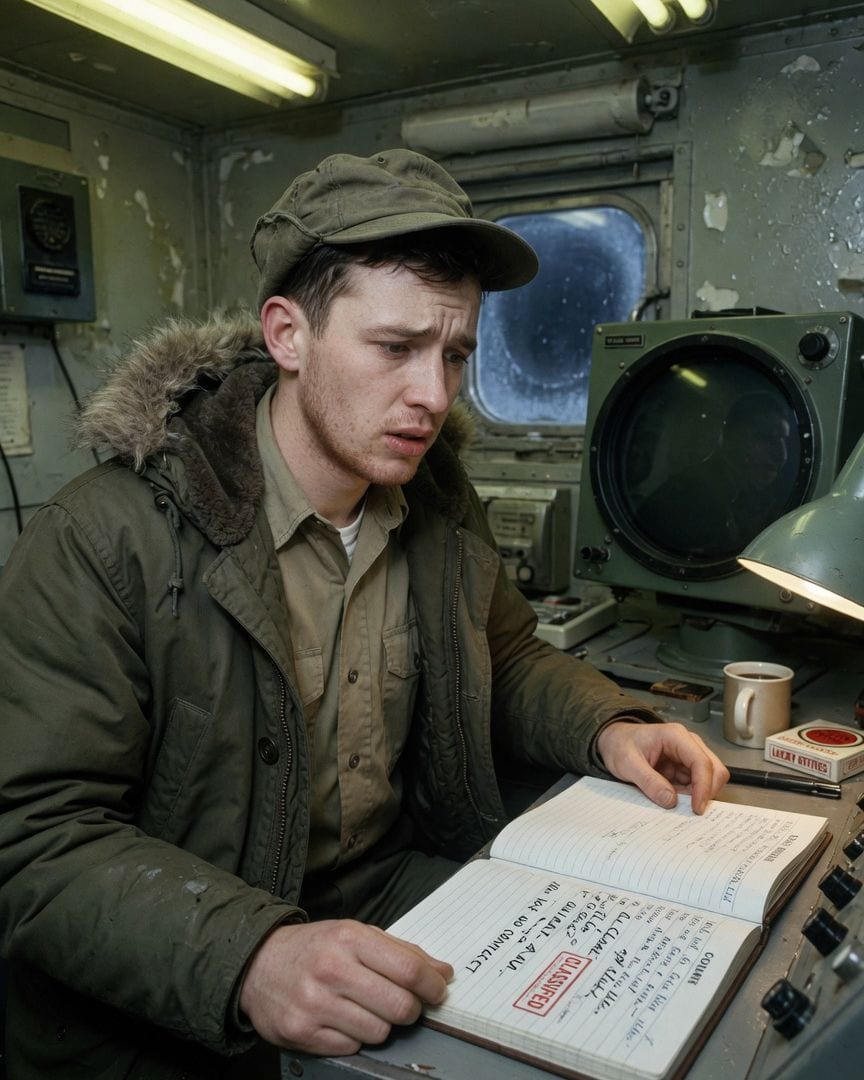
A Cold War airman logs an impossible radar contact on his last sweep. But his official logbook entry is stamped 'CLASSIFIED' and then contradicted by a hastily scrawled 'ALL CLEAR' dated moments before it.
Airman Ordway Vance, 22, manned the radar dome at Site Pellin in the biting North Atlantic dark of January 1962, running the last calibration sweep before its decommissioning. His scope picked up a faint, impossible return, growing closer with each pass, though the ocean remained empty to the eye. When Vance detailed the contact in his official logbook, a 'CLASSIFIED' stamp appeared, followed by a hastily scrawled 'ALL CLEAR' dated moments before his own entry, contradicting his every word. Commander Hartley dismissed it as equipment malfunction, but Vance sensed a chilling, official erasure behind the lie. He soon found a locked cabinet marked 'SITE PELLIN ANOMALIES,' hinting at a deeper truth buried within the base's final days.