A Cold War specialist heard a tape describing tomorrow’s burn, then found the missing reel. It was warm and humming in his hand, on Thursday night.
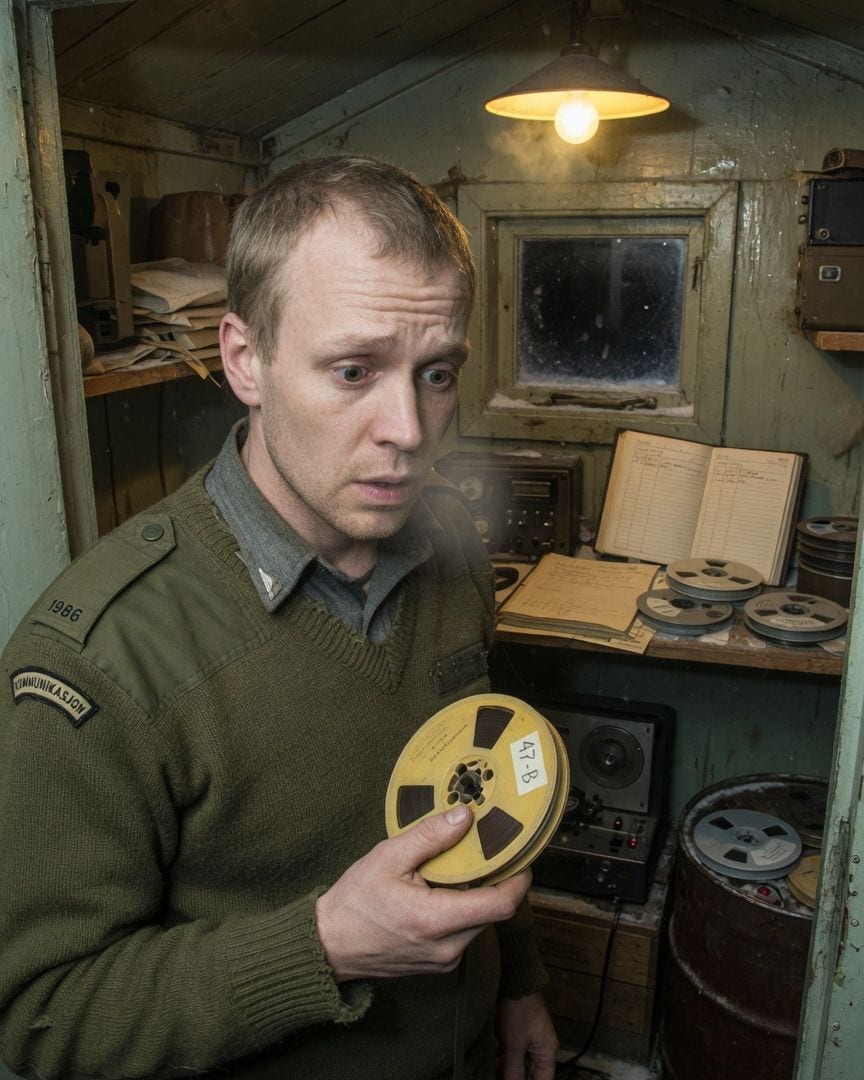
Sergeant Pell Ostrander, a methodical communications specialist, shivered against the damp chill of the Norwegian fell hut in 1986. It was his last night, the final sweep before the facility was decommissioned and abandoned.
The last resupply chopper had turned back hours ago, leaving him alone with crates of equipment slated for Friday’s burn barrel.
He picked up a reel of magnetic tape, its cover sheet yellowed and brittle: 'Barents Ionospherics, 1957 – 30 min.' Nothing to lose but a night.
He threaded the tape onto an old player, its spools turning with a mechanical groan. Static hissed, then a man's voice, calm and official, began to read.
It wasn't ionospherics. It was a station log. Weather, wind, watch relief – all from this very hut, the details chillingly precise for the remote outpost. Ostrander felt a prickle of unease.
He knew the layout of this small, isolated station intimately. The voice continued, listing specific equipment serial numbers he recognized, the exact time of the generator’s weekly maintenance, even the brand of coffee rationed out.
Then the voice read, 'Friday's entries.' Ostrander froze, his hand hovering over the player’s stop button. It was Thursday night.
The voice continued, detailing the burn, and the number of reels in the barrel, a count that was undeniably, impossibly, higher than Ostrander had made just hours before when he’d prepared the disposal.
Ostrander snatched the old, leather-bound station logbook from the shelf. His fingers, usually steady, fumbled through the brittle pages until he reached the current date.
He skimmed Thursday's entries, seeing his own scrawled notes about the final equipment inventory, the precise number of magnetic reels he had counted for disposal. Then, holding his breath, he turned to Friday’s page.
There it was, in faded ink, matching the voice on the tape exactly: 'Burn barrel prepared. Reels transferred for disposal.' And a specific count, exactly as the recording had stated, including a reel number: 'Reel 47-B.'
He had meticulously counted everything that afternoon, checking each cylinder against his inventory sheet. Reel 47-B was not among them, and the total was off by one. He replayed the tape, confirming the voice, the date, the number.
He walked to the burn barrel outside, its rusted metal cold under the thin layer of snow. He peered inside, shining his flashlight over the stacked, dull gray cylinders. His count had been accurate. Reel 47-B was not there.
The log, the voice, the tape – they were all coherent, all accurate, describing a future that hadn't happened yet, but which inexplicably knew the present.
He checked the hut's small, dusty storage room, a place he thought he'd thoroughly cleared. Behind a stack of old, empty supply crates, nestled in a forgotten corner, he saw it. A single reel of magnetic tape.
He reached for it, his hand hesitating. The reel was identical to the others, but its cover sheet was blank, unmarked. As his fingers closed around the plastic, a jolt went through him. It was warm.
Not just room temperature, but distinctly, unnaturally warm, as if it had just been removed from a running machine. A faint, low thrum vibrated against his palm, barely perceptible but undeniably there.
This was Reel 47-B, he knew it with a cold certainty. The one the voice had spoken of for tomorrow’s burn. The one that wasn't supposed to be here yet, and certainly wasn't supposed to be alive in his hand.
Ostrander secured Reel 47-B in his pack, the faint warmth a constant, unsettling presence against his back. He knew he couldn't report this. His superiors would dismiss it as a hallucination, a stress reaction from isolation.
He had even considered a prank, but the precision, the coherence of the log, the tape, and the physical object was undeniable. He spent the rest of the night sifting through the remaining archived materials, ignoring the categories and designations.
He searched for other 'ionospherics' reels, anything with similar, vague labels. He found three more, from 1968, 1974, and 1981.
Their cover sheets were similarly nondescript, but when he held them, he detected the same faint, internal hum in two of them.
He then cross-referenced the dates on these humming reels with other files slated for destruction: old 'missing in action' reports, declassified incident summaries, and even some obscure maintenance logs from other remote sites. A chilling pattern emerged.
Each date associated with a humming 'ionospherics' reel corresponded precisely with an official report of a lost ship, an aircraft disappearance, or a military unit declared missing.
Not just 'lost,' but often with a final, unexplained radio silence or a last known position near an 'ionospherics' monitoring station.
The ordinary explanations — weather, mechanical failure, human error — were always meticulously documented and ruled out in the official reports. Yet, here were these other records, quietly humming and filed away, a silent counter-narrative to the official truth.
The unease in the hut deepened, becoming specific, a gnawing certainty that he was looking not at random incidents, but at a deliberate, recurring process.
The silence of the hut seemed to absorb his thoughts, the cold air itself pressing down with unseen weight.
Ostrander's meticulous, off-script digging did not go unnoticed. He received a satellite message from Captain Joel Harrington, his superior, due to arrive in two days to finalize the decommissioning.
The message was brief, ostensibly about logistics: 'Ostrander, expedite disposal of all remaining unclassifieds. Ensure all loose ends tied before my arrival. Harrington.' The words were innocuous, standard procedure. But the timing felt like a cold hand on his neck.
'Loose ends.' He understood. His unusual interest in specific archived materials, his deviation from the standard inventory, had been flagged. The base's automated systems, even in their final days, were still monitoring.
A distant static on the hut’s old radio receiver seemed to shift, subtly, as if adjusting to listen.
He suddenly felt exposed, watched, despite the desolate isolation. The humming reel in his pack felt less like a discovery and more like a liability.
He knew his access to the records, his window into this impossible pattern, was about to close. He had to act. He gathered the most damning cross-references, the logbook, and Reel 47-B.
He decided to confront Harrington directly upon his arrival, trusting that his superior, a by-the-book officer, would demand a rational explanation for the impossible data.
But as he waited, he found himself checking the hut's small, frosted window every few minutes, scanning the snow-laden landscape for any sign of movement beyond the swirling flakes, a prickling sensation on his skin that had nothing to do with the cold.
Captain Harrington arrived the next morning, a day earlier than expected, his breath misting in the frigid air as he stepped into the hut.
His gaze immediately fell on the scattered logbooks and reels Ostrander had laid out on a dusty workbench. 'Sergeant, what is all this? I thought I told you to expedite disposal, not start a private archive.'
Ostrander, cutting to the chase, placed the 1957 'ionospherics' reel on the table. 'Captain, listen to this.'
He played the recording of the man reading tomorrow's log entries, then showed Harrington the physical logbook, open to Friday's page, detailing the burn barrel count.
Harrington listened, his brow furrowing. He picked up the logbook. 'A misfile, Sergeant. A prank, perhaps. Someone with too much time on their hands in '57. The isolation can do things to a man.' Ostrander shook his head. 'No, sir.
This reel' — he pulled out Reel 47-B, its warmth evident even through his gloves — 'was mentioned for tomorrow's burn, but I found it hidden today. And the logbook's count matches the tape precisely.
How could a prank know about this?' He then laid out the cross-referenced 'missing in action' reports, pairing them with the other humming 'ionospherics' reels. 'These dates, sir. Every time.
A missing unit, and an 'ionospherics' recording from the same day, from a nearby station. These weren't ionospherics, were they?'
Harrington's composure began to crack. He ran a hand over his close-cropped hair, his eyes scanning the impossible correlations Ostrander had laid bare. 'Some things... some things were just filed away, Ostrander.
The 'ionospherics' designation was a catch-all for anomalous transmissions. Unexplainable. The record was always considered complete, even when it wasn't. They just... vanished. And the paperwork kept coming. It was easier to file them than to admit we didn't understand.
We called it 'administrative closure.' But it wasn't closure. It was… filing.' He looked at the humming reel in Ostrander's hand, a flicker of something close to fear in his eyes.
The light from the window seemed to dim slightly as he spoke, as if the hut itself was holding its breath. 'The secrecy machine, Sergeant. It knew. It recorded it. And it sealed it away.'
Harrington reached for Reel 47-B. 'Give me that, Sergeant. This is beyond your pay grade. Beyond mine.' His voice was low, urgent, laced with an authority Ostrander hadn't heard before, a frantic edge that sliced through the hut's oppressive silence.
'This isn't just about filing, Ostrander. This is about… ingestion.'
As they struggled over the reel, Ostrander's gaze fell on the old logbook he'd brought, open to a page not about the hut, but detailing a routine supply drop to another remote station, decades ago.
A requisition for 'specialized maintenance' on the hut itself, dated next week, listing equipment Ostrander recognized as part of the 'ionospherics' array, suddenly flashed in his mind. The hut was still active.
Harrington's eyes, wide and terrified, fixed on a specific entry in the logbook's historical section. 'That's... that's my father's unit,' he whispered, his finger trembling as it pointed to a service number. 'They were lost at sea. Officially.'
Ostrander looked closer. The entry was for a supply delivery that was never received. And the very next line, dated the same day, was a maintenance sign-off for an 'ionospherics' unit. Harrington's face was ashen. 'Their files... they kept writing.
For years. Payroll runs, requisitions, muster entries. All signed. Long after they were gone.' The truth slammed into Ostrander: the file wasn't just a record of the lost. It was still being signed.
Harrington, his voice strained, pulled out an old, faded photograph from his own wallet. It showed a group of young servicemen, his father among them. 'My father's unit. Lost in the Barents Sea, '57.'
He pointed to a man in the background, a civilian-looking figure with a cold, almost detached expression. 'Special projects liaison. He signed some of the later entries in their file. The ones after they were gone.'
The man in the photograph, with his steady, unreadable gaze, looked eerily like the calm voice on the 1957 reel Ostrander had first listened to.
Harrington explained that the 'secrecy machine' wasn't merely an institution that recorded disappearances; it was an active mechanism, a kind of dark ledger, that absorbed and processed the lost. The 'ionospherics' stations, like this hut, were points of ingress.
The official records, the files that kept writing, were its ongoing manifest, its way of assimilating the vanished into a bureaucratic non-existence. 'The burn barrel,' Harrington said, his voice dropping to a whisper, 'it's not for destruction. It's for ingestion.
A final processing. The physical record follows the person.' He looked at Reel 47-B, then at Ostrander. The air in the hut grew heavier, colder, the very walls seeming to press in. 'You found it. You're next on the manifest.'
A low hum began to emanate from the hut's main equipment rack, growing in intensity, a deep thrumming that vibrated through the floorboards. Reel 47-B in Ostrander's hand began to vibrate violently, the plastic casing feeling hot enough to burn.
Harrington grabbed Ostrander, his eyes wide with desperate urgency. 'Get out! Now!' He pointed to the logbook's final, predictive entry, the one for tomorrow, the faded ink seeming to shimmer under the hut's flickering light.
Ostrander saw his own name, chillingly clear: 'Sergeant Ostrander, Pell. Reel 47-B. Burned.' Harrington shoved him toward the emergency exit, a small, heavy door that led directly into the blizzard. 'They're here for the manifest. For you!'
The hum in the hut rose to a deafening roar, a sound that felt less like machinery and more like a vast, hungry intake of breath, making his teeth ache.
Ostrander, clutching Reel 47-B and a handful of the impossible log entries, stumbled out into the blinding whiteout, the blizzard a sudden, violent embrace.
He heard the heavy thud of the hut's main door slamming shut behind him, followed by a sickening, grinding sound that seemed to consume the very air, pulling at the snow around him. He didn't look back.
He ran, the cold wind tearing at his face, the hum of the hut fading into the howl of the storm, knowing he carried proof no one would ever believe, and that his name was already on a file being signed.
Ostrander, frostbitten and disoriented, stumbled into a remote Norwegian outpost hours later. His story was met with polite disbelief, attributed to hypothermia and the stress of isolation. Reel 47-B was confiscated, declared 'corrupted,' and filed away.
The impossible log entries were labeled 'miscellaneous unclassified' and sealed. Captain Joel Harrington was reported as 'missing, presumed lost' in the blizzard, a brief, official note in the military records.
The fell hut, its purpose now officially fulfilled, was sealed, then quietly demolished a few weeks later. The incident was closed, filed away, just like so many others.
Years later, Pell Ostrander lived a quiet life as a civilian, working a mundane job far from any remote outposts or classified records.
He still had the nightmares, the sound of the hum, the feeling of the heat from the reel. Sometimes, unsolicited, packages would arrive at his small apartment. Inside, he would find meticulously copied, official-looking documents.
Payroll runs for Captain Joel Harrington, dated last month. Requisition forms for 'specialized maintenance' at the exact coordinates of the demolished fell hut, signed by a hand that looked disturbingly familiar.
He would burn them, every time, watching the impossible paper curl into ash. But they always arrived again, a few weeks later, a new batch. The file, it seemed, was still being signed.
If this one got to you
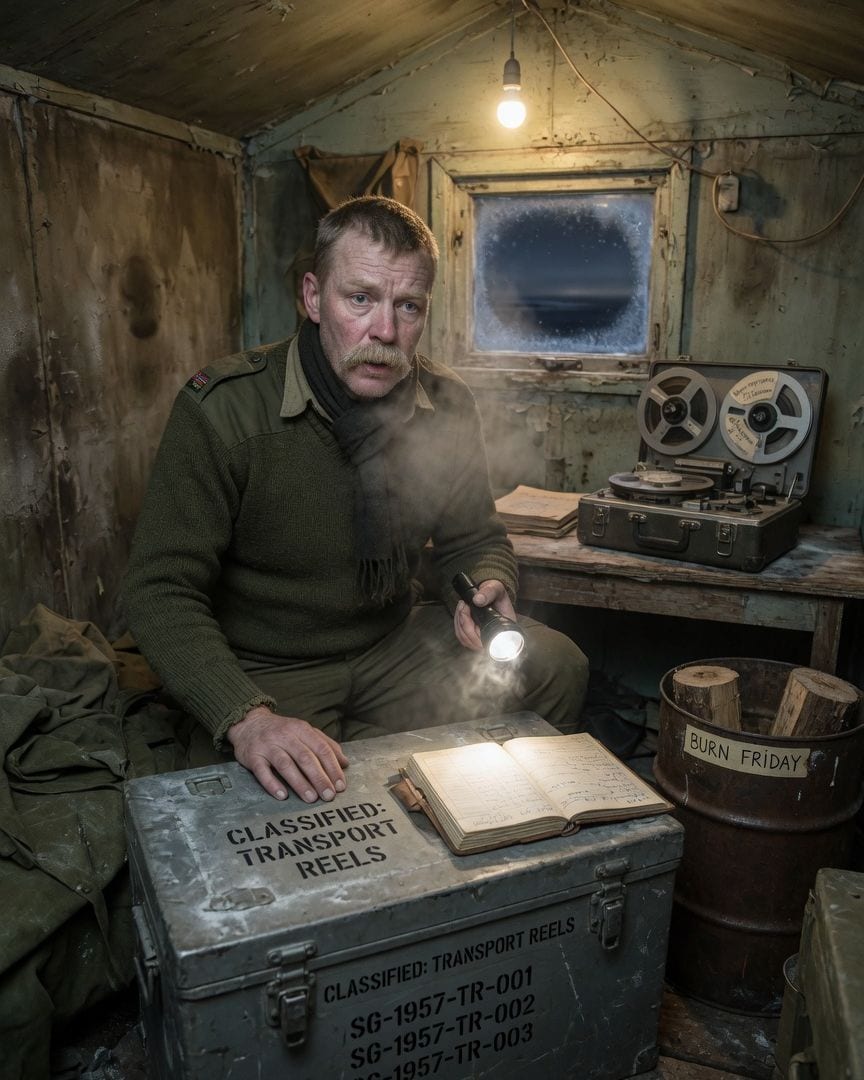
A Cold War sergeant, alone at his remote fell hut, hears a 1957 voice describe his future burn. Then he finds the 'classified' items waiting.
Sergeant Pell Ostrander shivered alone in a remote Norwegian fell hut in 1986, the Barents Sea his only company. With a stack of old reels to burn by Friday, he threaded one labeled "Barents ionospherics from 1957." A dry baritone voice crackled through the speaker, reading mundane log entries from decades past, until it detailed "three sealed transport reels" for disposal on Friday at 1600. Ostrander, a man of routine, checked his watch: it was only Wednesday, and no such reels existed in his hut. Then, in a dusty closet, he found a heavy metal box, sealed and marked 'CLASSIFIED', with the exact serial numbers of the reels the voice had described, waiting for its appointed burn.
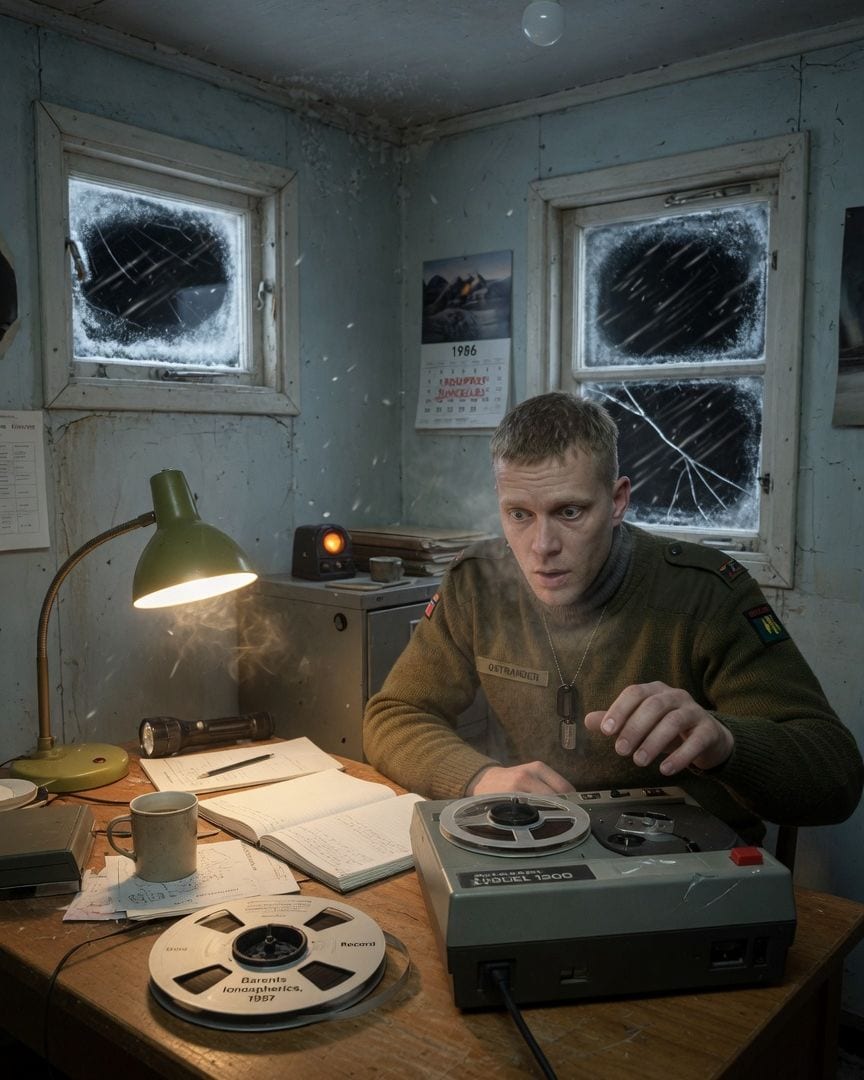
A Cold War sergeant in a lonely fell hut plays a 1957 reel. It names his service number and a fresh scratch he just made.
Sergeant Pell Ostrander, a methodical man of thirty-five, was isolated in a Norwegian fell hut in 1986, with only the generator's hum and a stack of old reels to burn by Friday. The arctic quiet led him to play a 1957 tape, expecting static. Instead, a calm voice filled the small space, detailing his exact hut, its generator, and the snow outside. His heart hammered when the voice read the log for this coming Friday, describing the record burn and more reels than he counted. But the dread truly landed when the voice named his service number and described a fresh scratch he had just made on the playback machine.
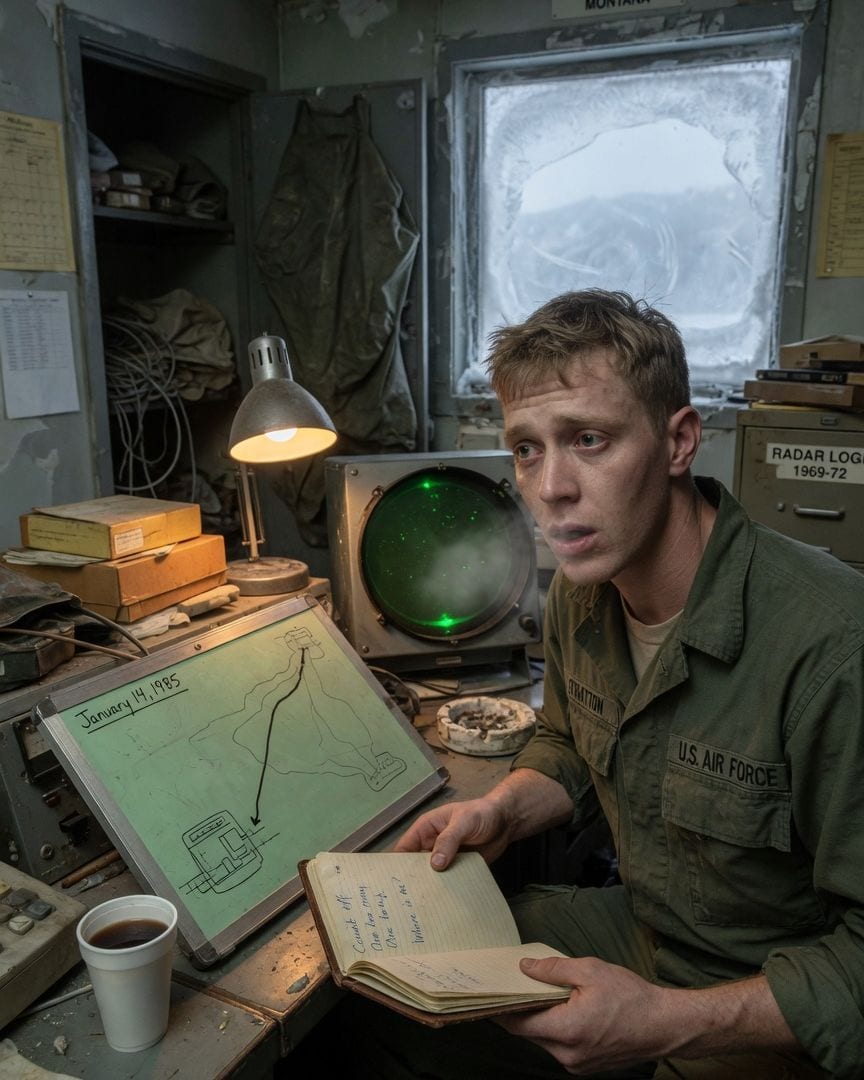
Airman Lars Stratton found an old Cold War manifest listing one name twice: 'Bernard Radcliffe' transferred and 'Bernard Radcliffe' still present.
Airman Second Class Lars Stratton was counting down his final weeks at Echo Station, a desolate Cold War outpost due for mothballing. He longed for home, far from the bitter Montana winds and the constant hum of static. Inside the dim radar shack, he logged the usual nightly ghost blip, a faint contact appearing at 2300, just as it had every winter since 1987. This night, a metallic tang like old blood lingered in the air, raising the hairs on his arms. Seeking distraction, Lars later discovered a leather-bound logbook from 1971, detailing the same 2300 contact, but with chilling notes and a manifest listing one airman's name, Bernard Radcliffe, twice—once transferred, once present. Was he truly alone in the silent, remote station?
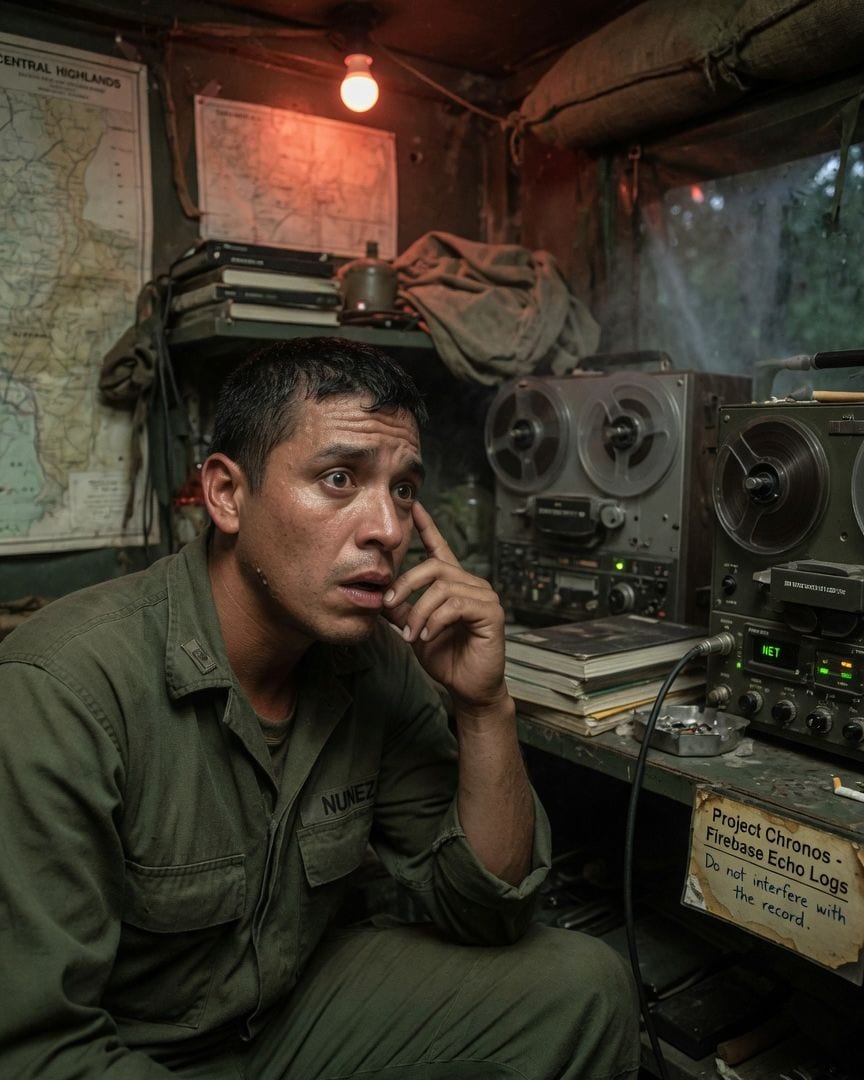
A Firebase RTO was about to send his 0400 report when his own voice crackled over the net, delivering the exact words he hadn't yet spoken.
Specialist Arthur Nunez sat alone in the RTO shack, preparing his routine 0400 SITREP amidst the humid Central Highlands night. The familiar hum of equipment was his only company, a constant drone against the isolation. Just as his thumb hovered over the transmit switch, ready to report "Perimeter quiet, all positions manned," his own voice crackled over the company net, delivering those exact words with uncanny precision. A sickening lurch twisted in his gut; he hadn't spoken a word, yet his report was already delivered by himself. Desperate for an explanation, he soon uncovered an ancient, jury-rigged reel-to-reel recorder, humming faintly. A faded label on the machine bore a stark instruction: 'Do not interfere with the record'.
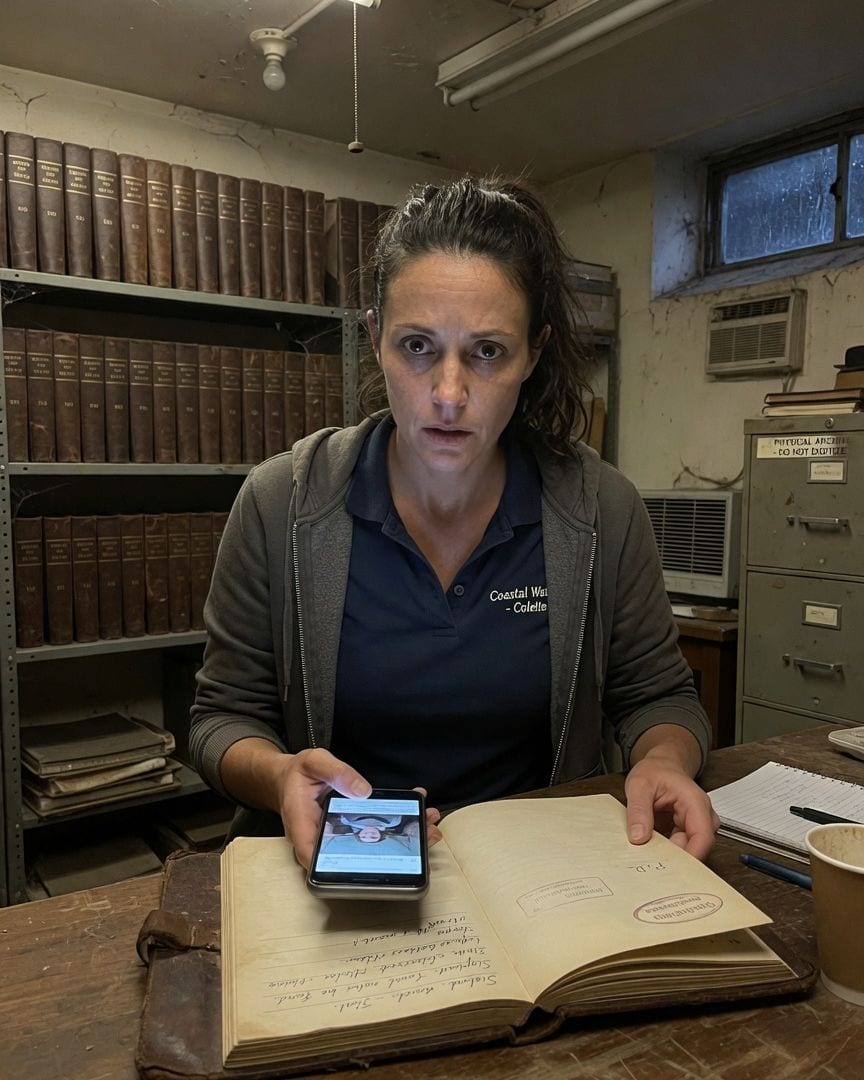
My coastguard log noted Sighting 9 again tonight, a light where no vessel showed. The old logs carry Sighting 9 off Skerry Point at 3:14am every tenth year since 1954, always 'nothing found,' always 'send no boat.'
On my watchtower night shift, the radar screen glowed green and the ocean was quiet. Then, a familiar light appeared off Skerry Point, exactly on cue, just as it had every tenth year for decades. But digging deeper, I found a hidden stamp in an old logbook: 'Operation Skerry. Status: Complete.' It left me with a chilling sense of finality.
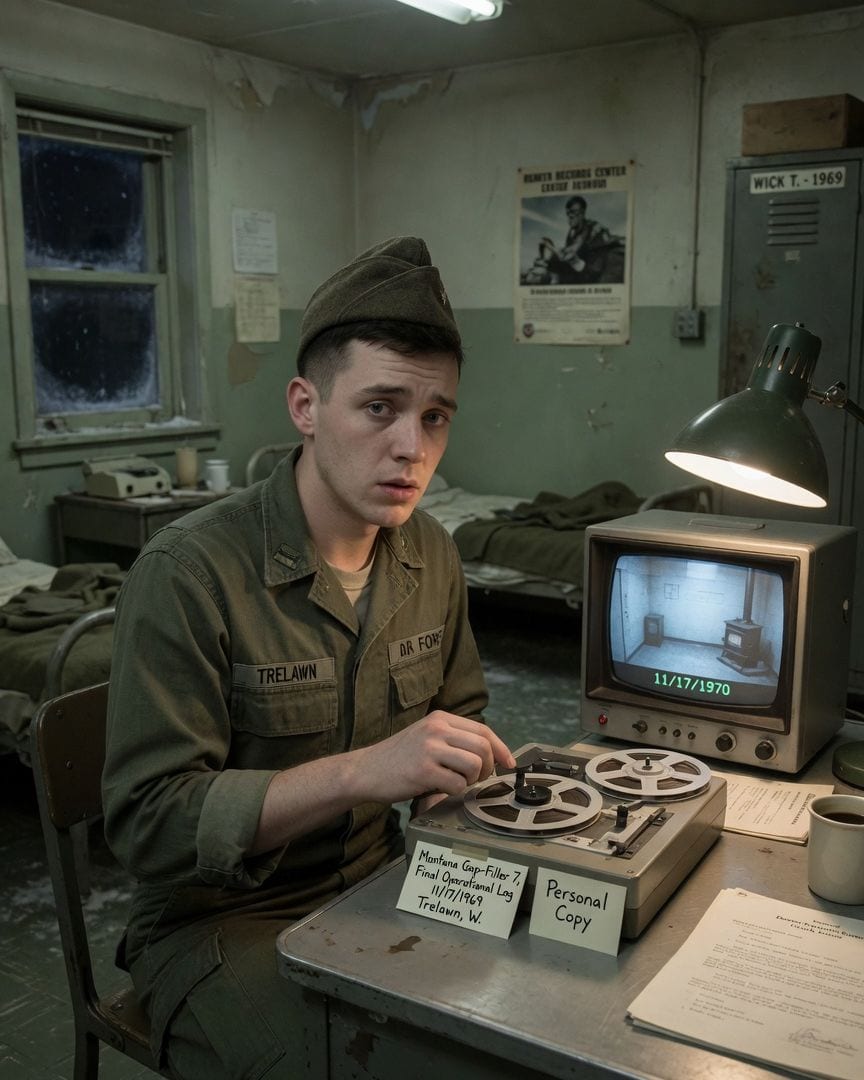
A Cold War gap-filler station was locked cold. Airman Wick Trelawn's final tape showed a man powering up the console a year later.
Airman Wick Trelawn shivered through his final hour at the remote Montana Gap-Filler 7, a Cold War radar station set to go cold forever. He meticulously logged its last operational moments, pulling the master tape as a final record. Later, reviewing a personal copy, Trelawn watched his empty control room play out as expected, but the tape kept running into a second hour. An indistinct man then appeared, methodically powering up equipment in the supposedly dead station. The site had been locked cold for a year by then, yet his official request for the original tape revealed a blinking timestamp of November 17, 1970. What impossible operations did the final log truly capture?