A Cold War comms operator at a remote outpost hears predecessors listed as 'stopped answering' — then the voice calls his own name.
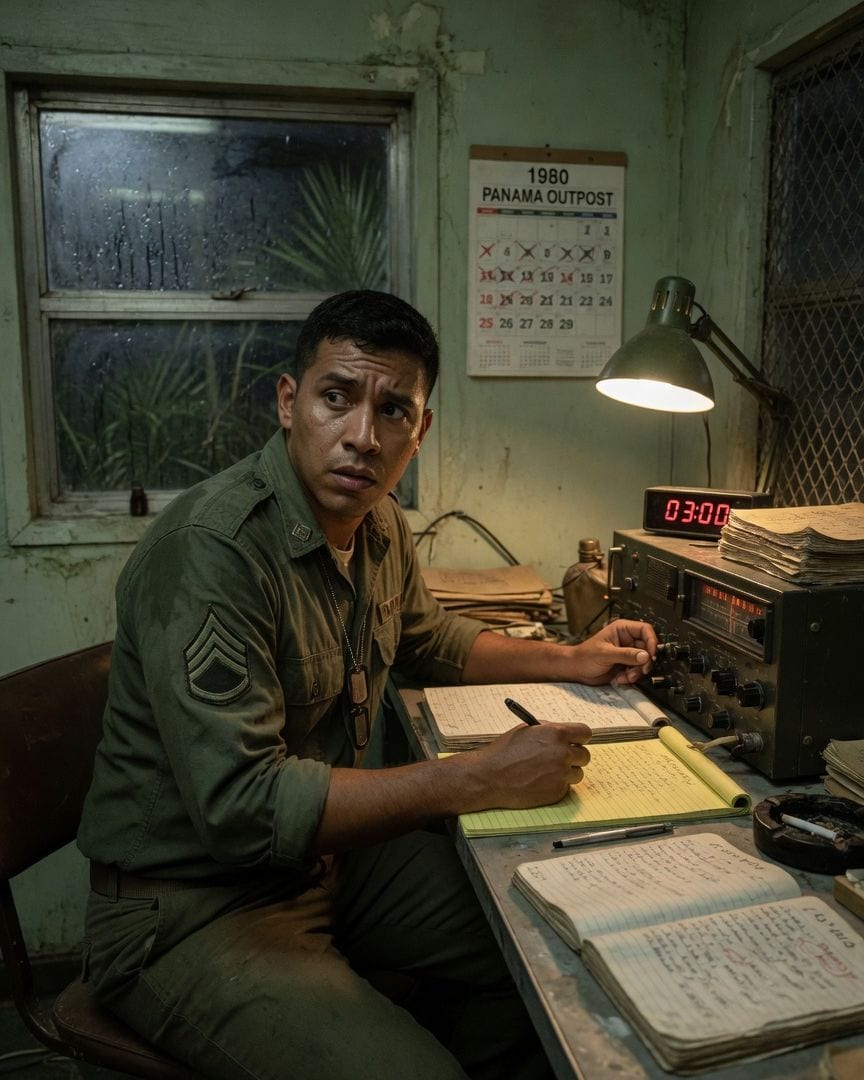
The damp Panamanian night pressed against the thin walls of the remote outpost. Sergeant Adam Ibarra sat in the comms shack, the hum of the old equipment his only companion. It was 1980.
For three nights, at exactly 0300, a looping transmission began on the single set. A woman’s calm, level voice read a list of names and dates.
The first night, Ibarra had dismissed it as a test loop, a forgotten training tape perhaps. The second, he’d checked the frequency, the equipment, found nothing amiss that a reset couldn’t fix, or so he told himself.
The third night, as the names 'Hughes, Theodore – 1953-04-12,' 'Lockwood, Isaac – 1961-08-01,' and 'Ford, Brooke – 1974-02-29' drifted through the air, Ibarra felt a cold certainty settle in his gut. This wasn't a random list.
These were the names of operators who had held his exact billet before him, in order, each name followed by the date they had stopped answering.
And after the last name, the one just before him, there was a single, expectant blank space.
The next morning, Ibarra, a squared-away soldier, began his investigation with the most mundane explanation he could find. He pulled dusty station logbooks, manifests, and personnel rosters from the storage locker, their pages brittle with humidity.
The names on the transmission—Theodore Hughes, Isaac Lockwood, Brooke Ford—were indeed listed as previous comms operators assigned to the Panamanian station.
But their official rotation dates, the dates they were transferred or honorably discharged, rarely matched the 'stopped answering' dates from the transmission. Hughes, for example, officially rotated out in '54, according to the records, but the voice said '53.
Lockwood's record simply ended with a 'transfer to classified duties' note, no specific date or destination, yet the transmission had a very precise one.
Ford's official record was heavily sealed, a rare occurrence for a simple operator, the kind of classification usually reserved for special forces or intelligence assets, not a comms tech.
Ibarra tried to reconcile the numbers, to find a clerical error, a bad sensor, anything that would bridge the gap. He ran the names, cross-referenced the dates, his brow furrowed in concentration.
The military, he knew, accounted for every single person. Every movement, every assignment, every discharge was logged, double-checked, and filed. Yet, the official records, while containing the names, offered no explanation for the transmission's dates.
It was as if two separate ledgers existed for the same men and women, with two distinct, irreconcilable outcomes for their service.
The dread that had been a chill in his gut was no longer just that; it was a tightening band around his chest.
The ordinary explanation was failing, and the gap between what should be and what was, widened with every page he turned.
That night, Ibarra didn't wait for the surprise. He sat rigid by the comms set, the receiver volume high, a pen ready, a fresh pad of paper open on the console.
The digital clock on the console blinked to 0300, and the static cleared with a soft hiss. The calm voice began its roll, exactly as it had for the past three nights. 'Hughes, Theodore – 1953-04-12. Lockwood, Isaac – 1961-08-01.
Ford, Brooke – 1974-02-29. Stratton, Donald – 1979-11-17.' Ibarra’s breath hitched in his throat. Stratton had been the operator immediately before him, according to the official manifests. The voice paused, a beat longer than usual, the silence deepening.
Then, clear as a bell, it spoke: 'Ibarra, Adam.' A profound, echoing silence followed, stretching, waiting, pregnant with an unspoken date. The receiver crackled, the static a living thing in the humid air, and the silence held.
The blank space after his name was a physical weight, pressing down on Ibarra. He spent the next days in a blur, fueled by stale coffee and a growing sense of urgency that gnawed at his stomach.
He abandoned the official manifests, knowing they would offer no solace, and sought out the station's deep storage. It was a humid, forgotten room filled with old equipment, mildewed boxes, and the scent of decay.
There, amidst antique radio parts and moth-eaten uniforms, he found a trove of handwritten logbooks, unofficial duty rosters, and personal notes left by previous operators.
These were the unofficial histories, the things that didn't make it to headquarters, the detritus of decades of lonely assignments. He meticulously cross-referenced the transmission's 'stopped answering' dates with these informal records.
He found consistent discrepancies: operators would log their last shift, describing mundane tasks or plans for their upcoming rotation, then simply vanish from the unofficial records, with no mention of transfer or discharge, often days or weeks before their official rotation dates.
One entry, dated 1961, by an operator named Joseph Kingsley, read: 'Strange hum tonight. Equipment acting up. Feels like something is listening.'
The next entry was in a different hand, a relief operator simply noting the station was 'unmanned' upon his arrival. The hum Kingsley mentioned was a constant, low thrum Ibarra now perceived beneath the normal static of the comms shack.
It was always there, a deep, resonant vibration. It grew subtly louder when he focused on the looping 0300 transmission. He felt the cold touch of a system far older, far more insidious, than simple military bureaucracy.
Every attempt to find a rational explanation, a prank, a glitch, a cover-up, dissolved into the chilling coherence of the station's own private ledger.
As Ibarra continued to dig, the comms shack, once his refuge from the encroaching jungle, became a cage.
The ambient hum grew more pronounced, a low, resonant vibration that seemed to emanate from the very walls, a subtle tremor under his feet. His equipment, usually reliable despite its age, began to act erratically.
Frequencies would drift out of calibration for no reason, static would spike to deafening levels, and sometimes, for a fraction of a second, the receiver would cut out entirely, only to snap back on with a burst of white noise.
He’d catch faint, indistinct whispers in the static, just beyond the edge of intelligibility, like distant voices murmuring his name, just out of reach.
One afternoon, while sifting through a stack of old instruction manuals that smelled faintly of mold, a folded piece of paper slipped out from between the pages of a 1950s-era field guide.
It was a small, yellowed note, brittle at the edges, handwritten in faded ink. It contained a single, stark sentence: 'Don't try to reconcile the count.' There was no signature, no date, just the stark, imperative warning.
Ibarra’s blood ran cold. Someone had known. Someone before him had seen the impossible numbers, had tried to make sense of the irreconcilable ledgers, had faced the same chilling discrepancies, and had left this desperate, quiet plea.
He was no longer just investigating; he was being observed, his futile efforts to impose order on the chaos noted by whatever intelligence maintained the station’s impossible accounting.
The silence after his name on the transmission now felt like a living gaze upon him.
Driven by the chilling note and the growing hum that now permeated his thoughts, Ibarra expanded his search to the station's locked, classified archives.
It was a small, heavily secured room he’d previously avoided, assuming its contents were merely outdated operational plans.
After picking the lock with a skill honed in basic training—a skill he never thought he’d use in this way—he found a single, thick binder marked 'Project Nightingale - Anomaly Reports.'
He pulled it out, its weight surprising, and blew dust from its cover. Inside, buried beneath layers of mundane administrative documents and obsolete equipment schematics, was a heavily redacted after-action report, dated 1957.
The report detailed a 'pattern of contact cessation' at the Panamanian comms station, noting that 'personnel assigned to billet 3-Alpha consistently cease contact by unofficial means within 6-8 weeks of assignment, with no recoverable traces.'
The report referred specifically to 'the recurring 0300 transmission' as an 'unidentified audio phenomenon' directly correlated with these disappearances. It confirmed that attempts to trace the signal source had yielded 'negative results.'
It concluded, in a chillingly bureaucratic tone, that 'the phenomenon's source remains unidentifiable, and its effects on personnel, while consistent, are not attributable to known hostile actors or environmental hazards. Recommend continued monitoring and classification as an isolated, non-threat anomaly.'
The report didn’t explain why it happened, only that it did, and that the institution he served had known for decades. Ibarra’s earlier attempts to find a rational explanation, a clerical error or a prank, shattered into a thousand pieces.
The military, the most accountable system on earth, had simply absorbed the impossible into its files, treating human disappearance as a recurring, acceptable 'anomaly,' a footnote in a classified binder.
The names on the transmission, the dates they 'stopped answering,' the sealed records, the abrupt ends to service, even the ever-present hum – it all coalesced into a horrifying, coherent pattern.
The truth was not a conspiracy, but a cold, institutional acknowledgement of something deeply, fundamentally wrong.
The classified report was a punch to the gut, but Ibarra knew there was more. The 'anomaly' had to start somewhere, had to have a beginning.
He returned to the deep storage room, his flashlight beam cutting through the dust motes dancing in the stale air. Behind a stack of rusted field radios, he spotted a loose floorboard.
He knelt, grunting as he pried it open with the flat end of a crowbar he’d found.
Inside, tucked away in the damp earth, he found a small, leather-bound book, its pages brittle with age, its cover cracked: an original construction log, handwritten, dated 1948.
This wasn’t an official military document; it was a foreman’s personal record from before the station was even completed. It detailed the challenges of building in the jungle, the endless rain, the strange soil.
And then, starting on page 17, entries began to change. He read about a 'peculiar resonance' detected during excavation, a 'crystalline structure' found deep underground. The entries grew more erratic, detailing workers feeling 'disoriented,' 'losing days.'
On the last preserved page, the foreman had listed the names of his crew, noting who had 'walked into the jungle and not returned.'
At the very bottom, scrawled in a shaky hand, was 'Theodore Hughes, Comms Operator' followed by a date: '1949-07-22.' Ibarra stared, a cold dread seizing him, an icy grip around his heart. The station wasn't officially commissioned until 1951.
Theodore Hughes, the first name on the transmission, had 'stopped answering' before the station was even officially assigned, before the military even formally existed here. The count had begun before the system even existed.
The construction log revealed the genesis of the anomaly. The foreman’s entries detailed how the crystalline formation, when disturbed during the initial excavation, emitted a low, resonant hum that caused disorientation and a strange compulsion to 'wander.'
He described how, one by one, his crew members, including the initial comms operator he had hired, Theodore Hughes, simply walked away from the site, drawn by an unseen force, never to be seen again.
The log ended abruptly, mid-sentence, the last entry describing the hum growing deafening, the foreman feeling 'pulled,' his hand shaking as he wrote.
The 'unidentified anomaly' wasn't an external force or a forgotten curse; it was the station's foundation, the very ground it stood on.
The 0300 transmission, the calm woman's voice, was the station itself, a living, resonant entity, performing its own 'accountability.' It was a systemic anomaly, not a glitch in the system, but the true, horrific function of the place.
Every 'stopped answering' date, every discrepancy Ibarra had found in the official and unofficial records, every sealed record, every abrupt end to service—it all clicked into place with horrifying precision.
The station didn't just house comms equipment; it was a mechanism that consumed and cataloged its operators, and the military, in its infinite capacity for record-keeping, had simply incorporated its impossible accounting into its own classified lexicon, acknowledging its existence without ever attempting to understand or stop it.
Ibarra was not dealing with a forgotten ghost or a prank; he was facing a living, operating system that had marked him for its next entry.
The hum in the comms shack was no longer subtle; it vibrated through Ibarra's bones, a deep, resonant thrum that seemed to align with his heartbeat, echoing in his chest.
He scrambled to his main comms set, desperate to transmit an emergency signal, to break the cycle, to send some warning. But the display was dead, the dials unresponsive, frozen.
Only the looping transmission played, the calm voice now seeming to emanate from the very air around him, a presence in the room, not just a sound from the speaker.
He tore at the control panel, yanking wires, trying to cut the power, to silence the station's deadly hum. The internal lights flickered, plunged into a momentary darkness, then flickered back on.
The hum spiked to a deafening roar that pressed against his eardrums, and the walls of the shack seemed to pulse, to breathe, their concrete surfaces subtly shifting, almost imperceptibly.
He looked at the receiver, where the list of names continued to play, his own name still followed by that terrible, waiting blank space.
He felt a profound, alien presence in the room, not hostile, but utterly indifferent, an ancient, patient intelligence that merely existed. He knew, with a certainty that chilled him to the core, that he couldn't escape.
The station had already added him to its roster. He was accounted for, in a way the military would never officially acknowledge.
He looked at the blank space after his name, and for a fleeting moment, he could almost see the date shimmering there, waiting to be filled.
Weeks later, a relief team finally arrived at the remote Panamanian station. They found the comms shack locked, its equipment silently humming. Sergeant Adam Ibarra was gone.
His personal effects were neatly stowed, his bed made, as if he had simply stepped out for a moment and would return any second.
The official logs, checked by the relief commander, showed nothing amiss: Sergeant Ibarra's rotation had ended on schedule, his transfer papers processed, though no destination was listed.
A brief 'unaccounted for' report was filed, noting an absence of explanation, then quickly closed, marked 'administrative error' by a tired clerk back at headquarters. The station, as always, was ready for its next operator.
Private Cecilia Holloway, fresh out of advanced comms training, settled into her new billet. The remote Panamanian station was quiet, save for the constant, low hum of the equipment that she was already beginning to ignore.
On her fourth night, at exactly 0300, the comms set crackled to life. A calm, level woman's voice began to read a list of names and dates.
Holloway listened, intrigued by the unexpected broadcast, as the list progressed: 'Ford, Brooke – 1974-02-29. Stratton, Donald – 1979-11-17. Ibarra, Adam – 1980-08-03.' The last date was recent, strikingly so. Holloway felt a shiver trace its way up her spine.
Then, the voice spoke her own name, 'Holloway, Cecilia,' and paused, leaving a long, expectant silence in its wake.
The hum in the comms shack was a constant, low thrum that Private Holloway had already grown accustomed to. She simply adjusted her headset, waiting for the list to loop back to the beginning.
If this one got to you
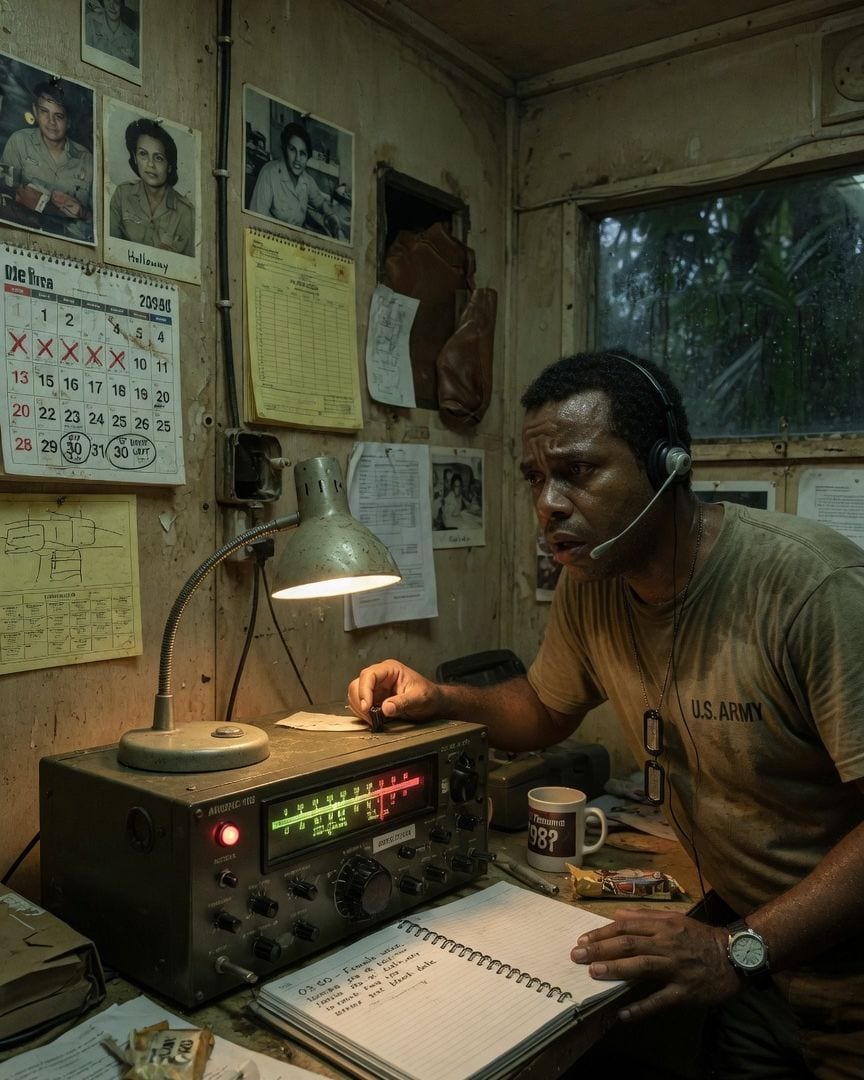
Three months from his tour ending, a sergeant's Cold War radio lists his name with a blank 'ceased answering' date. A hidden logbook warns: 'It knows my name.'
Sergeant Kevin Brooks was three months from finishing his year-long tour at a remote Panamanian jungle station. He meticulously marked each passing day, eager to escape the humid nights and unseen blossoms pressing against the comms shack walls. But at 0300, his old radio crackled to life with a woman's calm voice, listing names of past operators who 'ceased answering.' Then the voice spoke his own name, leaving a chilling blank space where his date should have been. What grim roll call had Sergeant Brooks stumbled upon?
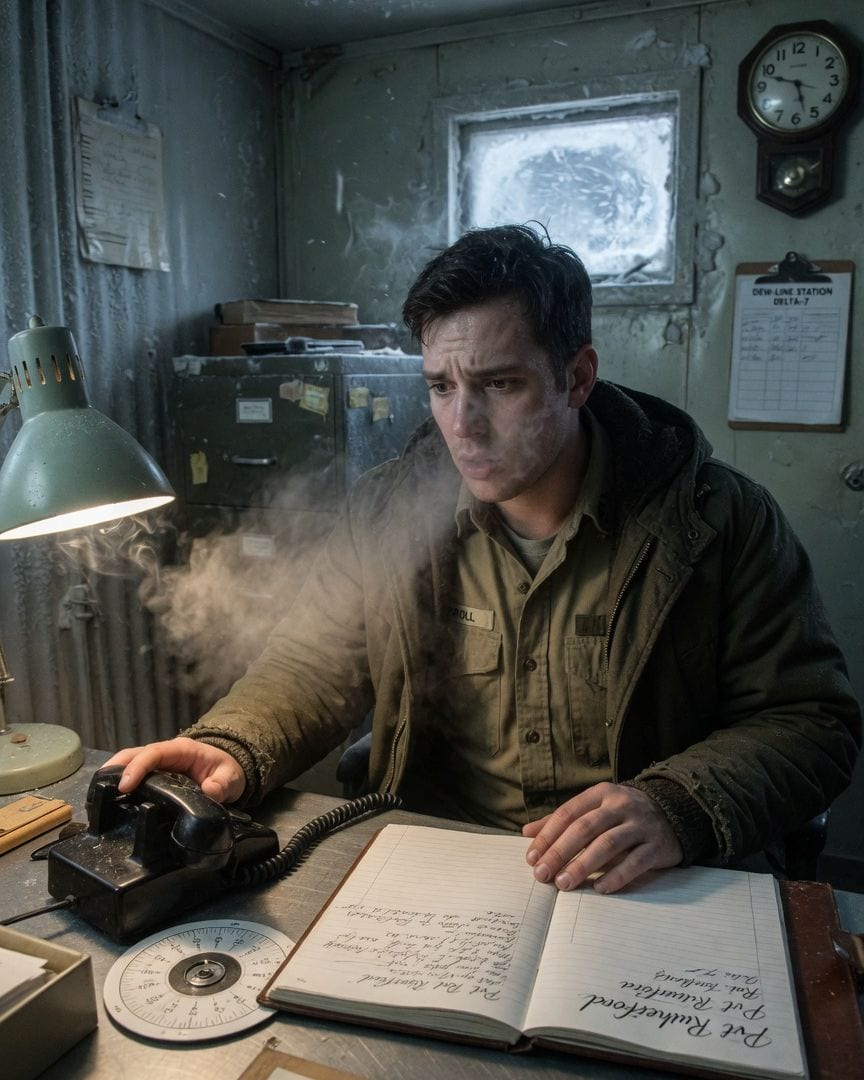
A communications specialist saw his last line go dead. Then the old Cold War field phone rang with a voice from 1966, naming a man freshly signed into his current shift log.
Specialist Walter Kroll shivered in the frigid communications room of DEW-line Station Delta-7, completely cut off by a historic Arctic blizzard. He had personally watched the last hard-wired connection to the outside world snap earlier that day. Now, past midnight, the old field phone at his position began to buzz, impossible from a line he knew was dead. A calm, unfamiliar voice spoke, reading a crew roster Kroll didn't recognize, including Private Rutherford. His search through decades of dusty logbooks revealed Rutherford was assigned to this exact watch in 1966, but then Kroll found the same name freshly inked into his *current* shift's sign-in sheet.
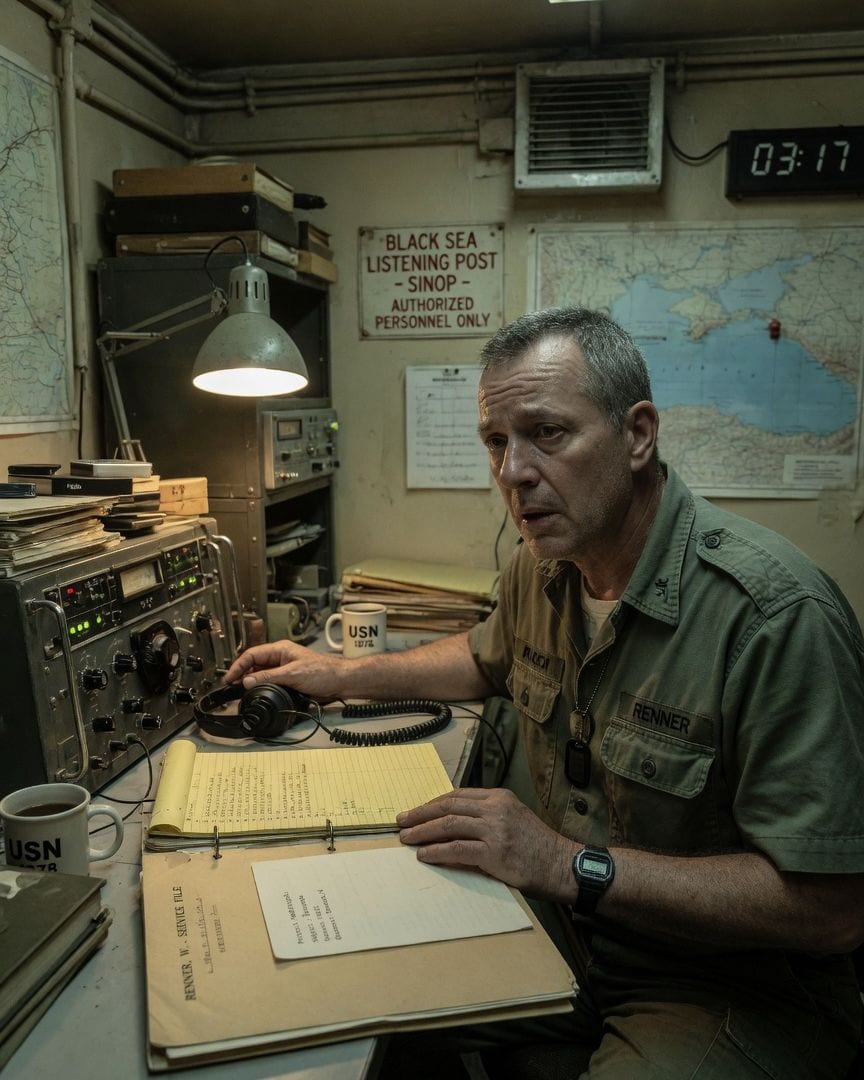
Specialist Walt Renner had six weeks left at Sinop when his Cold War numbers station stopped counting and spoke his mother's name: 'Walter.'
Specialist Walt Renner had just six weeks left at the Sinop station, anticipating the close of his thirty-year career. For almost two decades, he had tracked a mysterious numbers station, broadcasting from an impossible point in the Black Sea. Tonight, the woman's flat voice stopped counting, and the static cleared, replaced by a single, perfectly clear word: 'Walter.' It was the intimate name his mother had used, a name he hadn't answered to in decades. Yet, it emanated from the same empty water, a deeply personal address from the void itself.
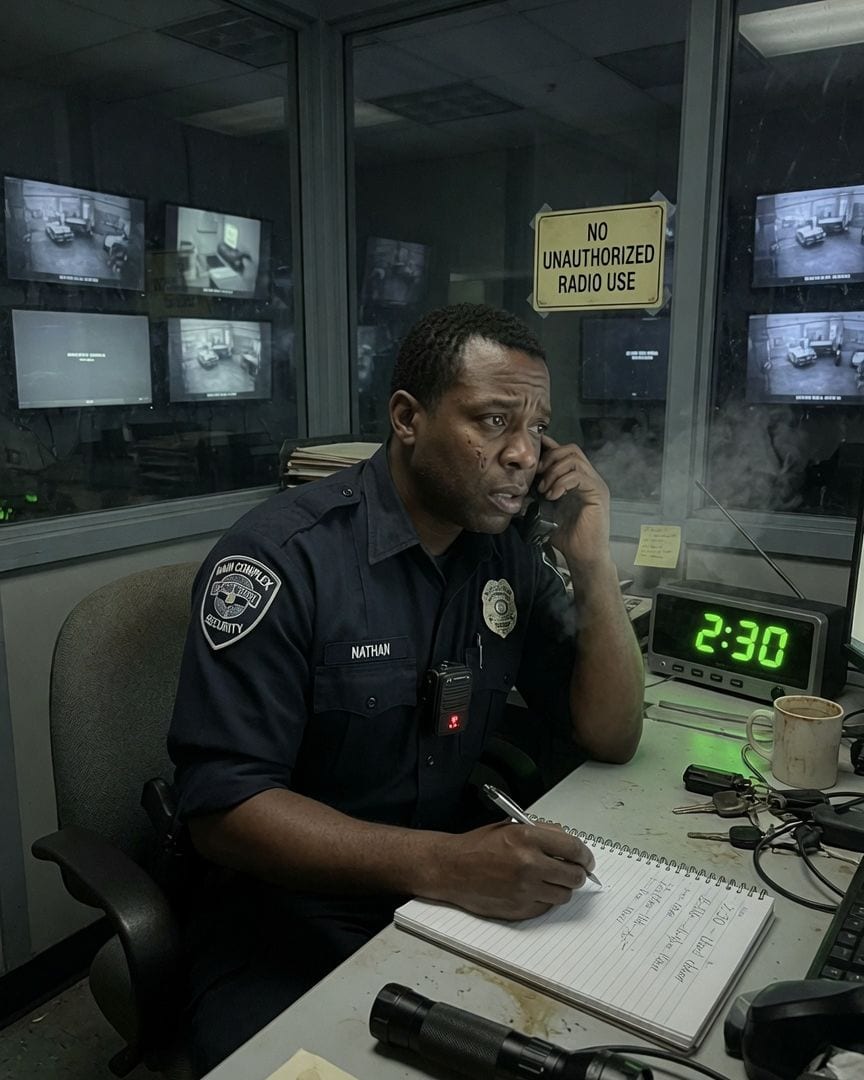
I radio Cole every night. My supervisor says his dock post was cut two years ago, and no Cole exists. But I just found Cole’s old logbook.
My graveyard shift usually consists of monotonous hourly check-ins with Cole, the guard at the loading dock. But my supervisor just revealed that the dock post was cut two years ago, and no one named Cole has ever worked for the company. I've been talking to someone who simply isn't there.
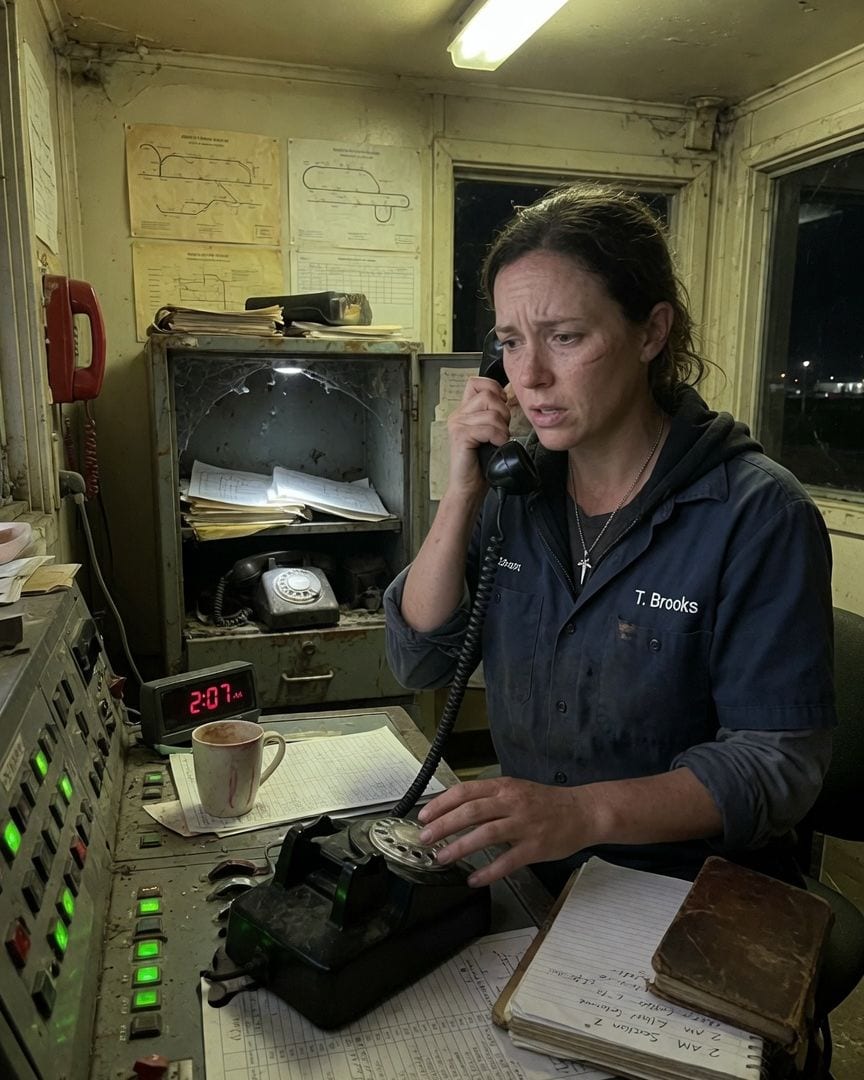
My signal box gets a 2 AM call every night from a man whose section was demolished eleven years ago. Now I found his logbook with today's date.
My night shift at the signal box is quiet and precise, defined by the routine 2 AM call from Ellis confirming Section 7 is clear. But when I asked my duty manager to log it, he said Section 7 hasn't had a track walker in eleven years, not since its cabin and phone were demolished.
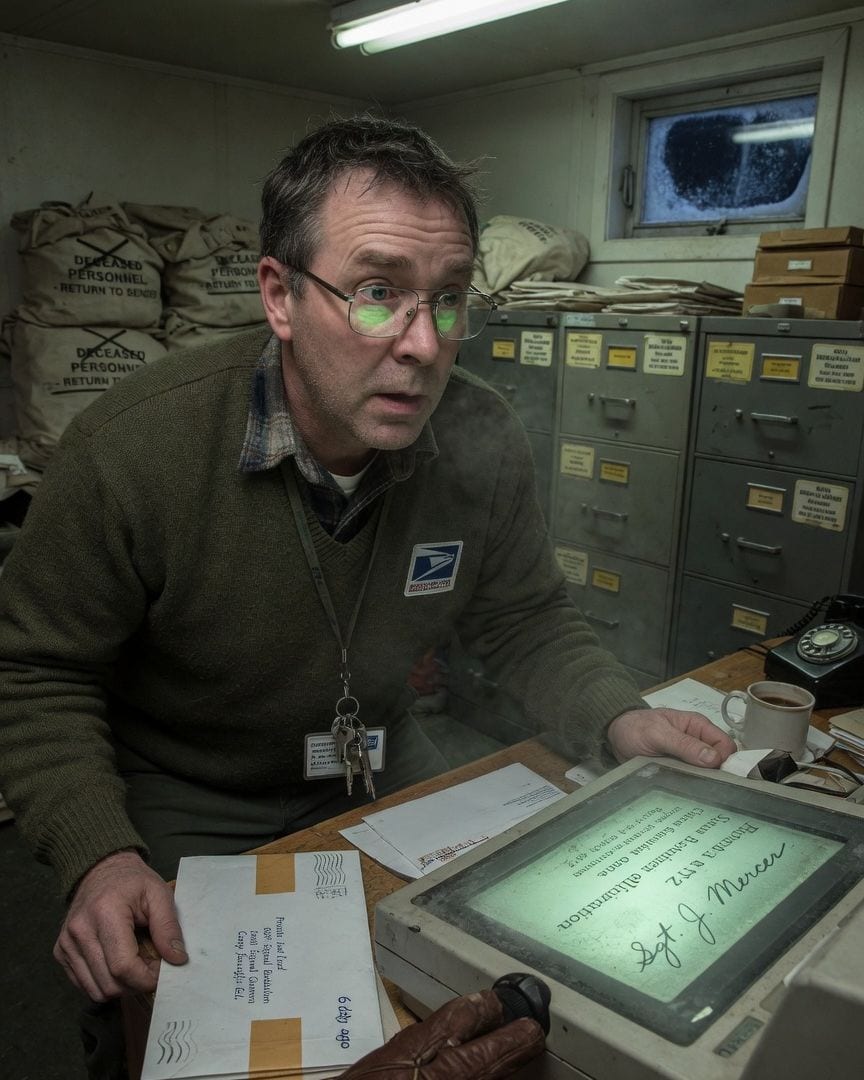
A postmaster at a Cold War Alaskan outpost still received mail for soldiers declared dead in 1969. Then he found their base was active three years later.
Postmaster Rowan Ashcroft had spent two decades watching the weekly mail plane land at Camp Bidwell Annex, a lonely outpost in the bitter Alaskan wind. His methodical mind, accustomed to order, was jolted when the latest mail sack contained forty-three letters for men officially declared dead in 1969. Each envelope, postmarked within days, was addressed to a soldier who wasn't coming back, and Rowan found one already opened and neatly resealed. Driven by duty, he began to sift through declassified Army archives, only to uncover a chilling maintenance log entry for the camp's equipment, dated three years after the base was officially shuttered. What was still happening at Camp Bidwell?