Specialist Walt Renner had six weeks left at Sinop when his Cold War numbers station stopped counting and spoke his mother's name: 'Walter.'
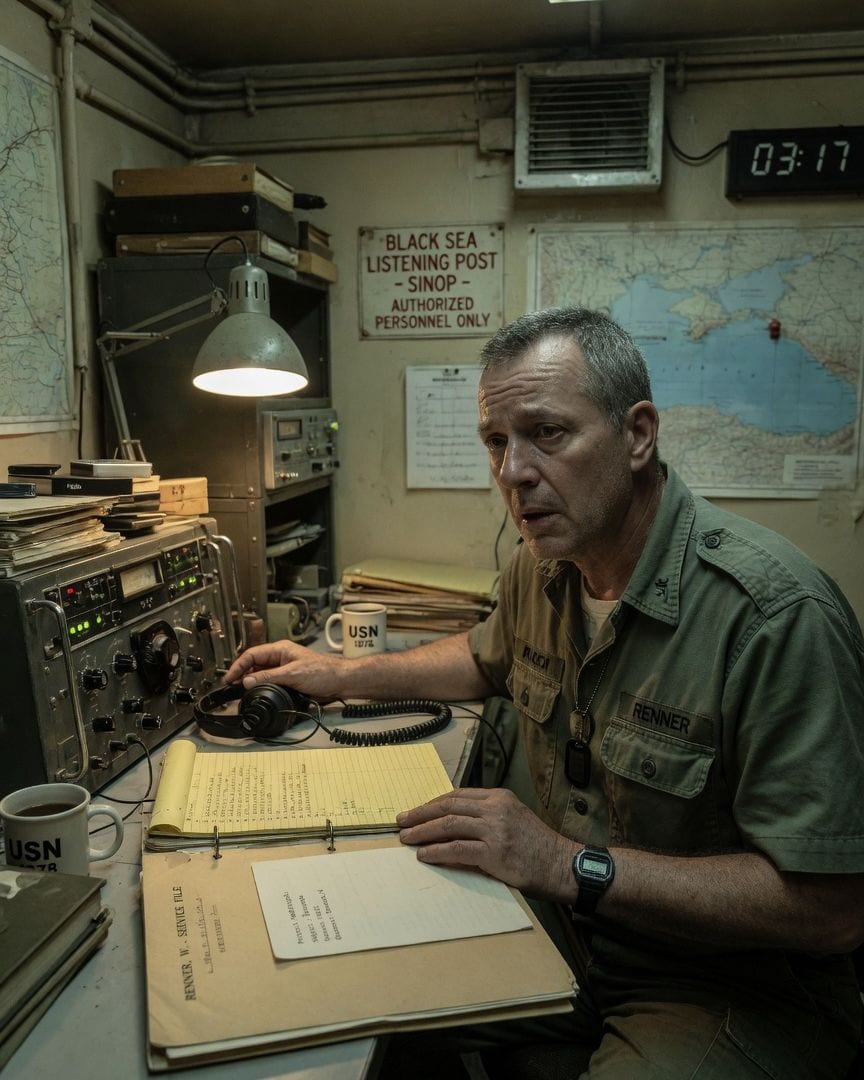
Specialist Walt Renner adjusted the dials on the AN/SLR-1 receiver, the familiar static of the Black Sea numbers station filling his headphones. Six weeks.
That’s all he had left at Sinop, then the station would be decommissioned, and his thirty-year career would finally close.
He’d chased this particular ghost since 1952, a woman’s flat, uninflected voice reading sequences of numbers from an impossible point in the open water where no transmitter could be.
For almost two decades, the anomaly had been a constant, a quiet hum beneath the surface of his professional life.
He'd made his peace with the impossible, accepting it as an unsolvable quirk of the ionosphere or some deeply buried, unacknowledged program.
But tonight, the voice stopped counting.
The static cleared, cutting out with an abruptness that made the silence in the small radio room feel vast. Then, a single, perfectly clear word came through.
It was calm and resonant, utterly devoid of any detectable accent or inflection, yet intimately familiar. "Walter."
It was the name his mother had used, the one he hadn't answered to since she died, decades ago. Not ‘Specialist Renner,’ not ‘Walt,’ just ‘Walter.’
The receiver’s direction finder still pointed to empty water, the vast, featureless expanse of the Black Sea where nothing could transmit, but the voice had found him.
A chill settled over him, deeper than the usual night air from the vents.
Walt, ever the methodical technician, systematically checked every component of the set. He traced the cables, verified the power supply, and confirmed antenna alignment – all nominal. The equipment lights glowed steady green.
He ran diagnostics programs that cycled through frequencies and power outputs, swapped out tubes, even pulled a backup receiver from its climate-controlled storage and hooked it up.
The voice, now back to its usual numbers, continued its placid count in his headphones, steadfastly, impossibly, emanating from the same empty coordinates.
It mocked his attempts at a mundane explanation, refusing to be a faulty component, a stray signal, or a prank. The room itself seemed to hold its breath around him, waiting.
He accessed the station’s archives, a dusty, dimly lit annex filled with decades of logs and reports. He cross-referenced past incidents of unusual transmissions, searching for anything remotely similar to a personal address.
He found scattered reports of 'anomalies' over the decades: strange harmonics, unidentifiable modulations, brief bursts of unintelligible speech. These were always dismissed by official channels as atmospheric distortions or foreign jamming attempts. Nothing like a specific, personal address.
The rational part of his mind, the part that had kept him sane through years of listening to the void, suggested a breach, a highly sophisticated, targeted psychological operation. But why him? And why 'Walter'?
He requested his own service file, a thick manila folder filled with commendations, postings, and medical records from his thirty years of service.
He carried it back to the radio room, the folder heavy and stiff, and meticulously scanned every page, looking for anything out of place, any hint of compromise, any reason a targeted operation might focus on him.
Near the bottom, tucked behind a commendation from his time in Korea, he found a single, faded addendum. It was a single line, almost erased, dated 1952, the year he first heard the voice. It simply read: 'Project Nightingale.
Subject: VOICE. Observer: Renner, W.'
Walt’s finger traced the faint, looping script. Project Nightingale. He'd never heard of it. The words seemed to almost hum beneath his touch, a quiet, impossible resonance.
His own name, typed cleanly in the main record, was then followed by the handwritten 'Observer: Renner, W.' It wasn't a breach, he realized with a cold certainty; it was a record. A record of him, from the very beginning.
He wasn't just a lone witness; he was, in some official capacity, part of whatever this was. The file had known, even then.
He looked up, his gaze sweeping the silent, humming equipment in the secure room, the static of the Black Sea now a faint whisper around him. The numbers station continued its placid count in his headphones, a calm, unwavering drone.
But now, it wasn't just a signal. It was an entry in a ledger that had been tracking him for nineteen years.
Over the next few days, Walt leveraged his access and the impending station handover as cover, digging deeper into 'Project Nightingale.'
He tried the official channels first, but they yielded nothing; it was a ghost entry, declassified and then apparently purged from all accessible databases. No one seemed to have heard of it, or if they had, they weren't saying.
He tried the unofficial route, leaning on old contacts in Ankara, hinting at a historical technical curiosity, an obscure Cold War-era program.
Eventually, a cryptic message led him to a forgotten sub-basement at Sinop, a place he hadn't known existed despite his years at the station. It was a dusty, sealed-off archive room marked 'DEACCESSIONED – HOLD.'
The air inside was thick and stale, smelling of ozone and forgotten paper.
Inside, amidst mothballed equipment, decaying furniture covered in white sheets, and stacks of rusted ammo cans, he found a single, heavy wooden crate, stenciled roughly with 'NIGHTINGALE – BLACK SEA ANOMALY.'
The crate contained dozens of thick, bound logbooks, reel-to-reel tapes that crumbled at the edges, and brittle reports, spanning from the early 1950s through the late 1960s.
He started with the logs, noting the meticulous entries detailing the voice’s impossible coordinates, its consistent cadence, and the recurring frustration of operators trying to locate its source. The entries were dry, technical, but a pattern slowly began to emerge.
Some reports hinted at more, scrawled marginalia in different hands: 'Operator reports… personal interaction?' or 'Subject exhibited unusual distress after transmission.' But these were always crossed out, officially dismissed in red ink as 'operator fatigue' or 'psychological stress.'
The logs became a morbid diary of unexplained incidents, meticulously documented and then just as meticulously disavowed.
As Walt continued his covert research, he started to notice things in the archive room.
The heavy steel door, which he'd sealed with a simple string-and-tape 'do not disturb' sign, occasionally showed signs of having been briefly entered, the faint layer of dust on the floor disturbed in faint, almost imperceptible patterns.
Files he'd been actively reviewing, left neatly stacked on a table, would sometimes be re-shelved, not quite in their original spot, or a logbook he'd left open to a specific page would be closed and placed back on the shelf.
The air itself sometimes felt colder, as if someone had just passed through, leaving a faint chill in their wake.
Then there was Dean Vance, the station's civilian archivist. Vance was a man Walt had barely noticed before, a quiet figure who kept to himself in his small office crammed with files.
But Vance began to appear more frequently, always with a polite, almost too-casual question about Walt's 'historical research,' or a comment about 'how some things are best left buried.'
His eyes, behind wire-rimmed glasses, seemed to follow Walt with an unsettling, patient quality. One afternoon, Vance approached Walt directly as he was leaving the archive, carrying a stack of files back to his office.
Vance stood in the dimly lit hallway, arms crossed, his shadow long and distorted by the single bare bulb overhead.
'Interesting stuff down there, Specialist?' Vance asked, his smile not quite reaching his eyes. The words seemed to hang in the stale air. 'Some of those old records… they can get under your skin.
Especially the ones about the ones who just… disappeared. Best to let the past stay where it is, wouldn't you say?' The implication was clear: Walt's digging was noticed, and Vance knew exactly what he was looking for.
Walt cornered Vance in his office the next day. The numbers station’s hum felt like a low thrum in Walt's ears even without headphones, a phantom sensation. 'What do you know about Project Nightingale, Dean?'
Walt asked, cutting straight to it, watching Vance’s pleasant facade crack like old plaster.
'Just… old history, Specialist,' Vance mumbled, picking at a loose thread on his tweed jacket. 'Things from before my time, mostly. Obscure stuff.'
Walt pushed, his voice low and insistent. 'Your file says you were a junior clerk here in '52. You were here when I first heard it.
You were here when the marginalia started appearing, the ones about 'personal interaction' and 'unusual distress.' You were here when people started vanishing.'
Vance sighed, running a hand over his thinning hair, his eyes darting to the closed door. 'Alright, alright. It wasn’t just 'operator fatigue.' The voice… it was selective. It would sometimes… engage. Call out names. Private nicknames.
The kind of name only a mother would use, or a childhood friend.' A fresh wave of cold washed over Walt. 'And the operators… some of them just… vanished. No trace. Official line was desertion, or 'classified relocation.'
But we all knew.'
He pulled a small, leather-bound diary from a locked drawer, its cover worn smooth. 'This was my predecessor's. He kept his own notes, unofficial. Said the voice was 'integrating' them. He vanished too.'
Vance flipped through the brittle pages to a specific entry, dated late 1952. Walt leaned closer, reading the faded ink. It detailed a young airman, Private Robert Ellison, being addressed by his childhood nickname, 'Bobby,' by the voice.
The entry ended with a chilling postscript: 'Bobby never reported for his next watch. File closed: Subject Integrated.'
Walt felt a cold knot tighten in his gut. The 'personal interaction' wasn't a glitch; it was a mechanism. The disappearances weren't random; they were part of a process. And the voice had called him 'Walter.'
The hum in his ears intensified, a phantom echo of the impossible signal.
Vance, his face pale, closed the diary with a soft click. 'It's a pattern, Specialist. Across decades. Different stations, different operators. Always the same. The voice picks them, calls them, and they're gone. The files just… stop. Or get sealed.'
He opened another drawer and pulled out a single, large, faded ledger, its spine cracked, the pages thick and yellowed. 'This is the master list. The 'integrations'.'
He pointed to a column of names and dates, each followed by the chilling phrase 'File Closed: Subject Integrated.'
Walt’s eyes scanned the list, his heart hammering against his ribs. He saw Robert Ellison's name from 1952. Then, further down, his own name appeared again, an entry from 1952: 'Renner, Walter. Classification: MONITOR. Status: UNINTEGRATED.'
He felt a wave of nausea, a dizzying sense of being observed from a distance that spanned years. He wasn't just an observer; he was an anomaly, a target that hadn't been 'integrated.'
But then, just below his own entry, in a different, more recent hand, perfectly neat and precise, dated 1971, was a new line. It stated: 'Status: TARGETED.'
He looked up at Vance, whose face was now utterly devoid of emotion, his eyes fixed on some distant point beyond Walt, as if seeing an inevitable outcome already unfolding. The file hadn't just been writing; it had been waiting.
Walt stumbled back, the ledger falling to the floor with a dull thud. 'Targeted?' he whispered, the word catching in his throat. Vance finally looked at him, his gaze heavy with a terrible, resigned understanding.
The light from the single window caught the dust motes dancing in the air, making the room feel suddenly fragile.
'Project Nightingale wasn't about understanding the anomaly, Specialist,' Vance said, his voice flat. 'It was about containing it. Or, when containment failed, documenting it. The voice… it's a kind of consciousness, or an echo of one.
It senses, it learns, and it absorbs. The numbers are its language, its way of mapping the structure of things. The names are its way in. Its method of initiating contact for assimilation.'
Vance pointed to an older section of the ledger, where the name Dr. Constance Ellison’s signature appeared on every 'integration' report, a neat, looping hand that Walt now recognized. 'Dr. Ellison. She understood it. She formalized the process.
Not to stop it, but to record it. To track the 'acquisitions'.'
Walt realized the horrifying coherence. The voice wasn't a foreign enemy, an intelligence to be defeated, but a fundamental, patient horror that had found a way to bridge dimensions, using the very systems designed to listen as its conduit.
The 'files' were the institutional record of its slow, methodical consumption. The military, the government, hadn't defeated it; they had simply decided to manage the paperwork of its slow, inevitable spread, filing away the lost as 'integrated subjects.'
He was not just a target; he was the next file to be closed, the next entry to be signed off. The numbers station wasn't just broadcasting; it was hunting.
The thought of being 'integrated,' of his consciousness being subsumed into the endless, numerical hum, sent a primal terror through Walt. He had six weeks. No, less now.
The handover was a deadline, a final closing of the file, and his own. He had to escape Sinop before it was too late.
He tore through the archive, shredding his personal copies of the Nightingale logs into tiny pieces, deleting his digital footprints from the station's computers, wiping any trace of his access.
He felt a faint, almost imperceptible whisper in the back of his mind, a low, rhythmic counting that tugged at his thoughts, testing his resolve. It was the voice, already probing, already reaching.
He ran, scrambling through the deserted corridors of the closing station, the hum of the numbers station now a constant, internal drone, louder than any external signal.
His only chance was the last transport convoy, scheduled to depart for the port in an hour, carrying the final personnel and equipment out of Sinop forever.
As he burst out into the cool night air, the wind off the Black Sea sharp and cold, he saw them.
Dean Vance and Dr. Constance Ellison stood by a parked staff car, observing him from a distance near the main gate.
Their faces were impassive, almost serene, as if watching a predictable, inevitable event, a known variable reaching its predetermined end.
He didn't look back, adrenaline coursing through him, as he sprinted towards the distant rumble of the departing trucks, the Black Sea wind whipping at his face.
He made it, leaping onto the tailgate of the last vehicle as it pulled away, leaving the silent, watchful station, and the two figures, behind.
Walt made it back to the States, discharged with a commendation for 'exceptional service' and a record mysteriously scrubbed clean of any mention of Sinop or Project Nightingale.
The voice had not followed him through the radios, but the quiet drone of the numbers station never truly left him; it was a persistent echo in the hollow space between his thoughts.
He moved from town to town, always restless, always listening, always checking his radio, always expecting the silence to break.
He learned to live with the hollow space inside him, the permanent sense of being watched, of being a file that was still open, still waiting for its final entry.
The world moved on, oblivious to the quiet horror filed away in forgotten archives, and the ones who quietly watched over its ledger.
Months later, a plain envelope arrived at his anonymous rented room in a small coastal town. No return address, no stamp. Inside was a single, official-looking form, titled 'Personnel Status Update.'
His name, 'Renner, Walter,' was typed neatly at the top. The box for 'Status' was blank. Beneath it, in a steady, official hand, was a handwritten note:
Still listening?
If this one got to you
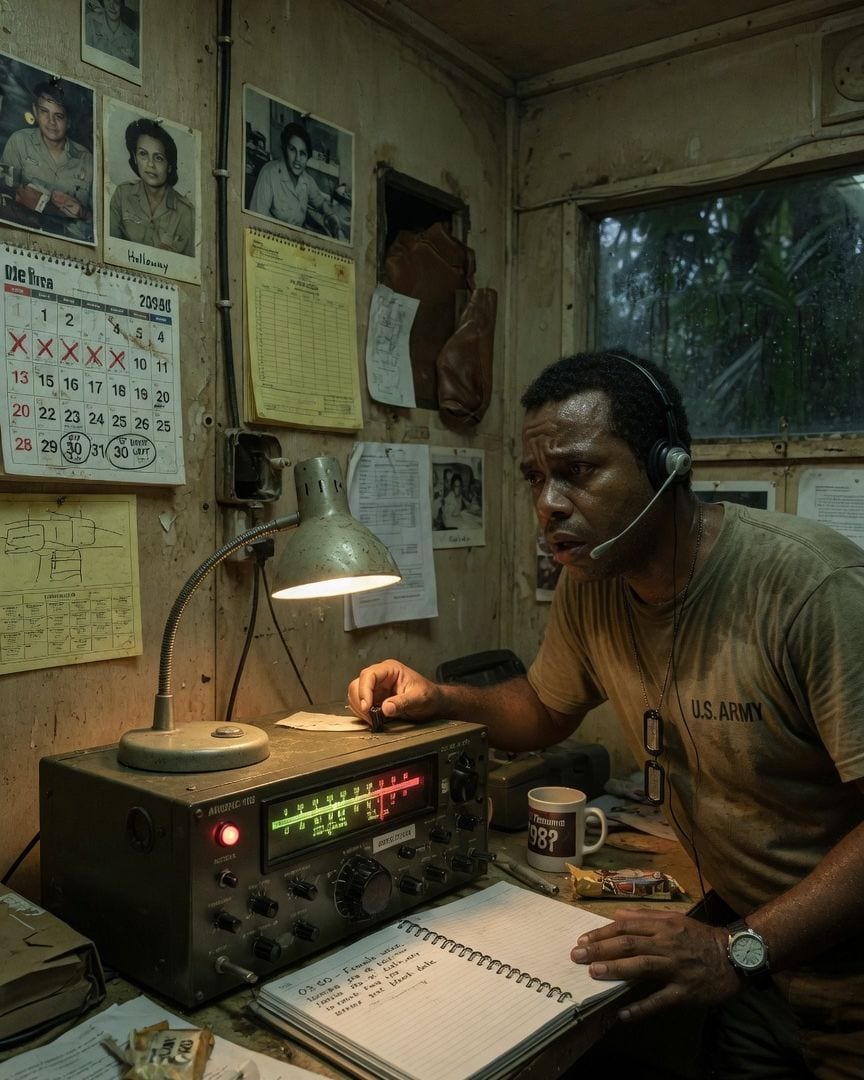
Three months from his tour ending, a sergeant's Cold War radio lists his name with a blank 'ceased answering' date. A hidden logbook warns: 'It knows my name.'
Sergeant Kevin Brooks was three months from finishing his year-long tour at a remote Panamanian jungle station. He meticulously marked each passing day, eager to escape the humid nights and unseen blossoms pressing against the comms shack walls. But at 0300, his old radio crackled to life with a woman's calm voice, listing names of past operators who 'ceased answering.' Then the voice spoke his own name, leaving a chilling blank space where his date should have been. What grim roll call had Sergeant Brooks stumbled upon?
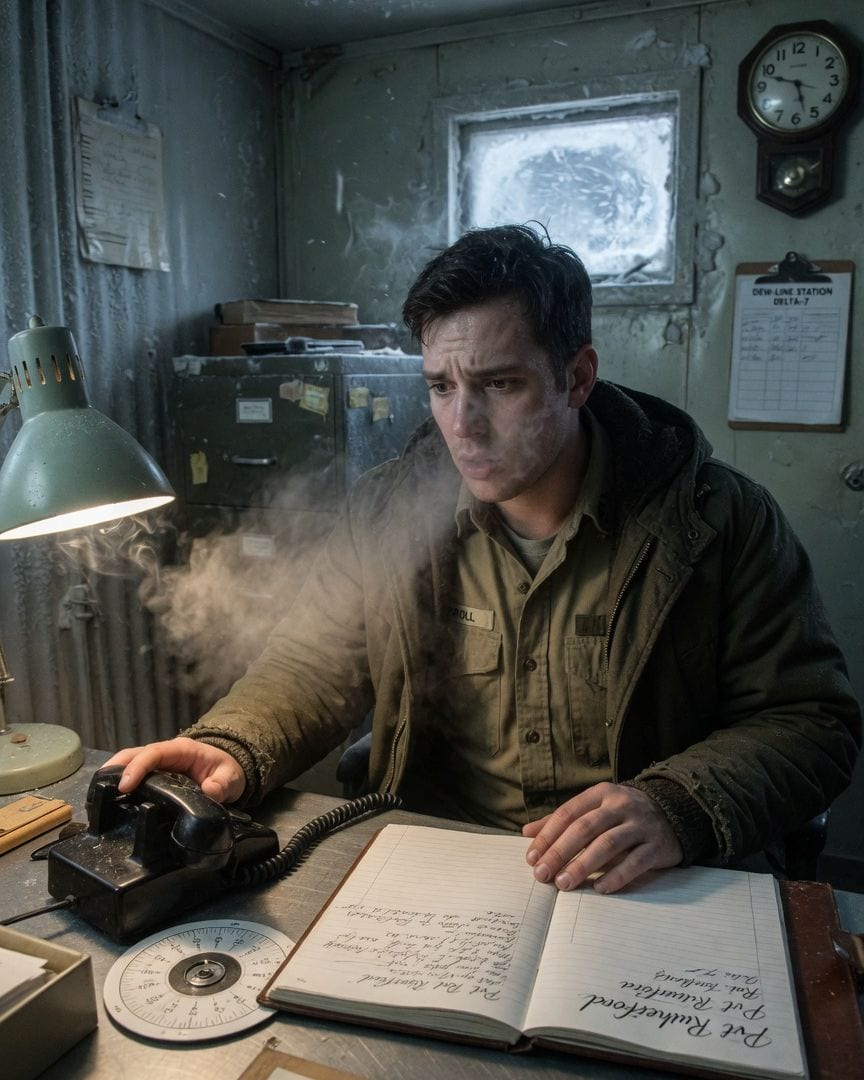
A communications specialist saw his last line go dead. Then the old Cold War field phone rang with a voice from 1966, naming a man freshly signed into his current shift log.
Specialist Walter Kroll shivered in the frigid communications room of DEW-line Station Delta-7, completely cut off by a historic Arctic blizzard. He had personally watched the last hard-wired connection to the outside world snap earlier that day. Now, past midnight, the old field phone at his position began to buzz, impossible from a line he knew was dead. A calm, unfamiliar voice spoke, reading a crew roster Kroll didn't recognize, including Private Rutherford. His search through decades of dusty logbooks revealed Rutherford was assigned to this exact watch in 1966, but then Kroll found the same name freshly inked into his *current* shift's sign-in sheet.
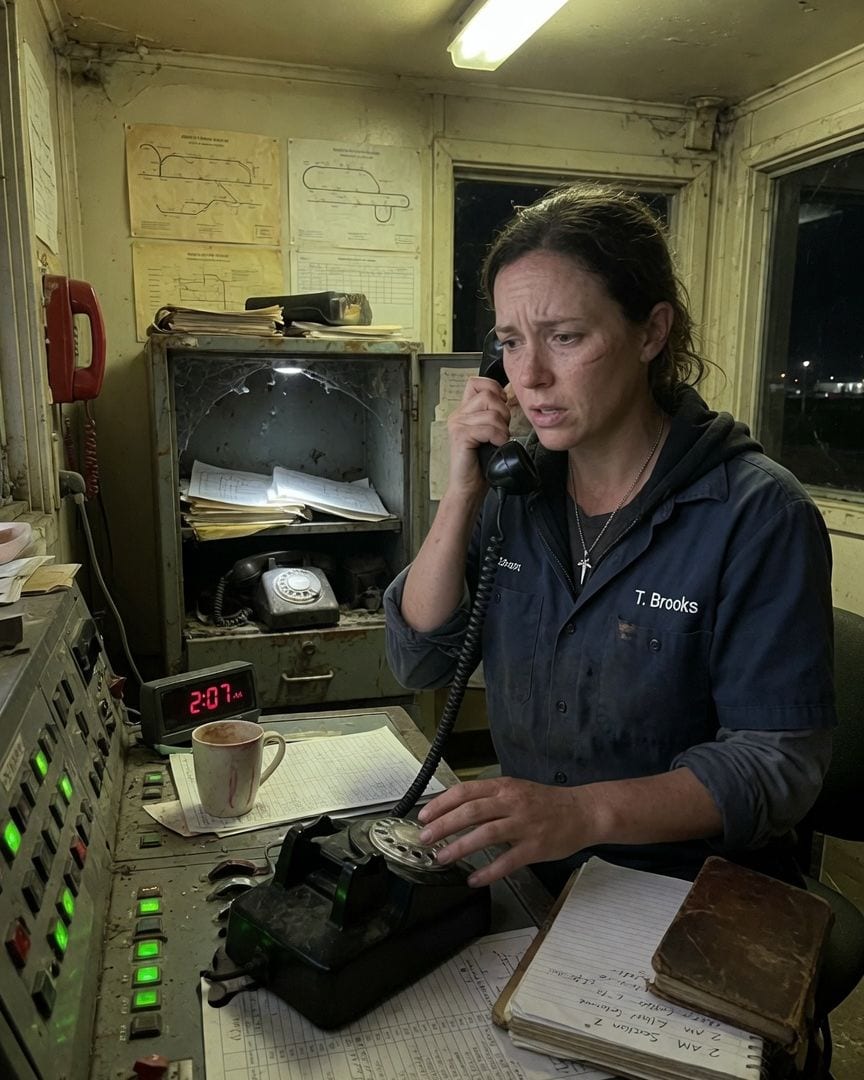
My signal box gets a 2 AM call every night from a man whose section was demolished eleven years ago. Now I found his logbook with today's date.
My night shift at the signal box is quiet and precise, defined by the routine 2 AM call from Ellis confirming Section 7 is clear. But when I asked my duty manager to log it, he said Section 7 hasn't had a track walker in eleven years, not since its cabin and phone were demolished.
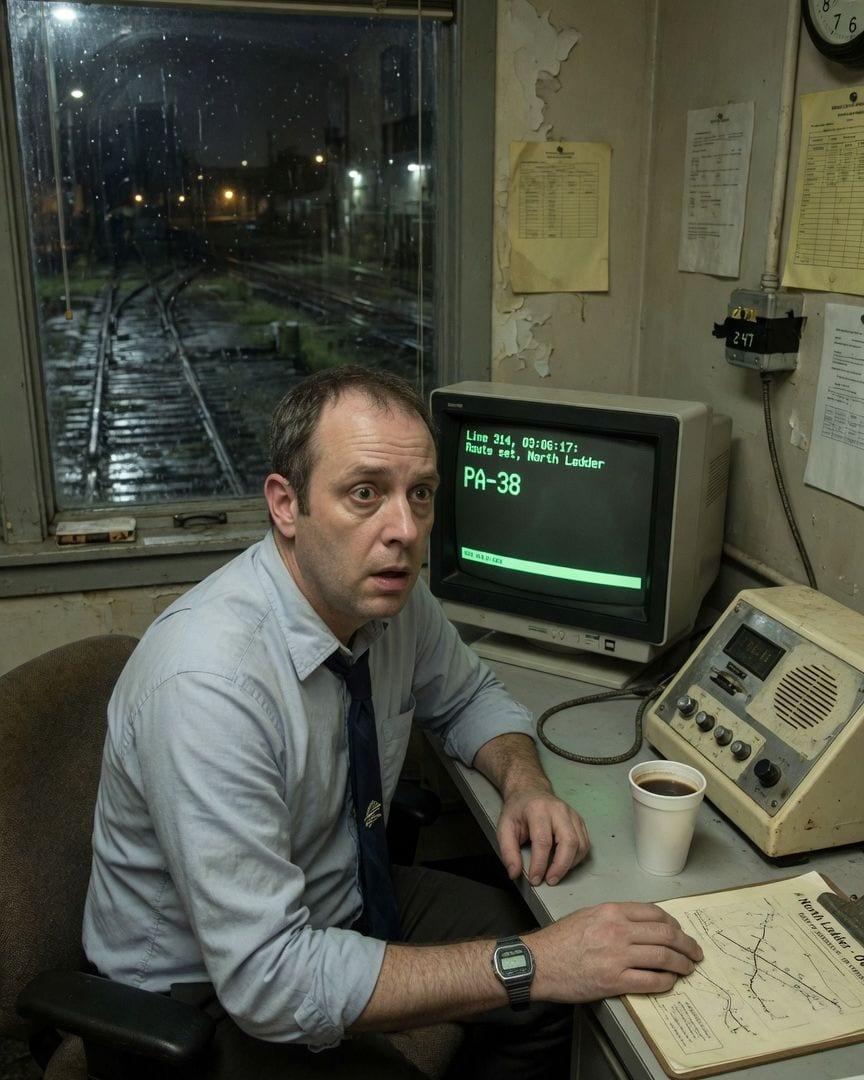
The log says my lever set a route at 3:06 AM through a track that's been shut for repair work — and the circuits show something moved down it. I never touched that lever; I sat there still.
I, Preston Abbott, a night dispatcher, was running a routine signal log check when I saw my code had set a route. It was for the North Ladder, a track decommissioned twenty years ago and physically impassable. Then, the yard's old, physically severed intercom system crackled to life, whispering a specific routing instruction for that very track.
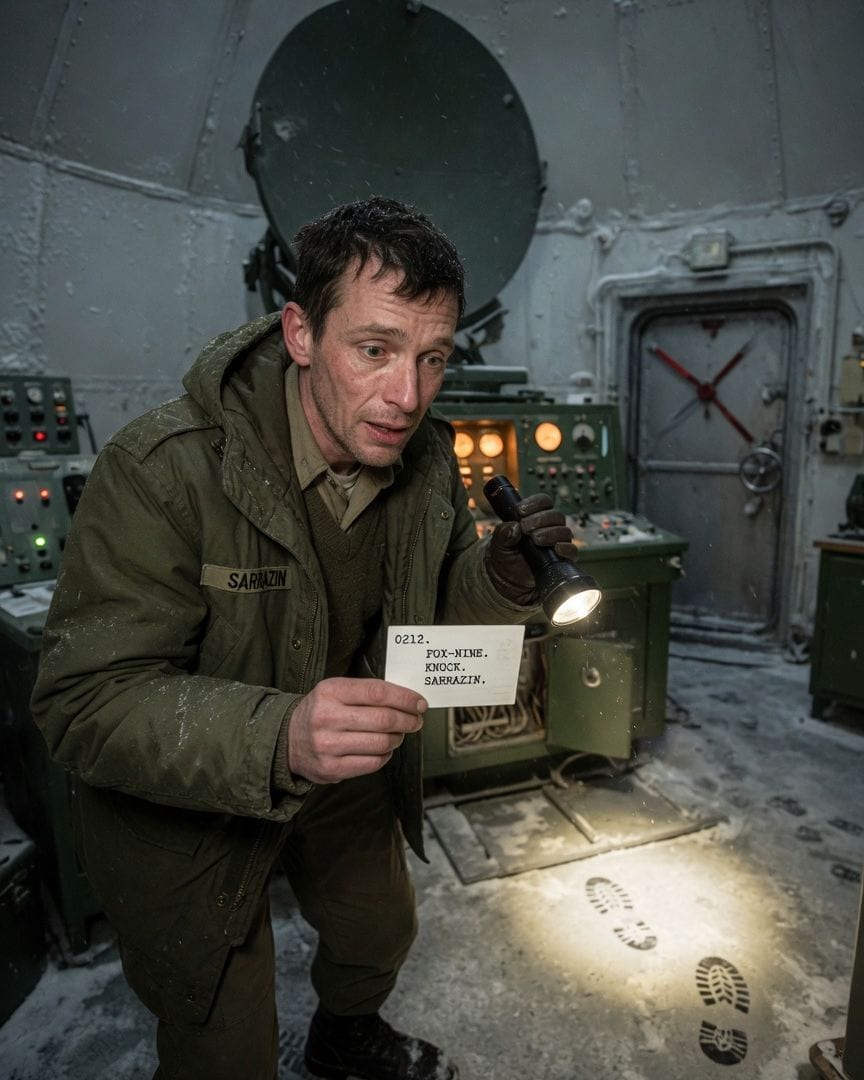
Airman Ludo Sarrazin found a ladder standing in Arctic snow, warm to the touch. Then the knock came from *inside* his sealed Cold War radar dome.
Airman Ludo Sarrazin was nearing the end of his isolated year-long tour at DEW site FOX-Nine, surrounded by the Arctic dark of 1959. His only comfort in the vast silence was the steady hum of his radar equipment, but for nine nights, an impossible rhythm had joined it. Every night at 0212 UTC, a mechanical knock grew closer, until Ludo found a service ladder standing alone in the snow, shockingly warm. Yet, as he stood there, the knock came from *inside* his secure, sealed radar dome, where he had been alone for months.
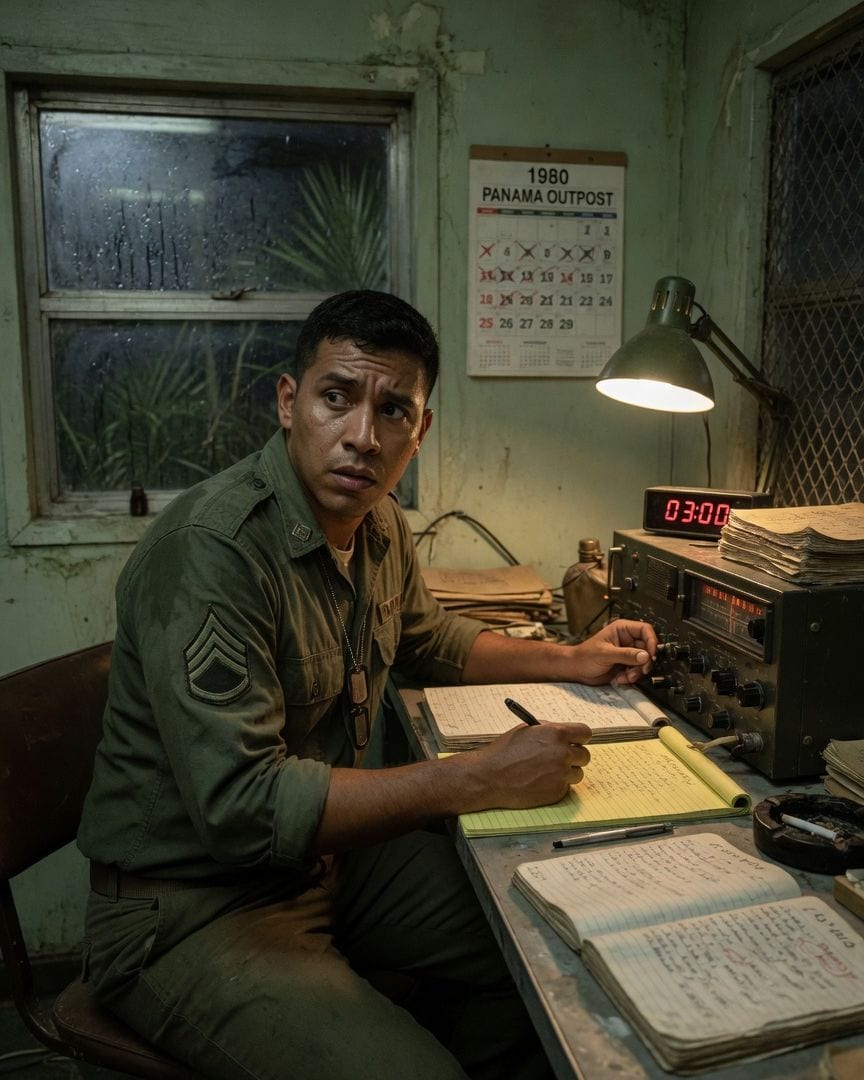
A Cold War comms operator at a remote outpost hears predecessors listed as 'stopped answering' — then the voice calls his own name.
Sergeant Adam Ibarra endured the damp Panamanian night in his remote outpost, the hum of old equipment his only companion. For three nights, a calm woman's voice transmitted a looping list of names and dates on the comms set, initially dismissed as a forgotten test loop. But the truth chilled him: these were his predecessors at the station, listed with the precise dates they had 'stopped answering' — and the sequence ended with a blank space just before his own. On the fourth night, Ibarra waited, rigid, as the voice added the last operator's name before him, then paused. Clear as a bell, it finally spoke: 'Ibarra, Adam.' What date would it add next?