Corporal Delk's own boots sat warm at his forbidden bunk, laced in a knot he'd never used.
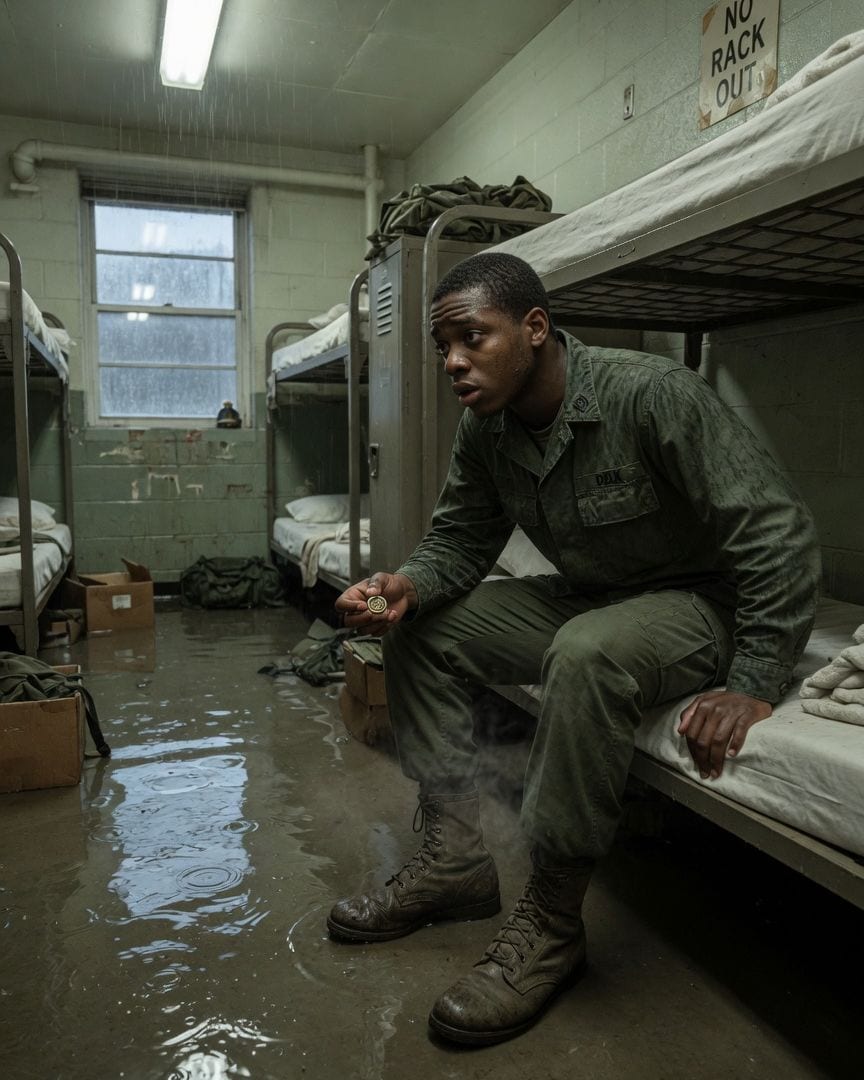
The barracks at Camp Ledoux were a misery of standing water, a black, rain-hammered spring day after day. Every rack sat in an inch of cold water, soaked mattresses dripping, except for the one in the far corner.
It was made tight, impeccably dry, empty. Nobody ever racked out there; you just nodded at it passing, that was the rule.
Corporal Joseph Delk, a boot two weeks in and desperate for dry sleep, couldn't take another night of shivering on a soaked mattress.
He dragged his own sodden gear off the floor, piled it on a locker, and climbed into the forbidden bunk. The sheets were crisp, the pillow cool. He slept better than he had since arriving.
At reveille, the bugle blast ripped through the barracks. Delk swung his legs over the side, blinking away sleep. Then he froze.
His own combat boots, the ones he'd left by his old rack, were now set toe-to-toe at the foot of the dry bunk.
They were laced in a pattern he had never once used, a tight, precise military knot he'd only seen in ancient training manuals. And they were still warm, as if just taken off.
Delk stared at the boots. A prank? But who? And why? He picked one up; the warmth was undeniable, fading quickly as he held it. He tried the laces, pulling at the unfamiliar knot. It was tight, practiced.
Not something a sleep-addled recruit would do. He checked the bunk, running his hands over the mattress, under the pillow, along the metal frame. Nothing. Just the dry, clean bedding.
He even lifted the mattress, peering into the dusty space beneath.
That's when he saw it, tucked into a seam where the frame met the wall: a small, tarnished metal button, uniform-issue, but older, a slightly different alloy and insignia than anything currently worn.
It was a type he recognized from old movies, a relic. He knew, with a cold certainty, that it hadn't been there when he'd moved his gear in. He clutched the button, the rational explanations failing one by one.
This wasn't a prank. This was something else, something that had been here, in this bunk, just before him.
Later that morning, Delk found Sergeant Naomi Sterling in the supply depot, organizing inventory. He approached her, the button heavy in his palm. "Sergeant," he began, "I found this in the corner bunk. Do you recognize it?"
Sterling, a no-nonsense NCO with a reputation for knowing everything about Camp Ledoux, took the button. Her eyes, usually sharp and direct, softened just slightly as her thumb rubbed over the faded insignia.
Her mouth, normally set in a firm line, thinned. She looked up from the button, her gaze meeting Delk's, betraying a flicker of something he couldn’t quite name: not surprise, not anger, but a deep, weary recognition.
Sergeant Sterling didn't answer Delk's question directly. Instead, she asked him about the boots, the lacing, the warmth. She listened intently, her expression unreadable. "Corporal," she finally said, her voice low, "some things at Ledoux… they just are.
Don't go looking for answers in official channels. You won't find them." But she didn't dismiss him. Over the next few days, Sterling subtly directed Delk to odd jobs.
He found himself cleaning out a disused records annex, then organizing old, forgotten equipment in a remote storage bunker that hadn't seen daylight in years.
In the annex, he stumbled upon a dusty, oversized ledger, not part of any official system.
Its pages were filled with handwritten entries, mostly terse, almost coded: "2100 hrs, Sector Gamma, extra track, no source." "0300 hrs, Radio Relay 7, anomalous voice, call sign 'Ghost'."
The dates spanned decades, often clustered around periods of heavy rain or when a post was slated for decommissioning. The entries described incidents uncannily similar to his own, often mentioning "unaccounted-for personal effects" or "sporadic heat signatures" in vacant areas.
The unease in him deepened, hardening into something cold and specific. This wasn't just a bunk; it was a pattern.
A week later, Delk was assigned to "Watch That Won't End" at Radio Relay Tower 7, a skeletal structure on the camp's periphery, overlooking a desolate, flooded marshland. It was a 24-hour solo shift, ostensibly for "preventative maintenance."
The tower's instruments, meant to monitor perimeter breaches, flickered with faint, intermittent contacts that registered as large, human-sized heat signatures, then vanished. The perimeter wire remained undisturbed.
Delk, alone in the small, cramped control room, tried to rationalize it as faulty sensors, a persistent bug. Then, over the secure net, a faint, distorted voice crackled to life. "Ghost actual," it said, the words barely audible, "perimeter clear."
Delk’s blood ran cold. "Ghost" was a non-existent call sign, a legend. The voice, though distorted, had a strange, unsettling resonance. It sounded like his own. He tried to respond, but the channel went dead. He checked the external cameras.
Nothing. Just the vast, empty marsh. But a cold, prickling sensation crawled up his spine. He wasn't just watching; he was being watched, and whatever was out there, or inside, knew his voice.
Back at the barracks, Delk confronted Sergeant Sterling, the unofficial ledger in his hand. "This isn't just faulty equipment, is it, Sergeant?" he demanded, his voice tight. "It's been happening for decades." Sterling sighed, a deep, weary sound.
She led him to a small, locked cabinet in her office. From it, she pulled a leather-bound journal, much older than the ledger. "This was my grandfather's," she said, "He was stationed here in the fifties."
She opened it to a page detailing an incident at an old observation post. "The 'extra man' phenomenon," she explained, her voice barely a whisper. "It's not a ghost, not a prank. It's… an echo.
A part of the base that never mustered out. It manifests when a place is forgotten, isolated, or about to be decommissioned. It performs its duties, perfectly, silently."
She flipped through the pages, showing him entries about warm boots, impossible voices, and unaccounted-for uniforms. "The system is designed to account for everything, Corporal. Every man, every piece of gear. But it has blind spots.
And this thing… it lives in those blind spots. It's the ultimate accountability failure." Delk’s mind reeled.
The dry bunk, the warm boots, the button, the voice on the net – it all clicked into place, forming a horrifying, coherent pattern that defied every military regulation he knew.
Sergeant Sterling finally showed Delk her own entry in the unofficial log, written just three years prior.
It described an incident during a routine perimeter patrol: "Patrol 3-Alpha reported an extra man in formation, perfectly mimicking Private Carter, but never logged. Disappeared at dawn. No record." The details matched the old stories, the silent mimicry.
"I logged it here," Sterling said, tapping the page, "because the official report was filed as 'heat fatigue and hallucination.' Can't have an unaccounted for soldier, can we?" Delk felt a chill deeper than any rain. "Where did this happen?"
he asked, his voice barely a whisper. Sterling pointed to a faded map tacked to the wall, a small circle marked in red pencil. "Old Bunker 4. Disused, forgotten, deep in the marsh.
We were meant to decommission it, but funding got cut. It's been sitting there ever since." Delk’s blood ran cold as he glanced at the duty roster for tonight, his eyes landing on his next assignment: "Corporal Joseph Delk.
Solo watch. Old Bunker 4. 2000-0800." The previous entry in Sterling's logbook echoed in his mind, "It takes the forgotten places. And the forgotten watches."
Inside Old Bunker 4, the air was thick with the smell of damp earth and stale metal. Delk, armed with his standard issue and a phone he kept charged, scanned the empty corridors. The bunker was a relic, half-flooded, forgotten.
He checked the instruments, the same perimeter sensors as the tower, only more rudimentary. For hours, nothing. Then, a faint flicker on the screen – a heat signature, moving through the lower levels.
Delk held his breath, pressing himself against a cold concrete wall. A figure emerged from the shadows, moving with an eerie, practiced cadence. It was a soldier, dressed in an older, slightly off-pattern uniform, the fabric faded but impeccably clean.
The figure moved through the bunker's forgotten control room, checking gauges that no longer functioned, adjusting levers that led nowhere. It was perfectly proportioned, solid, utterly mundane in its actions, yet profoundly wrong.
It was "The Soldier Who Never Mustered Out," a living, breathing accountability error. It wasn't hostile; it simply was, a perpetual, unlogged rotation, carrying out phantom duties in a place the army had forgotten.
Delk saw the boots, the very lacing pattern from his bunk, the precise, economical movements. Every clue, every hushed story, every impossible log entry, solidified into this one, horrifying, coherent truth.
Delk watched the phantom soldier, his heart hammering, but his training kept him from panicking. He raised his phone, silently recording the figure, the instruments, the eerie, impossible scene. He knew no one would believe him without proof.
The soldier moved towards a disused radio console, its hand hovering over rusted buttons. Delk knew he couldn't stay. The anomaly thrived on isolation. He had to break the pattern.
He subtly nudged a loose piece of equipment, sending it clattering down a metal stairwell. The sound echoed, sharp and loud. The phantom soldier paused, its head tilting slightly, as if listening, then slowly turned towards the sound.
Delk didn't wait. He knew he couldn't confront it, couldn't fight what wasn't truly there. He activated his emergency beacon, a "man down" signal, knowing it would bring a patrol.
As the distant wail of sirens began to cut through the night, growing closer, the phantom soldier turned its head fully, its gaze falling on Delk. There was no expression, no malice, just an empty, perfect mimicry of attention.
Delk bolted, scrambling through the flooded lower levels, past the figure, towards the bunker's exit. He burst out into the pre-dawn mist as the first Humvee lights cut through the darkness, leaving the impossible presence behind him.
He had escaped, but he carried something that would never leave him.
Delk was debriefed for hours, his story dismissed as stress-induced psychosis after his "disturbing" solo watch. His phone, with the video evidence, was confiscated for "forensic analysis" and returned a week later, wiped clean.
His claims were officially categorized as "hallucinations due to fatigue and isolation." Sergeant Sterling visited him, her eyes heavy with sympathy. She told him he was being honorably discharged for "medical reasons," citing stress and adjustment disorder. He was out.
The military, the only life he'd known, was gone. He tried to explain to his family, his friends, but the words sounded hollow, unbelievable. They just saw a young man, broken by the service.
Years later, Joseph Delk works a quiet, civilian job, far from the echoes of Camp Ledoux.
He still wakes sometimes, convinced he feels the faint warmth of boots by his bed, or hears a distorted voice calling a non-existent call sign on an empty frequency.
He follows the news, always drawn to stories about abandoned military installations, decommissioned outposts, or remote, forgotten places.
He sees the photographs, the empty barracks, the rusted equipment, and he knows what lingers in the gaps of accountability, in the places the system forgets. He knows it's still out there, serving its perpetual, silent watch.
He just has to live with it now.
Months after Camp Ledoux was finally decommissioned and its last structures demolished, a civilian contractor conducting a final sweep of the marshland discovered a single pair of combat boots, perfectly laced, sitting upright by the remains of an old bunker’s rusted entrance.
They were still warm.
If this one got to you
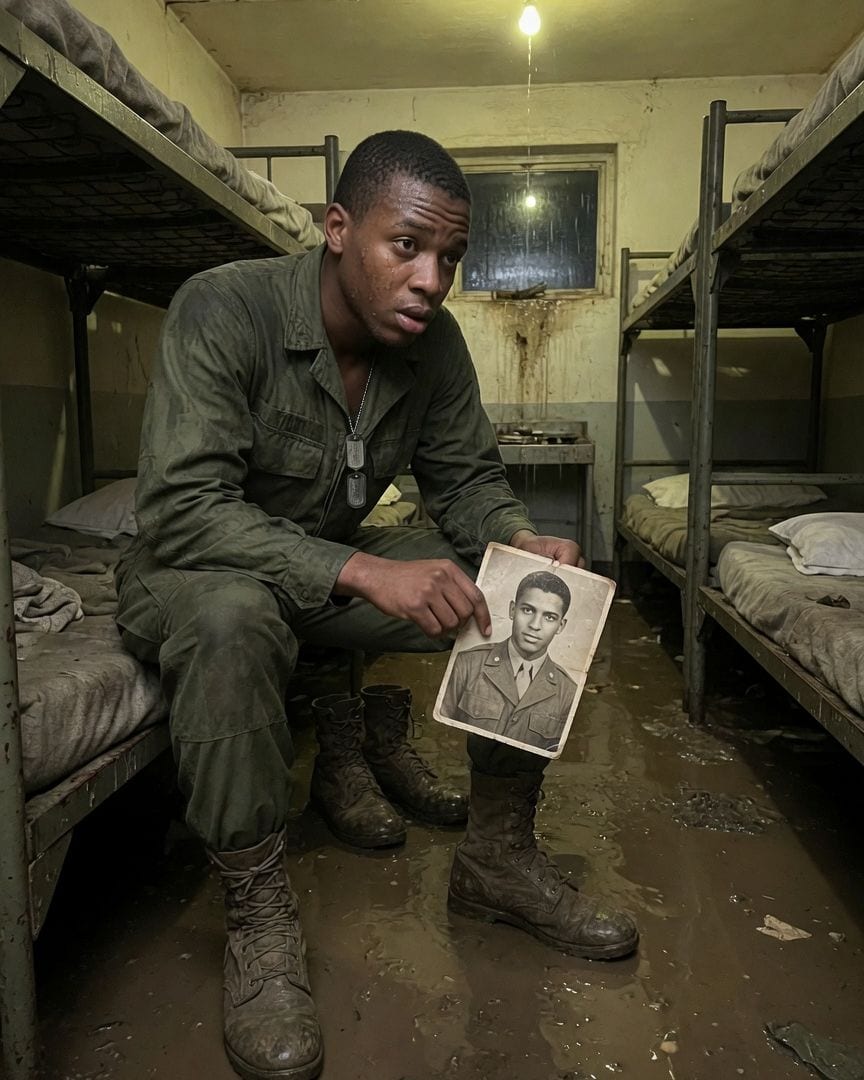
Corporal Delk finally took the dry bunk everyone avoided. He woke to his own boots, re-laced in a strange knot, still warm as if someone had just taken them off.
Corporal Benjamin Delk, bone-tired from two weeks in the flooded Camp Ledoux barracks, finally sought refuge in the dry, untouched corner bunk. It was a small, desperate victory against the camp's relentless damp. But reveille brought a cold shock: his own boots sat perfectly at the foot of the rack, laced in an intricate, unfamiliar pattern, and still warm with residual heat. Later, investigating the bunk, he found a faded photograph of a young Private in an identical, old-style uniform. The man's intense, familiar eyes seemed to acknowledge Delk, hinting at an impossible connection to the warm boots and the bunk's unspoken rule.
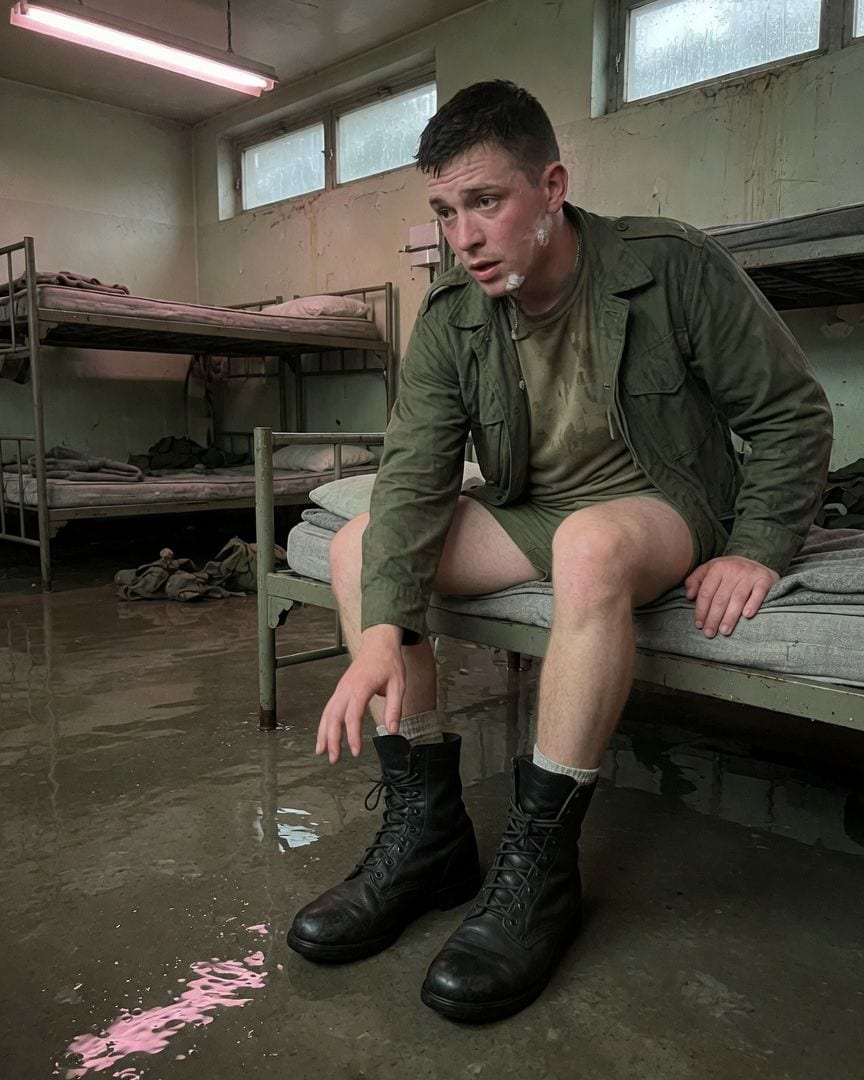
Corporal Delk found his name signed into the bunk log, weeks before he ever stepped foot in Camp Ledoux.
Corporal Gerald Delk, bone-weary after just two weeks at Camp Ledoux, found himself in barracks flooded with standing water, a grim reflection of flickering fluorescents. Desperate for dry sleep, he claimed the only empty bunk untouched by the damp, Bunk 12, only to wake and find his combat boots at its foot. These weren't just dry; they were laced in an intricate pattern he'd never seen, still warm from impossible recent wear, smelling faintly of ozone and damp earth. Driven by unease, Delk eventually uncovered a dusty barracks logbook, its brittle pages holding a chilling entry. There, consistently assigned to 'Bunk 12,' was his own name – dated weeks before he ever arrived at the camp. Who was signing him in?
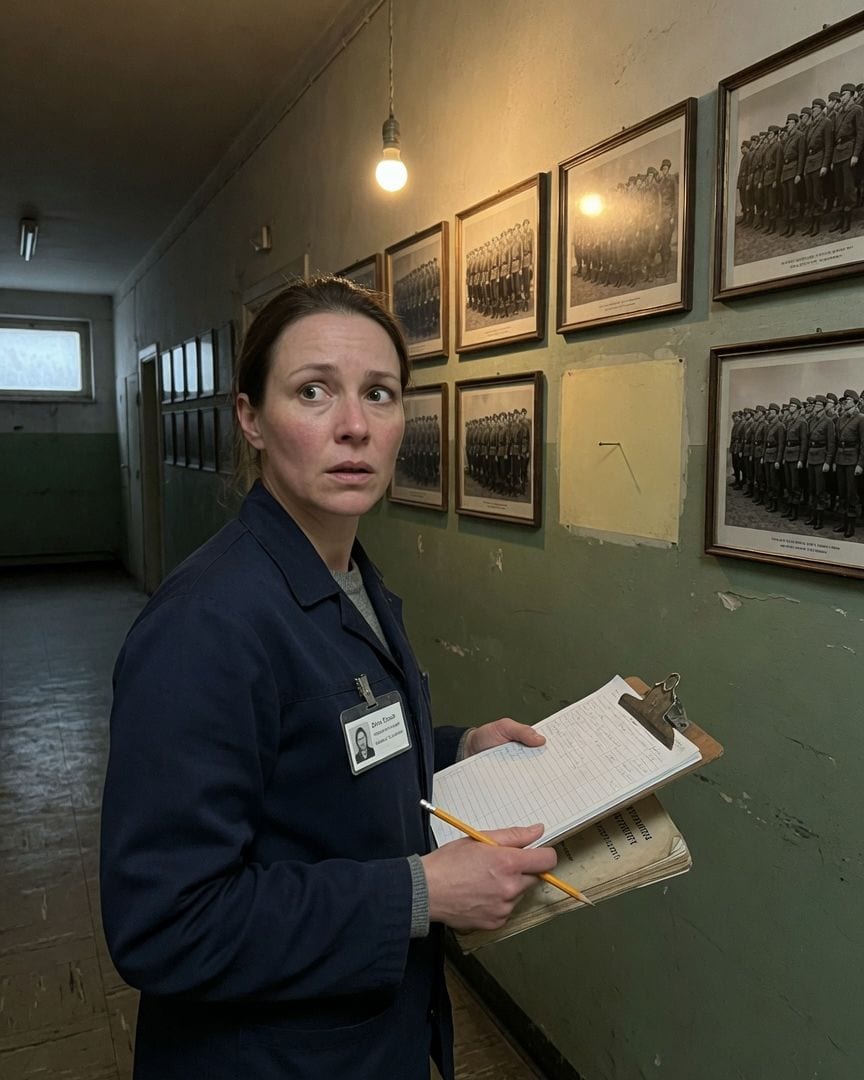
On a closing Cold War base, an inventory clerk finds every soldier in old photos staring at an empty wall. Her own name is on a hidden footlocker holding the missing picture: a dark, blurred figure among them.
Delia Straub has eleven days to inventory Kaserne Ottmarsheim, a former German base slated for demolition. The air in its echoing, abandoned halls smells of coal smoke and old wax as she races against the clock. Her task takes an unsettling turn when she discovers a phantom unit, the '604th Ordnance Detachment,' explicitly listed in old records despite never existing. Even more unnerving, every soldier in adjacent photos stares fixedly at the empty space where its picture should be. But why does a hidden footlocker, bearing Delia's own name, hold the missing photograph, revealing a dark, blurred figure among the men?
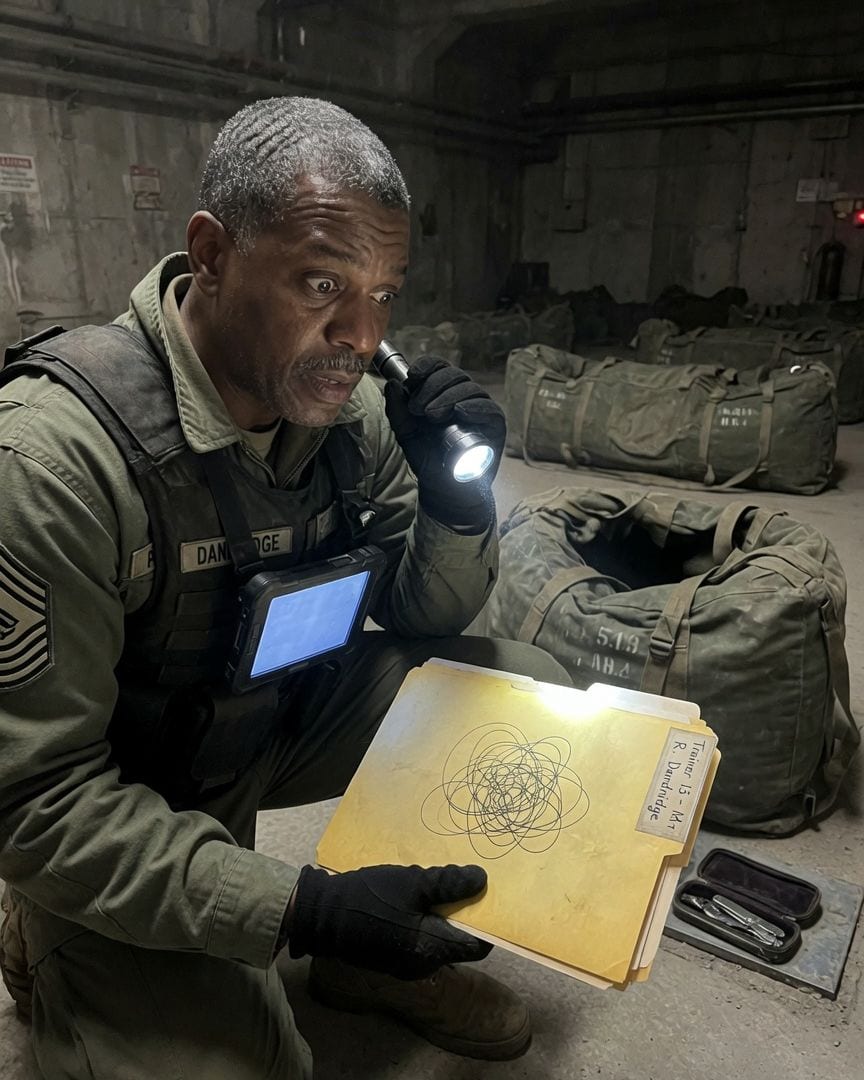
Thirty days from closing a Cold War vault, a Master Sergeant finds a thirteenth warhead cradle with his own name on it, its velvet lining strangely warm.
Master Sergeant Ruel Dandridge had just thirty days left at Kestrel Mountain, conducting its final inventory before the underground vault was sealed forever. He methodically counted twelve warhead trainer cradles, but then his beam caught a thirteenth: bolted down, empty, its straps dented as if something immense had shifted. A tag bore his own precise handwriting: ‘Trainer 13 - R. Dandridge,’ an impossible find in a bay he'd never entered and not on any manifest. Prying at its base, Ruel discovered a hidden compartment holding a yellowed file with a symbol that pulsed with light and subtly shifted, its velvet lining strangely warm. This confronted the Master Sergeant with a pattern that defied all logic.
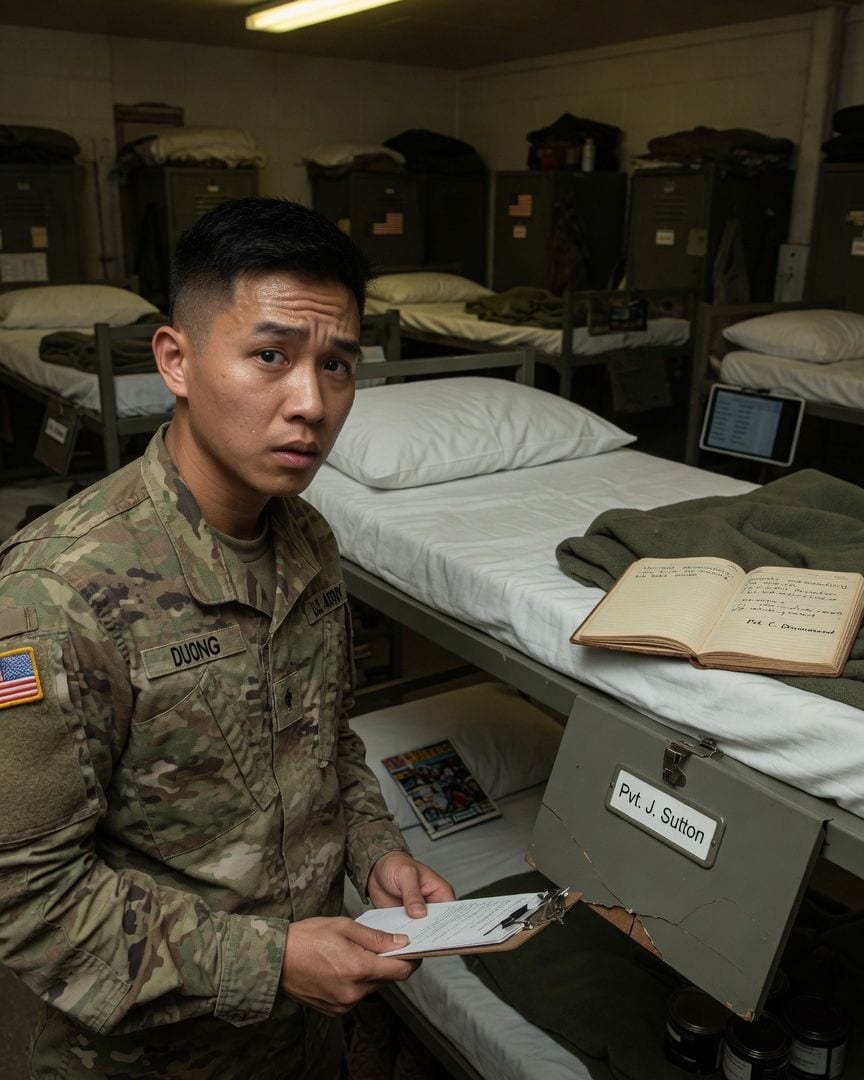
Specialist Duong’s final check unearths a logbook from decades past: an entry for '9 men present, 10 bunks made'.
Specialist Quentin Duong meticulously conducted his platoon's final barracks accountability check before graduation, the air thick with stale boot polish. He confirmed nine men against the roster, but the tenth bunk in the bay stood apart, always perfectly made and tagged 'Pvt. J. Sutton,' a name not on any current manifest. Despite dismissals from his battle buddy and sergeant, Duong couldn't shake the quiet unease. He returned to the immaculate bunk, uncovering a false bottom in its footlocker holding a decades-old logbook. Inside, a chilling entry from a previous cycle detailed '9 men present, 10 bunks made,' signed with a hand eerily similar to his own.
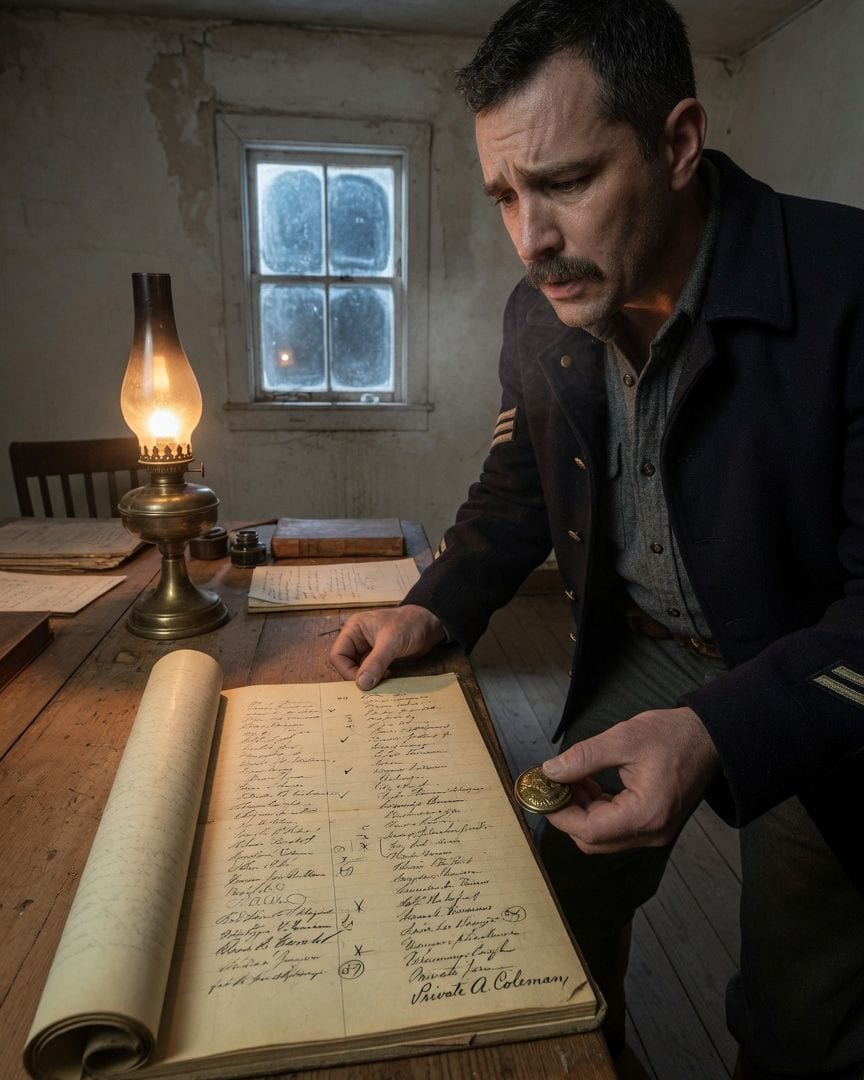
For his final muster, Sergeant Thatcher found an extra signature on the roll, and a warm, antique button pressed into the table beneath it.
Sergeant Felix Thatcher stood in the paymaster's office at Fort Hayes, the bitter Wyoming wind rattling the panes as the last company signed their muster roll. He needed a clean closure here before his transfer, but his meticulous count of thirty-six men soon clashed with Corporal Whitlock's tally of thirty-seven signatures. The discrepancy led him to 'Private A. Coleman,' an unknown name on the roll, signed with an oddly archaic hand. Beneath where the roll lay, Thatcher discovered a tarnished brass button, inexplicably warm to the touch, and matching a uniform design from the 1850s. How could an ancient, warm relic be linked to a fresh, impossible signature?