Corporal Delk finally took the dry bunk everyone avoided. He woke to his own boots, re-laced in a strange knot, still warm as if someone had just taken them off.
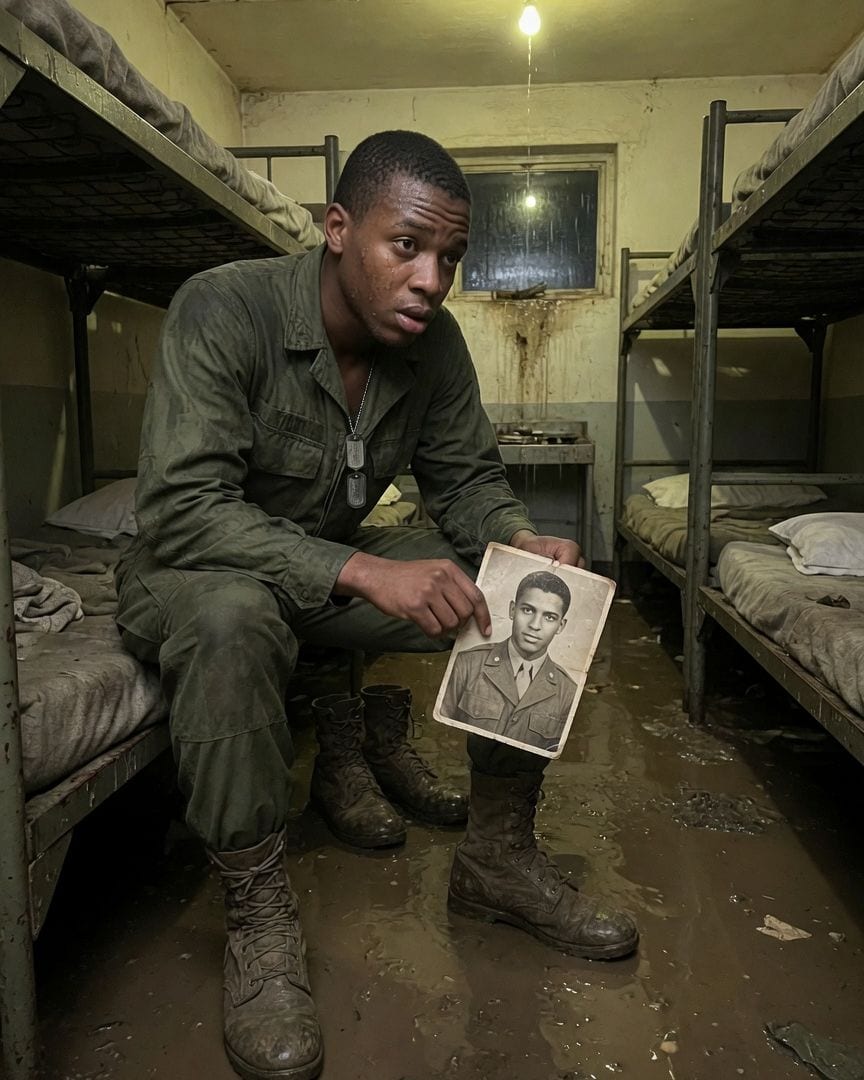
The barracks at Camp Ledoux groaned under a black, rain-hammered spring, every floor-level rack sitting in an inch of cold, muddy water.
Corporal Benjamin Delk, a boot two weeks in and already bone-tired, had spent his last two nights shivering on a soaked mattress.
He’d seen the corner bunk, the one nobody ever touched, the one that remained stubbornly dry, a silent, unwritten rule. Tonight, desperation won.
He dragged his own soaked mattress aside, careful to avoid the eyes of the few other soldiers still awake, and climbed into the dry rack. It felt impossibly good, a small victory against the camp’s relentless damp.
He fell asleep almost instantly, the drumming rain a muffled lullaby. Reveille blared, a harsh metal shriek, pulling him from a deep, dreamless sleep. His eyes snapped open.
On the floor at the foot of the bunk, set perfectly toe-to-toe, were his own boots. They were laced in a tight, intricate pattern he had never once used in his life.
And they were still warm, as if someone had just taken them off.
Delk stared at the boots, a cold knot forming in his stomach. A prank? But who? And why this? He picked one up; the leather was still pliant with residual heat.
He sniffed it, a faint, metallic scent, not his own, clinging to the worn rubber. He ran a hand over the laces, tracing the unfamiliar knotwork. He checked his own gear, tucked neatly under his original, now-vacant rack.
Nothing else seemed disturbed. He tried to rationalize it away: fatigue, a senior NCO messing with the new guy, some elaborate, silent hazing. But the warmth, the specific lacing – it felt too intimate, too deliberate.
The thought gnawed at him through breakfast and morning duties. Back in the barracks during a brief lull, he approached the dry bunk with a new wariness. He pulled back the thin mattress, checking for any hidden devices, any clue.
His hand brushed against something stiff, tucked deep between the canvas and the rusted bedsprings. He pulled it out: a faded, dog-eared photograph, stiff with age.
It depicted a young Private, no older than Delk himself, in an old-style fatigues uniform, the kind from decades ago, but unmistakably military. The uniform was identical to Delk’s own issue, down to the insignia.
The Private stood stiffly, a faint, almost imperceptible smile on his lips.
But it was the eyes that caught Delk’s attention – dark, intense, and holding a strange, unsettling familiarity, as if the man in the photo was looking directly at him.
Delk sat on the edge of the dry bunk, the ancient photograph clutched in his hand. He traced the faded lines of the Private’s face, the high cheekbones, the slight curve of the nose.
The uniform, the haircut – it was all from a bygone era, yet the face felt unnervingly present. He felt a prickle of recognition, a visceral jolt that had nothing to do with memory.
The Private’s eyes seemed to follow him, or rather, to acknowledge him. The photograph wasn’t just old; it felt like a direct message, a silent challenge.
Delk’s rational mind screamed 'coincidence,' but his gut twisted with something far older, far colder.
He knew, with a certainty that froze his blood, that this photograph, this man, was connected to the warm boots, to the dry bunk, and to the impossible, unspoken rule.
The photograph burned a hole in Delk’s pocket. He couldn’t shake the unnerving sense that the face in the picture was a mirror, a distorted reflection from another time.
He cautiously approached Sergeant Deborah Russo during a break, feigning casual interest in the camp’s history. “Heard some old stories about this place, Sarge. Any ghost stories about the barracks?” Russo, a no-nonsense veteran with a sharp gaze, scoffed.
“Only ghosts here are the ones who don’t pull their weight, Delk. Stick to your duties.” But she paused, a flicker of something unreadable in her eyes. “There’s old Marsh in records, civilian now. Been here since forever.
He’s got a memory like an elephant for every screw-up and missing pencil.” The hint was enough. Delk found Ronald Marsh in the musty, overflowing records office, a man whose face was as creased as the old files he sorted.
Marsh, initially gruff, softened slightly at Delk’s polite persistence. Delk, without showing the photo, described the dry bunk and the odd rule surrounding it. Marsh chuckled, a dry, rattling sound. “Ah, the ghost bunk.
Been that way since before your grandpappy was in diapers. Some things just… stick. Like a bad entry in a ledger that won’t balance.” Delk pressed, “But why? Was there someone…?” Marsh’s eyes narrowed, a guarded look replacing his amusement.
“Some things are better left alone, son. Especially in a place like this. Too much paperwork to dig through for old rumors.” He turned back to his files, dismissing Delk with a wave of his hand.
But the phrase 'bad entry in a ledger that won’t balance' stuck with Delk, resonating with the 'Count That Won't Reconcile'.
Delk’s unease ratcheted up. The boots were now a constant, chilling reminder, reappearing at the foot of his bunk every morning, sometimes even after he’d hidden them in his locker.
His small personal effects, a razor, a spare t-shirt, would be subtly rearranged on his footlocker. He’d catch glimpses of movement in his peripheral vision, a shadow at the end of the aisle, gone when he turned his head.
One evening, walking back from the mess hall through the rain, he heard it: a faint, military cadence, echoing from the empty, flooded barracks, stopping abruptly as he reached the door. Sergeant Russo cornered him the next day.
“Delk, you’ve been jumpy. And Marsh mentioned you asking about old stories. You’re two weeks in, Private. Don’t go stirring up old dirt where it doesn’t belong. Some people don’t like questions about Camp Ledoux’s… peculiarities.”
Her voice was low, serious, a clear warning. She didn't sound like she believed in ghosts, but she sounded like she believed in consequences.
That night, Delk found a single, muddy boot print on the floor beside his dry bunk, facing inward, as if someone had just stepped out of the water and into his space.
The print was a size too large for his own boots. He felt a cold breath on the back of his neck, though the barracks was empty save for the rhythmic drumming of rain on the roof.
The next morning, Delk confronted Marsh, the photograph now openly in his hand. “This is who I’m asking about, sir. This Private. He’s connected to that bunk, isn’t he?” Marsh’s eyes, usually sharp, widened slightly as he took the photo.
His hand trembled. “Where did you get this?” he whispered, his voice hoarse. Delk explained finding it under the mattress. Marsh stared at the image, then back at Delk, a profound sadness on his face.
“Theodore Hale,” he finally said, the name a rusty hinge. “Private Theodore Hale. Vanished from this camp, just like the rain you’re seeing now, thirty-five years ago. A spring flood, just like this one. Never found a body.
Never found a trace.” Delk felt a chill deeper than the barracks’ damp. “Vanished? But… his record?” Marsh sighed, a long, weary sound. “That’s the thing, son. Officially, he was listed as ‘administrative separation – unresolved.’
Never KIA, never MIA, never discharged. A clerical nightmare. His name just… sits. Like a phantom entry in the oldest manifests. Every few years, someone pulls an old roster, and the count comes out one too many. Hale.
The ghost soldier. The accountability that cannot be.” Marsh pulled open a heavy, ancient filing cabinet, its drawers groaning. He retrieved a brittle, yellowed incident report. “This is what they let me keep. Declassified, but still buried. Pvt. T. Hale.
Last seen in Barracks 7, Bunk C-14.” Delk’s blood ran cold. C-14 was his dry bunk. The report detailed Hale’s last known movements, his personal effects, and the lack of any explanation for his disappearance.
It also mentioned a pair of boots, left by his bunk, laced in a distinctive, complex knot. Delk looked at the photo, then at the report, then at his own boots, still bearing the strange lacing.
It all clicked into place with horrifying precision. The boots, the dry bunk, the photograph – they weren't random. They were Hale, still here, still accounted for, still trying to manifest.
Sergeant Russo, disturbed by Delk's persistent questions and Marsh's sudden evasiveness, had decided to do her own digging.
She’d spent the afternoon in a forgotten storage room in the records annex, dust motes dancing in the single shaft of light from a high window.
She wasn’t looking for ghosts; she was looking for an explanation, something to make sense of Marsh’s hushed tones and Delk’s wild-eyed intensity. She'd found a stack of ancient, hand-written manifests, brittle with age, from the camp’s earliest days.
Flipping through them, she found the one from 1989, the year Hale vanished.
Her finger traced down the faded names, looking for ‘Hale, T.’ She found it, a clean, clear entry for Private Theodore Hale, assigned to Barracks 7, Bunk C-14. But her gaze snagged on something else, something impossible.
Next to Hale’s name, faint, almost erased but undeniably present, was another entry. A different name. A name that shouldn’t be there, not in 1989, not on this manifest. It was ‘B. Delk.’
Not a separate line, but almost woven into Hale’s, a phantom addition. Russo leaned closer, her heart hammering. The ink was different, almost like a bleed-through, but clearly legible: 'Pvt. T. Hale / B. Delk.'
The count still came out one too many, but now it was Delk himself, impossibly, inextricably linked to the ghost soldier, his name an echo in the system, an accountability that cannot be.
Russo burst into the barracks, the ancient manifest clutched in her trembling hand. She found Delk sitting on his bunk, staring blankly at the wall. “Delk! Look at this. You won’t believe it.” She thrust the paper at him.
Delk’s eyes scanned the faded script, landing on the impossible entry. His own name, intertwined with Hale’s. A cold dread settled over him, heavier than the barracks’ damp.
He remembered Marsh’s words: 'a bad entry in a ledger that won’t balance.' He was that bad entry now. They rushed back to Marsh’s office, the old clerk looking up, eyes wide with a mixture of fear and grim resignation.
Marsh, when shown the manifest, didn't seem surprised. “The system,” he murmured, “it tries to account for everything. When something goes missing, truly missing, it leaves a void. And the system… it tries to fill it.
Hale’s record was never closed. His presence, his slot, remained. You, Corporal, by taking his bunk, by picking up his traces, you’ve become the closest match. The system is trying to reconcile Hale’s absence by… overlapping you with him.
Making you the new Hale.” He explained that the specific, complex lacing on Hale’s boots was a unique signature, a way for the system to identify his 'presence.'
The dry bunk was Hale’s anchor, a constant in a world of flux. Delk’s despair deepened. He wasn't just investigating a ghost; he was becoming one, his identity dissolving into an unresolved historical anomaly.
The horror wasn't a monster, but a bureaucratic phantom, a system failing to let go, dragging him into its perpetual loop.
Delk felt a sudden, desperate urge to sever the connection, to break free. He rushed back to the dry bunk, tearing at the mattress, searching for anything else of Hale’s. He found nothing.
He tried to move his own gear, but his footlocker felt impossibly heavy, rooted to the spot.
He saw his reflection in the small, cracked mirror above his bunk, and for a fleeting second, the face staring back had a subtle shift, a hint of the eyes from the photograph.
He ran, not from the barracks, but from the camp itself, a frantic, rain-soaked dash towards the perimeter wire. Russo, seeing his panicked flight, yelled after him, but he didn't stop.
He needed to get out, to escape the impossible accountability. As he neared the gate, the very air around him seemed to thicken, pressing down, heavy with the smell of damp earth and old canvas.
The boots, his boots, appeared in his path, perfectly laced, steaming faintly in the rain. He kicked them, sending them skittering, but they simply reformed ahead, blocking his way.
He tried to scramble over the wire, but his hands slipped on the cold metal, and a sudden, sharp pain shot through his arm, as if something unseen had grabbed him.
He looked down, and for a terrifying instant, saw the faint imprint of a hand, the uniform sleeve, dissolving into his own arm.
He felt a profound weariness wash over him, a sense of belonging not to himself, but to the camp, to the bunk, to the endless, unresolvable count. His struggle ceased.
He was not escaping; he was being drawn in, integrated, a new entry in a very old ledger.
Corporal Benjamin Delk remained at Camp Ledoux. He was still physically present, still answered roll call, still performed his duties. But something in him had changed. He was quieter, his eyes often distant, fixed on some unseen point.
His movements were precise, almost mechanical.
The other soldiers noticed he rarely left the barracks now, preferring to sit on his bunk, the dry one in the corner, which remained stubbornly dry even as the spring rains continued to batter the camp.
He was still accounted for on the rosters, but sometimes, during a head count, a low murmur would pass through the ranks, a fleeting sense of an impossible plus-one, a shadow that moved just out of sight, always just behind him.
Sergeant Russo watched Delk from across the mess hall. He sat alone, eating slowly, his gaze fixed on nothing in particular. She had tried to talk to him, but his responses were hollow, rote. He was there, but he wasn't.
The mystery of the manifest, of his name appearing next to Hale’s, had been officially dismissed as a clerical error, a smudge on an old document. But Russo knew better.
She saw the way the other soldiers subtly avoided Delk, the way their eyes would sometimes linger on his dry bunk, even as the rest of the barracks floor shimmered with standing water.
She saw the way his boots, always perfectly laced, were set toe-to-toe beneath his rack, just so.
She saw the faint, almost imperceptible smile that sometimes touched his lips, a smile that wasn't quite his own, a smile that seemed to belong to someone else, someone long gone.
She remembered the photo, the eyes that had looked back at Delk, and she wondered if they were looking back at her now, through him. She sighed, a deep, weary sound, and turned back to her coffee.
The next morning, during the company's formation, the First Sergeant called roll. “Delk, Benjamin?” A clear, steady voice answered, “Here, First Sergeant.” The count was correct, as always.
But as Russo glanced down the line, she felt, for a fleeting moment, a distinct sense of two distinct presences standing in Corporal Delk’s place, perfectly aligned, one just behind the other.
It was a perfect count, and it was perfectly wrong.
If this one got to you
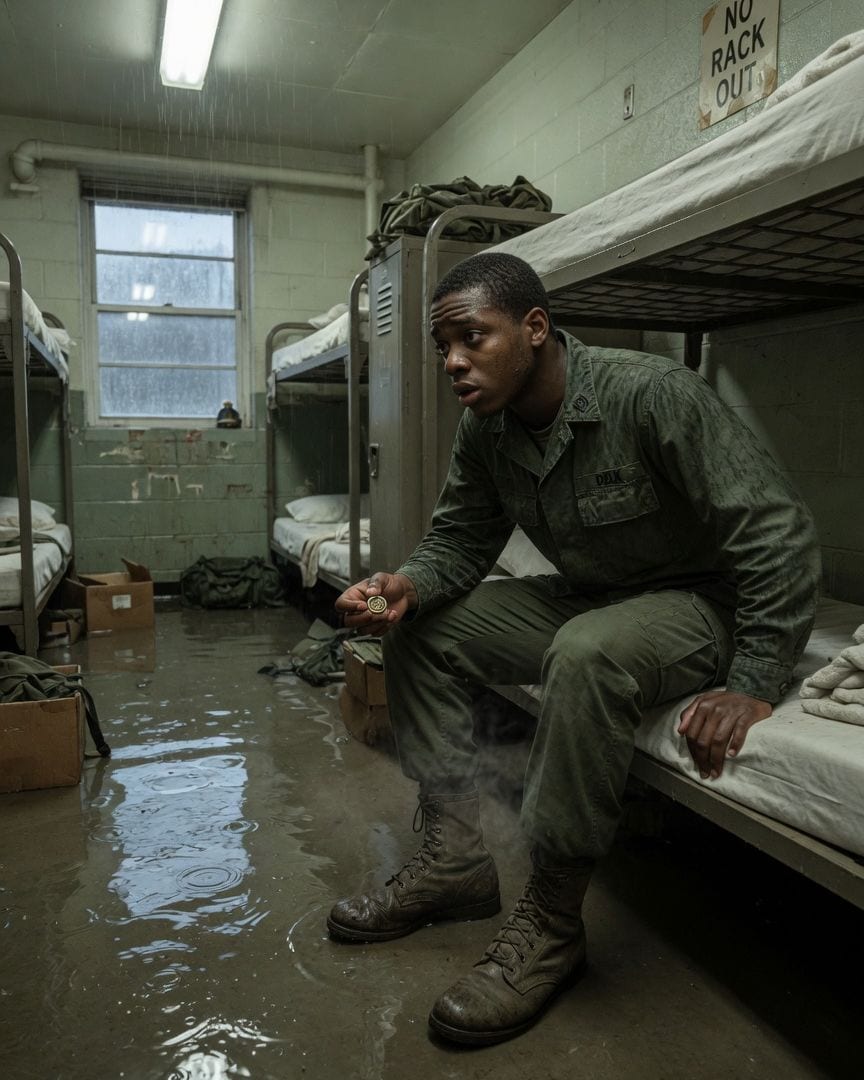
Corporal Delk's own boots sat warm at his forbidden bunk, laced in a knot he'd never used.
Corporal Joseph Delk, a new recruit at Camp Ledoux, was desperate for dry sleep amidst the barracks' misery of standing water. He broke the unwritten rule, taking the single impeccably dry bunk in the far corner. But reveille brought a cold shock: his own combat boots, left elsewhere, were now at the foot of his new bunk, laced in an unfamiliar military knot and still warm. Searching for answers, Delk found an old, tarnished uniform button tucked into the bunk frame, a relic that hadn't been there moments before.
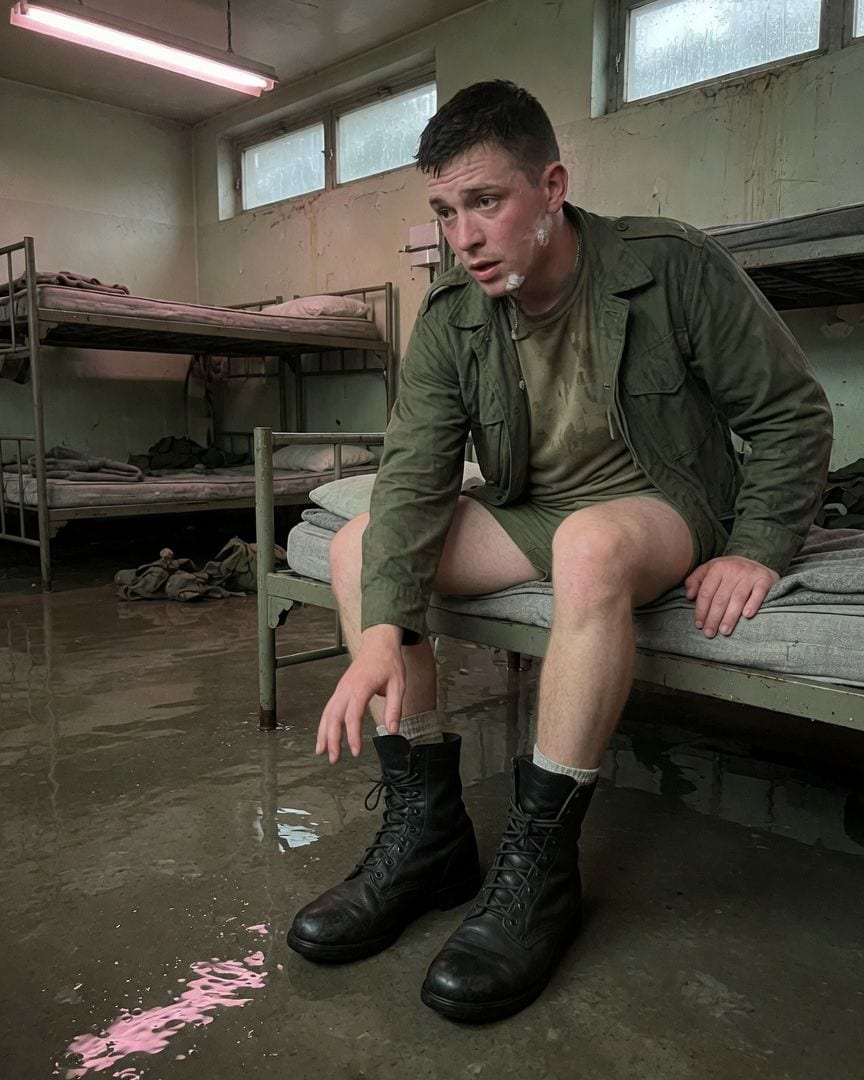
Corporal Delk found his name signed into the bunk log, weeks before he ever stepped foot in Camp Ledoux.
Corporal Gerald Delk, bone-weary after just two weeks at Camp Ledoux, found himself in barracks flooded with standing water, a grim reflection of flickering fluorescents. Desperate for dry sleep, he claimed the only empty bunk untouched by the damp, Bunk 12, only to wake and find his combat boots at its foot. These weren't just dry; they were laced in an intricate pattern he'd never seen, still warm from impossible recent wear, smelling faintly of ozone and damp earth. Driven by unease, Delk eventually uncovered a dusty barracks logbook, its brittle pages holding a chilling entry. There, consistently assigned to 'Bunk 12,' was his own name – dated weeks before he ever arrived at the camp. Who was signing him in?
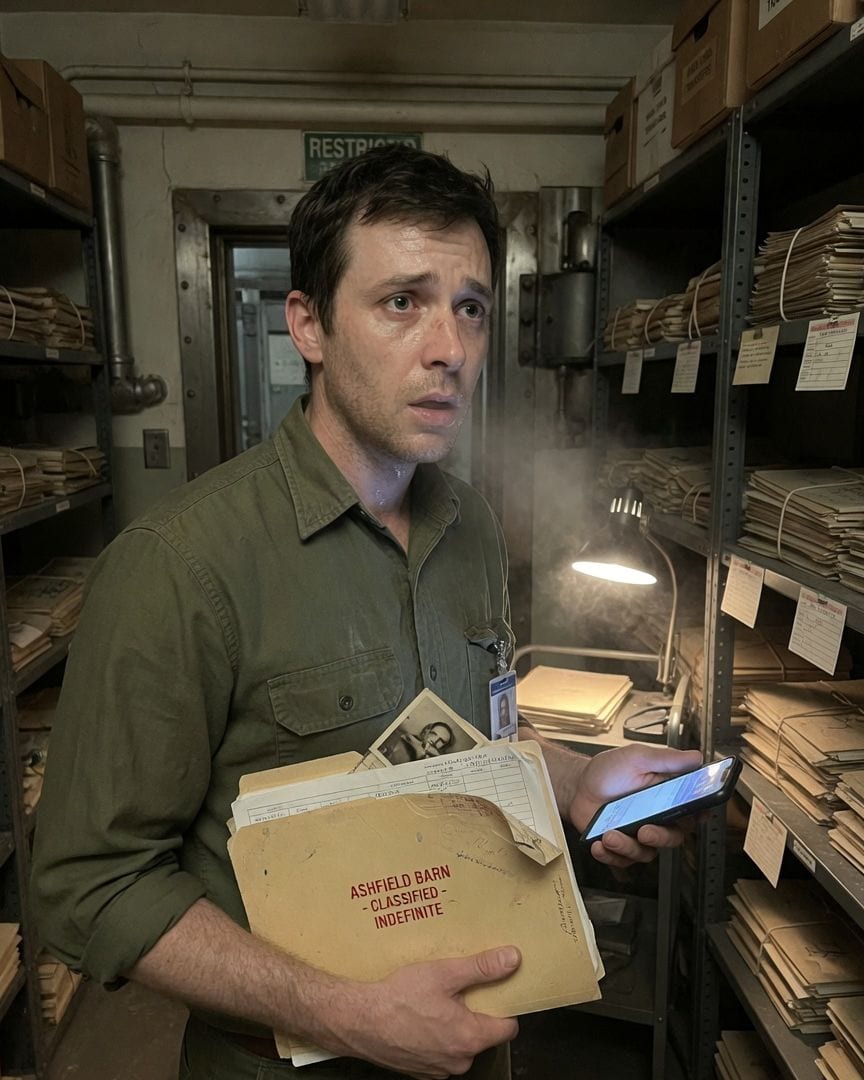
An archivist closing his vault found a file: boot prints led into a shed, none out. Its subject was 'in custody' for eighty-one years, re-signed six days ago.
Archivist Devin Mauch was on his last shifts, transferring files before Fort Loran’s vault closed for good. Tired and ready for his own move, he uncovered a slim, classified file about the Ashfield Barn. Inside was a sepia photo of a dilapidated shed, showing boot prints leading straight to its door, with none leading out. The official caption stated a 'subject' remained 'in custody, indefinite,' a status re-signed quarterly for eighty-one years, most recently just six days ago. Driven by a chill colder than the vault itself, Devin later found the shed, its dust-covered floor bearing the same impossible prints, and then heard a soft, almost imperceptible sound from its darkness.
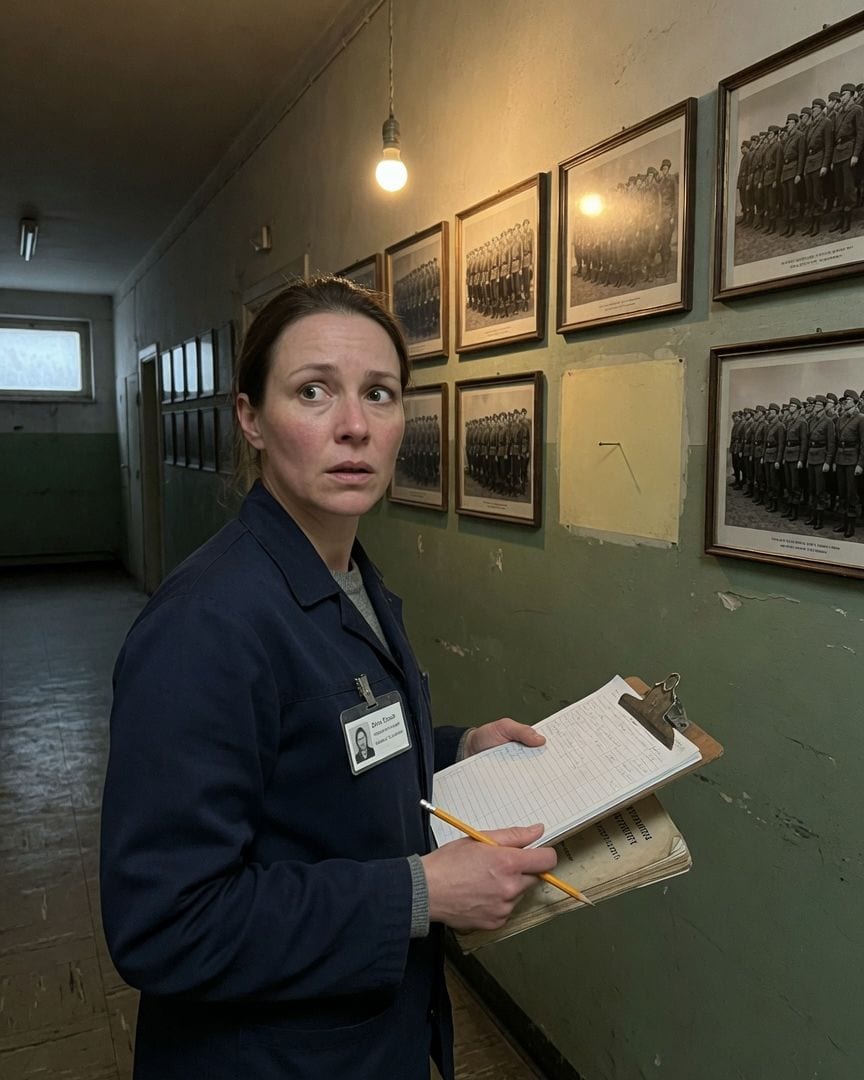
On a closing Cold War base, an inventory clerk finds every soldier in old photos staring at an empty wall. Her own name is on a hidden footlocker holding the missing picture: a dark, blurred figure among them.
Delia Straub has eleven days to inventory Kaserne Ottmarsheim, a former German base slated for demolition. The air in its echoing, abandoned halls smells of coal smoke and old wax as she races against the clock. Her task takes an unsettling turn when she discovers a phantom unit, the '604th Ordnance Detachment,' explicitly listed in old records despite never existing. Even more unnerving, every soldier in adjacent photos stares fixedly at the empty space where its picture should be. But why does a hidden footlocker, bearing Delia's own name, hold the missing photograph, revealing a dark, blurred figure among the men?
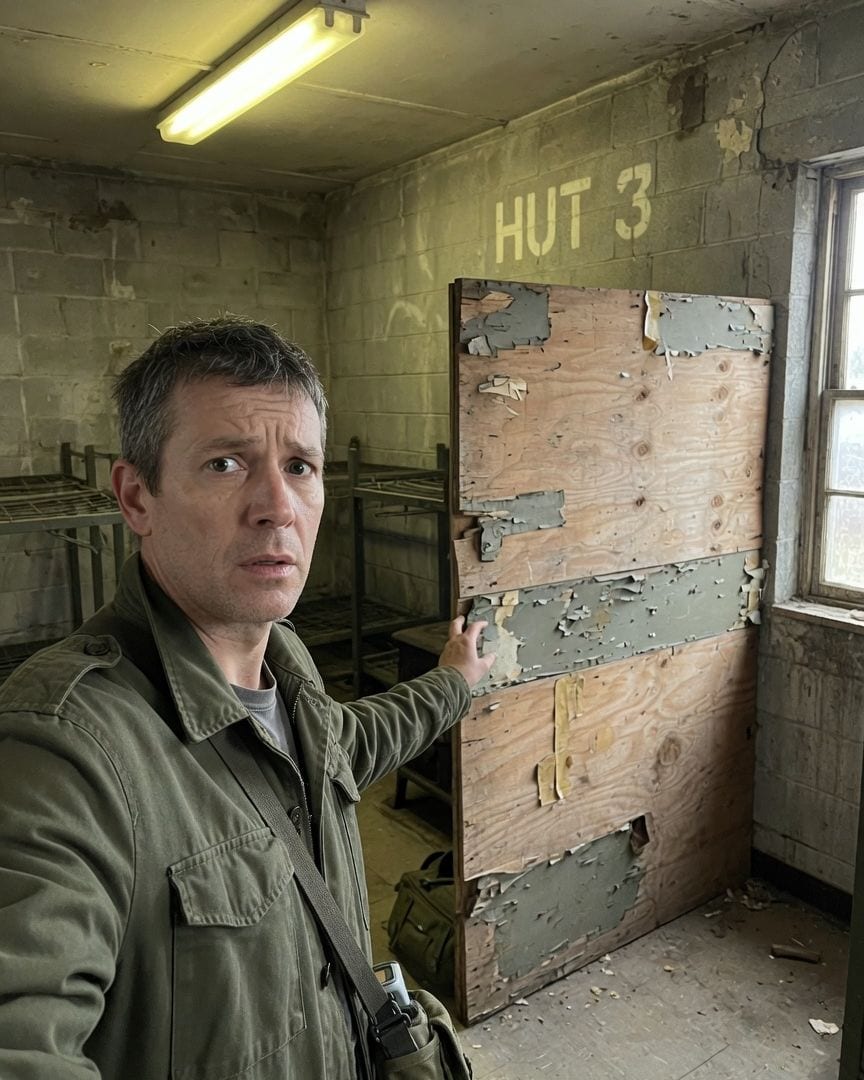
One morning there were twenty-one bunks in a hut built for twenty — the extra one made up tight at the far end past the stove, a kitbag beneath it stencilled with a name no roll could match. By nightfall the sergeant had that end boarded over.
I was a young recruit in a barracks hut built for twenty men, each bunk accounted for. But one morning, a twenty-first bunk appeared, impossibly tucked into a corner, meticulously made up for a man who didn't exist on any roster. Twenty-eight years later, the boarded-up wall concealing its secret remains, defying all logic and every measurement.
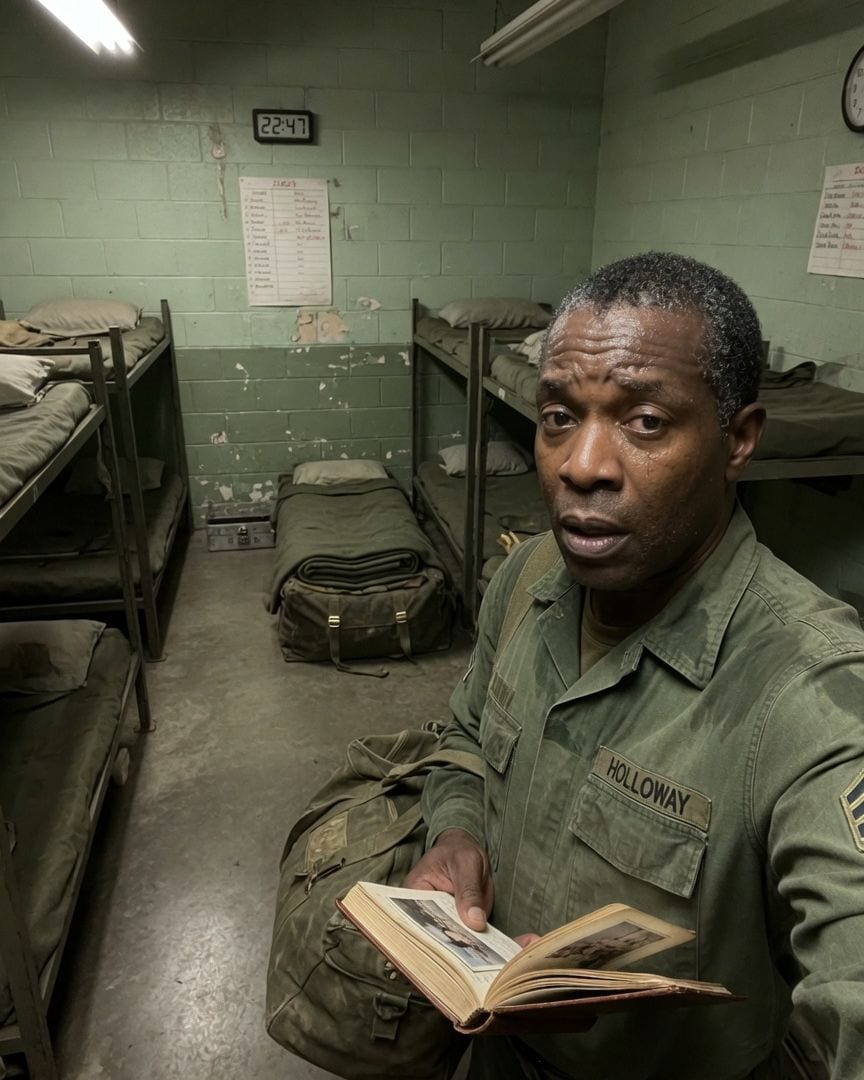
Sergeant Holloway's final platoon had seventy-nine recruits. That night, eighty voices answered the evening count.
Sergeant Raymond Holloway stood before his last platoon, seventy-nine recruits just two days from graduation, the Carolina summer humidity clinging to his uniform. In the sweat-scented squad bay, he called the evening count, but the junior DI, Donald Bishop, reported an impossible number: eighty. When Holloway called the roll himself, eighty distinct voices answered seventy-nine names, leaving a cold, unresolved hum in the air. The next morning, the impossible repeated, and soon Holloway discovered a mysterious, perfectly made-up bunk, and an old, faded duffel bag, in a squad bay built for exactly seventy-nine. Who was the phantom eightieth presence among his seventy-nine recruits?