One morning there were twenty-one bunks in a hut built for twenty — the extra one made up tight at the far end past the stove, a kitbag beneath it stencilled with a name no roll could match. By nightfall the sergeant had that end boarded over.
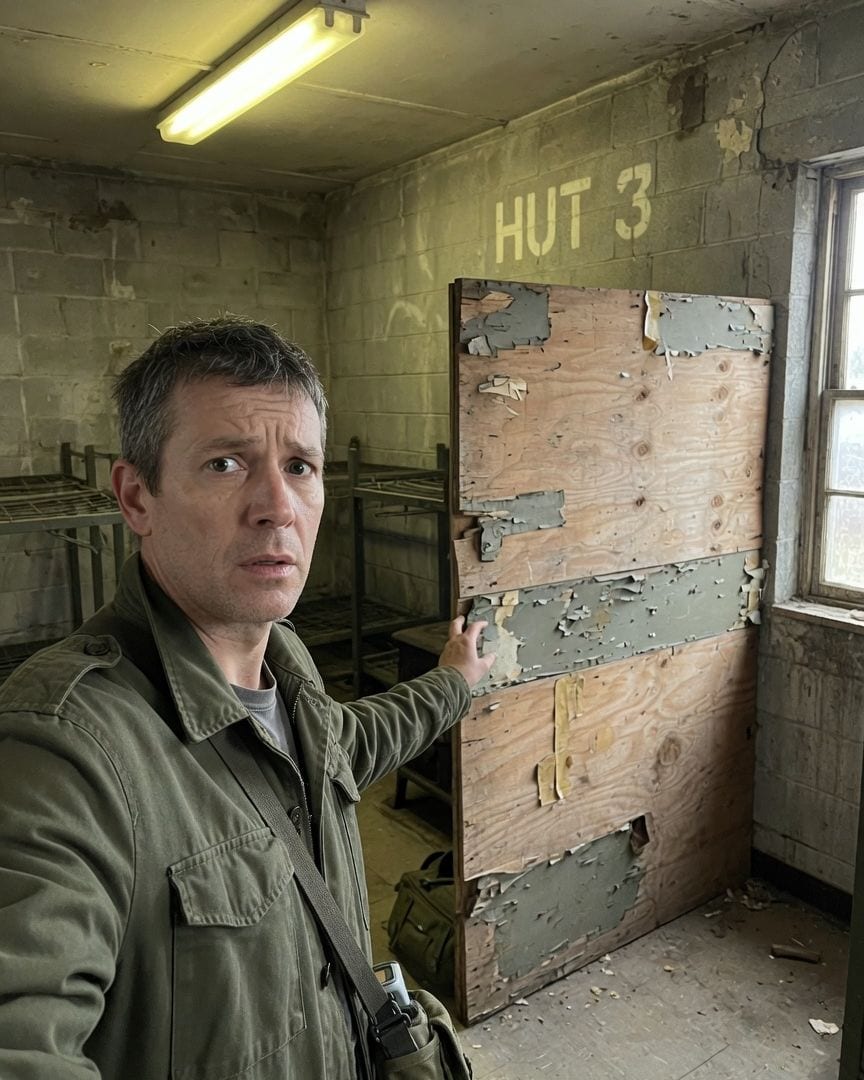
I was 20, fresh out of basic, assigned to Barracks Hut 3. It was a standard layout, concrete block and corrugated iron, designed to house twenty men, two rows of ten bunks. Simple, functional, cramped. We all knew our spot.
My bunk was the second from the stove, on the left. Twenty bunks. Always twenty.
Then came the morning of my third week. The usual drill sergeant, Sergeant Davies, called roll. Routine, barking orders, the smell of stale sweat and cheap disinfectant. We stood by our beds, kitbags aligned. Davies did his count.
Twenty men, twenty names, all present and accounted for. But then he stopped. His eyes, usually dead and unreadable, flickered to the far end of the hut, past the squat, black stove that radiated little heat.
There, tucked against the back wall, where there should have been nothing but a bare expanse of concrete, stood a twenty-first bunk.
It was made up tight, regulation perfect, blanket pulled taut, pillow fluffed. Beneath it, a green canvas kitbag, just like ours, stencilled in faded white: 'P. Jennings, 773-C'. I remember my breath catching, a cold knot in my stomach.
No one on our company roll, not for Hut 3, not for the entire company, had that name or number. Davies counted the bunks again, slowly, his lips pressed thin. He didn't say a word to us.
Just turned on his heel and walked out. An hour later, a work detail arrived. No explanations, no questions. Just orders.
By nightfall, the entire stove end of our hut, where the impossible bunk sat, was boarded over with rough plywood.
The smell of fresh lumber briefly masked the damp barracks air, and the quiet thud of hammers echoed the unsettling feeling that everyone else just accepted it.
We went to sleep that night, all twenty of us, in a hut that had swallowed a secret.
Twenty-eight years later, that memory still surfaced, sometimes a cold shiver, sometimes a phantom smell of wood and damp. I was a land surveyor now, precise, rational. I measured the world.
So when I found an old, faded photo from my service days, taken by a fellow serviceman, showing the interior of our hut—and the boarded-up wall—it pricked at something inside me. The memory wasn't a dream.
I found the decommissioned barracks easily enough; they were used for storage now. The plywood wall was still there, aged and peeling, a monument to an impossible fact.
I stood before it, tracing the rough grain, feeling the solid resistance of it. It was real. Next, the archives. I pulled the official blueprints for Hut 3. Clear as day: twenty bunks, 28x15 feet.
I returned to the barracks with my laser measure, double-checked every dimension. There was no way. Not an inch of extra space.
If a twenty-first bunk had been there, it would have been half-embedded in the concrete wall, or hanging in thin air. No structural explanation.
Then the rosters. I spent days poring over microfilm, scrolling through digitized records, cross-referencing names and service numbers from that year, that company. 'P. Jennings, 773-C' simply didn't exist in any official capacity.
Not a transfer, not a medical discharge, not a deserter. Nothing. It infuriated me, this impossible hole in the neat fabric of reality.
I tried to dismiss it, to tell myself it was a shared hallucination, a stress-induced anomaly, a prank orchestrated by the sergeants to mess with our heads.
But the measurements, the undeniable physical presence of that boarded-up wall, the absence of Jennings, all refused to let it go. It was a physical contradiction, a geometry that defied the world I measured every day.
The quiet obsession drove me deeper into the local archives, past the official records, into the forgotten corners. I found a dusty box, tucked away on a high shelf, labeled in faded ink: 'Misc. Drawings - Barracks Redevelopment'.
It smelled of dust and forgotten time. Tucked at the bottom, beneath layers of plans for drains and electrical conduits, was a single, hand-drawn blueprint.
It was clearly unofficial, the lines rendered with a meticulous, almost artistic precision, but on rough, yellowed paper. It was a layout of my exact barracks hut, dated from my national service year.
I recognized the crude, yet precise lines of the hut's interior, the placement of the stove, the windows. And there it was. A twenty-first bunk, drawn in pencil, tucked impossibly into the corner by the stove.
It was identical to my memory. Beneath the drawing, in a faded, elegant script, was the architect's signature: 'N. Bishop'. The name sent a chill through me.
I vaguely remembered it from old town council records, a distant, almost forgotten name, now reaching out from a impossible past.
The name ‘N. Bishop’ gnawed at me. My colleague, Sylvia Hayes, a GIS specialist with a knack for digging up obscure information, agreed to help, mostly out of pity for my increasingly frantic state.
She traced the name to Nathaniel Bishop, a retired local land registrar. Sylvia described him as a 'town legend,' meticulous to the point of obsession, with an almost encyclopedic knowledge of the region's history, not just the official version.
I found his house nestled among old growth trees, a quiet, unassuming place that felt ancient. Nathaniel Bishop, when he answered the door, was exactly as Sylvia described – sharp, reserved, his eyes surprisingly clear behind thick glasses.
He was 72, but moved with a brittle energy. I tried to play it cool, feigning interest in local architectural quirks, claiming to be researching a piece on historical military structures. Nathaniel listened, his gaze unblinking.
"You're interested in the old barracks, then?" he asked, his voice a low, gravelly murmur. "Particularly Hut 3, I'd imagine." He didn't smile, but a knowing glint entered his eye. I felt a prickle of unease. He already knew.
I mentioned the unofficial diagram, the one with his signature. He simply nodded. "Ah, yes. My own little side project. Some of the older buildings… they had certain… unaccounted for spaces, shall we say.
Not on the official records, of course." He picked up a polished river stone from his desk, turning it over and over.
"Unaccounted for?" I pressed, trying to keep my voice steady. "Mr. Bishop, there was a bunk in that hut. A twenty-first bunk. It shouldn't have been there. It couldn't have been there."
He put the stone down, his gaze distant. "The region has its peculiarities, young Robert. Always has. There’s a stretch of highway, for example, just outside of town, you might have heard of it? 'The Loop Road,' they call it.
People drive it, turn right, then left, they measure their mileage, see the fuel gauge drop, but end up exactly where they started. Every time. No matter what. Consistent anomaly, they call it." He paused, looking at me.
"Sound familiar, Mr. Carter?" The phrase, 'consistent anomaly,' hit me like a physical blow. It was precisely what I had been struggling to articulate about the bunk.
A few days after my visit to Nathaniel, I found a small, hand-drawn map tucked under my windshield wiper. It was crude, sketched quickly, but instantly recognizable: 'The Loop Road.'
A specific, unmarked turn-off was highlighted with a thick, red arrow. Below it, in precise, old-fashioned script, were the words: 'Some paths are meant to return. Some questions are not.'
A cold prickle of unease snaked its way down my spine. There was no doubt who it was from.
I had to try it. I drove to the beginning of The Loop Road. It was a familiar stretch of asphalt, unremarkable. I set my trip odometer to zero, noted my starting fuel level, and engaged my GPS tracker.
I followed the map precisely, taking the unmarked turn-off, then a series of seemingly logical lefts and rights, covering what my odometer insisted was miles of winding country road.
The GPS tracking, displayed on my phone, showed a bizarre, meandering path, a spaghetti-like tangle of lines. My fuel gauge dropped, noticeably.
After what felt like a good twenty minutes, the road straightened out, and there it was: the precise spot where I had started. My odometer read 14.7 miles. My fuel gauge was down a quarter tank.
My GPS, however, showed that my starting point and ending point were identical, overlaying each other perfectly on the map.
The lines of my supposed journey formed an impossible loop, a spatial contradiction that could only be reconciled by accepting that the miles I'd driven had, somehow, not actually moved me.
It wasn't a warning, I realized with a sickening lurch. It was a demonstration. Nathaniel Bishop wasn't just aware of these anomalies; he was actively observing my investigation, guiding me, perhaps, or testing me.
The quiet hum of the car engine, the familiar landscape, everything felt tainted by this impossible geometry. The air in the car grew strangely cold, though the sun beat down outside.
The world, I was beginning to understand, was not what I thought it was.
I returned to Nathaniel Bishop’s house, this time without pretext. I didn't bother knocking. I just walked in when the door was ajar. He sat at his desk, as if expecting me, the river stone back in his hand.
I didn’t waste words. I laid the old barracks diagram and the crude map of 'The Loop Road' on his polished oak desk.
"You know about these, don't you?" I asked, my voice tight. "The bunk. The road. You know what they are."
Nathaniel sighed, a slow, deliberate sound that seemed to carry the weight of decades. "Some things... are simply part of the land, Robert. They have always been. My family has known for generations." He gestured to the maps.
"These aren't glitches, you understand. Not random errors. They're stable, recurring distortions. Places where the geometry of the world simply doesn't add up. We call them spatial fault lines."
He spoke with an unsettling calm, as if discussing the weather. "The extra bunk you saw, the 'Road That Returns' – they are fixed points. Like scars on the landscape.
They manifest, they persist, and then they sometimes recede, only to return. Always in the same place, always in the same way." He pushed a heavy, leather-bound ledger across the desk. It was thick with age, its cover cracked.
I opened it carefully. Inside, meticulous hand-drawn maps filled the pages, alongside precise dates and annotated notes. I saw entries describing similar impossibilities across the region, some dating back centuries. Impossible structures appearing and disappearing.
Roads that folded in on themselves. Entire sections of forest that, when measured, were both larger and smaller than they physically could be.
My fingers trembled as I turned a page. There, in the same elegant script as the barracks diagram, was an entry that made my blood run cold: 'Barracks Hut 3, anomaly 19xx – additional bunk, kitbag 'P. Jennings'.
Occurrences noted: 1948, 1965, 1996.'
The wrongness was not new. It was not random. It was a pattern, a quiet, persistent haunting of space itself, documented with the detached precision of a meteorologist charting a storm.
The room seemed to expand, its walls subtly shifting, as if the very air was now imbued with the impossible.
"Why?" I demanded, my voice raw, pointing at the ledger. "Why did your family compile all this? What purpose does it serve?"
Nathaniel closed the heavy ledger with a soft thud, his gaze distant, fixed on some unseen point beyond the window. "Because we live amongst them, Robert. And because, sometimes, we are part of them."
He then rose, moving to a locked drawer in an antique cabinet. He produced a set of keys, the brass worn smooth with age, and with a soft click, pulled out a scroll of parchment.
He unrolled it carefully across his desk, flattening it with a practiced hand. It was an antique land registry map, hand-annotated with a spiderweb of faint, archaic symbols I didn’t recognize.
His gnarled finger, steady and unwavering, pointed to a familiar, looping property line, drawn with a strange, almost organic curvature. "Your family's land, young Robert," he murmured, his eyes unreadable, seeming to see not me, but generations of my ancestors.
"Always… a very interesting piece of ground."
I leaned closer, my heart thudding a frantic rhythm against my ribs. The lines on the map, the very boundaries of my childhood home, did not meet. They could not.
A segment of the property, when measured against the map’s grid, consistently overlapped itself, creating a geometric impossibility. It mirrored the bizarre, self-enclosing geometry of 'The Loop Road' and the phantom bunk.
The symbols Nathaniel had mentioned were concentrated around my property, like strange hieroglyphs marking a forbidden boundary. My childhood home was drawn onto an impossible geometry. I had always lived inside it.
"What do you mean, 'part of them'?" I demanded, the words tearing from my throat. "My family? My home?" My hands were shaking, gripping the edge of the antique map.
Nathaniel, calm as ever, almost infuriatingly so, retrieved the river stone and began turning it in his palm again. "The Bishop family, for generations, served as the unofficial caretakers of this region's true geography.
The official records, those are for convenience. This," he tapped the ancient map, "this is the reality. And yes, Robert, certain families, including your own, have ancestral ties to these spatial fault lines.
A long-term presence on these specific lands… it can lead to a heightened sensitivity. An unconscious awareness of the distortions, perhaps."
He then reached into the same drawer and pulled out a small, leather-bound photo album, its pages brittle. He found a specific page, sliding it across the desk. It was an old, faded photograph.
A young man, barely older than I was during national service, stood beside a bunk. An extra bunk, impossibly tucked into a corner, precisely as I remembered it. The uniform was identical to mine.
The face… it took me a moment, but I recognized it. It was a much younger Nathaniel Bishop. But the name stenciled on the green canvas kitbag beneath the bunk was not 'Bishop.' It was 'P. Jennings'.
"P. Jennings," Nathaniel said, his voice softer now, almost a whisper. "My uncle. My mother's brother. Lost to one of these distortions decades ago. His presence... it occasionally bleeds through at that specific anomaly point in the barracks.
The kitbag, the name, the bunk itself – they weren't random. They were a recurring echo, an imprint of someone lost within the geometry, perceived by those sensitive enough, like you, to notice the impossible."
He looked up at me, his eyes sharp. "You carry that sensitivity, Robert. It's why you saw the bunk, why you couldn't let it go. It's why your land has always been… problematic, on paper."
The terror and anger warred within me. "So my family, my home… we're just part of this? A fixed point? A ghost of someone lost?"
Nathaniel simply nodded, the gesture almost dismissive. "You see it, Robert. Most do not. Your family's property, like the barracks, like 'The Loop Road,' exists at a specific nexus point.
It's not a curse, it's just… how this part of the world is. And sometimes, it takes people. People who step too far into the folds."
He paused, then added, "People like P. Jennings."
I tried to argue, to find a rational solution, a way out, a path to normal. "There has to be a way to fix it, to map it out properly, to... close these fault lines!"
Nathaniel merely shook his head. "Generations of Bishop men have simply observed, documented, and quietly accepted. There is no fixing it, Robert. Only living with it. Or, sometimes, living in it."
He gestured again to the ancient map, the one outlining my impossible property. "This map… it charts the safe passages, the places where the geometry is stable. And the places where it is not.
You will learn to feel the difference." The calm acceptance in Nathaniel's voice was chilling, a pronouncement that I now shared this burden, this terrible knowledge, and was expected to endure it just as the Bishops had.
The weight of centuries settled on my shoulders.
I left Nathaniel's house, the antique map clutched in my hand, feeling like I was walking through a different world.
I drove home, taking an unfamiliar route, deliberately avoiding the main roads, actively skirting what I now knew was 'The Loop Road.' My hands gripped the steering wheel tight.
I found myself constantly checking my odometer, my GPS, my fuel gauge, half-expecting some subtle, impossible shift.
Every crack in the pavement, every slightly off-kilter window on the houses I passed, every gentle curve in the road, now held a sinister implication, a hidden fold.
I resigned from my surveying job a week later. The precise geometry of my profession, the certainty of lines and angles, was an unbearable mockery of the impossible reality I now knew.
Sylvia called, concerned, asking why I was suddenly abandoning my career, but I offered only vague explanations, telling her I needed a change, couldn't quite put my finger on it. How could I?
Weeks later, I found myself back at the old barracks, standing before the plywood wall. The afternoon light cast long shadows, and the air was still, quiet.
I traced its rough surface with my fingers, no longer feeling fear, but only a profound, cold understanding. The hum of impossible geometry was in the air, in the silent space beyond the wall.
I pulled out a small notebook and a pencil.
I began to sketch, not the official blueprints, but the true, impossible layout of the hut, marking the twenty-first bunk precisely where it was, where it always had been, and where it always would be.
I felt a strange sense of purpose, a quiet duty I never asked for. I knew I would never be free of this knowledge, nor of the strange, unmappable geometry that now defined my world.
The dread had outlived the answer, leaving only a quiet, terrible clarity.
Sylvia Hayes, driving past the old barracks, saw Robert standing by the boarded-up hut, sketching intently in a small notebook. She waved, but he didn't seem to notice.
He looked older, she thought, and there was a peculiar, knowing calm in his eyes, as if he finally understood a joke no one else was in on. He just kept sketching the impossible geometry.
If this one got to you
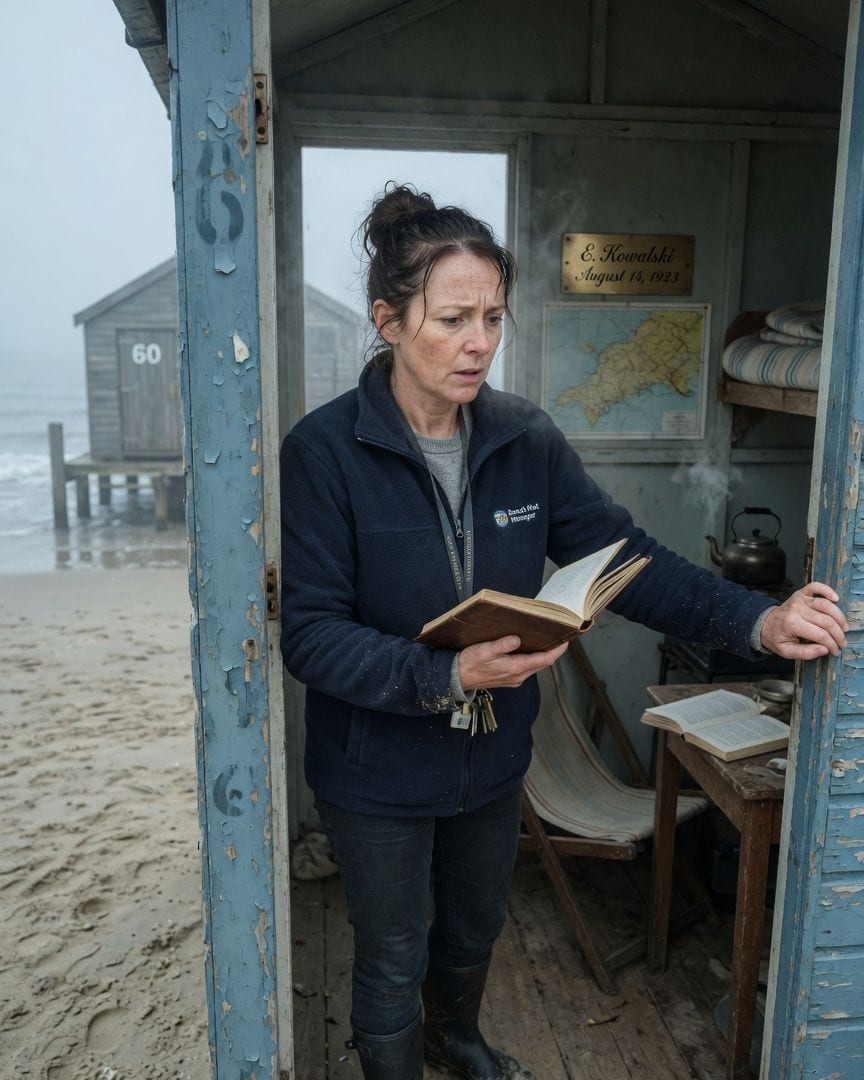
My beach hut row now has Hut 61, but it's not in my books. Inside, a kettle steams, and a plaque on the wall bears my family name, dated 1923.
As manager of the council's sixty beach huts for ten years, I knew my route blind. But on my usual morning walk, nestled against the groyne beyond Hut 60, stood a Hut 61. It looked decades old, just like the others, yet my ledger held no record of its existence.
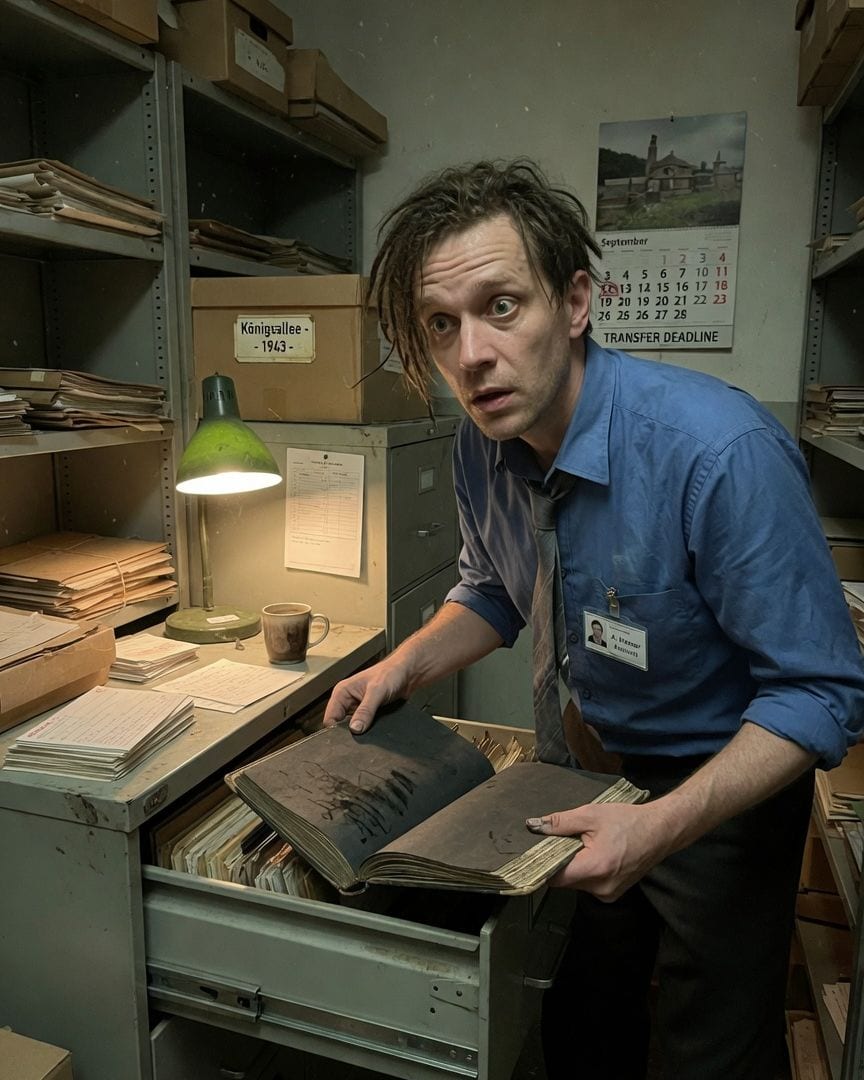
A Berlin archive researcher races a deadline. A hidden log for a Cold War barracks on a vacant lot has ink still wet from last month.
Ansel Vidmar, a methodical researcher, felt the pressure of a looming deadline. The municipal transfer of the old Berlin archive was days away, and he still had countless documents to categorize amidst towering stacks of forgotten history. His focus narrowed to an unindexed metal cabinet, revealing records for a garrison company at Königsallee – an address that had been a vacant lot since the war. A punishment log inside listed an entry from 1983, a date far too recent for a non-existent building. When Ansel visited the site, he found only overgrown grass, save for a single, eerily clean concrete doorstep emerging from the earth. His unease solidified into dread when he later uncovered a hidden Quartermaster's Log, meticulously detailing supplies for the same barracks, with entries extending to "last month," the final page's ink still faintly wet. What unseen operations were still being maintained?
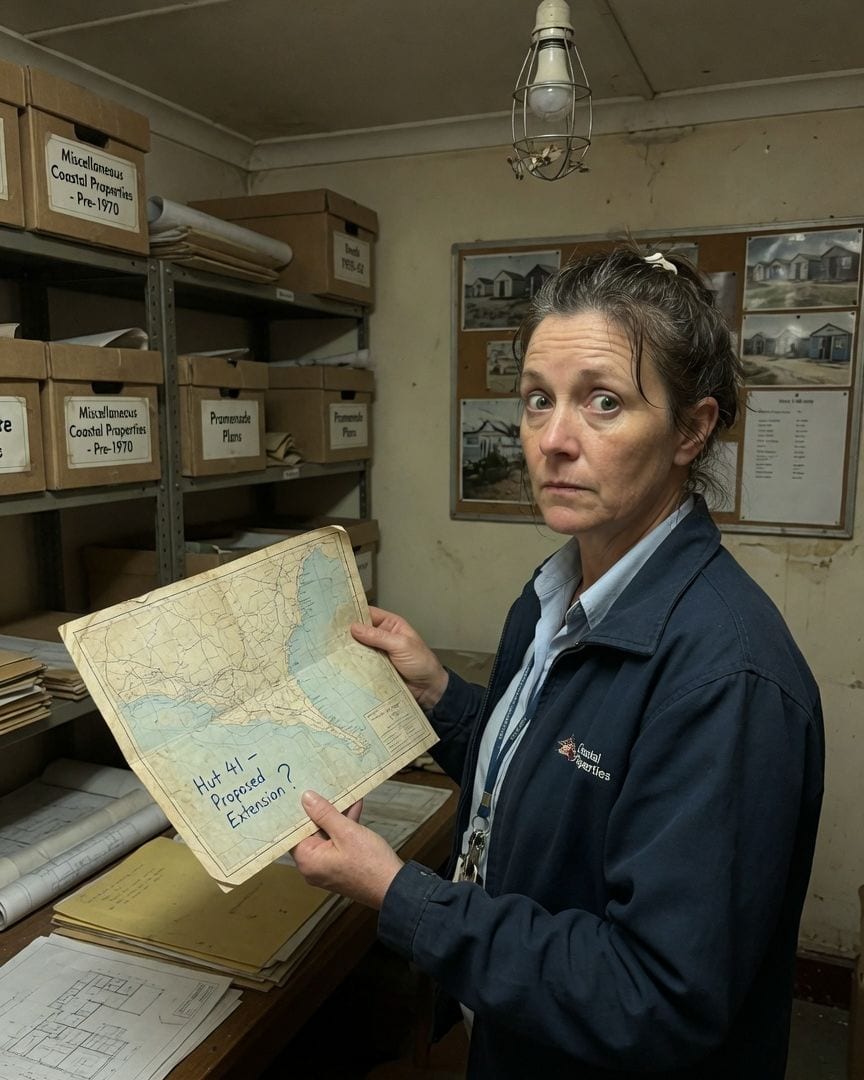
My beach huts now number forty-one. Hut 41 appeared past the promenade's end, locked with a padlock I don't own, washing stiff and dry on its line every morning since Monday.
My morning rounds along the promenade were always predictable: forty beach huts, each numbered and accounted for. But one morning, past the usual end of the concrete slipway, a new hut appeared. Hut 41 stood there, identical to the others, yet its padlock was a tarnished brass and a child's swimsuit hung bone-dry on a line.
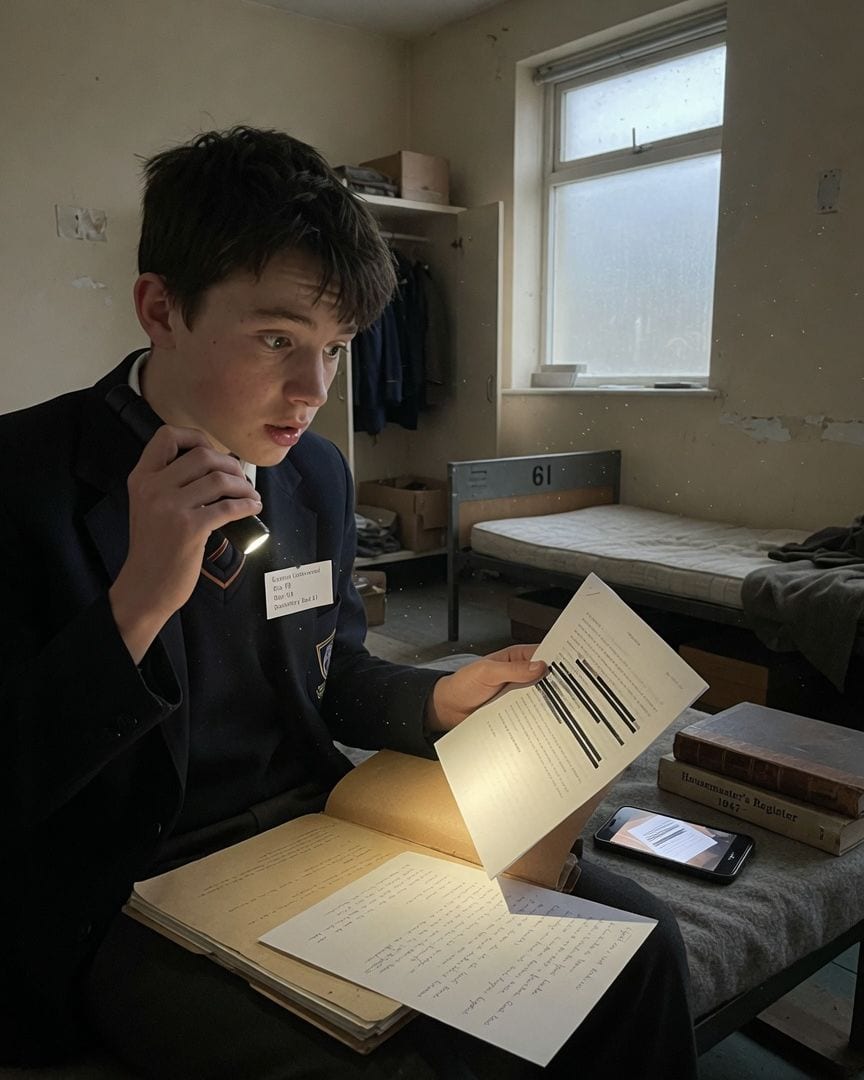
My boarding school bed number was 61, and the archive shows a boy assigned it every eight years since 1947, each leaving mid-term with the bed 'to remain made up'.
I found my matriculation card, listing me as 'Boy 61, Dormitory Bed 61.' Later, an old ledger revealed every boy assigned that bed since 1947 left mid-term, with an unsettling note: 'bed to remain made up.' Our housemaster’s recent scribble, 'as the others,' only deepened the dread around my own assigned bed.
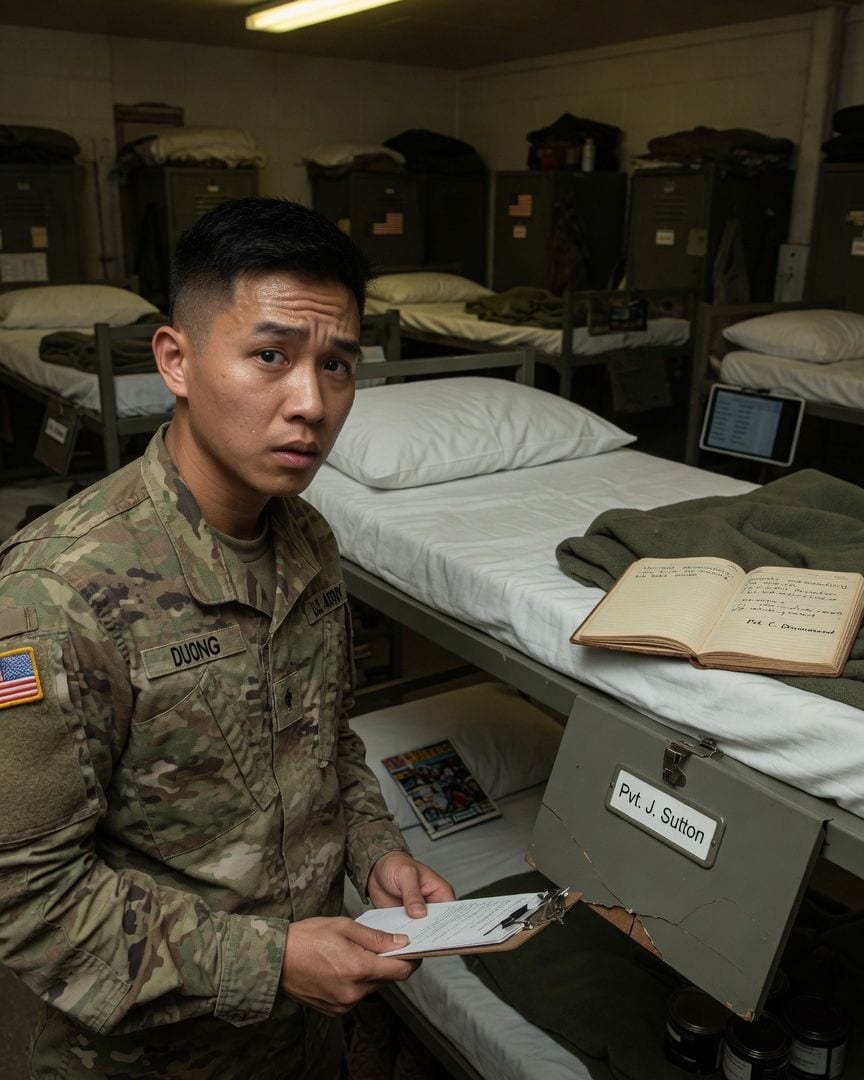
Specialist Duong’s final check unearths a logbook from decades past: an entry for '9 men present, 10 bunks made'.
Specialist Quentin Duong meticulously conducted his platoon's final barracks accountability check before graduation, the air thick with stale boot polish. He confirmed nine men against the roster, but the tenth bunk in the bay stood apart, always perfectly made and tagged 'Pvt. J. Sutton,' a name not on any current manifest. Despite dismissals from his battle buddy and sergeant, Duong couldn't shake the quiet unease. He returned to the immaculate bunk, uncovering a false bottom in its footlocker holding a decades-old logbook. Inside, a chilling entry from a previous cycle detailed '9 men present, 10 bunks made,' signed with a hand eerily similar to his own.
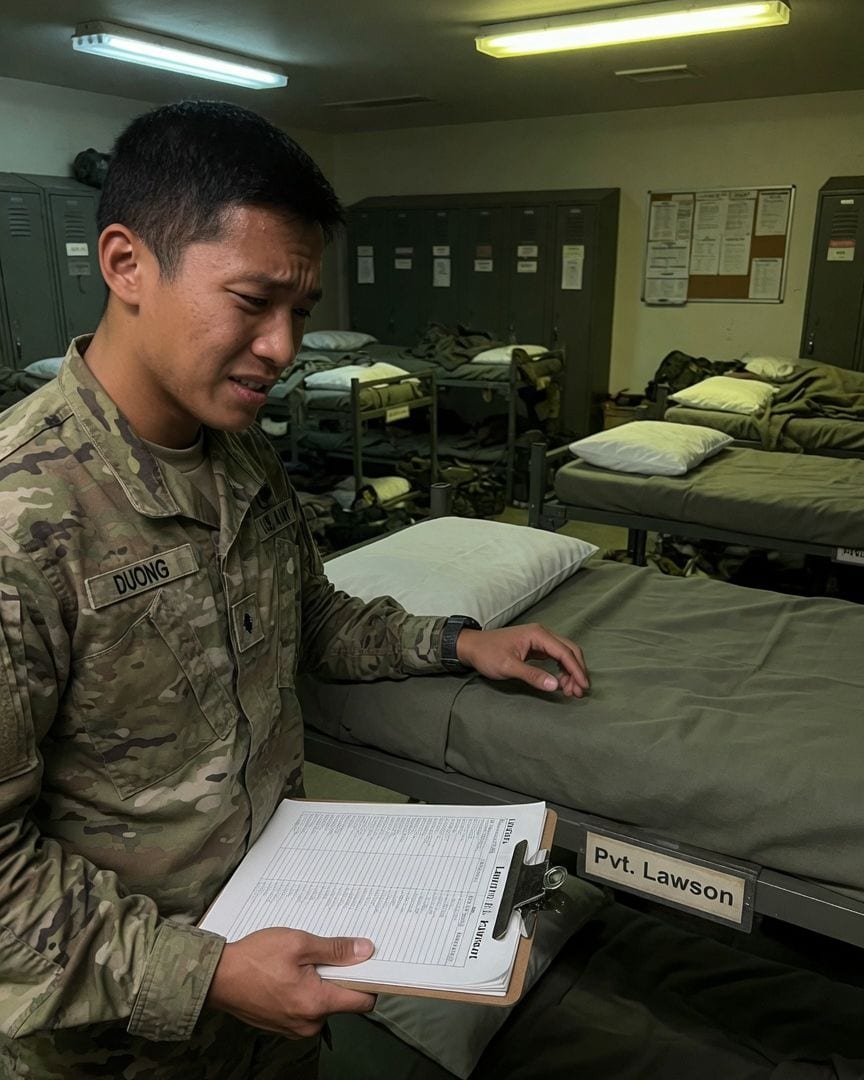
Specialist Duong found a perfectly made bunk for a Private Lawson who didn't exist, then saw his own signature on a duty log with him.
Specialist Gideon Duong found solace in the precise order of barracks life, especially after a grueling week in the field. His final task before tomorrow's graduation was barracks accountability, a routine count of sleeping soldiers against the official roster. But at the end of the aisle, a tenth bunk stood impossibly perfect, sheets hospital-folded, with a faded name tag for 'Pvt. Lawson'. No one was in it, no one ever used it, yet the roster listed Lawson, and Duong's own signature later appeared on a duty log for a patrol he never pulled, alongside the phantom Private. What secret did the meticulously made bunk hide?