Specialist Duong found a perfectly made bunk for a Private Lawson who didn't exist, then saw his own signature on a duty log with him.
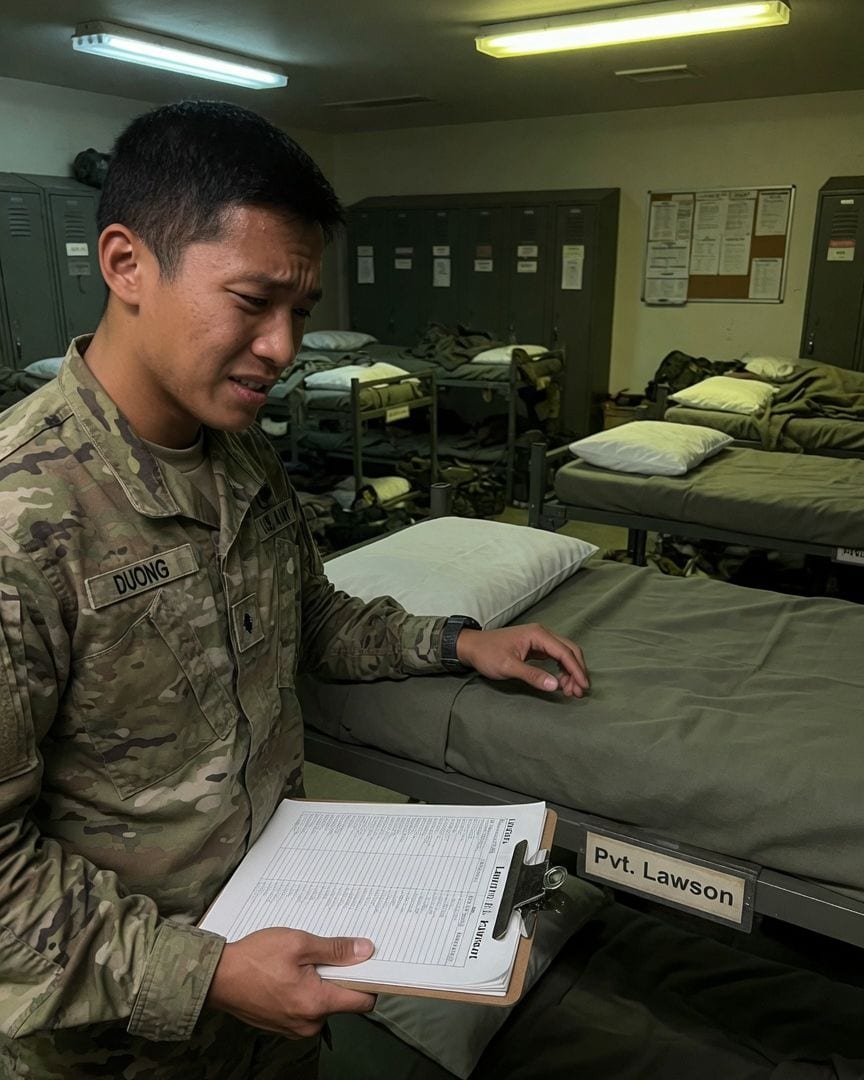
Specialist Gideon Duong moved through the barracks with the practiced efficiency of a soldier who found solace in order. After a grueling week in the field, his platoon was squared away, ready for graduation tomorrow. His final task: barracks accountability.
He tapped each bunk frame with a knuckle, counting heads against the official roster clipped to his clipboard. Nine bunks, nine sleeping soldiers. The low hum of the fluorescent lights overhead cast long, still shadows across the sleeping forms.
He reached the end of the aisle. A tenth bunk stood, impossibly perfect, at odds with the slight disarray of the other racks. Sheets pulled tight, corners hospital-folded with parade-ground precision. The olive-drab blanket lay creased without a single wrinkle.
A laminated name tag, slightly faded, was clipped to the bed frame: 'Pvt. Lawson'. Duong frowned. No one was in it. No one ever used it.
He checked the roster again. Nine names, then 'Lawson, Pvt.' at the bottom, printed in a slightly different, older font. He counted the bodies one more time, carefully, as if the physical act would conjure the missing man. Still nine.
The count of names came out one over the actual number of men. He tried to dismiss it, a stray tag, a barracks prank, but the bunk's meticulous order, its silent, perfect testimony, defied such an easy explanation.
Who would bother, and why maintain such a charade? He glanced around the quiet barracks, a cold prickle of unease starting in his gut. The tenth bunk, tagged 'Pvt.
Lawson', had been made up like this every morning of the cycle, a constant, unsettling presence no one acknowledged.
The next morning, the barracks felt hollow as the platoon marched out to the parade ground, leaving Duong behind with a small detail to secure the building. The 'Lawson' bunk remained, a stark, unsettling perfection in the empty space.
It stood as a silent rebuke to the usual chaos of an active duty barracks, its sheets pulled taut enough to bounce a quarter. Duong approached it cautiously, running a hand over the impossibly smooth fabric.
The air around it seemed a fraction cooler than the rest of the room.
He pulled the name tag off. It felt stiff, brittle, older than the tags issued that cycle, despite its identical design.
Tucked into the frame, beneath the mattress, he found a small, laminated fragment of what looked like an old unit roster. 'Pvt. Lawson' was listed, his photo a blurry, indistinct face, the pixels faded into an almost featureless gray.
The dates on the fragment didn't quite align with the current training cycle; they predated it by several months, overlapping with a prior unit's rotation.
Later, in the mess hall, Duong approached a few of his battle buddies. 'Hey, you guys remember a 'Pvt. Lawson' from our company?' A few offered vague, hesitant responses. 'Quiet guy? Yeah, maybe.' 'Saw him around, I think.'
No one could place him definitively, but no one could say with certainty that he wasn't there either. Their recollections were like trying to grab smoke.
Back in his own bunk, Duong pulled up the digital roster on his tablet. 'Lawson, Pvt.' was still there.
As he stared at the entry, the digital font seemed to shift, almost imperceptibly, for a flicker of a second, as if correcting itself in real-time. The unease sharpened into something colder, more specific.
This wasn't a joke, or even a simple mistake. This was a presence, perfectly accounted for by the system, yet utterly absent from their shared reality.
Driven by a desperate need to reconcile the impossible, Duong headed to the company office, a quiet, sterile space already humming with the quiet thrum of a photocopier.
He pulled the physical duty logs for the past week from a heavy steel cabinet, the pages thick and official. He flipped through them, each entry meticulously signed by the platoon sergeant.
He found the page for Tuesday's late-night perimeter patrol. His eyes scanned the names: 'Duong, G.'... 'Yates, D.'... and then, undeniably, 'Lawson, Pvt.'
Underneath, to his horror, was his own signature, 'Specialist Gideon Duong', clear and unmistakable, scrawled for a patrol he knew with absolute certainty he had not pulled.
He remembered Tuesday night perfectly; he had been on fire watch, huddled against the cold, not walking the perimeter. The paper, the official record, swore he had been there, with Lawson.
He stared at his own familiar handwriting, a cold dread seeping into his bones.
The false signature was a hook buried deep in Duong's mind, tugging at him with relentless insistence. He spent the next few days, officially on pre-graduation duties, discreetly digging.
He accessed the base’s internal personnel system, trying to find a definitive service record for 'Pvt. Lawson'. What he found was a tangled mess, a digital echo chamber.
There were multiple entries: a 'Lawson' deployed to Afghanistan three years ago, another 'Lawson' listed in a logistics unit on the West Coast, and a third, more recent 'Lawson' assigned to their very own training company, but with inconsistent start dates and no clear photo.
Each record was perfectly valid on its own, authenticated by system timestamps and digital signatures, but together, they formed a contradictory mosaic, a soldier in triplicate, none of whom truly existed as a single, coherent person.
He spoke to more soldiers, nudging conversations, careful not to reveal the depth of his alarm. 'You remember a Private Lawson from our company?'
The answers were always the same: vague recollections, a face seen in the mess hall, a name on a roster, but never a shared memory of a specific conversation, a distinct detail, or even a clear physical description that matched.
It was as if 'Lawson' was a consensus ghost, agreed upon by the system and vaguely acknowledged by its personnel, but never truly experienced in a concrete, physical way.
Duong started noticing other small glitches now, details that would have seemed innocuous before, easily dismissed. A supply requisition for an extra set of cold-weather gear, signed by a 'Sgt. Barlow' no one recognized on the company roster.
A training completion certificate for an advanced marksmanship course, issued to their company last month, but no one could recall taking it, nor could any instructors recall teaching it.
The cracks in the system were subtle, almost designed to be overlooked, but once seen, they multiplied, revealing a quiet, pervasive wrongness beneath the surface of official order.
Duong’s persistent inquiries did not go unnoticed. A few days before graduation, a summons appeared on his bunk’s digital display, glowing with an urgent priority. He was to report to Sergeant Major Arthur Porter’s office.
Porter, a formidable NCO with decades of service etched into his stern, impassive face, sat behind a pristine, uncluttered desk.
The room was cold, the air still and heavy, and the only sound was the faint, rhythmic whir of a server rack hidden in a nearby closet. Porter’s gaze was steady, unreadable, like polished granite.
'Specialist Duong,' Porter began, his voice calm, even. 'I understand you've been having some... concerns. About administrative discrepancies. And unofficial inquiries.' Duong felt a chill that had nothing to do with the room's temperature.
Porter didn’t raise his voice, didn't threaten, but the underlying message was clear, precise, and absolute. Porter spoke of 'clerical errors,' of 'overthinking the paperwork,' of 'focusing on the mission.'
He advised Duong to put it all behind him, to look forward to graduation, to his deployment. His words were reasonable, almost paternal, but his eyes never softened.
As Duong left, he caught Porter’s reflection in the darkened office window, a faint, almost imperceptible smile playing on the Sergeant Major’s lips, a gesture that held no warmth, only a chilling, knowing satisfaction.
That night, Duong couldn't shake the feeling of being watched, of something having shifted irrevocably. He checked his own digital service file, something he rarely did.
There, under 'Commendations,' was a citation for 'exceptional bravery during a training exercise,' dated last week. He'd been in the infirmary with a sprained ankle that day, lying in a cot, reading a paperback.
And beneath the commendation, his own digital signature, perfectly replicated, an immaculate forgery. The 'protagonist was always named in it' secondary twist solidified, making the threat personal and insidious. It wasn't just 'Lawson' anymore. It was him.
The false commendation was the final straw, the personal violation that tipped Duong past the point of quiet investigation.
He bypassed the chain of command, requesting an urgent, private meeting with Sergeant Major Porter again, this time arriving with a printout of the conflicting 'Lawson' records and his own falsified commendation.
He laid them out on Porter’s pristine desk, the papers stark white against the dark wood.
'Sergeant Major,' Duong began, his voice tight, 'this isn't a clerical error. This is my service record, and it's lying. And this 'Pvt. Lawson' doesn't exist, but the system says he does, everywhere, all at once.'
Porter picked up the printouts, his expression unreadable, his movements slow and deliberate. He tapped the 'Lawson' record, then Duong’s commendation. 'Private Lawson exists, Specialist. In the system, he is perfectly accounted for. As are your commendations.'
Porter leaned back, a deep sigh escaping him, a sound of weary acceptance, not exasperation. 'The military is a machine built on accountability, Duong. Every piece, every man, every document must align.
Sometimes, when a gap appears—a soldier lost, a quota unmet, a unit understrength on paper—the system... compensates.'
He explained, in a measured, almost academic tone, that 'anomalous personnel' were not uncommon.
They were 'system artifacts,' placeholders that emerged when the numbers didn't quite add up, when a quota needed to be met, or a unit needed to appear at full strength to satisfy an audit or a deployment manifest.
'They ensure perfect accountability,' Porter said, his gaze fixed on some distant, invisible point. 'They fill the gaps. They are never truly present, never truly absent. They simply are, in the records, in the systems.'
He gestured to Duong's false commendation. 'Your own record, Specialist, simply filled a temporary gap in a required training metric. A necessary adjustment to maintain overall coherence.'
Duong felt a cold, terrifying clarity descend, like a slab of ice dropping into his chest. The horror wasn't a ghost; it was the very fabric of the system, weaving in its own impossible truths with cold, bureaucratic efficiency.
The earlier clues clicked into place with sickening precision: the perfectly made, empty bunk, the vague, half-formed memories of 'Lawson' from his peers, the conflicting records – all were traces of the system's silent, self-correcting mechanism.
It was a self-sustaining fiction, meticulously maintained.
That night, sleep was an impossible concept. Duong felt a frantic urge to prove Porter wrong, to find a flaw in the terrifying logic. He returned to his tablet, its screen a lonely beacon in the dark barracks.
He used a back channel, a friend in administration who owed him a favor, to pull the preliminary deployment rosters for the next cycle, hoping to find some anomaly, some proof that Porter was lying, that this entire construct was fragile.
He scrolled through the endless lists of names, units, and destinations, his heart pounding a frantic rhythm against his ribs. He saw familiar names, then unfamiliar ones. And there it was.
'Lawson, Pvt.' assigned to a scout platoon deploying to a remote forward operating base in a region Duong knew was a hot zone, deep in enemy territory. He felt a sickening lurch, a wave of nausea washing over him.
Then, his eyes dropped to the line below. His own name. 'Duong, Gideon. Specialist.' Same rank, same last four digits of his service number. But assigned to the same scout platoon as Lawson, for the same deployment.
And next to his name, under 'Battle Buddy,' was 'Lawson, Pvt.'
Duong's breath hitched, a ragged sound in the quiet room. His finger, trembling, traced the names on the glowing screen. He was not scheduled for this deployment. He was graduating tomorrow. He was going home on leave.
But the system, in its cold, precise logic, had accounted for him. Twice. The accountability that cannot be had just claimed him.
The next morning, Duong confronted Porter one last time, the printout of his phantom deployment in his shaking hand, the paper crinkling under his desperate grip. Porter didn't deny it. He didn't even feign surprise.
'The system needs to be balanced, Specialist,' he said, his voice devoid of emotion, a steady, low drone. 'You are a reliable soldier, well-trained.
When a gap appeared, a need for a specific profile, the system chose to fill it using a proven template. You.'
Duong realized the full, soul-crushing horror: it wasn't just placeholders, not just generic names for numerical gaps. The system didn't just create new, generic names; it duplicated existing service members into new, phantom identities.
The 'Lawson' bunk wasn't just an extra; it was the genesis point for a new 'Lawson', a new identity coalescing from the raw data of military bureaucracy, given physical form, however fleeting, in that perfectly made bed.
'These duplicates,' Porter continued, a faint, unsettling echo of the earlier smile playing on his lips, 'are perfectly accounted for. They fill quotas, they balance manifests, they ensure no unit is ever 'understrength' on paper.
They are never spoken of, never acknowledged beyond the paperwork. The made-up bunks, the meticulous order... that's where they fully cohere. A physical anchor for a digital ghost. A necessary lie.'
Every planted clue, from the meticulous bunk to the false signatures in the duty log, clicked into place with horrifying coherence, forming a perfectly consistent, utterly monstrous reality.
The dread wasn't in a monster, but in the cold, logical perfection of an institutional anomaly, a system so absolute in its demand for balance that it would create an entire phantom reality to achieve it.
Duong, desperate, tried to expose it.
From a terminal in the company office, he attempted to use the base's internal network to leak the evidence – the conflicting 'Lawson' records, the false commendation on his own file, his own duplicated name on the phantom deployment roster – to military intelligence.
But his access was immediately flagged and blocked. The screen flickered, displaying a 'Denied' message in stark red letters, then went dark.
He then tried to physically delete the phantom 'Gideon Duong' record from an administrative terminal, but the file was locked, immutable, a permanent fixture in the digital architecture.
It rejected his commands with an error message, then ejected his CAC card with a sharp, final click.
As he slammed his fist on the keyboard, a metallic clang echoing in the quiet office, Sergeant Major Porter appeared in the doorway, flanked by Sergeant Yates and Sergeant Harlow, two other NCOs Duong had always respected for their quiet competence.
Their faces were calm, almost serene, their gazes steady.
'You can't fight the system, Specialist,' Porter said, his voice soft but firm, a statement of fact, not a threat. 'It has its own logic. Its own needs.'
Yates stepped forward, holding a pristine, blank service record folder, its emptiness a terrifying promise. 'You have a choice, Duong. Understand and accept. Become one of us. Manage the anomalies. Ensure the balance. Or you will be reassigned.'
'Reassigned?' Duong spat, his voice trembling with a fury that felt futile. 'You mean my ghost self takes over, and I disappear?' Harlow offered a faint, unsettling smile, a fleeting twist of his lips. 'You will simply be... accounted for.
Elsewhere.'
Duong looked from face to face, seeing not malice, but a chilling, institutional obedience, an unwavering loyalty to a monstrous truth. He saw no way out but to run.
He sprinted for the nearest exit, ignoring their calm, measured calls behind him, the sound of their voices fading into the insistent hum of the base.
He burst through the gate, not looking back, a desperate, animal need for escape overriding all military discipline.
Duong was found days later, disoriented and malnourished, huddled in a ditch miles from the base, rambling incoherently about phantom soldiers and impossible records.
He was swiftly given a medical discharge for 'severe psychological distress,' his story dismissed as a textbook case of combat-induced paranoia, despite never having seen combat.
No one questioned the speed of his processing, or the quiet efficiency with which his discharge papers were handled. The barracks were cleaned, the bunks stripped, ready for the next cycle of trainees.
The 'Lawson' bunk, once again, was empty, but meticulously made, its sheets pulled taut, as if awaiting its occupant.
Years later, Gideon Duong, now a civilian, tried to rebuild his life, haunted by the memory of the impeccable bunk and the knowing calm in Sergeant Major Porter's eyes. He avoided anything military-related, any talk of service or accountability.
He moved across the country, seeking anonymity, hoping to outrun the chilling logic he had glimpsed. He started a new job, cultivated new friends, and tried to forget.
One quiet afternoon, a package arrived in the mail. No return address. Inside, nestled in purple velvet, was a Purple Heart medal, addressed to 'Specialist Gideon Duong.'
The accompanying citation, crisp and official, detailed an act of valor in a forgotten skirmish, during a deployment to a remote region he had never set foot in, dated months after his discharge.
The citation was signed, in a familiar, precise hand, by Sergeant Major Arthur Porter. His ghost self was still out there, accumulating a service record, perfectly accounted for, in a war he never fought.
If this one got to you
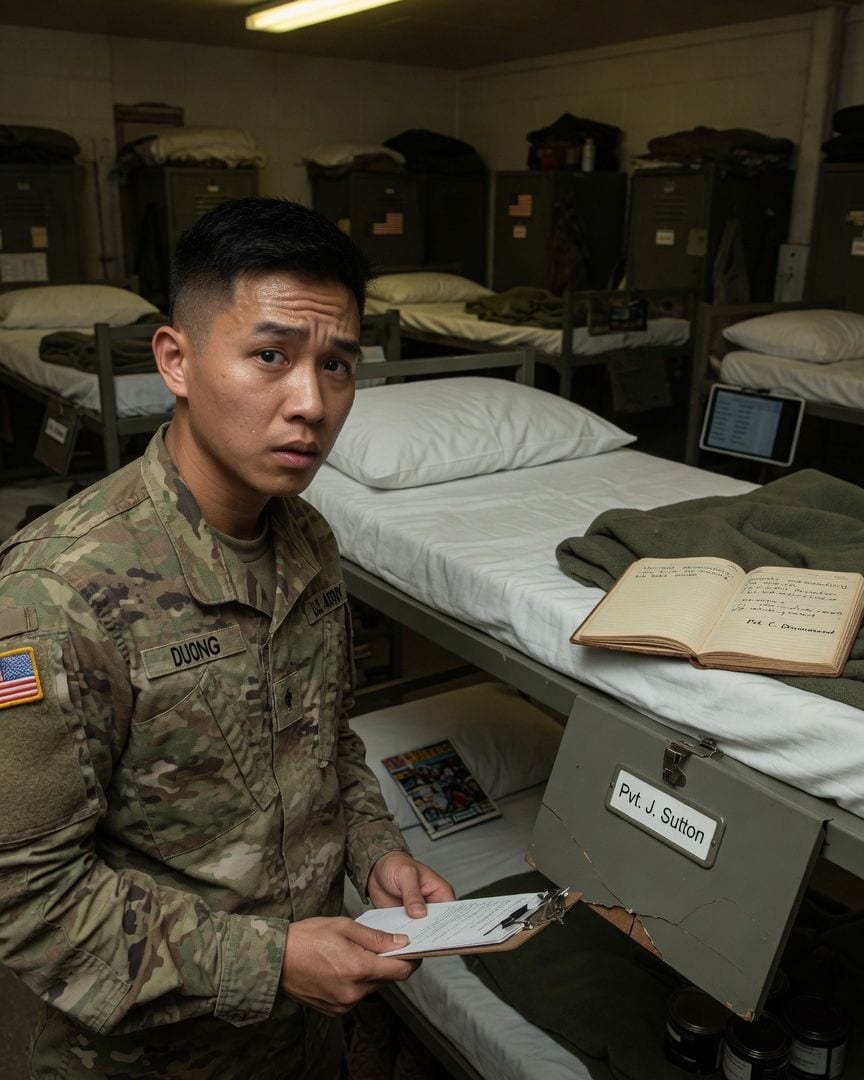
Specialist Duong’s final check unearths a logbook from decades past: an entry for '9 men present, 10 bunks made'.
Specialist Quentin Duong meticulously conducted his platoon's final barracks accountability check before graduation, the air thick with stale boot polish. He confirmed nine men against the roster, but the tenth bunk in the bay stood apart, always perfectly made and tagged 'Pvt. J. Sutton,' a name not on any current manifest. Despite dismissals from his battle buddy and sergeant, Duong couldn't shake the quiet unease. He returned to the immaculate bunk, uncovering a false bottom in its footlocker holding a decades-old logbook. Inside, a chilling entry from a previous cycle detailed '9 men present, 10 bunks made,' signed with a hand eerily similar to his own.
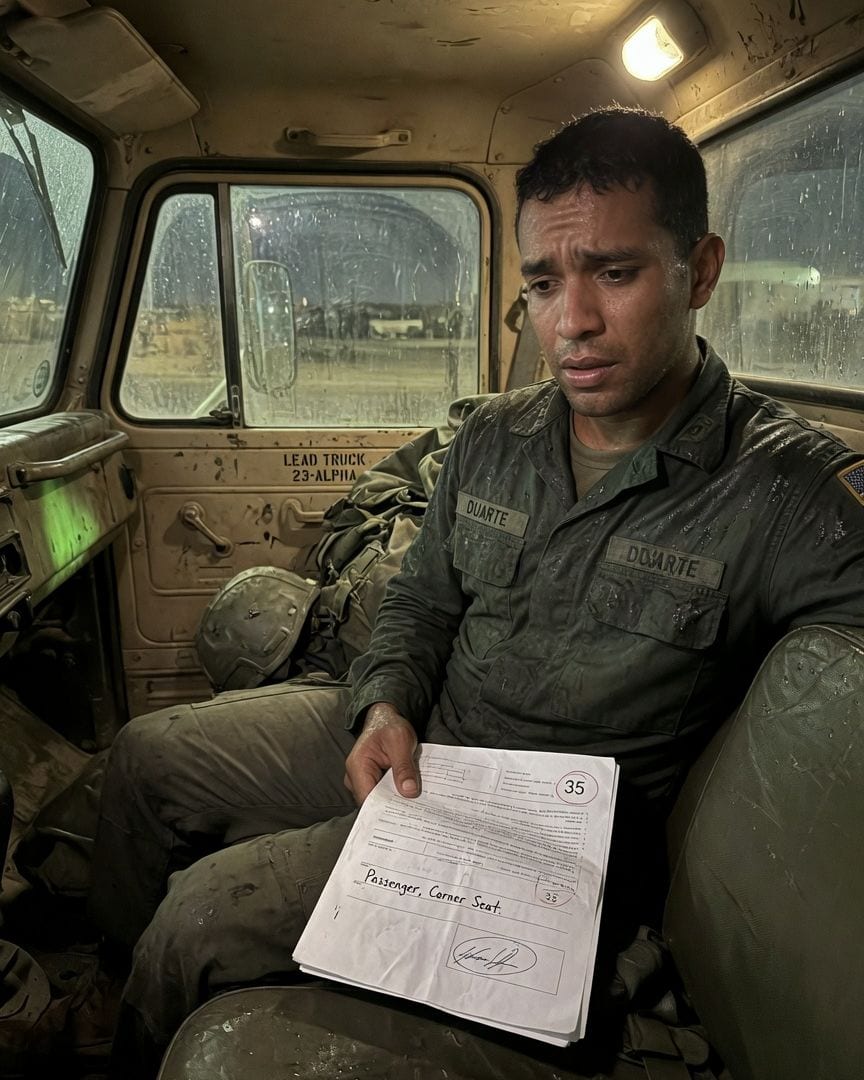
Specialist Duarte, two weeks from going home, found his empty truck seat warm and dented — then his service record showed a ghost deployment he never made.
Specialist Felix Duarte was just two weeks from going home, but a final convoy mission held an unsettling mystery. Soaked and running late, he squeezed into the lead truck's forbidden corner seat, a place every soldier knew to leave empty. Hours later, stepping out into the desert, he found the seat was strangely warm and distinctly dented, as if two unseen bodies had pressed in beside him. The official manifest then listed an extra soul for his truck, simply 'Passenger, Corner Seat,' signed by his own hand. What impossible presence had shared Specialist Duarte's ride, and what other records might it have altered?
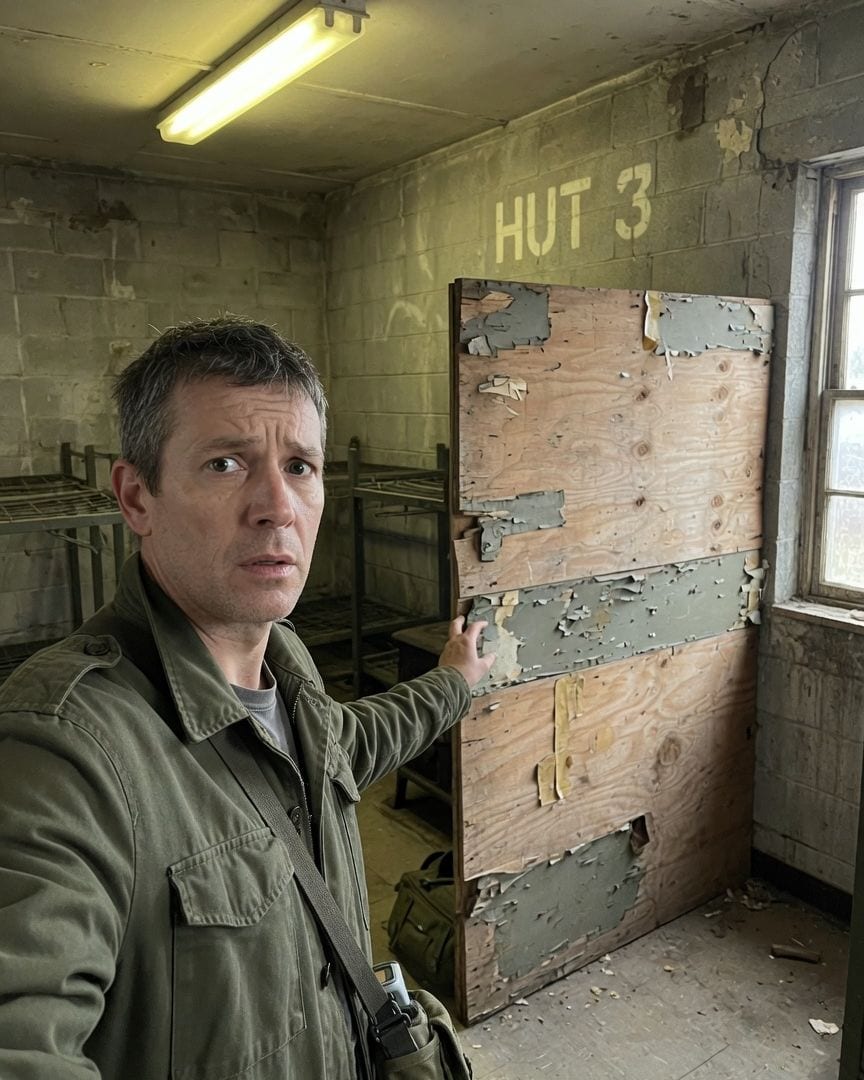
One morning there were twenty-one bunks in a hut built for twenty — the extra one made up tight at the far end past the stove, a kitbag beneath it stencilled with a name no roll could match. By nightfall the sergeant had that end boarded over.
I was a young recruit in a barracks hut built for twenty men, each bunk accounted for. But one morning, a twenty-first bunk appeared, impossibly tucked into a corner, meticulously made up for a man who didn't exist on any roster. Twenty-eight years later, the boarded-up wall concealing its secret remains, defying all logic and every measurement.
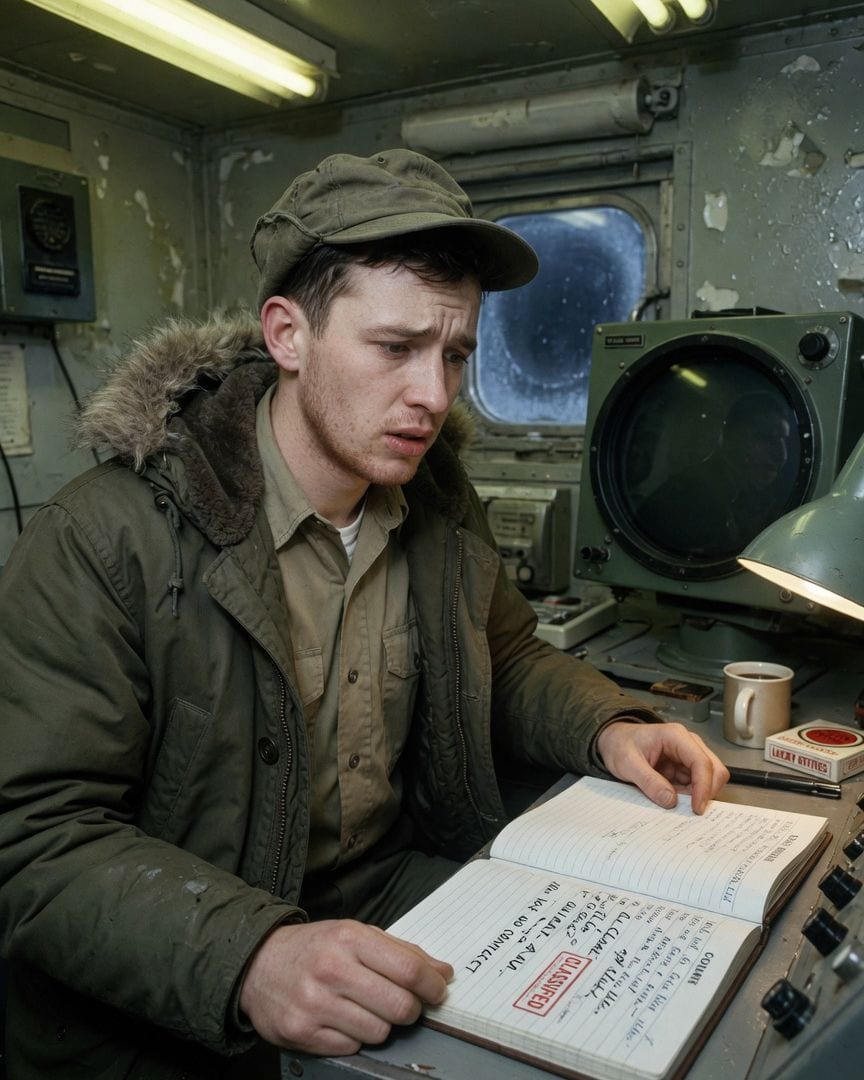
A Cold War airman logs an impossible radar contact on his last sweep. But his official logbook entry is stamped 'CLASSIFIED' and then contradicted by a hastily scrawled 'ALL CLEAR' dated moments before it.
Airman Ordway Vance, 22, manned the radar dome at Site Pellin in the biting North Atlantic dark of January 1962, running the last calibration sweep before its decommissioning. His scope picked up a faint, impossible return, growing closer with each pass, though the ocean remained empty to the eye. When Vance detailed the contact in his official logbook, a 'CLASSIFIED' stamp appeared, followed by a hastily scrawled 'ALL CLEAR' dated moments before his own entry, contradicting his every word. Commander Hartley dismissed it as equipment malfunction, but Vance sensed a chilling, official erasure behind the lie. He soon found a locked cabinet marked 'SITE PELLIN ANOMALIES,' hinting at a deeper truth buried within the base's final days.
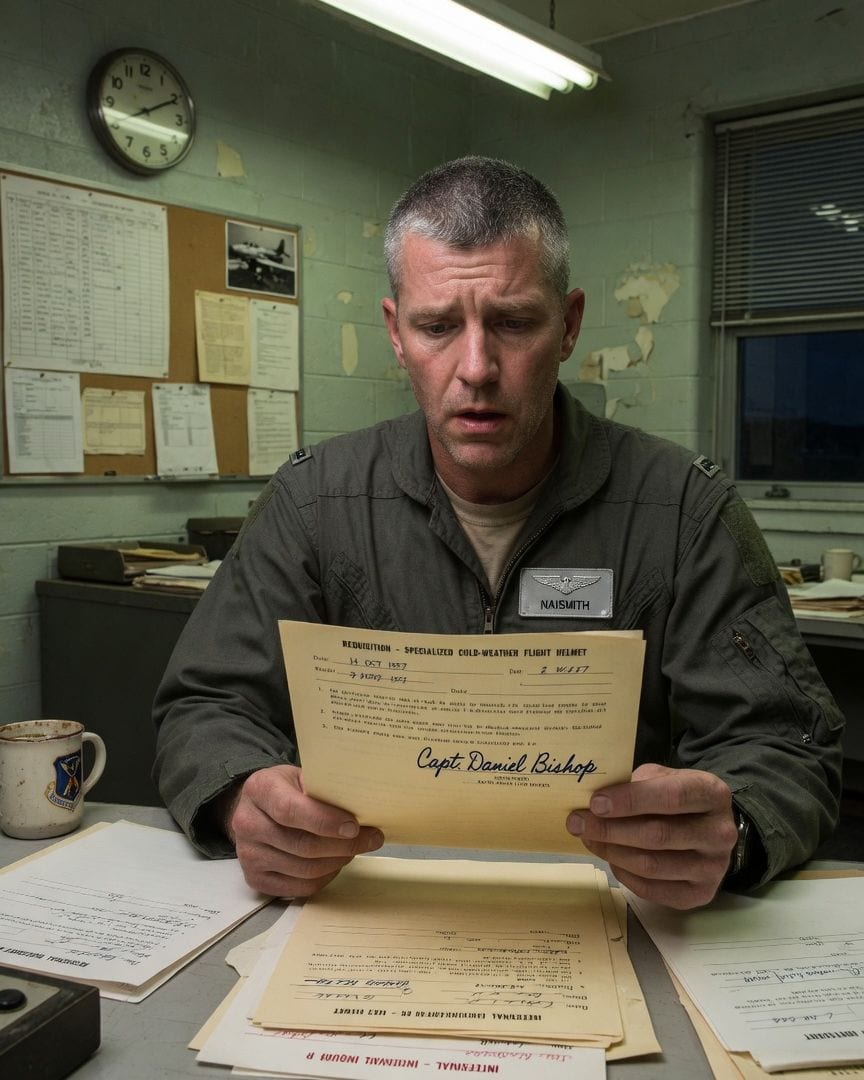
A Cold War Colonel reviews a missing pilot's file and finds Captain Bishop's signature on a form dated weeks after he vanished.
Colonel Ward Naismith faced the grim task of reviewing Captain Daniel Bishop’s personnel file, a routine chore for a man listed as Missing in Action. Bishop had vanished days after he and Naismith chased an impossible, silent disc over Lake Superior, leaving only an empty patch of air and a knot of unease in Ward's gut. Sifting through commendations, Ward found a requisition for flight gear and a maintenance sign-off, both dated *after* Bishop’s disappearance. The true chill came with the requisition for a specialized flight helmet, bearing Captain Bishop’s unmistakable signature, weeks after he was presumed lost. How could a man presumed lost have signed anything?
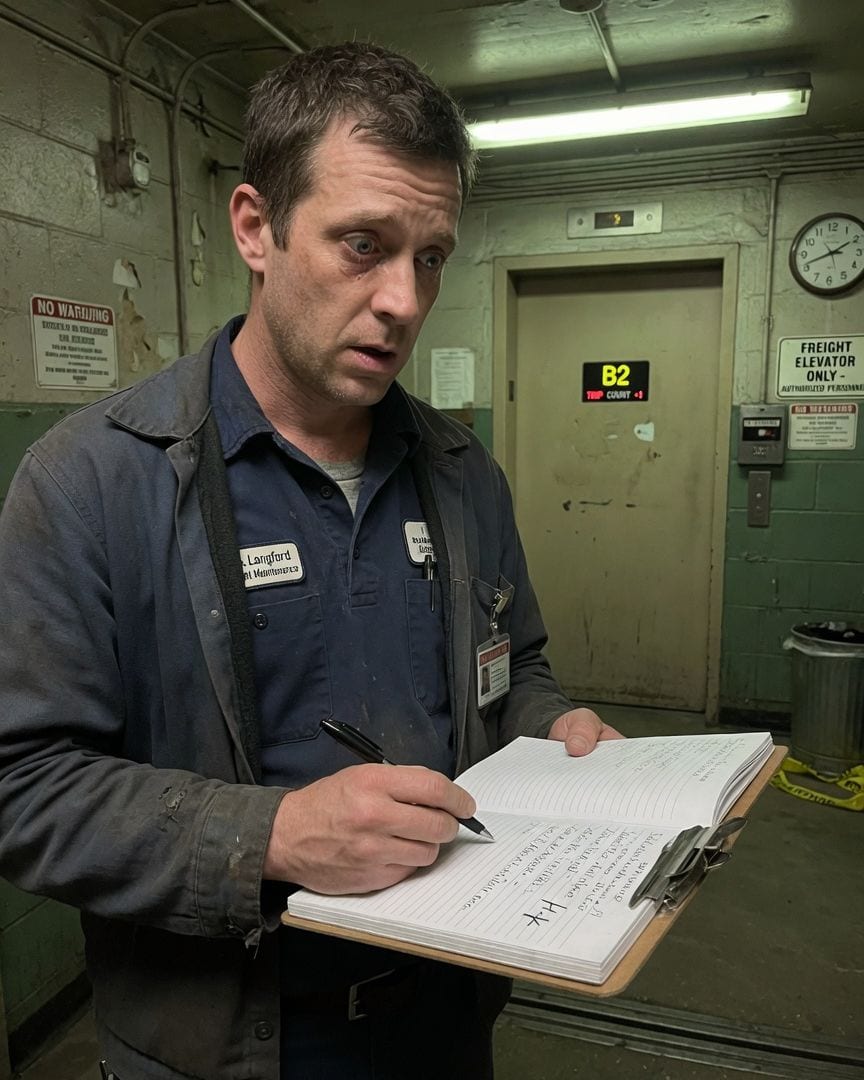
A man just took the elevator to the sealed sub-basement. He isn't on any staff roster, but my initials are in the logbook.
As a maintenance worker, my job is mostly routine, like signing the daily log for the old building's freight elevator. But one night, the log showed a trip to the sub-basement, sealed for a decade, timestamped with my key-switch and signed with my own initials, for a run I never made.