For his final muster, Sergeant Thatcher found an extra signature on the roll, and a warm, antique button pressed into the table beneath it.
The bitter wind of the Wyoming frontier whipped around Fort Hayes, rattling the windows of the paymaster's office.
Inside, Corporal Whitlock, a young man with a perpetually anxious frown, stood next to Sergeant Felix Thatcher, both watching the last company of soldiers make their marks or sign their names on the muster roll.
The light was fading fast, casting long, dancing shadows across the worn wooden floor. Thatcher, meticulous as ever, kept an eye on Whitlock's count, ensuring every man was accounted for before the final winter abandonment.
He was due for transfer himself, and a clean closure here was vital. When the last soldier shuffled out, Whitlock, with a relieved sigh, slid the roll across the table. “All accounted for, Sergeant. Thirty-seven men, thirty-seven signatures.”
Thatcher glanced at the tally, then at the list of names. He frowned. “Whitlock, Company C is thirty-six men. Not thirty-seven.”
Whitlock’s brow furrowed, his relief evaporating into confusion. “But I counted them out, Sergeant. Each man stepped up, each signed. I swear, it was thirty-seven.”
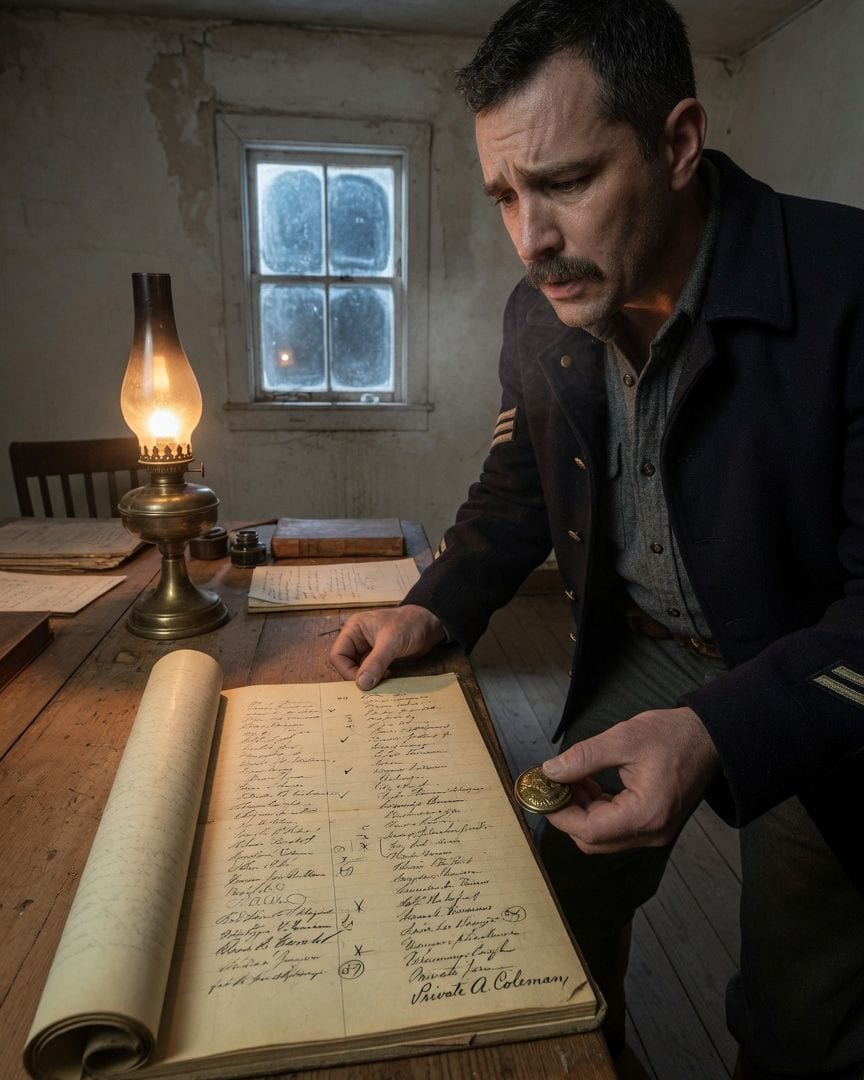
Thatcher took the roll, his finger tracing the lines. He read each name aloud, and Whitlock confirmed each man had been present. But there, at the very bottom, after the last expected name, was another: 'Private A. Coleman.'
A signature, a clear hand, but no Private Coleman was on their manifest. They ran the names again, comparing to the official roster, then to the men's bunk assignments. Always thirty-six men on paper, always thirty-seven signatures on the roll.
Each time, 'Private A. Coleman' was there, undeniably signed, undeniably answered for, yet utterly absent from any official record.
Thatcher spent the next hour with Whitlock, meticulously cross-referencing every scrap of paperwork. They checked supply manifests, medical logs, even the quartermaster's inventory, searching for any trace of a Private A. Coleman. There was nothing.
The name existed only on that one signed pay roll. Captain Montgomery, a man who lived by regulations and despised any deviation, listened to Thatcher's report with a tight jaw. “A clerical error, Sergeant. An old habit, perhaps.
Someone signed an extra name as a joke, or a miscount, easily rectified.” He dismissed it, ordering Thatcher to simply cross out the extra signature and finalize the muster.
But Thatcher couldn’t shake the uncanny feeling. The cold certainty that something was profoundly wrong burrowed deep. He returned to the paymaster's office, now empty and silent, the wind rattling the panes like a persistent ghost.
He pulled the muster roll back out, examining 'Private A. Coleman's' signature under the weak lamplight.
It was a neat, flowing script, yet it seemed oddly archaic, almost as if written with an older style of penmanship than the other soldiers used.
The ink, too, was strange—it looked fresh, yet somehow sunken into the paper, as if it had been there for decades. He ran his finger over it, a faint chill prickling his skin.
He then noticed a slight indentation on the wooden table beneath where the roll had rested. Curious, he knelt, scraping away a thin layer of dust with his fingernail.
Embedded in the worn wood, barely visible, was a single, tarnished brass button. It was old, clearly from a military uniform, but unlike any contemporary button he recognized from their current issue.
He pried it loose; it felt inexplicably warm in his palm, despite the frigid air of the room, a warmth that seemed to throb faintly.
Thatcher took the button to his spartan office, setting it on his desk beside the problematic muster roll.
He pulled out an old, leather-bound book—a history of Fort Hayes he’d been reading in his downtime—and flipped to a section on early uniforms. The button matched a description from the 1850s, a design long obsolete.
How could a button from half a century ago be pressed into the wood beneath a table used today, yet feel warm? And why was it still warm?
He held the button, its heat a strange counterpoint to the growing cold inside him. He looked from the ancient button to the impossibly fresh, yet archaic, signature of 'Private A. Coleman' on the roll.
The two details, utterly disconnected by time, now seemed inextricably linked, a silent, impossible testimony to something profoundly wrong that defied any rational explanation.
Ignoring Captain Montgomery's dismissive order, Thatcher carefully documented the button and the signature.
He spent the next few days, as the fort slowly emptied, sifting through the fort's archives—a dusty, forgotten room filled with ledgers and records dating back to its founding.
He was searching for any mention of a Private A. Coleman, or any other anomaly in the counts. The isolation of the fort deepened as more men departed, leaving only a skeleton crew, Thatcher among them.
The snow fell relentlessly, blanketing the landscape in an eerie silence, muffling all sound. Thatcher found nothing under 'Coleman' in the main personnel files.
He widened his search to old supply requests, quartermaster inventories, even disciplinary actions, spending long, solitary hours hunched over brittle pages. The hours blurred into days, fueled by strong, bitter coffee.
Then, in a faded, barely legible ledger from 1863, he found it: a single entry on a supply manifest for 'one extra mess kit, issued to Private A. Coleman, per muster, Fort Hayes.'
The handwriting for the name was strikingly similar to the one on the 1898 pay roll – that same archaic flourish, the ink bleeding subtly into the brittle paper.
He felt a prickle of dread, a cold certainty that this wasn't an isolated incident.
He continued to dig, finding more sporadic mentions of 'Private A. Coleman' or similar 'extra' personnel, always tied to periods of troop rotation, supply shortages, or, most chillingly, the fort's temporary abandonment for winter.
Each time, the name would appear, be accounted for in some minor way, and then vanish from subsequent records. The ordinary explanations – pranks, clerical errors – crumbled under the weight of this consistent, recurring pattern.
This wasn't a mistake; it was a horrifying feature of the fort itself.
Thatcher’s relentless investigation didn’t go unnoticed. Captain Montgomery, growing increasingly frustrated with Thatcher’s 'obsession' over what he considered a trivial matter, assigned him extra, menial duties, hoping to distract him from his 'fanciful notions.'
“Sergeant, your focus should be on securing this post for winter, not chasing ghosts in ledgers,” he’d barked, his voice tight with impatience. But Thatcher persisted, driven by a dread he couldn't ignore.
One evening, as Thatcher was returning to his office after a late shift in the archives, a chill deeper than the freezing air settled over him.
He noticed a faint, flickering light in the Quartermaster’s office, where the old ledgers were stored. He knew he was the only one with authorized access to that room.
His hand went to his sidearm, the cold metal a small comfort. He approached cautiously, pushing the door open slowly. The room was empty, the air still and heavy.
But the old ledger he’d been studying was open on the central table, not where he’d left it.
And on the page, someone had circled the entry for 'Private A. Coleman' in a fresh, dark pencil, a mark that hadn't been there when he'd closed it hours ago. A shiver ran down his spine.
Later that night, as he tried to sleep in his bunk, now one of only a handful of men left at the sprawling, silent fort, he heard it: a soft, rhythmic creak of heavy boots on the snow just outside his window.
Slow, deliberate. He froze, listening intently, his breath held. The sound moved, slowly circling his quarters. He grabbed his rifle, heart pounding a frantic rhythm against his ribs, and peered through a crack in the shutters.
The snow lay pristine, undisturbed. No footprints, no visible form. The sound stopped directly outside his window, then faded, leaving him alone in the chilling silence. Someone, or something, was watching him. It knew he was digging.
The next morning, Thatcher, his nerves frayed, sought out Old Man Harrington, the local trapper and guide. Harrington was a gaunt, weathered man with eyes that seemed to have seen too much of the desolate frontier.
Thatcher showed him the muster roll with the impossible name and the old brass button, carefully explaining the recurring, impossible count. Harrington listened, his face impassive, occasionally grunting, his gaze fixed on the button.
“The ground remembers, Sergeant,” he finally said, his voice raspy, a low growl. “Especially here. This fort… it’s built on old ground. Ground that seen a lot of comings and goings, a lot of men left behind.”
Thatcher pressed him, his voice urgent. “What do you mean, ‘the ground remembers’?” Harrington took a long drag from his pipe, the smoke curling around his ancient face. “Before the fort, this was a trading post.
Before that, a burial ground for some of the old tribes. A place where spirits lingered, where time got thin. When the fort came, and all the counting, all the names… it just gave ‘em a way to show themselves.
The system, you see. It’s so good at accounting, it tries to account for what ain’t there, but is.” He paused, looking at the button in Thatcher’s palm. “This little fella… he’s been here a long time.
They come back when the fort’s quiet, when the men leave. They try to get counted again, to make the numbers right.” Thatcher's mind raced, piecing together the fragments.
The archaic signature, the recurring entries across decades, the inexplicably warm button, the bootsteps on undisturbed snow. It wasn't a glitch, but a terrifying feature, a horrifying coherence.
The fort's own rigorous system, designed for order and accountability, was inadvertently registering an echo, a presence that refused to be forgotten.
The 'extra man' wasn't a ghost in the traditional sense, but a persistent, systemic anomaly, a phantom soldier whose identity was repeatedly being impressed onto the fort's records, demanding to be accounted for.
It was a perfect, horrifying bureaucratic consumption, a demand for reconciliation from the very earth beneath their feet.
Armed with Harrington’s unsettling explanation, Thatcher returned to the archives, now understanding precisely what he was looking for.
He found more instances of the 'extra man' phenomenon, always coinciding with the fort's winter abandonments or other major transitions, not just at Fort Hayes, but in transferred records from other remote outposts, abandoned and reactivated over the decades, echoing the same impossible counts.
The dread deepened, chilling him to the bone. This wasn't just Fort Hayes; it was a pattern, a recursive demand for accounting.
He dug deeper, looking for any record of what happened to those who investigated too closely, those who tried to 'reconcile' the fort's impossible math.
In a brittle, water-damaged ledger from the fort's earliest days, he found a faint, almost erased entry from 1863.
It was a brief report on a 'Sergeant Felix,' who had 'gone missing after questioning the muster during the temporary winter abandonment.'
Thatcher stared at his own first name, his own role, his own current investigation, reflected back at him from the past. The blood ran cold in his veins, a sudden, horrifying realization.
He wasn't just observing a pattern; he was walking into it, becoming part of it.
As he looked up from the page, the faint, rhythmic creak of boots on snow, the sound he'd heard outside his window last night, began again, just outside the archive door, slowly growing louder, closer, insistent, echoing the beat of his own panicked heart.
Thatcher didn't wait to be found. He snatched up the ledger, his heart hammering against his ribs, and bolted out the back exit of the archives, narrowly missing the heavy thud that struck the front door moments later.
The snow was deep, the air biting, but the cold outside was nothing compared to the icy terror within him. He ran, the boots creaking behind him, not quite a chase, more like a relentless, inexorable following. He understood now.
The fort's 'memory' wasn't passive. It wasn't just printing names on paper. It was an active, consuming force, seeking to 'reconcile' its phantom personnel, to fill the gaps in its own records. And it used living men to do it.
The missing 'Sergeant Felix' from 1863, the recurring 'Private A. Coleman'—they weren't just names. They were roles, positions, vacancies in the fort's eternal muster.
And Thatcher, by investigating, by obsessing over the count, had drawn its attention, had offered himself as the next entry.
The fort needed someone to fill that 'missing' slot, to become another phantom, another name on a roll that wouldn’t reconcile for the next generation. It was a horrific form of bureaucratic consumption, absorbing those who noticed its impossible math.
He realized the bootsteps weren't those of a living person, but the sound of the fort itself, its memory manifesting, drawing him in, demanding that its count be made whole.
The sound was everywhere now, seeming to come from the very ground beneath his feet, echoing the beat of his own panicked heart, a drumbeat of dread. He was being counted, and he knew what that meant.
Thatcher knew he couldn't fight it directly. He couldn't shoot a sound, or reason with a ledger. His only chance was to break the cycle, to escape the fort's recursive grip before he became another forgotten entry.
He fled towards the temporary stable, where the last remaining horses were kept, his breath ragged in the frigid air. The creaking boots grew louder, closer, seeming to emanate from the very walls of the fort, from the ground itself.
He could almost feel a cold, intangible presence reaching for him, a spectral hand brushing his spine. He burst into the stable, startling a skittish mare, which whinnied nervously.
He fumbled with the saddle, his hands clumsy with cold and terror, his fingers numb. The creaking stopped just outside the stable door. A profound, suffocating silence descended, heavier than the snow outside.
Then, from the darkness just beyond the threshold, a voice, deep and resonant, spoke his name: “Sergeant Felix Thatcher. Report for muster.”
It wasn't Captain Montgomery's voice, nor Harrington’s, but a composite of many voices, echoing from the fort's past, a chorus of forgotten soldiers. It was the voice of the fort itself, demanding its due.
Thatcher threw the saddle on the mare, cinching it tight with desperate speed, his muscles screaming. He ignored the voice, the chilling summons. He knew if he answered, if he acknowledged it, he would be counted. He would be reconciled.
He would be lost, another phantom in the fort's impossible ledger. He swung himself onto the horse's back, grabbing a handful of oats to keep the mare calm, whispering frantic reassurances.
As he spurred the horse out of the stable, the voice called again, louder, more insistent, this time with a note of cold, ancient anger. “Thatcher! You are out of line! You will be accounted for!” He didn't look back.
He rode hard through the blizzard, the ledger clutched to his chest, the phantom bootsteps pounding in the snow behind him, an endless, impossible pursuit.
He rode until the fort was a distant, dark smudge against the white horizon, until the sound of the boots faded into the wail of the wind, until his hands and feet were numb with frostbite.
He had escaped, but the memory of that voice, that impossible count, would ride with him forever.
Thatcher rode for two days through the blizzard, half-frozen and delirious, before he stumbled upon a small, isolated ranch. He was nursed back to health, but the experience had fundamentally changed him.
He reported his findings to military authorities, presenting the muster roll, the archaic button, and the old ledgers detailing the recurring anomalies. His report was met with incredulity and polite dismissal.
Captain Montgomery, angered by Thatcher's unauthorized departure, filed a formal complaint. Thatcher was officially reprimanded for dereliction of duty and insubordination, his transfer cancelled, his career irrevocably stained.
The evidence he provided was written off as the ravings of a man suffering from 'winter madness' and 'isolated post syndrome.' The fort's records were deemed 'unreliable due to age and poor storage conditions.'
The extra name on the muster was simply crossed out, as Montgomery had initially ordered. Thatcher carried the truth, but no one in the system would ever believe it, or even acknowledge it as anything other than a delusion.
Years later, Felix Thatcher, now a civilian, lived a quiet life, far from any military post. He still kept the old ledger and the brass button, hidden away in a locked chest.
He never spoke of Fort Hayes, but he often found himself idly counting things: coins in his pocket, bricks on a wall, sheep in a field.
And sometimes, when the wind howled just right, or a door creaked in the silence of his home, he would hear it: the faint, rhythmic creak of heavy boots on snow.
He knew it was just an echo in his mind, a phantom sound, a memory of dread.
But sometimes, when he looked at his own reflection, he thought he saw a subtle shift in his eyes, a faint, ancient weariness that hadn't been there before, as if a part of him had indeed been counted, reconciled, and remained forever at Fort Hayes.
He was no longer just Felix Thatcher; he was also the man who had been called, a living testament to an impossible ledger.
Long after Felix Thatcher's passing, his distant nephew, sorting through old family effects, found a dusty, leather-bound ledger among his uncle's possessions.
Inside, amidst fading entries about Fort Hayes, was a meticulous list of names, followed by a final, unsettling line. 'Felix Thatcher, accounted for, 1898.'
If this one got to you
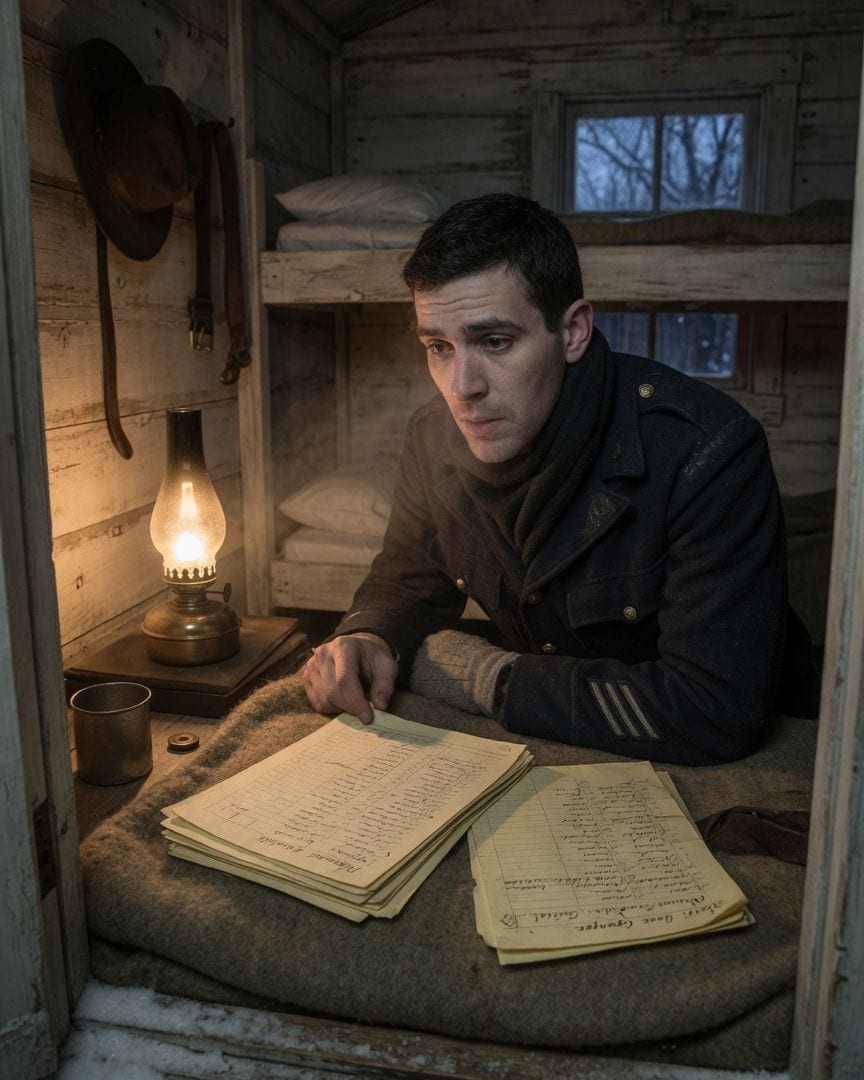
On his last watch, Corporal Carter found boot prints ending inside a sealed magazine, and a blood-red handprint from a soldier decades out of time.
Corporal Franklin Carter shivered, not from the biting November wind, but from the chill of his last pay muster at Fort Taggart before its winter abandonment. His final duty was to count every man, tallying thirty-seven, precisely the company strength. But his breath hitched when he saw the completed roll: it ran thirty-eight names long. An impossible extra slot, filled by a voice that answered 'Here, Corporal,' for a soldier whose name, Pvt. Isaac Granger, vanished from all official records, only to reappear in a forgotten supply log from 1863. Was Fort Taggart abandoning its dead, or something far older?
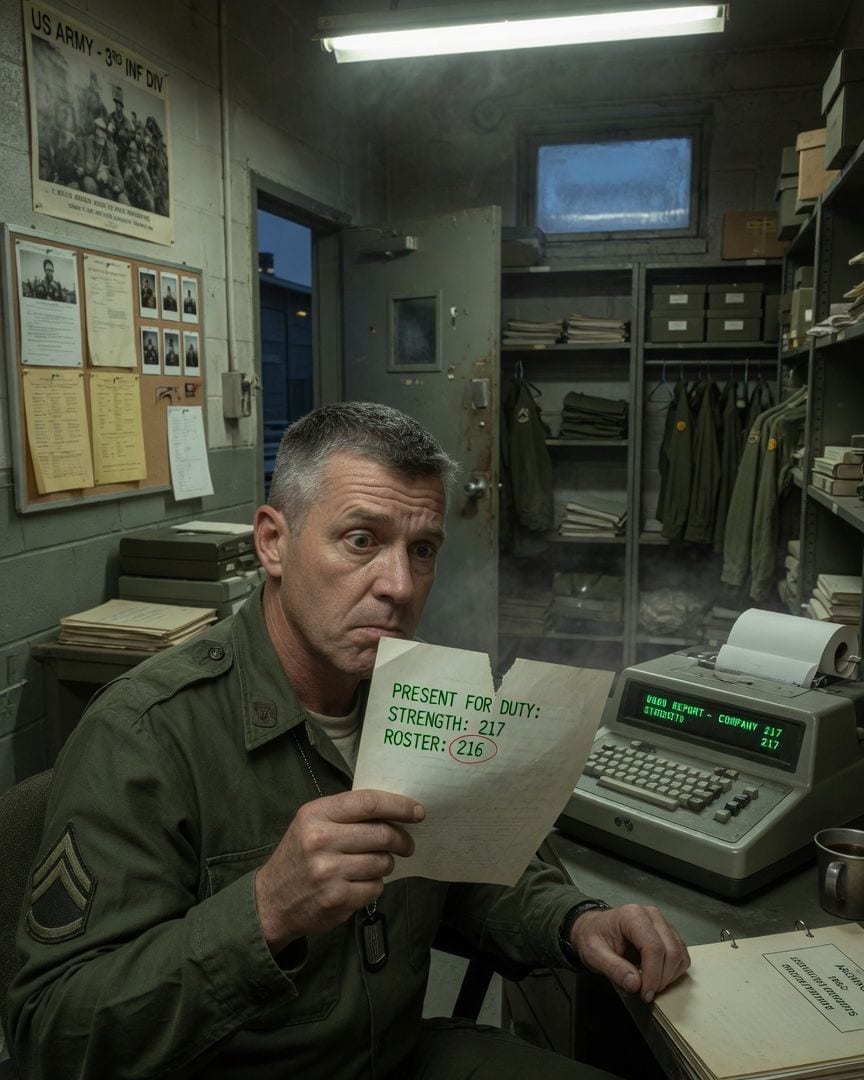
Sergeant Halloran is three months from a promotion, but his Cold War morning report shows 217 men. He counted only 216. A cold, hidden log from 1963 records the same impossible count.
Sergeant First Class Joseph Halloran, three months from a promotion and stateside transfer, faced the chilly 0600 darkness of his West German garrison in 1987, his career built on impeccable order now threatened. For a week, his morning reports had defied him: a meticulous physical count of 216 shivering soldiers always resulted in the Teletype machine blinking 217. His exhaustive double-checks confirmed no error, yet the impossible 'plus one' persisted, leading him to a distinctly colder section of the supply room. Behind ancient manuals, a hidden alcove revealed a worn leather log, where a Sergeant Hayes in 1963 had recorded the identical, chilling discrepancy.
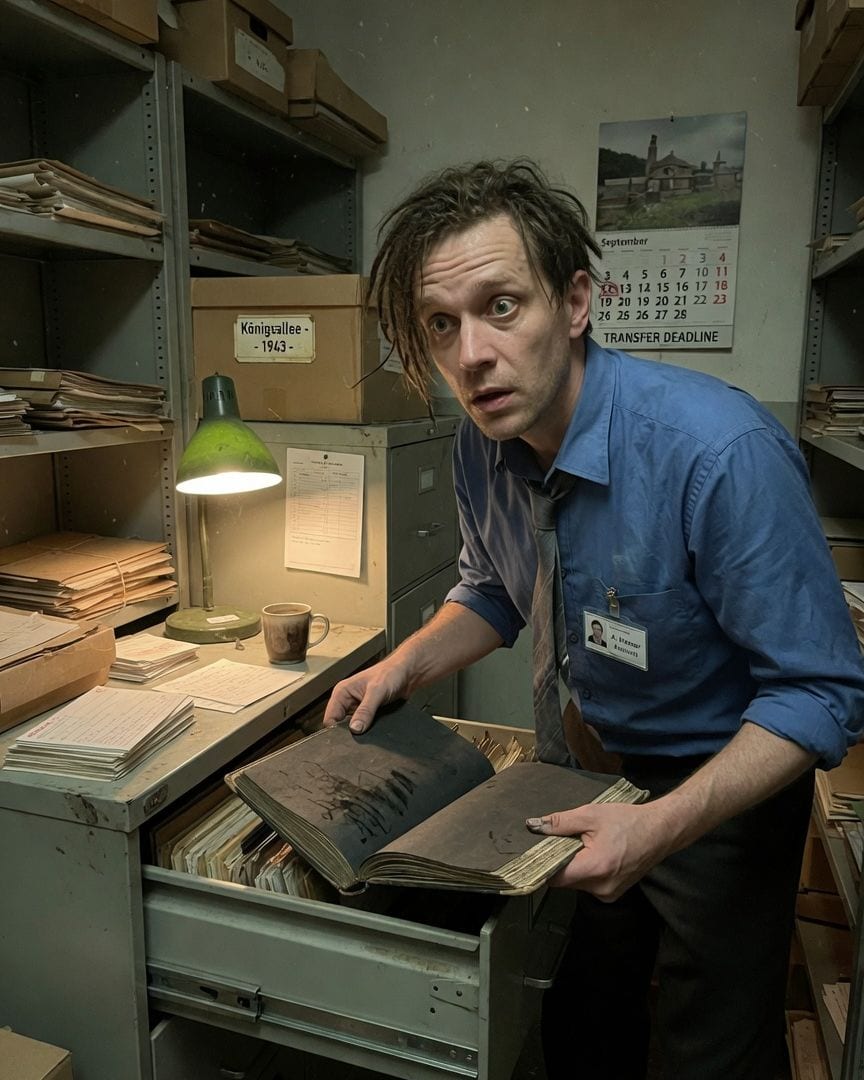
A Berlin archive researcher races a deadline. A hidden log for a Cold War barracks on a vacant lot has ink still wet from last month.
Ansel Vidmar, a methodical researcher, felt the pressure of a looming deadline. The municipal transfer of the old Berlin archive was days away, and he still had countless documents to categorize amidst towering stacks of forgotten history. His focus narrowed to an unindexed metal cabinet, revealing records for a garrison company at Königsallee – an address that had been a vacant lot since the war. A punishment log inside listed an entry from 1983, a date far too recent for a non-existent building. When Ansel visited the site, he found only overgrown grass, save for a single, eerily clean concrete doorstep emerging from the earth. His unease solidified into dread when he later uncovered a hidden Quartermaster's Log, meticulously detailing supplies for the same barracks, with entries extending to "last month," the final page's ink still faintly wet. What unseen operations were still being maintained?
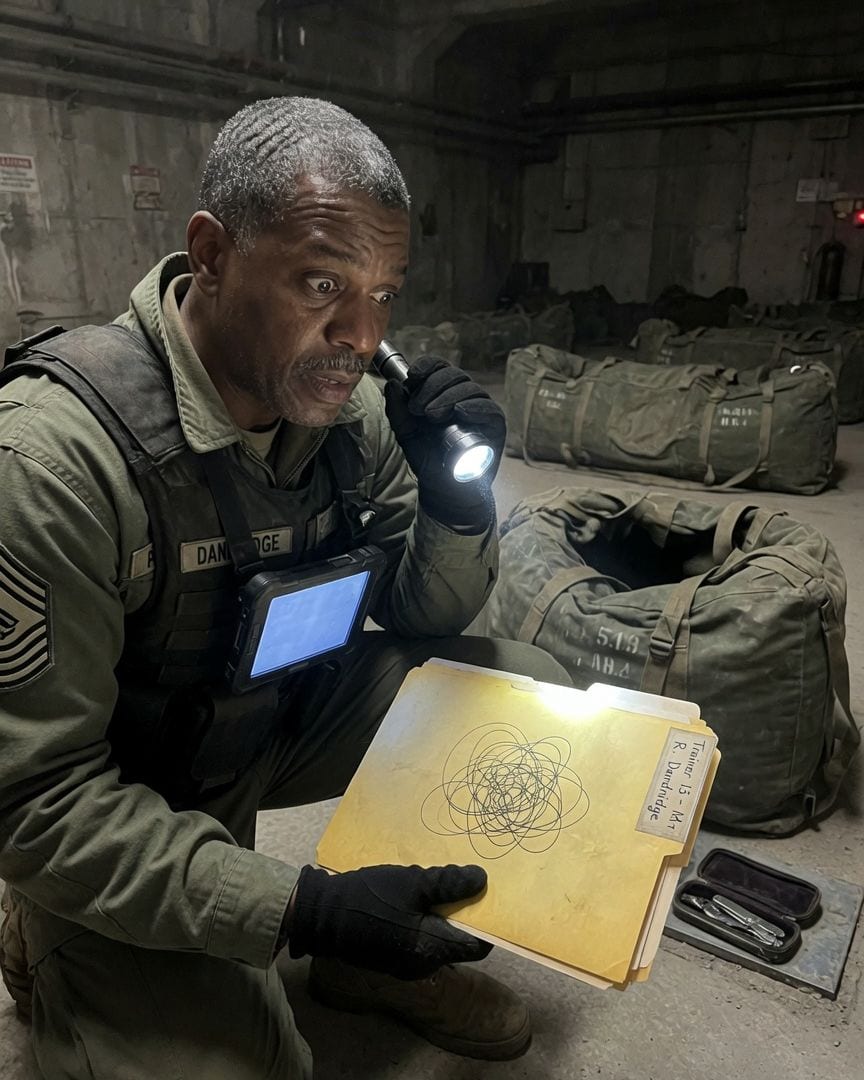
Thirty days from closing a Cold War vault, a Master Sergeant finds a thirteenth warhead cradle with his own name on it, its velvet lining strangely warm.
Master Sergeant Ruel Dandridge had just thirty days left at Kestrel Mountain, conducting its final inventory before the underground vault was sealed forever. He methodically counted twelve warhead trainer cradles, but then his beam caught a thirteenth: bolted down, empty, its straps dented as if something immense had shifted. A tag bore his own precise handwriting: ‘Trainer 13 - R. Dandridge,’ an impossible find in a bay he'd never entered and not on any manifest. Prying at its base, Ruel discovered a hidden compartment holding a yellowed file with a symbol that pulsed with light and subtly shifted, its velvet lining strangely warm. This confronted the Master Sergeant with a pattern that defied all logic.
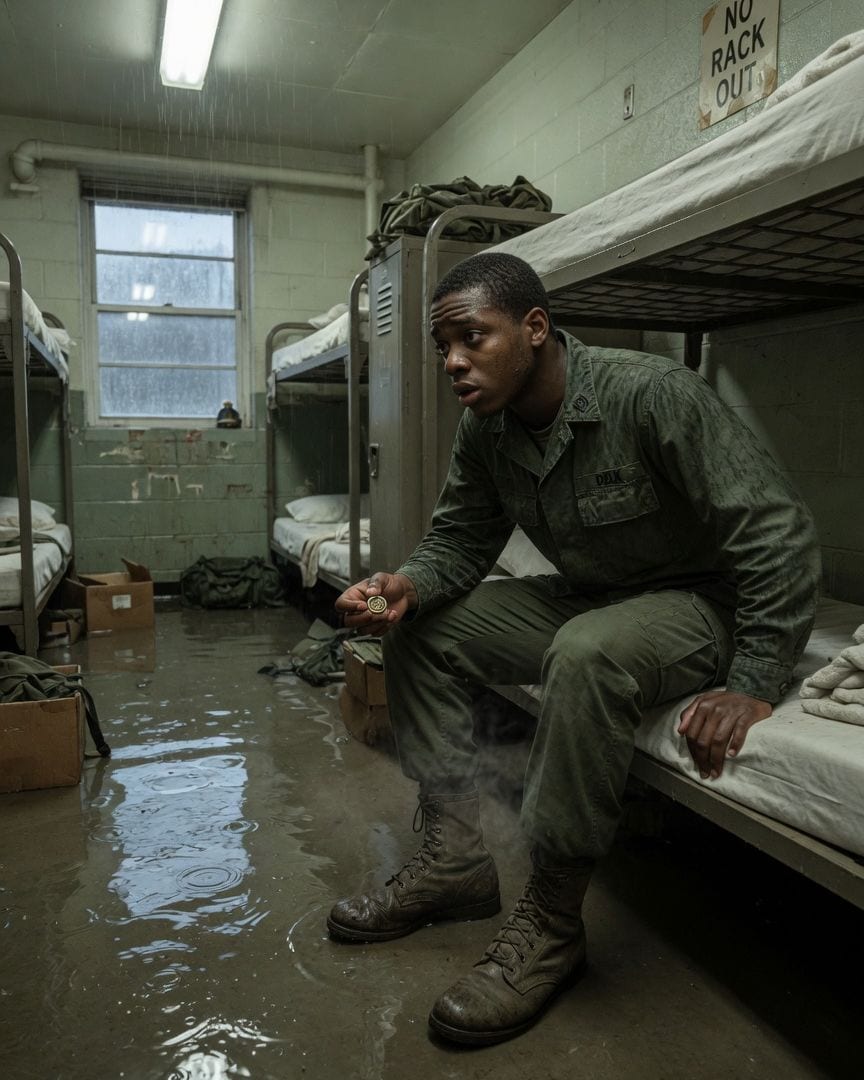
Corporal Delk's own boots sat warm at his forbidden bunk, laced in a knot he'd never used.
Corporal Joseph Delk, a new recruit at Camp Ledoux, was desperate for dry sleep amidst the barracks' misery of standing water. He broke the unwritten rule, taking the single impeccably dry bunk in the far corner. But reveille brought a cold shock: his own combat boots, left elsewhere, were now at the foot of his new bunk, laced in an unfamiliar military knot and still warm. Searching for answers, Delk found an old, tarnished uniform button tucked into the bunk frame, a relic that hadn't been there moments before.
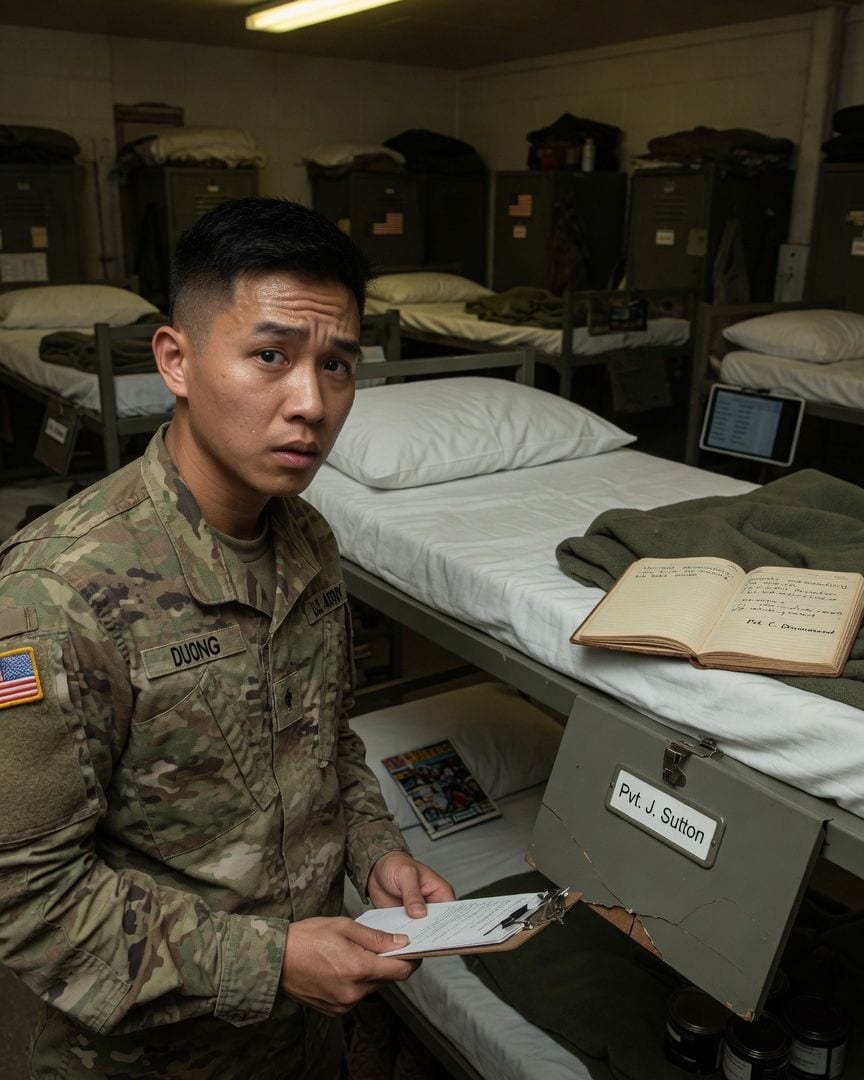
Specialist Duong’s final check unearths a logbook from decades past: an entry for '9 men present, 10 bunks made'.
Specialist Quentin Duong meticulously conducted his platoon's final barracks accountability check before graduation, the air thick with stale boot polish. He confirmed nine men against the roster, but the tenth bunk in the bay stood apart, always perfectly made and tagged 'Pvt. J. Sutton,' a name not on any current manifest. Despite dismissals from his battle buddy and sergeant, Duong couldn't shake the quiet unease. He returned to the immaculate bunk, uncovering a false bottom in its footlocker holding a decades-old logbook. Inside, a chilling entry from a previous cycle detailed '9 men present, 10 bunks made,' signed with a hand eerily similar to his own.