Sergeant Halloran is three months from a promotion, but his Cold War morning report shows 217 men. He counted only 216. A cold, hidden log from 1963 records the same impossible count.
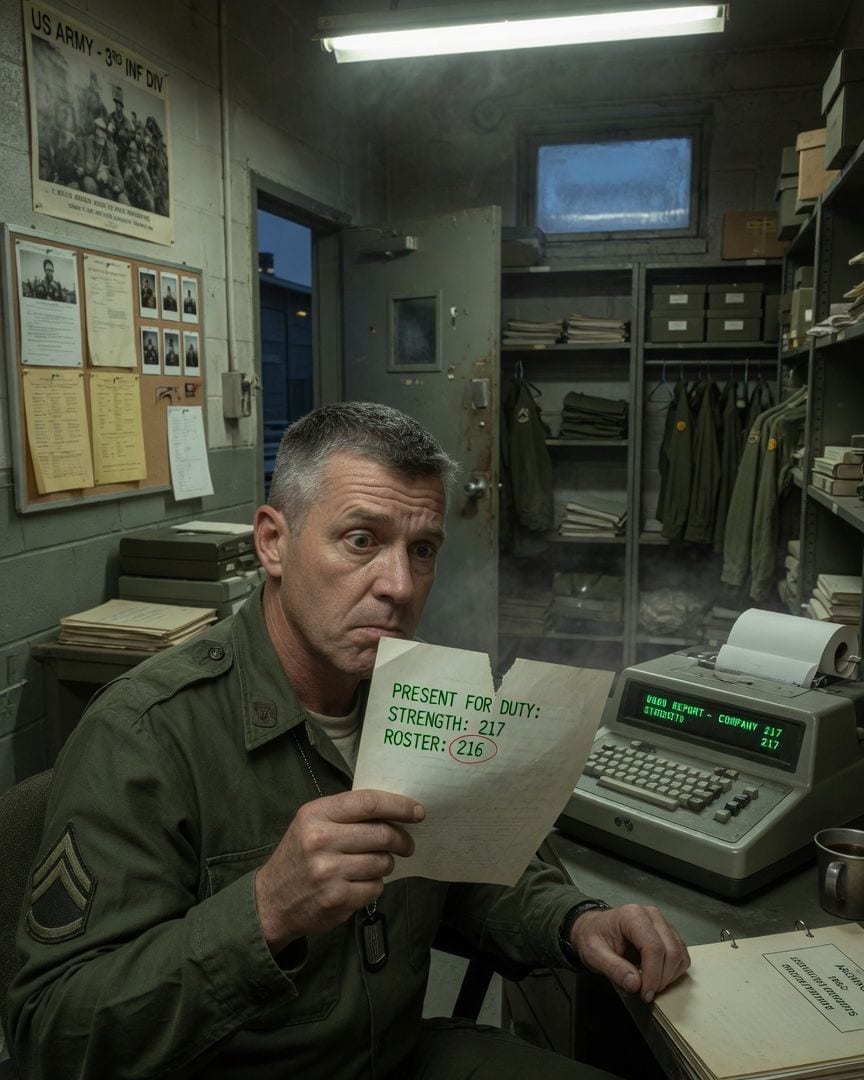
Sergeant First Class Joseph Halloran, 42, a man whose career was built on impeccable order, typed the morning report.
In the chilly 0600 darkness of the West German garrison, 1987, the old Teletype machine hummed, its green characters blinking against the pre-dawn gray. For a week, the numbers had fought him.
The present-for-duty strength, keyed off the company’s first formation, always came out one man high. This morning was no different.
He’d stood the entire company in ranks, a crisp line of 216 soldiers shivering in the cold, their breath misting in the air. He had walked the line himself, name by name, face by face, front rank to rear.
Every man was present; every name on the roster had a man. He’d even had Specialist Warren Sterling, his junior NCO, do a parallel count, double-checking the double-check. Sterling, young and eager, had confirmed 216, crisp and confident.
Still, the digital readout on the Teletype machine blinked: 217.
Halloran signed the report, his signature neat and precise, but the impossible number mocked him, a stubborn, digital stain on his otherwise perfect paperwork.
He tore the report from the machine and walked back to his office, the faint chill from the supply room at the end of the hall seeming colder than usual, a ghost of an error he couldn't banish.
He was three months from rotating stateside, a promotion on the line, and this impossible discrepancy threatened everything he had worked for.
Later that morning, Captain Eleanor Walsh, 35, Halloran's company commander, called him into her office. Her brow was furrowed, a slight tension around her eyes. “Halloran, this strength report. Are you certain?”
Halloran laid out his meticulous procedure, detailing the double-checks, the physical count, even Sterling’s parallel tally. He explained the precise movements of each soldier, the roster he had personally updated.
Walsh, a by-the-book officer with a sharp mind, couldn't fault his process. “Clerical error, then. Or a bad sensor on the system?” she suggested, but the doubt lingered in her eyes, betraying her own inability to reconcile the facts.
Halloran knew it wasn’t. He had checked every wire, every connection, every entry. The machine was old, but reliable.
He spent the afternoon re-checking archived reports, pulling dusty binders from storage, comparing his current numbers to previous months.
Everything was perfect, except for this persistent ‘plus one’ that had materialized out of nowhere, an anomaly that defied his professional rigor. Frustrated, he walked through the supply room, a cavernous space filled with forgotten gear, seeking a distraction.
Rows of shelves held obsolete radios, moth-eaten uniforms, and long-expired medical kits.
A section of shelving, long-unused, felt distinctly colder than the rest of the room. He ran his hand over a dusty metal shelf, the surface biting cold against his palm.
The chill intensified, a pinpoint cold that raised gooseflesh along his arms, as if the air itself had solidified. Behind a stack of ancient field manuals, brittle with age, he noticed a faint, almost invisible seam in the wall paneling.
Curious, he pressed against it. The panel gave way with a soft groan, revealing a small, hidden alcove, swallowed by shadow. Inside lay a single, leather-bound book, its pages yellowed and brittle, its spine cracked.
It was not a standard military issue item, but clearly old, its edges worn smooth by countless hands. A faint, metallic scent, like old iron and damp paper, emanated from the recess.
Halloran pulled the book out, its leather cover cracked with age, the smell of dust and something vaguely organic rising from its pages. It wasn't an official record, but a personal log, its heft surprising.
The first page was dated 1963, signed by a Sergeant First Class Gerald Hayes. Halloran flipped through the opening entries, a meticulous hand detailing daily supply movements, inventory numbers, and equipment transfers – the ordinary minutiae of a quartermaster’s life.
Then, a shift in tone. Hayes began recording unusual observations, his calm, professional script slowly giving way to a more frantic scrawl as the entries progressed. The methodical details gave way to questions, then to a creeping desperation.
Halloran’s flashlight beam settled on a specific entry, his own military-issue penmanship almost identical in its precision to the faded ink on the page. It read: 'Morning Report, 0600. Strength: 217. Roster: 216. One over again.
This is the third time this week. The chill in Barracks 4 is constant.'
Halloran spent the next few nights poring over Hayes's logbook in his office, the chill from the supply room seeming to seep under his door and into the very air around him, making the fluorescent lights buzz with a faint, unsettling hum.
Hayes's entries detailed the same 'one man over' phenomenon, not just once, but recurring over months in 1963, almost exactly 24 years prior. Hayes, like Halloran, was a stickler for detail.
He described his own frustrated attempts to reconcile the numbers, even standing down entire companies for re-counts, walking the lines multiple times, just as Halloran had done.
Hayes wrote of 'a presence that demands to be counted,' and how the discrepancy always centered on the company's barracks, specifically Barracks 4, where Halloran's company was currently housed. The chilling consistency was undeniable.
Halloran cross-referenced the logbook's dates with official archived records from the garrison. He found nothing. There were no notes of 'clerical errors' or 'sensor malfunctions' for those periods, no anomalies reported.
The official record simply reflected the correct number, ignoring Hayes's reported discrepancy. It was as if the system had actively suppressed the truth, neatly excising the impossible from its perfect ledger.
He discovered that SFC Hayes had abruptly transferred out of the garrison a few months after his last log entry, under 'medical grounds' that were unusually vague and offered no further details, merely a date and a destination that didn't appear on any other transfer roster Halloran could find.
The cold dread growing in Halloran mirrored the literal chill in the supply room. He began to feel observed, especially when reviewing the logbook.
He'd glance up, convinced someone was standing just outside his office door, but find only an empty hallway, the shadows long and still.
The thought of his impending rotation stateside, once a comfort and the pinnacle of his career goals, now felt like an escape he might not achieve, a deadline that was tightening around him like a noose.
The next morning, Halloran found his office door slightly ajar, though he distinctly remembered locking it, hearing the satisfying click of the deadbolt engaging.
Nothing was disturbed, no papers out of place, no drawers opened, but the logbook, which he'd hidden under a stack of regulation manuals in his bottom desk drawer, was now sitting conspicuously on his desk, open to an entry describing Hayes’s growing paranoia and an increasing sense of being watched.
Halloran felt a prickle on his neck, a cold finger tracing his spine, raising a line of gooseflesh.
He tried to dismiss it, to rationalize it as Sterling, perhaps, or even Walsh, checking up on him, but neither of them would have touched his personal effects, let alone moved a hidden, unofficial logbook. This was something else.
That evening, as he walked the perimeter fence for a routine check, the night seemed unusually quiet, the distant sounds of German traffic muted, absorbed by the damp, heavy air. The streetlights cast long, swaying shadows.
He heard a faint scraping sound behind the old, abandoned motor pool building, a section of the base rarely used, choked with weeds and disused equipment.
He drew his sidearm, the cold steel heavy in his hand, and cautiously approached, his breath held tight. He saw no one, but on the dusty ground, clearly visible in the beam of his flashlight, were fresh boot prints.
They were distinct, military issue combat boots, but larger than any of his men’s, and they led directly to a section of the chain-link fence that had been carefully cut and then re-sealed with wire ties, almost perfectly camouflaged.
Someone had been in, or out, an intrusion that defied casual explanation. The prints were on the wrong side of the wire for an internal patrol, and too large for any local youth.
He reported the cut fence, attributing it to local teens, desperate for an ordinary explanation, but the cold dread was deepening, a certainty that whispered in his mind. He knew it wasn't teens.
He felt a presence, a watchful gaze, whenever he was near Barracks 4 or the supply room. It felt like a challenge, a silent, unsettling promise, a tightening grip around him.
Halloran decided to confront Captain Walsh. He laid out the logbook on her desk, its brittle pages open to Hayes’s increasingly erratic handwriting.
He spoke of the consistent 'one man over' reports spanning decades, the vague medical transfer of SFC Hayes, the cut fence, the unsettling boot prints, and the logbook moved to his desk.
Walsh listened, her expression shifting from skepticism to concern, her fingers tracing the faded ink of Hayes’s meticulous but desperate script. She picked up a page, scanning the numbers. “Joseph, this is… a lot.
Are you sure you’re not just stressed about your rotation? We can arrange for you to see a medic, get you some rest.” Her voice was gentle, tinged with worry.
Halloran shook his head, his voice steady, resolute. “Captain, I’ve never missed a detail in my life. My record is spotless. This isn’t stress. This is real. This garrison has a ghost in its machine, Captain.”
He pressed her, leaning forward slightly, his eyes holding hers. “I need to know about any forgotten incidents, any ‘lost’ soldiers in this garrison's past that might align with Hayes's timeline. Anything from ’63.”
Walsh, visibly uncomfortable, her gaze flicking away, finally admitted there was an unofficial understanding, a story whispered among the older staff. “There was an incident, back in ’63. A soldier, Private Albert Coleman, went missing. No body, no trace.
Officially, AWOL. But the unit was… odd about it. His service record was eventually sealed, and the official line was that he deserted.
But some of the old-timers, they always said he just… vanished within the base itself, from Barracks 4.” She pulled up an old, declassified file on her computer, the screen glowing an eerie green. 'Pvt. Albert Coleman, 19, male.
Last seen Barracks 4, November 1963.'
The name and location hit Halloran with a cold wave. Barracks 4. The same barracks Hayes wrote about, the same barracks his company now occupied, the persistent chill emanating from its walls.
The 'extra man' wasn't just a number; it was Private Coleman, still seeking to be accounted for, still trying to register his presence in the system that had erased him.
Halloran felt the pieces clicking into place, a horrifying coherence, as if a lock had finally yielded to its hidden key.
The meticulous military system, designed for ultimate accountability, had created a void by denying Coleman’s presence, and something was trying to fill it, relentlessly, through the years.
The sheer, terrifying logic of it sent a fresh shiver down his spine, colder than any draft.
Halloran returned to the logbook, looking for more clues about Coleman, his hands trembling slightly as he turned the brittle pages.
Hayes’s entries became increasingly desperate, detailing how the 'presence' seemed to actively interfere with his records, moving papers, changing numbers, even causing his own hand to write things he didn’t intend.
Hayes wrote of feeling his own identity blurring, his meticulously kept records becoming less his own, his thoughts no longer entirely his. The ink in his own pen, he'd noted, sometimes felt like it moved under its own volition.
Halloran’s eyes fell on a specific entry, an addendum from 1963, written in a different, scratchier hand than Hayes’s usual script, almost a frantic scrawl.
It detailed another ‘unaccounted for’ incident, a minor discrepancy a week after Coleman vanished, a single ration card missing.
And next to it, a handwritten note, in Hayes's familiar hand, but shakier, dated 1963, scrawled almost as an afterthought: 'SFC Halloran, 1987. He'll see it too.'
Halloran stared at the logbook, his own name, 'SFC Halloran,' written in an old NCO's hand next to an entry from 1963, a chilling prophecy nestled in decades-old ink.
Beneath it, a new line, scratched out with desperate force, as if Hayes had fought against writing it: 'The system will account for you, too. It always does.'
The words in the logbook seared into Halloran’s mind. 'The system will account for you, too. It always does.' It wasn’t a warning; it was a promise.
He remembered the cut fence, the impossibly large boot prints leading away, the logbook appearing on his desk as if conjured.
It wasn’t just a ghost wanting to be counted; it was an entity that could manipulate the very fabric of the garrison’s meticulous order, influencing its record keepers, twisting the ink and the numbers.
And it had chosen him, just as it had chosen Hayes.
He realized the 'extra man' was not merely an echo, a memory of Private Coleman, but a persistent, recurring pattern, a 'glitch' in the system that could ensnare those who sought to correct it.
The entity needed a living, breathing, accountable NCO to legitimize its presence, to fill the void Coleman had left in the ledger of existence.
Hayes's 'medical transfer' wasn't a transfer; it was an escape, or perhaps a replacement, the system having finally accounted for him in its own horrifying way.
Halloran’s own name, pre-written in a decades-old log, meant he was not just tracking the anomaly; he was its next target, its next 'accounted for' slot.
He was due for rotation in three months, and he realized the clock was ticking, not on his departure, but on his absorption, on becoming another unlisted 'extra man' himself, another name to fill the void.
The cold in the supply room now felt like a living thing, a breath against his neck, a phantom presence settling onto his shoulders.
The boot prints on the wrong side of the wire, the open office door, the logbook moved – these were not warnings, but preparations. The entity was making space for him, making him ready to be counted among the missing.
Halloran knew he couldn't simply report this. He was already implicated, already being drawn into the pattern, his name a pre-ordained mark in a ledger from the past.
He had to break it, not just for himself, but for Hayes, for Coleman, for every NCO who had ever felt the chill of the unaccounted for.
He raced to Barracks 4, the source of the persistent cold and the focus of Hayes’s original entries.
The barracks was empty, the soldiers at evening mess, but the air inside was frigid, the cold biting through his uniform, making his teeth ache. The light bulbs in the hall seemed to flicker with an invisible current.
He went to the room where Private Coleman was last seen, a small, dusty corner room with peeling paint and an unsettling quiet.
Following Hayes’s desperate, last-ditch notes in the logbook, he found a loose floorboard beneath a bunk, its edge slightly raised. With a grunt, he pried it up.
Beneath it, wrapped in oilcloth, was Coleman’s dog tag, tarnished but legible, his name and serial number clear.
Next to it, a faded photograph of a young man, Private Albert Coleman, smiling, his eyes wide and hopeful, looking almost identical to the face in Walsh's declassified file.
And finally, a hand-written note, not from Hayes, but from Coleman himself, scrawled on a scrap of paper, the ink faded to brown: 'I didn’t desert. They just… didn’t see me. Make them see me.'
Halloran understood. The system had erased him, and now he was erasing others to make himself visible. This wasn't malice, but an echoing, desperate need. Halloran took the dog tag and the photo.
He returned to his office, grabbed his personal pen – a standard military-issue black ink pen, its simple familiarity a small comfort – and for the first time in his career, deliberately falsified an official morning report.
He added Coleman’s name, officially, to the roster, backdated it to November 1963, and added a 'Present for Duty' status. He then, with shaking hands, typed a new, official report for the current day, manually adjusting the strength to 216.
He signed it, his hand trembling, but his signature was firm, a defiant act of accountability, a correction made against decades of official oversight.
The act of acknowledging Coleman, of making him 'visible' again within the system, was the only way to sever the link, to finally close the void.
He felt the cold in his office recede, a profound stillness settling in its place, as if a long-held breath had finally been released.
The oppressive weight lifted, leaving only the quiet hum of the lights and the gentle creak of the old building.
The next morning, the report came out 216. Exactly. The 'extra man' was gone. Halloran felt a profound exhaustion, bone-deep, but also a strange, unsettling calm.
He carefully placed Coleman’s dog tag and photo in a sealed envelope, addressed to Captain Walsh, with a brief, uncharacteristically vague note about a 'historical discrepancy resolved.'
He knew she wouldn't fully understand, but he trusted her, a by-the-book officer, to ensure Coleman's official record was finally updated, to give him the accountability he'd been denied for so long.
He then packed the old logbook, his own signature pen, and the falsified report into a secure box, marking it for destruction. He would never speak of it, not a word.
The garrison returned to its usual rhythm, the chilling anomaly seemingly forgotten by everyone but him, its ghost finally laid to rest, or so he hoped.
Three months later, Joseph Halloran rotated stateside, his spotless record intact, his promotion confirmed. He never again saw a discrepancy on a morning report, but he also never signed another document with the same unthinking confidence.
He kept the strange, recurring cold he sometimes felt at his back, a phantom presence that occasionally pricked his neck, a reminder of the void he had once stared into. He knew the system had accounted for Private Coleman.
But he often wondered if it had fully accounted for him, too.
He sometimes caught himself, in quiet moments, meticulously checking and re-checking the locks on his doors, just as he had in Germany, a habit he couldn't shake, a small ritual against an unseen intrusion. The dread had outlived the answer.
His wife, Marie, once asked him why he always signed his name with such an exaggerated flourish now, a habit he'd picked up recently, the loops and tails more pronounced than before.
He just smiled, a faint, wrong little smile, and said, 'Just making sure it’s counted.'
If this one got to you
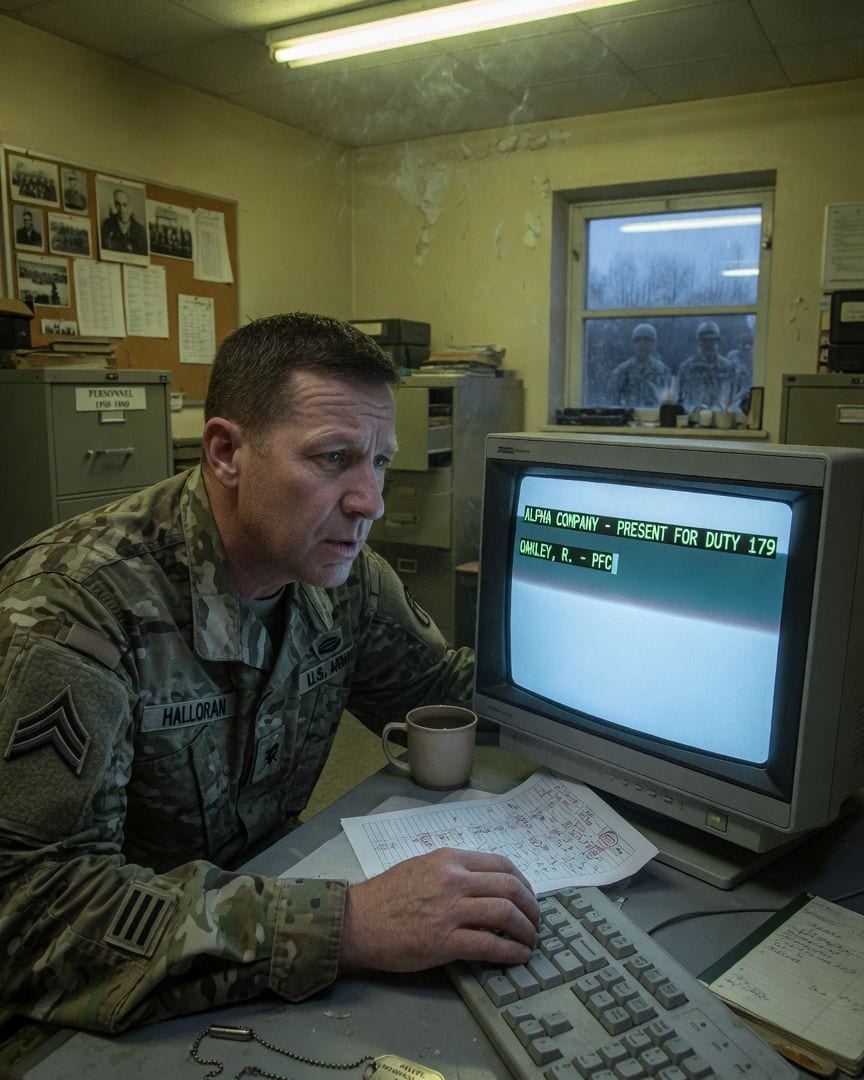
Sergeant Halloran’s computer logged an impossible 179 men. Days later, a 1953 dog tag appeared for the phantom Cold War soldier it named.
Sergeant First Class Roy Halloran was nearing his 20-year retirement, meticulously counting his company in the chilly German orderly room. He knew the number by heart: 178 men. Yet, day after day, his computer insisted on 179. The digital phantom deepened when a new name, 'Oakley, R. - PFC,' appeared, locked and uneditable. Then, from a forgotten cabinet, a tarnished brass dog tag surfaced, bearing the name 'OAKLEY, REGINALD P. - PFC' and the impossible date '1953.' Who was this extra man, and why had his dog tag appeared decades later?
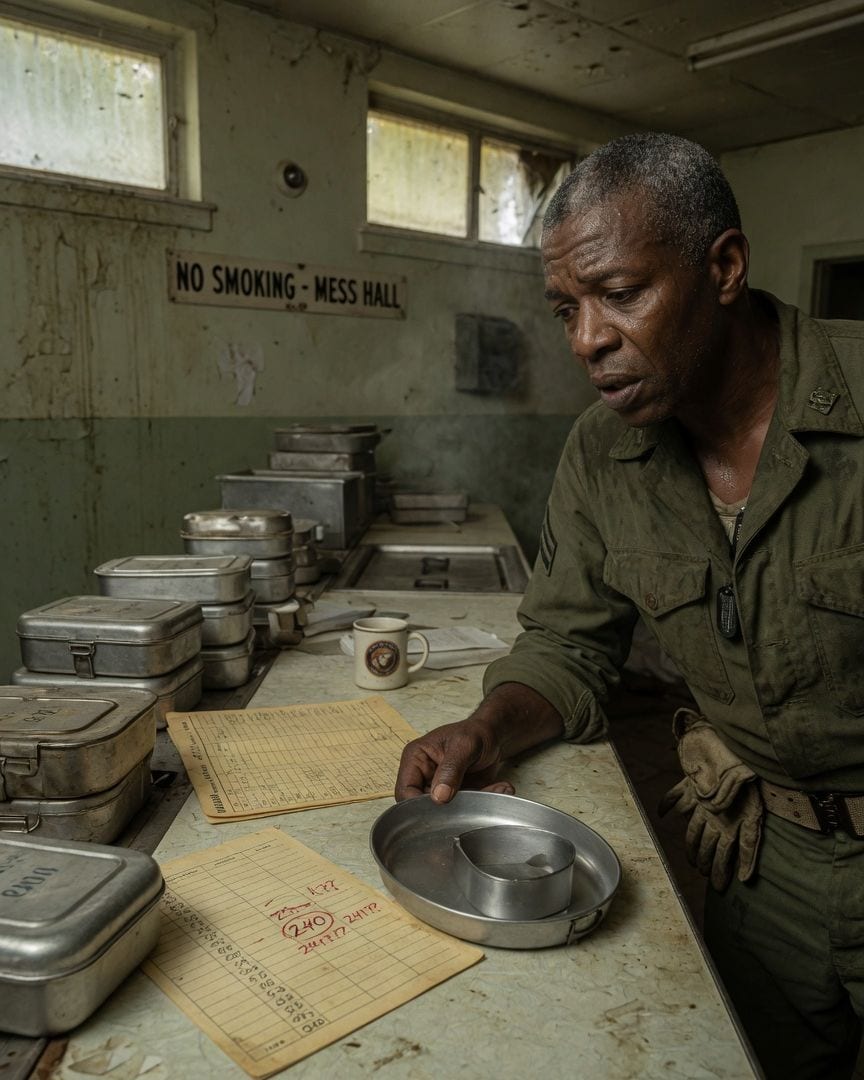
Sergeant Romano counts mess kits at a closing outpost. An extra plate matches a 1944 log of a missing soldier.
Sergeant William Romano, a meticulous Marine on his final deployment, supervised the last inventory of Outpost 73 before its permanent closure. His task in the humid, derelict mess hall was tallying tarnished mess kits, a mundane job until his count stubbornly showed one extra, pristine plate. His junior confirmed the anomaly, chilling Romano and sending him to the mildewed archives. There, a 1944 logbook revealed Mess Sergeant Okafor had documented the exact same extra plate, linked to a Private Brooks who was reported missing and never found. The humid air turned cold as Romano stared at the impossible presence.
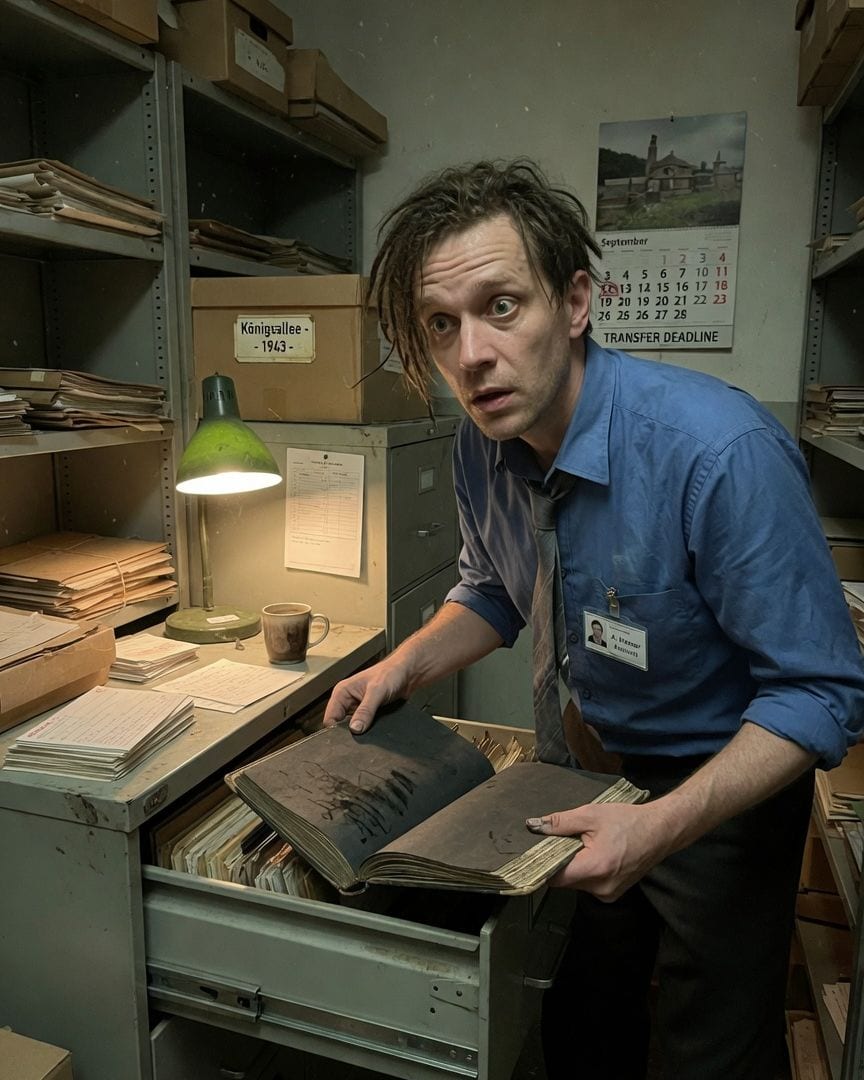
A Berlin archive researcher races a deadline. A hidden log for a Cold War barracks on a vacant lot has ink still wet from last month.
Ansel Vidmar, a methodical researcher, felt the pressure of a looming deadline. The municipal transfer of the old Berlin archive was days away, and he still had countless documents to categorize amidst towering stacks of forgotten history. His focus narrowed to an unindexed metal cabinet, revealing records for a garrison company at Königsallee – an address that had been a vacant lot since the war. A punishment log inside listed an entry from 1983, a date far too recent for a non-existent building. When Ansel visited the site, he found only overgrown grass, save for a single, eerily clean concrete doorstep emerging from the earth. His unease solidified into dread when he later uncovered a hidden Quartermaster's Log, meticulously detailing supplies for the same barracks, with entries extending to "last month," the final page's ink still faintly wet. What unseen operations were still being maintained?
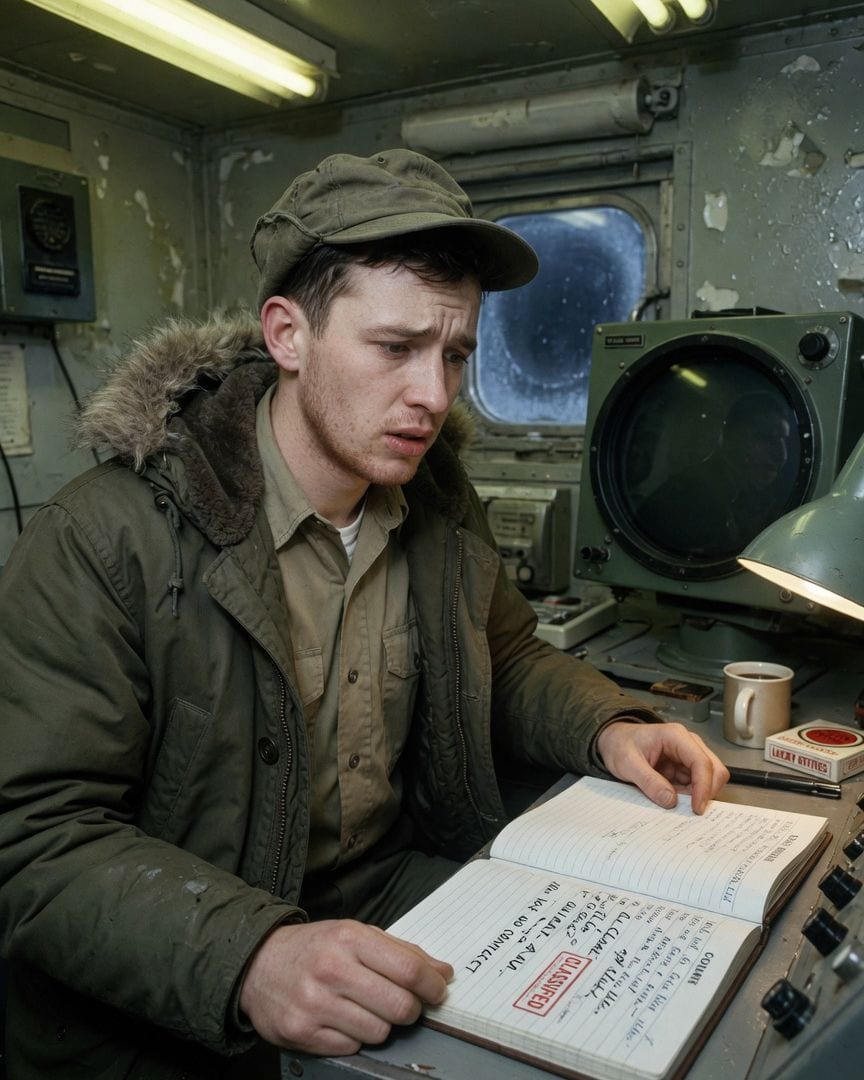
A Cold War airman logs an impossible radar contact on his last sweep. But his official logbook entry is stamped 'CLASSIFIED' and then contradicted by a hastily scrawled 'ALL CLEAR' dated moments before it.
Airman Ordway Vance, 22, manned the radar dome at Site Pellin in the biting North Atlantic dark of January 1962, running the last calibration sweep before its decommissioning. His scope picked up a faint, impossible return, growing closer with each pass, though the ocean remained empty to the eye. When Vance detailed the contact in his official logbook, a 'CLASSIFIED' stamp appeared, followed by a hastily scrawled 'ALL CLEAR' dated moments before his own entry, contradicting his every word. Commander Hartley dismissed it as equipment malfunction, but Vance sensed a chilling, official erasure behind the lie. He soon found a locked cabinet marked 'SITE PELLIN ANOMALIES,' hinting at a deeper truth buried within the base's final days.
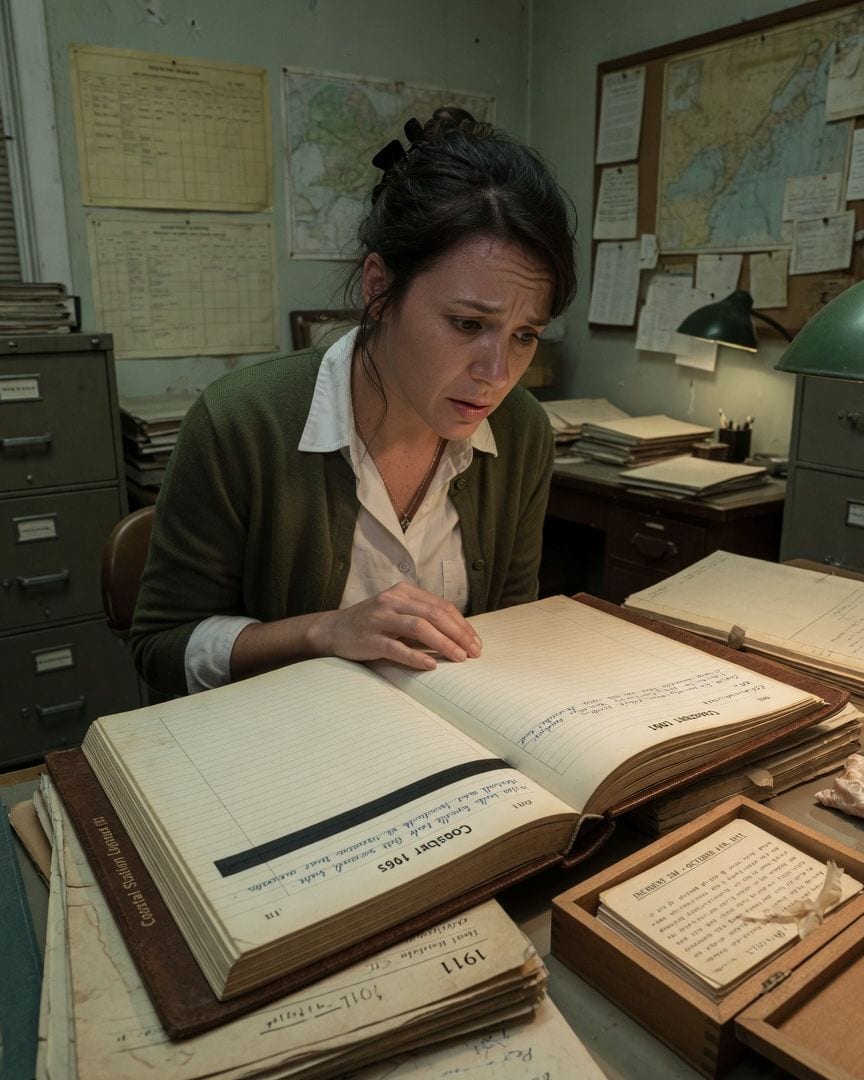
My weather station's old logbooks show a single line redacted every October 4th since 1911. The observer's note just says: 'the reading that should not occur.'
As the new archivist, I was reconciling old rainfall data when my finger stopped on October 4th, 1963. In the logbook, a thick black bar covered all weather observations, with a cryptic note: 'the reading that should not occur.' This wasn't a mistake; it was a century-long pattern, meticulously maintained.
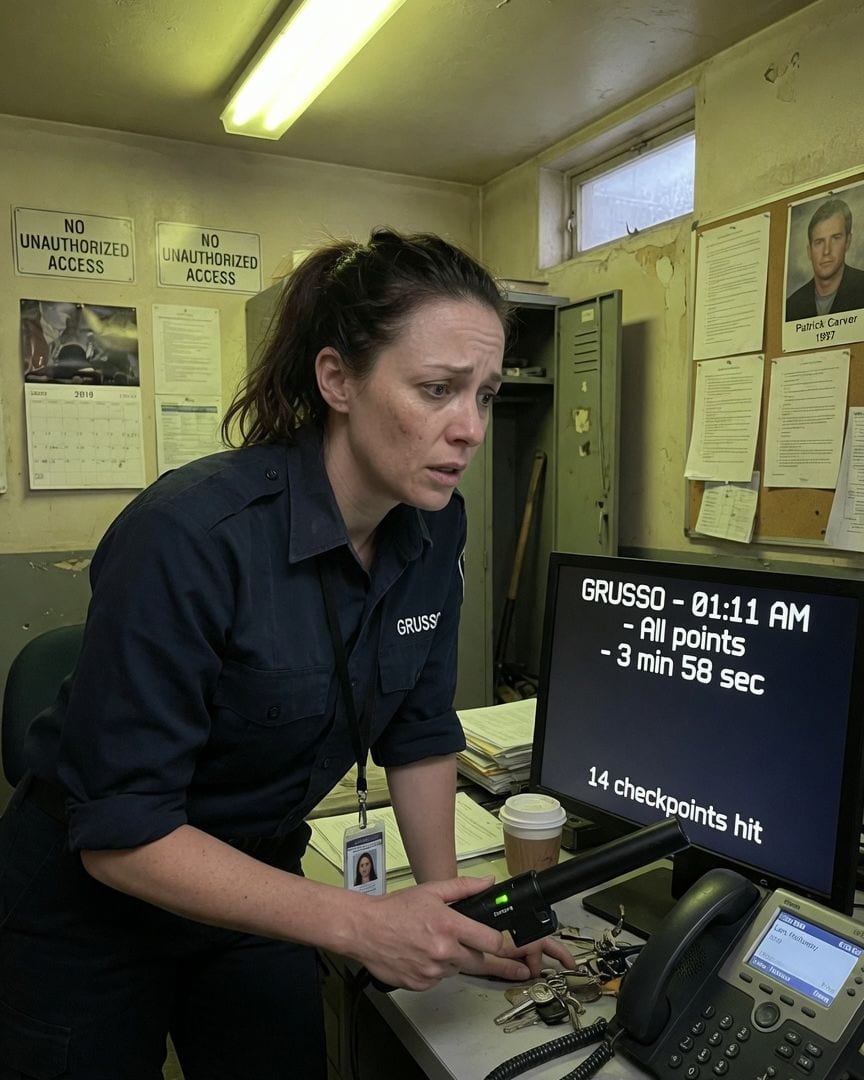
My security wand logged a full round at 1:11 AM in under four minutes. It was in the charger. Every tap is logged as mine.
Finishing my night shift, all I wanted was to get home. But the dock readout screen showed my security wand logged a full patrol at 1:11 AM, completed in just under four minutes. I knew my wand had been charging right beside the monitor the entire time, yet the log, under my ID, confirmed the impossible.