Sergeant Halloran’s computer logged an impossible 179 men. Days later, a 1953 dog tag appeared for the phantom Cold War soldier it named.
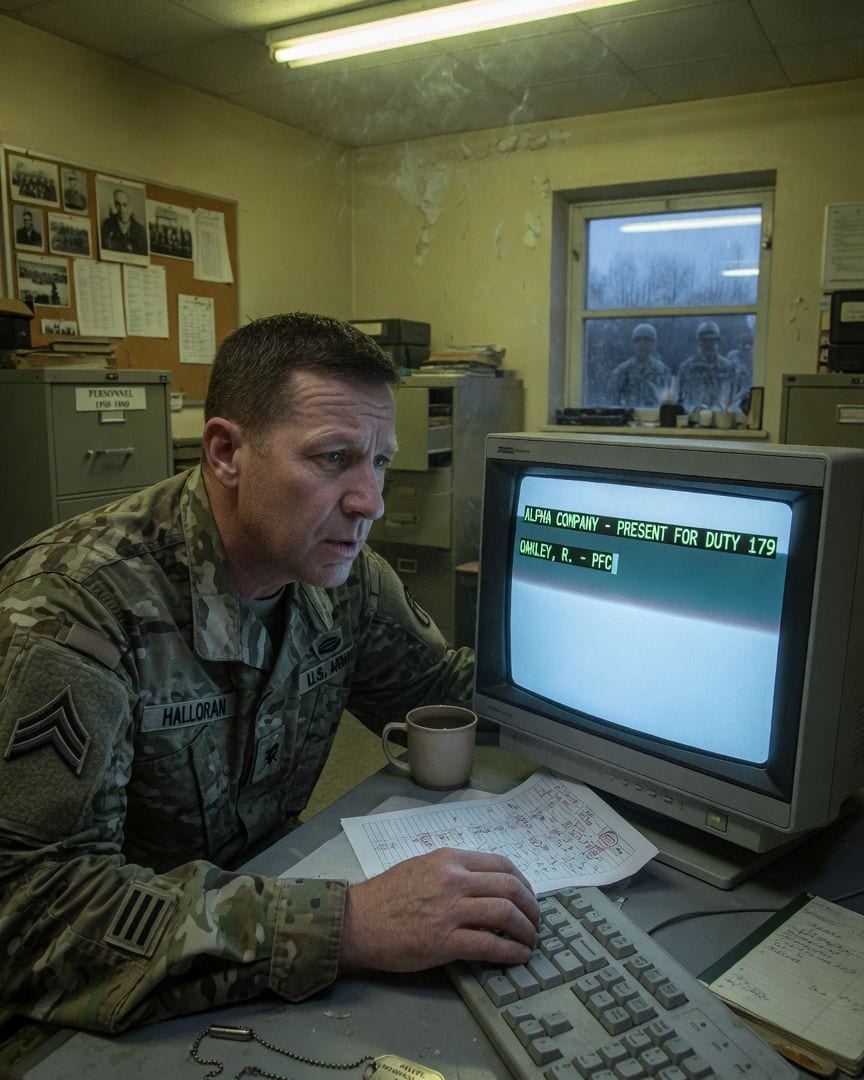
Sergeant First Class Roy Halloran, a squared-away NCO nearing his 20-year retirement mark, sat at his desk in the chilly German orderly room at 0600.
The company’s first formation stood stiff in the cold outside, their breath pluming white in the predawn gloom. Halloran keyed in the present-for-duty strength, a number he knew by heart: 178 men. He hit Enter. The computer screen returned '179.'
Halloran frowned. He stared at the glowing numbers, then back at his notes. 178. He counted again in his head, mentally ticking off each squad leader’s report. Still 178.
He called Private Gideon Patterson, his junior clerk, who was just starting to organize the supply manifests.
Patterson, a young man of twenty, returned minutes later, saluting sharply. 'Sir, 179 present, accounted for.' His voice carried the same slight confusion Halloran felt.
Halloran sighed, the knot in his stomach tightening. He pushed back his chair, the squeak echoing in the quiet room. 'Patterson, stand fast.' He walked out into the biting air, the chill seeping through his uniform.
He stood at the front of the formation, his gaze sweeping across the ranks. He called every man by name, his voice clear and resonant. Every soldier was present. Every face looked back at him. Every name was accounted for.
Yet, when he re-entered the count into the computer system, the screen still stubbornly insisted on 179. The fluorescent lights hummed above him, and for a moment, the orderly room felt colder than the air outside.
Halloran spent the next two days trying to reconcile the impossible count. He cross-referenced the digital roster with the physical bunk assignments, the chow hall sign-in sheets, the duty roster.
He pulled out the company’s internal personnel files, checking leave requests and hospital admissions. Every piece of paper, every logbook, every physical check confirmed 178 men.
He even had Patterson stand at the gate and count them leaving for training, then again returning. It was always 178. But the morning report, day after day, stubbornly declared 179.
It was a digital phantom, a single extra digit that refused to vanish.
On the third morning, Halloran arrived at his desk before the sun was fully up, determined to crack the anomaly. He pulled up the digital report again, his fingers hovering over the keyboard.
A new line item had appeared under Alpha Company, Present For Duty. Halloran stared at it. It read: 'Oakley, R. - PFC.'
A jolt ran through him. He hadn't typed it. It hadn't been there yesterday. He tried to delete the entry, his thumb pressing hard on the Backspace key. Nothing. The field was locked, unresponsive to his commands.
He tried to highlight it, to cut it, to overwrite it. The cursor skipped over it as if it weren't there, yet the name remained, a digital ghost, solid and immutable.
That single line, 'Oakley, R. - PFC,' was the impossible +1. The hum of the computer monitor seemed to deepen, a low, persistent thrum against the silence of the room.
Frustrated, the new name a buzzing irritant in his mind, Halloran went to the quartermaster's office, a musty space filled with the smell of canvas and old leather.
He sought Staff Sergeant Everett Crane, a quiet NCO who’d been on this particular base for over thirty years. Crane was a fixture, a silent sentinel of supplies and requisitions.
Halloran found him meticulously stacking boxes of field rations. 'Staff Sergeant Crane,' Halloran said, his voice tight, 'I need to ask you about someone. Oakley, R. – a PFC.'
Crane paused, a box halfway to the shelf. He turned slowly, his gaze unreadable, the lines around his eyes deepening as he considered Halloran.
He offered no verbal response, just that long, assessing look, then turned back to his inventory without a word.
Halloran returned to the orderly room, a knot tightening in his stomach. The chill in the air felt suddenly sharper. Gideon Patterson sat hunched over an old, forgotten filing cabinet in the corner, his face pale in the fluorescent light.
He held up a small, brass disc, heavily tarnished, between his thumb and forefinger.
'Sergeant,' Patterson whispered, his hand shaking slightly as if the metal itself pulsed with a strange energy, 'I found this in the back. Tucked behind some old supply manifests from the fifties.'
Halloran walked over, his eyes fixed on the object. He took the disc. It was a dog tag. Faded but legible, the letters were stamped deep into the brass. It read: 'OAKLEY, REGINALD P. - PFC - US ARMY.'
Stamped beneath the name was a date: '1953.' Unit records for Alpha Company, Halloran knew, showed no soldier by that name, ever.
The dog tag ignited a cold fire in Halloran. It sat on his desk, a heavy, silent accusation, the proof of something impossible.
He spent every spare moment digging, sifting through microfiche records that scratched across his vision, dusty unit histories that crumbled at his touch, and archived records stored in the base’s deep, cold vaults.
He found no Reginald Oakley assigned to their company, not in any official capacity. But the name, or something like it, did appear.
It surfaced sporadically, a spectral echo in other, older US Army unit records from across Germany, dating back through the 1950s and 60s.
Each mention was vague, like a story half-told, deliberately obscured. 'Transferred under unusual circumstances,' one entry read, barely legible on a yellowed dispatch. Another simply stated, 'assigned to special detachment, location classified.'
Most chillingly, several records simply recorded 'disappeared from roster, no further details.' Always, these entries coincided with brief, unexplained strength discrepancies, numbers that fluctuated inexplicably, only to be quickly 'corrected' by higher command without explanation.
Halloran started noticing similar, smaller inconsistencies in his own base’s ancient logbooks – faint pencil marks that seemed to shift and change under his gaze, erased entries where a name might once have been, numbers that didn't quite add up before being neatly overwritten with a different ink, a different hand.
He tried to speak to other long-serving NCOs, to show them the growing stack of anomalies.
They dismissed his findings with a wave of a hand, as 'ghost stories from the old days,' 'admin errors from the fog of war,' or 'just the way things were when everything ran on paper.'
They talked over him, smiled patronizingly, or changed the subject.
The more he dug, the more a pattern, barely visible like a watermark on old paper, began to emerge from the bureaucratic static, pointing to something far deeper than simple mistakes.
Halloran returned to Crane, the unyielding quiet of the Quartermaster’s office pressing in around them. He laid out the recurring name, the scattered discrepancies he’d found in the archives, the copies of old reports.
Crane listened, unperturbed, his large hands methodically polishing a brass buckle, its surface glinting in the dim light.
'Some things,' he said, his voice a low rumble, the sound barely disturbing the dust motes dancing in the air, 'are just the way they are, Sergeant. Always have been.'
He didn’t elaborate, didn't offer a theory, simply returned to his polishing.
Halloran felt a prickle of unease. Crane’s calm was too absolute, too unyielding. Over the next few days, he noticed Crane more often.
The Staff Sergeant would be lingering near the orderly room, standing just at the edge of Halloran’s peripheral vision, observing him with an unnerving calm.
Halloran would look up, and Crane would be there, a silent shadow, his eyes fixed on Halloran’s desk, on the stack of files, on the dog tag that still sat beside Halloran’s keyboard.
Halloran’s gut tightened with a cold, creeping certainty.
One evening, after a late chow, Halloran returned to his desk. He had locked his personal service record file inside a drawer, a habit ingrained after nearly two decades of service.
But now, it lay open on his desk, its crisp cover sheet exposed. It wasn’t how he’d left it. He picked it up, his fingers tracing the familiar lines of his name, his rank, his service number.
Then he saw it: a single, faint red pencil mark, barely visible, drawn next to his name on the cover sheet. It wasn't a correction, not an official notation.
It was just a simple, unsettling checkmark, a silent acknowledgement that someone was watching his every move, every discovery. The air in the room felt suddenly thick and heavy, as if it held a whispered secret.
Halloran confronted Crane directly, the weight of the dog tag and the stack of evidence burning in his hands.
He cornered him late one night in the quiet, echoing quartermaster’s office, the only sound the distant drip of a leaky pipe.
He slammed the tarnished brass dog tag, the printouts of his archival research, and the marked service record onto Crane’s dusty desk. The items scattered slightly, tiny explosions in the suffocating silence.
'What is this, Staff Sergeant?' Halloran demanded, his voice low and tight, betraying the tremor that had started in his hands. 'What in the hell is going on?'
Crane sighed, a long, slow exhalation that seemed to carry the dust from the room’s deepest corners. He sat down behind his cluttered desk, his movements deliberate and unhurried.
He picked up the dog tag, turning it over in his fingers, his gaze distant. 'It’s not a 'what,' Sergeant. It's a 'when.' And a 'how.' He looked at Halloran, his eyes clear and unsettlingly calm.
'Reginald Oakley,' he murmured, the name suddenly heavy with meaning. 'Not a person, not anymore. He was the first recorded instance. The designation.'
Crane explained that 'Reginald Oakley' was a systemic designation, not a soldier in the conventional sense. It was, he said, an entity, or perhaps a pattern, that ensured the 'continuity' of a unit.
It surfaced during times of significant change for the base – major deployments, deactivations, closures. It needed a 'host,' a vessel to manifest its presence.
He pulled out an old, leather-bound ledger from a locked compartment in his desk, distinct from any official Army records, its pages brittle and yellowed with age. The leather was worn smooth, almost polished from decades of handling.
He opened it to a page filled with names, dates, and cryptic notes written in a precise, almost calligraphic hand. He pointed to the first entry. 'Oakley, R. - 1953 - First Designated.'
The dog tag, the recurring name, the impossible count errors – it all snapped into a terrifying, coherent pattern, like tumblers falling into place in a lock. The past, once murky and fragmented, became chillingly clear.
Crane then flipped to a more recent page, its entries sparse, almost chillingly neat. The room seemed to expand, its walls pressing in on Halloran, the air growing colder with each word Crane spoke.
Crane's finger traced a line in the old, leather-bound ledger, the faint scraping sound amplified in the absolute silence of the quartermaster’s office. He stopped on a page filled with cryptic notes and dates, under a column marked 'Next Designated.'
The columns listed names, dates, and sparse, almost clinical observations.
Halloran leaned closer, his breath catching in his throat. There, faintly penciled, unmistakably, was his own name: 'Halloran, Roy.' The elegant script of the preceding entries gave way to a hesitant, almost nervous hand for the current ones.
The date next to it, 'T-3 Months,' precisely matched the base's deactivation orders, which Halloran knew from his own records had been issued just weeks ago.
A cold dread, unlike anything he’d ever known, washed over him, turning his stomach to ice. His eyes darted from his name to the date, back to his name, then up to Crane’s face.
Crane looked up, his gaze calm and unwavering, directly into Halloran's eyes. There was no malice there, no triumph, only a profound, unsettling acceptance. 'It was always going to be someone, Sergeant,' Crane said, his voice devoid of any emotion.
'And you, you were always in the system.'
Halloran stared at his name in the ledger, then at Crane, his mind reeling. The words, simple and direct, felt like physical blows. 'What do you mean, 'in the system'?'
he demanded, his voice thin and reedy, alien to his own ears. 'What system?'
Crane leaned back, his expression as placid as still water. The low hum of the fluorescent lights above them seemed to vibrate with a strange, internal energy. 'This base, Sergeant, sits on old ground. Very old.
There’s a… continuity mechanism here. When a unit is formed, when it deploys, and especially when it’s dissolved, this mechanism ensures its essence, its memory, persists. It binds to the unit. 'Reginald Oakley' is that mechanism.
It’s not a person who was once here, but a designation, a placeholder identity within the unit's records that periodically surfaces. The count errors you saw?
That’s the system making space, an extra presence that isn't quite solid yet, preparing for the absorption.'
He explained how the previous 'Oakley' would cease to be a distinct individual. Their consciousness, their identity, would become part of the overarching designation, their physical presence replaced by the systemic placeholder, their identity subsumed into the unit's enduring record.
Crane spoke of the ledger as his family's duty, passed down through generations of NCOs who 'understood' this particular posting, who maintained the records of these transitions.
The base’s imminent deactivation was a critical trigger, necessitating a new 'Designated' to carry the unit’s memory forward.
Every clue Halloran had found, every discrepancy, every ghostly entry in the digital report, now clicked into place, forming a coherent, horrifying pattern. The dread was in the simple, irrefutable logic of it all.
Halloran felt a surge of adrenaline, cold and sharp, pushing him back from the desk. 'No,' he said, the word a desperate rasp. 'I won't. I'm not going to just… disappear. This is insane.'
Crane merely shook his head, his composure unwavering. 'It's not a choice, Sergeant. It's an assignment. Just like any other.' He reached into a drawer in his desk, his movements slow and practiced, and pulled out a yellowed, official-looking document.
It bore a faded US Army seal, but the language within was archaic, almost ceremonial, unlike any military order Halloran had ever seen. It was a 'Designation Order' for 'Reginald Oakley,' detailing the 'continuity protocol' and the 'transfer of identity.'
The document, though ancient, felt terrifyingly official, its words carrying a weight that superseded modern regulations.
'Attempts to fight it only make the transition more… uncomfortable,' Crane added, his voice still calm, almost sympathetic. 'The system is thorough. It will account for you.'
Halloran looked from his own name in the ledger to the ancient Designation Order. The meticulous, impenetrable bureaucracy he had always trusted, the very system designed to account for every man, was now the instrument of his erasure.
He could feel the weight of it, the cold, creeping inevitability. There was nowhere to run from a system that had already claimed him, whose gears were already in motion.
The orderly room, once a place of routine and order, became a cage.
Three months later, the US Army garrison was a skeleton, a ghost of its former self. Most units had already transferred out, their buildings emptied and stripped bare. Private Gideon Patterson was among the last personnel preparing to leave.
He tried to find Sergeant Halloran to say his goodbyes, to thank him for his mentorship, but Halloran was gone. His personal effects had been packed with unsettling efficiency, his bunk stripped clean.
His name, once so prominent, had been removed from the final manifest without a trace. The computer system showed a clean zero strength for Alpha Company, the impossible +1 finally resolved.
But as Patterson tidied Halloran's old desk for the last time, running a hand over the smooth, worn surface, he felt something small and metallic.
Tucked into the back of a drawer, carefully placed as if left for him to find, was a single, small, brass dog tag, heavily tarnished.
It was identical to the one Halloran had discovered months ago, but the engraving was different. It read: 'OAKLEY, ROY H. - SFC - US ARMY.' The date stamped on it was the day the base officially closed.
Patterson picked up the dog tag, its weight cold in his palm, a tiny, heavy secret. He looked around the empty, cavernous orderly room, the silence pressing in around him.
He remembered Halloran's quiet intensity in the weeks before, the way his eyes seemed to track something unseen in the corners of the room, as if watching for an invisible presence.
Patterson pocketed the dog tag, a strange chill settling over him, a cold he knew had nothing to do with the unheated building. He was the last one out.
He locked the door, the click echoing sharply in the deserted hallway, turning his back on the silent building, its secrets buried deep within its walls.
Years later, a new recruit at a different, sprawling installation checked the morning report. The system returned a count one man high. The name on the manifest, which he didn't recognize, read: 'Oakley, R. - PFC.'
His Sergeant, a squared-away NCO with eyes that held a quiet knowing, looked over his shoulder. 'Is that so?'
If this one got to you
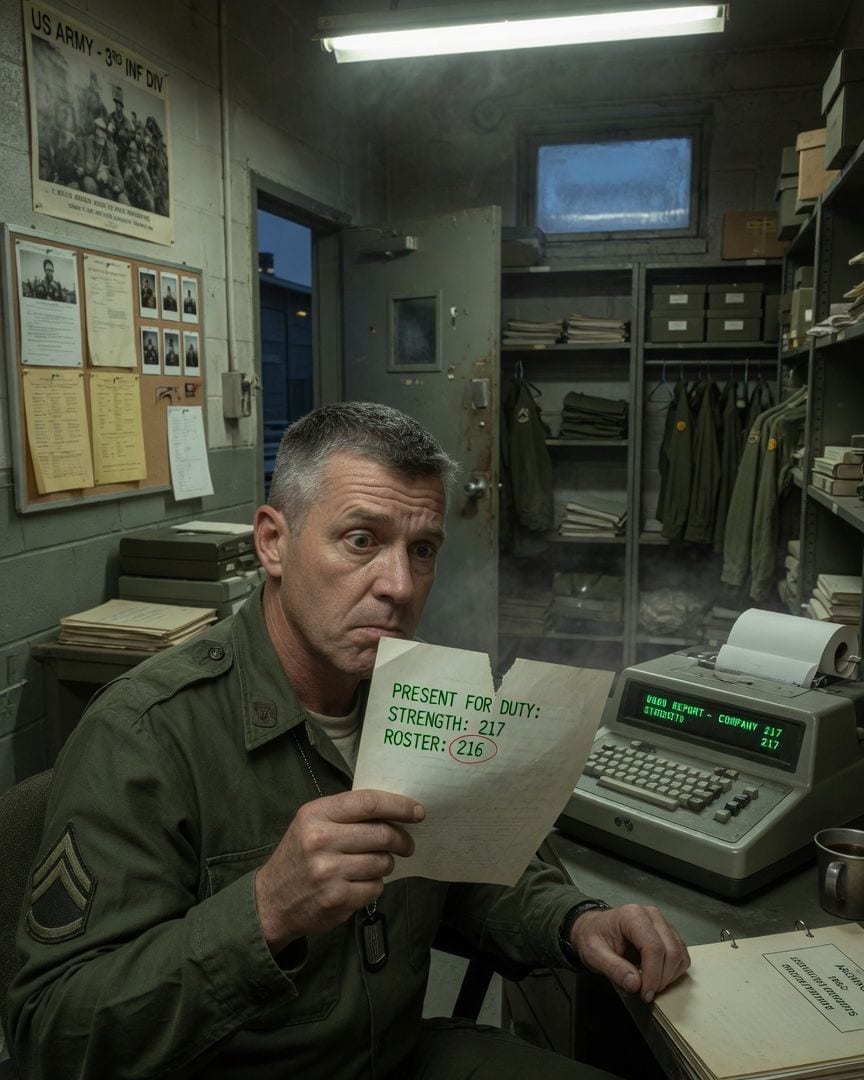
Sergeant Halloran is three months from a promotion, but his Cold War morning report shows 217 men. He counted only 216. A cold, hidden log from 1963 records the same impossible count.
Sergeant First Class Joseph Halloran, three months from a promotion and stateside transfer, faced the chilly 0600 darkness of his West German garrison in 1987, his career built on impeccable order now threatened. For a week, his morning reports had defied him: a meticulous physical count of 216 shivering soldiers always resulted in the Teletype machine blinking 217. His exhaustive double-checks confirmed no error, yet the impossible 'plus one' persisted, leading him to a distinctly colder section of the supply room. Behind ancient manuals, a hidden alcove revealed a worn leather log, where a Sergeant Hayes in 1963 had recorded the identical, chilling discrepancy.
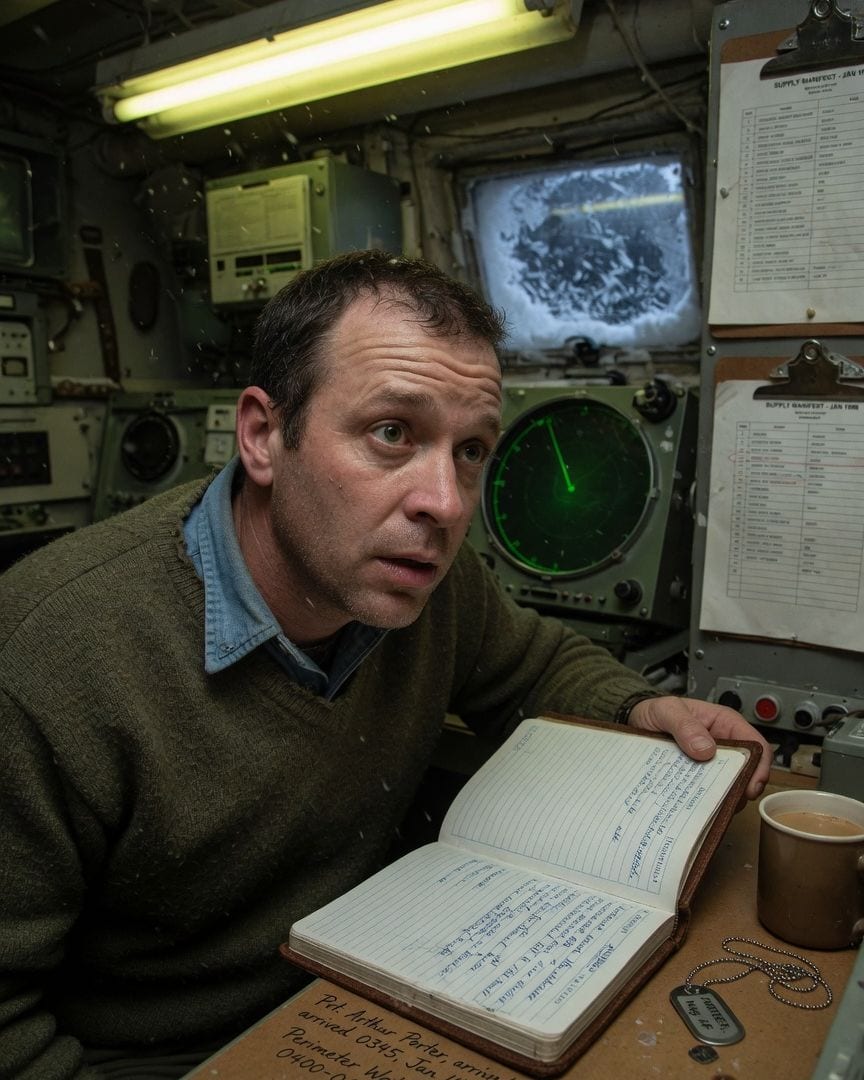
Cold War Radar Operator Conrad Oakley watches a man enter a shed. His boot prints lead in, but no tracks ever lead out.
At the isolated Cutbank radar station, deep in the Alaskan interior, Radar Operator Conrad Oakley maintained a lonely vigil against the howl of a relentless blizzard. His routine overnight watch on January 14th was shattered by an impossible radar contact: a solid, human-sized presence crossing the perimeter and stopping at the generator shed. At dawn, the shed door stood ajar. Inside, fresh boot prints led deeper into the cold darkness, but no tracks led out into the snow-choked landscape. Later, preparing the duty roster, Oakley found a new name in the station logbook: Pvt. Arthur Porter, assigned to perimeter watch. Beneath an empty bunk, a dog tag confirmed the identity of a soldier who was never there.
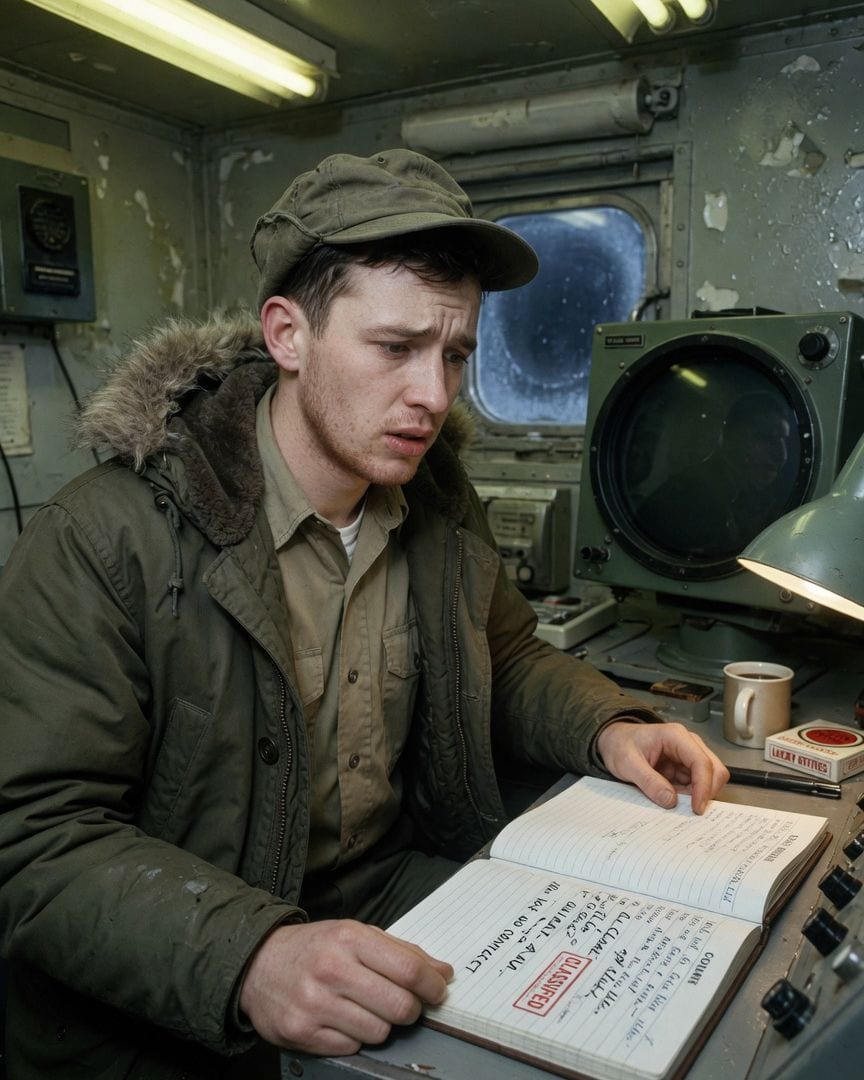
A Cold War airman logs an impossible radar contact on his last sweep. But his official logbook entry is stamped 'CLASSIFIED' and then contradicted by a hastily scrawled 'ALL CLEAR' dated moments before it.
Airman Ordway Vance, 22, manned the radar dome at Site Pellin in the biting North Atlantic dark of January 1962, running the last calibration sweep before its decommissioning. His scope picked up a faint, impossible return, growing closer with each pass, though the ocean remained empty to the eye. When Vance detailed the contact in his official logbook, a 'CLASSIFIED' stamp appeared, followed by a hastily scrawled 'ALL CLEAR' dated moments before his own entry, contradicting his every word. Commander Hartley dismissed it as equipment malfunction, but Vance sensed a chilling, official erasure behind the lie. He soon found a locked cabinet marked 'SITE PELLIN ANOMALIES,' hinting at a deeper truth buried within the base's final days.
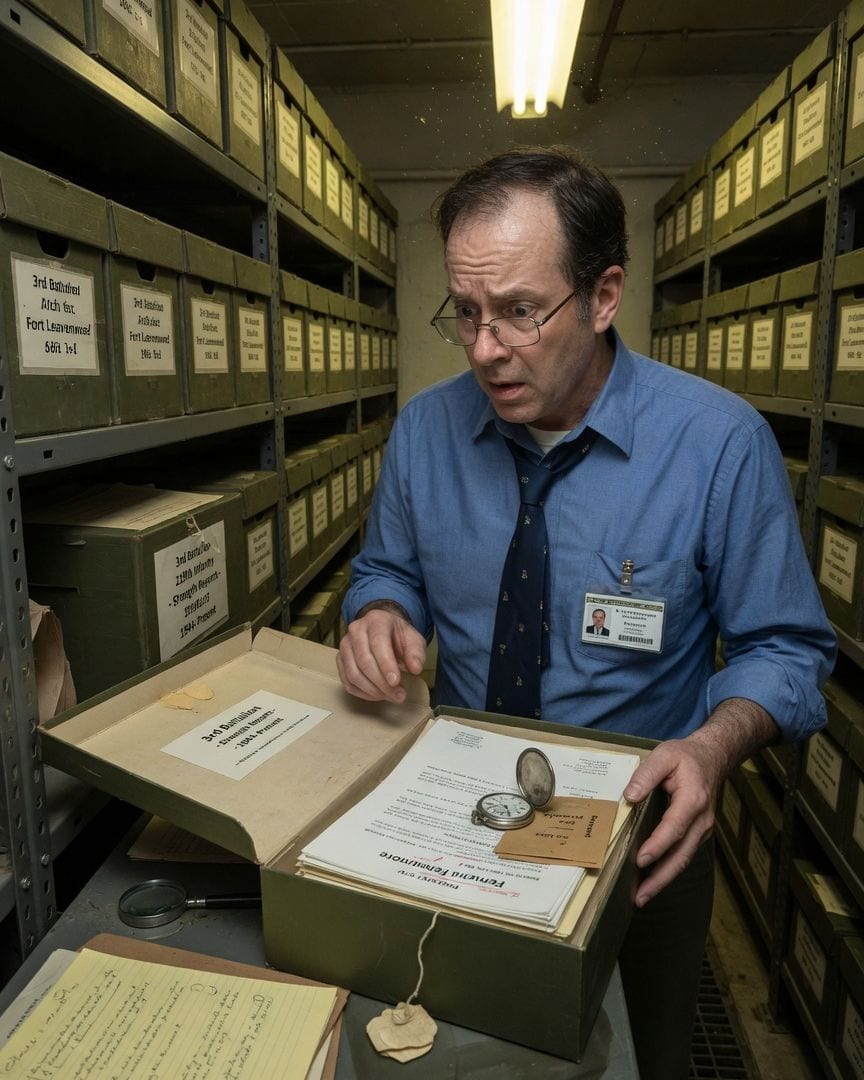
On his last Friday, an archivist finds his dead father's pocket watch in a Cold War ghost unit's file, ticking and warm.
Marcus Fennimore, a meticulous archivist, was on his final Friday at Fort Leavenwood's lineage vault, a place he knew intimately after thirty-one years. He stumbled upon twenty-two dust-sealed boxes for '3rd Battalion, 219th Infantry'—a unit that, according to every official record, simply did not exist. Inside, reports ran from 1944 to just last month, with the most recent listing his long-dead father, Kenneth Fennimore, as 'absent.' Marcus’s own father. Then, from a 1944 folder, he pulled his father's actual dog tags and a silver pocket watch, inexplicably warm and steadily ticking, freshly engraved with 'K.F. - Present for Duty.'
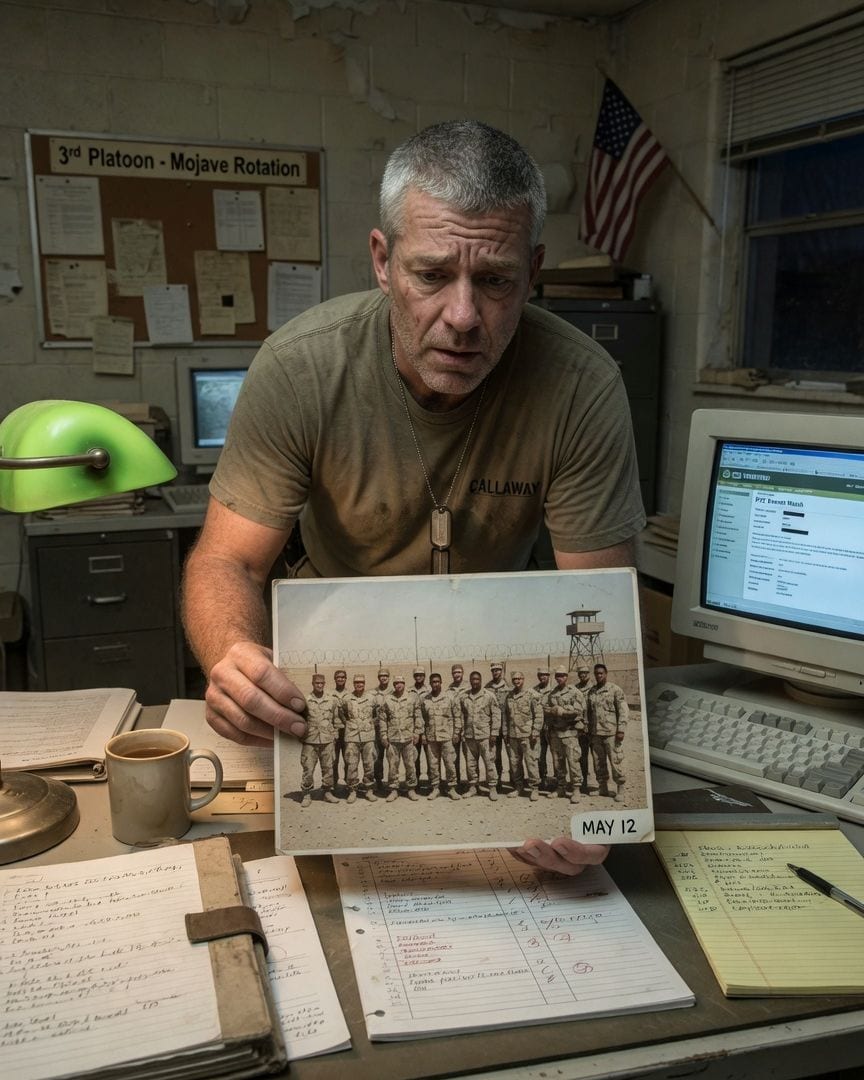
An extra man grinned from Master Sergeant Calloway's old platoon photo. His own men named the stranger he'd never seen.
Nearing retirement from the U.S. Army, Master Sergeant Trevor Calloway kept his platoon photo from the Mojave rotation tacked over his desk, every face a familiar memory. But a week before his final deployment, a casual count revealed a chilling impossibility: an extra man, grinning broadly, stood perfectly positioned in the back rank. His own soldiers, Suggs and Ramos, readily named the stranger "PFC Everett Walsh," yet Calloway knew with undeniable certainty that no such man had ever served under him. The question of the extra soldier, known by his men but unknown to him, solidified a cold, hard knot in Calloway’s stomach. How could a man exist in their shared history, yet be entirely absent from his memory?
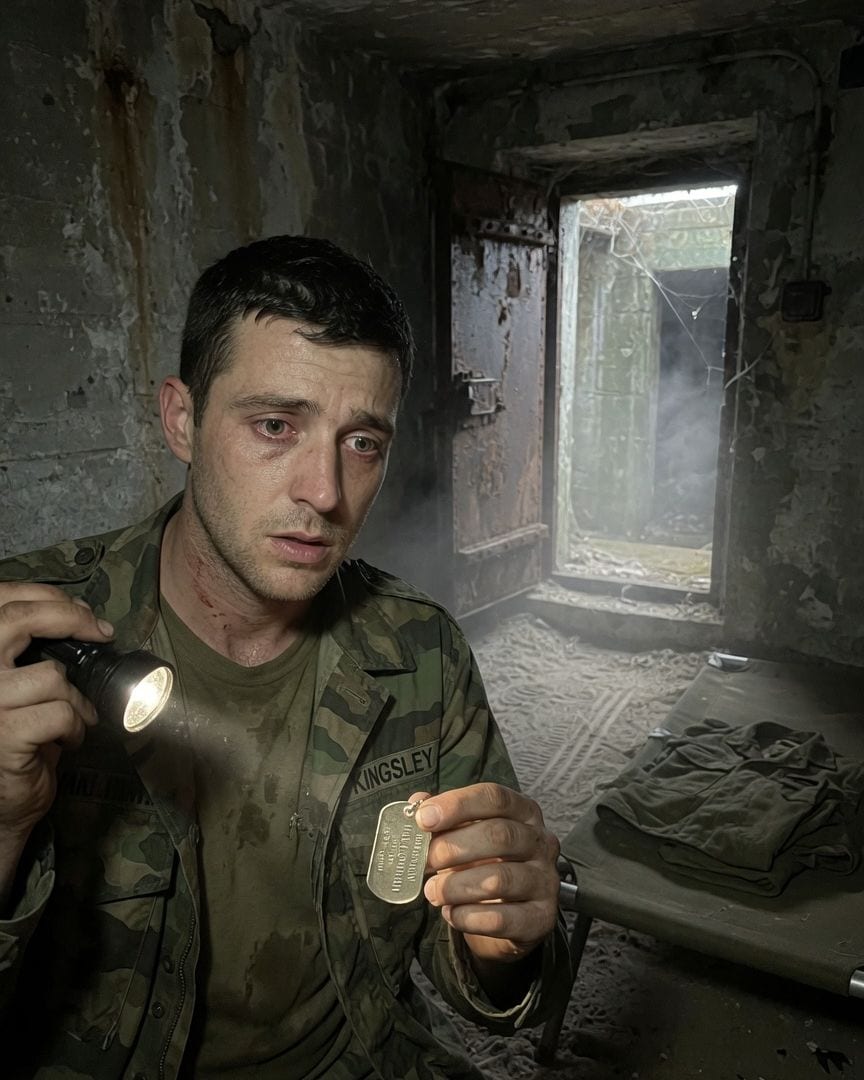
On his final rotation, a Private finds a WWII dog tag for 'Halloran' in a bunker sealed for eighty years.
Private Roland Kingsley endured the bone-deep weariness of his final graveyard watch at a reactivated WWII bunker on the Northern California coast, just hours from dawn and the end of his deployment. His searchlight cut through thick fog, revealing impossible figures: men in archaic WWII uniforms, assembling on the deserted beach, only to vanish moments later. As dawn broke, Kingsley discovered the bunker's rear hatch, sealed for decades, now stood mysteriously ajar. Inside, on an empty cot, lay a WWII-era field jacket, and in its pocket, a dog tag for 'Halloran' — a name impossible to the bunker's eighty-year history. What unseen presence had disturbed the long-sealed past?