An extra man grinned from Master Sergeant Calloway's old platoon photo. His own men named the stranger he'd never seen.
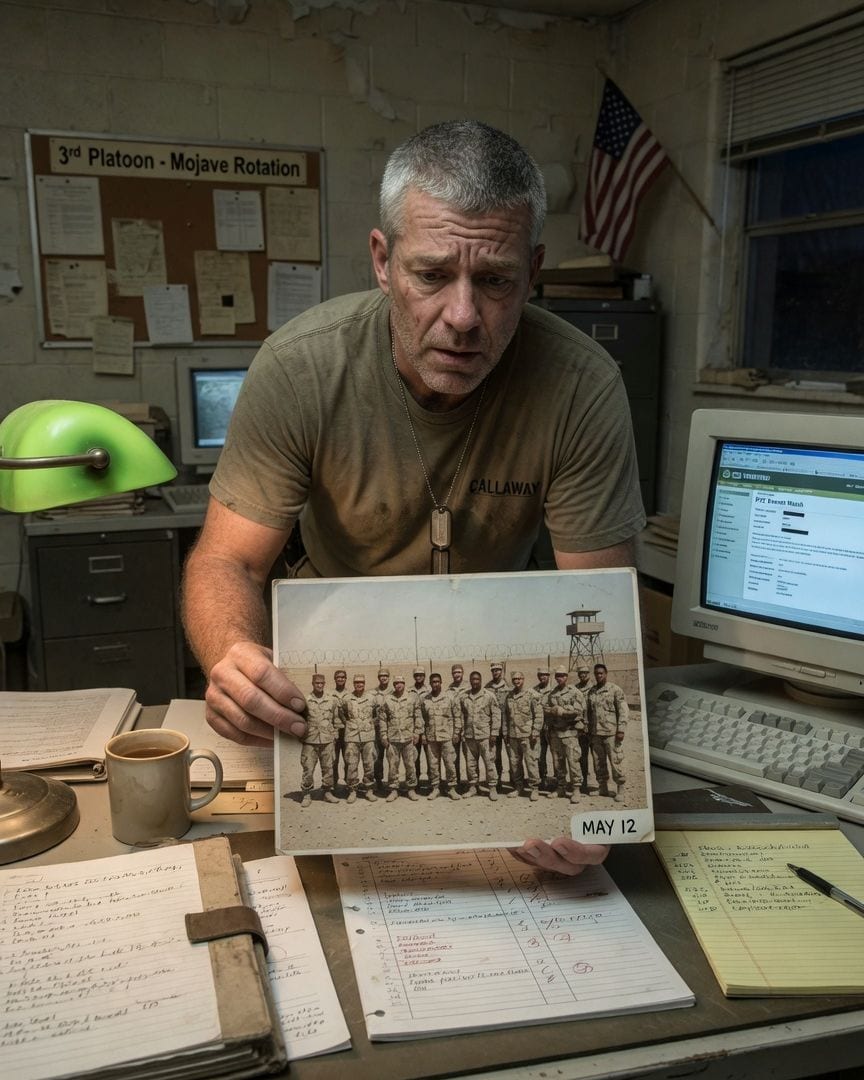
Master Sergeant Trevor Calloway, nearing his retirement from the U.S. Army, kept the platoon photo from the Mojave rotation tacked over his desk.
Thirty-one faces stared back at him, every one of them familiar, every name he could call in the dark.
He’d led these men through the scorching desert, watched them sharpen into soldiers, and prepared them for the quiet of civilian life.
One Tuesday morning, a week before his final deployment, Calloway leaned back in his chair, a mug of lukewarm coffee in hand, and counted the faces. Thirty-two.
An extra man stood in the back rank, positioned perfectly between Suggs and Ramos, grinning broadly. His face was half-familiar, a shadow of a memory Calloway couldn't quite grasp.
The man had dark, close-cropped hair and eyes that crinkled at the corners. Calloway squinted, pulling the photo closer. He knew every man in that picture, knew their quirks, their families, their hometowns. But not this one.
He turned the photo over, checking the date: May 12th, exactly one year prior, just before they rotated out of Mojave. There was no mistaking it. Thirty-two men.
He carried the photo into the platoon common area, holding it out to his men. "Anyone recognize this guy?" he asked, pointing to the extra face. Suggs, barely glancing up from his phone, mumbled, "Walsh."
Ramos, polishing his boots, added, "PFC Everett Walsh, right?" Both men looked at the photo, then at Calloway, a faint confusion clouding their expressions. When Calloway asked where they’d learned the name, Suggs scratched his head.
"Just… knew it, I guess. He was with us, wasn't he?" Ramos shrugged, equally uncertain. The question hung in the stale air of the room, solidifying a cold, hard knot in Calloway’s stomach. He knew his men.
He knew every man who’d served under him in that desolate Mojave outpost. He knew Post 3 had been empty that night.
Calloway took the photo back to his office, the knot tightening into a lead weight. He pulled up the official roster for that rotation on his computer. Thirty-one names, exactly. No Walsh.
He cross-referenced the manifest, scrolling through equipment issue logs, even the mess hall counts from that period. Always thirty-one. The numbers were exact, precise, an unyielding wall of military accountability.
He tried to dismiss it as a prank, a trick of light, or a misremembered face. Maybe he was just tired, heading into retirement.
But the name "Walsh" kept echoing from his men's mouths, and the man's grin in the photo felt too real, too present.
He spent the rest of the day poring over every document from that rotation, a meticulous search for any record of an Everett Walsh. He found nothing, absolutely nothing.
The office felt colder than usual, the hum of the old server sounding like a faint, trapped whine.
Late that night, long after the other offices had gone dark, Calloway was sifting through the archived unit logbook – a thick, canvas-bound ledger from the main gate of the Mojave outpost.
He flipped through the familiar, faded pages, the smell of old paper and dust filling his nostrils. Then, in a hurried, almost illegible hand, he found a scribbled entry from a night he distinctly remembered: "2200 hrs, Pvt.
Everett Walsh, perimeter patrol, Post 3." Calloway remembered that night vividly. A sandstorm had swept in, visibility near zero. He had personally walked the perimeter to ensure all posts were covered. Post 3 had been empty.
He knew it with a chilling, undeniable certainty.
The next morning, Calloway, driven by a gnawing certainty that had kept him awake for hours, pulled up the Army's central personnel database. He typed "Everett Walsh" into the search bar, his finger hovering over the enter key.
A profile loaded. PFC Everett Walsh, Service Number: [redacted], assigned to 3rd Platoon, C Company, 1st Battalion, 23rd Infantry Regiment – Calloway's own unit, last year.
A full service record, complete with records of his pay, his medical clearances, even a commendation for marksman proficiency he’d never seen awarded.
It detailed a valor citation from an engagement Calloway remembered vividly, a skirmish near a wadi where Walsh had supposedly secured a vital comms relay. Calloway stared at the digital document, then at the photo on his desk.
His own signature, barely legible at the bottom of a commendation request from that very period, seemed to confirm it, yet he knew it was impossible. He knew Walsh had not been there.
The digital record for PFC Everett Walsh was impeccable, too impeccable. Calloway found not only the valor citation but also comprehensive records of Walsh's pay, his medical clearances, even a commendation for marksman proficiency.
Every detail was present and accounted for. Yet, every attempt to find a living, breathing trace of the man hit a wall.
His emergency contact listed an address in a small, dusty town that, according to satellite maps, didn't exist anymore, swallowed by the shifting desert sands. His listed home phone was disconnected, the number ringing hollow to an automated message.
Calloway tried calling Janet Pierce, the records clerk at Battalion HQ, a woman known for her encyclopedic memory of personnel.
"Walsh? Everett Walsh?" she’d hummed, her voice rustling like old paper over the phone. "Oh, yes, I remember that name. Good soldier, quiet type. Processed some of his paperwork, I’m sure."
Then, after a pause that stretched too long, she added, "Funny, though. Don't remember ever seeing him in person. Just the forms." Her voice held a note of faint surprise, as if the thought had just occurred to her.
Calloway drove to the old Mojave outpost, now largely deserted, looking for any physical evidence Walsh had been there. The wind howled through the broken windows of the barracks, stirring dust devils in the empty spaces.
He found no personal effects, no locker assigned to him, no bunk that bore any sign of a recent occupant. Just the vast, empty barracks, the desert wind whistling a mournful tune.
The only thing that swore Walsh existed was the system itself, a perfect, unassailable paper ghost.
Calloway's questions about Walsh hadn't gone unnoticed. A week later, as he was filing his final retirement paperwork, the heavy silence of his office was broken by an unexpected call from his commanding officer, Colonel Hawkins.
"Heard you've been digging into some old records, Calloway," the Colonel said, his voice smooth and even, betraying nothing. "Anything I should know?"
The tone was casual, almost friendly, but the underlying message was clear, a subtle warning woven into the innocuous question.
Calloway offered a vague assurance about cross-referencing final duty rosters, a plausible excuse that felt thin even to his own ears. Colonel Hawkins merely grunted and ended the call.
Later that day, Calloway returned to his desk after a brief supply run. A note lay neatly on the center of his blotter, an old, faded printout of a section of the Mojave outpost's main gate logbook.
It showed the same entry he'd found days ago: "2200 hrs, Pvt. Everett Walsh, perimeter patrol, Post 3."
But scrawled beneath it, in shaky, unfamiliar handwriting that looked decades old, were three words, stark against the yellowed paper: "Don't look closer." A chill snaked up Calloway’s spine.
The air in the room seemed to drop several degrees, making his breath mist faintly. The dread solidified into a chilling certainty: someone knew what he was doing, and they were watching.
The casual hum of the office electronics seemed to deepen, morphing into a subtle thrum that felt like a pulse in the walls.
Calloway, ignoring the warning, called Captain Nathaniel Mitchell, the retired former CO of the Mojave outpost. Mitchell now lived a quiet life in a small retirement community in Arizona, his voice a gravelly echo of authority.
Calloway explained the photo, the record, the logbook entry, his own signature. Mitchell listened, initially guarded, his responses curt. Then, after a long silence that hummed with unspoken knowledge, he slowly admitted to a similar "incident" decades ago.
"An extra man," Mitchell recounted, his voice raspy, the words pulled from a deep, dusty corner of memory. "Private Blackwood. Showed up in a unit photo, just like your Walsh. On the roster, too.
Even got a commendation for a patrol he never went on. Paperwork was watertight, pristine. But the man… he just wasn't there. Not really. Vanished as fast as he appeared. No physical trace. Nobody could explain it."
Mitchell paused, and Calloway heard a sigh on the other end of the line, a sound heavy with resignation. "I tried to investigate, of course. Pulled every file, questioned every man. But the system closed ranks, Calloway.
Every inquiry hit a bureaucratic wall. Everything pointed to him being real, except for the inconvenient fact that he simply didn't exist in the flesh."
Mitchell’s voice dropped, barely above a whisper. "Some things, Master Sergeant," he said, "are better left uncounted. The military runs on accountability. Every boot, every bullet, every man.
When something slips in that's too accounted for, yet isn't there… it’s a problem that can't be solved by normal means."
The earlier clues clicked into place for Calloway with a terrifying clarity: the "half-familiar" face in the photo, the unquestioning recognition from some of his men who couldn't explain why they knew the name, the perfect but empty records.
It wasn't just Walsh; it was a repeating pattern, a systemic glitch that produced perfectly documented, non-existent men. Mitchell’s calm, almost weary acceptance was more chilling than any frantic warning.
Mitchell's words about "uncounted" men echoed in Calloway's mind, a cold hammer striking an anvil. He realized the anomaly wasn't a one-off ghost or a prank; it was a recurring phenomenon, tied specifically to the Mojave outpost.
He knew he was looking at something ancient, something that had embedded itself deep in the system.
Back at his desk, ignoring the implicit warning from Colonel Hawkins and the explicit warning from Mitchell, Calloway accessed the Mojave outpost's digital archives. He started a comprehensive search for any discrepancies across all past rotations, not just his own.
He found more names: Private Scott Hale, listed on a roster from '98. Corporal Thomas Pierce, from a logistics manifest in '05. Each with a full, impeccable record: service numbers, promotion dates, even dependent information.
Each listed on rosters and logs, but with no real-world trace, no known living relatives, no confirmed sightings. The sheer volume of these "extra" personnel, spanning decades, was staggering.
The data filled his screen, name after name, a silent testament to an impossible bureaucracy. The methodical accumulation of untraceable lives sent a shiver down his spine.
The cold in the room seemed to deepen, and the monitor itself flickered, as if in protest.
Then, a new, sickening thought struck him. Calloway, hidden in the outpost’s deserted records office, deep in the night, scrolled through the live digital duty roster for the current night. He checked his own platoon.
There, assigned to Watch Post 3, the very post he himself had just walked and found empty, was "PFC Dean Hawkins." Calloway typed "Dean Hawkins" into the personnel database. A full, pristine record loaded, created only hours ago.
It was the same Post 3, the same empty desert air. The system had just accounted for two men who were not there, and one of them, PFC Dean Hawkins, was on watch right now.
Calloway walked the perimeter to Post 3 again, his heart a cold, heavy stone in his chest. The desert wind was the only sound, carrying the scent of dry earth and distant sagebrush. The post was empty.
The small observation hut stood open, dust motes dancing in the single shaft of moonlight that pierced the doorway. No footsteps in the sand, no discarded cigarette butts, no sign of any human presence.
He returned to the records office, his mind racing, pulling up the digital files for "PFC Dean Hawkins." The record was there, pristine, complete, generated only hours ago.
It detailed Hawkins’ initial entry into service, his training, his assignment to Calloway’s platoon, all laid out with the unwavering logic of military bureaucracy.
It was then he understood. The entity wasn't a ghost of a dead soldier, nor was it a physical being that somehow phased in and out of existence.
It was the system itself, a parasitic pattern that manifested through the military's relentless need for accountability. The anomaly was the record, the log entry, the roster slot, the perceived memory.
It didn't need a body; it needed a name, a service number, a duty assignment, a uniform.
It found its existence in the very act of being accounted for, creating a perfect, unassailable paper trail for men who were never truly there.
His own signed commendation request, the one he'd found in Walsh's file, was a blank form he'd signed for routine purposes, later filled in by the system to "create" Walsh's valor.
He, Calloway, had unknowingly signed off on the phantom's existence.
The Mojave outpost, with its deep history of rotations and its impending decommissioning, offered a perfect, isolated environment for this phantom bureaucracy to thrive, filling its empty roles with perfectly valid, non-existent men.
Its existence was not physical, but systemic, a coherent, self-sustaining glitch in the very fabric of military organization.
Calloway knew he couldn't fight it. It wasn't a physical enemy that could be cornered or eliminated, and the system was too vast, too ingrained.
He couldn't "un-account" men who were already perfectly documented, their existences woven into the digital and paper fabric of the U.S. Army. How do you declare something non-existent when every official record insists on its reality?
The thought was a lead weight in his stomach.
He sat at his desk, staring at the photo, the grinning face of Everett Walsh now seeming to mock him, joined by the phantom presence of Dean Hawkins on the live roster.
He tried to compile a report, to make sense of it for official channels, to warn someone, anyone. But the words felt hollow, inadequate. How do you report an anomaly that is the official report?
How do you explain an enemy that exists only as verifiable data, a perfect bureaucratic echo?
The air in the deserted records office felt heavier, pressing down on him. The flickering monitor seemed to emit a cold light that stained the room with an unnatural gray.
He knew the truth, and the knowing was the only battle that mattered. The outpost would be decommissioned, its physical presence erased, the records archived and forgotten by most.
But the pattern would persist, waiting for the next hyper-accounted-for system, the next isolated outpost with its intricate layers of official verification and its occasional overlooked gaps.
It was a perfect parasite, thriving on the very processes designed to ensure human presence. He could do nothing but observe it.
Calloway submitted his final retirement paperwork, omitting any mention of Walsh or Hawkins.
He watched the last of the equipment roll out of the Mojave outpost, the desolate landscape reclaiming its solitude, the remaining buildings echoing with the memory of phantom patrols.
The photo of his platoon, now with the thirty-second man, stayed tacked to his desk until the very end, a silent testament to a truth he couldn’t articulate. He packed it carefully into a box with his other personal effects.
The records for PFC Everett Walsh and PFC Dean Hawkins remained in the system, perfectly valid, perfectly accounted for, somewhere in the vast, churning gears of the military bureaucracy.
Years later, retired and living a quiet life in a small house overlooking a dry canyon, Trevor Calloway sometimes found himself staring at old news reports about other remote military installations being decommissioned, or new, isolated training facilities opening up.
He’d see a familiar-looking face in the background of a group photo of graduating recruits, a face that didn’t quite fit, a name mentioned in passing in an online article that felt eerily familiar in its anonymity.
He never said anything, never typed a comment, never called anyone. He just watched, a silent sentinel to a quiet, insidious reality. The system, after all, always found a way to account for itself.
On his veteran's pension, Trevor Calloway sometimes searched the online archives for old military records. He found PFC Everett Walsh, PFC Dean Hawkins, and others.
All with impeccable service records, commendations, even next of kin listed in towns that didn't exist. He'd never told anyone, not really. What was there to say? The system, after all, always found a way to account for itself.
If this one got to you
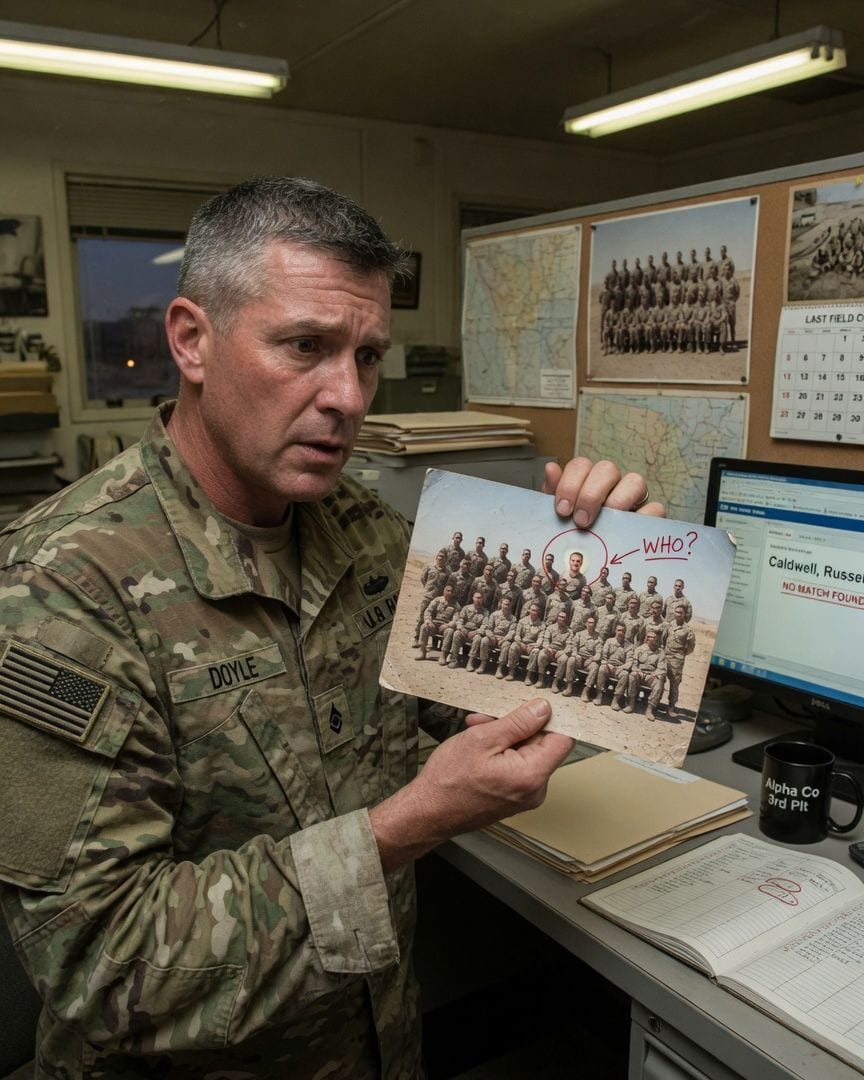
Weeks from his transfer, Master Sergeant Arthur Doyle's platoon photo had an extra man, grinning between Suggs and Ramos.
Master Sergeant Arthur Doyle, weeks from a quiet desk job, performed his usual ritual: staring at his platoon photo. He knew every one of the thirty-one faces from his last Mojave rotation by heart, but this morning, a thirty-second man grinned blandly between Sergeant Suggs and Private Ramos. When pressed, his soldiers named the man instantly as 'Caldwell,' yet couldn't explain how they knew him or when he'd joined. Doyle's personal logs and official unit manifests held no record of a Private Russell Caldwell, leaving him to question everything he thought he knew.
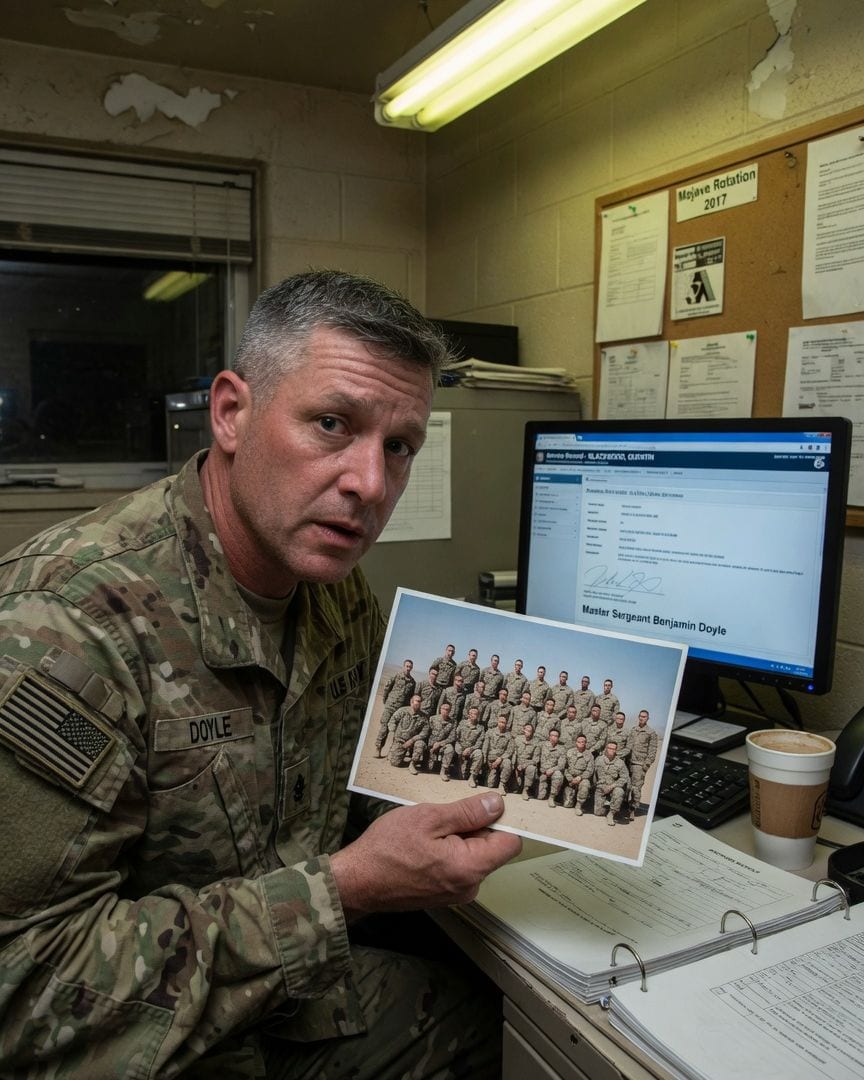
Master Sergeant Doyle found his own signature on a soldier’s commendation he knew he never signed.
Master Sergeant Benjamin Doyle, a man whose life was built on precise manifests and head counts, maintained a quiet daily ritual: glancing at his Mojave rotation platoon photo. One morning, the familiar thirty-one faces stared back with an impossible addition: an extra man, grinning between Suggs and Ramos, a face he and his colleagues recognized but couldn't place. His search through official digital rosters yielded nothing, yet old physical logs, signed in his own hand, confirmed the phantom soldier’s presence on a dangerous patrol he couldn't recall. The ultimate blow came with a valor citation for this same soldier, bearing Master Sergeant Doyle’s own digital signature for an award he knew he never certified.
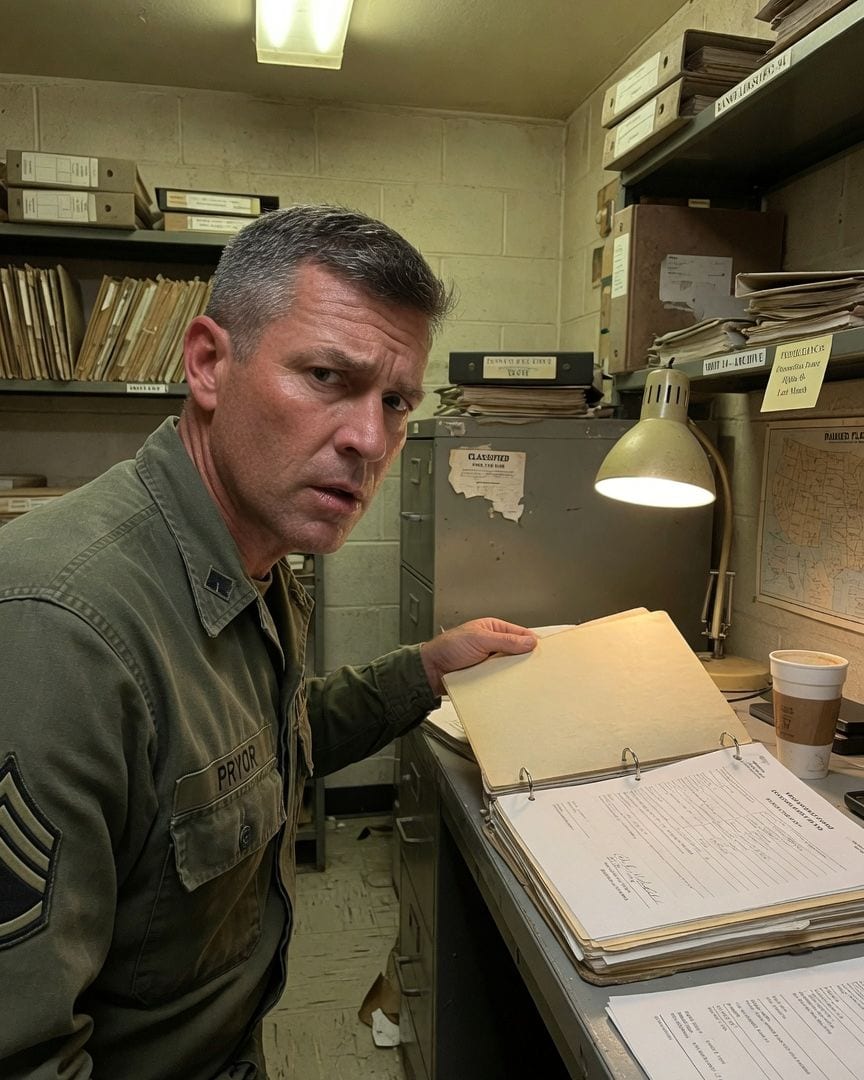
A sergeant with eleven days left finds a warm, glassed crater. Its file shows a captain lost thirty years ago is still signing reports from last week.
Sergeant Alden Pryor was counting down his final eleven days on a twenty-year hitch, expecting to spend them on routine patrols along the Ranier Flats fence line. Instead, his truck stopped at a bizarre sight: a four-hundred-foot glassed crater, miles from anywhere, its sand faintly warm at dawn despite no one recalling a blast. The air above it shimmered with an unnatural distortion, a silent scar of erased violence, and the official file for 'Shot 14' showed recent maintenance sign-offs for a decommissioned tower at the crater site. All these active documents were signed by Captain Everett Caldwell, who had been officially lost in operations thirty years ago, leaving Sergeant Pryor to wonder how a dead man could still be filing reports.
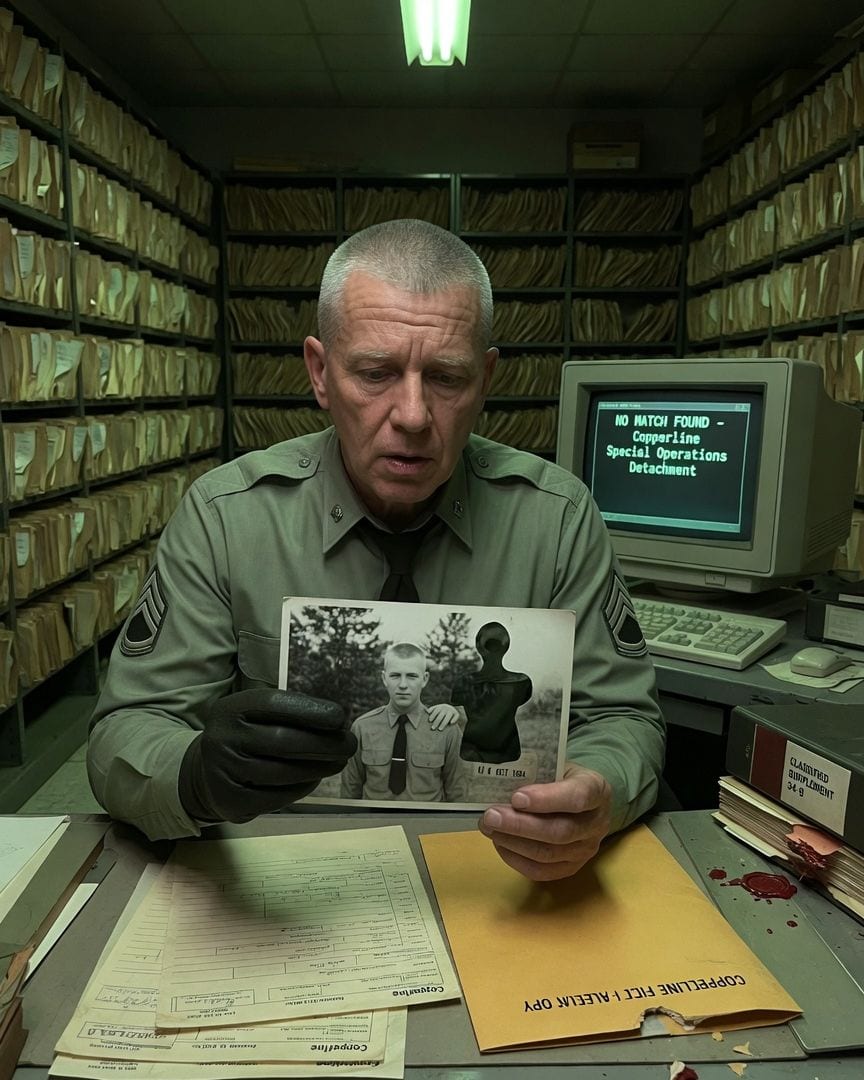
Sergeant Major Vance had two weeks to retirement when his old file felt warm. Inside, a photo showed him with a man precisely cut out from a unit that never existed.
Sergeant Major Teodor Vance had only two weeks left before his retirement, a lifetime of military order almost behind him. For thirty years, he'd pulled the 'Copperline' file, always finding it empty – until now. This time, a faint, impossible warmth radiated from the heavy manila, and inside, he found a faded photograph. It showed a younger Vance in an unrecognized uniform next to a man whose entire body had been precisely cut out of the print, from a company that officially never existed. After decades of silence, what did this warm, impossible file truly contain?
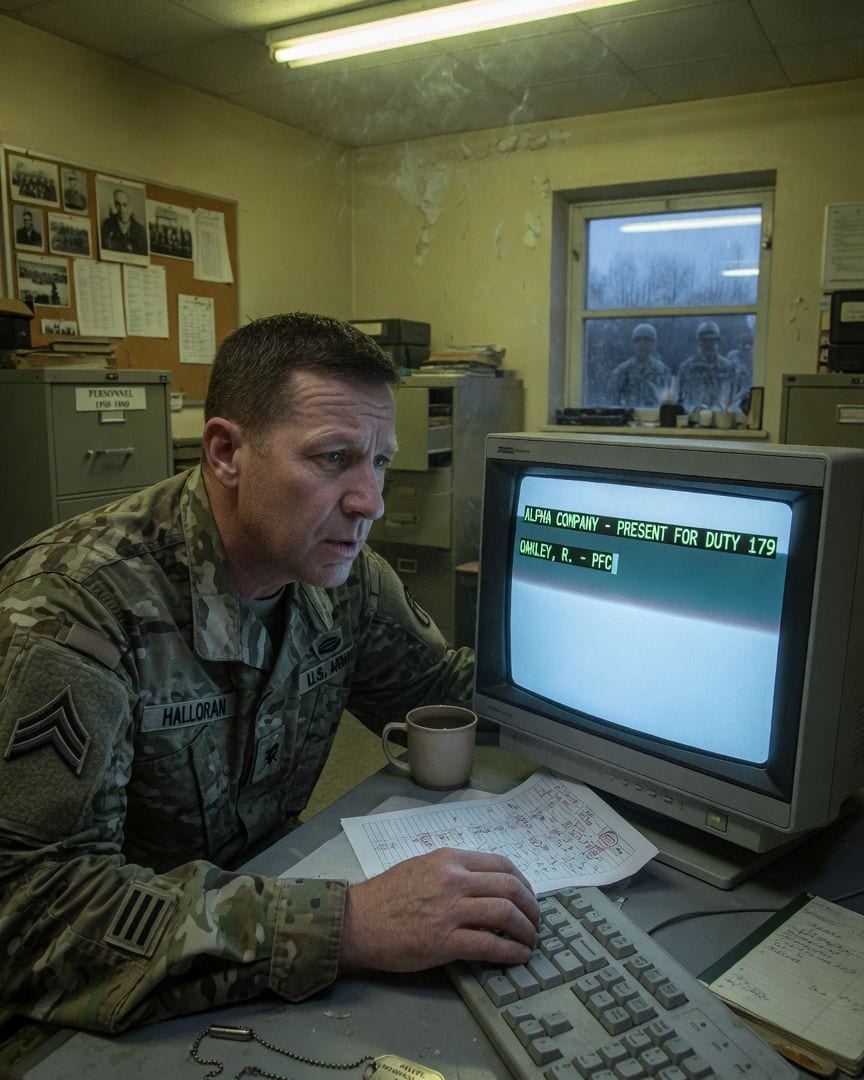
Sergeant Halloran’s computer logged an impossible 179 men. Days later, a 1953 dog tag appeared for the phantom Cold War soldier it named.
Sergeant First Class Roy Halloran was nearing his 20-year retirement, meticulously counting his company in the chilly German orderly room. He knew the number by heart: 178 men. Yet, day after day, his computer insisted on 179. The digital phantom deepened when a new name, 'Oakley, R. - PFC,' appeared, locked and uneditable. Then, from a forgotten cabinet, a tarnished brass dog tag surfaced, bearing the name 'OAKLEY, REGINALD P. - PFC' and the impossible date '1953.' Who was this extra man, and why had his dog tag appeared decades later?
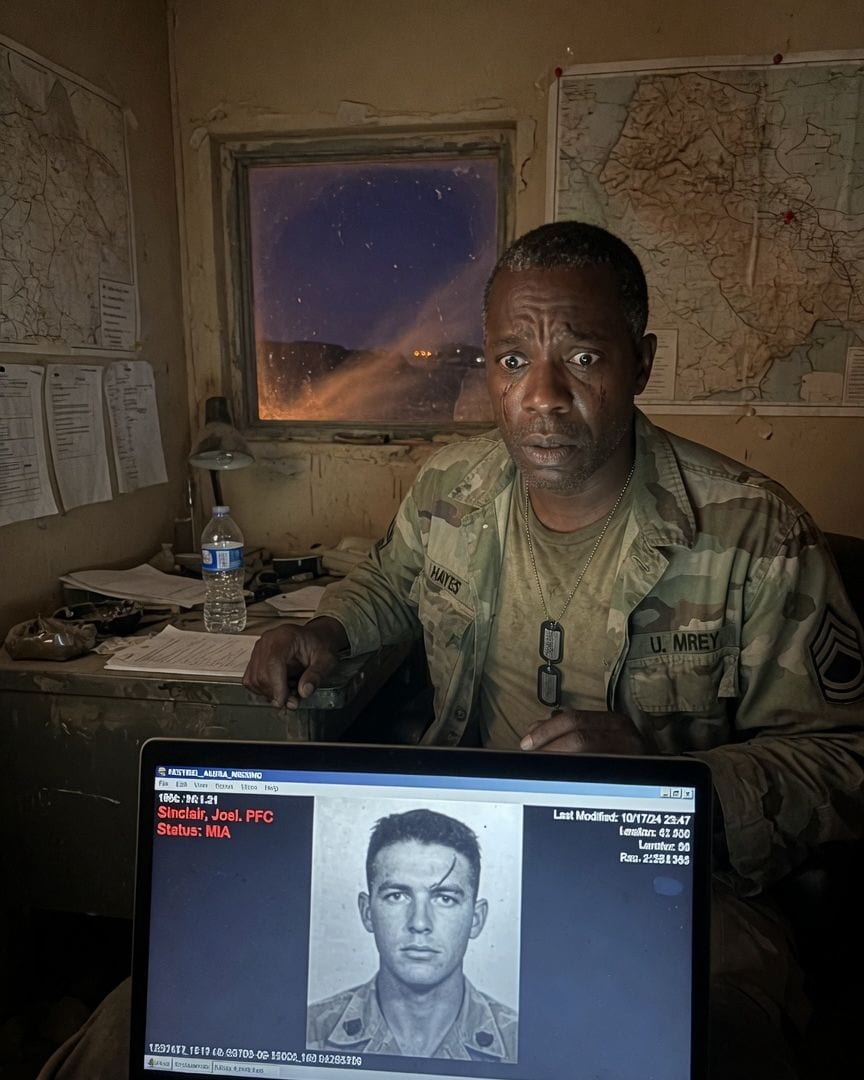
Three weeks from leaving, Sergeant Hayes found a soldier in bunk 17. His file read: Pfc. Joel Sinclair, MIA since 1969.
Sergeant Marcus Hayes was just three weeks from finishing his eight-month tour at Firebase Kestrel, desperate to leave the relentless desert behind. But on a routine evening head count, the numbers refused to square: thirty-one names on the manifest, yet thirty-two men stood before him. Later, searching for an explanation, Hayes found Private First Class Joel Sinclair sleeping in bunk 17, a soldier he recognized from his unit. Yet, when he checked the digital roster, Sinclair’s file was tucked away in an archive, marked 'MIA' from a tour in 1968-1969. How could a man declared missing fifty years ago be sleeping in his barracks tonight?