On his final rotation, a Private finds a WWII dog tag for 'Halloran' in a bunker sealed for eighty years.
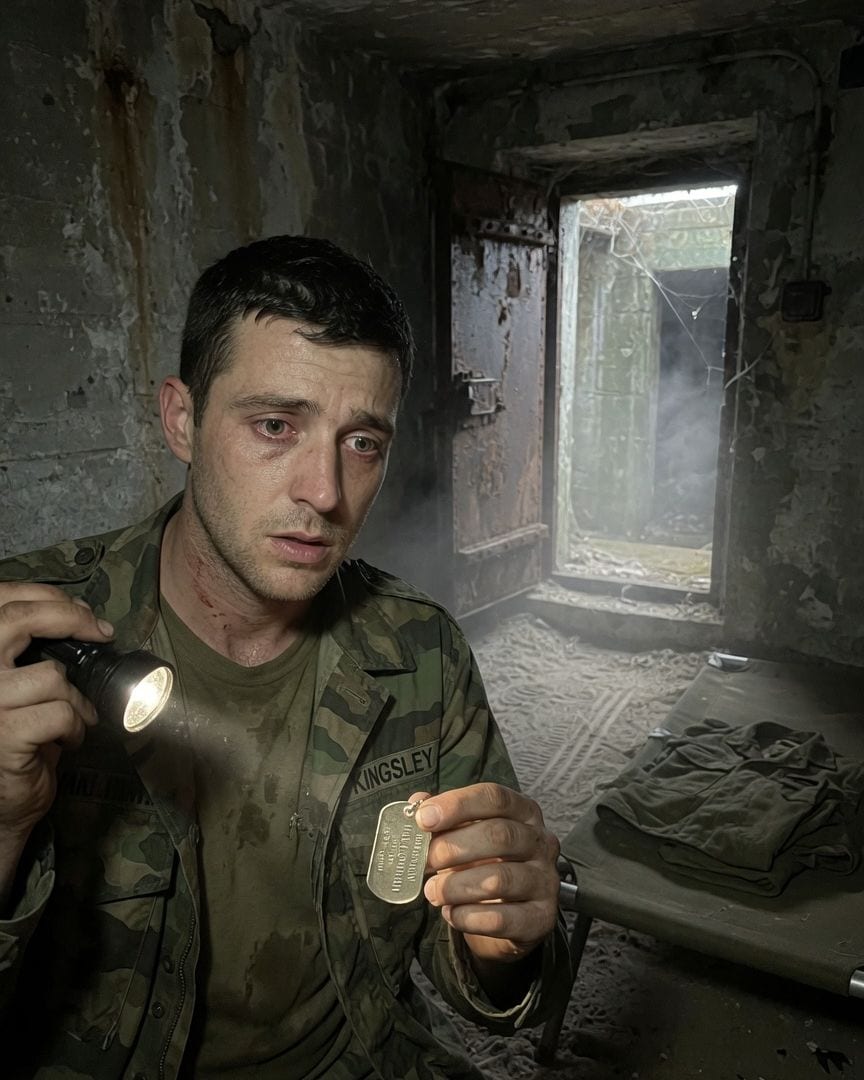
Private Roland Kingsley shivered, not from the chill of the Northern California night, but from the bone-deep weariness of a graveyard watch.
His final rotation at the reactivated WWII coast-artillery bunker was almost over, just a few more hours until dawn and the end of his three-week deployment.
He swung the massive searchlight in its slow, familiar arc over the crashing waves and the deserted beach, a routine he'd performed countless times. At 0100, the fog rolled in, thick and fast, swallowing the coastline.
As the beam cut through the swirling grey, it caught something impossible: a formation of men, silhouetted against the mist, assembling on the sand.
Their helmets were too bulbous, their rifles too long, their uniforms a heavy wool he didn't recognize from any modern doctrine. They stood perfectly still, waiting. Kingsley blinked, rubbed his eyes, and swung the light back.
They were still there, distinct, solid, and utterly out of place. He watched them for a full minute, the breath freezing in his lungs. When the searchlight passed over them again, they were gone.
He kept the beam fixed on the spot, but the fog had reclaimed the beach, leaving only the sound of surf.
He tried to rationalize it – fatigue, a trick of the light, the fog playing games – but the image was burned into his retinas. He knew what he had seen.
The rest of his watch passed in a tense, silent vigil, the beam sweeping the empty beach over and over, finding nothing but swirling mist and the endless ocean.
As dawn broke, thin and watery, the fog began to burn off, revealing the beach once more. Kingsley, still wired from his watch, focused the searchlight's last arc on the spot where the figures had stood. Nothing.
He scanned the wet sand, half-expecting footprints, half-dreading them. What he found instead, stretching from the waterline up towards the bunker's rear, was a set of deep, parallel drag-marks, as if something heavy had been hauled across the sand.
His gaze followed them, past the eroded concrete barrier, to the bunker's rear hatch. It was a heavy steel door, rusted solid and sealed decades ago by a crust of salt and corrosion, impossible to open without heavy equipment.
But now, it stood ajar, a sliver of darkness visible in the gap. Kingsley approached, weapon at the ready, his rational mind scrambling for an explanation. A prank? Unlikely, given the rust. A break-in?
More plausible, but the gear of the 'landing party' hadn't looked like scavengers. He pushed the hatch further open, the rusted hinges groaning in protest, echoing eerily in the damp concrete interior.
The air inside was cold, stale, and carried a faint, briny scent. He flicked on his tactical light, sweeping it across the cavernous space. Empty storage rooms, old equipment mounts. Nothing immediately out of place, no sign of recent entry.
Then, his beam caught it. On a low cot, tucked into a corner that he was certain had been empty yesterday, lay a neatly folded, olive-drab field jacket.
It was heavy wool, faded but intact, clearly a uniform from the WWII era, not something from the modern supply chain. He approached cautiously, his boots crunching on loose grit. He ran his hand over the pockets, feeling for anything.
In the left breast pocket, his fingers closed around something hard, metallic. He pulled it out. A dog tag. Standard issue, but old, tarnished with age.
He held it up to the beam of his light, his heart hammering against his ribs. The name stamped on it was clear: HALLORAN. Below it, a serial number from a long-deactivated unit.
He knew, with a sickening certainty, that no 'Halloran' was on the current roster. No 'Halloran' had been assigned to this bunker in any official capacity for eighty years. Yet, here it was.
Kingsley pulled the dog tag from the jacket pocket, the cold metal clinking against his thumb. The name 'HALLORAN' was stamped clearly, along with a WWII-era serial number.
He knew, instinctively, that this name was not just old; it was an impossible addition to the bunker's long, documented history, yet here it was, undeniably real in his hand.
He turned the tag over, the reverse side blank save for a faint, almost imperceptible scratch that looked like a numeral '1' followed by a small, hand-etched '0'.
He looked from the tag to the cot, then to the rusted-open hatch, a chill far deeper than the bunker's damp air settling over him. The logical explanations had all failed. This wasn't a prank. This wasn't a break-in.
This was something else entirely, something that mocked the very idea of order and accountability.
He clutched the dog tag, its cold weight a tangible link to the impossible, and felt the silence of the bunker pressing in around him, no longer empty, but waiting.
Kingsley reported his findings up the chain, meticulously detailing the landing party, the drag-marks, the open hatch, and the dog tag. His immediate superior, Sergeant Ellison, listened with a skeptical frown, attributing it to fatigue and overactive imagination.
"Private Kingsley, this bunker is a historical landmark, not an active combat zone. There's no record of any 'Halloran' being assigned here, ever, let alone a landing party."
Despite the dismissal, Kingsley was instructed to secure the hatch and continue his duties, with a note about 'potential psychological stress' added to his file. Undeterred, Kingsley spent his off-duty hours digging.
He used the bunker's limited internet access to search for Private Philip Halloran, cross-referencing the serial number with WWII rosters. He found a match: Private Philip Halloran, 1st Infantry Division, reported MIA in the Pacific Theater in 1944.
No connection to the California coast, no coast artillery assignment. The discrepancy only deepened his unease. How could a soldier lost in the Pacific have left his dog tag in a Northern California bunker, eighty years later?
He started examining other historical data for the bunker itself. The official records were sparse, mostly construction logs and decommissioning papers.
But tucked away in a digitized manifest for a supply run in 1943, he found a curious entry: 'One (1) additional personnel complement, temporary assignment, Bunker 7.' No name, just a count.
He chased this thread, looking for other vague 'personnel complements' or 'temporary assignments' that lacked specific names. There were a surprising number of them, always associated with the bunker's coordinates.
He tried to reconcile these with known units, but they never quite fit. Each time, the numbers came out wrong, or the dates were off by a few crucial days, or the personnel listed were already accounted for elsewhere.
It was the signature device, manifesting in bland bureaucratic language.
He felt a growing certainty that the 'landing party' wasn't a one-off hallucination, but a recurring event, one that the system, in its own cryptic way, was attempting to account for.
He started to compile his own list of these discrepancies, a growing file of impossible numbers and phantom assignments, each one pointing back to the isolated bunker.
Kingsley's persistent inquiries did not go unnoticed. One evening, while he was trying to access a restricted military historical database from a terminal in the bunker's repurposed comms room, the screen suddenly froze.
A message flashed across the black display: 'ACCESS DENIED. FURTHER INQUIRIES REGARDING PROJECT ECHO MANIFESTS WILL RESULT IN IMMEDIATE TRANSFER.' The message vanished as quickly as it appeared, leaving only the standard login screen. Kingsley felt a cold dread.
Someone was watching his digital trail. He tried to shake it off, but the warning was clear. He knew he was close to something. He decided to seek help, discreetly.
He remembered Captain Theresa Reynolds, a military archivist he'd met briefly during his initial processing, known for her encyclopedic knowledge of obscure records.
He sent her an encrypted message, vaguely referencing 'historical discrepancies at Bunker 7' and 'unusual personnel accounting practices.' A day later, a reply landed in his inbox: 'Meet me at the old library annex, 2100 hours. Come alone.'
The meeting was tense. Captain Reynolds, a sharp-eyed woman with a no-nonsense demeanor, initially dismissed his story as folklore. "Private Kingsley, the military is a bureaucracy built on paper. Every man, every weapon, every ounce of fuel is accounted for.
There are no ghosts in the system." But as Kingsley laid out his compiled list of impossible supply manifests, the 'additional personnel complements,' and the dog tag belonging to a soldier lost thousands of miles away, her expression shifted.
He showed her the 'Project Echo Manifests' warning he'd received. She recognized the database name. "Project Echo is… highly restricted. It's for records that are, shall we say, 'anomalous.' Only a handful of people have access."
She looked at him, a new, unsettling glint in her eyes. "You’ve stirred up something. They're watching you." The next morning, Kingsley found a small, unmarked USB drive tucked under his bunk pillow. He hadn’t heard anyone enter.
On it, a single file: 'ECHO_MANIFEST_HALLORAN.db'.
Kingsley cautiously inserted the USB into his terminal, the 'ACCESS DENIED' message still fresh in his mind. The file opened to a highly encrypted database, requiring a password. He tried his own, then a series of common military acronyms. Nothing.
Just as he was about to give up, he remembered the faint scratch on Halloran’s dog tag: '10'. He typed it in. The database unlocked. What unfolded on the screen made his blood run cold.
It was the 'Project Echo Manifests,' and it wasn't just Halloran. The system displayed a complex web of entries, cross-referencing personnel records, supply manifests, and incident reports.
For Private Philip Halloran, MIA 1944, there were impossible entries: a 'medical leave' request filed from a base in Alaska in 1952, a 'supply requisition' for winter gear in 1968 from a different California base, and even a 'transfer request' to a unit in Germany in 1975.
Each entry was accompanied by a string of classification codes, identical to the one Kingsley had seen in the warning message.
He scrolled through, finding similar impossible entries for other names – names that didn’t exist on any regular roster for Bunker 7, but whose profiles in 'Project Echo' were eerily complete.
A 'Private Lydia Foster,' reported k*lled in action in Korea, 'reassigned' to a clerical position in the 1980s. A 'Corporal Roy Thornton,' lost at sea in the Atlantic, 'detailed' to a special operations unit in the 1990s.
All linked to the coordinates of Bunker 7. The 'additional personnel complements' from the old supply manifests now made horrifying sense; they were the cover-up, the mundane explanation layered over the impossible.
The system wasn't malfunctioning; it was working as designed, meticulously accounting for the un-accountable. Reynolds arrived, looking grim. "You found it," she said, her voice barely a whisper. "The ghost in the machine. It's not a glitch, Private. It's a feature."
She explained, "These aren't individual records being tampered with. It's a parallel system. When an anomaly occurs, when one of them manifests, they get an entry here. A phantom existence, so the official numbers always 'reconcile.'" "But why?"
Kingsley demanded, gesturing at the screen. "Why go to such lengths to log people who aren't real?" Reynolds leaned closer, her voice dropping to a conspiratorial tone. "Because the military values accountability above all else. Even above sanity.
If something impossible happens, it must still be accounted for. These are the records of those who never truly left. The ones who keep trying to land." She paused, then added, "This is just one layer, Private.
There's an even deeper one. A protocol. A history. They've been watching this site, and them, for longer than anyone living remembers."
Captain Reynolds stared at the flickering screen, her face pale. She pointed to a highlighted string of code buried deep within the 'Project Echo Manifest' entry for 'Halloran.' "This isn't a glitch, Private," she whispered, her voice tight.
"This is a reference. A classification code for… non-existent personnel. It's not just Halloran. Look here." She scrolled, revealing identical codes attached to dozens of other names, all linked to the bunker's coordinates, stretching back to the 1940s.
"They've been logging them. For eighty years." Then, she pulled a small, worn leatherbound journal from her bag. Its cover was stamped with a faded insignia: 'Operation Sea Ghost.' She opened it to a page dated 1945.
"This is a field log from the bunker's original commander. He writes about the fog, the landing party, the open hatch… and the 'additional personnel' he was ordered to add to his manifest, even though he never saw them.
It’s the original entry for Private Halloran. But it gets worse. Look at the last line." Kingsley leaned in. The entry described the commander's growing distress, his certainty that the 'ghosts' were real.
The final sentence, scrawled in a shaky hand, read: 'They are not just landing. They are looking for a way in. And I think… one of them found it.' Reynolds closed the journal with a soft thud.
"The official story is he vanished without a trace a week later. But his entry in Project Echo states he was 'reassigned' to a deep-cover research project. At this very bunker. He never left. He just… changed roles."
Kingsley’s eyes widened, a horrifying implication settling over him. The 'accountability that cannot be' wasn't just for the phantom soldiers. It was for the living, too.
If the system could absorb the dead, what could it do to the living who knew too much? And if the commander was 'reassigned' to this bunker, what was his new 'role'?
Reynolds led Kingsley deeper into the bunker, to a section he’d never seen before, a reinforced vault behind a false wall. Inside, a single, ancient server rack hummed softly, its lights blinking. "This is where Project Echo originates," she explained.
"The real, physical manifestation of the impossible. This site doesn't just attract the anomaly; it processes it." She opened a heavy, steel-bound ledger beside the server. "This is the master log for 'Operation Sea Ghost.'
Instituted in 1945, after the original commander's 'reassignment.' It details every manifestation, every 'personnel complement,' every attempt by a living service member to investigate too deeply." Kingsley flipped through the yellowed pages.
Dates, coded references, and chillingly sparse descriptions filled the entries. '0100, 15 March 1946: Manifestation of 'Halloran Unit' (H-7). Standard egress via rear hatch.
Logged as 'Routine Coastal Patrol Exercise (RCPE).' '0100, 22 September 1958: 'Foster Unit' (F-12) observed attempting entry via main gate. Dispersed by 'Environmental Hazard Protocol' (EHP). Logged as 'Minor Seismic Event (MSE).'
Each entry confirmed his initial sighting, the drag marks, the open hatch, the dog tag.
The 'landing party' wasn't just trying to land; they were a recurring phenomenon, meticulously documented and managed by a military establishment determined to maintain its perfect record, even if it meant distorting reality.
The ledger even detailed the 'reassignment' of the original commander, his name now listed as 'Project Lead (Observation & Integration).' "They don't just log them, Private," Reynolds said, her voice heavy. "They observe them. They study them.
And they protect the secrecy of it all. The system cannot tolerate an unaccounted for anomaly. So they account for it, no matter how impossible." The full horror of the pattern across rotations and dates became clear.
The military wasn't fighting these ghosts; it was assimilating them, and anyone who discovered their existence, into its own impenetrable logic. The bunker wasn't just a point of entry; it was a processing center.
As Kingsley absorbed the decades of impossible truth, the bunker's internal alarm blared, a piercing, insistent sound. Red emergency lights flickered on, casting long, menacing shadows. "They know we're in here," Reynolds said, her hand going to her sidearm.
"The system is protecting itself." Footsteps echoed down the concrete corridors, approaching rapidly. Kingsley knew they wouldn't be met with a friendly welcome.
He had a choice: surrender to the system that absorbed inconvenient truths, or try to escape with the knowledge.
"We need to get out," he urged, pulling Reynolds towards a smaller, unmarked utility tunnel she had pointed out earlier as a possible escape route. They scrambled through the narrow passage, the sounds of approaching boots growing louder behind them.
The tunnel opened into a hidden alcove overlooking the beach, a small, camouflaged hatch built into the cliff face. Below, the waves crashed, and the first hints of dawn painted the sky.
Just as Kingsley reached for the latch, a voice boomed from behind them. "Hold it right there, Private Kingsley!" Sergeant Ellison, flanked by two armed MPs, stood at the tunnel entrance, his face grim. "You're in violation of security protocols.
Stand down." Reynolds, seeing the trap, pushed Kingsley forward. "Go! Get out! Tell someone!" He hesitated, but the urgency in her eyes, and the glint of the MPs' weapons, spurred him. He unlatched the hatch, the salt-crusted metal groaning.
As he slipped out, he saw Ellison grab Reynolds, pulling her back into the tunnel. Her eyes met his for a split second, a silent plea.
He scrambled down the cliff face, the sounds of a struggle and muffled shouts fading behind him. He didn't look back.
He ran along the beach, desperate to put distance between himself and the bunker, the truth he carried a burning weight in his mind. He was free, but the knowledge was a brand.
The military machine, built on order and accountability, had simply absorbed another anomaly, another inconvenient truth, another dissenting voice. He was just another witness who got out, but the system remained, unbroken, watching.
Kingsley made it to the nearest civilian town, disoriented and shaken, his uniform sandy and torn. He reported his story to local authorities, who, after a brief, bewildered interview, quickly handed him over to military police who had been dispatched.
He was debriefed extensively, his account dismissed as a severe stress-induced hallucination, compounded by fatigue. His transfer was expedited, not to the new posting he'd hoped for, but to a remote, administrative desk job far from any active duty.
Captain Reynolds officially vanished, her records stating a 'voluntary reassignment to an undisclosed research facility.' The bunker was quietly decommissioned, its reactivated status revoked, its rear hatch welded shut with fresh, impenetrable steel.
The 'Project Echo Manifests' and 'Operation Sea Ghost' ledger were never mentioned again. Kingsley carried the weight of it all, the knowledge a silent, invisible burden. He knew what he had seen, what he had uncovered.
He knew what the military knew. And he knew that the system had simply closed ranks, absorbing the truth, and him, into its impenetrable silence.
Years later, Roland Kingsley sat alone in his small apartment, far from the ocean. He held a tarnished dog tag, its surface worn smooth. He never spoke of the bunker, or the landing party, or Captain Reynolds.
He lived a quiet, unremarkable life, always looking over his shoulder, always checking the numbers, the rosters, the manifests for any discrepancy, any impossible entry. He knew it was futile.
The system was too vast, too meticulous, too perfect in its imperfection. He was a survivor, but he hadn't escaped the truth. It was simply part of him now, a secret knowledge that altered his perception of the world.
One night, a news report briefly mentioned a rare, heavy fog rolling in over the Northern California coast, delaying shipping traffic and obscuring the old headlands.
Kingsley watched, his breath catching in his throat, a cold certainty settling in his bones. He knew what the fog would hide, and what it would reveal. He knew they were still trying to land.
He knew the system would simply account for it. He set the dog tag down. The numbers always had to reconcile.
If this one got to you
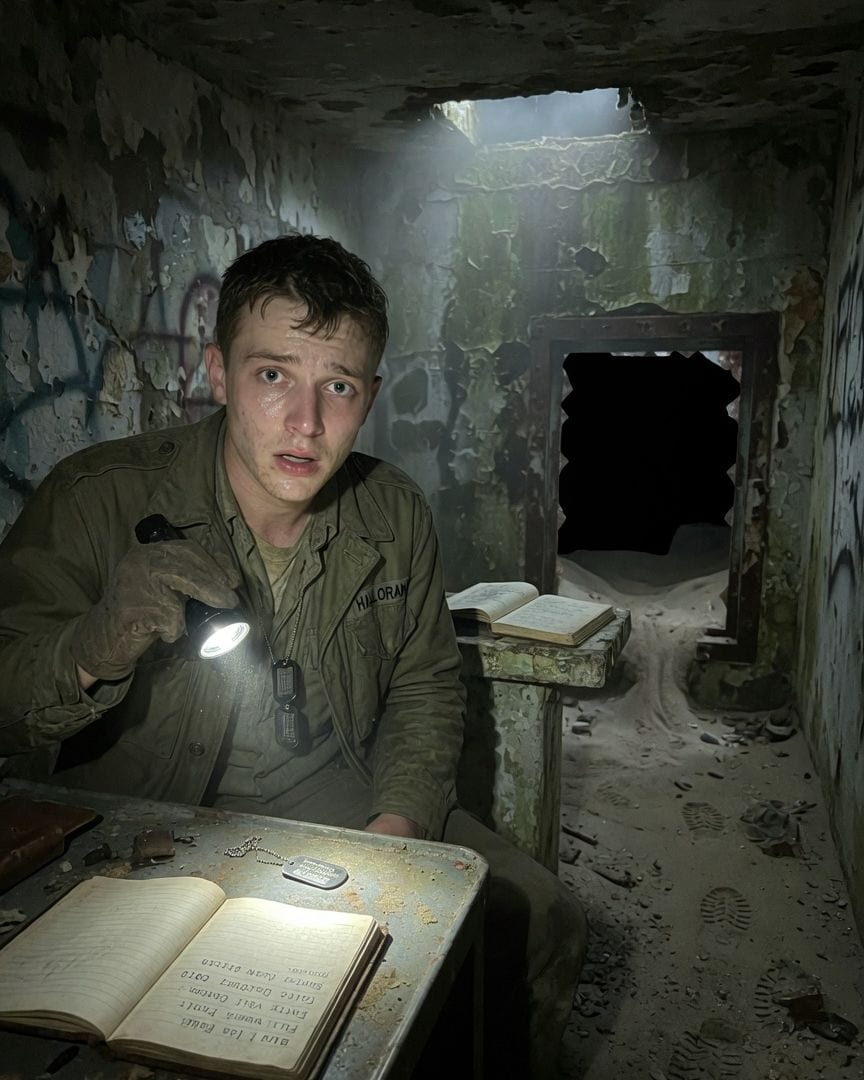
On his last lonely watch, a young private found the decades-sealed bunker hatch gaping open, with a logbook confirming an impossible landing.
Private Frank Halloran shivered through his final graveyard watch at a disused WWII bunker on a lonely California headland, just two days from his transfer. At 0100, a thick fog swallowed the ocean, and through the swirling gray, figures in archaic gear coalesced on the beach below, silent and waiting. By dawn, the beach was empty, but the bunker's rear hatch, sealed for decades, now stood gaping open, leading to a logbook entry confirming an impossible landing party at that exact hour. Inside, Private Halloran found fresh boot prints leading into the winding darkness, culminating in a hidden room holding his superior officer's modern dog tag.
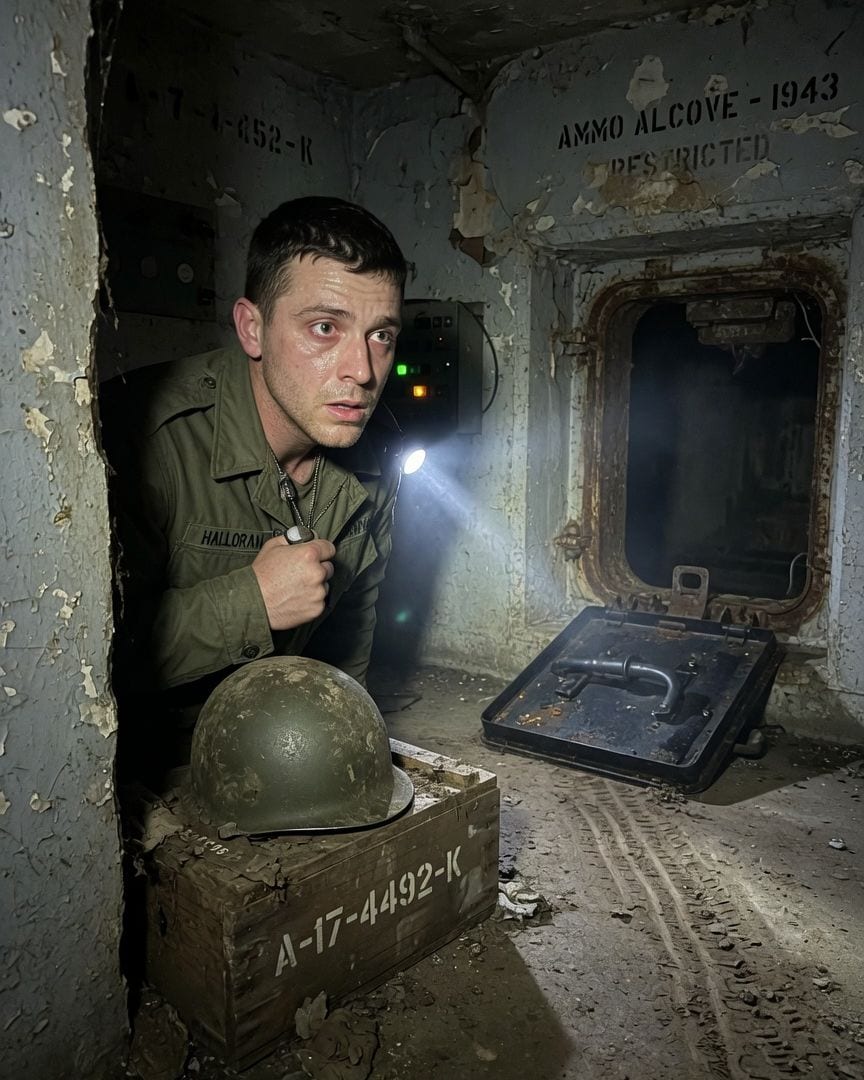
A coastal sentry on his last watch found the bunker's decades-sealed hatch ripped open by impossible strength.
Private Daniel Halloran shivered through his final hours on watch at the old WWII coast-artillery bunker, counting down to his discharge and going home. The pre-dawn fog rolled in thick, and through its swirling white, he watched a landing party form on the beach below, their outdated gear impossibly clean, their forms unmoving. After dawn burned off the mist, the beach was empty, but up the embankment, the bunker's rear hatch—sealed for decades—stood violently ripped open, its locking bar twisted. Inside the dark, silent chambers, Daniel's flashlight found a mud-caked military helmet, unlike any he'd ever seen, bearing a faded serial number that felt sickeningly familiar.
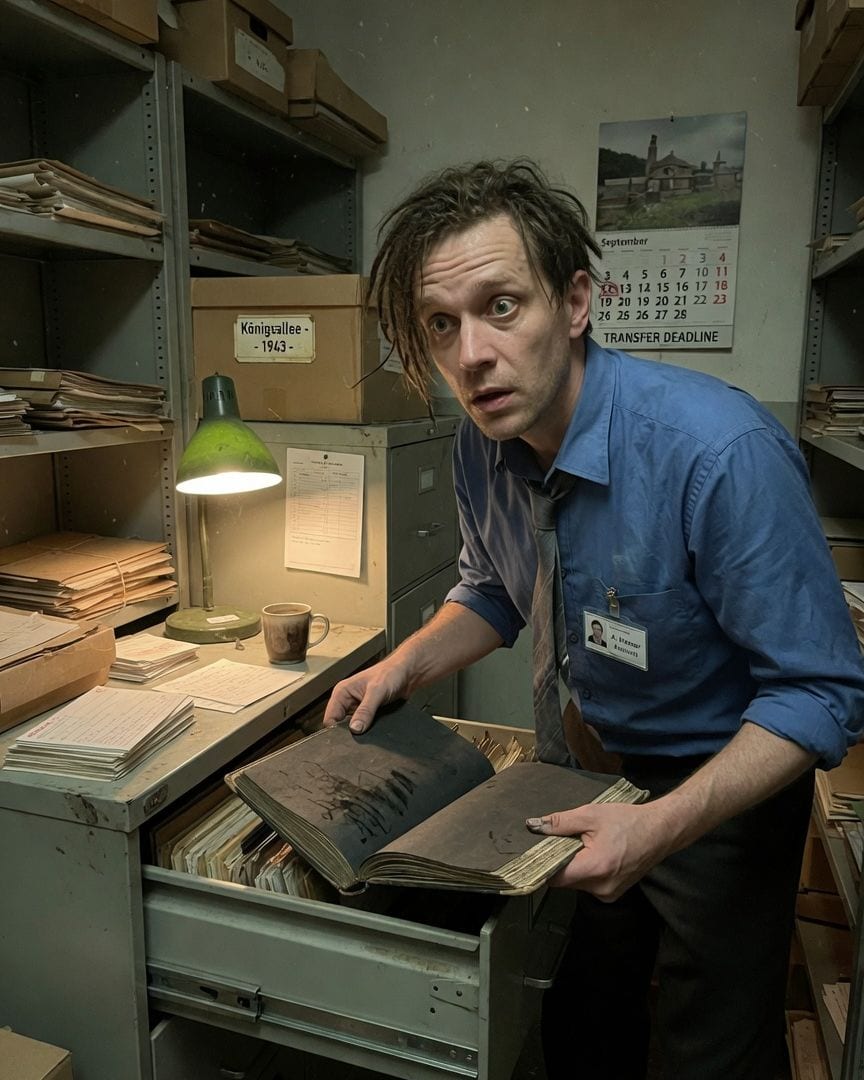
A Berlin archive researcher races a deadline. A hidden log for a Cold War barracks on a vacant lot has ink still wet from last month.
Ansel Vidmar, a methodical researcher, felt the pressure of a looming deadline. The municipal transfer of the old Berlin archive was days away, and he still had countless documents to categorize amidst towering stacks of forgotten history. His focus narrowed to an unindexed metal cabinet, revealing records for a garrison company at Königsallee – an address that had been a vacant lot since the war. A punishment log inside listed an entry from 1983, a date far too recent for a non-existent building. When Ansel visited the site, he found only overgrown grass, save for a single, eerily clean concrete doorstep emerging from the earth. His unease solidified into dread when he later uncovered a hidden Quartermaster's Log, meticulously detailing supplies for the same barracks, with entries extending to "last month," the final page's ink still faintly wet. What unseen operations were still being maintained?
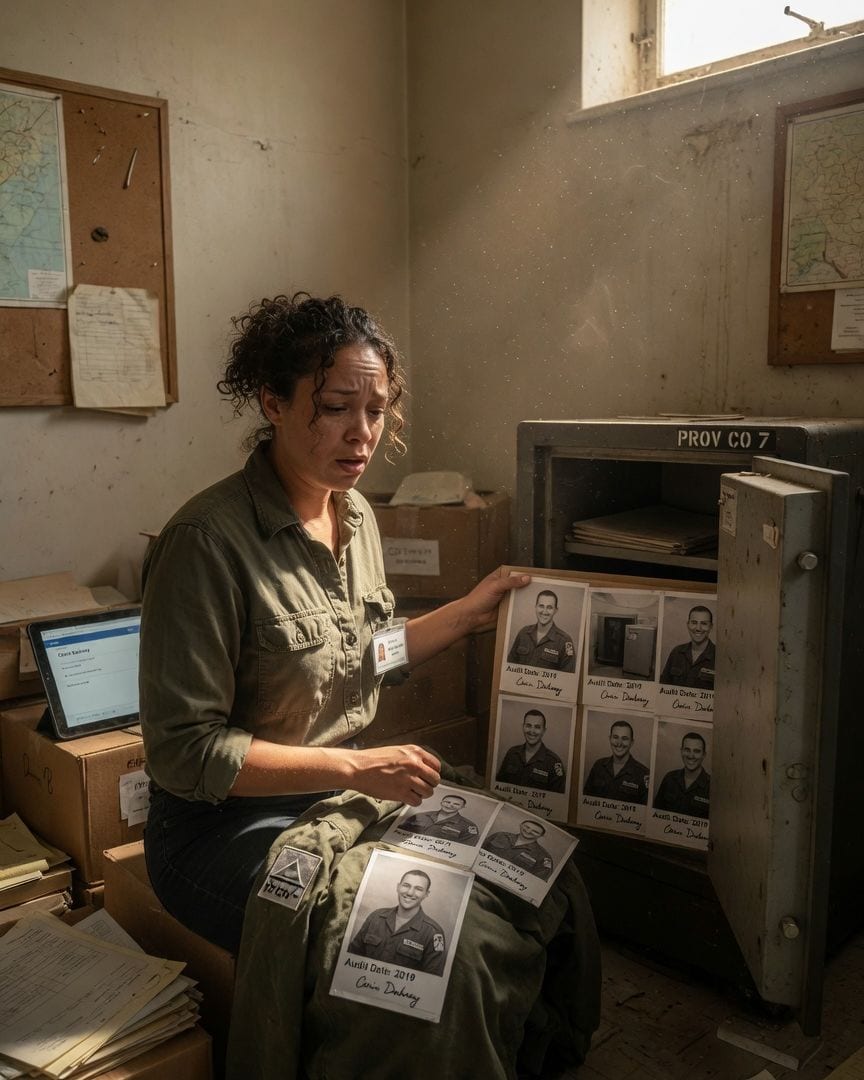
With eight days to clear a Cold War fort, Corin Calloway found files signed 'Corin Dabney' from 2019.
With just eight days left before Fort Halloway was gutted by demolition crews, Corin Calloway worked to clear half a century of forgotten lives from its dusty archives. As she meticulously sorted through records, she discovered an old, unlisted safe, its pitted door stenciled with a phantom designation. Inside, Corin found seven personnel jackets, each dated '2019' and signed with the name 'Corin Dabney.' But Corin Calloway knew she had never set foot in the building before this week, and the name 'Corin Dabney' existed nowhere in the base's official history. What secret was Fort Halloway's forgotten safe trying to reveal?
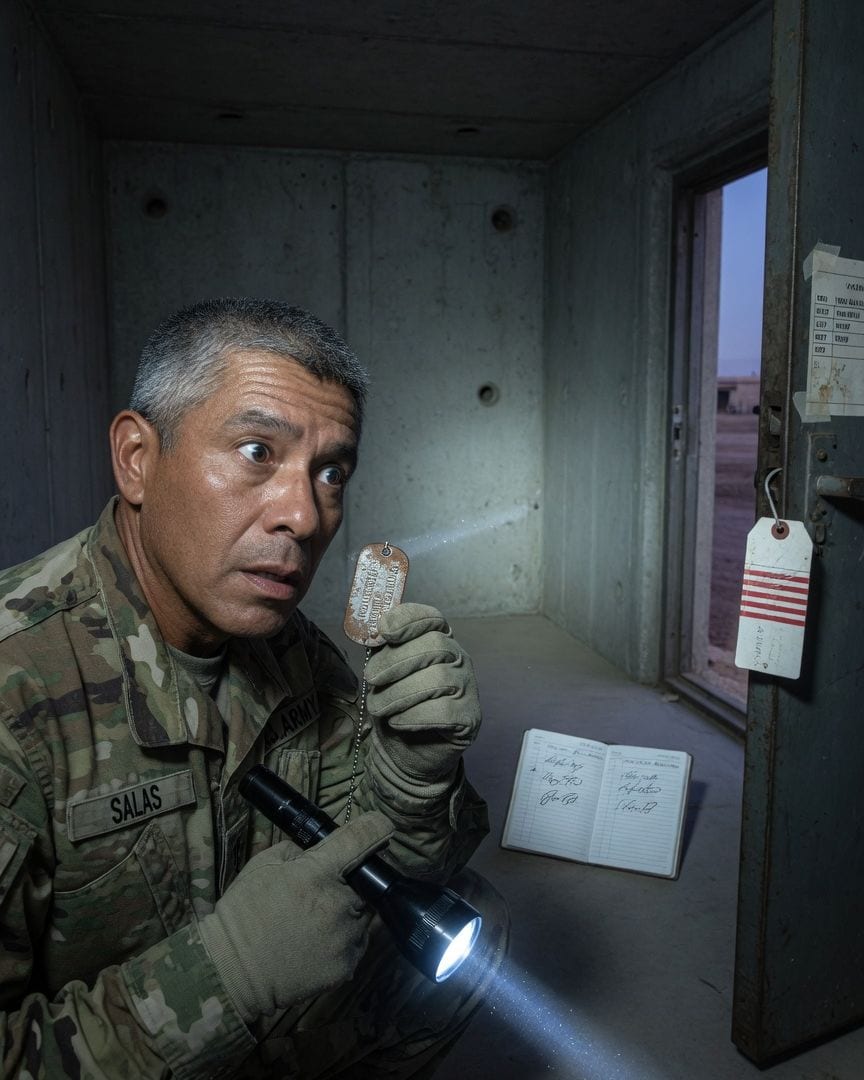
An inventory officer found a bunker's log of soldiers, then found one of their dog tags marked 'KIA, 1970'.
Chief Warrant Officer Gideon Salas meticulously oversaw the Hawthorne Ammunition Depot's inventory, racing against its final closure in two weeks. The high desert winds whipped dust across the familiar igloos as he worked, each bunker accounted for, until he reached the eastern perimeter. There, an extra igloo, Bunker 40, stood with a current lock and seal, though it wasn't on any map. A duty log propped open nearby listed inspections signed by men the Army swore didn't exist. His gut, honed by decades of service, churned with unease; inside the empty bunker, his flashlight found a corroded dog tag bearing one of those names, marked 'KIA, 1970'.
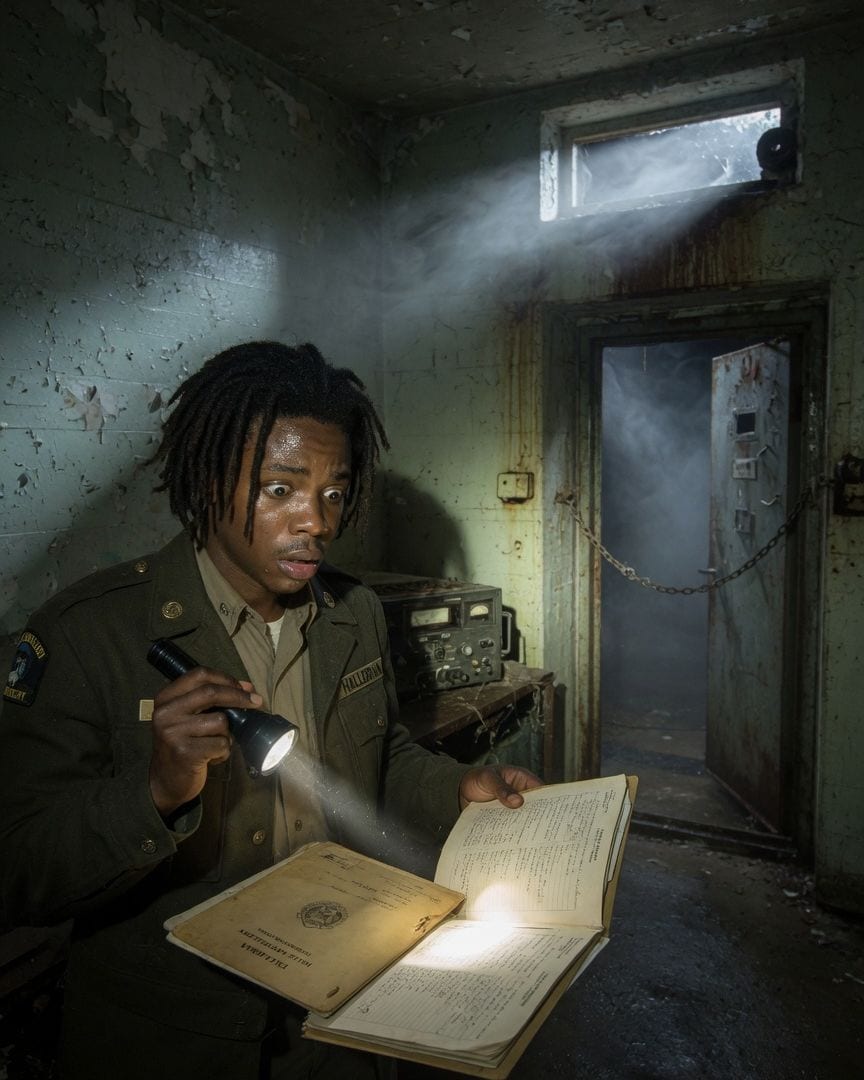
On his last shift, a coast sentry finds his own name signed in fresh ink on a 1943 army record, dated exactly one year ago.
Private Roy Halloran counted the final hours of his last watch behind the searchlight of an old, rust-tinged artillery bunker on the northern California coast. His monotonous graveyard shift was nearly done, and his transfer close, but at 0100, the swirling coastal fog revealed a silent landing party of men on the beach, their gear anachronistic and alien. When dawn burned off the mist, the beach was empty, yet faint drag marks led directly to the bunker’s long-sealed rear hatch, now mysteriously ajar. Inside, amidst the cold, acrid air, he discovered a pristine 1943 army service record bearing his own name. A freshly signed entry dated exactly one year ago to the day left him wondering: had the past somehow reached out to claim him?