With eight days to clear a Cold War fort, Corin Calloway found files signed 'Corin Dabney' from 2019.
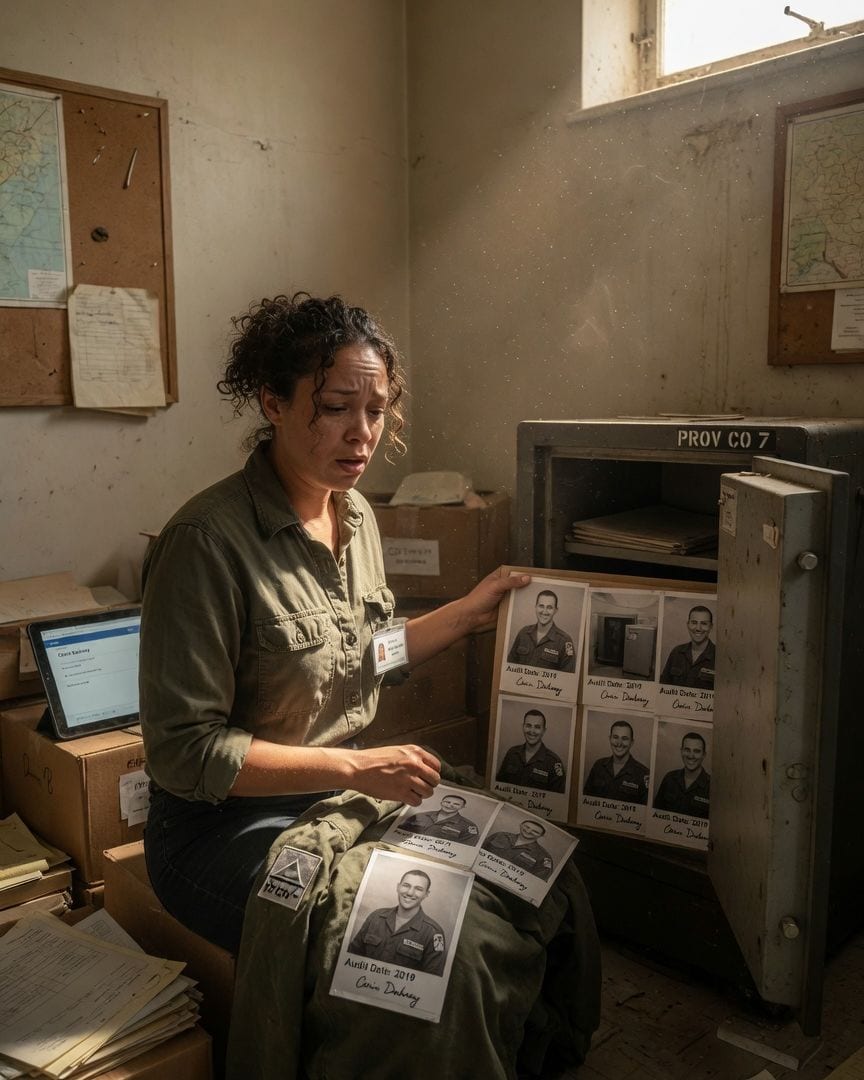
Corin Calloway had eight days. Eight days to clear half a century of forgotten lives from Fort Halloway’s archives before the demolition crews moved in to gut the building.
Dust motes danced in the single shaft of late afternoon sun piercing the high window, illuminating the thick, lingering scent of old paper and mildew.
At 32, Corin prided herself on her meticulous efficiency, but the sheer volume of unsorted records felt like a personal challenge. She worked methodically, sorting boxes, stacking binders, ticking off item after item on her digital manifest.
Her deadline loomed, a constant hum in the back of her mind.
She nudged aside a stack of moldering discharge papers in a far, neglected corner and found it: an old, heavy safe, squat and gray, almost swallowed by the shadows.
No designation on the manifest, no record in the base’s inventory system. Stenciled roughly across its pitted door, in faded white paint, were the letters ‘PROV CO 7’. Corin frowned.
She’d spent weeks reviewing Fort Halloway’s entire operational history, its wartime deployments, its training programs, its various code names. ‘PROV CO 7’ appeared in no official lineage, no historical document, no supply chain record.
Just a phantom designation on a forgotten safe.
Dismissing it as some long-abandoned, unofficial project—a misfile, or perhaps a unit too obscure to be documented—she tried the handle. To her surprise, it turned with a soft click.
The heavy door swung open, revealing not a void of empty shelves, but seven identical personnel jackets, each neatly secured with a brass clasp. They were stacked upright, the photos on their covers all facing outward.
Corin pulled out the first jacket. On its cover, a grainy black-and-white photo showed a man in a crisp, unfamiliar uniform, a wide, unnerving smile plastered across his face.
On his shoulder, a patch Corin had never seen: a stylized, impossible geometric shape. Beneath the photo, a typed line read: ‘Audit Date: 2019’. And below that, a signature, bold and looping: ‘Corin Dabney’.
Corin froze. Her breath caught in her throat. Her own name. Corin Calloway. She checked her base ID, still clipped to her shirt pocket: Corin Calloway.
She knew, with chilling certainty, that she had never set foot in this building before Monday. Not in 2019, not ever.
Her hands trembled as she went through all seven jackets. Each one held a different man, but the details were unnervingly consistent. They all wore that same strange, unknown patch on their shoulders.
They all smiled in the exact same unnerving way, a flat, vacant expression that seemed to stretch their faces.
Every photograph, she noticed, was taken in what looked like the very same room she now occupied, with the same faded paint on the walls, and behind them, unmistakably, the squat gray safe itself.
And every single jacket was dated ‘2019’, each one signed ‘Corin Dabney’.
She tried to rationalize it, her mind scrambling for a mundane explanation. A common name, perhaps? A bizarre clerical error, stretched across seven identical files?
Some elaborate, deeply unsettling prank by a departing base historian, designed to mess with their replacement? The possibilities felt thin, like stretched rubber.
Corin pulled up the base’s personnel records on her tablet, her fingers flying across the screen. She searched for any ‘Corin Dabney’ who had ever worked at Fort Halloway—nothing.
Not a single record, not a former employee, not even a civilian contractor. The name simply didn’t exist in the official system. Then she searched for the names of the men in the jackets.
They were all there, officially listed as ‘transferred’ or ‘retired’ years ago. But their service records were unusually sparse, almost blank, lacking the usual commendations, assignments, and training logs. It was as if their careers had simply… ended.
A cold dread began to settle in her stomach, a leaden weight. She researched the patch, frantically running image searches, cross-referencing military insignia, even obscure contractor logos. Nothing.
The stylized, impossible geometric shape didn't correspond to any military unit, any known organization, or even any historical artifact she could find. This wasn't a mistake; it was a deliberate, unsettling record, meticulously constructed to defy explanation.
This wasn't just a misfile. This was a secret.
Corin returned to the safe, her heart pounding a frantic rhythm against her ribs. She meticulously re-examined the jackets, a growing unease making her hands unsteady.
The sixth jacket felt slightly heavier than the others, a subtle imbalance she hadn't noticed in her initial, rattled inspection. She pulled it out again, turning it over, feeling the added weight beneath the stiff cardstock.
Inside, beneath the standard personnel form, she found not a photograph, but a single, brittle, glossy 8x10 print. It was a still frame, grainy and dark, from what looked like a gun camera.
The image showed a vast, dark expanse—ocean or perhaps even sky—and in the center, a distorted, metallic form, impossible to identify. It seemed to be turning, its featureless surface reflecting the lens in a dull gleam.
A faint date stamp in the bottom left corner read: 1987. Below it, a set of coordinates. And in the very bottom right, almost obscured by the frame's edge, a tiny version of the unknown patch.
Using the base’s antiquated mapping system, Corin cross-referenced the coordinates from the gun-camera frame.
They pointed to an isolated patch of ocean off the coast of Maine, a desolate area historically known for a spike in unexplained disappearances of fishing vessels and small aircraft in the late 1980s.
She dug deeper, sifting through digitized archives, unearthing declassified reports from that era. Phrases jumped out at her: ‘unidentified aerial phenomena,’ ‘unexplained radar contacts,’ ‘search and rescue operations terminated without success.’
Not a single mention of ‘PROV CO 7,’ of course.
A chilling pattern began to emerge. The dates of these disappearances, clustering around 1987 and 1988, aligned eerily with the ‘transfer’ dates of some of the men in the jackets, though their official records were frustratingly vague.
The reports were thin, almost sanitized, as if scrubbed clean of anything too specific or too revealing.
Corin felt a growing dread tighten its grip—this wasn't about lost records, but records that were deliberately created to obscure a truth, designed to leave just enough of a trail to lead someone, like her, down a rabbit hole of dead ends and unanswered questions.
She tried to contact Deborah Sinclair, the previous base historian, hoping she might have some insight into ‘PROV CO 7’ or the bizarre patch. Sinclair’s contact information, however, was outdated, leading only to a disconnected line that hummed with emptiness.
As Corin worked late into the night, the records room felt colder than before, larger, the shadows stretching and shifting around her as the overhead fluorescents flickered weakly.
She heard faint, rhythmic clicking sounds from the old ventilation system above her head, like someone else was moving through the ducts, listening.
She dismissed it, trying to rationalize the unease as the building settling, an old structure groaning under the weight of decades of disuse and decay.
Her fingers, still sore from prying open the safe, brushed against a stack of old maintenance logs for the records room itself. One entry, dated 2019, caught her eye. It mentioned ‘routine audit of secure archive, PROV CO 7.’
Below the description, a signature. There it was again, scrawled in unmistakable looping script: ‘C. Dabney.’ Corin’s stomach clenched, a knot of icy fear. It wasn't just on the jackets.
The ghost of her own name was actively documenting the very room she now inhabited, years before she arrived.
Later, as she prepared to leave for the night, she received an anonymous email. The subject line was blank, the message stark and unpunctuated: ‘Some files are best left buried Calloway You have a deadline.’
No sender, no traceable IP address. Her heart pounded against her ribs. Someone knew exactly what she’d found, and they were watching her.
Corin, unnerved and profoundly shaken by the anonymous email, decided she couldn't ignore it any longer. She strode through the quiet halls of Fort Halloway and confronted her superior, Base Commander Joel Bishop, 55, in his office.
She told him about the PROV CO 7 safe and the strange occurrences, her voice tight with a desperate urgency.
Bishop, a man whose default setting was jovial pragmatism, initially waved off her concerns. “Calloway, you’re under a lot of pressure with this demolition. Probably a prank. Some old timer had too much time on his hands.”
He chuckled, but the sound was thin, lacking its usual warmth.
“A prank?” Corin pushed, her patience wearing thin. She laid the gun-camera frame on his desk, the impossible metallic shape glaring up at them. Then she showed him the distinctive patch, drawn roughly on a notepad.
“This isn’t in any military database, Commander. And this.” She pushed the audit log, open to the 2019 entry, across his desk. “’Routine audit of secure archive, PROV CO 7.’ Signed ‘C. Dabney.’ My name, sir.
But I wasn’t here in 2019.”
Bishop’s genial demeanor hardened, the chuckle dying on his lips. He picked up the gun-camera frame, then the notepad with the patch. A flicker of something – fear, recognition – passed through his eyes, so fleeting Corin almost missed it.
He cleared his throat.
“Right. ‘PROV CO 7’.” Bishop leaned back in his chair, his posture subtly stiffening. “That was… an unofficial, highly classified project. Long since disbanded, Calloway.” He paused, picking at a loose thread on his uniform.
“It dealt with… unconventional asset recovery. The personnel jackets were… cover identities. For agents involved in sensitive operations. Nothing for you to worry about.”
He met her gaze, his eyes unwavering, but Corin saw the lie in them, the subtle shift in his shoulders that tightened just a fraction too much. “Sir, the men in those jackets have almost no service history.
And the coordinates on this photo point to a major incident zone for disappearances in the late eighties.”
Bishop’s voice took on an edge of command. “My advice, Calloway, is to drop it. This fort is being decommissioned in eight days. Focus on your job. That’s your priority. Anything else is a distraction.”
He tapped the audit log with a finger, then the gun-camera photo. “As for the signature… there was a historian, a C. Dabney, who worked here years ago. Transferred. I don’t know the details.”
His explanation felt forced, his eyes avoiding hers. He tried to steer her away, to distract her with other tasks, detailing a new inventory list he needed immediately.
But Corin knew. The ‘disbanded’ program was clearly still active, and Bishop was complicit in its secrecy. His casual mention of ‘asset recovery’ now sounded like a chilling euphemism for something far more sinister than retrieval—it implied taking, not finding.
Corin, now certain Bishop was involved and desperate for answers, returned to the safe. Her determination overriding her mounting fear, she approached the cold steel, her eyes scanning every inch of its surface.
This time, she noticed a faint, almost invisible seam in the steel lining the back of the safe, a detail she'd missed in her initial, rattled inspections. It was barely perceptible, a hairline crack against the dull gray metal.
Prying at it with the flat, dull edge of a letter opener she found on a nearby desk, a section of the back plate gave way with a soft, metallic click. It wasn't a hinge, but a release.
The small panel swung inward, revealing a shallow, hidden compartment, barely deep enough to hold a single document. Her breath caught, a gasp trapped in her throat.
Inside, tucked neatly into the recess, was a single, sealed manila envelope. The front was stenciled with the exact same block lettering as the safe itself, stark and unsettling: ‘PROV CO 7 - C. CALLOWAY - ACTIVE.’
Her own name. Corin Calloway. Active.
Her hands trembled violently as she tore open the seal, the paper rasping loudly in the sudden silence of the records room.
Inside was a personnel jacket, identical in every detail to the seven she had found earlier, down to the stiff cardstock and brass clasp.
And clipped to the inside cover, her own base ID photo, taken just last month, her hair pulled back, a faint, professional smile on her face.
Below it, typed in stark, chilling clarity, was a line of text: ‘Projected Transfer Date: [8 days from now].’
Corin stared at her own personnel jacket, the photo of her smiling back with a chilling echo of the men in the safe. Her own face, looking back at her from within the ominous ‘PROV CO 7’ file.
The ‘Projected Transfer Date’ was the very day Fort Halloway was scheduled to be gutted, the same deadline she’d been working towards. Eight days from now.
The realization hit her with the force of a physical blow.
The ‘Corin Dabney’ who signed the audit logs in 2019 wasn’t a different person; it was a previous iteration of herself, or a future self, somehow folded into the system, into the very fabric of this place.
The name was a pre-file, a placeholder. A marker.
The ‘PROV CO 7’ program wasn't about recovering assets in the traditional sense; it was about identifying, tracking, and ‘filing’ individuals who had had close encounters with the ‘Thing on the Scope’—that impossible metallic form in the gun-camera frame.
These individuals were then either integrated into its unseen network, their existence replaced, or erased entirely from conventional reality. The ‘audits’ were a continuous process of maintaining the archive of those absorbed, a predictive system ensuring the cycle continued.
The men in the photos were not agents, but the first subjects, their unsettling smiles a sign that they were already ‘filed,’ their true selves gone, their records maintained by the very entity that took them.
The fort’s decommissioning wasn't just a closure; it was a final processing event, a purge of remaining loose ends, including her. She was the next ‘file,’ her destiny meticulously recorded before she even arrived at Fort Halloway.
She had walked right into it, following the path already laid out for her.
Corin shoved her jacket back into the hidden compartment, the file feeling cold and alien beneath her fingers. Her heart pounded a frantic drum against her ribs, a frantic rhythm of panic and adrenaline.
She snatched the gun-camera frame and one of the original personnel jackets, clutching them like talismans – her only proof. She had to get out, now.
Heavy, deliberate footsteps echoed in the hall, approaching the records room door. Bishop. He called her name, his voice tight with a controlled fury, no longer jovial. “Calloway? Are you in there? I told you to leave those files alone.”
Corin glanced wildly from the heavy safe to the main door, then to the far end of the room. There was a back exit, a rarely used service stairwell, its rusted door a faint beacon of hope.
She lunged for a heavy, wheeled filing cabinet, its drawers stuffed with antiquated records. With a grunt, she shoved it against the main door just as Bishop tried the handle from the outside.
The cabinet scraped loudly, a screech of metal on linoleum, momentarily blocking the entrance. It would buy her precious seconds.
She scrambled for the stairwell door, her movements clumsy, the heavy documents thumping against her chest with every frantic step.
She yanked the door open and burst out into the cool, deserted night air, the smell of damp earth and distant salt water filling her lungs.
Running across the gravel lot of the base, the distant lights of the main gate seemed impossibly far, her only hope. She could hear Bishop shouting her name again, closer now, his heavy footsteps pounding after her.
She didn't look back, adrenaline coursing through her veins.
She made it to her car, fumbling desperately for the keys, her hands shaking so violently she almost dropped them.
The engine roared to life just as Bishop rounded the corner of the building, his face a mask of grim determination, his uniform dark against the fading light.
He saw her, raised a hand as if to stop her, but she slammed the car into reverse, then drive, tires squealing on the gravel. She sped out of the fort, a ghost of a shadow in her rearview mirror.
Corin drove for hours, the old base disappearing behind her, a blur of forgotten secrets. She eventually pulled into a nondescript motel parking lot far from Fort Halloway, miles inland from the coast.
She checked into a room, the sterile air conditioning a contrast to the musty records room.
She placed the gun-camera frame and the personnel jacket carefully on the bed beside her, the only tangible proof of the nightmare she had just escaped.
She spent the next few days trying to call federal agencies, local police, even a few investigative journalists she found online. Each call was met with polite skepticism, then outright dismissal.
The evidence she presented was too bizarre, too disconnected, too easily explained away as a hoax or the ravings of a delusional, disgruntled employee.
Bishop’s official report, she knew, would undoubtedly brand her as unstable, her account dismissed as a stress-induced breakdown. Her career, her entire professional life, was over.
Weeks later, Corin Calloway lives under a new name, in a small, anonymous town nestled deep in the interior, always looking over her shoulder.
She keeps the gun-camera frame and the jacket in a locked box beneath her bed, tangible proof of a truth no one will ever believe, a constant, chilling reminder of what she escaped. Or what she thought she escaped.
One quiet evening, as the sun set, casting long shadows across her rented room, she got an unexpected email. It was from an unknown sender, just a single image attached, no subject, no message.
Her hand trembled as she opened it.
It was a photo of a woman, smiling faintly, standing in front of an unfamiliar, rusty safe, its stenciled designation obscured by shadows. The woman was wearing a patch Corin had never seen before.
The woman in the photo is Corin.
If this one got to you
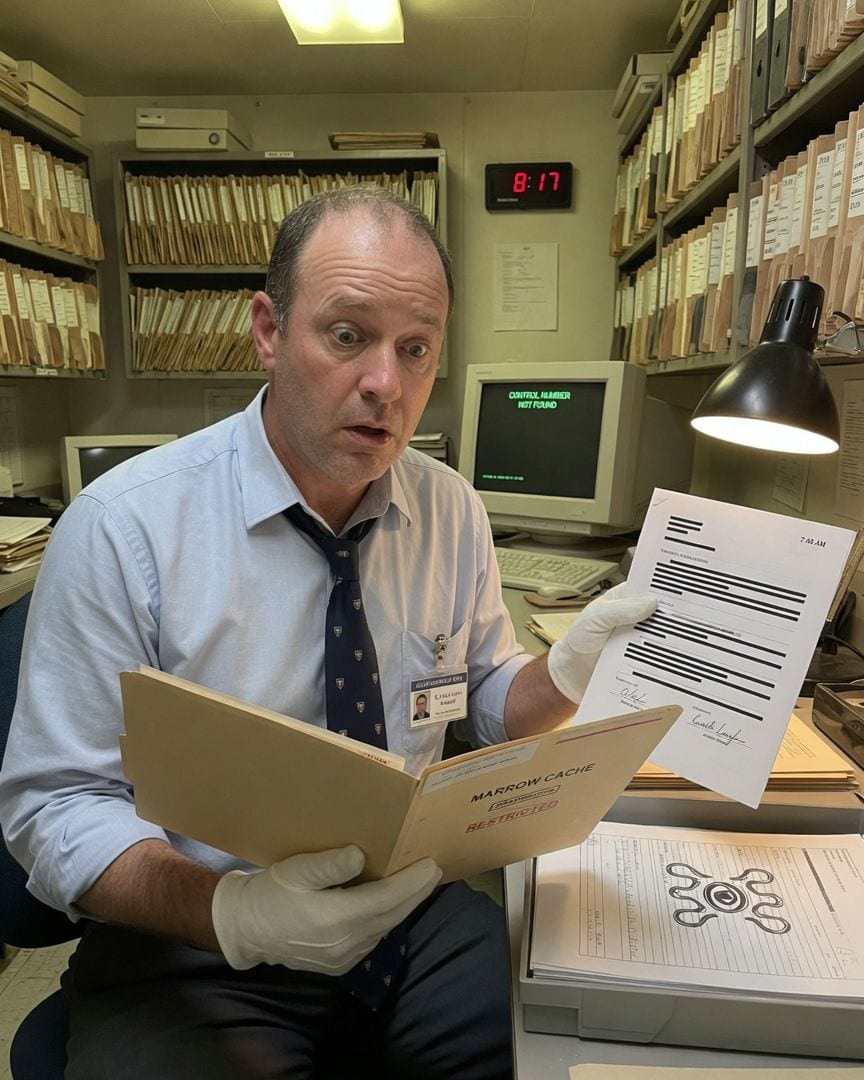
A records manager found a file extension signed at 7:48 AM. He hadn't clocked in yet, and a strange symbol pulsed in its redacted pages.
Corwin Vale, lead records manager for Fort Ruthven, lived by routine, his world precise and ordered. This morning, however, that order shattered when he found the Marrow Cache file's extension signed at 7:48 AM. Corwin had not clocked in until 8:00 AM, and the vault logs showed no other entry. As he reviewed the heavy file, he discovered its control number did not exist in any database. Then, deep within the redacted pages, a strange, geometric symbol pulsed faintly, an alien glyph etched into the classified paper. What impossible secret did the file hold?
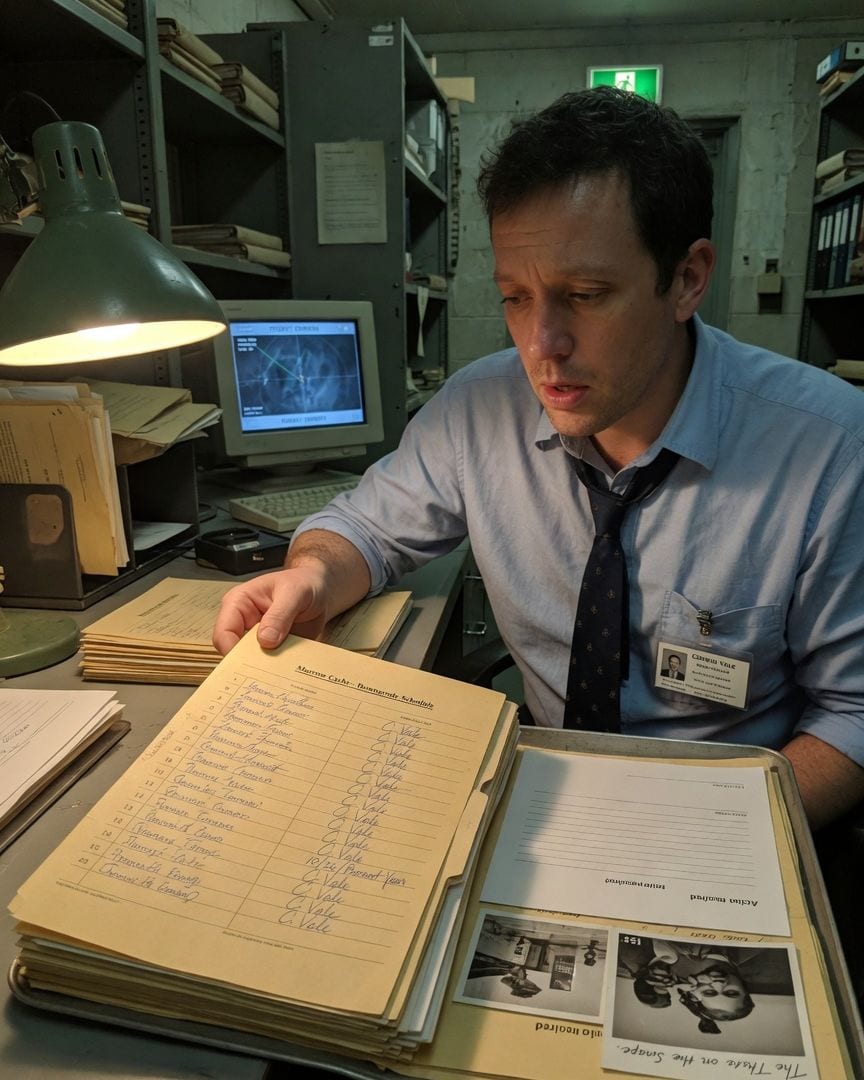
Chief Archivist Corwin Vale found his own signature on a Cold War vault log, dated 1988. He was years from even working there.
Chief Archivist Corwin Vale aimed to unravel the bureaucratic enigma of the Marrow Cache file, perpetually extended since 1972. In the cold, ozone-scented vault of Fort Ruthven, he sought to discover who was signing off on the endless delays. His breath hitched when he found his own signature on the log, dated this very morning, despite being home sick. But then, a chilling discovery: another identical signature, dated 1988, years before he was even employed. What impossible hand was tracing his name through time?
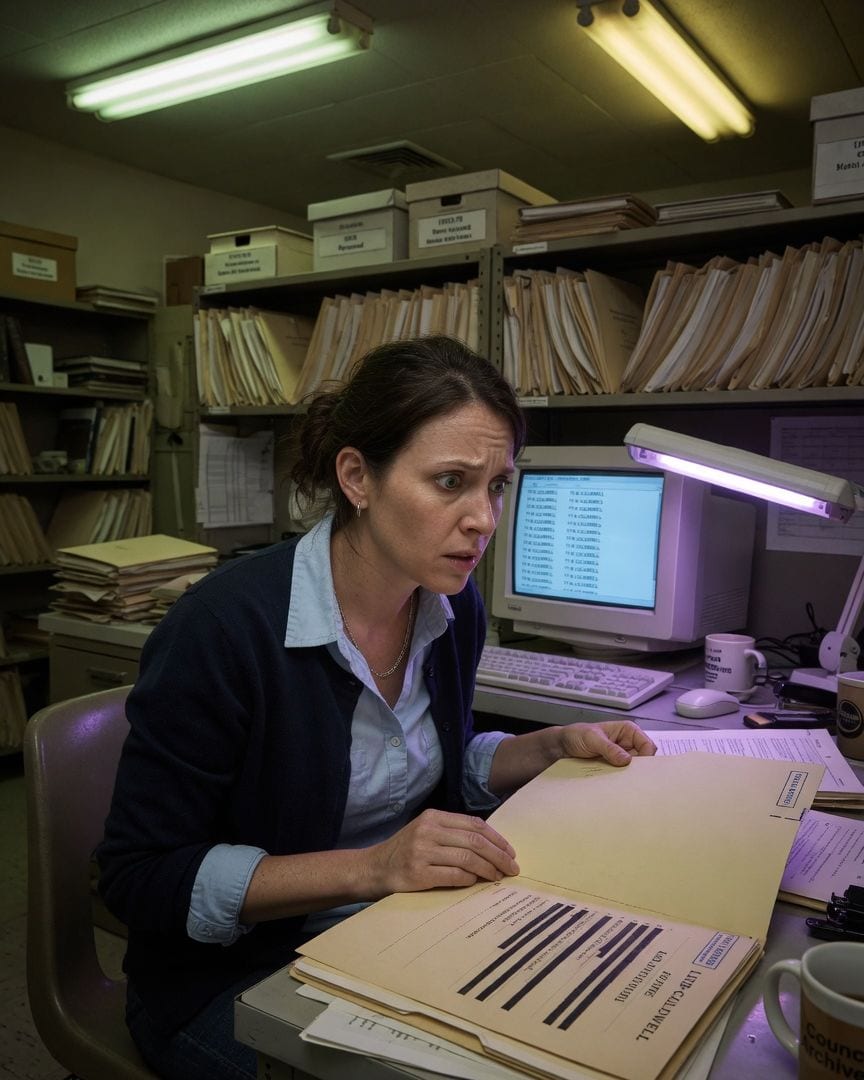
My employer's security file holds a vetting report on me dated nine years before I ever applied. It has my full name and my parents' address — with only one line, the source who referred me, blacked out.
Working a routine data audit, I pull my own security file. The issue date is nine years before I even applied for the job. Then, hidden within an old archive file, I find my current address etched under a blacked-out line.
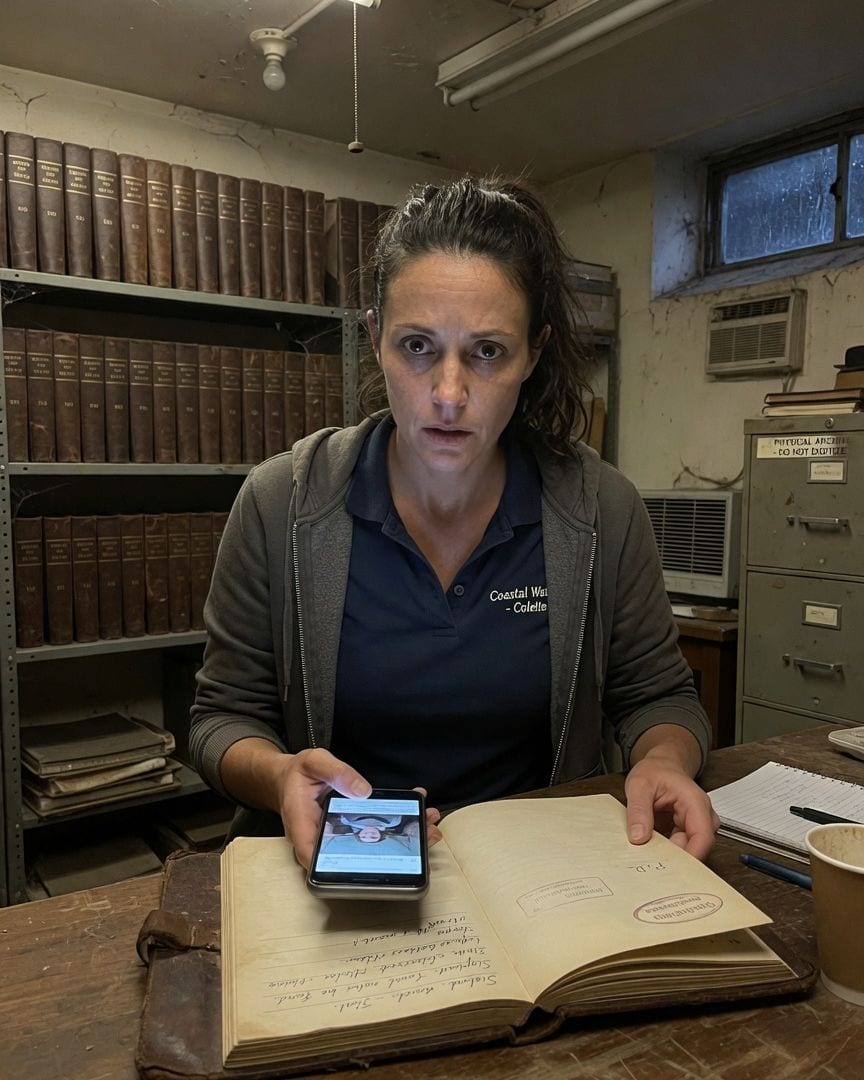
My coastguard log noted Sighting 9 again tonight, a light where no vessel showed. The old logs carry Sighting 9 off Skerry Point at 3:14am every tenth year since 1954, always 'nothing found,' always 'send no boat.'
On my watchtower night shift, the radar screen glowed green and the ocean was quiet. Then, a familiar light appeared off Skerry Point, exactly on cue, just as it had every tenth year for decades. But digging deeper, I found a hidden stamp in an old logbook: 'Operation Skerry. Status: Complete.' It left me with a chilling sense of finality.
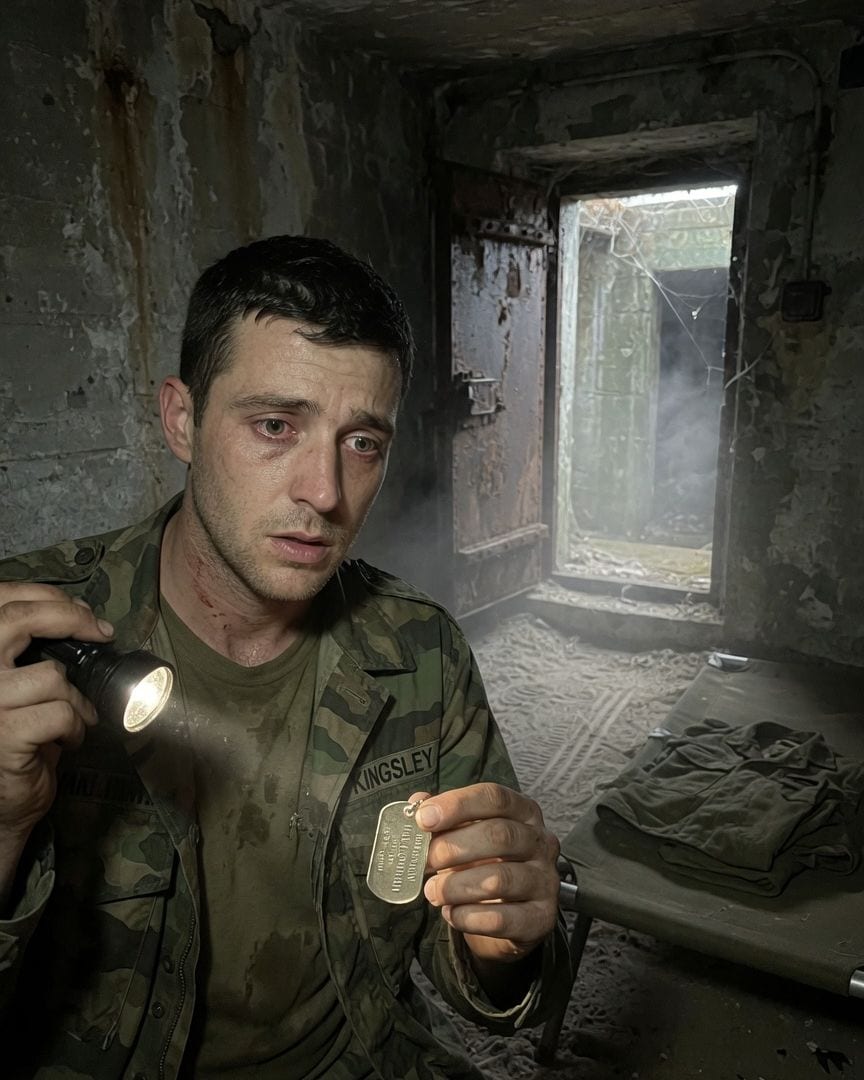
On his final rotation, a Private finds a WWII dog tag for 'Halloran' in a bunker sealed for eighty years.
Private Roland Kingsley endured the bone-deep weariness of his final graveyard watch at a reactivated WWII bunker on the Northern California coast, just hours from dawn and the end of his deployment. His searchlight cut through thick fog, revealing impossible figures: men in archaic WWII uniforms, assembling on the deserted beach, only to vanish moments later. As dawn broke, Kingsley discovered the bunker's rear hatch, sealed for decades, now stood mysteriously ajar. Inside, on an empty cot, lay a WWII-era field jacket, and in its pocket, a dog tag for 'Halloran' — a name impossible to the bunker's eighty-year history. What unseen presence had disturbed the long-sealed past?
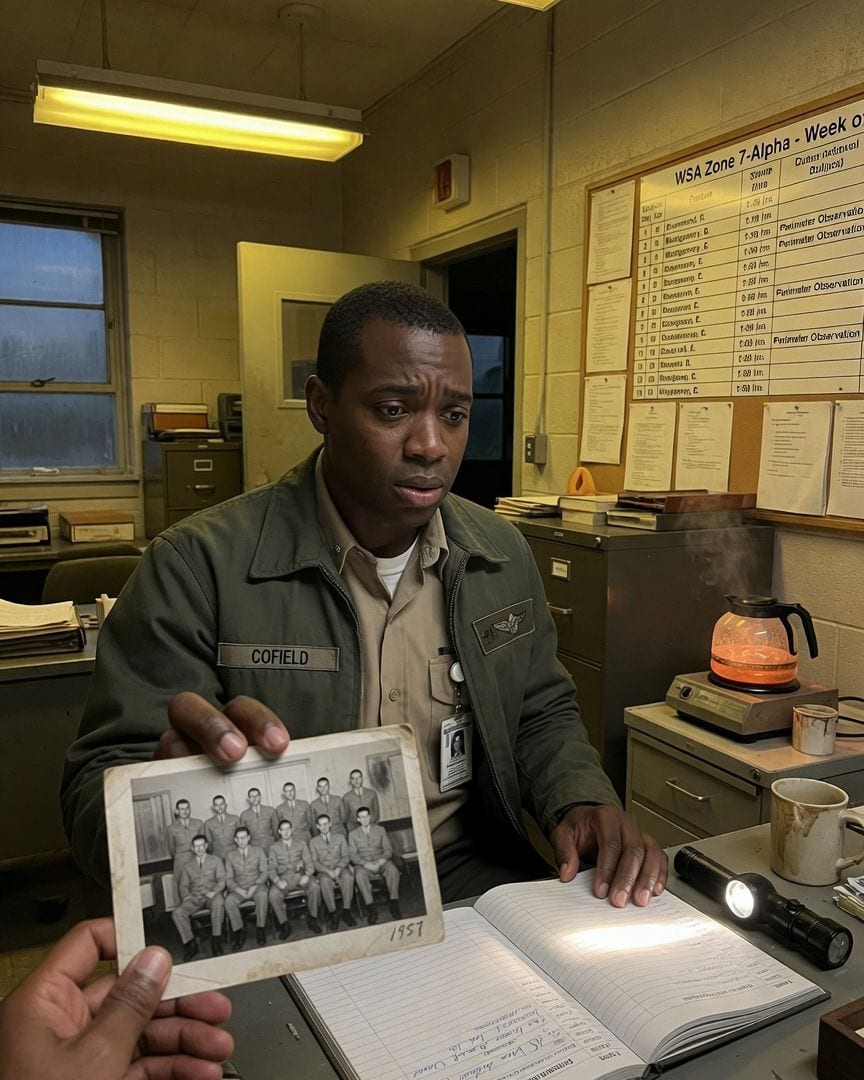
On his last patrol, Senior Airman Cofield found hot coffee steaming inside a base building mothballed since 1992. The fresh roster was signed by a man from a 1957 photo.
Senior Airman Felix Cofield was on his last perimeter patrol of the decommissioned Weapons Storage Area when an impossible light bloomed in the pre-dawn dark. The building had been mothballed for decades, yet a warm, unnatural glow pulsed from within. Ignoring Central Security's all-clear, Cofield found an unlocked door and a brightly lit office, as if someone had just stepped out. A freshly printed roster for the coming week lay on a corkboard, and a coffee pot on the counter was still steaming hot. Then he saw the faded group photo from 1957, showing the very man who had just signed today's logbook.