On his last patrol, Senior Airman Cofield found hot coffee steaming inside a base building mothballed since 1992. The fresh roster was signed by a man from a 1957 photo.
The light bloomed in the alarm-monitoring building, a soft, impossible glow against the pre-dawn dark. Senior Airman Felix Cofield, on his last perimeter patrol of the decommissioned Weapons Storage Area, stopped his Humvee.
The structure had been officially de-energized and mothballed since the base gave up its special-weapons mission in 1992. His comms crackled, Central Security Control’s voice crisp in his ear, confirming the zone was clear: no entry, no maintenance scheduled.
Yet, the light persisted, a faint, steady glow through the frosted panes that seemed to hum with an unnatural energy.
Cofield checked his watch, then his patrol log, double-checking the time against the base clock. Everything squared away. He radioed Central Security again, a quick, almost apologetic query about a ‘possible sensor glitch.’
The reply was instantaneous, firm: ‘WSA Zone 7-Alpha, all clear, Airman Cofield. Remain on patrol.’ He killed the engine and stepped out, the crunch of gravel under his boots the only sound in the still night.
The light was undeniably real, burning with an impossible warmth that made the surrounding darkness feel colder.
He found the service door unlocked, a clear violation of every protocol for a facility that was supposed to be a concrete tomb. Cofield pushed it open slowly.
Inside, the interior lights blazed, casting a sterile, yellow glow over a small, functional office. It was as if someone had just stepped out for a moment. No dust motes danced in the air, no sign of long disuse.
On a corkboard by the door hung a freshly printed shift-change roster for the coming week, filled with unfamiliar names like 'Drummond, R.' and 'Montgomery, E.' He scanned it, noting the precise hours, the assigned duties, the formal military font.
Then his gaze fell on a coffee pot on a small counter. It was half-full, and a wisp of steam curled from its spout.
Cofield reached out, touching the glass carafe. It was still hot, almost scalding. His mind raced through mundane explanations: a forgotten maintenance crew, a prank by a departing unit trying to leave a parting message for the next shift.
But the roster was for a full week, the coffee still steaming, and Central Security had sworn the zone was dead. The building itself felt too settled, too used for any quick, unauthorized visit.
He saw a logbook open on a desk, dated for today. The last entry, a neat, confident signature: 'R. Drummond, Perimeter Observation.' The name was identical to one on the brand-new roster, listed for an upcoming shift.
The dread in Cofield's gut outweighed his training. This wasn't a glitch; it was a deliberate, impossible act.
He was backing away, ready to report the undeniable facts, to describe the hot coffee and the current roster and the unlocked door to anyone who would listen, when a glint of metal caught his eye.
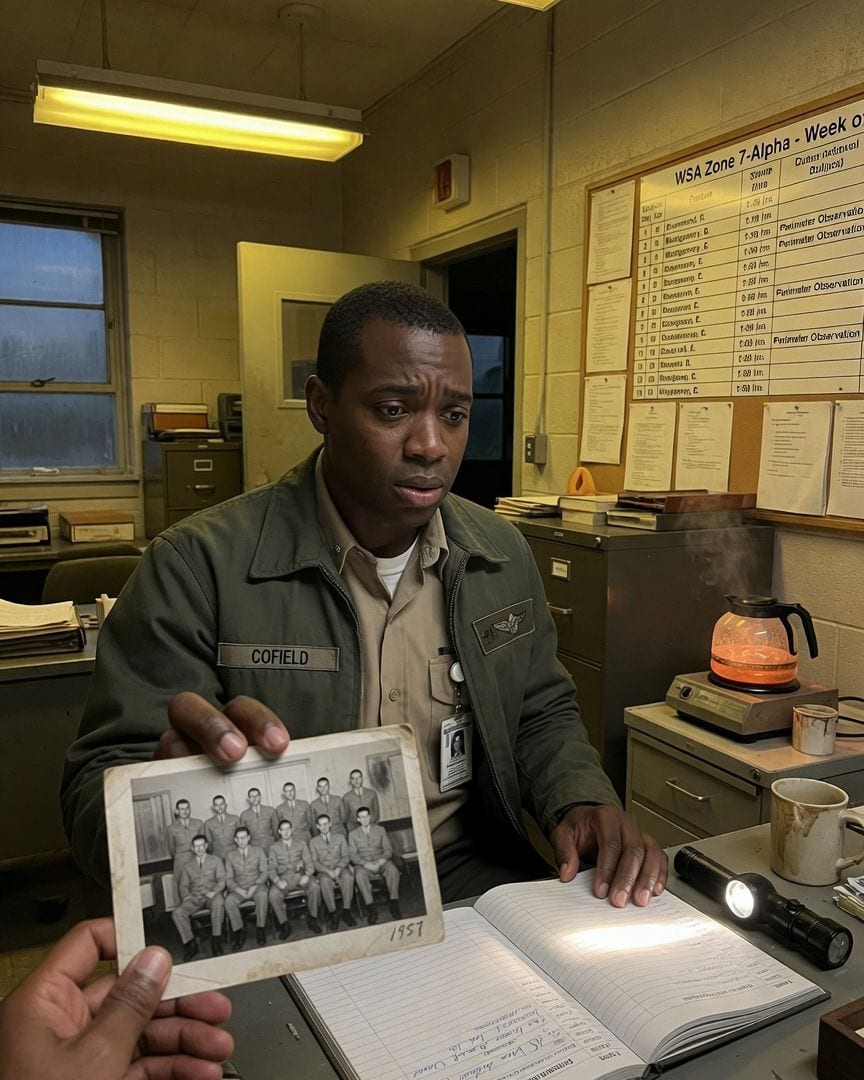
Tucked behind the logbook, half-hidden by a stack of old manuals, was a small, framed photograph. He picked it up. It was a group shot, faded and blurry, taken inside this very office, judging by the background’s distinctive wall panels.
The uniforms were older, from decades past, but one figure, in the back row, was unmistakably the same man who had just signed the logbook. The face was identical, down to the slight tilt of his smile.
The photo was dated 1957 on the back in faint, almost erased ink.
Cofield’s breath hitched in his throat as he stared at the blurry, decades-old group photo, then back at the current shift roster, a knot tightening in his stomach as he recognized the same unaged face on both, a face belonging to a name that had just signed today's logbook.
Cofield’s report to Captain Susan Porter was met with a mixture of skepticism and concern. She checked official records herself, confirming the WSA was indeed decommissioned and empty. No maintenance, no personnel, no activity.
She chalked it up to fatigue, a pre-transfer stress dream, advising him to get some rest before his departure. But Cofield couldn’t let it go. Using his remaining days before transfer, he began to dig.
He approached Eleanor Montgomery in base records, a civilian clerk who had worked there for decades.
He asked about anyone named Drummond or Montgomery assigned to the WSA, trying to sound casual, as if he were just tidying up old files.
Eleanor found no active records for an 'R. Drummond' past 1992, and no 'E. Montgomery' ever assigned to the WSA. “Might be a retired reserve, Airman,” she offered, not looking up from her screen. “They get around.”
Cofield then visited Russell Drummond, a retired Colonel who had served at the base in the 1950s, a distant relative he’d looked up on a hunch.
The old Colonel, now frail but sharp, spoke in fragments of 'irregular personnel' and 'special assignments' at the WSA, things that 'never quite made it onto the official books.'
He vaguely recalled a 'unique accountability protocol' that bypassed standard channels, a system designed to keep certain operations 'off the grid.' The words hung in the air, heavy and unexplained.
As Cofield continued his quiet investigation, an unsettling awareness began to prickle at him. He felt watched. A dark, unmarked sedan seemed to appear in his rearview mirror more often than coincidence allowed, always keeping a steady, unnerving distance.
Back on base, he noticed unusual access attempts flagged on his personal computer's security logs, attempts to view his personnel file, attempts that were quickly overridden by a higher authority.
One evening, alone in his barracks, his secure comms unit pinged, displaying a new message. It was untraceable, anonymous, and appeared on the screen as he was researching old WSA documents: 'Some things are best left de-energized, Airman Cofield.
Your transfer is approved.' The words were cold, precise, and carried a chilling implication. Someone knew exactly what he was doing, and they were warning him to stop.
The danger was no longer abstract; it was personal, and it was closing in, the very air in his small room seeming to tighten around him.
Cofield confronted Captain Porter again, his voice tight with urgency, the anonymous message a phantom chill in his hand. He laid out the warning, the strange access attempts, Colonel Drummond's fragmented memories.
Porter, though visibly shaken, still tried to find a mundane explanation. "It's a prank, Airman. Or a misunderstanding. Maybe an overzealous security detail trying to haze a transferring officer."
Cofield slammed the impossible roster and the photo of the unaged man onto her desk. The laminated sheet crackled, the glass of the frame clinked against the wood. "This isn't a misunderstanding, Captain. This is a lie."
He pushed, describing the hot coffee, the unlocked door, the logbook, the impossible logic of it all. The sheer coherence of it, the way every piece fit, began to break through her skepticism.
She admitted, in a hushed tone, that she'd heard rumors, 'ghost stories' about the WSA from older officers, tales of 'phantom shifts' that were always dismissed as legend. But Cofield's evidence was too concrete, too immediate.
With a heavy sigh, her usual composure cracking, she agreed to access the 'special projects' archive, a deep, physical ledger kept under lock and key in a secure vault beneath the base, a last resort for truly unexplainable anomalies.
The ledger was dusty, rarely accessed, its heavy cover thick with an institutional silence.
After a tense search, their flashlight beams cutting through the gloom of the vault, they found a single, thick entry for 'WSA-Gamma,' dating back to the 1950s. It detailed an 'ongoing, classified monitoring operation' with its own 'internal accountability matrix.'
Below it, a list of 'assigned personnel' appeared. The impossible name from the roster, 'R. Drummond,' was there, with an active status, dating back to 1957.
Captain Porter and Cofield stared at the chilling ledger entry, the weight of the impossible truth settling around them. The official history of the WSA was a lie.
The names, the dates, the 'active status' for a man who should be decades older or long dead—it was all there in black and white. The vault air, already cold, seemed to drop another ten degrees.
Just as they thought they understood the depth of the deception, a subsequent entry caught Cofield's eye. It was a 'transfer order' for the 'WSA Special Monitoring Unit,' dated for next month.
His own name, Felix Cofield, was listed at the top. His blood ran cold, a sudden, sickening drop in his stomach. He looked at Captain Porter, who was now staring, wide-eyed, at the signature beneath his name. It was hers.
Captain Susan Porter. A signature she couldn't remember making, authorizing his transfer into a unit she had only just discovered existed, into a fate she could not comprehend.
The ledger, once opened, spilled its secrets with a cold, institutional precision. It detailed a system where certain individuals, designated 'Monitors,' were not assigned but absorbed into the WSA operation.
Their duties were indefinite, often lifelong, maintaining the illusion of a decommissioned site while managing an unknown anomaly within. Their official service records were 'scrubbed,' leaving no trace, while their true assignments were maintained only within this hidden ledger.
'R. Drummond' was one such Monitor, active since 1957, his unaging face a testament to the system's terrifying effectiveness.
The 'hot coffee' and 'shift roster' Cofield had found were part of their endless, internal routine, a shadow bureaucracy mirroring the real world, a perpetuating charade. The ledger also meticulously documented 'incidents' where outside personnel stumbled upon the operation.
Each such 'incident' was followed by an 'evaluation for integration' into the Monitor program. Cofield's impending 'transfer' was not an exit, but an induction, his departure from the base a cleverly disguised trap.
Captain Porter stared at her own forged signature, realizing she was either a complicit cog in a vast, decades-old machine or a pawn whose authority had been usurped by a deeper, older power, one that had anticipated their every move.
The 'accountability that cannot be' was the system's ability to create its own reality, to erase and rewrite official truth, and to absorb new 'personnel' into its ranks, quietly, endlessly.
The realization hit Cofield with the force of a physical blow: he was already marked, already selected. Captain Porter, horrified, slammed the ledger shut, the heavy thud echoing in the vault.
"This can't be real," she whispered, but her trembling hands, fumbling for the lock, betrayed her. Footsteps echoed in the hallway outside the records office, growing louder, closer. They were coming for them.
Porter, acting on raw instinct, grabbed the nearest fire pull, yanking it down with a desperate force. Alarms shrieked through the building, a jarring, deafening sound that ripped through the quiet base, a chaotic symphony of warning. "Go!"
she yelled, shoving Cofield towards a rarely used maintenance tunnel access hatch, the old metal groaning open. Cofield, clutching the heavy ledger like a shield, scrambled into the dark, narrow passage, the alarms reverberating around him, disorienting and urgent.
He could hear voices on the comms, distorted by the sirens, calling his name, then Porter's. They were being hunted.
He moved through the labyrinthine tunnels, his knowledge of the base's forgotten infrastructure his only advantage, the desperate shouts of his pursuers drawing closer behind him.
The air grew stale, heavy with the dust of ages, but he pushed on, adrenaline burning.
He burst out into the night beyond the perimeter fence, gasping for air, the ledger clutched tight to his chest, the base's emergency lights painting the sky in a chaotic, pulsing red.
Felix Cofield vanished. His official service record, to the surprise of many, listed an honorable discharge with a vague 'medical separation.'
His story of a secret operation and unaging personnel was dismissed as a delusion from a disgruntled airman, an unfortunate consequence of pre-transfer stress.
The WSA remained 'de-energized' on all official maps, its silent concrete structures blending back into the landscape.
Captain Susan Porter was quietly transferred to a remote, administrative post in Alaska, her career effectively sidelined, her frantic reports of a deep archive ledger summarily ignored.
The deep archive ledger in her old office was reported as 'lost in a fire alarm incident,' its contents never officially accounted for. The system, undisturbed, continued its silent operation, a hidden heartbeat beneath the surface of official reality.
Years later, Felix Cofield lived a quiet life, far from any military installation. He worked a mundane job, avoiding anything that hinted at surveillance or hidden systems.
He kept the ledger, now brittle and faded, hidden in a lockbox, a constant, heavy reminder of the truth he carried.
He knew he had escaped, but the knowledge that the system continued, unseen, was a permanent weight, a shadow cast over every newspaper headline, every innocuous announcement.
One evening, a local news report flickered across his TV screen: a new security detail had been assigned to an old, abandoned industrial complex on the outskirts of town. A grainy photo of the 'site manager' flashed on screen.
The name beneath it was 'R. Drummond.' Cofield clicked the remote, plunging the screen into darkness.
If this one got to you
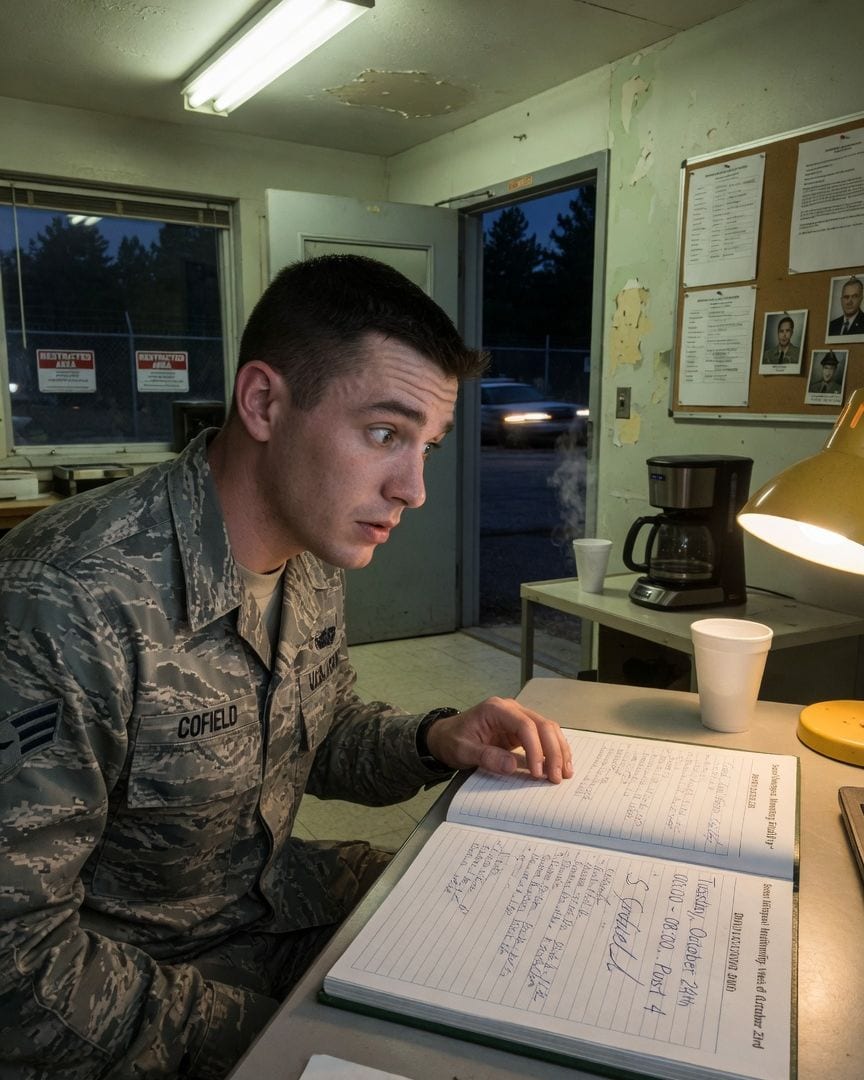
Two weeks from discharge, Senior Airman Cofield found his own signature on a logbook for an impossible shift at a facility mothballed decades ago.
Senior Airman Simon Cofield was just two weeks from discharge when he patrolled the quiet, forgotten perimeter of a mothballed weapons storage area. On a night thick with pine scent, he spotted a faint yellow light in a building officially powered down for over three decades, its alarm system inert. Inside, the building hummed with power, spotless, with hot coffee brewing and a crisp shift-change roster on the wall. But Cofield froze when he found a duty logbook with current entries, including his own name and signature, assigning him to an impossible shift next Tuesday. A cold dread settled as he realized something had just claimed him for a duty that no longer existed.
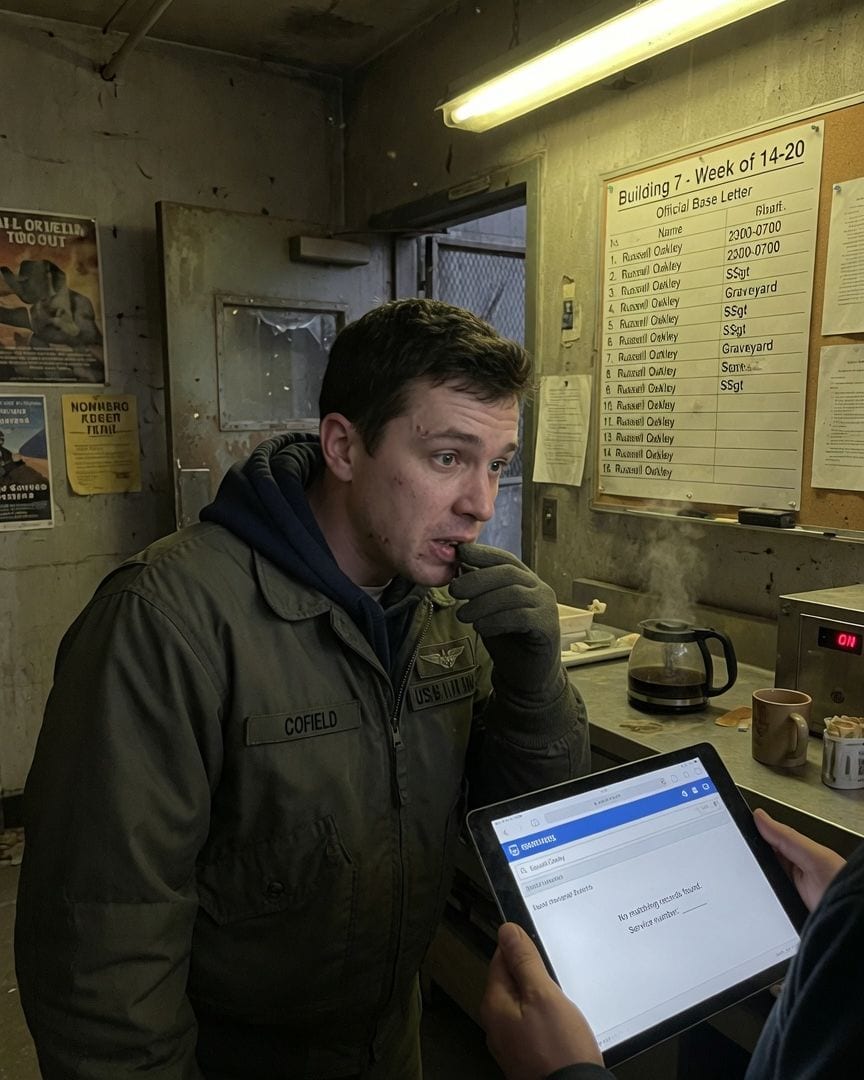
Airman Cofield, two weeks from transfer, found a warm coffee pot in a building without power for thirty years. Its new shift roster listed a name that didn't exist.
Senior Airman David Cofield, just two weeks from his long-awaited transfer, patrolled the perimeter of a decommissioned weapons storage area. Building 7, a concrete shell dark since 1992, suddenly showed a faint, warm light in its window. Inside, fluorescent lights hummed, and a coffee pot on the counter was still warm, defying the building's decades-long power shutdown. A freshly pinned shift roster for the coming week then revealed a name: 'Russell Oakley,' listed for Cofield’s own graveyard shift, yet completely absent from every official base record. Who was Russell Oakley, and how was he on shift in a dead building?
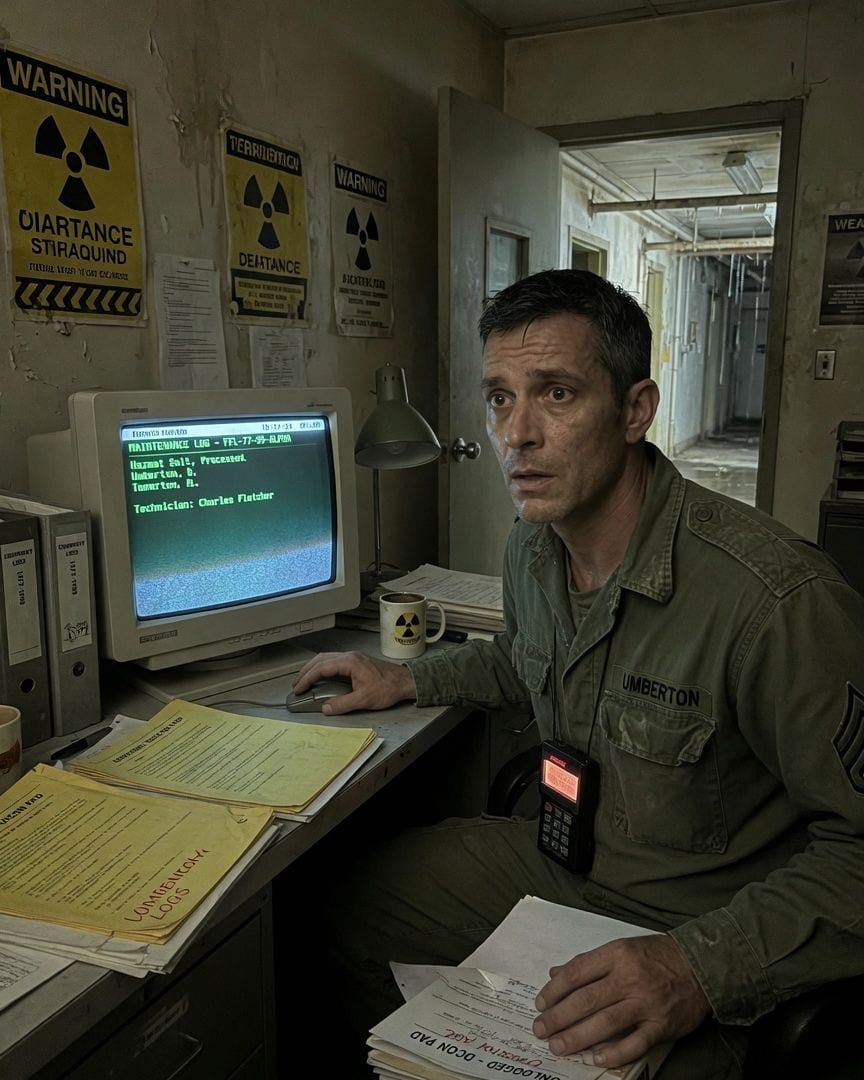
On his last shift at the closing Cold War facility, Sergeant Umberton found a hazmat suit glowing hot with his own name.
Sergeant Blaise Umberton walked his final shift at the soon-to-be-shuttered Ferriday Flats decontamination pad, the predawn air thick with ozone and the heavy silence of a closing era. His peace with the desolate site shattered when he discovered a hazmat suit, glowing faintly and shrieking on his Geiger counter, laid out with his own name stitched perfectly on the breast. Dismissed as a prank by his superior, Umberton followed protocol, but a cold dread compelled him to check the digital records of the facility's Cold War bureaucracy. There he found an entry for a hazmat suit processed under his name, dated for *tomorrow*, and signed by a technician who had retired a decade ago.
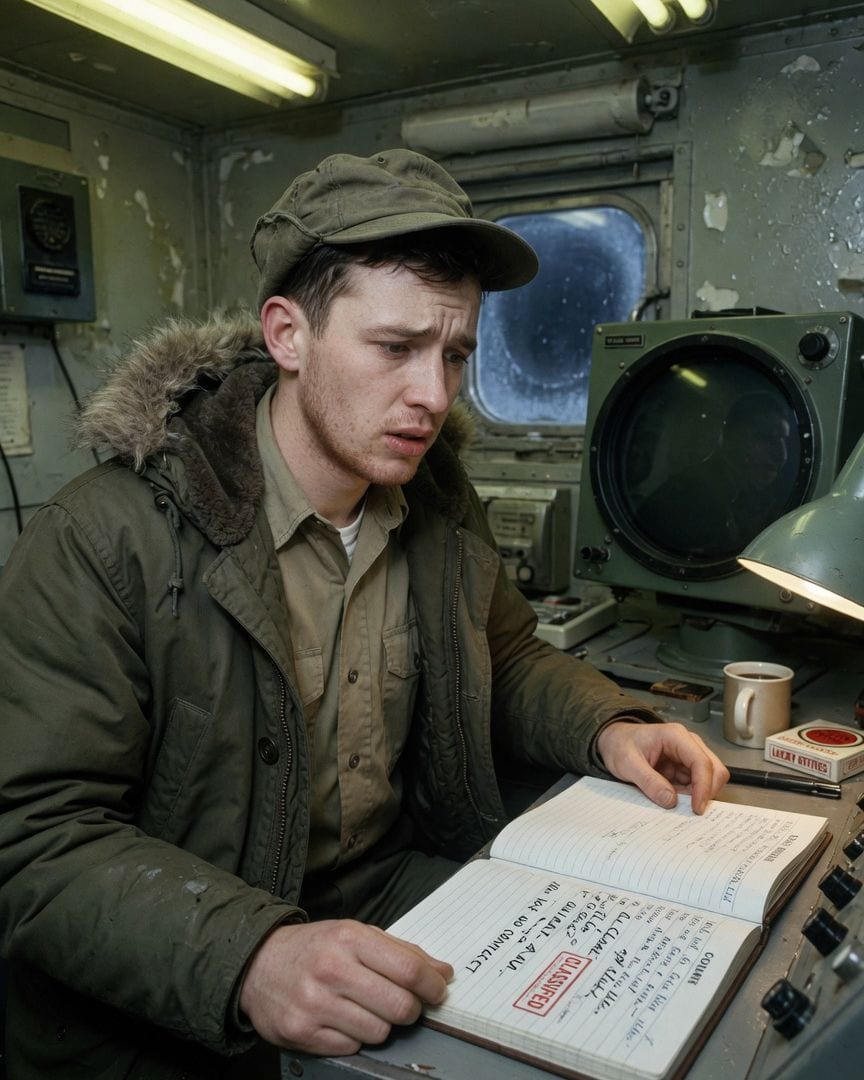
A Cold War airman logs an impossible radar contact on his last sweep. But his official logbook entry is stamped 'CLASSIFIED' and then contradicted by a hastily scrawled 'ALL CLEAR' dated moments before it.
Airman Ordway Vance, 22, manned the radar dome at Site Pellin in the biting North Atlantic dark of January 1962, running the last calibration sweep before its decommissioning. His scope picked up a faint, impossible return, growing closer with each pass, though the ocean remained empty to the eye. When Vance detailed the contact in his official logbook, a 'CLASSIFIED' stamp appeared, followed by a hastily scrawled 'ALL CLEAR' dated moments before his own entry, contradicting his every word. Commander Hartley dismissed it as equipment malfunction, but Vance sensed a chilling, official erasure behind the lie. He soon found a locked cabinet marked 'SITE PELLIN ANOMALIES,' hinting at a deeper truth buried within the base's final days.
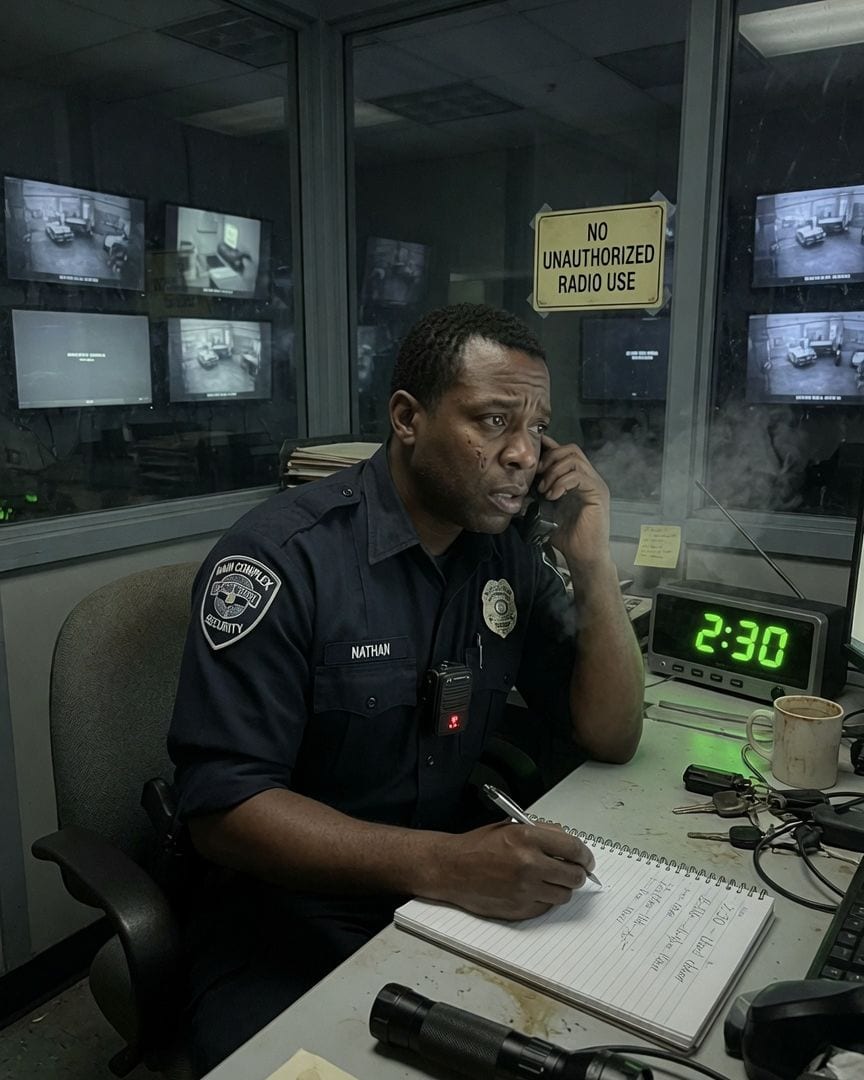
I radio Cole every night. My supervisor says his dock post was cut two years ago, and no Cole exists. But I just found Cole’s old logbook.
My graveyard shift usually consists of monotonous hourly check-ins with Cole, the guard at the loading dock. But my supervisor just revealed that the dock post was cut two years ago, and no one named Cole has ever worked for the company. I've been talking to someone who simply isn't there.
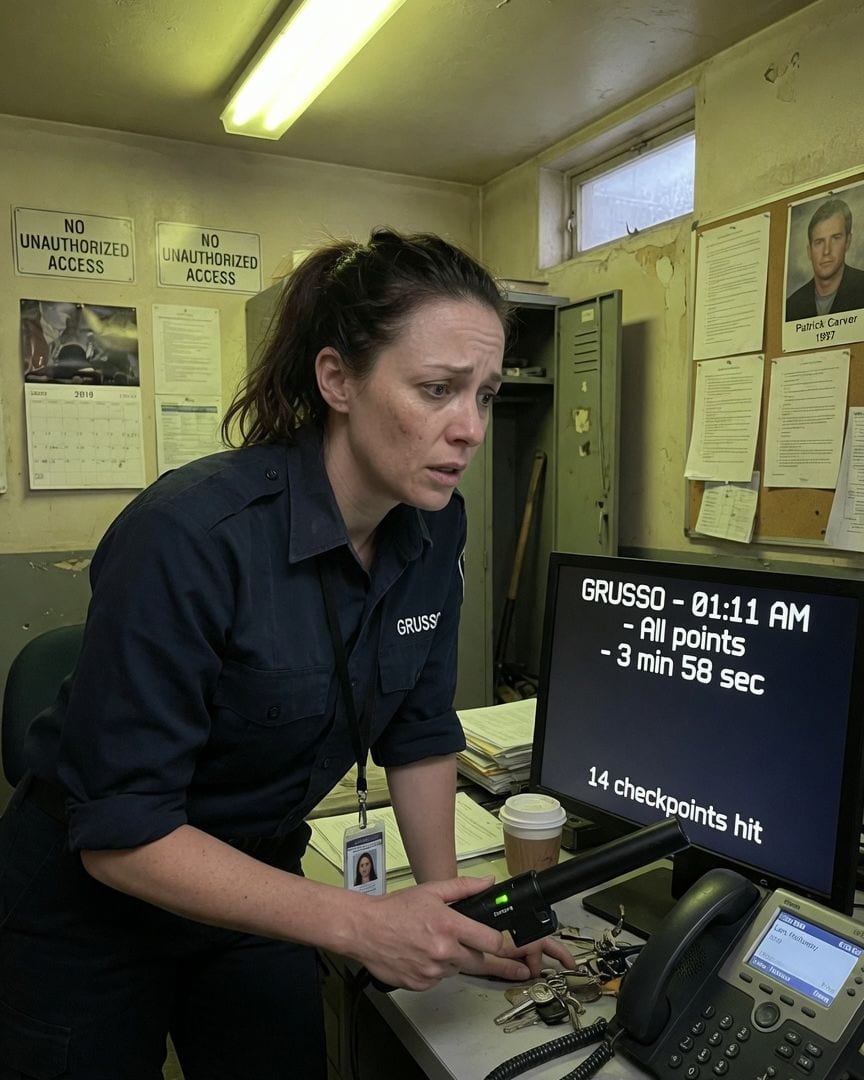
My security wand logged a full round at 1:11 AM in under four minutes. It was in the charger. Every tap is logged as mine.
Finishing my night shift, all I wanted was to get home. But the dock readout screen showed my security wand logged a full patrol at 1:11 AM, completed in just under four minutes. I knew my wand had been charging right beside the monitor the entire time, yet the log, under my ID, confirmed the impossible.