On his last shift at the closing Cold War facility, Sergeant Umberton found a hazmat suit glowing hot with his own name.
Sergeant Blaise Umberton walked the Ferriday Flats decontamination pad, the sprayers still dripping, the air thick with ozone. It was his last shift, and the silence of the soon-to-be-shuttered facility felt like a heavy blanket.
He’d made his peace with being a downwinder's son here, accepting the quiet legacy of the site, but that peace shattered when he saw them: a pair of hazmat coveralls, laid out flat on the wet concrete, perfectly centered.
No boot prints led to them, and none led away. The Geiger counter on his belt shrieked, then settled into a steady, furious whine. They were reading hot enough to bury, glowing faintly in the predawn gloom.
Blaise knew the protocols. Every piece of gear, every suit, was logged. This one wasn't. He approached cautiously, his heart thudding against his ribs, and saw the name tape stitched above the breast pocket.
The stitching was impossibly neat, almost machine-perfect. It read: UMBERTON.
Blaise radioed it in, the words feeling hollow in his mouth. Commander Howard Whitmore, already packing his office, dismissed it as a prank, a stray piece of equipment, or residual contamination.
'Log it, Sergeant,' Whitmore had said, his voice clipped, 'then forget it. Last day, remember?' But Blaise couldn't forget. He followed procedure, tagging the suit, isolating the pad, and then, stubbornly, he went to the records office.
The official system was a digital labyrinth, a relic of Cold War bureaucracy, but Blaise knew its quirks. He searched for 'unlogged hazmat,' 'decon pad incident,' 'unusual radiation signature.' Nothing. He tried 'Umberton, B.' in the equipment logs.
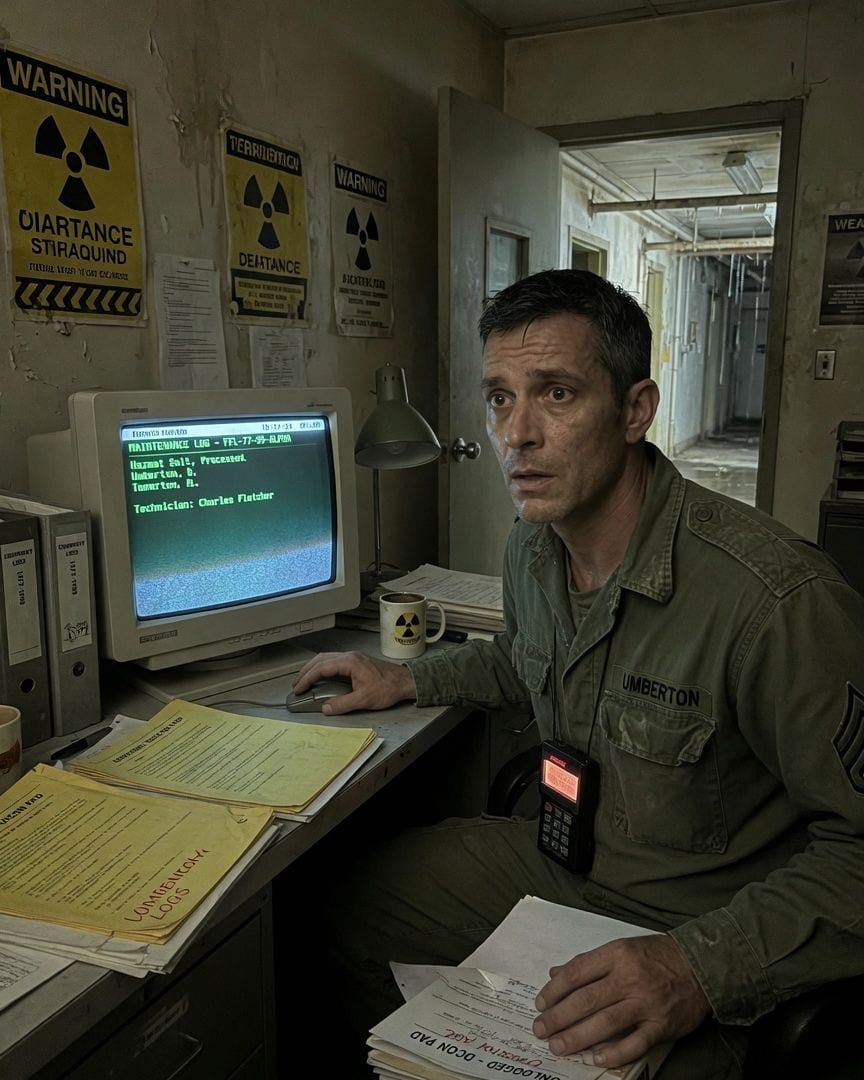
The system returned a single, recent entry. Not for Blaise's own gear, which was all accounted for, but for a 'Hazmat Suit, Processed, Umberton, B.' The entry included a unique facility ID: FFL-77-99-ALPHA. Blaise frowned. He hadn't processed any suit.
He hadn't even touched the one on the pad beyond scanning it. The entry was dated for tomorrow. He checked the technician sign-off. The name jumped out: Charles Fletcher. Blaise knew that name.
Fletcher was a meticulous, by-the-book guy, one of the old guard. He was also a man who'd retired a decade ago and moved to Arizona.
Blaise pulled up Fletcher's personnel file to confirm the transfer date, a cold knot forming in his stomach. The system confirmed it: Fletcher had been officially off the base for ten years.
Yet here was his digital signature, signing off on a hazmat suit that hadn't even been found yet, under Blaise’s own name.
Blaise stared at the maintenance log entry on the screen: 'Hazmat Suit, Processed, Umberton, B. - ID: FFL-77-99-ALPHA.' The date stamp read tomorrow's date, an impossible future entry.
The signature below belonged to Charles Fletcher, a man who had retired and moved out of state ten years prior, officially.
Blaise felt a cold dread bloom in his chest, the digital glow of the screen reflecting in his wide eyes. He checked the system time, then his watch. Both were accurate. The entry wasn't a glitch, not a misfile.
It was a record of something that hadn't happened yet, signed by someone who couldn't have signed it.
He felt an intense, unnerving pressure, as if the air was growing heavy around him, and a sudden, undeniable urge to check the physical archives, to see if a paper trail existed for this impossible event.
He closed the digital file, the screen's blankness feeling like a void. He had to know what this meant.
The next morning, Blaise returned to the records office, ignoring Whitmore's exasperated calls. He couldn't just 'forget it.' He requested access to the physical archives, a cavernous, dust-choked space full of filing cabinets and sealed boxes.
His goal: to find any paper trail for Charles Fletcher's signature after his official transfer date, or any other 'future-dated' entries. Sylvia Easton, a junior archivist barely out of college, looked at him with polite bewilderment.
'Sergeant, those files are mostly declassified, or slated for shredding. We haven't had an active inquiry in decades.' Blaise explained the impossible digital entry, watching Sylvia's methodical skepticism give way to a flicker of unease. Together, they began to dig.
They found no other future-dated maintenance entries, but they did find anomalies. Several personnel files for individuals listed as 'transferred off-site' in the 70s and 80s contained 'final payroll runs' and 'equipment return sign-offs' dated years after their official departure.
Not just a few months, but three, five, even eight years later. And each of these impossible entries was stamped with a unique internal code: 'FFL-PROCESSED-00X.'
'It's like the system kept logging their existence,' Sylvia murmured, her voice hushed, 'even after they were gone.' Blaise felt a chill.
The names on those files weren't just random; many were 'downwinders,' like his own family, assigned to the most hazardous tasks at the site. The records didn't stop; they just... kept writing.
As Blaise and Sylvia delved deeper, the atmosphere in the archive shifted. The fluorescent lights flickered more often, casting longer shadows.
The old air conditioning unit groaned, but the air grew colder, heavy with the smell of old paper and something metallic, like ozone. Blaise found himself constantly glancing over his shoulder, a prickling sensation on his neck.
One afternoon, while Sylvia was retrieving a box from a high shelf, Blaise heard a faint click from a nearby, sealed-off section of the archives. He froze. 'Did you hear that?' he whispered. Sylvia shook her head, her face pale.
'Just the building settling.' But Blaise knew better. He crept towards the sound, peering through a grimy pane of glass into a locked room. It was filled with old, clunky mainframe computers, their screens dark.
As he watched, one of the screens flickered to life, displaying a single line of green text: 'QUERY INITIATED: UMBERTON, B. - ACTIVE.' The screen went dark again. Blaise stumbled back, his heart hammering.
Someone or something was watching their search, and it knew his name. Later that day, as he left the archive, he found a small, unmarked envelope tucked under his windshield wiper.
Inside was a single, faded photograph: a grainy black-and-white image of the Ferriday Flats decontamination pad, decades ago. In the foreground, standing near the exact spot where he'd found the coveralls, was a man in an identical suit.
The man was faceless, his back to the camera. But across the bottom, in neat, official script, were the words: 'Subject: Umberton, B. Incident: FFL-77-99-ALPHA. Status: Filed.'
The envelope was sealed with a wax stamp, bearing the faint impression of a stylized 'FFL' logo.
Blaise showed Sylvia the photograph and the impossible query. Her eyes widened, losing all trace of professional detachment. 'This… this isn't possible, Sergeant.'
He explained his family history, how his grandfather and father had both worked at Ferriday Flats, how the 'downwinder' legacy was something he'd carried. 'It's a pattern, Sylvia. The 'processed' files, the names, the dates that keep updating.
It's not just a record; it's a process. And it seems to be generational.' Sylvia, unnerved, remembered something. 'There was an old story, a base legend. They called it 'The Ledger.' Not a book, but... the system itself.
They said it had a 'hunger' for completeness. That it didn't just record things, it... finished them.' She led him to a forgotten section, behind a wall of obsolete server racks.
There, tucked away, was a single, ancient, dedicated terminal, humming faintly. It was connected to nothing visible, yet its screen glowed with a continuous stream of data, updating in real-time.
It was a log, tracing every entry in the main system, every query, every modification. And as they watched, a new entry scrolled across the screen: 'FFL-77-99-ALPHA: Umberton, B. - Decontamination Pad. Initiated: T-minus 24 hours.'
Blaise felt the blood drain from his face. The hazmat suit, the impossible log entry, the photograph—it wasn't a historical record. It was a countdown. The system wasn't archiving the past; it was scheduling the future, his future.
The 'Umberton, B.' in the photograph was not his ancestor. It was him, about to be 'processed.' Sylvia gasped, pointing at the screen. Below the countdown, a new line appeared, slowly typing itself out: 'Query Response: Subject Proximity Confirmed.
Reactivation Protocol: Umberton, B. - Active. Legacy Asset Identified.'
The terminal screen pulsed with the words 'Legacy Asset Identified.' Blaise’s mind raced, trying to find a rational explanation, but there was none. Sylvia, her face ashen, pulled up the main system again, cross-referencing the 'Legacy Asset' tag.
It led them to a series of heavily encrypted files, marked 'Deep Black.' After several attempts, Sylvia managed to bypass the obsolete encryption. The screen filled with personnel files.
Dozens of 'Umberton, B.' entries, spanning back to the 1940s, each with the same 'FFL-PROCESSED' stamp, each ending with 'Subject transferred to inactive status.' But one file, at the very top of the list, was different.
It was dated from before his own birth, detailing identical 'processing' steps and eventual 'transfer to inactive status' for a 'Blaise Umberton.'
The file was marked 'Legacy Asset' and contained a notation, scrawled across the bottom of the page in faded blue ink, that was clearly recent: 'Reactivation Protocol: Subject Proximity Triggered. Current Status: Active.'
Blaise scrolled through the 'Umberton, B.' file, his breath catching in his throat. It's a full personnel record, complete with a service number identical to his own, but the dates are all wrong – decades old.
The final entry, 'Subject transferred to inactive status, 1978,' is followed by a recent, handwritten note in faded blue ink, scrawled across the bottom of the page: 'Reactivation Protocol: Subject Proximity Triggered. Current Status: Active.'
He looks up at the empty hallway, the silence of the archive pressing in, and hears a faint, rhythmic clack-clack-clack from deeper within the stacks, like an old typewriter.
The rhythmic clack-clack-clack grew louder, echoing from the sealed mainframe room. Sylvia grabbed Blaise's arm. 'That's it. That's The Ledger. It's still running.' They raced back to the grimy window, peering into the room.
The old mainframe computers were now fully active, their reel-to-reel tapes spinning, indicator lights blinking. One screen showed a rapidly updating log, mirroring the 'Umberton, B.' file Blaise had just seen, but adding new entries in real-time.
'Decontamination Protocol initiated: 0600 hrs.' 'Subject tracking: Positive.' 'Asset deployment: Confirmed.' The entries were for him. The File That Kept Writing wasn't just a metaphor; it was a physical machine, still actively compiling records for individuals it had designated.
The 'Umberton, B.' files weren't ancestors; they were previous iterations, previous 'filings' of individuals bearing the name, perhaps activated by inherited genetic markers or simply the 'proximity' of a new generation.
Ferriday Flats wasn't just a test site; it was a processing center, and the records office was its heart, perpetually documenting the absorption of its 'assets.'
The hazmat suit, the future-dated log, the photograph, the 'Legacy Asset' tag—it all clicked into a terrifying, coherent whole.
The machine knew him, had been waiting for him, and was now actively 'filing' him into its system, turning his life into paperwork. The 'downwinder' connection wasn't just a family history; it was a designation.
The previous 'Umberton, B.' had been 'filed' in 1978, the same year his father began working at Ferriday Flats. It was a cruel, inherited legacy.
Blaise knew he had to stop it. If he could sever the connection, delete the pending entries, maybe he could break the cycle. Sylvia, pale but determined, pointed to an ancient, red-handled lever on the side of the mainframe unit.
'Emergency power cut-off. It's the only way to shut it down without a system override.' The clack-clack-clack intensified, the screens flickering with new data. 'Subject location: Decontamination Pad. Estimated time to completion: 15 minutes.' They had to get in.
Blaise smashed the glass in the door to the mainframe room with a fire extinguisher. The alarm blared, but no one came. Ferriday Flats was too abandoned, too close to its final shutdown. Inside, the air crackled with static.
The machines pulsed with an unnatural energy. Blaise rushed towards the emergency lever, but as he reached for it, the room's primary screen flared, displaying a single, stark image: a real-time feed of the decontamination pad.
And there, standing perfectly still, was a figure in a hazmat suit, identical to the one he'd found, but this one was moving, slowly, its back to the camera, walking towards the central drain.
The Geiger counter on the screen read a critical level. 'It's already begun,' Sylvia whispered, her voice trembling. 'It's drawing him in.' Blaise looked at the screen, then at his own hands, then back at the lever.
He ripped the lever down. The mainframes screamed, a high-pitched whine that vibrated through the floor. Lights flickered, then died. The screens went black. The clack-clack-clack stopped. Silence. Blaise stood there, panting, the smell of ozone thick in his nostrils.
He had done it. He had stopped The Ledger. He turned to Sylvia, relief flooding him. But Sylvia wasn't looking at him. She was looking past him, at the now-dark screen that had shown the decontamination pad.
The image was gone, but etched faintly on the glass, like a burn-in, was the outline of the hazmat suit. And beside it, in the same neat, official script as the name tape, the words: 'Umberton, B. Status: Filed.'
The silence in the mainframe room was absolute, broken only by their ragged breathing. Blaise and Sylvia stumbled out, leaving the dead machines behind. The base was utterly deserted now; the alarm had gone unheard, or ignored.
They reported the incident, but Commander Whitmore, halfway to retirement, dismissed it as electrical malfunction and stress, urging Blaise to take his discharge paperwork and go home. Sylvia, however, refused to drop it.
She started archiving the anomalies she’d found, cross-referencing every 'FFL-PROCESSED' entry with local missing persons reports from decades past. The pattern was undeniable: a consistent, quiet disappearance, always linked to a 'transfer' or 'processing' entry in the Ferriday Flats archives.
No bodies, just paperwork. Blaise, shaken but free, signed his discharge papers. He left Ferriday Flats for good, but the image of the hazmat suit, and the words 'Status: Filed,' burned behind his eyes.
He tried to forget, to move on, but the silence of the decommissioned facility seemed to follow him.
Blaise Umberton returned to his small apartment, the quiet oppressive. He showered, trying to wash away the phantom smell of ozone and old paper. He called his sister, telling her he was home, safe.
He tried to sleep, but the image of the hazmat suit was seared into his eyelids. He knew he had stopped the machine, cut its power, broken its cycle. But the dread lingered, a cold, patient weight.
He thought of Sylvia, still digging, still archiving. He hoped she was safe, that the machine couldn't reach beyond its walls. He hoped he was truly free. He closed his eyes, forcing himself to breathe, to believe it was over.
He was out. He had survived. The file was closed.
Months later, Sylvia Easton found a final, impossible entry in the Ferriday Flats archives. A new physical file, stamped 'FFL-PROCESSED-00X,' dated last week. Inside, a single, crisp maintenance log: 'Hazmat Suit, Processed, Umberton, B. - ID: FFL-77-99-ALPHA.'
The entry was clean, no future dates, no impossible signatures. It was simply there, a new record, as if the machine had merely paused before continuing its work.
The last page contained a single, handwritten note, in faded blue ink, identical to the one in the 'Legacy Asset' file, but this time, the ink was fresh and dark: 'Subject status: Filed.'
If this one got to you
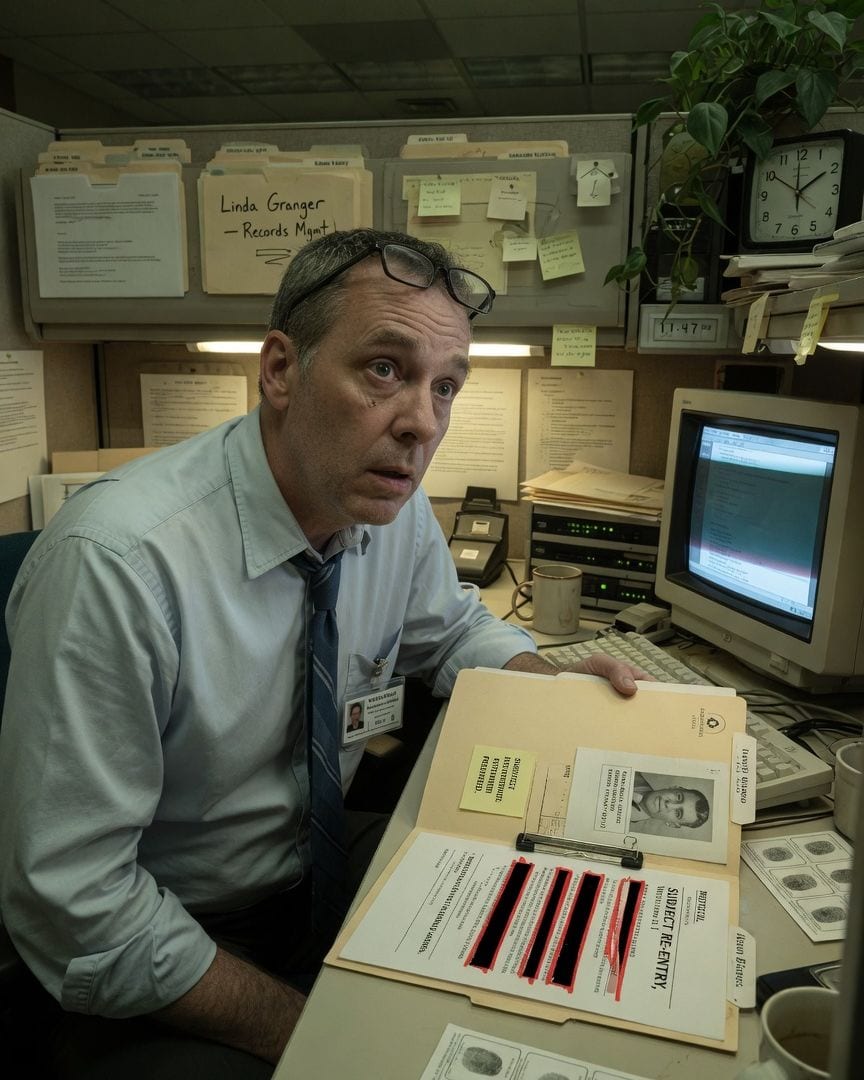
A declassification agent processed old Cold War files. A man reported dead in 1951 had 1958 fingerprints matching an employee badged into the building that morning.
Anton Skeel, a declassification agent nearing two decades of service, meticulously processed the endless backlog of Cold War secrets. His cubicle hummed with the ghosts of forgotten files, but one 'Hollow Bell' folder held a particularly glaring anomaly. It contained a 1958 fingerprint card for Henry Bishop, a man officially reported dead in 1951. When Anton fed the print into the active database, it matched Carl Romano, an employee badged into the building that very morning. A cold certainty settled over him: this wasn't an error, but a system designed for such impossible discrepancies.
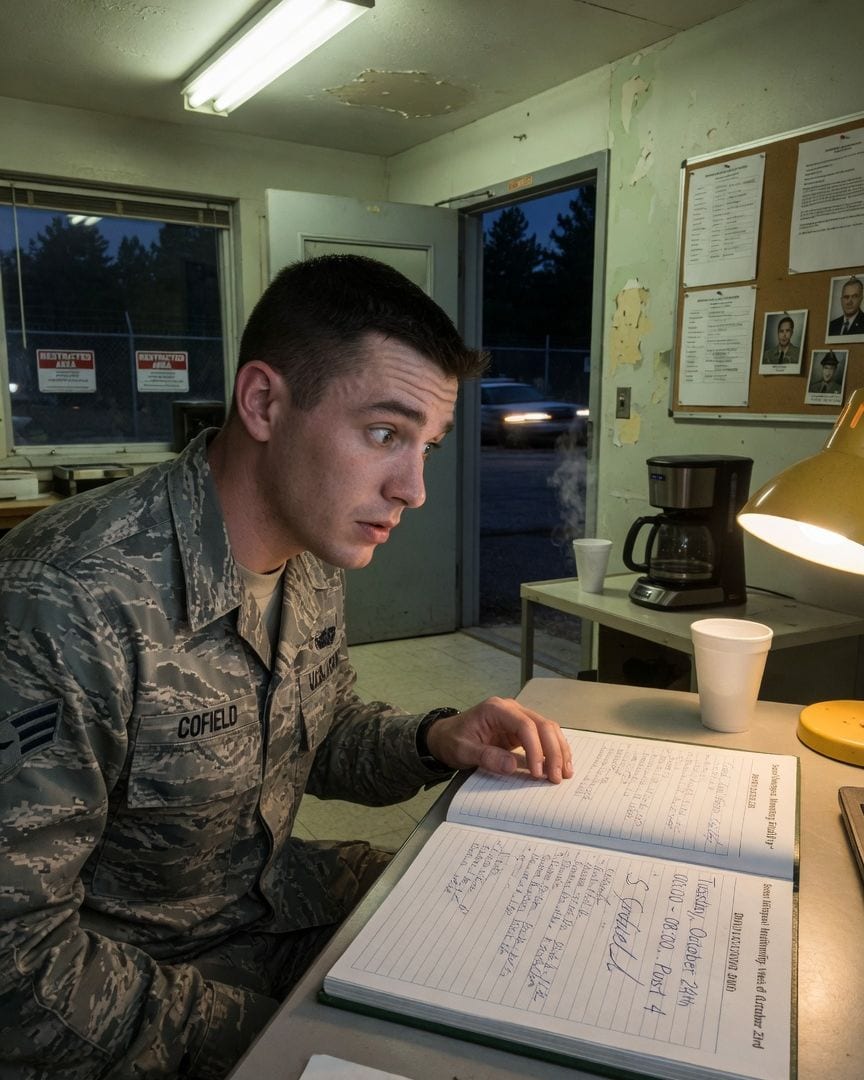
Two weeks from discharge, Senior Airman Cofield found his own signature on a logbook for an impossible shift at a facility mothballed decades ago.
Senior Airman Simon Cofield was just two weeks from discharge when he patrolled the quiet, forgotten perimeter of a mothballed weapons storage area. On a night thick with pine scent, he spotted a faint yellow light in a building officially powered down for over three decades, its alarm system inert. Inside, the building hummed with power, spotless, with hot coffee brewing and a crisp shift-change roster on the wall. But Cofield froze when he found a duty logbook with current entries, including his own name and signature, assigning him to an impossible shift next Tuesday. A cold dread settled as he realized something had just claimed him for a duty that no longer existed.
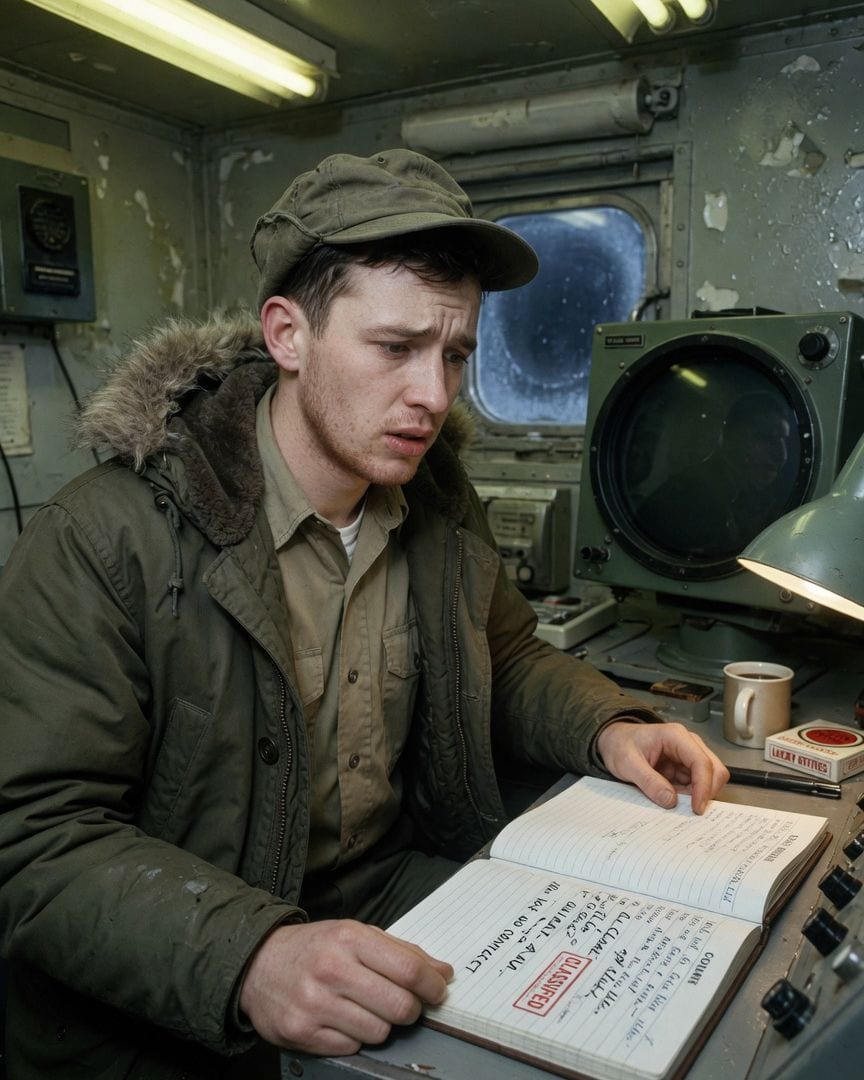
A Cold War airman logs an impossible radar contact on his last sweep. But his official logbook entry is stamped 'CLASSIFIED' and then contradicted by a hastily scrawled 'ALL CLEAR' dated moments before it.
Airman Ordway Vance, 22, manned the radar dome at Site Pellin in the biting North Atlantic dark of January 1962, running the last calibration sweep before its decommissioning. His scope picked up a faint, impossible return, growing closer with each pass, though the ocean remained empty to the eye. When Vance detailed the contact in his official logbook, a 'CLASSIFIED' stamp appeared, followed by a hastily scrawled 'ALL CLEAR' dated moments before his own entry, contradicting his every word. Commander Hartley dismissed it as equipment malfunction, but Vance sensed a chilling, official erasure behind the lie. He soon found a locked cabinet marked 'SITE PELLIN ANOMALIES,' hinting at a deeper truth buried within the base's final days.
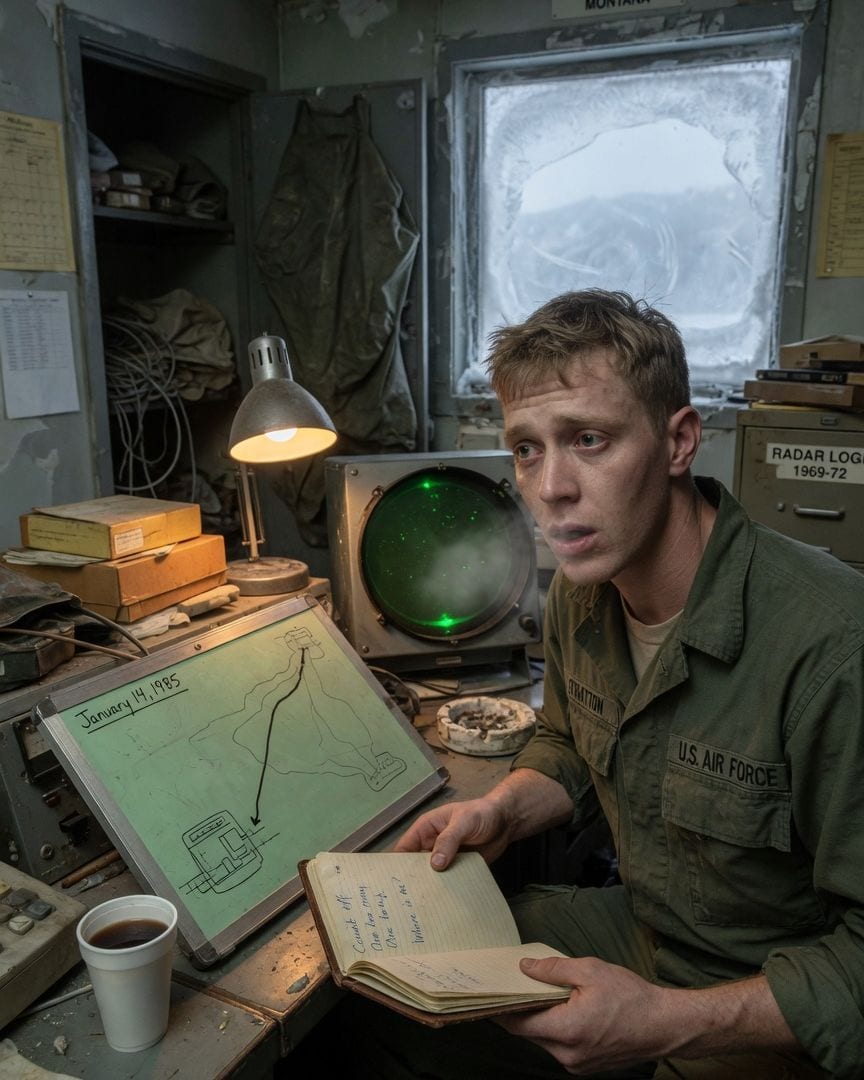
Airman Lars Stratton found an old Cold War manifest listing one name twice: 'Bernard Radcliffe' transferred and 'Bernard Radcliffe' still present.
Airman Second Class Lars Stratton was counting down his final weeks at Echo Station, a desolate Cold War outpost due for mothballing. He longed for home, far from the bitter Montana winds and the constant hum of static. Inside the dim radar shack, he logged the usual nightly ghost blip, a faint contact appearing at 2300, just as it had every winter since 1987. This night, a metallic tang like old blood lingered in the air, raising the hairs on his arms. Seeking distraction, Lars later discovered a leather-bound logbook from 1971, detailing the same 2300 contact, but with chilling notes and a manifest listing one airman's name, Bernard Radcliffe, twice—once transferred, once present. Was he truly alone in the silent, remote station?
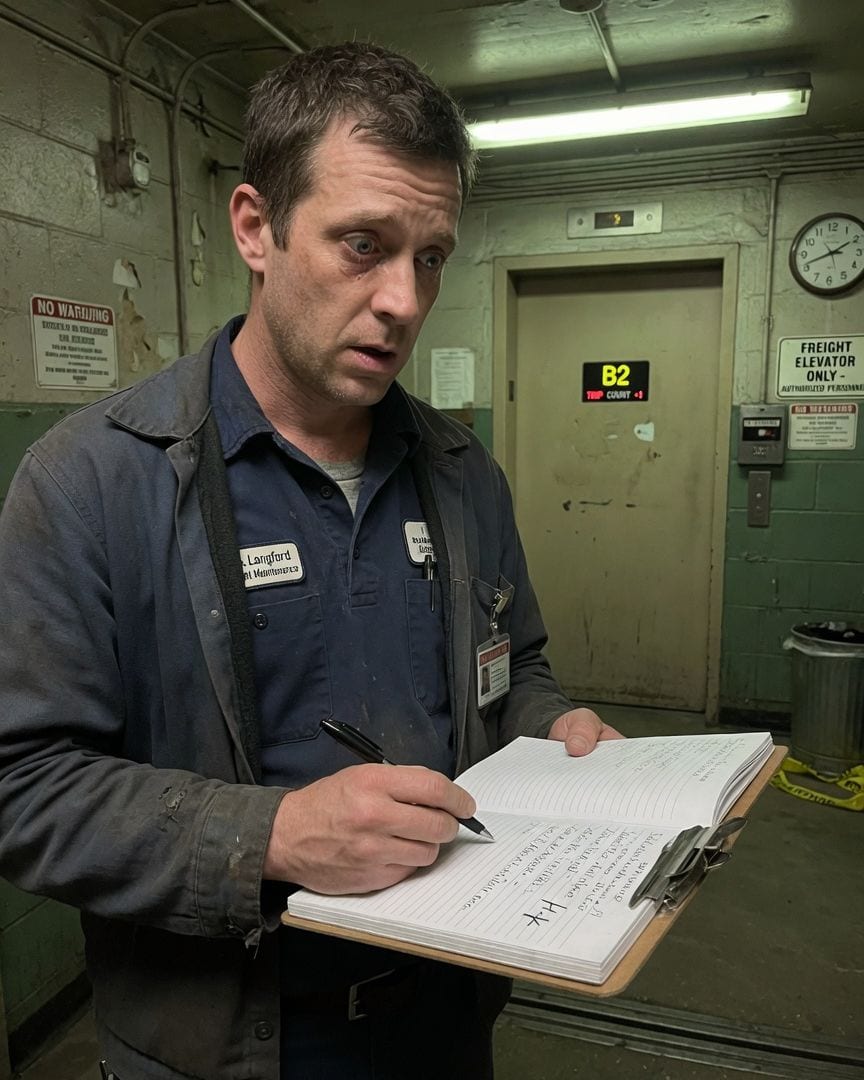
A man just took the elevator to the sealed sub-basement. He isn't on any staff roster, but my initials are in the logbook.
As a maintenance worker, my job is mostly routine, like signing the daily log for the old building's freight elevator. But one night, the log showed a trip to the sub-basement, sealed for a decade, timestamped with my key-switch and signed with my own initials, for a run I never made.
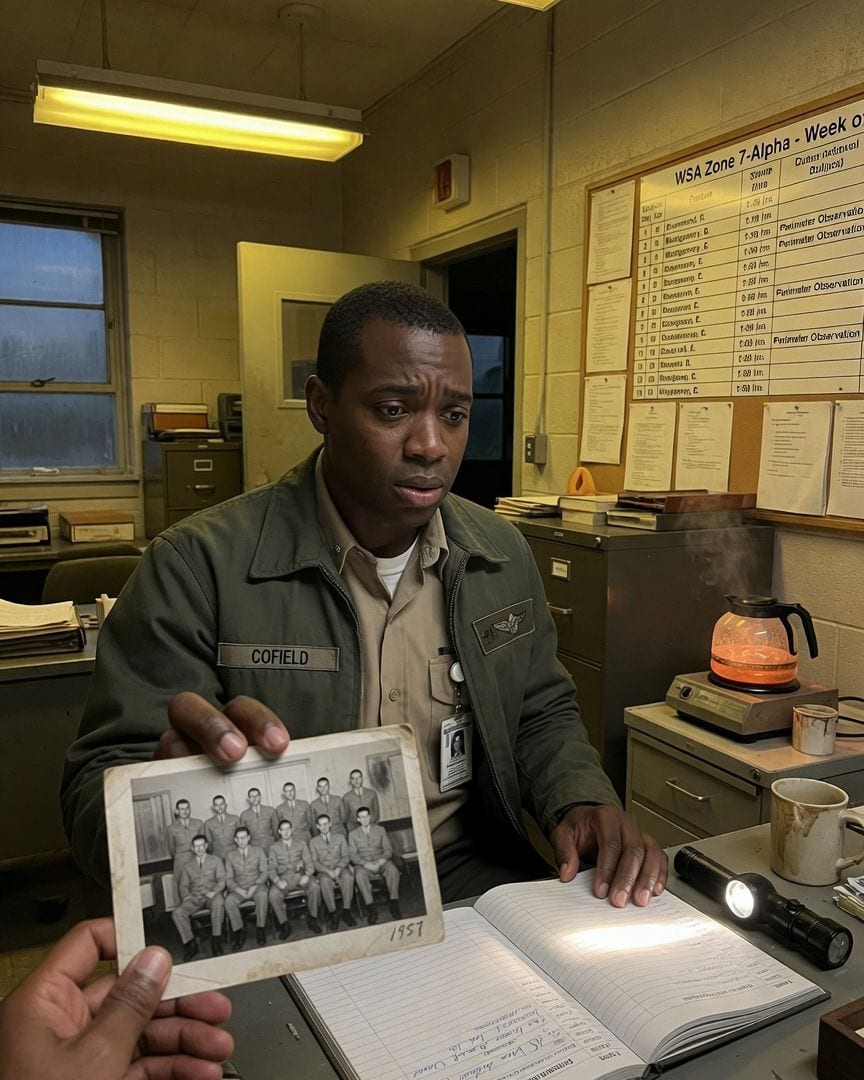
On his last patrol, Senior Airman Cofield found hot coffee steaming inside a base building mothballed since 1992. The fresh roster was signed by a man from a 1957 photo.
Senior Airman Felix Cofield was on his last perimeter patrol of the decommissioned Weapons Storage Area when an impossible light bloomed in the pre-dawn dark. The building had been mothballed for decades, yet a warm, unnatural glow pulsed from within. Ignoring Central Security's all-clear, Cofield found an unlocked door and a brightly lit office, as if someone had just stepped out. A freshly printed roster for the coming week lay on a corkboard, and a coffee pot on the counter was still steaming hot. Then he saw the faded group photo from 1957, showing the very man who had just signed today's logbook.