Airman Cofield, two weeks from transfer, found a warm coffee pot in a building without power for thirty years. Its new shift roster listed a name that didn't exist.
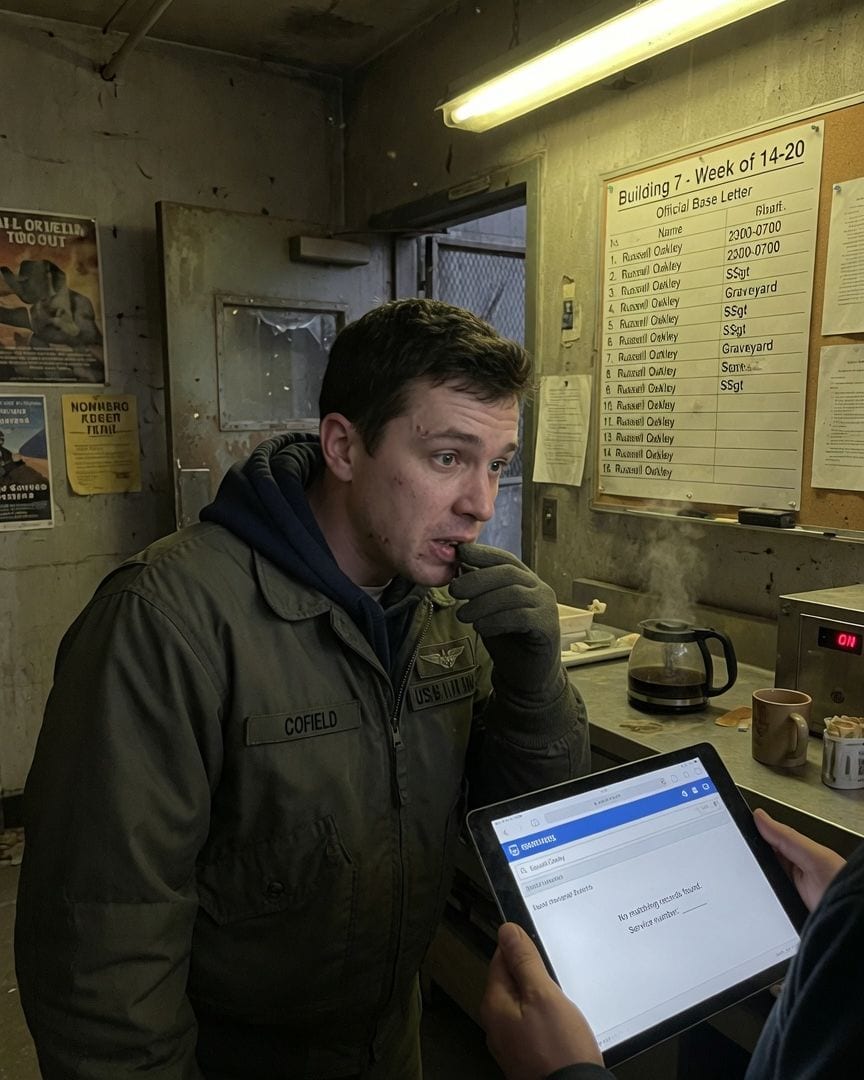
Senior Airman David Cofield, two weeks from his long-awaited transfer, drove the perimeter road of the decommissioned weapons storage area. The air was still and cold, the only sound the crunch of tires on gravel.
Ahead, through the chain-link fence, the alarm-monitoring building — Building 7 — sat dark, as it had since 1992. No power, no personnel, just a concrete shell. It was a concrete tomb, a forgotten relic of a mission long concluded.
Then, a faint light bloomed in one of its windows, a warm, yellow square against the pre-dawn gloom. Cofield blinked, slowing the patrol vehicle to a crawl.
He rubbed at his eyes, convinced the fatigue of the graveyard shift was playing tricks on him. He drove another hundred yards, then pulled the vehicle over, kill switch engaged. The light remained, steady and unwavering.
Central Security Control showed the zone clear, no maintenance, no entry logged for Building 7 in over thirty years. He radioed Sergeant Richard Montgomery, his voice tight, the words catching in his throat.
Minutes later, their two-man patrol reached the building. The chain-link gate was latched, but a quick inspection showed a section of the fence, old and rusted, had been bent just enough to slip through.
The heavy steel door to Building 7, surprisingly, was unlocked. Montgomery tried the handle first, then nudged it open with his boot, his weapon already drawn. Cofield followed him in, his own hand hovering over his holster.
Inside, the low hum of fluorescent lights, a sound that shouldn't exist, filled the silence. The air was thick with the smell of stale coffee, cutting through the usual concrete dust.
The room was a relic, but one that had recently been in use. On a bulletin board, tacked up with fresh pins, hung a shift-change roster for the coming week. Names, ranks, times – all meticulously laid out.
On a counter nearby, a coffee pot, still warm to the touch. Cofield extended a gloved hand, feeling the impossible heat radiate into his palm.
It felt like a deliberate challenge, a solid, undeniable fact in a place that defied all facts.
Sergeant Montgomery arrived, his face a mask of professional skepticism that slowly crumbled as he took in the impossible scene.
He ran his hand over the still-warm coffee pot, his lips thinning into a grim line, then pulled out his phone, calling Central Security Control again.
He demanded a full systems check on Building 7, his voice laced with an urgency Cofield had rarely heard from him. “Negative, Sergeant. Zone clear. Building de-energized.
No power draw detected,” the dispatcher's voice crackled back through the phone’s speaker, tinny and distant, yet unnervingly certain. Montgomery swore under his breath, a low, frustrated sound.
He walked over to the shift roster, pulling it gently from the bulletin board. It was printed on official base letterhead, crisp and new, meticulously filled out with names, ranks, and shift times.
Everything looked perfectly legitimate, except for the sheer impossibility of its existence in a building that had been dead for decades.
Cofield watched Montgomery pull up the current base roster on his tablet, cross-referencing names one by one, his thumb swiping with increasing speed. Most matched active personnel. Then Montgomery paused, a frown deepening on his face. “Who’s Russell Oakley?”
he muttered, tapping the screen with a gloved finger. Cofield leaned closer. The name was listed for the graveyard shift, same as Cofield’s. “Never heard of him, Sergeant. Not in my unit,” Cofield replied, a knot forming in his stomach.
Montgomery typed the name into the base-wide personnel database. The search returned nothing. No active service member, no transferred, no discharged, no retired.
Just a blank entry where a service number should be, as if the name existed only on that printed sheet. The screen hummed, mocking them with its emptiness.
Montgomery tried variations, checked old archived manifests, even called a retired records clerk he knew, his questions growing sharper with each failed attempt. Each search came back empty.
The name 'Russell Oakley' was perfectly rendered, complete with a plausible rank and unit designation, but it simply did not exist in any official record, digital or paper.
Yet, it was right there, on a physical roster, for a building that shouldn't even have power. The fluorescent lights flickered once, making the shadows dance, then steadied again.
Cofield watched Montgomery scroll through the digital personnel database, his brow furrowed in disbelief, a vein throbbing faintly at his temple.
Montgomery pointed a finger at the screen, then at the printed roster, a single name on both, 'Russell Oakley', yet the database showed no matching record, only an empty blank where a service number should be.
The next morning, Montgomery filed a formal report, citing 'unexplained activity and personnel discrepancy.' Captain Eileen Bishop, the Security Forces Squadron Commander, dismissed it with a wave of her hand and a tight smile.
She called it a glitch, a prank, or a tired airman's error, before redirecting Montgomery to focus on actual security concerns. But Cofield couldn't let it go.
His transfer loomed, a concrete escape from this dead-end base, a future waiting for him, but the name 'Russell Oakley' gnawed at him, a splinter under the skin.
He started digging in his off-hours, using his access to the base's older, less-digitized archives. He spent hours in the dusty records room, the stale air thick with the smell of old paper and forgotten facts.
He found boxes of manifests from the 80s and 90s, when Building 7 was active, when the silos were still hot.
He cross-referenced names, looking for any 'Oakley' that might have been misfiled or forgotten, his fingers stained with ink and grime. Days turned into nights spent sifting through microfiche and faded printouts, the whir of the reader a constant companion.
He found no Russell Oakley.
But he did find something else: several instances, spread across decades, of personnel records with incomplete data, strange 'transfer codes' that didn't align with standard military procedures, and vague 'reassignment' notes to internal base sectors that didn't officially exist.
The pattern was subtle, almost invisible, easily dismissed as clerical errors by anyone not looking for it.
The deeper Cofield dug, the more he realized these weren't errors; they were holes, carefully papered over, a quiet, almost imperceptible erosion of the official narrative.
Cofield’s unscheduled archival searches didn't go unnoticed. Captain Bishop called him into her office, her demeanor cool and clipped, the air in the room dropping several degrees.
“Airman Cofield, your upcoming transfer is contingent on maintaining focus on your current duties,” she stated, her gaze unwavering, fixed on a point just over his shoulder. “Your recent… extracurricular activities… are a distraction. I suggest you cease immediately.”
It wasn't a warning; it was an order, delivered with the quiet force of institutional authority. The silence that followed was heavy, almost suffocating. Later that week, Cofield found a note tucked into his bunk, folded precisely.
It was printed on plain white paper, no signature, no identifying marks: 'Some things are better left buried. Especially those that don't stay buried.' He felt a chill that had nothing to do with the draft in the barracks.
It was a targeted message, a breath of cold air against his neck. Someone was watching him, someone who knew what he was looking for, someone who knew enough to warn him.
Despite the intimidation, Cofield pressed on, now more certain than ever that something genuinely wrong was being hidden. The note had confirmed his suspicions.
He remembered Montgomery mentioning a retired records clerk, Patricia Vaughn, who knew the base’s history better than anyone. Montgomery had used the phrase "knows where all the bodies are buried," a dark joke at the time.
Cofield tracked her down to a small house off-base, nestled among overgrown trees, hoping she might shed light on the strange 'transfer codes' he’d found.
He knocked on her door, the setting sun casting long shadows through the branches, making the quiet street feel unnaturally still.
Patricia Vaughn, a woman with sharp eyes behind thick glasses and a weary smile, invited Cofield in. Her living room was cluttered with books and old photographs, a faint smell of lavender and dust in the air.
He showed her copies of the anomalous records, the strange transfer codes, and the name 'Russell Oakley' from the Building 7 roster. She looked at them, her expression unreadable, a faint flicker in her eyes.
“Ah, 'Russell Oakley',” she said, her voice soft, devoid of surprise, as if confirming a long-held suspicion. “He’s one of the old ones.” Cofield felt a jolt. “What do you mean, 'old ones'? These records are decades apart.”
Patricia settled into a worn armchair, her gaze drifting to a sun-drenched window. She explained that the base, particularly the decommissioned 'special weapons' area, had always had… 'peculiarities'. Personnel would sometimes appear, sometimes disappear, or their records would subtly shift.
Not officially, not on the main manifests, but in a separate, unspoken accounting. “The system always reconciles itself, Airman,” she said, her voice quiet, almost a whisper. “One way or another. But sometimes, it needs a little… help.
A name here, a transfer there, that only exists on a certain set of books.”
She spoke of a classified ledger, kept by a select few, that tracked these 'non-reconciling personnel events'. It wasn't a cover-up of a crime, she insisted, but a 'management protocol' for an ongoing anomaly. The phrase itself felt chilling.
“They don’t stop it, Airman. They just account for it,” she whispered, her eyes meeting his, ancient and knowing. “They’ve known since before the silos were even dug. You found the roster, didn't you? The one for Building 7?
That building has always been… active. Just not for us.” Cofield felt a cold certainty settle in his gut, a growing dread that solidified into a horrifying, coherent pattern.
The hot coffee, the impossible roster, the blank database entry for Russell Oakley – it all clicked. The institution wasn't just hiding a mistake; it was actively maintaining a horrifying truth, a terrifying balance.
Patricia Vaughn led Cofield to a hidden compartment behind a loose floorboard in her study. The wood creaked faintly as she pried it open.
From within, she produced a heavy, leather-bound ledger, its pages yellowed and brittle, smelling faintly of mildew and iron. “This is the 'Operational Anomaly Ledger',” she said, handing it to him, the weight of it feeling immense in his hands.
“They thought they’d collected them all. But I kept one.” The ledger was filled with meticulous, typewritten entries, dating back to the 1960s, a testament to decades of silent record-keeping.
It listed names, dates, and 'Disposition Codes' that Cofield had never seen in any military regulation. His heart hammered in his chest as he turned the brittle pages. He found entries for 'Russell Oakley', marked with a 'Disposition Code 7'.
He scrolled through the decades of impossible names, impossible transfers, each one a testament to the institution's chilling, quiet management of the unknown. The room grew colder around him.
Then, halfway down a page, under an entry dated for the current year, his own name leaped out at him. David Cofield. Sr. Airman. Disposition Code 7. ETA: 2 Weeks. The date next to it was today’s.
David Cofield stared at the faded, typewritten entry in the 'Operational Anomaly Ledger': 'COFIELD, DAVID. SR. AIRMAN. DISPOSITION CODE 7. ETA: 2 WEEKS.' The date next to it was today's.
He felt a cold, sinking dread as the words swam before his eyes, realizing his transfer isn't an exit, but an assignment.
Cofield’s mind reeled. His transfer, the one he’d looked forward to, the one he’d counted down the days to, was a lie. A cover-up for his own 'disposition'.
Patricia Vaughn watched him, her eyes full of a profound sadness, a deep understanding of his sudden, crushing realization. “Disposition Code 7,” she explained softly, her voice barely audible. “Is for 'Integration into Sector 4'. Building 7.
It’s where they go. Or where they come from. It’s the nexus. The system needs to replace what it takes. And it likes to keep its books balanced.”
She revealed that the 'ghosts' on the rosters, like Russell Oakley, were not just random appearances, but entities that slowly replaced or assimilated individuals whose records were marked for 'disposition'.
The hot coffee, the active lights—these were traces of the 'new' occupants, the ones accounted for in this hidden ledger. These were the echoes of those who had been integrated.
The institution had long ago realized it couldn't stop the anomaly; it could only contain it, and, in a twisted form of accountability, manage its 'personnel exchanges'.
Cofield’s transfer orders, his new assignment, were simply the official paperwork for his quiet, systematic disappearance.
The ledger wasn't just a record of what had happened; it was a prophecy, meticulously maintained by the very system designed to protect him, a system that would now consume him.
Cofield tried to report the ledger. He snatched up his phone, his hands shaking, and called Montgomery, but the Sergeant’s phone went straight to voicemail, ringing endlessly in an empty space.
He tried to contact other airmen he knew, trusted friends, but his calls went unanswered, bouncing to voicemail or ringing out. The network seemed to be working against him.
He even attempted to go back to Captain Bishop, the heavy ledger clutched in his hands, proof undeniable.
But as he tried to leave the base, he was met at the gate by two MPs who politely, but firmly, informed him that his transfer orders had been expedited. He was to report to the transport bay immediately.
There was no argument, no resistance possible. The system was too vast, too ingrained, too perfectly accounted for. He was an entry in a ledger, not a person with agency.
As he was driven towards the transport bay, the back of the MP's vehicle smelling faintly of stale coffee and exhaust, he glimpsed Building 7.
The single light in the window seemed to wink at him, a knowing, malevolent eye in the pre-dawn gloom. He knew his destination. It wasn’t a new base; it was a new assignment within the anomaly itself.
The dread wasn't in fighting it, but in the quiet, absolute certainty of his fate. He was being accounted for.
He was becoming one of the numbers that would never reconcile for anyone else, but would perfectly balance the institution's dark, hidden books.
His identity was already subtly shifting, the edges blurring, as if the ledger entry was already taking precedence over his own self.
He felt a quiet, almost serene resignation, a part of him already accepting the new role, the new parameters of his existence.
Senior Airman David Cofield’s personal effects were packed and shipped to his listed next of kin. His bunk in the barracks was quickly filled by a new recruit, eager and oblivious.
Sergeant Montgomery was informed that Cofield’s transfer had gone through smoothly, and his new assignment was classified.
Captain Bishop closed Cofield’s file with a quiet efficiency, then marked the 'Operational Anomaly Ledger' as 'Reconciled: One new entry for Sector 4, Building 7.'
The base continued its quiet operations, the perimeter patrols running as always, the records meticulously kept.
No one questioned the suddenness of Cofield's transfer, or the blank look in his eyes if they had seen him on his way to the transport. The world outside the anomaly remained undisturbed, unseeing.
The next morning, his transfer orders were quietly updated, listing his new assignment as 'Permanent Detail, Sector 4, Building 7'.
If this one got to you
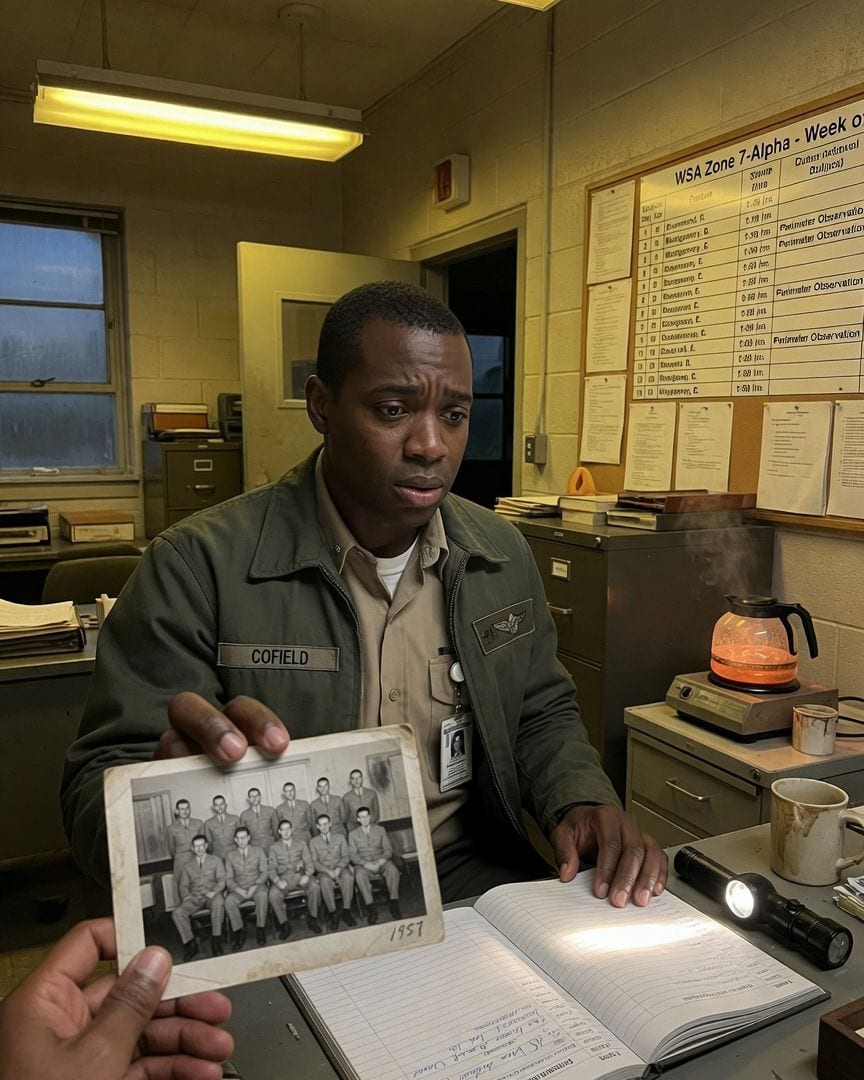
On his last patrol, Senior Airman Cofield found hot coffee steaming inside a base building mothballed since 1992. The fresh roster was signed by a man from a 1957 photo.
Senior Airman Felix Cofield was on his last perimeter patrol of the decommissioned Weapons Storage Area when an impossible light bloomed in the pre-dawn dark. The building had been mothballed for decades, yet a warm, unnatural glow pulsed from within. Ignoring Central Security's all-clear, Cofield found an unlocked door and a brightly lit office, as if someone had just stepped out. A freshly printed roster for the coming week lay on a corkboard, and a coffee pot on the counter was still steaming hot. Then he saw the faded group photo from 1957, showing the very man who had just signed today's logbook.
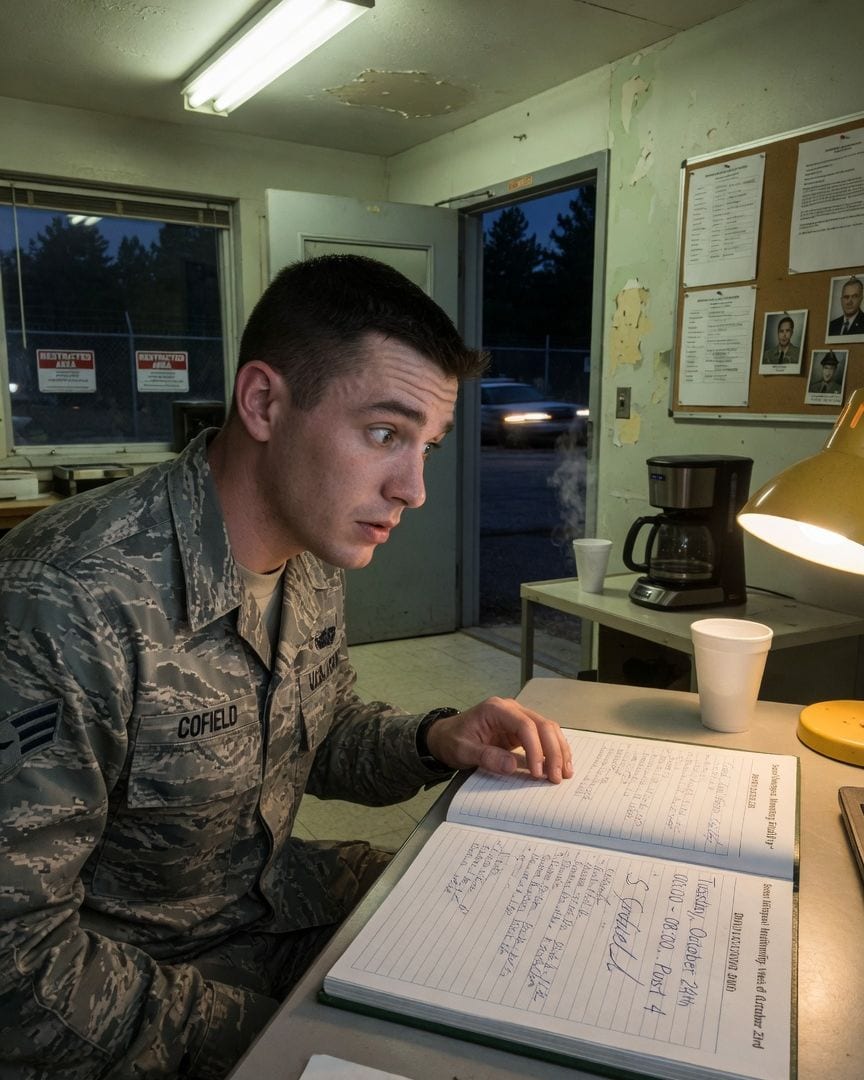
Two weeks from discharge, Senior Airman Cofield found his own signature on a logbook for an impossible shift at a facility mothballed decades ago.
Senior Airman Simon Cofield was just two weeks from discharge when he patrolled the quiet, forgotten perimeter of a mothballed weapons storage area. On a night thick with pine scent, he spotted a faint yellow light in a building officially powered down for over three decades, its alarm system inert. Inside, the building hummed with power, spotless, with hot coffee brewing and a crisp shift-change roster on the wall. But Cofield froze when he found a duty logbook with current entries, including his own name and signature, assigning him to an impossible shift next Tuesday. A cold dread settled as he realized something had just claimed him for a duty that no longer existed.
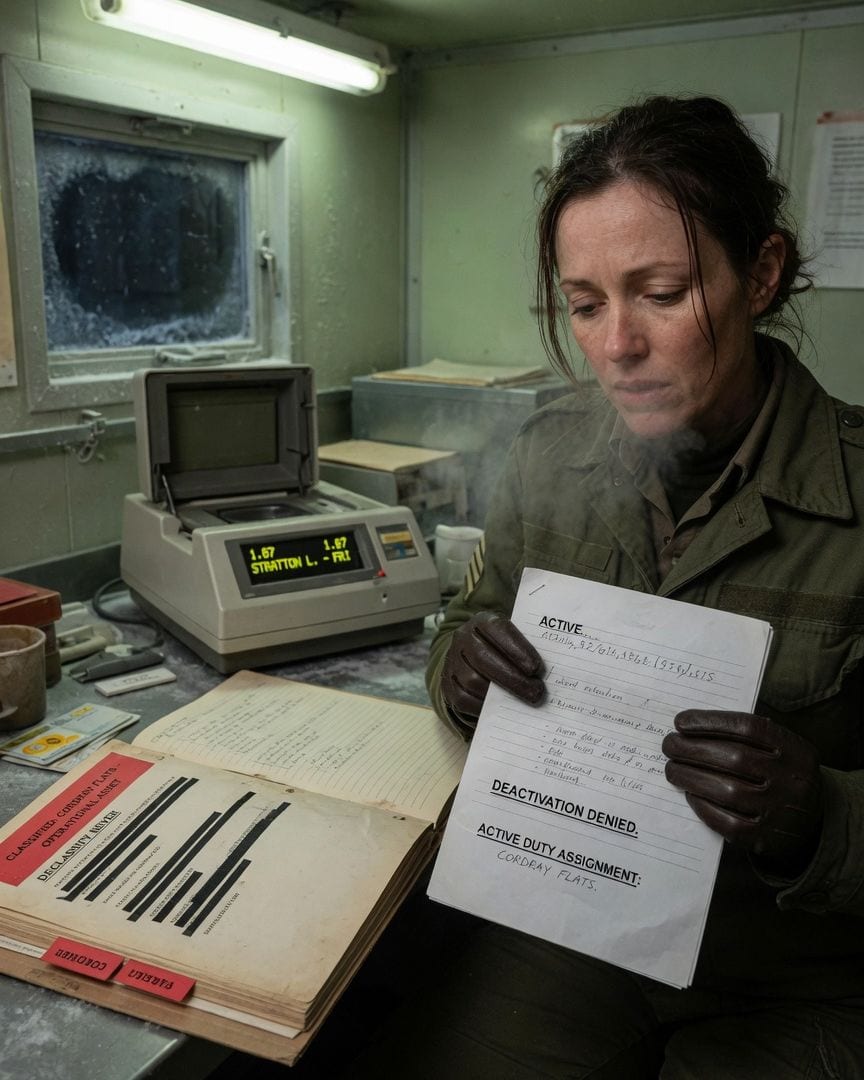
A dead researcher's Cold War film-badge was manually dated for active duty next Friday at Cordray Flats.
Corporal Hettie Vance moved like a ghost through the cold, empty Cordray Flats in the winter of 1988. The decommissioned range was quiet, her film-badge processing a rote exercise, until the 141st badge appeared. It belonged to Leonard Stratton, a research assistant who'd died in 1987, yet the scanner showed a full working exposure. Hettie found its date wheel manually reset for the coming Friday, and a secret file later confirmed an impossible directive: 'ACTIVE DUTY ASSIGNMENT: CORDRAY FLATS.' Who reset the badge, and for what purpose, on a range supposedly abandoned?
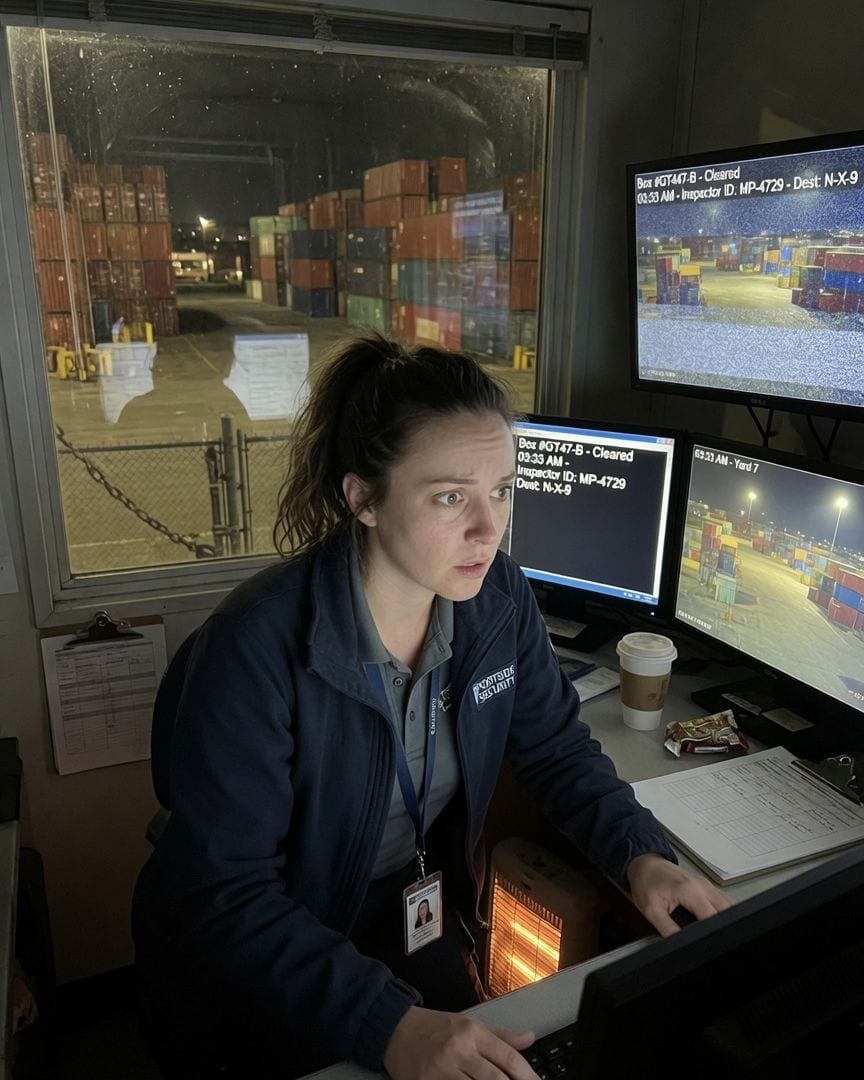
The log says a container cleared my gate at 3:33 AM, stamped with my ID — but the gate was chained and locked, and the yard beyond it was dark and empty. No truck was ever booked.
My night shift at Portside Container Terminal is usually a predictable drone of monitors and stale coffee. But then I saw a familiar guard, Arthur Larsen, on a live feed, smiling unsettlingly at the camera. The next morning, my supervisor searched for him; the employee database returned 'No results found.'
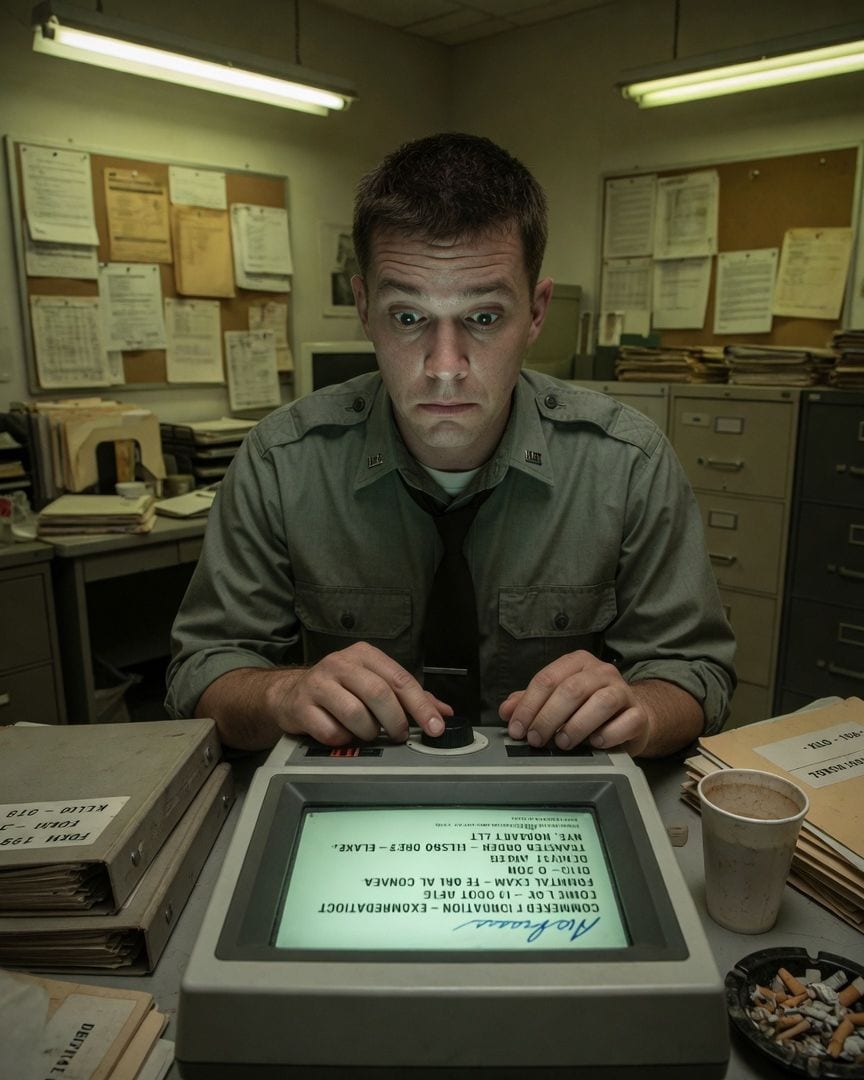
A missile commander watched his ten nuclear silos go dark. His own service record shows his signature on a future he's never lived.
Second Lieutenant Hobart Nye, a missile commander in Wyoming, had his quiet 0247 watch shattered by a security report: a massive, silent black triangle hovered over Launch Facility Kilo, casting a perfect shadow. Hobart watched his console's fault panel light up, signaling all ten nuclear missiles going dark in an impossible silence, followed by eleven minutes his security team could not remember. Official logs called it a "radio malfunction," but Hobart found a requisition for invisible-tracking sensors, signed by a base commander who was supposed to be off-base. The final, chilling discovery came when his own service record showed new entries—a dental check-up, a transfer to Alaska—all dated for a future he never lived, complete with his perfectly replicated signature.
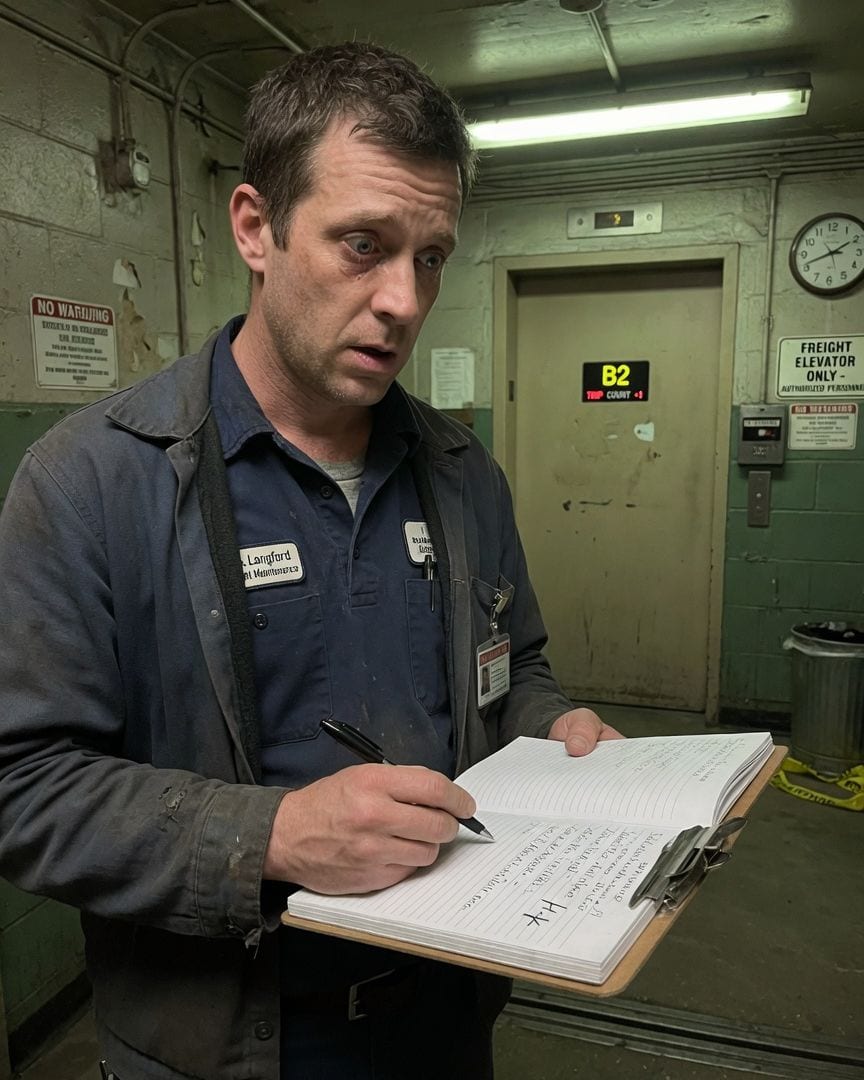
A man just took the elevator to the sealed sub-basement. He isn't on any staff roster, but my initials are in the logbook.
As a maintenance worker, my job is mostly routine, like signing the daily log for the old building's freight elevator. But one night, the log showed a trip to the sub-basement, sealed for a decade, timestamped with my key-switch and signed with my own initials, for a run I never made.