An inventory officer found a bunker's log of soldiers, then found one of their dog tags marked 'KIA, 1970'.
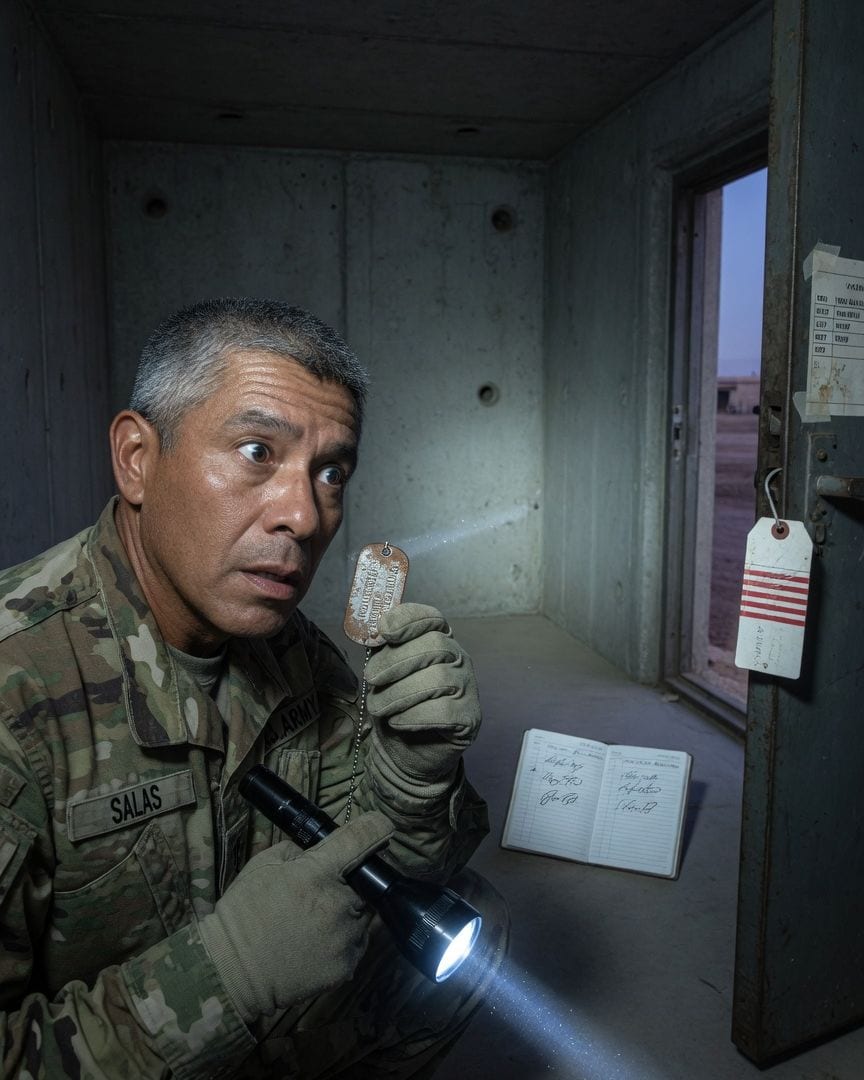
Chief Warrant Officer Gideon Salas, a squared-away professional with two decades of service, meticulously oversaw the inventory of the Hawthorne Ammunition Depot.
The high desert winds whipped dust against the faded green of the earth-covered igloos, counting down the two weeks until its final closure. Each bunker was accounted for, each lock, each seal, each data card verified against the master map.
Then he reached the eastern perimeter.
There, nestled amongst the familiar mounds, was one more igloo than the depot's own map allowed: Bunker 40. It bore a current, official lock, a pristine tamper-evident seal, and a magazine data card taped inside its heavy steel door.
The card listed lot numbers for a munition the Army had retired before Salas had ever enlisted. A small, official duty logbook was propped open nearby, its current entry detailing a recent inspection. The seal number matched the log.
But the precise, almost identical signatures beneath the entry belonged to men the depot roster, a document Salas knew by heart, had never carried.
Salas returned to his makeshift office in the depot's main administrative building, the duty log from Bunker 40 clutched in his gloved hand.
He cross-referenced the names against the master roster, then the digital personnel database, and finally, after a secured login, against the Army's historical service records. Nothing.
The names – 'PFC James Thornton,' 'SGT William Ingram,' 'CPL Donald Fairfax' – were ghosts.
No active service member, no veteran, no past recruit had ever borne those exact combinations at this depot, or even in any unit that could plausibly be assigned here.
It wasn't a clerical error; the system swore these men didn't exist.
He re-examined the signatures. They were unnervingly uniform, a precise, almost mechanical script, as if drawn by the same hand, despite the different names.
This wasn't a prank; the meticulousness of the seals and the dated log entries ruled that out. Salas's gut, honed by years of military order, churned with a primal unease.
He knew what the paperwork said, but he also knew what his eyes had seen. Bunker 40, and the names associated with it, were an anomaly that screamed a profound, systemic wrongness. He decided he had to get inside.
Armed with his master key and override codes, Salas returned to Bunker 40. The lock clicked, the seal snapped, and the heavy door groaned open, revealing a surprisingly stark, cold interior.
It was empty of munitions, unlike any bunker he'd ever seen. The air was still, dry, and carried a faint, metallic scent. His flashlight beam cut through the gloom, revealing bare concrete walls and floor.
His boot scuffed against something small, metallic, on the ground near the far wall. He bent, picking up a faded, corroded dog tag. He dusted it off, his fingers tracing the raised letters. The name: 'Private James Thornton.'
He recognized it immediately from the anomalous duty log. Salas's heart hammered. He turned the tag over, and the flashlight caught a date etched on the back, barely visible through the corrosion: 'KIA, 1970.'
He froze, the implications hitting him with a sickening lurch.
Back in his office, the dog tag heavy in his palm, Salas accessed the secure military database again. He input Private James Thornton's service number from the tag. The system confirmed it: KIA, Vietnam, 1970.
The record was irrefutable, archived, and marked as closed decades ago. Yet, Thornton's signature was undeniably in a duty log dated last week. Salas felt the cold dread solidify. This wasn't a mistake; it was a deliberate, impossible contradiction.
He began searching old depot logs, not just for Bunker 40, but for any mention of 'special containment' or 'unlisted assets.'
He found scattered, heavily redacted entries from the late 70s and 80s referencing 'Maintenance Rotation 40' or 'Unit Alpha Containment,' but never with names, only coded personnel identifiers.
The official records, for all their meticulousness, were a sieve, expertly crafted to show nothing while hinting at everything.
Salas widened his search, cross-referencing similar remote depot closures across the country, looking for any pattern of 'extra' bunkers or 'retired' munitions appearing in unusual contexts.
His access allowed him deep dives, and he found faint echoes: other depots, other retired munitions, other 'unlisted' facilities mentioned in passing in obscure audit reports, always with vague, unnamed personnel.
A pattern was forming, not of isolated incidents, but of a systemic, enduring anomaly. The dread was no longer personal, it was institutional.
Salas's unusual, deep-diving queries into historical and cross-depot records did not go unnoticed. A week later, Captain Eleanor Marsh arrived, officially for a 'pre-closure audit review.' Marsh was impeccably dressed for the desert, her gaze sharp, missing nothing.
She observed Salas with unnerving calm, her questions precise and pointed. 'Your focus on these... historical anomalies, Chief Warrant Officer,' she remarked, gesturing to his screen displaying an old, redacted report.
'It's thorough, but perhaps outside the scope of a standard inventory.' Salas tried to deflect, citing his 'commitment to comprehensive documentation for the sake of future historical records.' Marsh smiled faintly, a thin, knowing curve of her lips.
'Hawthorne's closure is on a tight schedule, Salas. Don't chase ghosts where there are only dust devils.' The warning was clear.
That night, after securing Bunker 40 and his office, Salas returned to retrieve a forgotten file. A faint light emanated from Bunker 40. He approached cautiously, his service pistol unholstered. The light vanished. The door was sealed, the lock undisturbed.
But a faint, almost imperceptible scratch marred the pristine seal, a subtle tampering he knew hadn't been there. He was no longer just investigating; he was being observed, warned, and actively countered. Someone knew exactly what he was doing.
The next morning, Salas confronted Captain Marsh in her temporary office. He laid out the evidence: Thornton's dog tag, the conflicting KIA record, the recent log entry, and the pattern of redacted reports from other depots.
Marsh's calm facade, usually impenetrable, wavered. Her eyes, fixed on the dog tag, grew distant. She didn't deny it. Instead, she rose and walked to the window, staring out at the desolate landscape.
'Some things, Salas, are beyond the purview of standard inventory. Some assets are... self-maintaining.' She turned, her voice low, almost a whisper. 'Bunker 40 isn't for munitions. It's a containment unit. Not for a weapon, but for a process.
A process that requires... personnel.' She explained, without emotion, that the 'retired munitions' were a euphemism, a code for the identities that were 'retired' from official records, subsumed into the anomaly's maintenance cycle.
The 'unknown men' were its current caretakers, their consciousnesses repurposed, their old lives erased. She described how the Army, unable to destroy or fully understand it, had learned to manage it, to feed it, to keep it contained.
'It's a necessary evil,' she concluded, her gaze unwavering. 'A cost of doing business in a world where not everything fits neatly into a manifest.'
The horror was not just the anomaly, but the realization that the institution itself was complicit, treating human lives as 'assets' to be 'repurposed,' and that this truth was a guarded secret, known by a select few.
Captain Marsh, seeing the profound horror on Salas's face, offered a chillingly practical piece of advice. 'Complete your inventory, Chief Warrant Officer. Seal Bunker 40. And forget it. It's the only way to stay... functional.'
She walked to a dusty bookshelf, pulling down a thick, leather-bound binder. 'Historical records,' she said, placing it on his desk. 'For context. To understand the scope.'
Back in his office, Salas sat alone, the binder open before him. It was filled with similar anomalous logs, hand-drawn maps of unlisted facilities, and redacted reports, spanning decades.
He saw the grim pattern across rotations and dates, the same discrepancies repeating in different forms at different remote outposts. The anomaly was ancient, pervasive. Then, a particular page caught his eye.
A duty roster from twenty years prior, for an inventory duty at this very depot. His breath caught. Listed as a junior CWO, assigned to 'Special Containment Unit 40: Inventory & Maintenance.' And next to it, his own signature.
His hand, unmistakable. But Salas remembered with perfect clarity that he had been deployed to a remote base in Germany that year, thousands of miles away.
He stared at the familiar script, his own signature, knowing he could not have written it. The implication crashed down on him: he was always meant for this. He was already part of its history.
Salas, clutching the old log with his impossible signature, burst back into Marsh's office. 'This! Explain this!' he demanded, thrusting the binder at her. Marsh didn't flinch. Her calm, now tinged with a weary resignation, returned.
'The anomaly,' she began, her voice flat, 'is a form of identity absorption. A self-replicating process that targets individuals with precise qualifications. It doesn't just consume, Salas. It recruits.
It identifies suitable candidates, then subtly manipulates events, records, assignments, to draw them into its sphere.' She explained that the 'retired munitions' were a grim pun, referring to the process of 'retiring' the original identities of its new 'caretakers.'
The pre-existing log entry with his name wasn't a mistake; it was a prediction, a pre-programmed assignment. The anomaly had been grooming him, waiting for his skillset, his experience, his rational mind, to become its next cog.
Marsh revealed that the entity, if it could be called that, fed on the meticulous order of the military, using its own systems to perpetuate itself.
Every clue Salas had found—the extra bunker, the retired munitions, the unknown signatures, even his own name in an impossible record—snapped into horrifying coherence. He wasn't just observing an anomaly; he was its designated successor.
The realization was a cold, hard knot in Salas's stomach. He refused to become another 'caretaker.' He would not be consumed. He would not be repurposed.
He turned from Marsh, striding towards the depot's central control room, determined to trigger the master self-destruct sequence. Marsh followed, her voice cutting through the hum of the desert. 'You can't destroy what is, Salas!
You can only redirect its attention!' He ignored her, punching in the authorization codes, his fingers flying across the console. The depot's lights flickered erratically, the air growing heavy with static.
A low, resonant hum began to emanate from the direction of Bunker 40, vibrating through the concrete floor. Marsh's voice grew desperate. 'Destroying this instance will only cause it to manifest elsewhere! In another depot, another outpost!
It will draw in more people, more perfectly suited individuals!' Salas completed the final input. A siren wailed, a deep, guttural sound that tore through the desert quiet.
The hum from Bunker 40 intensified, becoming a tangible pressure in the air, a silent scream. The lights died, plunging the control room into near darkness, illuminated only by the emergency strobes.
The ground trembled violently, a deep, rumbling groan rising from beneath the earth. Salas stood firm, his jaw set.
The wail from Bunker 40 reached a crescendo, a sound of profound, ancient agony and immense power, then abruptly cut off, replaced by the sudden, deafening silence of the desert wind.
Marsh stared at him, her face a mask of horror, then relief, then something unreadable. The battle, for now, was over.
The Hawthorne Ammunition Depot was officially closed, its bunkers sealed tight. Salas's final report was filed, meticulously accurate in every detail, save for the complete omission of Bunker 40 and its contents.
Captain Marsh vanished from official records, her post dissolved, her existence quietly scrubbed. The inventory was marked complete, the depot shuttered.
Salas was granted an immediate transfer, reassigned to a remote, isolated outpost in the Alaskan wilderness, far from any desert.
He carried the knowledge of what he had seen, what he had done, and the chilling implication of what he had become part of. The self-destruct sequence had silenced Bunker 40, but the silence felt temporary, a held breath.
Salas performed his duties at the Alaskan outpost with quiet, almost mechanical efficiency. He never spoke of the desert depot, never mentioned the names on the logs.
The frigid air, the endless snow, the isolation – it all felt like a natural extension of the silence he now carried.
One night, checking a perimeter sensor on the far side of the outpost, he saw fresh boot prints in the deep snow.
They led, not to the fence line, but directly into a storage shed that wasn't on the outpost's official map. He walked to the shed, his breath pluming in the sub-zero air. The lock was current, the seal pristine.
Inside, propped against a stack of crates, was a duty logbook. The entries were recent, the seal number matched, and the precise, mechanical signatures were hauntingly familiar.
He recognized one name from the old desert depot logs, a name that should have been 'retired.' He didn't open the shed. He simply closed the logbook, its pages cold beneath his fingers, and continued his patrol.
The wind carried a faint, low hum from within the shed.
A week later, his relief, Sergeant First Class Thomas Bryant, arrived at the outpost. Bryant found Salas's patrol report, perfectly filed, but noticed a new entry in the shed's duty log, dated that morning.
A fresh signature, precise and mechanical, sat beneath the other names. It read: 'CWO Gideon Salas.' The hum was always there, waiting for its next caretaker.
If this one got to you
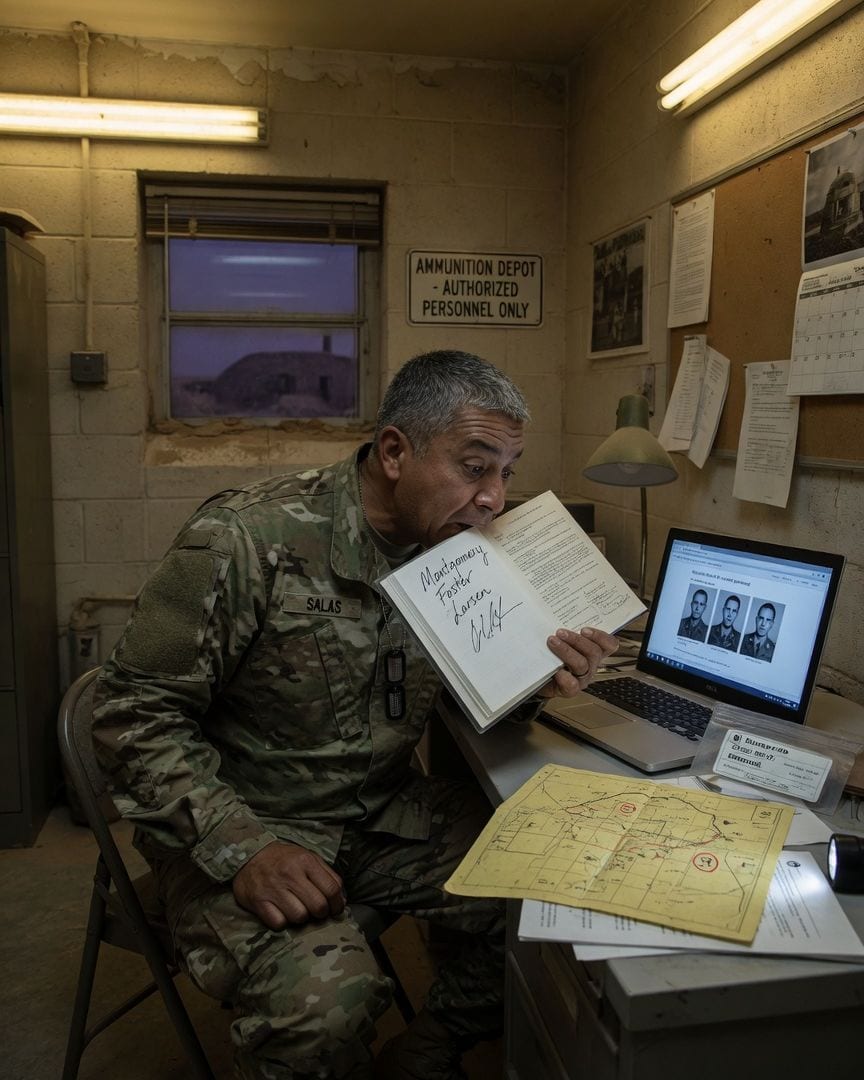
Chief Salas finds a new bunker seal signed by men d*ad or discharged decades ago.
Chief Warrant Officer Curtis Salas completes a final inventory at a desert munitions depot, finding an impossible fortieth bunker not on any map. Its fresh security seal bears signatures from three men: two officially K*lled in Action, and one honorably discharged, all decades ago. Someone, or something, just signed d*ad men's names to a new Army seal.
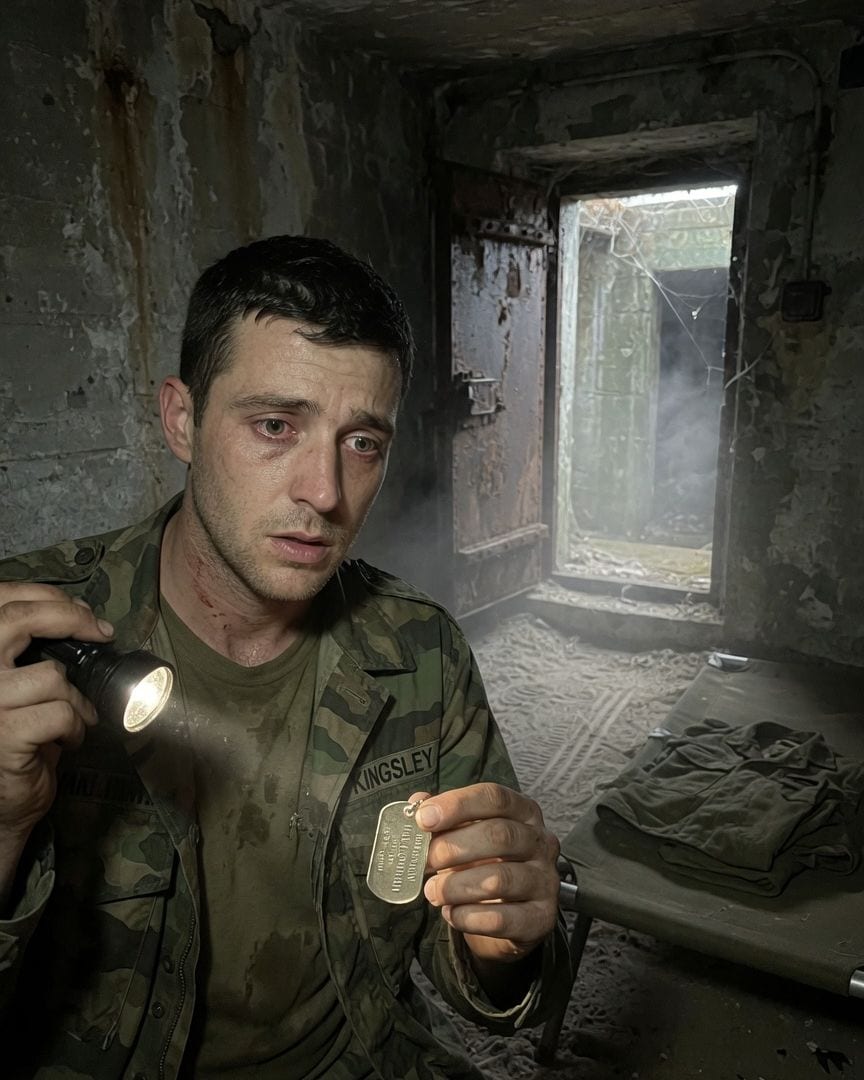
On his final rotation, a Private finds a WWII dog tag for 'Halloran' in a bunker sealed for eighty years.
Private Roland Kingsley endured the bone-deep weariness of his final graveyard watch at a reactivated WWII bunker on the Northern California coast, just hours from dawn and the end of his deployment. His searchlight cut through thick fog, revealing impossible figures: men in archaic WWII uniforms, assembling on the deserted beach, only to vanish moments later. As dawn broke, Kingsley discovered the bunker's rear hatch, sealed for decades, now stood mysteriously ajar. Inside, on an empty cot, lay a WWII-era field jacket, and in its pocket, a dog tag for 'Halloran' — a name impossible to the bunker's eighty-year history. What unseen presence had disturbed the long-sealed past?
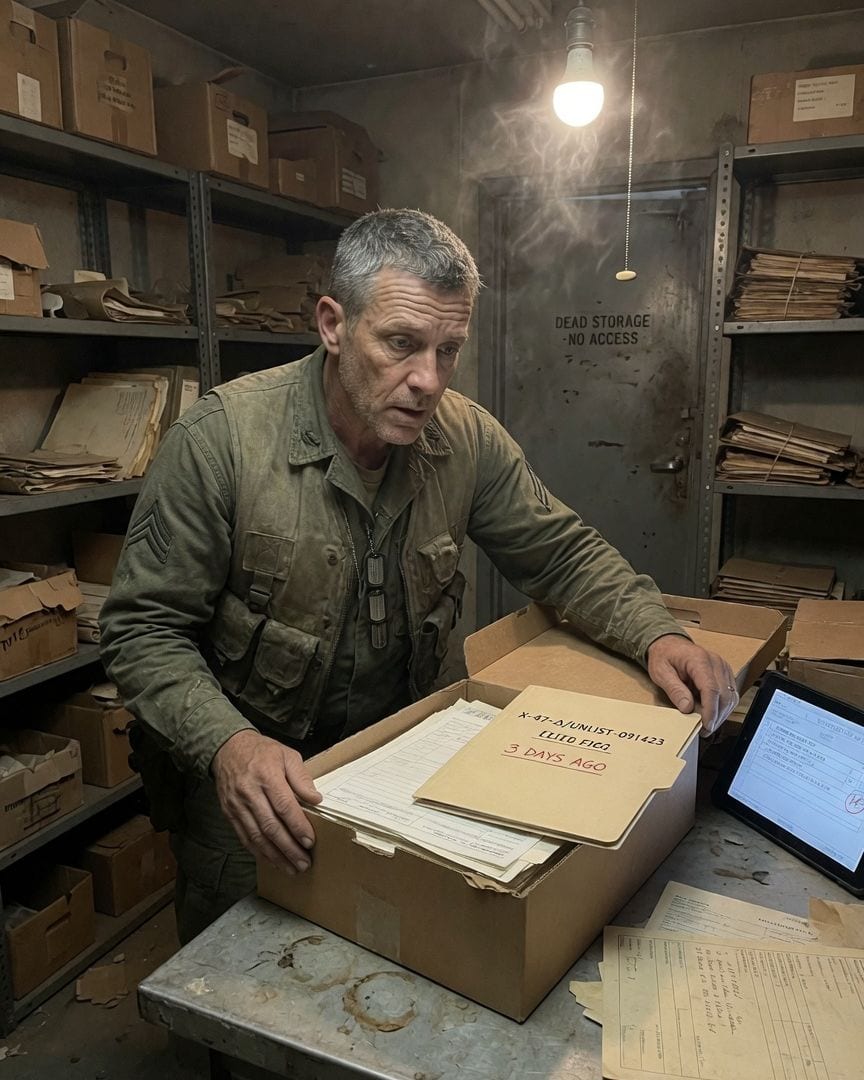
Sergeant Pryor, days from retirement, finds a four-hundred-foot crater. The desert floor is still warm, but no one remembers the blast.
Sergeant Alden Pryor, forty years old and just eleven days from retirement, drove the familiar Ranier Flats fence line for one of his final patrols. The desert stretched out, silent and vast, until he discovered a four-hundred-foot crater, dark and impossibly vast, where the sand had fused into slick glass. The ground within the crater was still faintly warm, a subtle heat defying the cool desert air. Yet, every official log confirmed the blast, while no one recalled a tremor or flash across three states.
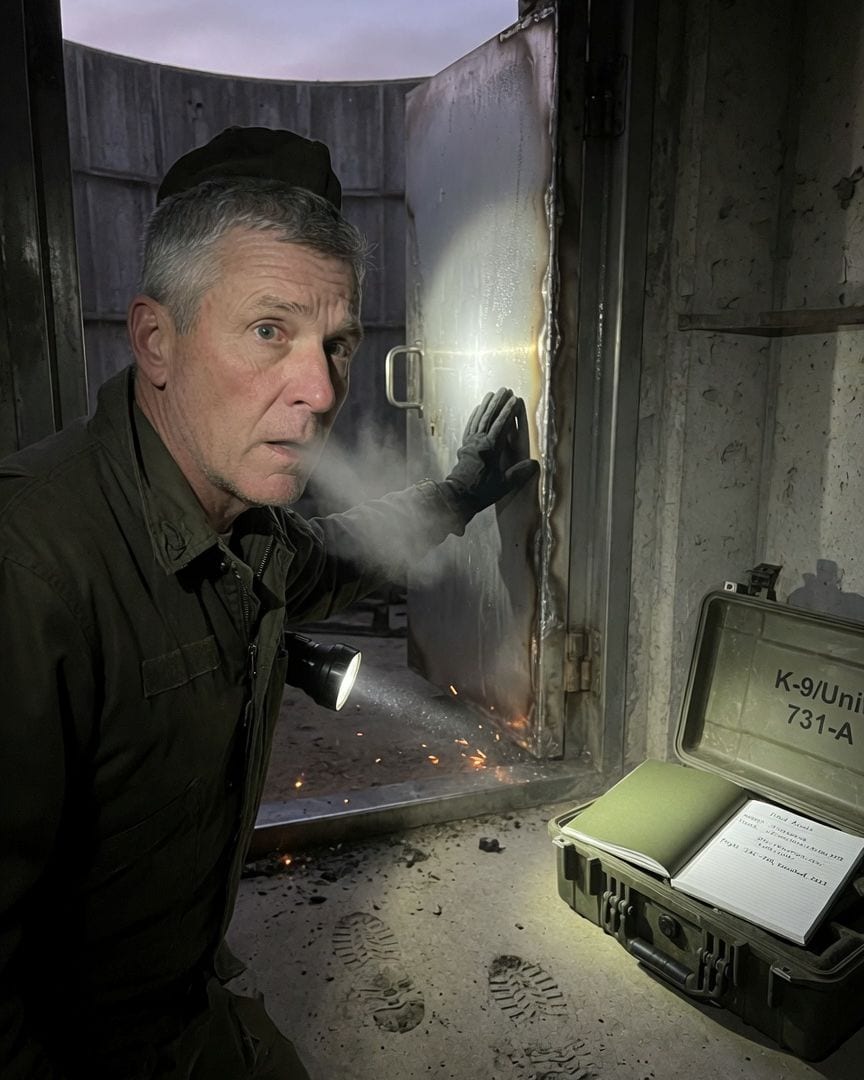
The Cold War silo was welded shut in 1968. A Captain found lights burning, fresh prints leading inside, and a logbook with a vanishing from last week.
Captain Merrit Sable faced a deadline at Silo K-9: one cold morning to retrieve classified hardware before its scheduled demolition at noon. The silo, officially welded shut by the Air Force in 1968 and long off-grid, should have been a tomb of forgotten machinery. Yet, through a cracked port, he saw nine work lights burning steadily forty feet down, and felt the faint suction of an active ventilation system. After breaching the decades-old weld, Merrit found more than just lights; fresh boot prints led deeper into the meticulously clean shaft, but none returned. A hidden compartment in an empty, warm hardcase revealed a logbook, its crisp pages detailing notorious military disappearances, with the latest entry dated just last week.
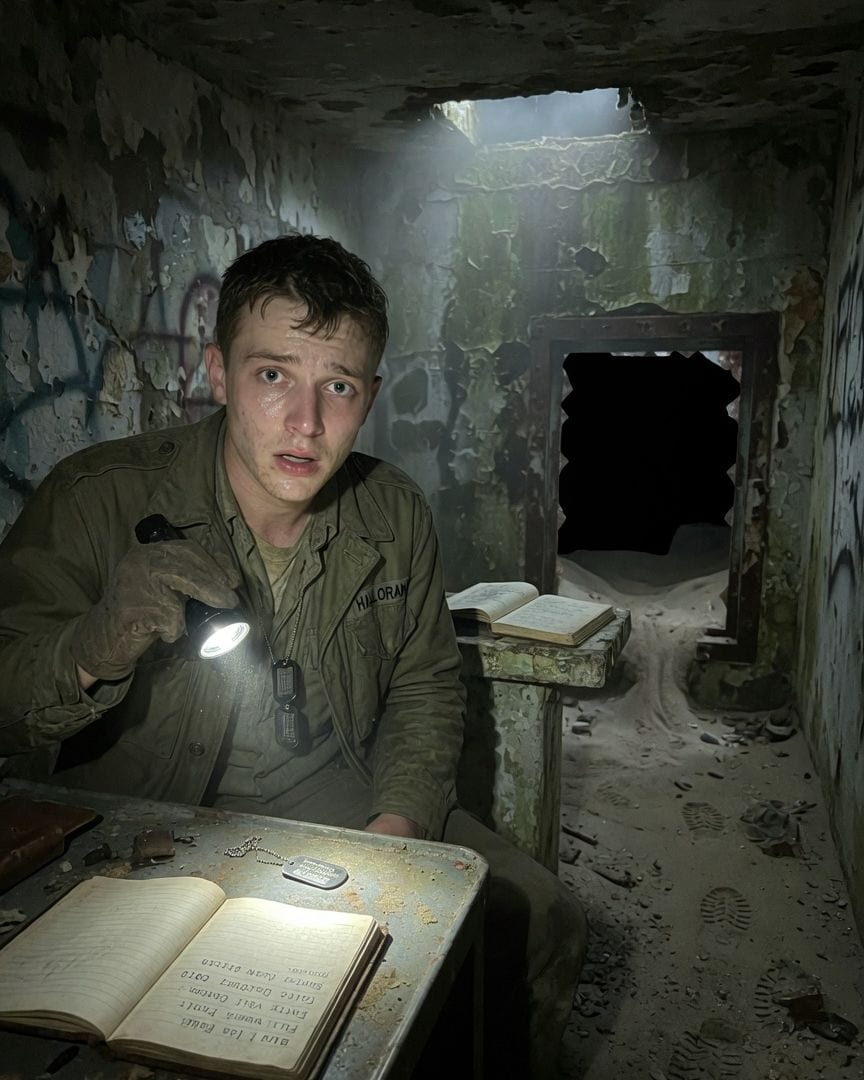
On his last lonely watch, a young private found the decades-sealed bunker hatch gaping open, with a logbook confirming an impossible landing.
Private Frank Halloran shivered through his final graveyard watch at a disused WWII bunker on a lonely California headland, just two days from his transfer. At 0100, a thick fog swallowed the ocean, and through the swirling gray, figures in archaic gear coalesced on the beach below, silent and waiting. By dawn, the beach was empty, but the bunker's rear hatch, sealed for decades, now stood gaping open, leading to a logbook entry confirming an impossible landing party at that exact hour. Inside, Private Halloran found fresh boot prints leading into the winding darkness, culminating in a hidden room holding his superior officer's modern dog tag.
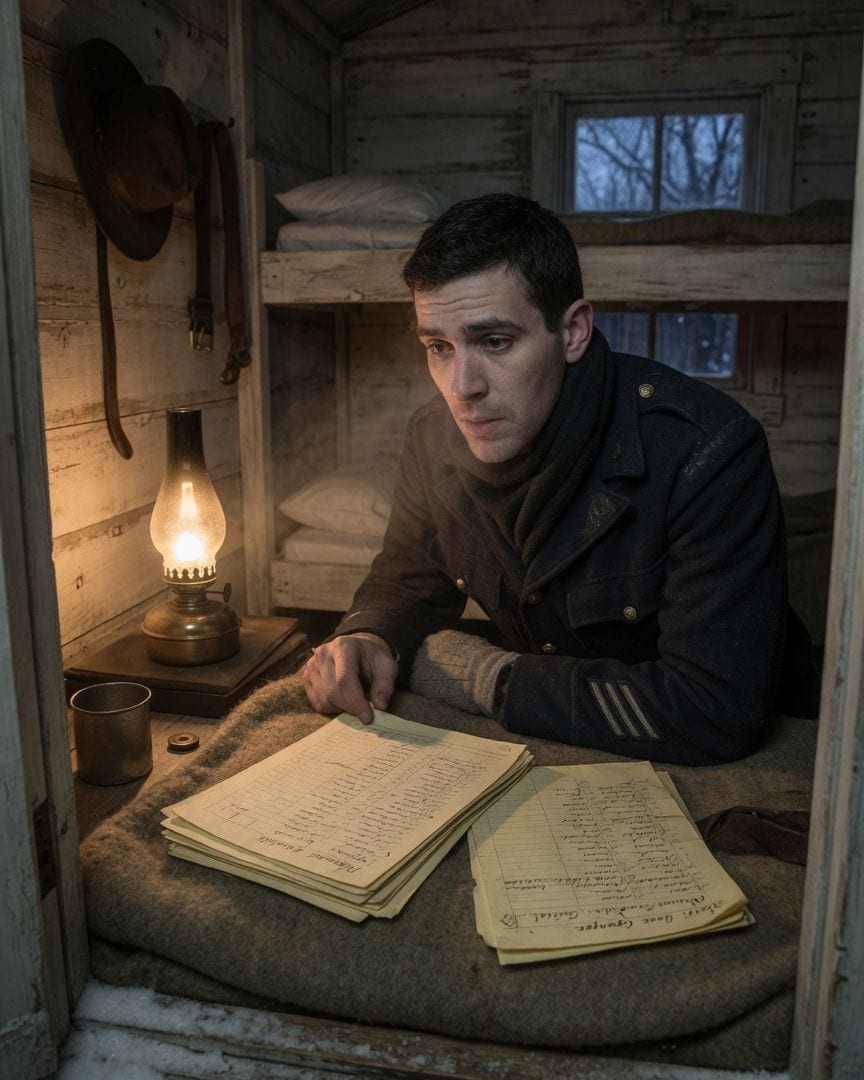
On his last watch, Corporal Carter found boot prints ending inside a sealed magazine, and a blood-red handprint from a soldier decades out of time.
Corporal Franklin Carter shivered, not from the biting November wind, but from the chill of his last pay muster at Fort Taggart before its winter abandonment. His final duty was to count every man, tallying thirty-seven, precisely the company strength. But his breath hitched when he saw the completed roll: it ran thirty-eight names long. An impossible extra slot, filled by a voice that answered 'Here, Corporal,' for a soldier whose name, Pvt. Isaac Granger, vanished from all official records, only to reappear in a forgotten supply log from 1863. Was Fort Taggart abandoning its dead, or something far older?