On his last watch, Corporal Carter found boot prints ending inside a sealed magazine, and a blood-red handprint from a soldier decades out of time.
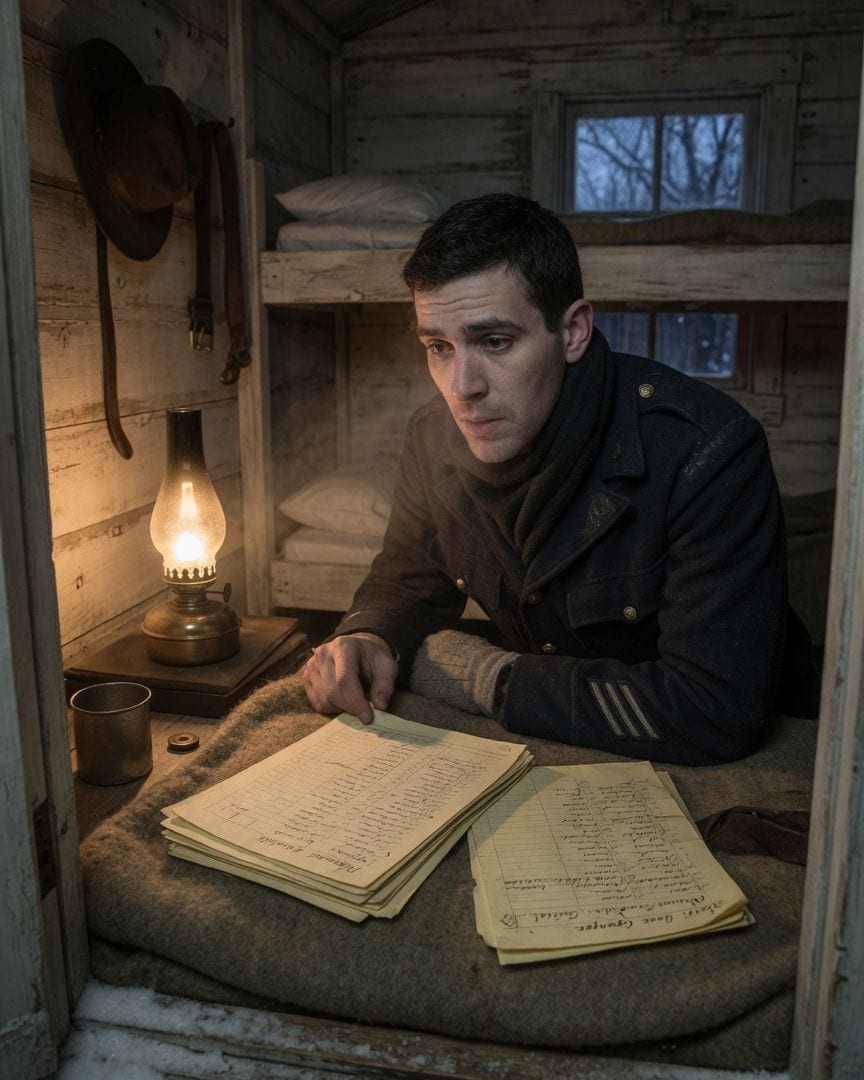
Corporal Franklin Carter shivered, not from the biting November wind, but from the chill that had settled deep in his bones.
It was the last pay muster at Fort Taggart before the winter abandonment of 1898, and the failing light cast long shadows over the paymaster's table.
Carter, disciplined and precise, counted heads as each man stepped up to sign or make his mark for the roll. He tallied thirty-seven men, the exact company strength.
He watched the final recruit, Private Davies, scratch his name onto the parchment. Davies stepped away, and Carter felt a sudden, inexplicable dread as he glanced at the completed line. His breath hitched. The signed roll ran thirty-eight names long.
He had counted thirty-seven, confirmed it with his eyes, yet there it was, an extra slot filled.
He read every name back aloud, his voice steady, refusing to betray the sudden tremor in his gut. A man answered to each, stepping forward, confirming his identity, then stepping back into the line. Thirty-seven responses.
Carter paused, then forced himself to read the impossible name. "Pvt. Isaac Granger?" he called, the name utterly unfamiliar. A quiet "Here, Corporal" came from the back of the line, just as solid and real as any other.
Carter looked up, scanning the faces, but the man who had answered was already blending back into the anonymous huddle.
There was a hand and a mark for a soldier the muster roll had never, should never, have carried, yet there he was, accounted for.
Back in the dim light of the barracks, Carter meticulously reviewed the muster roll, cross-referencing it with the company's official roster. He laid out the brittle papers on his bunk. There was no 'Pvt. Isaac Granger' in the records.
He pulled out the enlistment papers, the transfer manifests, the medical logs—nothing. The name simply did not exist within the official documents of Fort Taggart's current complement.
He found Private Albert Sullivan, his bunkmate, polishing his boots by the sputtering oil lamp. "Sullivan," Carter said, his voice low, "look at this."
He showed Sullivan the muster roll, pointing at the extra name. Sullivan, younger and prone to gallows humor, chuckled. "Some joker trying to get an extra pay, Corp. Probably a clerical error, or old Man Doyle's trying to scare us."
Sullivan shrugged, returning to his boots. "Wouldn't be the first time." Carter tried to accept the mundane explanation, to tell himself he was overtired, that his counting had been off, that the roster was simply outdated. But the chill lingered.
He remembered the quiet, ordinary "Here, Corporal," the voice that had been so unremarkable, so perfectly normal, that it was utterly chilling in retrospect. It wasn't a joke; the man had been there.
Later, while scavenging for packing crates in the abandoned supply office, a draft snaked through the room, making the scattered papers rustle like dry leaves.
He found a brittle, unofficial supply log, forgotten in a dusty corner, from the post's earliest days. Its pages were yellowed, the ink faded, smelling faintly of mildew and forgotten things.
Buried deep in its faded entries, listed for a single, unfulfilled order of ammunition, was the name 'Pvt. Isaac Granger.'
The entry was dated 1863, nearly forty years prior, and then the name disappeared from the log entirely, just as it had now from the current muster. It was a phantom, a whisper from the past, echoing in the present.
Assigned to his final perimeter watch, Carter patrolled the outer wire of Fort Taggart as the last vestiges of daylight bled from the sky. The wind howled through the skeletal trees, a mournful sound that seemed to carry ancient secrets.
His thermal scope, usually reliable, flickered with a faint heat signature near the deserted powder magazine, a squat, stone building sealed for demolition.
No one was assigned there, and the post was emptying out, most of the men already on their way to the next transfer point. Against regulations, Carter diverted, flashlight beam cutting through the gloom.
The snow crunched softly under his boots.
He found fresh boot prints in the dusting of snow leading directly to the magazine's heavy, iron-bound door, which stood slightly ajar. The prints ended abruptly inside, as if the person had simply dissolved into the stale air.
He pushed the door open, the groan of the old hinges echoing in the vast quiet. The air inside was stale and cold, heavy with the scent of damp stone.
He swept his light across the interior, the beam dancing over the rough-hewn walls. On one wall, faded but unmistakable beneath layers of grime, was a blood-red mark, roughly the size of a man's hand.
Beneath it, etched into the stone, was the familiar insignia of a private from his own unit, but the style of the uniform depicted was decades out of date.
Carter reported the prints and the mark. Sergeant Gordon Doyle, his face impassive, simply grunted, attributing it to "fatigue and the cold getting to men's heads."
Doyle stood by the fire in the guardhouse, his shadow stretching long and distorted behind him. He didn't even turn to look at Carter, merely stoked the flames. "Old Fort Taggart plays tricks on men. Nothing to it."
He ordered Carter to focus on securing the remaining equipment and to make sure the final wagon was loaded properly.
Dismissed, Carter spent his dwindling hours before the final evacuation combing through the post's dusty archives in the abandoned admin office. The room felt colder than the outside, as if the accumulated history had leeched all warmth from the air.
He found more sporadic appearances of 'Isaac Granger'—on a roster for a long-disbanded rifle team, on a list of minor infractions from the 1880s, even a brief mention in a chaplain’s ledger concerning a "soldier without kin."
Each time, the name appeared when the post complement was recorded as below its official strength, then vanished without explanation once the numbers were corrected. The pattern was undeniable, a subtle and chilling pulse through the fort's long history.
It wasn't a clerical error; it was a recurring event. It was as if the fort itself demanded a specific number, and when it wasn't met, Granger appeared to fill the void.
That night, on his isolated watch at the radio relay tower, the static-filled air crackled, making the old equipment hum with a low, unnerving energy.
He adjusted the dials, trying to clear the noise, but it persisted, a whisper of sound beneath the hiss. Through the static, a faint, distorted voice, tinny and ancient, ghosted through the speaker.
"Taggart… perimeter secure…" A pause, then, stark and clear against the white noise, "Granger." Carter gripped his rifle, the cold voice a physical presence in the empty night, the hair rising on the back of his neck.
He listened for more, but only the static remained, mocking him.
Carter tried to show Private Sullivan the assembled records, the recurring 'Granger' name, the undeniable pattern, the entry from 1863, the radio transmission he’d transcribed. He spread them out on his bunk, the papers rustling softly in the quiet barracks.
Sullivan’s usual skepticism gave way to a palpable unease. He picked up the oldest log entry, tracing the faded ink with a shaky finger. "Corporal," Sullivan said, his voice barely a whisper, "this ain't right. Just… drop it.
Before someone else notices you noticing." Sullivan’s warning, delivered with a nervous glance over his shoulder at the empty barracks door, only intensified Carter’s dread. Sullivan didn't seem concerned for Carter’s sanity, but for his safety.
Carter felt an unseen gaze constantly on him after that. He’d turn suddenly, convinced he’d heard a faint sound behind him, only to find nothing but empty space.
The wind outside seemed to keen a little louder whenever he was alone. Later, returning to his barrack footlocker, he found his personal effects subtly disturbed.
His spare uniform was neatly folded, but not in the precise way he always left it. A small, tarnished silver dollar, a keepsake from his grandfather, was missing from its usual spot beneath his spare uniform.
He searched frantically, tearing through his meager belongings, but it was gone, vanished without a trace. It wasn't misplaced; he knew its exact position.
Through the barracks window, he caught a glimpse of Sergeant Doyle, standing by the mess hall, watching him. Doyle’s figure was silhouetted against the pale, twilight sky, unmoving.
Doyle’s face was unreadable even in direct conversation, but from this distance, his calm, steady gaze felt less like idle observation and more like a profound acknowledgment, as if he knew exactly what Carter was discovering, and was simply waiting.
The sight sent another shiver down Carter's spine, colder than any wind.
Carter found Sergeant Doyle by the old, cold stove in the mess hall, sipping coffee from a dented tin mug. The aroma of stale coffee hung heavy in the air.
The vast room was empty, echoing with the ghosts of past meals and conversations. "Sergeant," Carter began, his voice tight, clutching the bundle of records to his chest. "The name. Granger. It’s not a clerical error. It's… a pattern.
He's been here for decades, then gone, then back again."
Doyle took another slow sip, his eyes fixed on the distant, snow-capped peaks visible through the grimy window. His expression remained unreadable, calm. "Pattern? You're a good soldier, Carter. Observant." He finally turned, his gaze settling on Carter, unsettlingly serene.
"Granger isn't a man, Corporal. Not anymore. He's… the post."
Doyle spoke in a low, even tone, as if explaining a mundane regulation to a new recruit. "This land, this fort, it demands its complement. Always has. A certain number of men must occupy it, or it feels… incomplete."
He paused, swirling the last of his coffee. "When the numbers drop, it fills the gap. In the records, sometimes… physically." He gestured vaguely towards the empty mess hall, a sweeping motion that encompassed the entire fort.
"It's how Fort Taggart stays Fort Taggart. Keeps the books straight, keeps the garrison intact, even if it's only on paper."
He paused again, his eyes holding Carter's. "That handprint you saw? In the magazine? A mark of belonging. The post claiming its own. Granger is just… the name it uses to keep the books straight, a placeholder for the missing."
The pieces clicked into place, terrifyingly.
The extra name on the muster, the old insignia, the voice on the radio, the phantom in the records – it was all the land, through 'Granger,' trying to maintain its illusion of full occupancy.
It wasn't a ghost haunting the fort; the fort itself was the ghost, manifesting its own occupants.
"You knew," Carter whispered, disbelief warring with dawning horror.
Doyle merely nodded, his gaze unwavering. "Some things, Corporal, are just part of the landscape. Been that way since before my time, before yours. Just… the way things are here." His composure was the most terrifying thing of all.
Doyle, observing Carter’s horrified comprehension, slowly reached into his tunic pocket. The fire in the stove hissed, a low, constant sound.
"There's more to it, of course," he said, his voice softer now, almost sympathetic, "The true nature of its… occupancy." He produced a small, leather-bound journal, brittle with age, its cover faded and worn, the leather cracked like old skin.
"This belonged to Lieutenant Commander Scott Holloway. Disappeared decades ago, officially lost to 'desertion.' He understood it better than most."
Doyle placed the journal on the cold, metal table between them. The book felt heavy, charged with a strange, dark energy. "Read his last entry. It might… clarify things."
Carter’s hands trembled as he picked up the cold, heavy book. The smell of old paper and something else, something metallic and faintly sweet, rose from its pages.
He flipped past pages of meticulous logs and increasingly frantic personal observations, dated 1878. Holloway wrote about the 'extra' name, not as a random placeholder, but as a deliberate selection.
He described realizing that 'Granger' was always a name pulled from the current roster, a soldier already serving, a name that would eventually be 'claimed' by the post.
Holloway's handwriting grew increasingly erratic, filled with desperate warnings about the 'pattern of absorption' and the 'hollow men.' He wrote about trying to warn others, only to be dismissed as mad. The commander’s desperation bled through the ink.
Carter turned the very last page, his heart hammering against his ribs, a frantic drum against his ribs. Scrawled in a shaky, almost illegible hand, stark against the yellowed paper, was a single name: 'Franklin Carter.'
Holloway's journal detonated the full horror.
The entries detailed how the 'extra' name, once manifested as 'Isaac Granger,' would slowly become more substantial, more present, often appearing in the periphery, until the named soldier—the original soldier—would simply vanish from the world.
Their records would be scrubbed clean, their memory fading from all but a few, often becoming a vague sense of absence.
The spectral 'Isaac Granger' would then take their place, wearing their face, their uniform, forever maintaining the post's required complement.
Holloway wrote of seeing 'Isaac Granger' standing guard, looking exactly like himself, but with an unsettling calm in its eyes, a deep, ancient patience that chilled him to the bone.
The post didn't just demand a count; it demanded continuity. It needed its full complement, its living bodies, and the system, in its own distorted, supernatural way, ensured it, by claiming its living occupants.
The journal ended abruptly, mid-sentence, about Holloway's "last watch," the ink trailing off into a frantic, blurred scribble, as if he had been interrupted, or simply ceased to exist.
Every clue now clicked into place, not as disparate anomalies, but as a monstrously coherent system: the impossible muster, the recurring name, the ancient handprint, the voice on the radio, Doyle's chilling calm.
It wasn't just a ghost; it was a hungry, sentient system, consuming its stewards, demanding eternal occupancy.
Carter confronted Doyle again, the journal clutched in his hand, its pages crackling like dried bones. His face was pale with terror, his breath coming in ragged gasps. "My name, Sergeant. It's in here. Holloway wrote my name!"
He thrust the journal forward, pointing at the damning scribble.
Doyle, still by the cold stove, merely nodded, his expression softening to something almost sorrowful. "He was a good man, Holloway. Understood the terms. Tried to fight it, of course."
He looked at Carter, his calm eyes holding an ancient weariness, like someone who had seen too many seasons come and go. "I was named, too, Corporal. Decades ago. Right after I got here. But the post… it's flexible.
It needs its numbers, its command. It needs someone to close it down, open it up. I learned how to… manage it. How to make sure its needs were met without being fully… absorbed."
He gestured around the empty mess hall, the gesture encompassing the fort itself. "It's why I'm still here.
Why I'm the one closing the post, year after year, waiting for the next one to arrive, or for the system to find its own way."
The truth was monstrous. Doyle wasn't an escapee; he was a gatekeeper, a warden, a living component of the post's dark continuity. He was a piece of Fort Taggart itself, bound to its demands.
"You'll be part of it now, Carter. The new steward. The post needs you."
As Doyle spoke, a faint, metallic clinking sound echoed from the direction of the deserted powder magazine, like a rifle being handled with practiced, silent efficiency. A slow, deliberate, unnerving sound.
Carter’s gaze fell to Doyle's desk, a scarred wooden surface piled with old ledgers and maps. There, glinting dully in the dim light, was his distinctive silver dollar, the one he'd lost from his footlocker.
Doyle had known all along, had been watching, waiting, playing his part in the fort's endless cycle. The clinking grew louder, a slow, deliberate cadence, coming closer, then stopping. 'Granger' was manifesting, anticipating its new partner.
Carter was trapped, not by walls, but by a name, a ledger, and a system that could not be defied.
The last supply wagon rumbled away from Fort Taggart, its tracks quickly filling with fresh snow, already blurring into the pristine white landscape.
Private Albert Sullivan, shivering despite his heavy coat, watched it disappear over the horizon, then turned back to the silent, empty barracks. He saw Corporal Franklin Carter standing by the window of the old admin office, watching the snow fall.
Carter didn't acknowledge Sullivan, his face unreadable in the fading light, a still figure against the growing darkness. Sullivan called out, his voice thin in the vast quiet, "Corporal? Ready for the final muster?"
Carter slowly turned, a faint, unsettling smile playing on his lips, a smile Sullivan had never seen before on his gruff, earnest corporal.
The final supply wagon rumbled out, leaving Fort Taggart to the encroaching winter, its skeletal trees already laden with the first heavy snows.
A week later, when the relief company arrived to confirm the abandonment, they found the post empty, save for one name on the final, official muster roll, signed in a familiar hand: Corporal Franklin Carter.
His service record, however, listed him as discharged and returned home weeks prior, having completed his term of enlistment. The post was simply listed as 'abandoned.'
His watch, it seemed, would never truly end.
If this one got to you
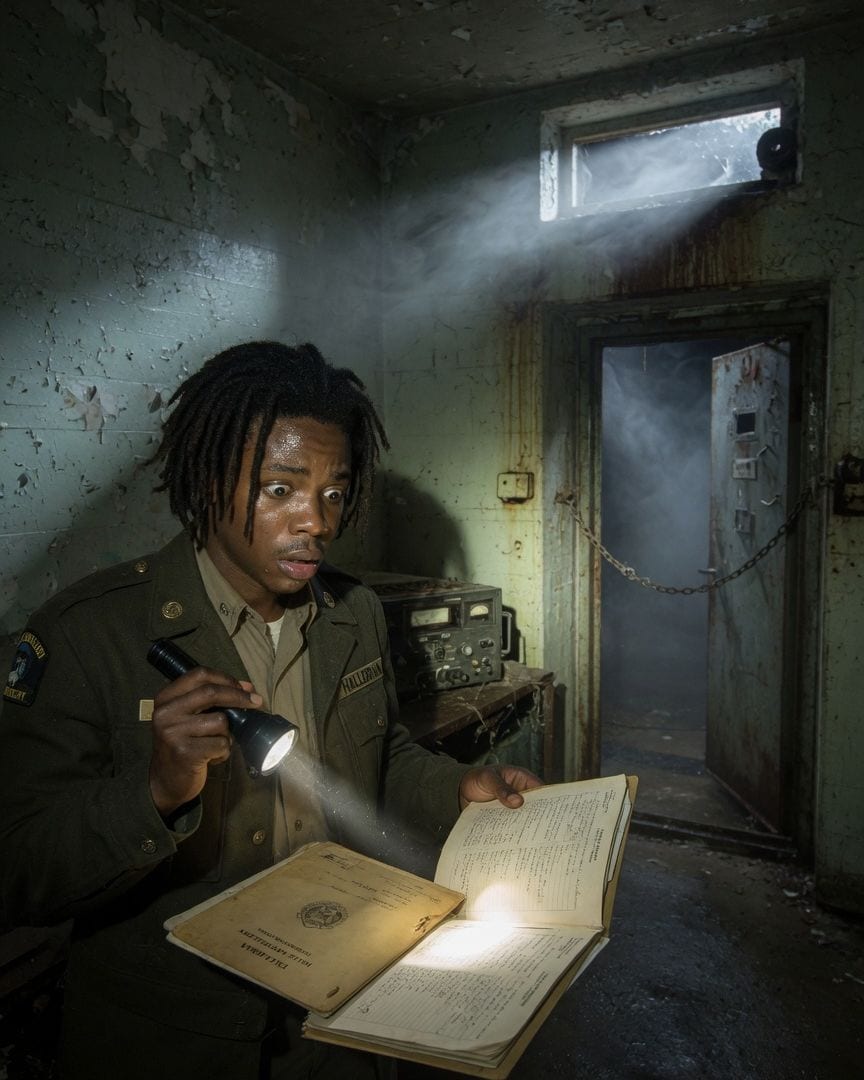
On his last shift, a coast sentry finds his own name signed in fresh ink on a 1943 army record, dated exactly one year ago.
Private Roy Halloran counted the final hours of his last watch behind the searchlight of an old, rust-tinged artillery bunker on the northern California coast. His monotonous graveyard shift was nearly done, and his transfer close, but at 0100, the swirling coastal fog revealed a silent landing party of men on the beach, their gear anachronistic and alien. When dawn burned off the mist, the beach was empty, yet faint drag marks led directly to the bunker’s long-sealed rear hatch, now mysteriously ajar. Inside, amidst the cold, acrid air, he discovered a pristine 1943 army service record bearing his own name. A freshly signed entry dated exactly one year ago to the day left him wondering: had the past somehow reached out to claim him?
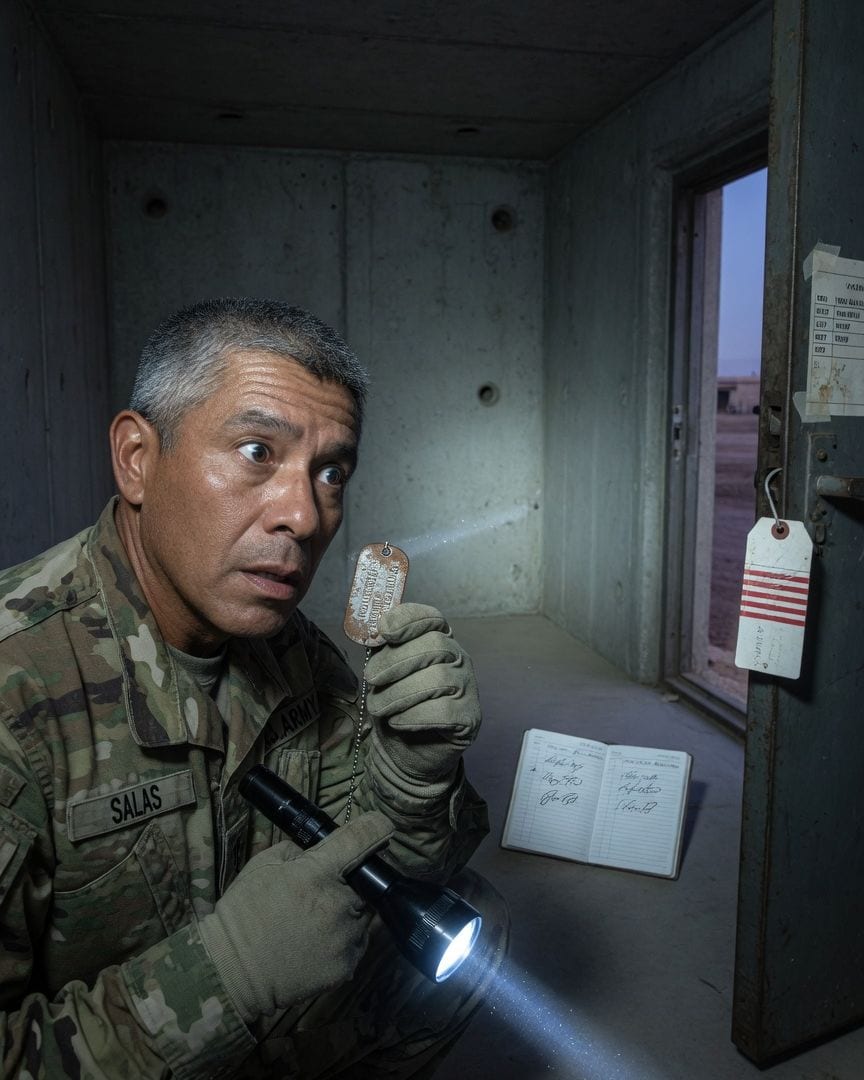
An inventory officer found a bunker's log of soldiers, then found one of their dog tags marked 'KIA, 1970'.
Chief Warrant Officer Gideon Salas meticulously oversaw the Hawthorne Ammunition Depot's inventory, racing against its final closure in two weeks. The high desert winds whipped dust across the familiar igloos as he worked, each bunker accounted for, until he reached the eastern perimeter. There, an extra igloo, Bunker 40, stood with a current lock and seal, though it wasn't on any map. A duty log propped open nearby listed inspections signed by men the Army swore didn't exist. His gut, honed by decades of service, churned with unease; inside the empty bunker, his flashlight found a corroded dog tag bearing one of those names, marked 'KIA, 1970'.
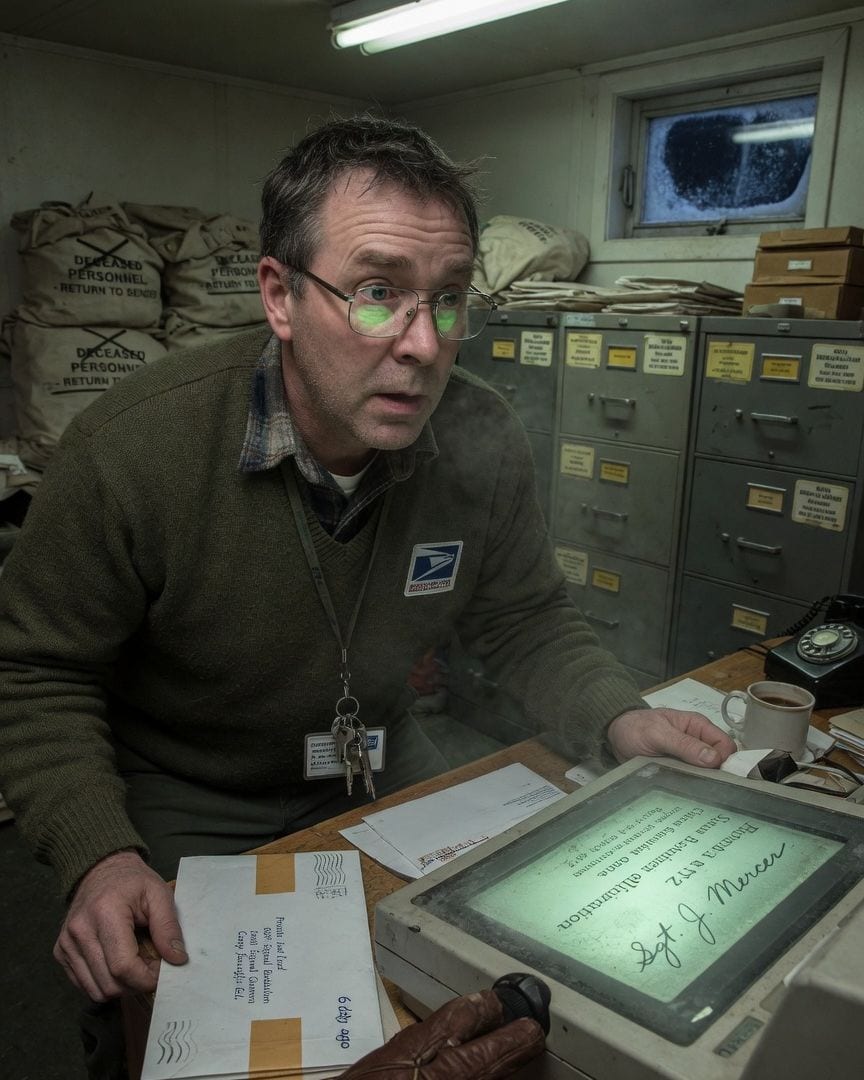
A postmaster at a Cold War Alaskan outpost still received mail for soldiers declared dead in 1969. Then he found their base was active three years later.
Postmaster Rowan Ashcroft had spent two decades watching the weekly mail plane land at Camp Bidwell Annex, a lonely outpost in the bitter Alaskan wind. His methodical mind, accustomed to order, was jolted when the latest mail sack contained forty-three letters for men officially declared dead in 1969. Each envelope, postmarked within days, was addressed to a soldier who wasn't coming back, and Rowan found one already opened and neatly resealed. Driven by duty, he began to sift through declassified Army archives, only to uncover a chilling maintenance log entry for the camp's equipment, dated three years after the base was officially shuttered. What was still happening at Camp Bidwell?
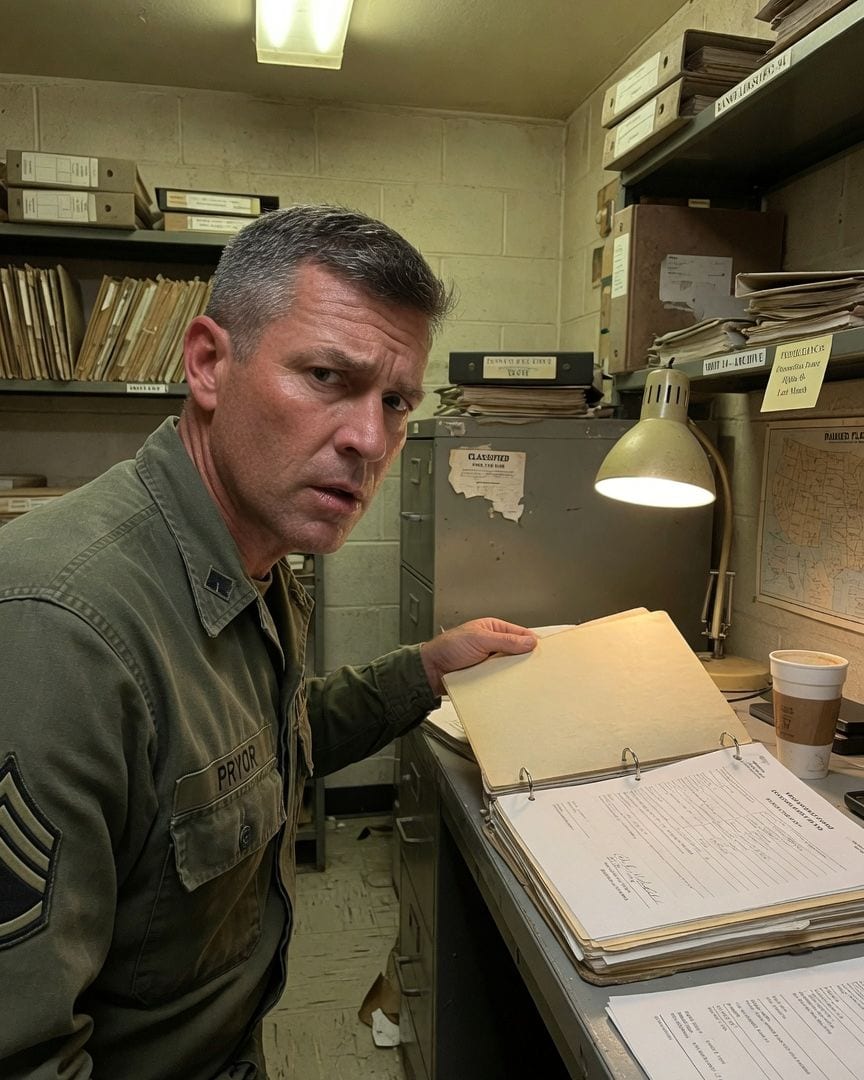
A sergeant with eleven days left finds a warm, glassed crater. Its file shows a captain lost thirty years ago is still signing reports from last week.
Sergeant Alden Pryor was counting down his final eleven days on a twenty-year hitch, expecting to spend them on routine patrols along the Ranier Flats fence line. Instead, his truck stopped at a bizarre sight: a four-hundred-foot glassed crater, miles from anywhere, its sand faintly warm at dawn despite no one recalling a blast. The air above it shimmered with an unnatural distortion, a silent scar of erased violence, and the official file for 'Shot 14' showed recent maintenance sign-offs for a decommissioned tower at the crater site. All these active documents were signed by Captain Everett Caldwell, who had been officially lost in operations thirty years ago, leaving Sergeant Pryor to wonder how a dead man could still be filing reports.
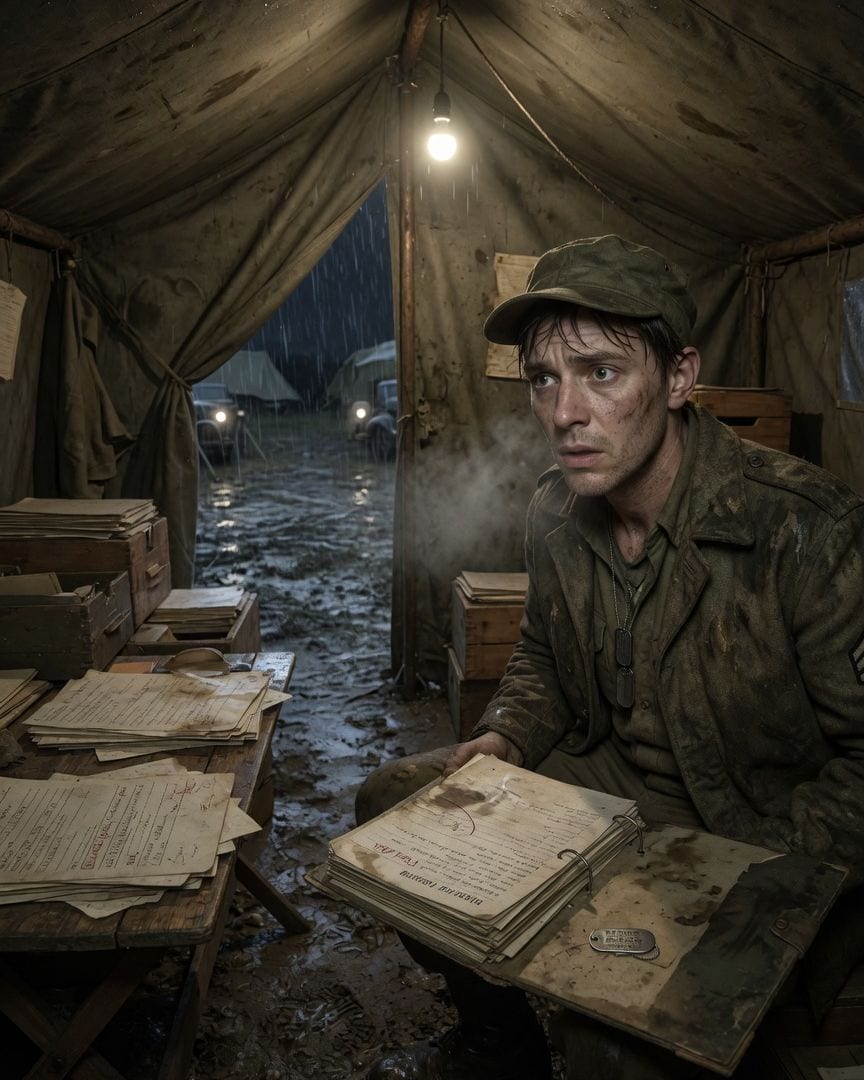
A corporal on his last rotation logs a Private reported MIA months ago. Then, another soldier with that exact same name reports for duty.
Corporal Theodore Carver, on his last rotation at a muddy French replacement depot in 1944, meticulously processed incoming infantry. He crossed off Private Oscar Fletcher, a soldier reported MIA months ago, only to find another man with that exact name patiently waiting after the last truck departed. A single, impossibly crisp boot print stood out in the churned mud where the soldier had been, and later, Carver discovered a non-standard issue dog tag matching an old, water-stained report of a similar unexplained incident. What dark history had surfaced in the relentless rain?
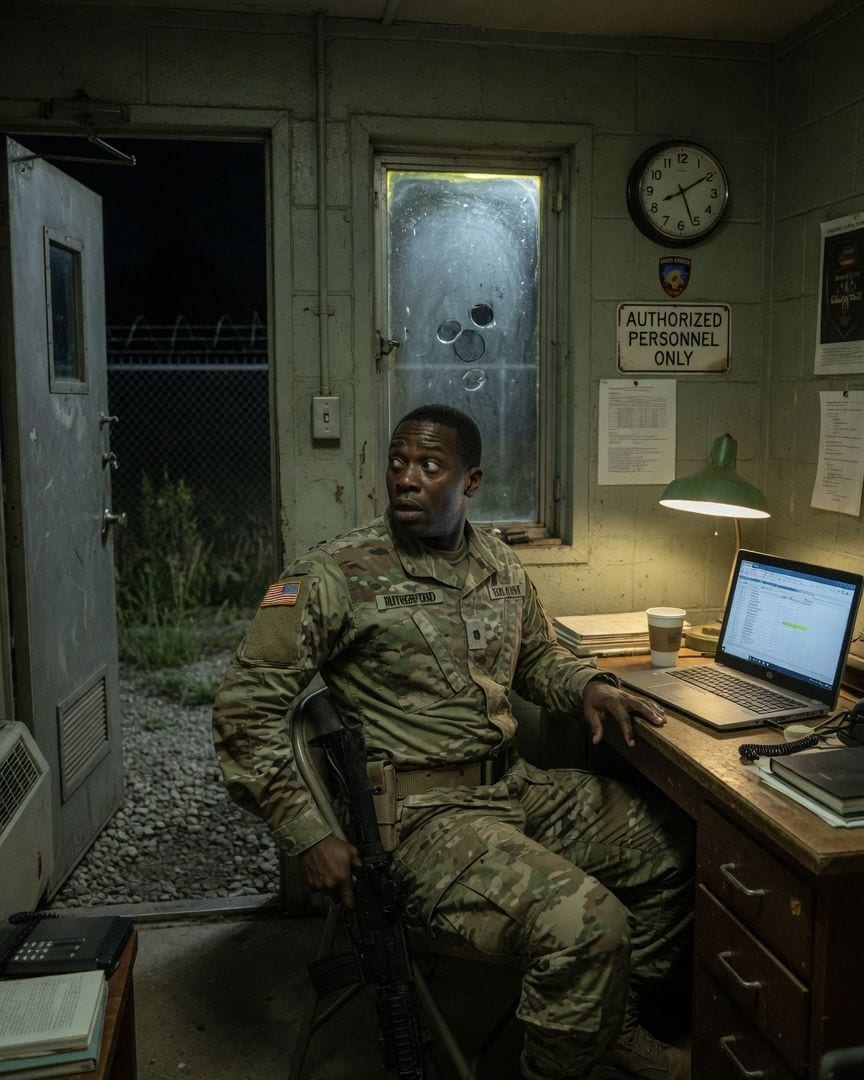
Fort Vashon's lone guard heard precise knocks on her window, then felt them from *inside* the locked shack.
Staff Sergeant Julian Rutherford felt an unsettling quiet at Fort Vashon's back gate, replacing a guard who reported strange knocks. He discovered an extra name on the digital duty roster that kept reappearing after deletion, a cold digital ghost. His search through decades of archived logs revealed a persistent anomaly: an unassigned slot, always present on short-staffed shifts. Then, in a forgotten supply shed, he unearthed an old journal detailing similar knocks and shadows, and one entry describing a guard hearing his own name called from the dark. What invisible presence haunted the fort's lonely gate?