The Cold War silo was welded shut in 1968. A Captain found lights burning, fresh prints leading inside, and a logbook with a vanishing from last week.
Captain Merrit Sable arrived at Silo K-9 before dawn. The air was cold and thin, carrying the scent of damp earth and distant pine.
Demolition charges were slated for noon Friday, giving him one morning to pull the last of the classified hardware from a hole the Air Force had welded shut in 1968. He remembered the briefing, the precise date, the definitive sealing.
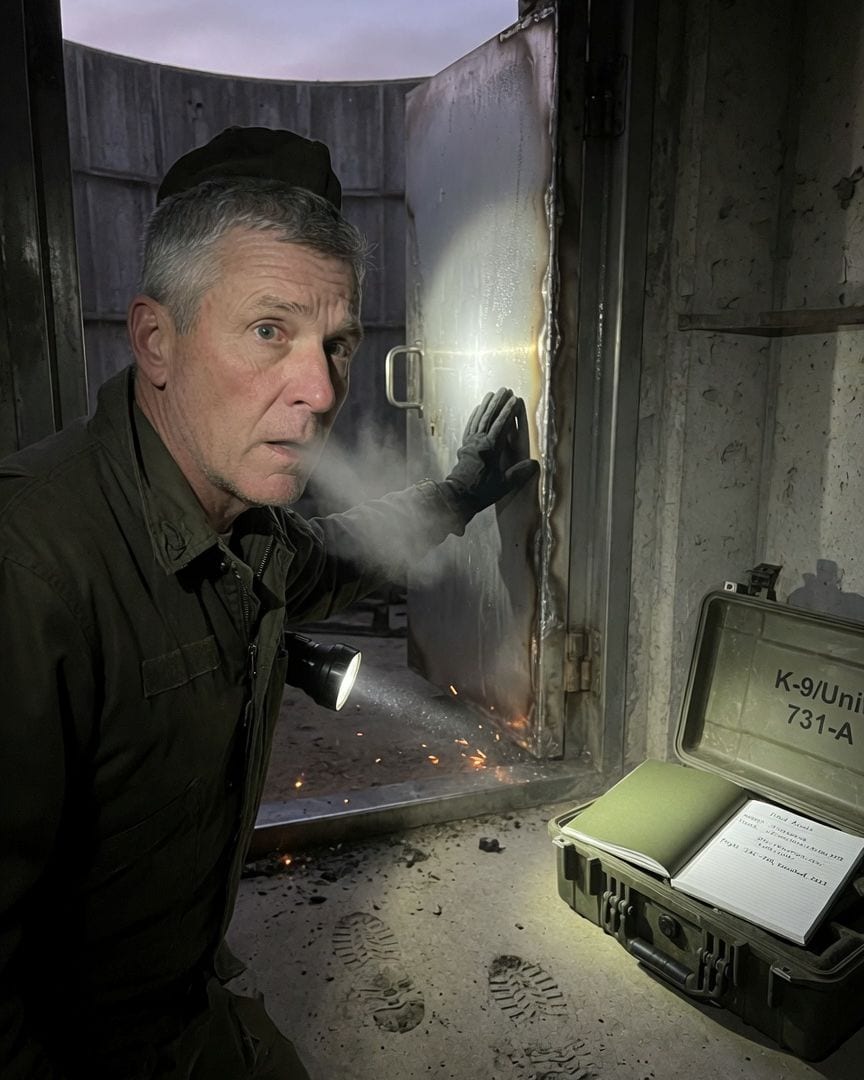
The cap seam of the silo door was still bright, a perfect, unbroken band of metal that spoke of skilled, permanent work. His breath plumed in the frigid air as he shone his flashlight through the personnel port's cracked glass.
Forty feet down, nine work lights were burning, steady and bright, illuminating the concrete shaft. They shouldn't be. The silo had been cut off the grid decades ago, before his daughter Lily was even a thought.
He pressed his palm against the cold steel of the door and felt a faint, undeniable suction against his skin: the ventilation system, pulling air inward.
The door hummed, a low vibration that resonated through the steel into his gloved hand.
Merrit, his mind racing for a mundane explanation—residual battery power, a freak atmospheric inversion creating a downdraft—called for a cutting torch. He watched the sparks fly, a brilliant, transient aurora against the predawn gloom, as the unbroken weld yielded.
A part of him still expected to find a dead, inert space, a cavern of stale air and forgotten machinery. The heavy steel door finally groaned inward, the sound echoing down the shaft.
The metallic scent, faint from outside, was stronger now, dry and almost acrid, like ozone mixed with old iron. Inside, the silo was meticulously clean, no dust motes dancing in the artificial light, no cobwebs in the corners.
His boots crunched softly on something. He swept his flashlight beam across the floor, and the beam caught them. There, perfectly preserved in a thin layer of fine, dark grit, were fresh boot prints.
They led directly from the entrance, deeper into the silo, but conspicuously, there were no prints leading back out. Further in, nestled against a reinforced wall, sat a hardcase, military-issue, unmarked save for a stenciled 'K-9/Unit 731-A'. It was empty.
The ordinary explanation — a maintenance crew, an oversight — dissolved. No crew would leave fresh prints without leaving, and no maintenance would be performed on a sealed, off-grid facility that had been welded shut for over fifty years.
He knelt, running a gloved hand over the hardcase. It felt strangely warm to the touch, as if it had recently been near a heat source.
Inside, tucked into a hidden compartment he found by instinct—a small latch, almost invisible—was a thin, bound logbook. Its cover was plain, a dull military green, stamped with the same 'K-9/Unit 731-A' designation. He flipped it open.
The pages were crisp, the paper bright white, the ink not faded, as if written yesterday. It wasn't a maintenance log. It was a list, meticulously organized by date, of 'Filed Assets.'
Call signs, service numbers, and brief notes: 'Vessel: USS Roanoke, Lost at Sea, 1978.' 'Personnel: Major Gideon Fairfax, MIA, 1992.' Every entry corresponded to a notorious military disappearance he vaguely recalled from classified briefings from his younger days.
His eyes scanned down the page, his breath catching. The last entry, in sharp, black ink, read: 'Flight: SAC-704, Vanished, 2023.' Just last week. The logbook was current.
Merrit Sable secured the logbook and sealed the silo door as best he could, leaving a single guard with strict orders not to let anyone near the site until he returned.
He spent the rest of the morning in his temporary office, cross-referencing every 'Filed Asset' in the logbook against the official military records he could still access.
Each entry was a perfect match for an officially classified incident: vessels lost without trace, aircraft vanishing from radar, ground units simply ceasing all contact.
The official explanations ranged from 'structural failure' to 'enemy action' to 'unknown causes,' but the pattern was undeniable. These were not just losses; they were erasures, complete and absolute.
The specificity of the dates, the precise designations, all matched official records of events that remained unresolved decades later. He tried to contact General Nathan Drummond, his commanding officer, but was put on hold, then told the General was 'unavailable.'
His calls were eventually routed to a junior aide who vaguely reminded him of the strict timeline for the demolition and the importance of 'not getting sidetracked by old ghost stories.'
The dismissive tone did little to calm the growing dread. The coherent fit of the logbook to the official 'lost' records was too precise to be a coincidence. It wasn't a clerical error; it was a parallel truth.
As the afternoon wore on, Merrit found his access to classified archives mysteriously revoked for 'routine system maintenance.' The screen of his secure terminal flickered, then displayed an 'Access Denied' message, a cold, digital wall.
He tried a backdoor channel, a secure messaging app he used with a trusted contact from his academy days, but the connection was repeatedly dropped, the signal dissolving into static.
Later, back at his quarters, he found a folded note slipped under his door. It was heavy, military-grade paper, with no discernible fingerprints. In block letters, it simply read: 'Don't open the next one, Captain.'
He checked the hallway, but it was empty, bathed in the anemic glow of overhead fluorescent lights. The base was isolated, the nearest town an hour's drive away, and personnel movement was strictly controlled.
There was no way anyone could have known he was even looking at the logbook, let alone that he was digging deeper.
The note wasn't a warning from a concerned party; it was a message from the system itself, proving it knew exactly what he had found, and that he was being watched.
The silence of the base felt oppressive, every shadow a potential observer, every distant hum of machinery a judgment. He was no longer the hunter; he was becoming the hunted.
Ignoring the warning, Merrit returned to Silo K-9 under the cover of dusk. He dismissed the lone guard with a fabricated errand, sending the young airman to check on a non-existent supply shipment.
He searched the silo's interior more thoroughly this time, his flashlight beam cutting through the dim, constant glow of the work lights. The air felt heavier, the metallic tang sharper.
He noticed a slight discoloration on a section of the concrete wall, almost imperceptible, a hairline seam that didn't quite match the surrounding pour.
Prying at it with a utility knife, he discovered a cleverly disguised panel, hinged and sealed with an older, mechanical lock, its brass gleaming faintly.
Inside, he found not more hardware, but dozens of additional logbooks and binders, older and more brittle than the one he'd found earlier. These were not just lists of 'filed assets.'
These were operational logs, dating back to the silo's construction, describing 'processing cycles,' 'absorption rates,' and 'containment protocols.' He read entries detailing how 'subjects' were 'integrated' into the system, how their 'data signatures' were 'repurposed.'
The chilling implication landed with the force of a physical blow, a sudden nausea in his gut. The silo wasn't a storage unit; it was a mechanism, a vast, patient machine that didn't just 'file' things, but consumed them.
The 'classified hardware' he was supposed to retrieve was a decoy, or perhaps a component of this very system, designed to draw in the next designated 'subject.'
The missing personnel weren't just lost to the world; they were filed into this machine, their existence repurposed, their records becoming the fuel for its continued operation. The fresh boot prints, the ventilation, the burning lights – they weren't anomalies.
They were the system, alive and active, preparing for its next intake. The silo hummed, a low, resonant thrum that seemed to vibrate in his very bones.
He continued to pore over the old logs, the air thick with the metallic tang, the hum of the ventilation a constant, low thrum against his ears, like a slow, deliberate breath.
He found a binder labeled 'Silo K-9 Personnel Assignments,' detailing every officer, every engineer, every demolition team leader who had ever been assigned to the facility, particularly during decommissioning efforts.
He recognized names from old service records, some of whom had retired abruptly or simply vanished from the Air Force's rolls, their careers ending in obscurity or unexplained disappearance.
There was a pattern: those who dug too deep, those who were too curious, they ended up on these lists. Merrit's hand trembled as he turned a brittle page, the corners flaking slightly under his touch.
There, near the end, was a freshly typed entry. 'Captain Merrit Sable.' The date of assignment was current, today's date. He scanned for the 'Date of Filing' column, expecting it to be blank, a future placeholder.
Instead, in a precise, familiar official hand, written in the same dark ink as the '2023' entry in the other logbook, was '0700 hrs, Friday.' The demolition charges were set for Friday at noon.
His own service number was beneath his name. He was the next entry. The silo wasn't being decommissioned. It was preparing to decommission him.
The full, monstrous shape of the pattern snapped into place. The silo was a trap, an active component of the 'secrecy machine' itself, designed to absorb and erase anyone who came too close to its true nature.
The 'classified hardware' he was sent to retrieve was a final lure, a pretext to ensure he was physically inside the silo, alone, at the designated time.
The lights and the ventilation were not just active systems; they were the system preparing, the internal mechanisms cycling up for his 'integration.'
Every 'lost' person in the logbooks, every vanished officer from the personnel files, they weren't victims of circumstance. They were 'filed.' Their official disappearance was merely the external manifestation of their absorption into this silent, subterranean maw.
The demolition charges, set for Friday at noon, weren't meant to destroy the silo, but to finalize the 'filing process' for Captain Merrit Sable, sealing him inside, erasing him from the world, and adding his name to the ever-growing, ever-current logbook.
He wasn't just investigating a buried record; he was about to become one. The very air around him felt denser, pressing in, as if the silo was already trying to compress him into an entry.
Merrit knew he couldn't confront the system directly; it was too vast, too ingrained. His superiors, General Drummond included, were either compromised or complicit. His only option was to escape, but not just physically. He had to escape the 'filing.'
He had to break the pattern. He began to work with a frantic, cold precision. The demolition charges were already in place, wired to detonate.
He accessed the silo's original schematics from the hidden compartment, finding a rarely used, barely visible service tunnel, a relic from its initial construction, long forgotten and officially sealed.
It was narrow, choked with debris, and led to an abandoned drainage system far from the main site, a forgotten artery of the facility. He then began to re-rig the demolition charges.
Instead of simply imploding the silo, he rewired them to target the central processing unit he'd identified in the operational logs – the very core of the 'filing system.'
This would ensure its destruction, but it meant a far more violent, unpredictable detonation. He would be cutting it close, risking his own 'filing' in the process.
He planted a final, small charge near the tunnel's entrance, set to detonate seconds after the main charges, to ensure no one would follow him into the escape route. The clock ticked relentlessly toward Friday morning.
He climbed into the cramped, dark service tunnel, the metallic scent of the silo clinging to his uniform, the grit grinding under his boots.
He could hear the faint, rhythmic hum of the machinery, growing louder, as if anticipating his entry, a hungry thrum in the earth itself. The system was waiting.
At 0701 hrs on Friday, the ground around Silo K-9 erupted in a deafening roar. A plume of dust and debris shot skyward, followed by the deep, resonant thud of a catastrophic implosion that shook the earth for miles.
The official report would state Captain Merrit Sable was tragically lost in the unforeseen, larger-than-expected detonation, a heroic casualty in the line of duty. No body was recovered, only fragments of his uniform scattered amidst the devastation.
The site was declared a hazardous crater, sealed off indefinitely. The Air Force closed the case, filing Sable as 'missing, presumed deceased.' The secrecy machine had seemingly claimed another.
But far from the blast, a figure emerged from a disused drainage pipe, coated in mud and grime, a single, empty hardcase clutched in his hand. Merrit Sable was gone from the world, but he had survived.
And the silo was truly, finally, silent.
Years passed. Merrit Sable lived off the grid, a ghost in a world that no longer knew his name. He watched the news, always for the subtle patterns, the quiet disappearances.
He saw reports of other remote military installations slated for decommissioning, other captains assigned to 'retrieve classified hardware.' He knew what they were walking into.
One evening, he saw a young, earnest face on a local news segment, a female captain, speaking confidently about her new assignment at a decommissioned coastal radar station. Her name was Annika Reynolds.
Merrit felt a cold dread settle in his stomach. He knew her type. He knew her fate. He had destroyed one part of the machine, but the machine itself was vast, patient, and endlessly adaptable.
It simply rebuilt, or found another access point, another silo. It was always filing. He turned off the small, battery-powered television, the screen going dark.
The news segment about Captain Annika Reynolds vanished from all archives within days, replaced by a bland report about her sudden, unexplained transfer.
A small, anonymous package arrived at a forgotten post office box Merrit maintained, containing only a single, empty hardcase, identical to the one he carried, but clearly factory-fresh. He picked up the empty hardcase.
It was still warm to the touch.
If this one got to you
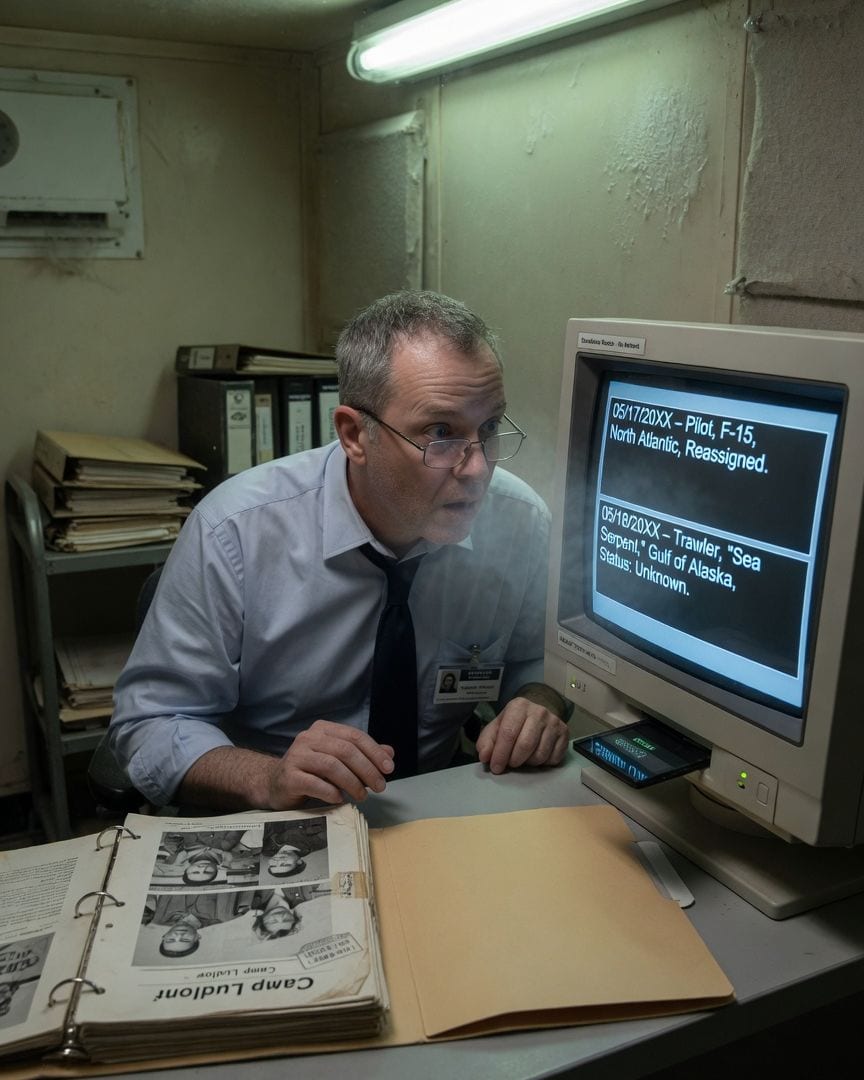
A declassification reviewer opened a Cold War 1959 file. A modern data chip inside showed a pilot missing yesterday.
Declassification reviewer Samuel Vance, whose world was built on the rigid order of official history, smoothed a letter confirming Camp Ludlow’s 1959 closure was a lie. Despite decades of records, the Air Force insisted the Greenland base remained active, its last radio check logged just four days prior. Driven by this profound wrongness, Samuel unearthed the base's ancient physical file, only to find a pristine, modern data chip hidden within its brittle pages. When he inserted it into a secure reader, the screen didn't show history, but a scrolling list of current missing persons—a pilot from yesterday, a trawler from today. How could an archived file hold a living record of the world’s most recent disappearances?
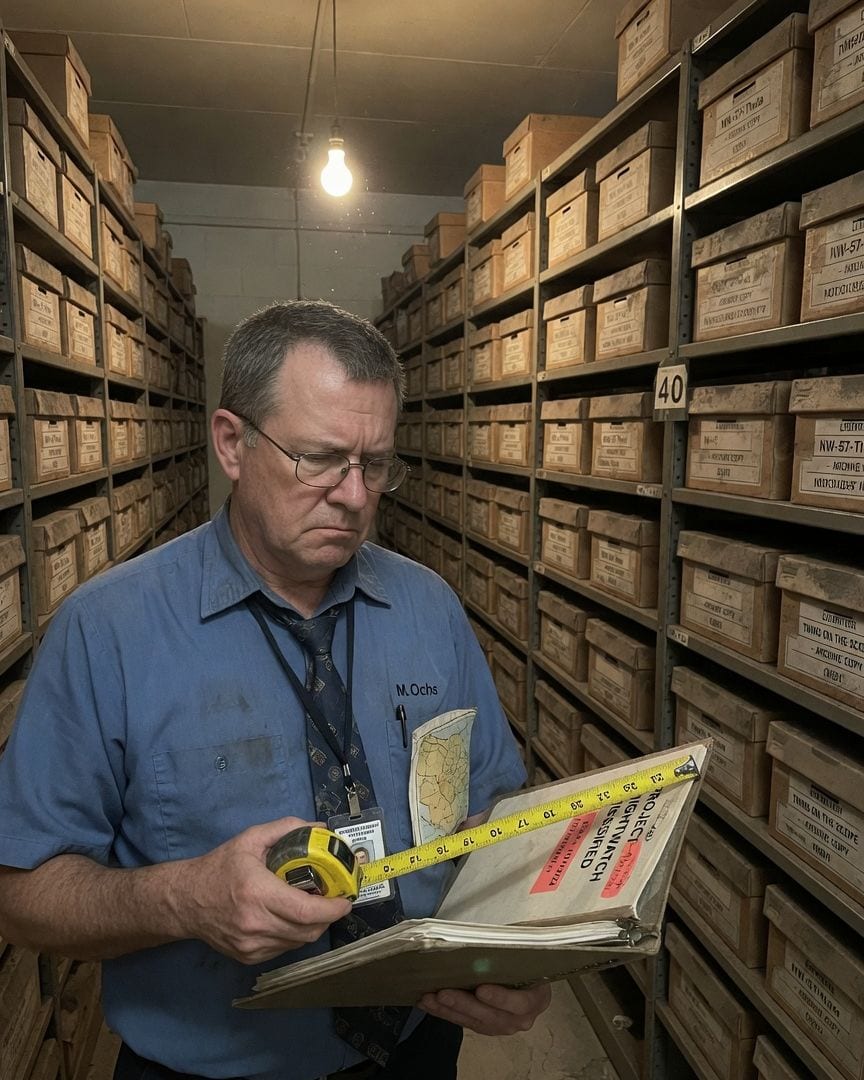
A Cold War records clerk on his final patrol found Aisle 40 stretched 61 feet longer, lined with unknown boxes. Inside one: 'PROJECT NIGHTWATCH - CLASSIFIED' with a fresh timestamp.
Marlin Ochs, a creature of habit after nineteen years at the St. Louis federal records depot, faced his final patrol through Aisle 40 before its scheduled pulping. His routine walk, usually 92 precise strides, suddenly stretched to an impossible 119, making the aisle 61 feet longer than its blueprint. The extra section felt colder, lined with dust-laden boxes bearing alien classification codes and no manifest. Inside one, he found a metal-bound file: 'PROJECT NIGHTWATCH - CLASSIFIED,' dated 1957, but with a timestamp just hours old.
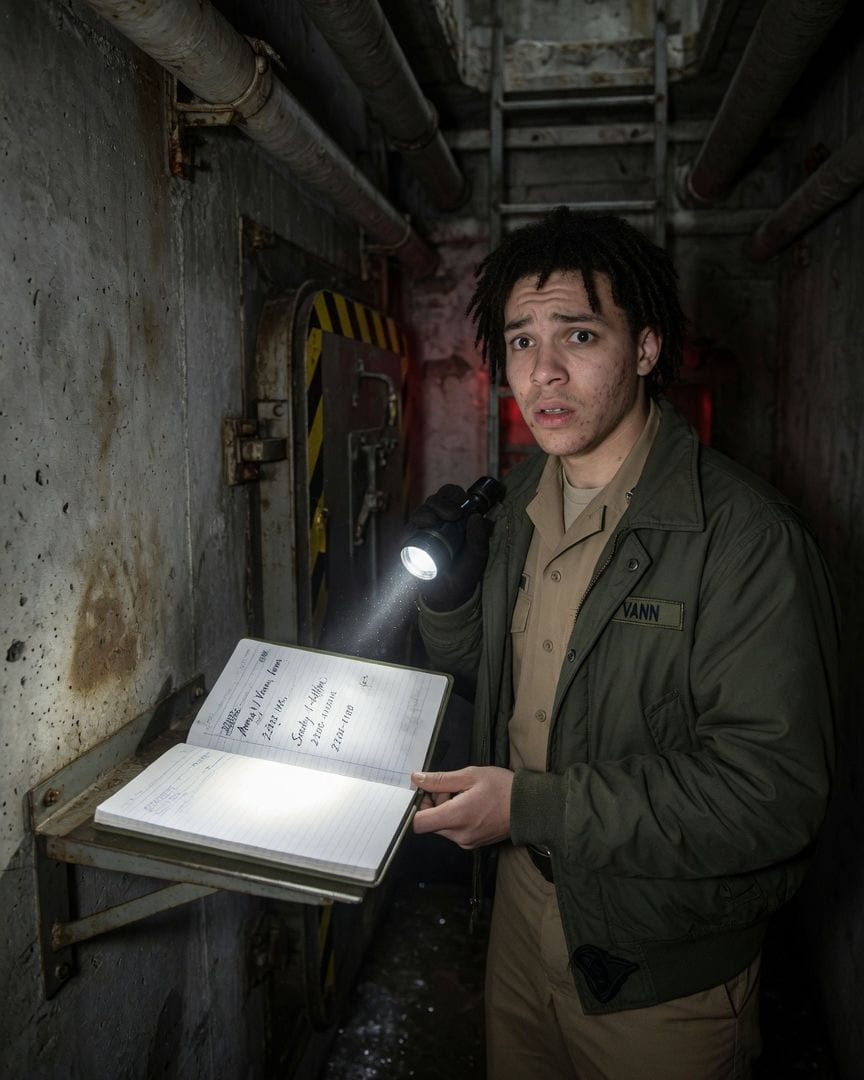
On his last patrol, Airman Vann sees a Cold War silo hatch light up from *inside*—it was welded shut a decade ago.
Airman Vincent Vann was on his last patrol across a vast, desolate Cold War missile field in the Dakotas, the cold, starless sky mirroring the emptiness of the landscape before his transfer. His routine check of eight hardened silo caps was shattered when a red fault light pulsed on Silo 4’s access panel, signaling an impossible breach from *inside* a hatch sealed for a decade. As more silos lit up, ignoring base orders, Vann found the hatch unlocked from within and descended into the dark shaft, where he discovered a pristine logbook bearing his own signature next to a chilling entry from a non-existent sentry, dated for *that very night*. Now, a steady *thump* echoed from deeper within the sealed concrete, leaving the Airman desperate for an explanation that simply wasn't there.
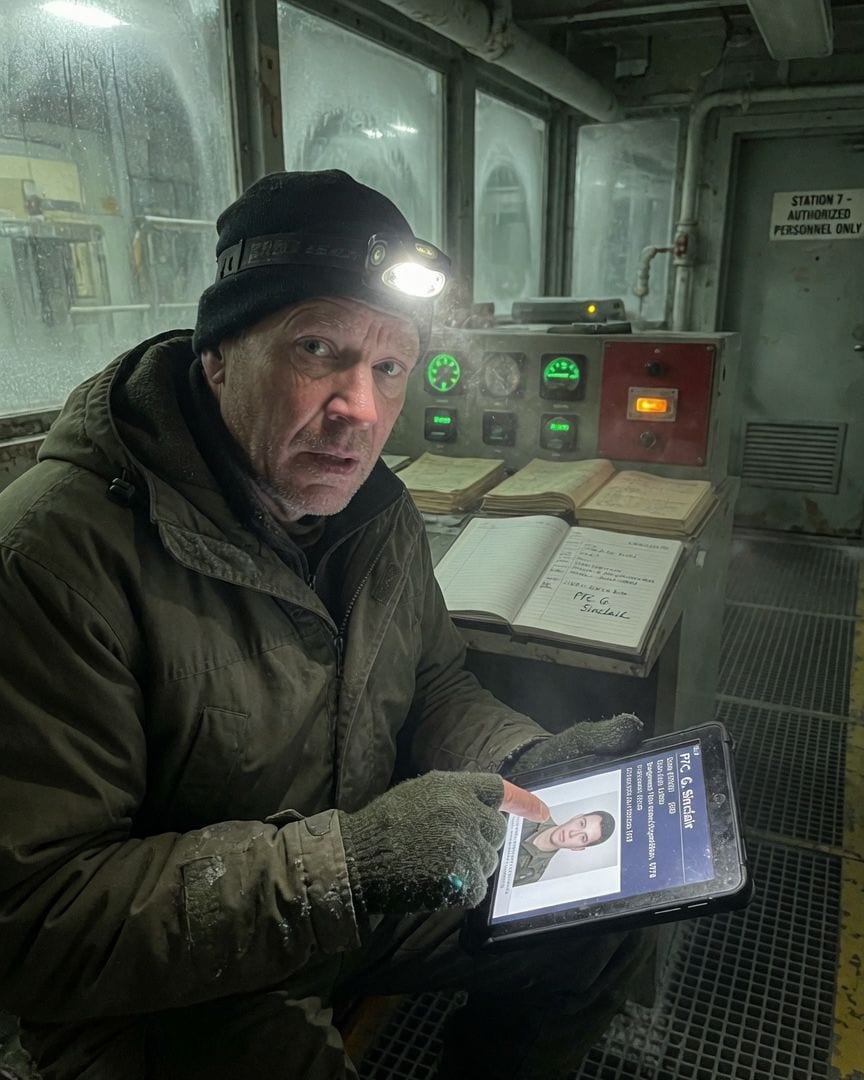
Chief Warrant Officer Ellison found a log signed last week in a Greenland Cold War base decommissioned in 1967, by a soldier MIA since 1978.
Chief Warrant Officer Franklin Ellison was two days from ending his Greenland deployment when his final core probe plunged into an unexpected void. A strange warmth and humid scent rose from the shaft, revealing the long-abandoned Station 7 below, its plant room surprisingly active with glowing gauges and a rhythmic hum. Ellison discovered an open shift log, its last entry, dated for the previous week, signed in fresh ink by PFC. G. Sinclair. Yet, a quick database check revealed Sinclair was reported Missing in Action in 1978, years after the station was officially decommissioned. How could a soldier missing for decades have signed a log last week in a base abandoned for half a century?
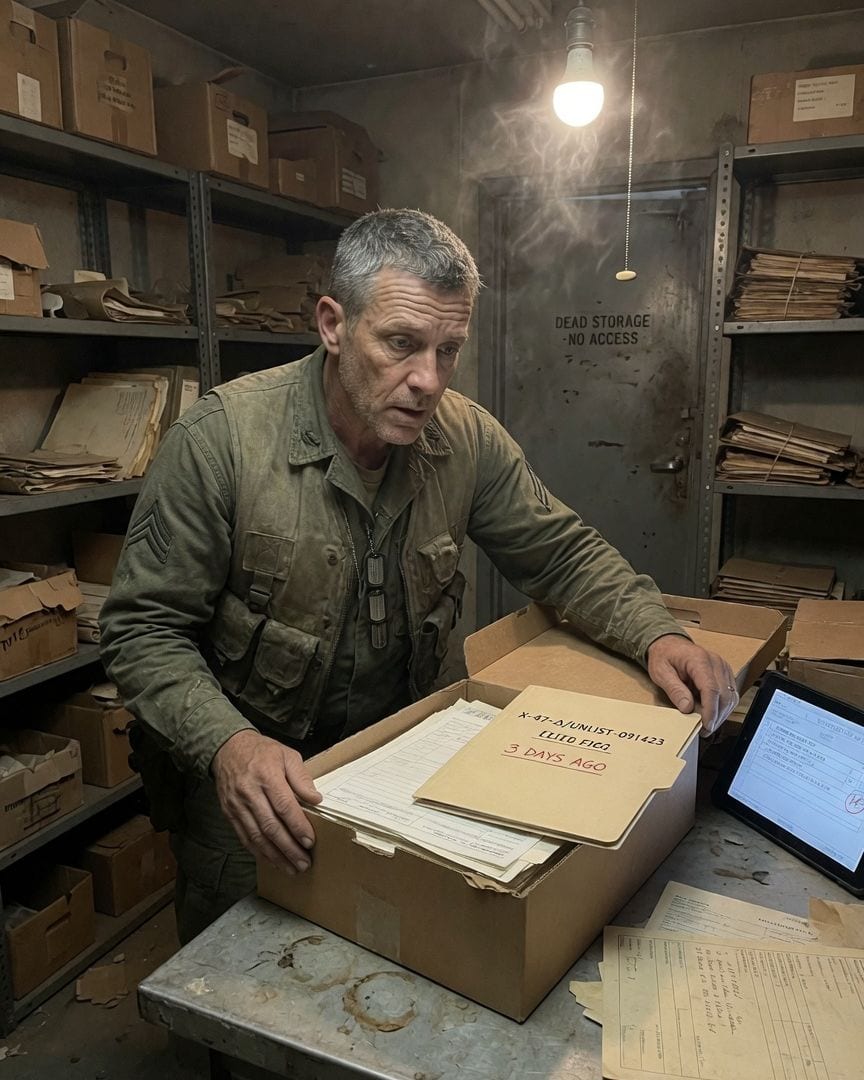
Sergeant Pryor, days from retirement, finds a four-hundred-foot crater. The desert floor is still warm, but no one remembers the blast.
Sergeant Alden Pryor, forty years old and just eleven days from retirement, drove the familiar Ranier Flats fence line for one of his final patrols. The desert stretched out, silent and vast, until he discovered a four-hundred-foot crater, dark and impossibly vast, where the sand had fused into slick glass. The ground within the crater was still faintly warm, a subtle heat defying the cool desert air. Yet, every official log confirmed the blast, while no one recalled a tremor or flash across three states.
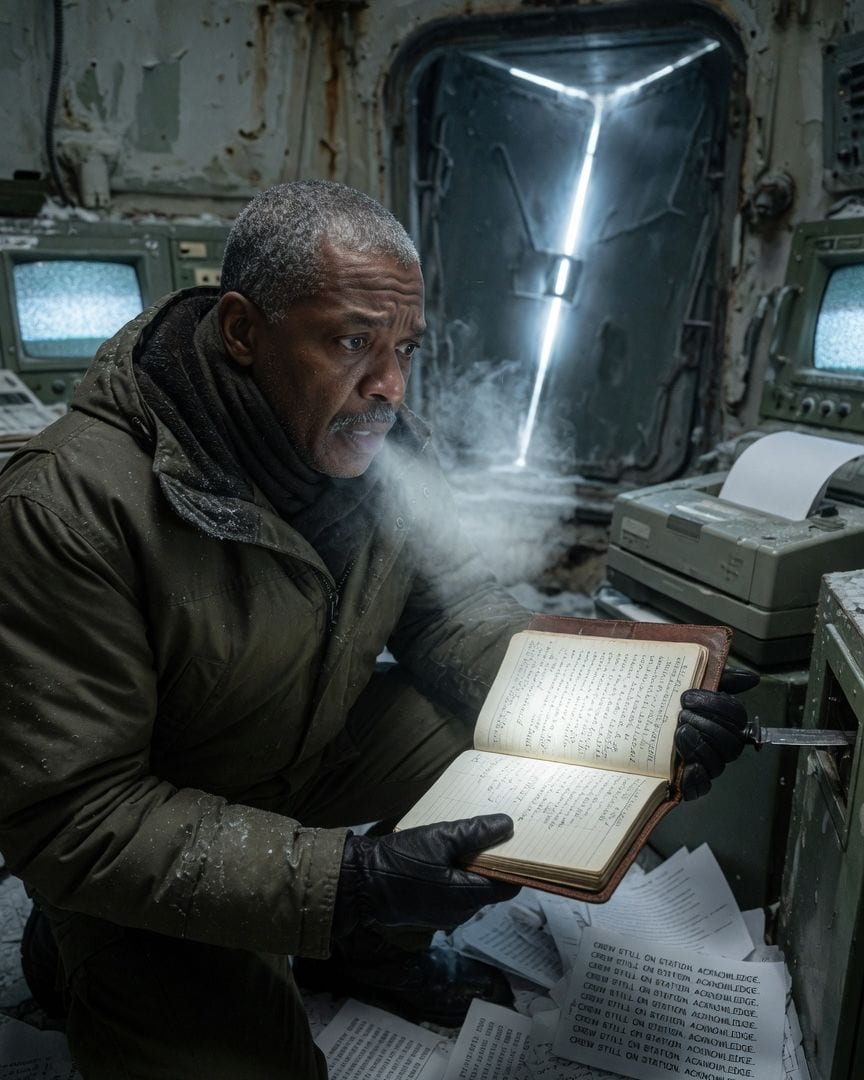
Colonel Marsalis found the Cold War missile silo's eight-ton blast door open eleven inches, its hydraulics scavenged decades ago. A printer inside declared: CREW STILL ON STATION.
Colonel Ren Marsalis braved the brutal North Dakota winter to inspect a decommissioned Cold War missile silo, a squat concrete structure half-buried in the frozen earth. The eight-ton blast door, a monolith whose hydraulics were scavenged in 1985, should have been sealed shut. Instead, an eleven-inch gap bled an unnatural bluish-white light. Inside, two console screens glowed without power, radiating an impossible warmth, while an emergency printer spewed four hundred feet of paper onto the deck. The repeating message chilled him to the bone: CREW STILL ON STATION. ACKNOWLEDGE.