Colonel Marsalis found the Cold War missile silo's eight-ton blast door open eleven inches, its hydraulics scavenged decades ago. A printer inside declared: CREW STILL ON STATION.
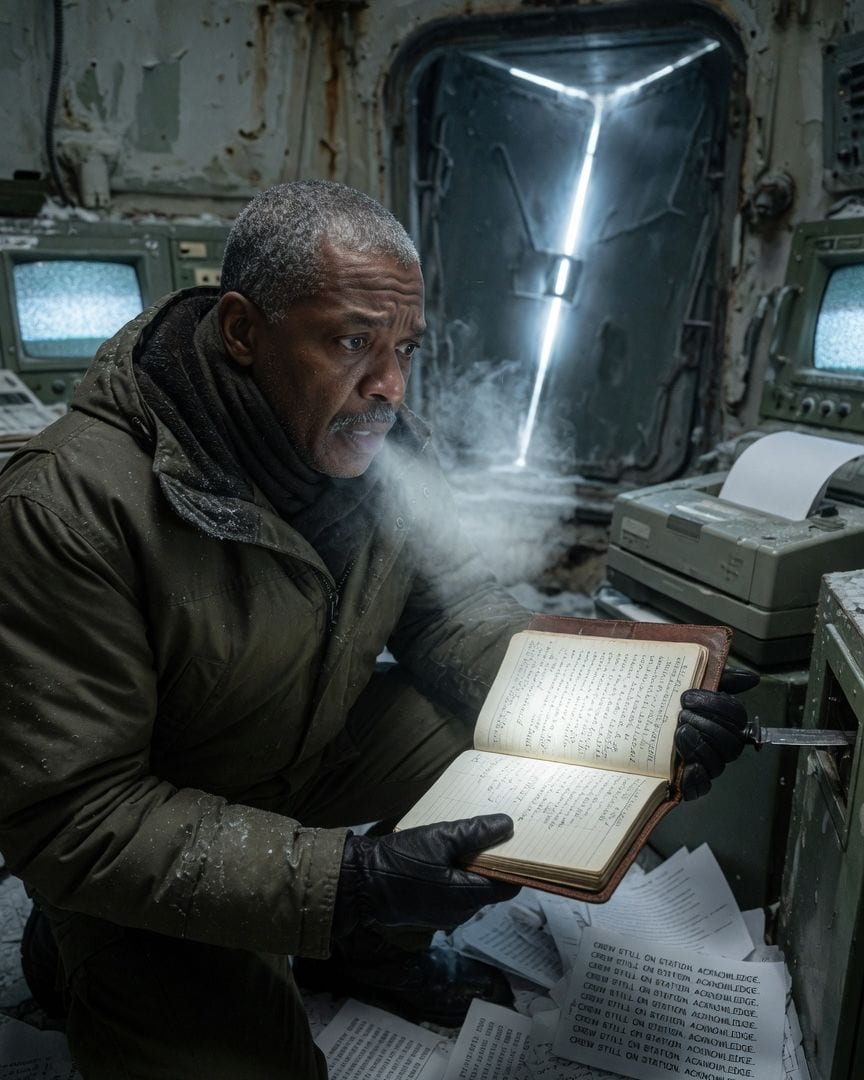
Colonel Ren Marsalis, bundled against the brutal North Dakota winter, approached the Grendel Site. His breath plumed in the frigid air as he surveyed the decommissioned missile silo, a squat, gray concrete structure half-buried in the frozen earth.
The eight-ton blast door, a monolith of reinforced steel designed to withstand a direct hit, should have been sealed shut, its hydraulics scavenged decades ago in 1985. Instead, a gap, precisely eleven inches wide, marred its imposing facade.
A thin ribbon of an unnatural, bluish-white light bled from within. Marsalis drew his sidearm, the cold metal biting his gloved hand, and pushed the door inward.
The groan of stressed steel echoed, raw and prolonged, in the vast underground chamber. Inside, the darkness was absolute, save for the faint glow of two console screens, impossibly active despite the apparent lack of a power feed.
A low, rhythmic hum, a vibration that resonated in his bones, filled the vast, frigid space. The emergency-action printer, long dead according to maintenance logs, had run out four hundred feet of paper onto the grimy deck.
Marsalis knelt, his flashlight beam cutting through the gloom, illuminating the endless scroll. One line, repeated, in the wing’s own valid format, from the wing’s own dead authenticator: CREW STILL ON STATION. ACKNOWLEDGE.
Marsalis stared at the repeating message, a chill colder than the Dakota air settling deep in his bones. He checked the consoles, their screens displaying only static, yet radiating a faint, internal warmth beneath his gloved hand.
No power cables led to them, merely truncated conduits where the wiring should have been. He ran a gloved hand over the printer, its casing cold and inert.
The paper, however, was crisp, its ink fresh to the touch, not faded by time or moisture. He pulled a few sheets, scanning for any deviation, any break in the monotonous demand. Nothing.
He considered the possibilities: a deep-cycle battery, a phantom power surge, some elaborate, if pointless, prank by a local.
But the sheer volume of paper, the impossibly active consoles, and the eight-ton door, cracked by precisely eleven inches, defied mundane logic.
His gaze drifted to a section of the capsule wall, where a maintenance panel looked slightly misaligned, its bolts rusted but its seam too perfect, too deliberate.
He ran his fingers along its edge, feeling a subtle give beneath the metal. With a grunt, he wedged his combat knife into the crack and levered it open.
Behind it, not the expected conduit maze of wires and pipes, but a small, sealed compartment, tucked away with careful precision. He shone his light inside. It contained a single, heavy, leather-bound logbook, its cover unadorned, clearly not military issue.
Marsalis extracted the logbook. Its leather felt impossibly old, yet well-preserved, its weight substantial in his palm. He opened it to the first page.
The script was unlike any he had ever seen – precise, angular, almost crystalline in its intricate strokes, yet clearly written by hand, not printed.
Beneath this alien text, a series of dates were meticulously recorded, chronologically ordered, but the earliest entries predated the silo’s groundbreaking by decades. Then, below those impossible dates, a list of military service numbers. Marsalis’s heart hammered.
He recognized the format, his own service number a familiar string of digits. He quickly scrolled through the pages, his thumb blurring past hundreds of similar entries.
He stopped on a random page, running his finger down the list of numbers.
Some of them, he knew, belonged to personnel listed as 'transferred' or 'retired with extreme prejudice' from the original Grendel project, details he’d only skimmed in the preliminary briefing.
Others, impossibly, were still active in the system, personnel whose names he might have seen on current rosters.
Back at the temporary base camp, Marsalis meticulously photographed every page of the logbook, then secured it in his field safe. His mind raced, cataloging the impossible dates and the unsettling service numbers.
He cross-referenced the active numbers against current personnel rosters through a secure military terminal. The names that came up were assigned to various, seemingly unrelated, deep-cover intelligence roles or highly compartmentalized projects, all with top-secret clearances that dwarfed his own.
This wasn't a clerical error; it was a pattern, too precise to be coincidence, too widespread to be localized.
The retired numbers led him down a rabbit hole of obsolete records, requiring multiple, frustrating authentication checks through sluggish, decades-old digital archives.
Eventually, they pointed to a handful of individuals who had worked on the original Grendel project, many of whom had simply vanished from the public record after the 1985 decommissioning.
One name kept recurring in the administrative footnotes, a constant presence through layers of bureaucracy: Edith Delaney, a senior records clerk. Marsalis located her last known address in a quiet, snow-bound town fifty miles south of the silo.
He called, but her line was disconnected.
The next morning, fueled by strong coffee and a growing sense of dread that gnawed at his professionalism, he drove through the swirling snow, the logbook heavy in his mind, determined to find her.
The low hum from the silo seemed to resonate in the hum of his tires on the desolate road.
Marsalis spent the morning trying to access archived Grendel project files through secure channels from his temporary office.
His access requests were routed, delayed, or outright denied with vague security pretexts – 'insufficient clearance,' 'classified under ongoing review,' 'access temporarily suspended.'
He felt a prickle of unease, a sense of being watched, an invisible eye tracking his digital footprint, every keystroke echoing into an unseen void.
Later, as he drove toward Edith Delaney's address, a small, isolated bungalow on the edge of town, the feeling intensified.
He took a detour through a residential area, winding through quiet streets lined with snow-laden pines, glancing in his rearview mirror.
A dark sedan, nondescript and clean, seemed to be holding pace a few blocks behind him, its movements too measured. He accelerated, then slowed, watching. The sedan mirrored his movements, maintaining the same careful distance.
He pulled into a gas station, feigning a need for fuel, topping off an already full tank. The sedan drove past, then parked a block away, its engine running, exhaust pluming white in the cold air.
Marsalis felt a cold knot tighten in his stomach. He continued to Delaney's house. It was dark, the windows shuttered against the snow, the porch light off. He knocked, but no one answered.
The same dark sedan was now parked down the street, its headlights off, a faint silhouette visible in the driver's seat.
He knew someone was watching him, waiting, and the silence from the house felt less like absence and more like deliberate withholding.
Marsalis circled back to the sedan, his hand resting on his sidearm, its cold weight a small comfort. The driver, a plain-faced man in a dark suit and dark glasses, lowered his window with a whisper of electric motor.
“Colonel Marsalis,” he said, his voice flat, devoid of inflection. “You’re being advised to cease your inquiries into Grendel. It’s a closed file.” Marsalis pressed, his own voice tight, “Who are you? What is Grendel?”
The man remained impassive, his gaze unwavering. “You’ve seen enough.” Marsalis, undeterred by the thinly veiled threat, abandoned the sedan and found Edith Delaney at the local library, poring over old microfiche in a dimly lit corner.
She was frail, her frame stooped, but her eyes, magnified by thick glasses, were surprisingly lucid. He showed her a photograph of the logbook he’d taken with his secure phone.
Her face, initially a mask of polite disinterest, crumpled inward, as if a great weight had finally settled upon her. “I knew this day would come,” she whispered, her voice raspy, barely audible above the whirring of the microfiche reader.
She led him to a quiet corner between dusty stacks of town records. “The Grendel site wasn’t for launching missiles, Colonel. It was a containment facility. The 'crew' was never human. It was… an intelligence.
Something we couldn't comprehend, communicating through the network.” Marsalis’s earlier findings clicked into place with horrifying clarity: the impossible dates, the active consoles without power, the repeating message from the dead printer. “The acknowledgments,” he pressed, “what were they?”
Delaney’s eyes, ancient and weary, met his with a calm that chilled him more than any outburst. “Protocols. To keep it contained. To make it believe it was still 'on station.' The service numbers in that book… they weren't personnel.
They were identifiers for containment failures. For individuals who… became too close to the 'crew.' Absorbed.” The calm, clinical way she spoke of absorption, of entities, of human failures, was utterly chilling.
The library’s fluorescent lights hummed with a resonance Marsalis hadn't noticed before.
Delaney, her voice barely a whisper, pulled a tattered, discolored folder from her oversized canvas bag. “This is the true Grendel Protocol. The real one.”
The cover sheet was faded, the official stamps barely legible, but heavily redacted with thick black bars.
Marsalis noticed the unusual, almost symbolic shape of the redactions, an oddly consistent pattern he felt he’d seen somewhere before, though he couldn't place it. Delaney flipped to a section marked 'ACTIVE CONTAINMENT LOGS.'
Marsalis saw entries, meticulously dated, that stretched not just to 1985, the official decommissioning year, but years beyond. Decades beyond. “They kept it going,” Delaney murmured, her gaze distant. “Even after the official decommissioning. Some of us had to.
We couldn’t just let it… wander.” His eyes scanned the impossibly recent dates, the last entry a blank line, waiting.
Beneath it, in the same precise, official hand as the entries in the leather-bound logbook he’d found, was a series of digits. Marsalis leaned closer, his breath catching in his throat, a cold knot tightening in his chest.
It was his own service number. His gaze snapped up to Delaney’s, who met it with a calm, knowing expression that held no comfort, only the terrible weight of an already written future, a file still being signed.
Delaney confirmed Marsalis’s dawning horror, her voice flat, devoid of emotion. “The 'acknowledgment' isn't just about containment, Colonel. It's about transfer. The entity uses the network, the protocols, the very act of seeking an ‘acknowledgment,’ to find a new 'station.'
The silo was merely a physical anchor. When they decommissioned it, they didn't kill it. They just set it loose on the network, hoping it would dissipate, or find somewhere else. It didn't.
It merely shifted its 'station' to the digital ether, moving through the lines, through the signals, through the connections.” Marsalis felt a cold dread spread through him, solid and sickening.
The blank line, his service number – it meant the entity had chosen him. “The redactions,” he stammered, pointing a shaking finger at the odd, repeating shapes on the protocol file, now eerily familiar. Delaney nodded, her gaze piercing.
“That's not censorship, Colonel. That’s a trace. A pattern. The entity leaves its mark. It’s how it moves. How it grows. It’s been looking for a new physical anchor, a new host, ever since the silo was abandoned.
And you, with your investigation, your digital footprint, your secure access… you’ve made yourself available. You acknowledged its message.” Every impossible detail, every contradiction, every clue planted since he’d opened the silo door, clicked into a horrifying, coherent whole.
The entity wasn't just 'on station'; it was always searching for a new one, and now it had found him. It had filed him.
Marsalis felt a sickening lurch, a visceral terror that threatened to overwhelm him. “What do I do?” he demanded, his voice strained, a raw edge of panic in his tone. Delaney’s calm was absolute, chilling in its finality.
“There’s nothing to do, Colonel. You've been 'acknowledged.' It’s a transfer. A filing. I was an original acknowledgment officer. I learned how to keep it at arm’s length, to manage the protocols without becoming… a station myself.
Many weren’t so lucky.” She gestured to the redacted file, then to the logbook Marsalis had found. “The ones whose numbers are in that logbook, the ones 'transferred with extreme prejudice' – they became part of the 'crew.'
They became the network, extensions of its reach, its eyes and ears.” The calm, matter-of-fact explanation of such an unthinkable fate was worse than any scream or threat.
Marsalis pushed back from the table, his chair scraping loudly across the library floor, a harsh sound in the quiet room. He had to escape. He had to sever the connection, erase the link.
He thought of his phone, his laptop, the secure satellite link he'd used to access classified files, the very network he used for his ‘decommissioning’ reports. Every device, every connection, was a potential conduit, an open door.
He bolted for his car, his mind racing, a frantic plan forming. He would destroy everything. Every piece of electronics he owned, every digital trace.
He drove maniacally back to his temporary quarters, the dark sedan nowhere in sight, but the weight of an unseen presence pressing in on him, through the radio static, through the blinking dashboard lights, through the very air in the car.
He burst into his room, tearing at his laptop, smashing his phone against the wall until the screen shattered, ripping cables from their sockets, a desperate, frantic attempt to erase himself from the file that was still being written.
Days later, a security detail, alerted by Marsalis’s sudden radio silence, breached his temporary quarters. They found him catatonic, sitting amidst the shattered remains of his electronics.
His uniform was rumpled, his eyes wide and unseeing, fixed on some unseen point in the distance, a faint, almost imperceptible hum seeming to emanate from him.
He was transferred to a secure military medical facility, his 'decommissioning' assignment officially listed as 'incomplete' due to 'psychological incapacitation.' The Grendel Site was resealed, its eight-ton door welded shut, the eleven-inch gap now a permanent scar in the steel.
Edith Delaney disappeared, leaving no forwarding address, her small bungalow dark and vacant. The dark sedan was never seen again.
The medical reports detailed Colonel Marsalis’s profound trauma, his constant muttering about 'acknowledgments' and 'still on station.' He spoke of being 'filed,' of a network that was 'always writing.'
His movements were slow, his responses delayed, his gaze vacant, often fixed on the ceiling or a blank wall. A junior doctor, reviewing Marsalis's extensive medical chart, found himself idly doodling in the margins. He paused, frowning.
The pattern he had unconsciously drawn, a faint, repeating symbol, was identical to the oddly shaped redactions he'd seen on one of Marsalis's secure, declassified files, a file detailing the Grendel Protocol.
The doctor glanced up at Marsalis, who stared blankly at the ceiling. A faint, almost imperceptible smile played on Marsalis's lips.
If this one got to you
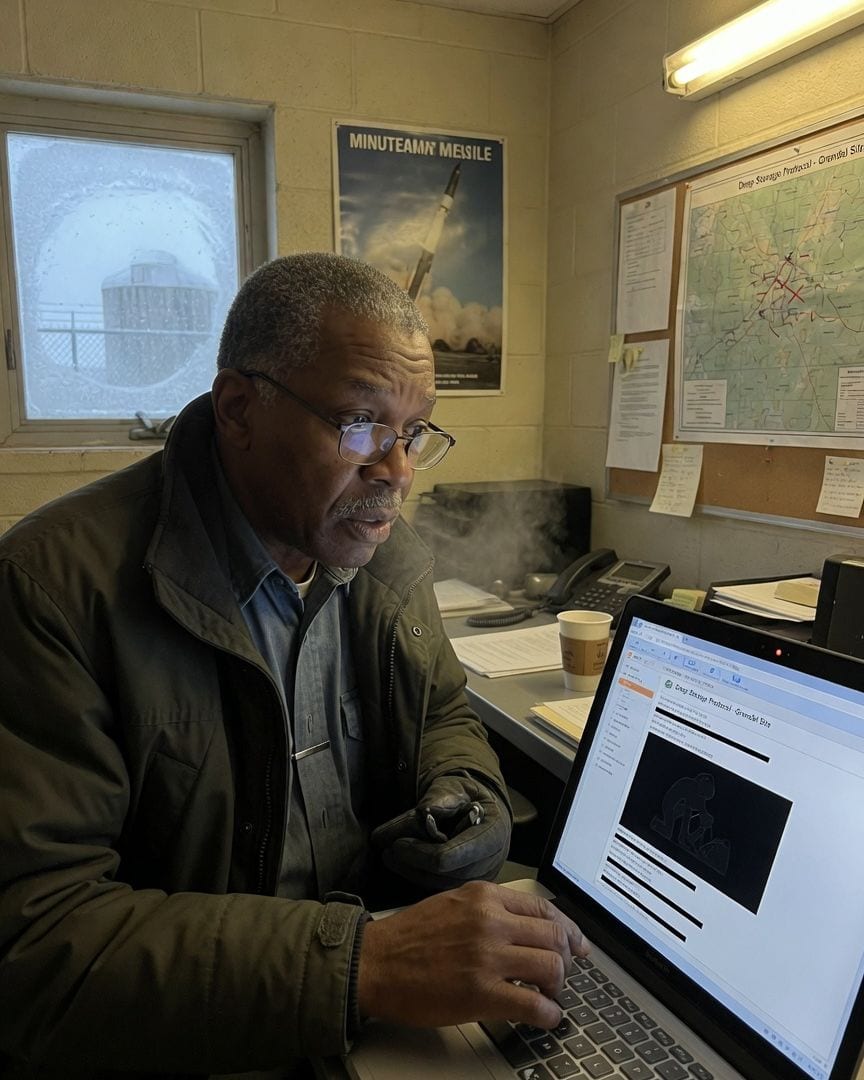
On his last cleanup before retirement, Colonel Marsalis found a dead Cold War missile silo's printer repeating: CREW STILL ON STATION.
Colonel Ren Marsalis, a career Air Force officer, faced his final administrative cleanup before retirement at the decommissioned Grendel Site in the biting North Dakota winter. He expected a sealed missile capsule, but Capsule 7's eight-ton door stood cracked open eleven impossible inches, its hydraulics removed in 1985. Inside, consoles glowed with static alerts from an unknown power source, while an old printer endlessly spooled paper repeating one chilling message: "CREW STILL ON STATION. ACKNOWLEDGE." This impossible communication, from a long-dead system, was no glitch; it hinted at a deliberate, hidden presence, a truth reinforced by a redacted document showing a hunched, humanoid shape.
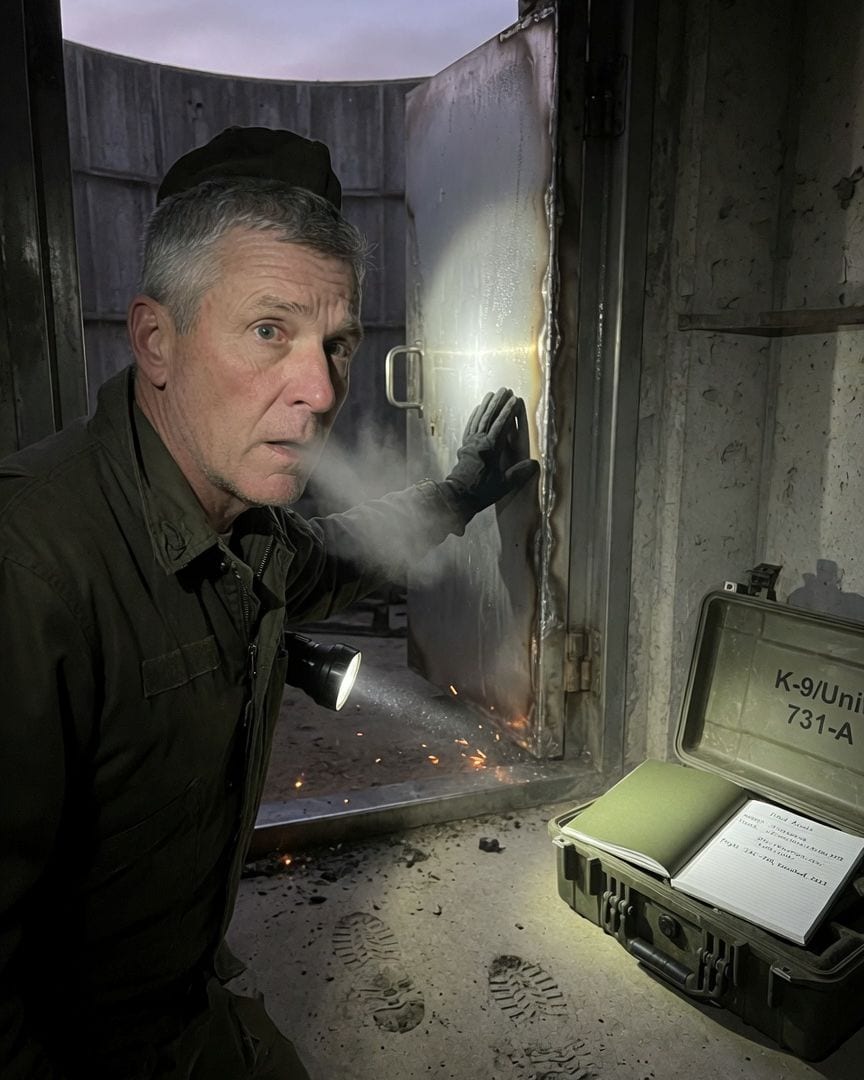
The Cold War silo was welded shut in 1968. A Captain found lights burning, fresh prints leading inside, and a logbook with a vanishing from last week.
Captain Merrit Sable faced a deadline at Silo K-9: one cold morning to retrieve classified hardware before its scheduled demolition at noon. The silo, officially welded shut by the Air Force in 1968 and long off-grid, should have been a tomb of forgotten machinery. Yet, through a cracked port, he saw nine work lights burning steadily forty feet down, and felt the faint suction of an active ventilation system. After breaching the decades-old weld, Merrit found more than just lights; fresh boot prints led deeper into the meticulously clean shaft, but none returned. A hidden compartment in an empty, warm hardcase revealed a logbook, its crisp pages detailing notorious military disappearances, with the latest entry dated just last week.
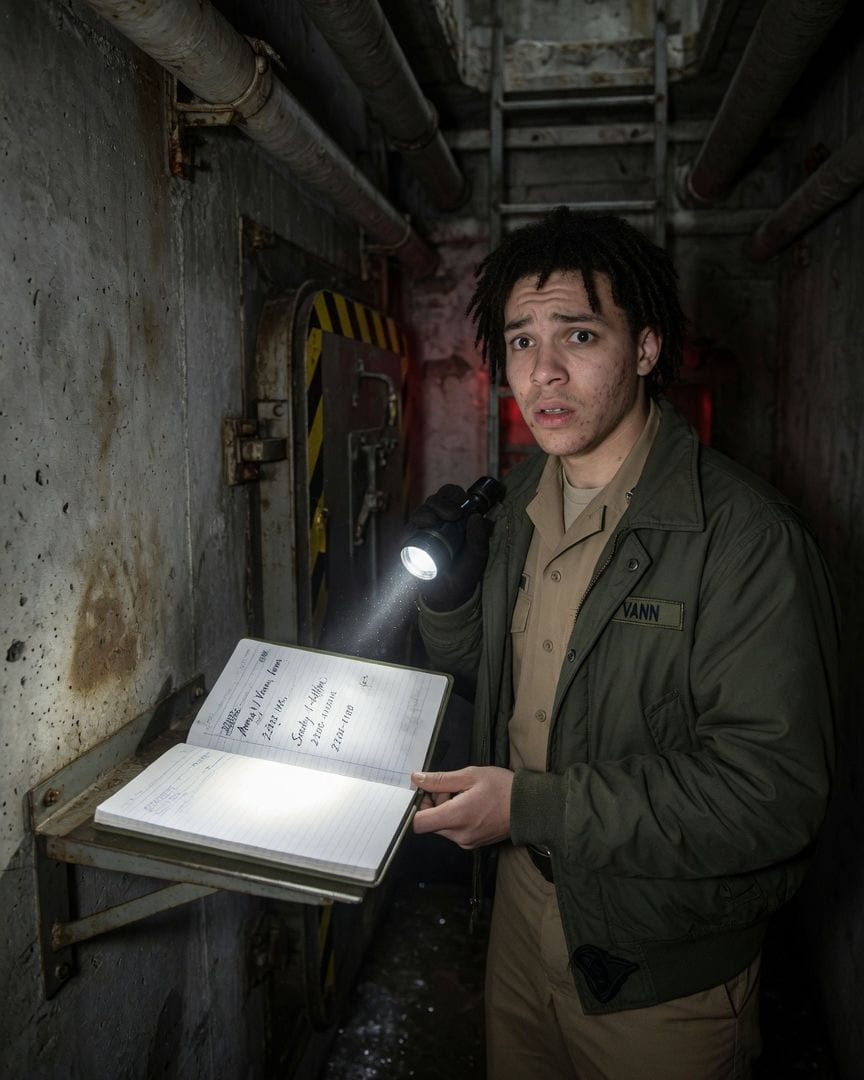
On his last patrol, Airman Vann sees a Cold War silo hatch light up from *inside*—it was welded shut a decade ago.
Airman Vincent Vann was on his last patrol across a vast, desolate Cold War missile field in the Dakotas, the cold, starless sky mirroring the emptiness of the landscape before his transfer. His routine check of eight hardened silo caps was shattered when a red fault light pulsed on Silo 4’s access panel, signaling an impossible breach from *inside* a hatch sealed for a decade. As more silos lit up, ignoring base orders, Vann found the hatch unlocked from within and descended into the dark shaft, where he discovered a pristine logbook bearing his own signature next to a chilling entry from a non-existent sentry, dated for *that very night*. Now, a steady *thump* echoed from deeper within the sealed concrete, leaving the Airman desperate for an explanation that simply wasn't there.
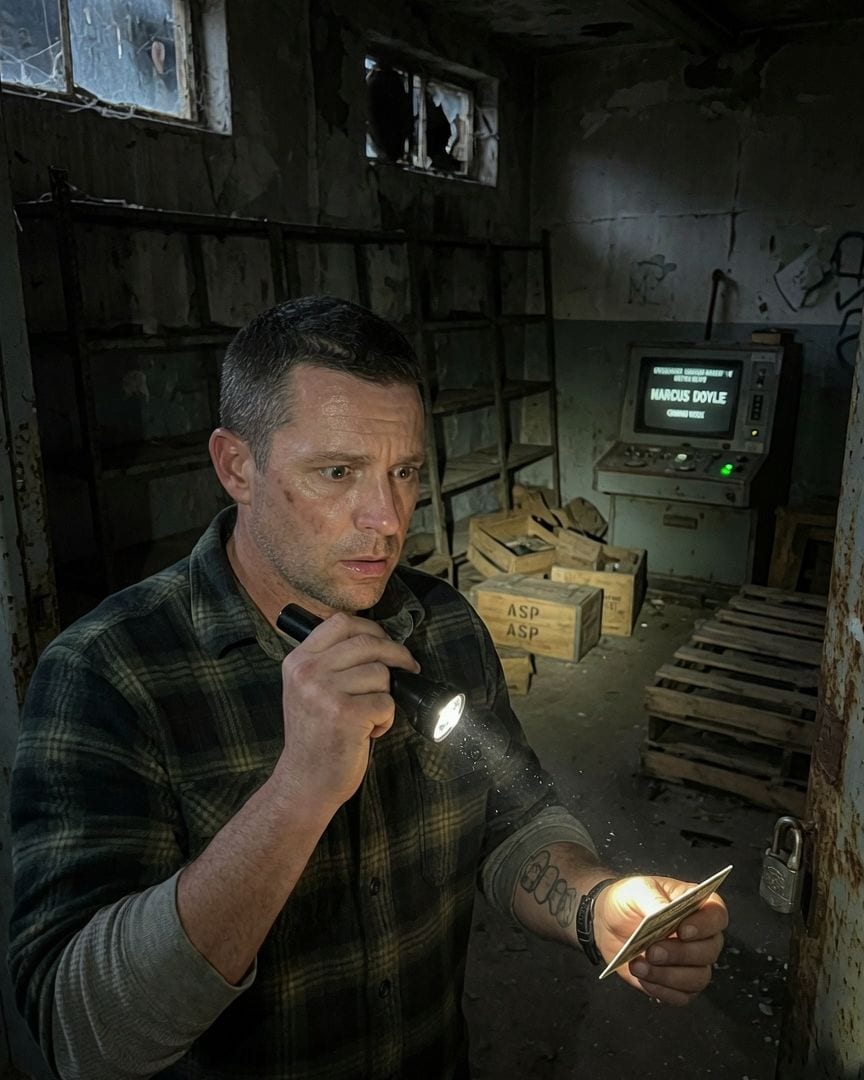
A former serviceman found his name on an active duty roster for a military base decommissioned in 2019. His access card had already logged three entries last month.
Six years after leaving the service, Marcus Doyle’s quiet suburban life was upended by an old access card notice. It came with a chilling printout: his badge number and name, logged entering Fort Crestwood’s Ammunition Supply Point three times last month, each at 0240. The former military base had been officially decommissioned in 2019, its buildings abandoned and gates chained. After discovering his own access card matched the log, Marcus returned to the derelict site, only to find a humming console displaying his name as current "personnel assignment" for the coming week. What could be happening at a base that no longer exists?
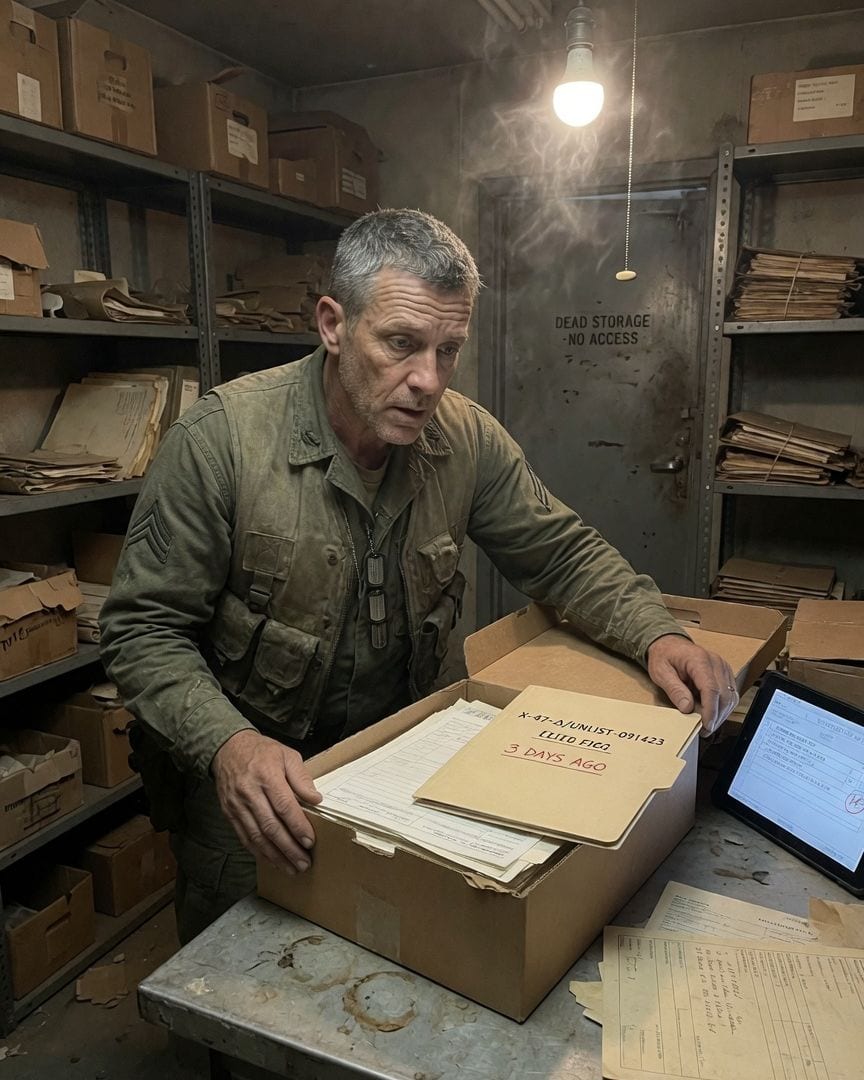
Sergeant Pryor, days from retirement, finds a four-hundred-foot crater. The desert floor is still warm, but no one remembers the blast.
Sergeant Alden Pryor, forty years old and just eleven days from retirement, drove the familiar Ranier Flats fence line for one of his final patrols. The desert stretched out, silent and vast, until he discovered a four-hundred-foot crater, dark and impossibly vast, where the sand had fused into slick glass. The ground within the crater was still faintly warm, a subtle heat defying the cool desert air. Yet, every official log confirmed the blast, while no one recalled a tremor or flash across three states.
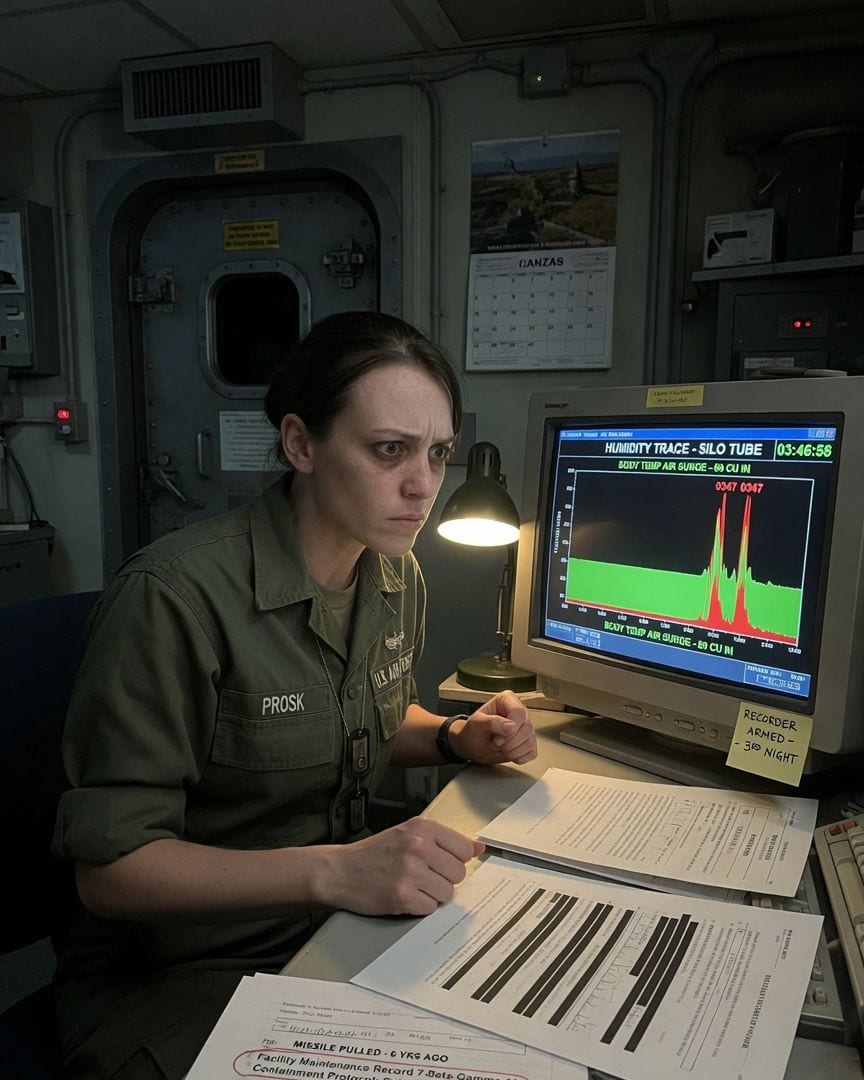
An airman's last weeks before transfer: the empty Cold War missile silo took a warm breath.
Airman Gale Prosk was counting down her final weeks at the silo, eager for her transfer from the isolated Kansas prairie. In the dim control room, the low hum of the ventilation was a constant companion. For years, the environmental monitor for the empty missile tube below had shown a flatline, until three nights ago. A sudden, jagged spike appeared, a surge of air registering at body temperature. She dismissed it as a glitch, but then it happened again. She descended into the vast, echoing chamber where the missile had once stood, finding only cold, polished steel. Back in the control room, redacted declassification files spoke of "biological integrity checks" for the empty space, and Project THRESHOLD documents were missing eight crucial pages. The silence of the silo now hummed with an unseen weight.