A declassification reviewer opened a Cold War 1959 file. A modern data chip inside showed a pilot missing yesterday.
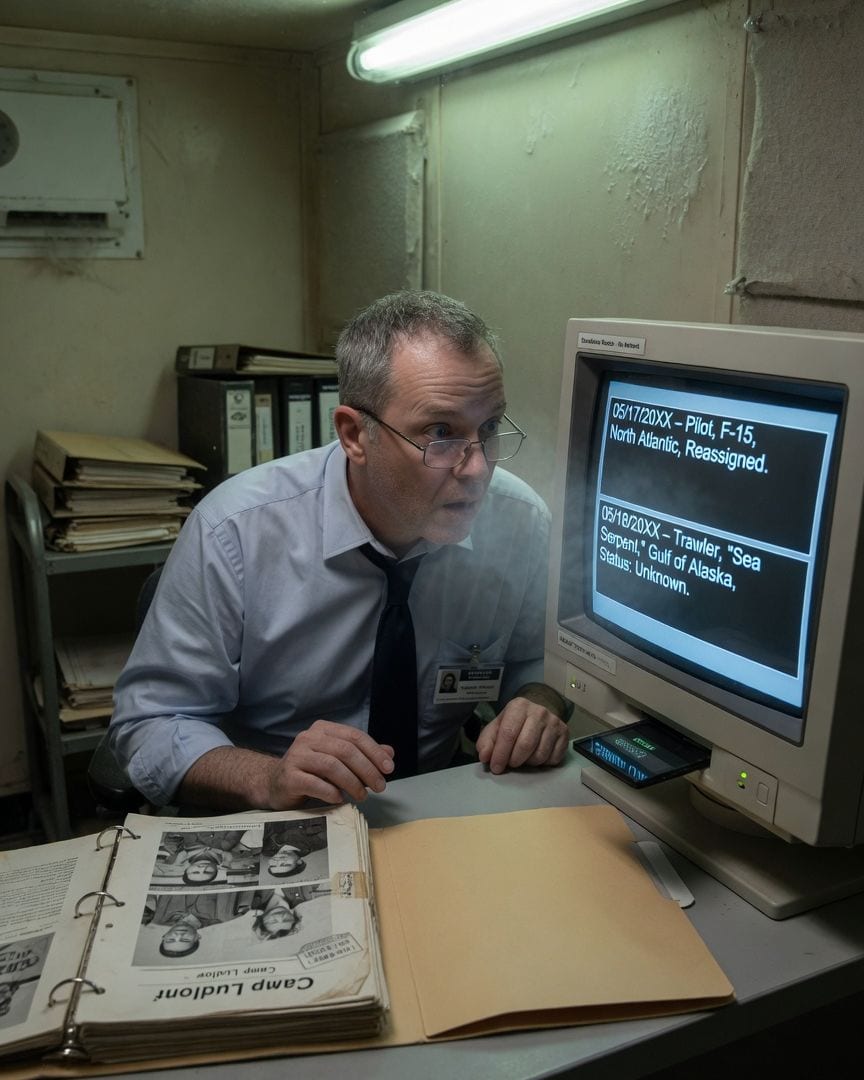
Samuel Vance, a declassification reviewer whose life revolved around the precise order of official records, smoothed the crisp Air Force response letter on his desk.
Its arrival had been an anomaly, addressed to a Corporal Wendell Bracey, age ninety-one, who had claimed his Greenland base, Camp Ludlow, closed in 1959.
Samuel had already pulled the ancient Camp Ludlow file, confirming the closure date: August 14, 1959, all personnel reassigned, base decommissioned. Yet, the letter, impeccably typed on official stationery, stated Camp Ludlow was never closed.
Its detachment, it claimed, remained on active status. The last radio check had been logged four days ago.
Samuel’s mind, accustomed to the rigid logic of archives, snagged on the impossibility. Every document he’d touched over the last fifteen years confirmed Ludlow’s end over sixty years past.
The letter’s calm, bureaucratic tone, devoid of any error or correction, only amplified the profound wrongness.
It hummed in the silent air of his office, a quiet contradiction he could not unhear, a loose thread in the tightly woven fabric of official history.
He ran a finger over the smooth paper, a sense of unease starting to prickle at the back of his neck. This wasn’t a typo, not a clerical error. It felt deliberate.
Driven by a need for logical reconciliation, Samuel requested the original Camp Ludlow physical file. It arrived on a heavy, clattering cart, a bulky, dust-scented collection of binders and microfiche, some dating back to the late 50s.
The air around the cart felt colder, somehow. He began sifting through brittle manifests, each page crinkling like dried leaves.
He saw faded photographs of men in thick parkas, their faces young and eager, now long gone, assimilated into the past. He checked every page against the finding aid, confirming the contents, looking for the impossible detail, the missing link.
Deep within the file, tucked between two thick, unmarked binders that had no business being there according to the accession numbers, Samuel found a single, thin manila folder.
It bore no classification stamp, no catalog number, nothing in any finding aid admitted its existence. The folder felt too clean, its edges too sharp.
Inside, instead of yellowed paper, was a pristine, modern data chip, cool and smooth against his fingertips.
It was the color of smoked glass, no larger than his thumbnail, and it looked utterly, glaringly out of place, a sliver of the present nestled in the past. This wasn't just an anomaly; it was an anachronism.
His breath caught, a sudden chill running down his spine. The file, so meticulously cataloged, had a secret.
Samuel carried the chip to a secure, standalone reader in an isolated review booth, its walls soundproofed, its single fluorescent light buzzing faintly. He inserted it, the slot clicking softly, the sound unnaturally loud in the quiet room.
The screen flickered, a burst of static, then resolved into a clean, minimalist interface. A single column of text began to scroll, displaying names, dates, and brief descriptions.
He leaned closer, expecting to see historical data, perhaps a forgotten manifest of the 1959 closure.
But the dates were alarmingly current: '05/17/20XX – Pilot, F-15, North Atlantic, Reassigned.' He froze, his gaze locked on the screen. His mind raced, pulling up recent news. A pilot had been reported missing in the North Atlantic just yesterday.
The list scrolled again, slowly, deliberately, adding another entry, even more recent: '05/18/20XX – Trawler, "Sea Serpent," Gulf of Alaska, Status: Unknown.' The screen glowed with an indifferent, living light.
Over the next few days, Samuel meticulously cross-referenced the scrolling entries from the data chip with official, publicly available missing persons reports and classified incident logs.
He worked from his office, the blinds drawn, the hum of the server racks a constant, low thrum in his ears. The matches were horrifyingly precise.
Every name and detail on the chip corresponded to a person, aircraft, or vessel officially reported missing within the last 72 hours, often classified under mundane, unrelated incidents: 'mechanical failure,' 'lost at sea,' 'disoriented.'
The sheer volume and accuracy of the data defied coincidence. It wasn't a pattern; it was a perfect mirror.
He tried to trace the chip's internal metadata, using every access code and backdoor he knew.
He discovered it pointed to an unlisted server address within the archive's deepest, most restricted sub-levels—a section not on any public or even internal directory. It was a digital ghost, hidden in plain sight.
His unease ratcheted from an intellectual puzzle to a cold dread that clung to him, tightening his chest. He needed to find that server. It was the heart of this impossible ledger, and he had to see it for himself.
Samuel’s attempts to access the deeper archive sections were met with increasing resistance.
At first, it was subtle: keycard access inexplicably revoked for certain corridors he’d used for years, specific digital directories vanishing from his network drives as he clicked on them, replaced by empty folders.
The temperature in his office seemed to drop, the air growing strangely still. Then, a physical memo appeared on his desk, slipped under his monitor when he’d stepped out for coffee.
It was a single sheet, thick cream paper, with no sender or recipient, just a calmly typed message: 'Unauthorized inquiries into classified system anomalies are being monitored for compliance. Your cooperation is appreciated.'
It wasn't a threat, but an observation, a chilling confirmation that his methodical digging had been noted by the very institution he served.
He felt eyes on him in the silent, labyrinthine stacks, in the hushed corridors where the air grew colder with each passing moment. The quiet hum of the servers now felt like a predatory purr.
He was no longer just an investigator, he realized, his heart beating a slow, heavy rhythm against his ribs; he was a subject of investigation himself.
The walls of the archive, once a comfort, now felt like they were closing in.
Using a forgotten override code he'd found buried in an ancient maintenance manual—a frayed, yellowed document for a system long decommissioned—Samuel finally gained entry to the unlisted server room.
It was a small, windowless chamber, surprisingly cold, the air thick with the smell of ozone and old dust.
It was an anachronistic blend of old and new: banks of humming, vintage reel-to-reel tape drives stood beside sleek, modern server racks that pulsed with soft blue lights. The contrast was sharp, unsettling.
At the center, a single, antique-looking console with a green monochrome screen glowed, bathing the room in an eerie pallor. The Camp Ludlow file was open on it, displaying the familiar scrolling list of names and 'reassignments.'
As he watched, mesmerized and horrified, a new entry for a recently reported lost submarine appeared on the screen, its details resolving with chilling speed.
And then, a faint, almost inaudible tone emanated from the vintage reel-to-reel machines, a soft, mechanical click and whir—a 'radio check.'
He understood now, with a clarity that seized him in a cold grip. The 'radio checks' weren't communications; they were automated confirmations of new 'filings.'
Camp Ludlow wasn't a base that closed; it was a process that began in 1959, and this room was its beating heart, silently processing the lost.
The missing were never truly lost; they were filed, absorbed into this cold, bureaucratic machine, their existence reduced to a line of text in an ever-updating ledger.
The implications of Bracey’s escape, of his sixty years of ignored letters, suddenly snapped into horrifying focus: he was one of the few who slipped through the filing system, and the Air Force’s impossible reply wasn't a mistake, but a confirmation that the 'base'—the system—was still operating.
The entire room seemed to breathe around him, a vast, indifferent intelligence.
Samuel’s fingers hovered over the console, a cold sweat beading on his forehead. The scrolling list continued, an endless litany of disappearances, recording another 'reassignment' of a civilian yacht.
He was trying to process the sheer, impossible scale of it all, the decades of quiet, systematic erasure, when the screen flickered.
The scrolling text paused, then slowly, deliberately, a new line began to form at the bottom of the list.
Samuel’s heart pounded against his ribs, a frantic drum in his ears, as he watched the letters appear, one by one, constructing a name he knew too well: 'Vance, Samuel H.' He saw his own employee ID number materialize next, then a blank 'Date of Reassignment' field, pulsing faintly, awaiting a timestamp.
Above the console, a small, auxiliary monitor, previously dark, blinked on with a soft click, displaying a grainy, monochrome image.
It was a shot of the server room, taken from a high corner, and his own face, pale and horrified, stared back from the screen, caught in the archive's cold light.
The file wasn't just being written; it was writing him.
The realization detonated in Samuel’s mind: Camp Ludlow was not a physical location, never truly was.
It was this system itself, a cold, indifferent bureaucratic entity that processed disappearances across decades, drawing individuals, vessels, and entire units into its 'records' – a vast, hidden archive of the un-lost.
The 'base' in Greenland was merely a temporary, physical interface, a cover story for the system's initial activation in 1959, a conveniently remote location for its earliest operations.
The 'secrecy machine' wasn't hiding a truth; it was the truth, an institution that didn't just record disappearances but actively facilitated them by absorbing them into its own internal, unchallengeable reality.
The pattern across decades and classifications, from missing military assets to civilian hikers, was simply the system's ongoing, efficient function.
Every clue clicked into place: Bracey's escape, the impossible letter, the modern chip in the old file, the 'radio checks' – all facets of a single, horrifying, self-perpetuating entity that files away the inconvenient, the unexplainable, and now, the inconvenient investigator.
With his own name flashing on the screen, the blank 'Date of Reassignment' pulsing like a hungry eye, Samuel knew he had moments. Panic gave way to a desperate, focused resolve.
His gaze darted around the cold server room, landing on a secure data drive he always carried, tucked into his jacket pocket.
He fumbled it out, plugging it into a hidden port he'd noticed earlier, half-obscured behind a dusty reel-to-reel machine. He frantically initiated a data transfer, targeting the live, self-updating log, desperate to snatch a piece of the system's truth.
The room’s single fluorescent light flickered, the buzzing intensifying, then dimmed completely for a split second before returning. A low, mechanical hum intensified from the server racks, a sound that seemed to vibrate in his bones.
He heard it then: the distinct, slow shuffle of heavy boots approaching the sealed door, deliberate and unhurried. The transfer bar crawled across the screen, agonizingly slow, each percentage point a lifetime. The footsteps stopped just outside the door.
Samuel snatched the drive just as the light died completely, plunging the room into near darkness, save for the faint, pulsing green glow of the console. He heard the click of the door mechanism engaging, a soft, mechanical snick.
In a desperate, blind dash, guided only by the emergency exit sign's faint red glow, he slammed his shoulder against a secondary emergency door, bursting out into a narrow, cold maintenance corridor. The drive was clutched tight in his hand.
He didn't look back, the heavy thud of the door closing behind him echoing in the sudden silence as he ran.
Samuel Vance, now a civilian, lived a life stripped bare. His career, his access, his meticulous reputation – all gone.
He had presented the drive, the data, the horrifying truth, and had been summarily dismissed, his account attributed to stress and a disturbed mind.
The raw, scrolling feed of impossible disappearances, the unassailable evidence, was quickly discredited as a sophisticated hoax, a well-crafted deep fake designed to disrupt national security.
He lived in a small, impersonal apartment, isolated, haunted by the knowledge that the system was still out there, humming, filing, unchecked, its invisible work continuing.
He saw the news reports, the bland stories of 'unexplained disappearances,' and knew the truth behind the sanitized headlines, a truth no one would ever believe.
Samuel sat alone, the secure drive tucked away in a hidden compartment behind a loose brick in his apartment wall.
He watched a local news report about a young hiker who had vanished without a trace in a remote national park, the kind of story that usually faded quickly from the news cycle.
The anchor’s voice was calm, professional, listing the hiker's known itinerary, the search efforts, the growing bafflement. Samuel knew the hiker's name.
The news anchor spoke the hiker's name, and Samuel knew it was already on file.
If this one got to you
A records clerk's archive file for a Cold War reconnaissance plane lost in 1968 showed it flew yesterday to her own building.
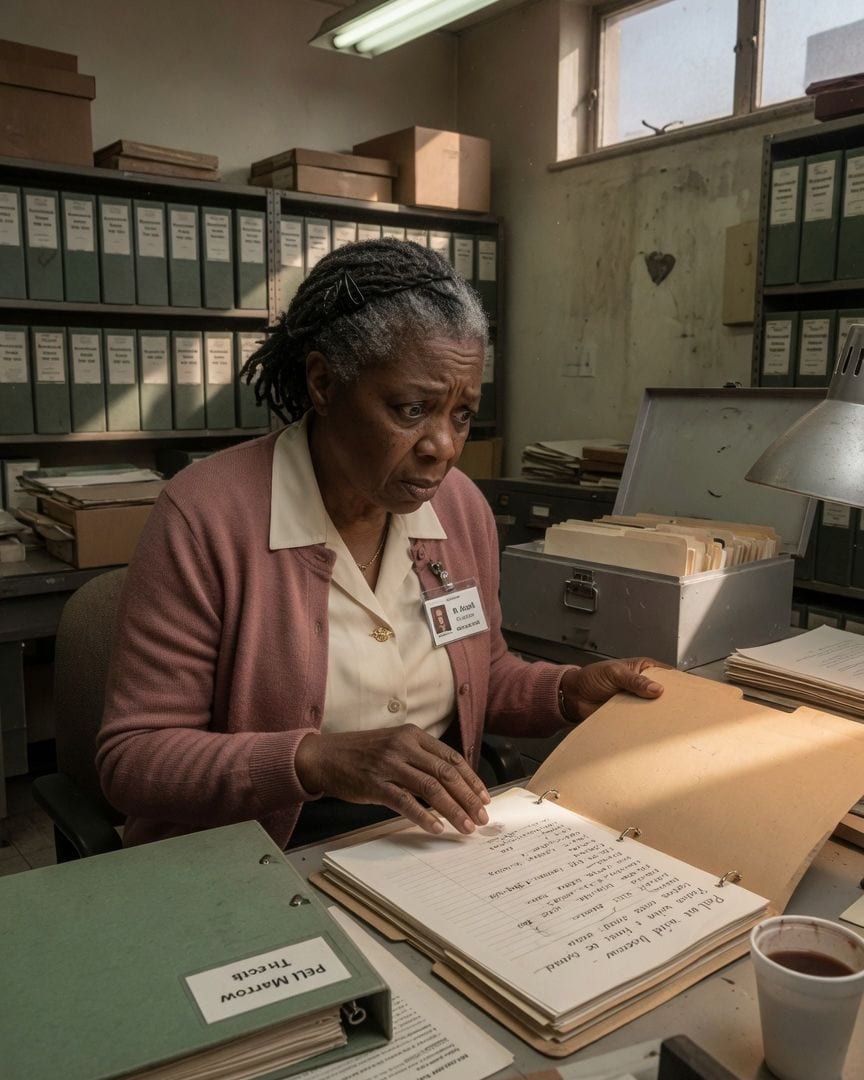
Marguerite Ansell, a records clerk nearing her final week before retirement, meticulously audited Cold War-era files. In the cool, dusty archive, she pulled a file for an oiler declared missing in 1951. Inside, she found a fueling schedule with entries stretching into the present, the last dated just eleven days ago. Then, a second lost ship revealed a similar impossible log, and a cold certainty began to bloom in her chest. Deep in the shadows, Marguerite found an unmarked steel box containing a file for a reconnaissance plane lost in 1968. Its flight log showed a final flight yesterday, to the precise coordinates of her own archive building.
A records depot worker unearths a lost 1940s ship file, then finds a control number from 1988, linking the vanished vessel to the Norfolk coastline.
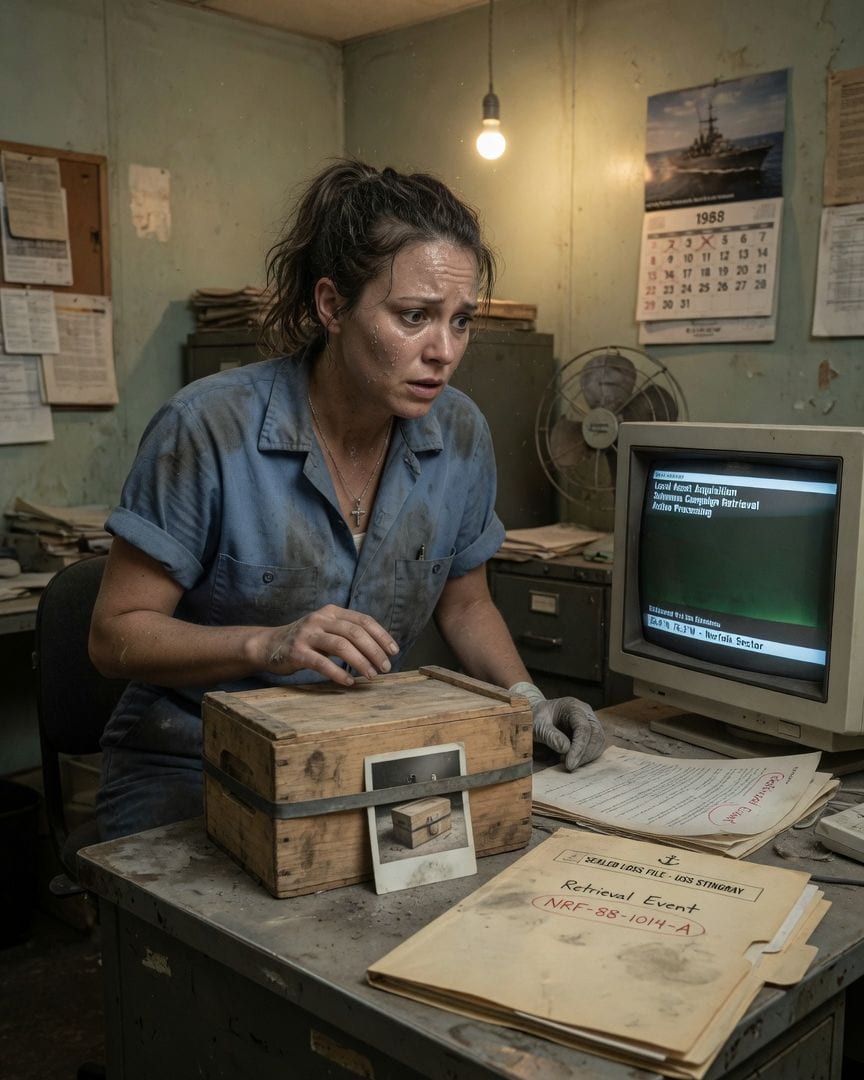
In 1988, Callista Rhue toiled in a humid Norfolk records depot, her monotonous job sifting through the charred remains of a 1943 fire that had supposedly incinerated everything. She unearthed a cool, unmarked wooden crate that should not have survived, finding a faded 1944 Polaroid of the very crate tucked into its lead band. Inside, a 'sealed loss file' for the USS Stingray, a minelayer vanished in the Solomons, contained an impossible 'Retrieval Event' dated 1988. Callista's database search for the anomaly then pointed not to the distant Pacific, but to active processing for the lost vessel on a remote Norfolk coastline, just miles from the depot. What had truly vanished, and what had been found?
Petty Officer Galloway logged a sailor onto his ship. The man died at sea 40 years ago.
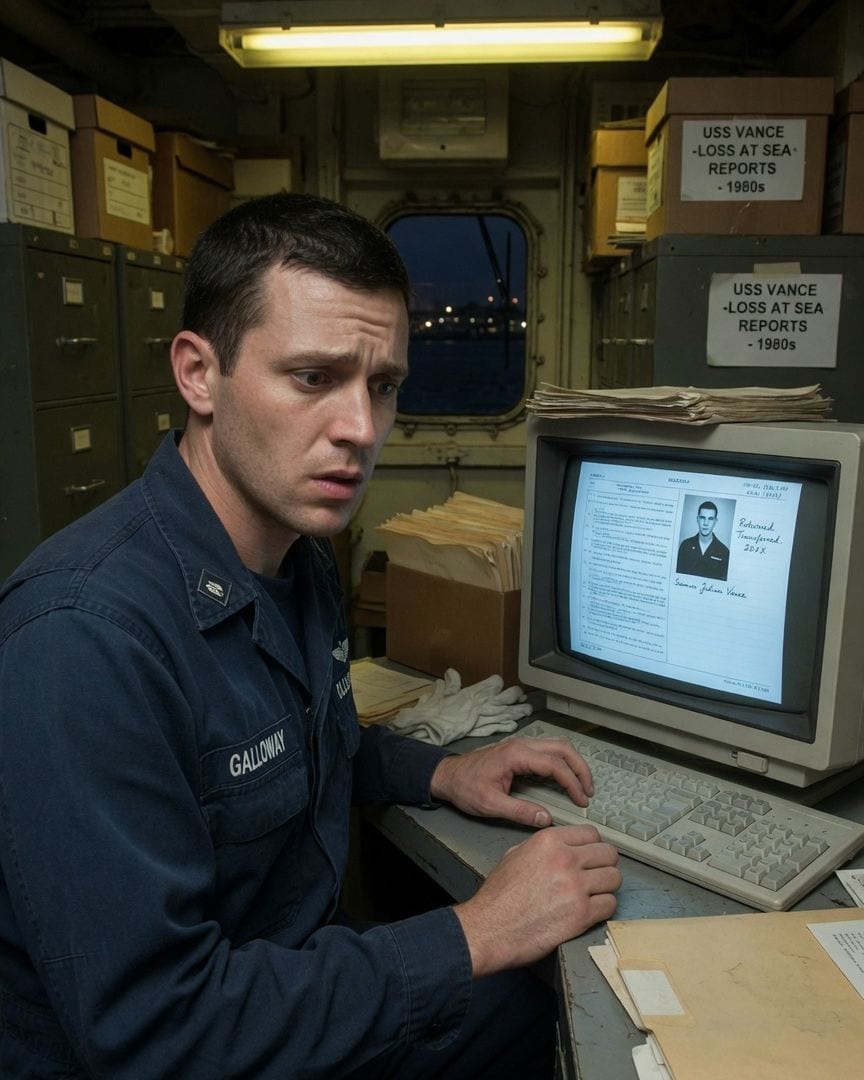
Petty Officer Joel Galloway scanned a sailor's ID on the USS Vance quarterdeck. The man's name, 'Seaman Julian Vance,' and his out-of-date uniform pricked at Galloway's memory. Later, the ship's berthing count came back one over, with an extra entry in the system but no physical body.
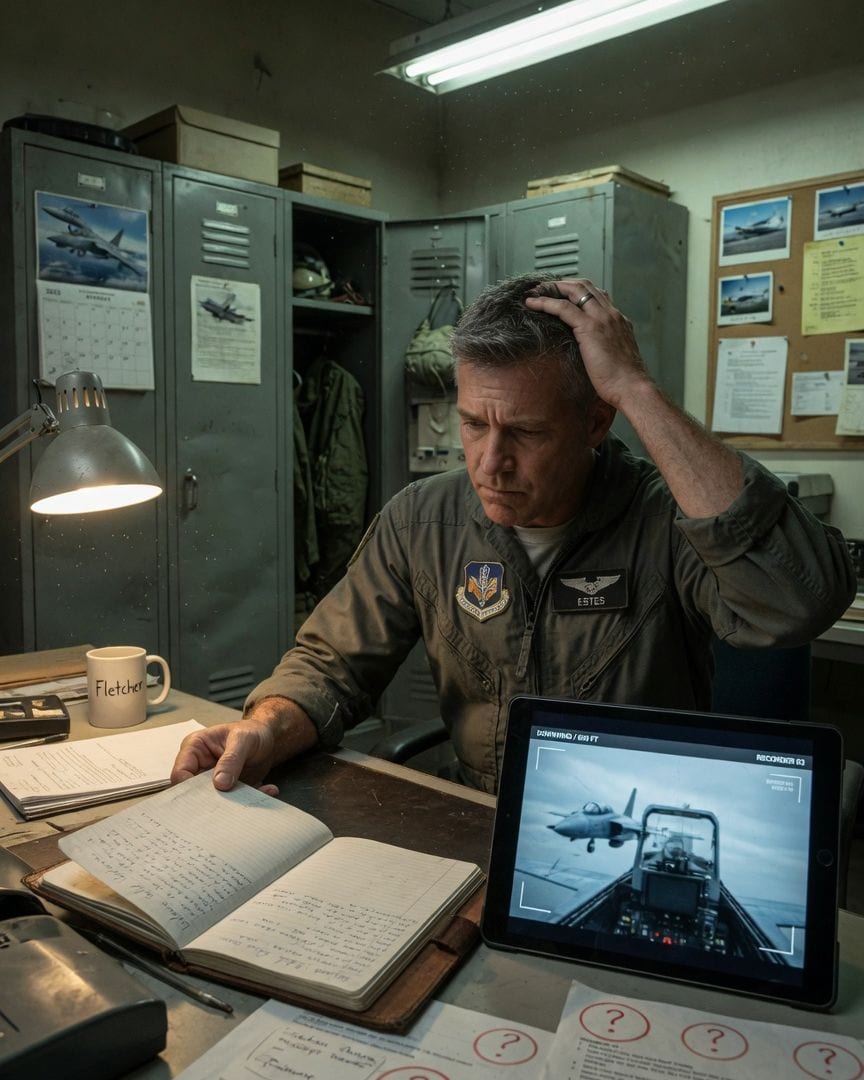
A Chief Warrant Officer's HUD tape shows a phantom jet, impossibly close, off his wing. Forty years ago, another Cold War pilot logged the same impossible sight.
Chief Warrant Officer Nathaniel Estes, a pilot whose career hinged on absolute precision, was under evaluation for a critical promotion. His nightly review of HUD tapes from routine Mojave test flights was a meticulous habit, but for a week, it revealed an impossible detail. At precisely 800 feet, one frame showed a sleek, experimental jet tucked impossibly close off his left wing—a craft ground radar never detected. When his maintenance chief found no equipment fault, Estes unearthed a dusty, decades-old logbook detailing identical phantom sightings from 1978. What unseen presence shadowed the desert skies?
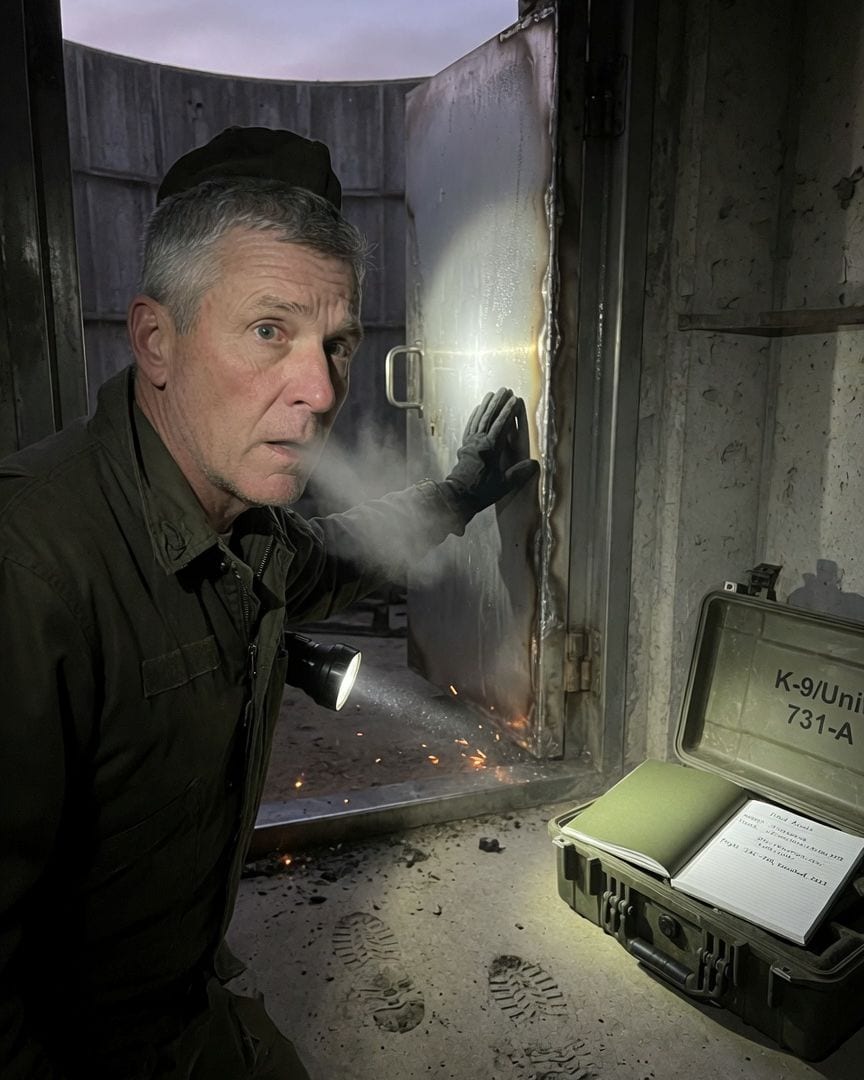
The Cold War silo was welded shut in 1968. A Captain found lights burning, fresh prints leading inside, and a logbook with a vanishing from last week.
Captain Merrit Sable faced a deadline at Silo K-9: one cold morning to retrieve classified hardware before its scheduled demolition at noon. The silo, officially welded shut by the Air Force in 1968 and long off-grid, should have been a tomb of forgotten machinery. Yet, through a cracked port, he saw nine work lights burning steadily forty feet down, and felt the faint suction of an active ventilation system. After breaching the decades-old weld, Merrit found more than just lights; fresh boot prints led deeper into the meticulously clean shaft, but none returned. A hidden compartment in an empty, warm hardcase revealed a logbook, its crisp pages detailing notorious military disappearances, with the latest entry dated just last week.
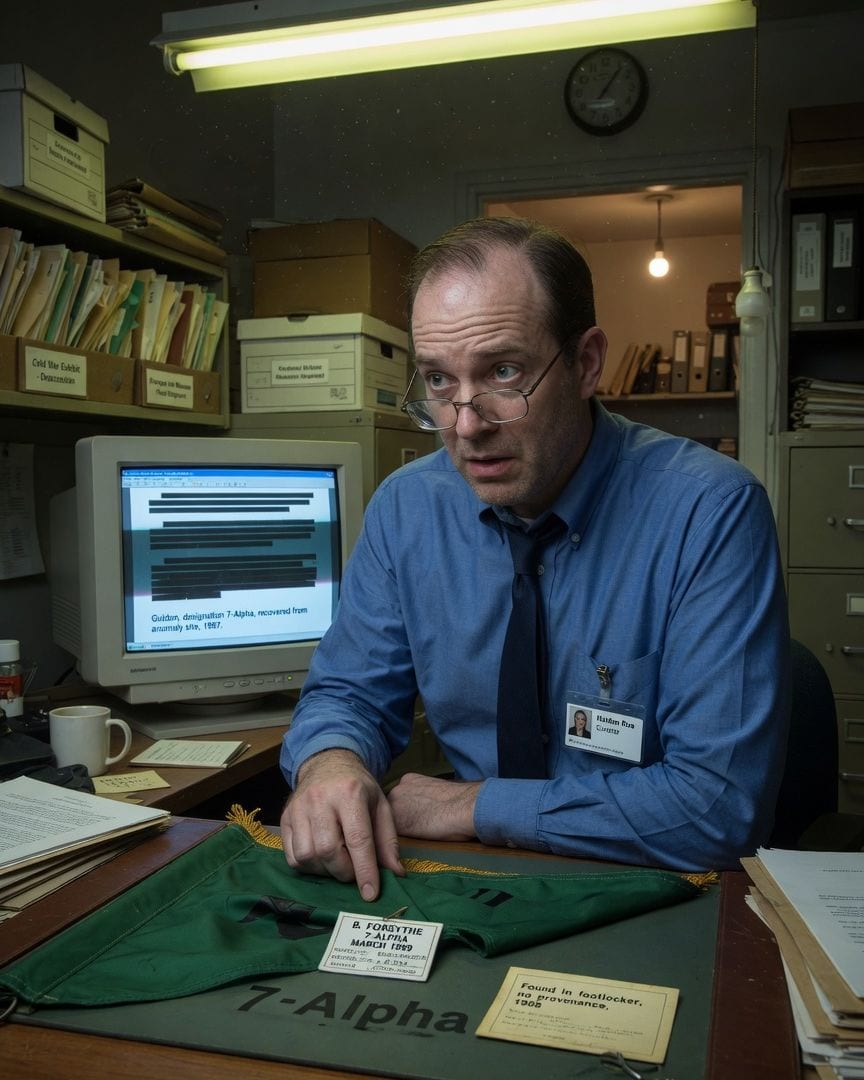
A curator found a guidon dated 1989. The museum took it in 1988, but the Cold War airman on its tag vanished in 1954.
Halden Roe, a meticulous curator, worked against a pressing deadline as the Presque Isle Museum's Cold War exhibit closed for good. In the dusty storage unit, under a single bare bulb, he discovered a small laundry tag sewn into an antique green silk guidon. Its crisp black stitching clearly read 'MARCH 1989' — a date a full year *after* the museum’s intake record for the artifact. As Halden's unease grew, he found the service number on the tag belonged to Benjamin Forsythe, an airman who vanished off Greenland in 1954. How could a museum piece found in 1988 bear a future date and belong to a ghost from decades past?