My county archive digital file has a redacted line from 1901, marked 'recurs each generation.' The address? My house. The instruction number? My son's school registration.
The kitchen table usually offered a kind of quiet solace.
My laptop was open to the county archive’s newly digitized records, the sort of mundane rabbit hole I’d found myself falling down lately, a distraction from the endless school forms for Samuel.
Five years old and starting proper school in September. Time flies, they say. It felt more like it stood still, then lurched forward with dizzying speed.
I was idly searching for old village history, our Church Lane, the people who lived here before us. I found the 1901 school log for our tiny village primary. The digital scan was clear, the handwriting faded but legible.
Entry after entry of familiar names: 'Thomas Higgins, Absent, Measles.' 'Sarah Jenkins, Progress Good.' Ordinary lives, ordinary records.
Then, there it was. Between two perfectly mundane entries, one that snagged my attention, pulled it taut like a wire. It read: ‘Pupil: [REDACTED LINE]. Residence: Church Lane, No. 17.’
The redaction was a stark black rectangle, perfectly opaque, a void in the flow of the text. Beneath it, a small, italicized transcriber’s note: ‘Withheld – recurs each generation, standing instruction EDU-447-B.’
I blinked. My coffee cup felt suddenly heavy in my hand. Church Lane, No. 17. That was my house. Our house. Samuel’s house. And the instruction number. EDU-447-B. My blood ran cold, a slow, deliberate seep.
That was the exact reference Monica Davenport at the Education Office had quoted me just last month when I registered Samuel. Not for attendance, not for medical history, but for the basic initial registration.
She’d just rattled it off, a code, an administrative formality.
An impossible, cold knot tightened in my stomach. Someone, over a century ago, had filed a blank space in a school log, tied to my home, with an instruction that was still active. Still relevant.
Relevant enough to be cited when registering my son. The air in the kitchen, usually so warm and bright, felt suddenly still, heavy.
The next morning, the knot in my stomach was tighter. I called the Education Office, my heart thudding a frantic rhythm against my ribs. I asked for Monica Davenport.
When she answered, her voice was calm, almost soothing, the same placid tone she’d used when I’d registered Samuel. “Ah, yes, Mrs. Barlow. Laura, isn’t it?”
“Yes,” I said, trying to keep my voice steady. “I have a query about an instruction number you mentioned when I registered Samuel. EDU-447-B.”
“Ah, yes, Mrs. Barlow. That’s a standard internal administrative code,” she replied, as if reciting from a script. “Nothing to worry about. Just ensures proper processing for specific residential catchment areas.”
“But it’s cited in a 1901 school log,” I pressed, the words tumbling out, “regarding my house, Church Lane, No. 17. And there’s a note saying it ‘recurs each generation.’ What does that mean?”
There was a slight, almost imperceptible pause on the line, a breath held too long. Then, Monica’s voice, a shade cooler. “Historical archiving can sometimes contain… unique annotations, Mrs. Barlow. Our current system is entirely digital and streamlined.
Rest assured, Samuel’s registration is complete.” Her evasion was smooth, professional, and entirely unconvincing. It was the kind of answer that sounded perfectly reasonable if you weren’t already looking for the cracks.
I hung up, feeling a distinct prickle of unease bloom into something sharper. ‘Unique annotations.’ ‘Residential catchment areas.’ It didn’t explain the recurring aspect, or the redacted line. It didn’t explain why the same code was still in use.
That night, the local history archives held no further interest. Instead of scrolling through village council minutes, I started digging into my house’s past. We’d bought it seven years ago, a pretty Victorian semi, solid and well-maintained.
The previous owners, the Lamberts, had moved away abruptly in the late 1990s, I remembered the estate agent saying. A sudden job relocation. Nothing specific. I thought about the attic.
When we’d moved in, they’d left a few boxes behind, mostly junk, but one of them was marked ‘Lambert – Misc.’ Maybe there was something there. Something less ‘streamlined’ than Monica’s assurances.
Something that didn’t quite fit into an internal administrative code.
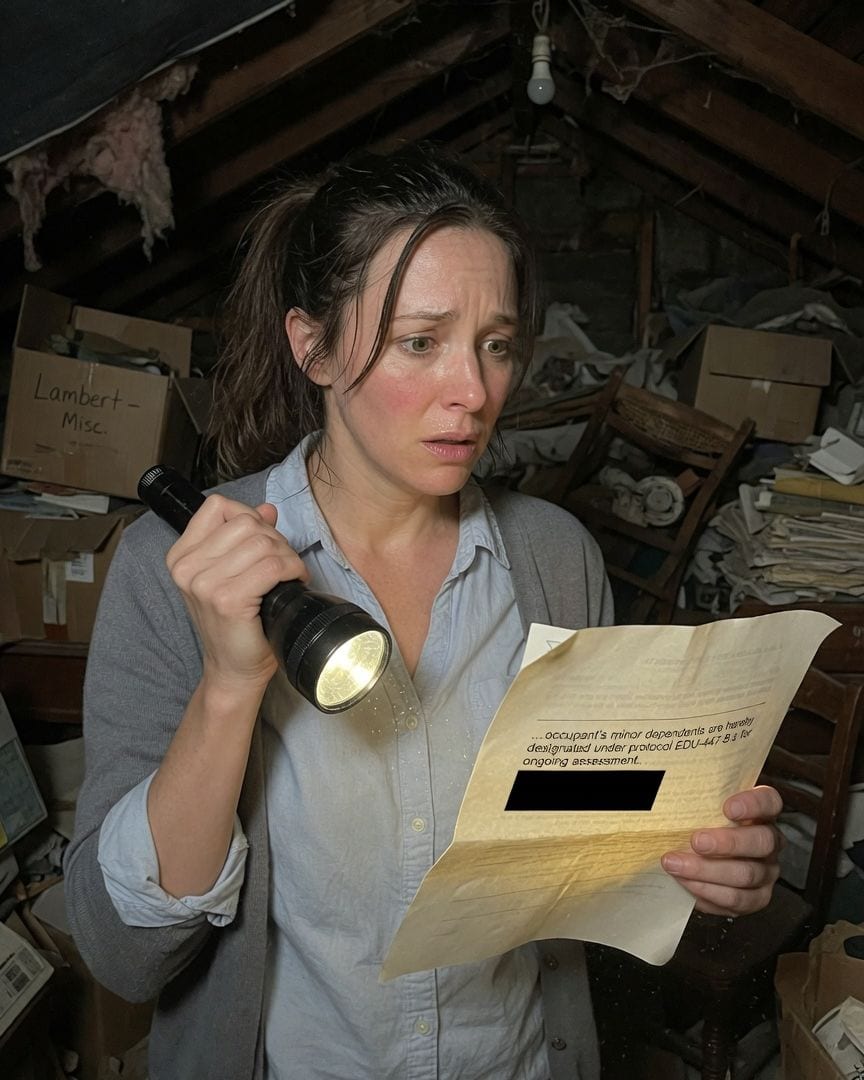
The attic was stifling, thick with the smell of old paper and insulation, a claustrophobic warmth that made my skin prickle. My flashlight beam cut through the gloom, illuminating forgotten furniture, dusty trunks, and stacks of forgotten lives.
I found the box, tucked away in a corner, labeled ‘Lambert – Misc.’ The cardboard was brittle, the tape peeling.
Inside were old utility bills, expired insurance policies, faded photographs of people I didn’t know, faces smiling out of another era. And then, nestled at the very bottom, beneath a stack of brittle newspapers, I found it.
A heavy, cream-colored document. It was a ‘Local Council Notice – Property Designation.’ Undated, but the paper felt ancient, crinkling delicately at the edges when I picked it up.
My breath hitched. Halfway down the page, between paragraphs about property maintenance and local levies – the usual bureaucratic boilerplate – was a stark, perfectly blacked-out line.
It was identical in length and placement to the one in the 1901 school log, a black rectangle of pure, unsettling silence.
My eyes darted to the text immediately surrounding it. Just above the redaction, in stiff, official script: ‘...occupant’s minor dependents are hereby designated under protocol EDU-447-B for ongoing assessment...’
Laura stood frozen, the dust motes dancing in the beam of her light. Her house. Her son. The same number. The same black silence.
The next day, I made an appointment at the County Archive. My hands were still trembling slightly as I clutched the printouts of the 1901 log and the council notice. I asked for Roland Crane, the archivist.
He was a quiet man in his early sixties, with spectacles perched on his nose, surrounded by the hushed reverence of old documents.
The air in his office smelled of aged paper and floor polish, comforting in its antiquity, but the chill in my own bones was far from soothed.
I laid the documents on his worn wooden desk. Roland examined them, picking up the council notice first. His brow furrowed as he traced the redacted line with a slender finger. “Fascinating,” he murmured, his voice soft, almost a whisper.
“I’ve seen this instruction number, EDU-447-B, crop up in various municipal records over the decades, always associated with certain properties. Never quite understood its purpose. It seems to predate most of our current cataloguing systems.”
He pushed his glasses further up his nose, peering at the note on the 1901 log. “’Recurs each generation,’ you say? Well, that would explain why it’s never been fully phased out, I suppose. Just carried forward.”
My heart hammered. “Do you have anything else on Church Lane, No. 17, specifically concerning this protocol?”
Roland, ever methodical, nodded slowly. He tapped a few keys on his keyboard, pulling up old council minutes on his screen. The digital display hummed softly in the quiet room. We scrolled through decades of mundane planning applications and resolutions.
Requests for new drains, arguments over boundary fences, debates about street lighting. All perfectly ordinary.
Then, in the minutes from 1952, a terse line appeared. It looked almost out of place amidst the tedious prose. ‘Discussion regarding the continued designation of property at Church Lane, No. 17, under EDU-447-B. Protocol to remain active.’
Another entry, this time from 1971: ‘Review of EDU-447-B designated properties. Status of Church Lane, No. 17: Active, with one minor dependent currently under observation.’
I felt a cold wave wash over me, a physical drop in temperature that made the hairs on my arms stand up. It wasn't just a record, not just a historical anomaly. It was an ongoing status.
My house was active. And in 1971, there had been a child. A child like Samuel.
Roland, sensing my distress, offered a sympathetic look but no explanation. He simply said, “The older records are often… less transparent. Bureaucracy has always had its quiet corners, Mrs. Barlow.”
He printed me a list of other properties that had also been designated under EDU-447-B, all within the same small village, all with similar sparse, ominous entries.
The thread was pulling taut, revealing a pattern far wider than just my house. The entire village, it seemed, had its quiet corners.
The next few days, I felt a subtle shift in the air, a prickle on the back of my neck. It was as if a membrane had thinned, and something on the other side was now paying closer attention.
I called Monica Davenport again, determined to push past her bureaucratic placidness. I asked if I could see the actual 'internal administrative code' for EDU-447-B.
Monica’s voice, usually so placid, had a new, almost brittle edge. “Mrs. Barlow, I’ve already assured you there’s nothing to be concerned about. Further inquiries into internal protocols are… discouraged.” The line went dead. She had hung up on me.
My hand lingered on the cold receiver. Discouraged. The word had the weight of a threat.
Later, picking Samuel up from school, I noticed Mrs. Henderson, a neighbor who worked part-time as a lunch monitor, watching me with an odd intensity.
Mrs. Henderson usually greeted me with a warm smile, a friendly wave, but today, her gaze was unblinking, unreadable. Her small, thin lips were pressed into a line. She looked at Samuel, who was chattering away about his day, oblivious.
“Samuel’s doing so well, isn’t he?” Mrs. Henderson said, her voice a little too loud, a little too bright, cutting through Samuel’s happy babble. “Such a bright boy. He’ll go far.”
The words hung in the air, a strange undertone of finality to them, a peculiar knowing that made my skin crawl. He’ll go far. Where?
That evening, the list Roland had given me was spread across the kitchen table. I was cross-referencing the other 'designated' properties with old census records, trying to find patterns in their occupants.
The window overlooking the street was dark, reflecting the lamp-lit kitchen. I saw a car, a dark sedan I didn't recognize, parked halfway down my street.
It was still there an hour later, its windows reflecting the streetlights like dark, empty eyes.
When I pulled back the curtain to check again, the car's headlights flashed, briefly illuminating my living room window in a stark, white glare, before it slowly drove away.
It felt less like a coincidence and more like a gentle, unmistakable warning. Someone knew I was digging, and they were letting me know they were watching. The silence of the house pressed in on me.
I decided I couldn't wait for answers. I had to confront Monica Davenport in person.
The next morning, fueled by cold dread and stronger coffee, I walked into the Education Office like a woman possessed, heart pounding, and demanded to see her.
The receptionist, a young woman with a deer-in-headlights expression, tried to deflect me, but I refused to leave.
Monica met me in a small, sterile meeting room, the kind with beige walls and uncomfortable chairs.
Her face was impassive, but her eyes held a flicker of something I couldn’t quite decipher – annoyance, perhaps, or a deep, weary resignation. “Mrs. Barlow, I really think this is unnecessary. You’re becoming… agitated.”
The word was meant to dismiss me, to label me as irrational.
I slapped the printouts of the 1901 log, the attic council notice, and the 1971 council minutes onto the polished table. The sound cracked in the quiet room. “Agitated?
My house has been ‘designated’ for over a century, and my son is now subject to the same ‘instruction number’ as a redacted entry from 1901! What IS protocol EDU-447-B?”
Monica’s composure finally cracked, just a fraction. Her lips thinned, a faint tremor passing through her hand as she instinctively smoothed her skirt. “It’s a special placement protocol, Mrs. Barlow. For certain children. For their own well-being.”
Her voice was flat, devoid of emotion, the kind of voice that speaks of long, ingrained habit.
“Well-being? What kind of well-being requires a redacted name and a century of quiet observation?” I pushed, leaning forward, my voice tight.
Monica sighed, a sound of profound, almost ancient, resignation. “There are… sensitivities. Certain… predispositions that manifest in particular residential locations. It’s a long-standing arrangement, designed to ensure the child receives the specialized environment they need.
It’s always been handled with the utmost discretion.” She looked at the documents on the table, then back at me, as if assessing a particularly difficult, but ultimately manageable, problem.
I felt a chill deeper than any I’d known, a cold that started in my bones and spread outwards. “Specialized environment? You mean you take them. You take children.” The words were a stark accusation, but her face remained unchanged.
Monica met my gaze, her eyes devoid of warmth, or even regret. “We facilitate their transition. It’s all documented. For generations.”
The words hit me like a physical blow. The redacted lines weren't about what the child was, but what was done to them. The instruction number wasn't for school registration, but for a quiet removal. The calm bureaucracy wasn't just filing; it was processing.
Samuel was not being registered for school; he was being processed for 'special placement'. The room suddenly felt very, very cold, as if all the oxygen had been sucked out.
Reeling from Monica’s chilling admission, the word ‘transition’ echoing in my ears, I stumbled out of the Education Office and back to the archive, desperate for any shred of hope, any counter-explanation.
Roland Crane was at his desk, his face impassive, as if nothing in the world of old documents could surprise him. “Is everything alright, Mrs. Barlow? You look… unwell.”
I ignored him, my mind racing. “I need to search. ‘EDU-447-B protocol reassignment’.” My fingers flew across the keyboard, typing the grim phrase into the archive search engine.
A single document appeared. Its title flashed on the screen, stark and unmistakable: Marked 'Confidential - Internal Use Only.' It was a memo from the Education Authority, dated 1978.
My hands trembled as I opened the digital file, the screen light suddenly too bright, too stark.
The subject line read: 'Successful Reassignment - Protocol EDU-447-B.'
The memo detailed the 'smooth transition' of a seven-year-old child from Church Lane, No. 17, into a 'specialized educational facility.'
It praised the 'exemplary cooperation' of the previous occupants, the Lamberts, and concluded with a note: 'Subject shows early signs of successful integration into the new program, as per generational observations.'
My vision blurred. Reassignment. Integration. My house. The Lamberts. And then, a new name, a different child, but the same address, the same protocol, decades ago. Samuel was five. The memo detailed a seven-year-old. I had two years.
Two years before Samuel would be 'reassigned.'
I shoved the printout of the 1978 memo across Roland Crane's desk. The paper rustled accusingly. “’Successful reassignment’?” My voice was a harsh whisper. “’Exemplary cooperation’ from the Lamberts? What did they cooperate with, Roland?
The taking of their own child?”
His usual calm fractured. He winced, recoiling from the paper as if it might burn him. He slumped in his chair, spectacles askew. “I… I knew about it, of course. Not the details, not the names.
Just that the protocol existed. My predecessor, Mr. Holloway, he was part of it.” He finally confessed, his voice a low whisper, almost lost in the cavernous silence of the archive. “It’s not… what you think. Not malicious.
They call it the ‘Containment Mandate.’ Certain families, certain bloodlines, living in these designated houses, they exhibit a recurring… sensitivity. A vulnerability to something. Something that passes down. The institution believes it’s protecting them. Protecting everyone.”
He explained that the redacted lines were internal classifications, not names. Not a secret identity, but a secret status. The instruction number, EDU-447-B, was a procedural code for ‘identified’ children.
The ‘special placement’ was a euphemism for their removal into isolated, monitored facilities, where they were supposedly safe from whatever influence plagued their lineage. A facility. A quiet, clinical box.
Roland pulled open a drawer in his desk, rummaging through old maps until he found one, faded and brittle.
It was a map of our village, marked with dozens of other designated properties, all with similar histories of 'reassignments' over the decades. A sprawling, unseen web.
The horror wasn't a monster, wasn't a shadowy cult, but the cold, clinical logic of an institution that had decided, generations ago, that certain children were better off removed, managed, and contained, for a threat they refused to name.
A threat so insidious, so generational, that it warranted this quiet, perpetual consumption.
Every clue clicked into place: the recurring entries, the calm bureaucracy, the quiet disappearances. It was all a system, running for over a century, utterly convinced of its own necessity. The chill in my bones deepened to an existential freeze.
I tried to pull Samuel out of school. I walked into the headmaster’s office, filled out the forms, offered any excuse I could conjure. He looked at me with sympathetic, knowing eyes.
He told me he was ‘unable to process such a request at this time.’ I tried to sell the house, called the estate agent, told them I needed to leave immediately.
The agent, usually so eager, suddenly became evasive, citing ‘market conditions’ and ‘administrative delays.’ I tried to simply leave. Pack a bag, take Samuel, drive away. But the system, once activated, was absolute.
Monica Davenport, now accompanied by a senior education official named Janet Holloway, met me in the same sterile meeting room.
Holloway was a stern woman in her late fifties, her silver hair pulled back in a severe bun, her voice resonating with quiet authority. “Mrs. Barlow, the protocol is not voluntary.
Once a child is identified, it is for their safety. And the safety of the community.” She spoke with the calm conviction of someone who had never questioned the righteousness of her actions.
They showed me legal documents, centuries old, granting the Education Authority extraordinary powers in cases of ‘community welfare.’ Parchment yellowed with age, filled with arcane legal language, but the meaning was clear. There was no recourse. No escape.
I fought. I screamed. I threatened them with lawyers, with the press, with whatever legal or public pressure I could imagine. But their calm, unyielding bureaucratic wall was impenetrable.
They had foreseen every objection, every attempt at resistance, and had a file for each. They had been managing this for generations. My outrage, my terror, was just another data point in their long, silent history.
I was given a date. A date for Samuel’s ‘transition.’
When the day came, two polite, unsmiling individuals, not police, but from a ‘Special Services’ department, arrived. They wore plain suits, their faces blank, efficient.
Samuel, confused, clutching his favorite dinosaur, looked at me, his eyes wide with a question he couldn’t articulate. I knelt, hugging him fiercely, tears streaming down my face, whispering promises I couldn’t keep.
Promises to find him, to bring him home, that felt utterly hollow in my own mouth. The officials waited patiently, their faces blank.
The dread wasn't a monster with claws and teeth, but the quiet, relentless machinery of people doing their job, following protocol.
Samuel was led away, his small hand waving goodbye, his eyes still holding the innocent confusion of a child who didn’t understand why his mother was crying, why she wasn’t stopping this. He was just gone.
The house became unnaturally quiet. Samuel’s toys lay untouched in his room, small plastic soldiers and cars frozen in mid-battle on the rug. The silence stretched, a vast, echoing space where his laughter used to be.
I stopped trying to fight. There was nothing left to fight. The local council sent a routine letter, confirming Samuel’s ‘enrollment in a specialized educational program.’
Monica Davenport called once, a week later, her voice still placid, to check if I needed any ‘support.’ I hung up without a word.
The village went on as usual. Other children laughed in the park, their voices bright and careless. The school bell rang, marking the start and end of another day for children who were not Samuel.
The designated properties on Roland’s map remained marked, quiet. Another generation had passed its vulnerability on, and the system had quietly, efficiently, managed it. The records were updated. The files were closed.
Life continued, oblivious to the quiet consumption of its children.
I sit on the porch swing, watching the street. The leaves are turning gold on the old oak tree at the corner, a crisp autumn air settling in.
A young couple, new to the village, walk hand in hand down Church Lane. They stop in front of No. 23, one of the other houses marked on Roland’s map.
The woman points, smiling, at the 'For Sale' sign that has just gone up. She looks pregnant, her hand instinctively resting on her gently rounded stomach.
I watch them, a hollow ache in my chest. I know the system. I know the protocol.
And I know that somewhere, deep in a file, a new instruction number will soon be quietly activated for that house, waiting for the next generation.
The sun dips, casting long shadows across the street, and the 'For Sale' sign seems to gleam with a quiet, patient menace.
She just sits there, watching them, knowing.
If this one got to you
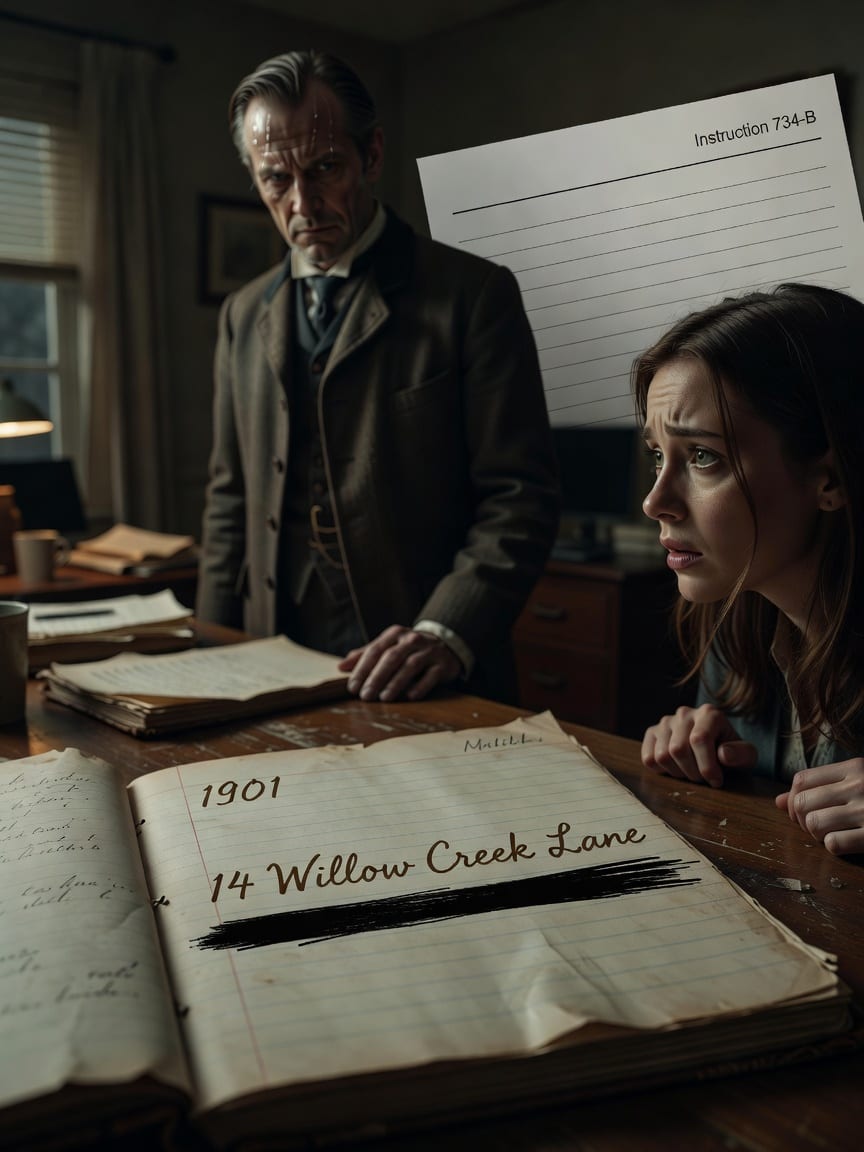
My son's school registration cited a 'standing instruction' for our house. The 1901 log shows that same instruction, blacked out, for a pupil living here.
Registering my son, Leo, for kindergarten felt routine, until I noticed 'Instruction 734-B' on his form. Weeks later, researching our house's history, I found a 1901 school log entry for 14 Willow Creek Lane. A pupil's name was blacked out, marked with the exact same instruction number, recurring each generation.
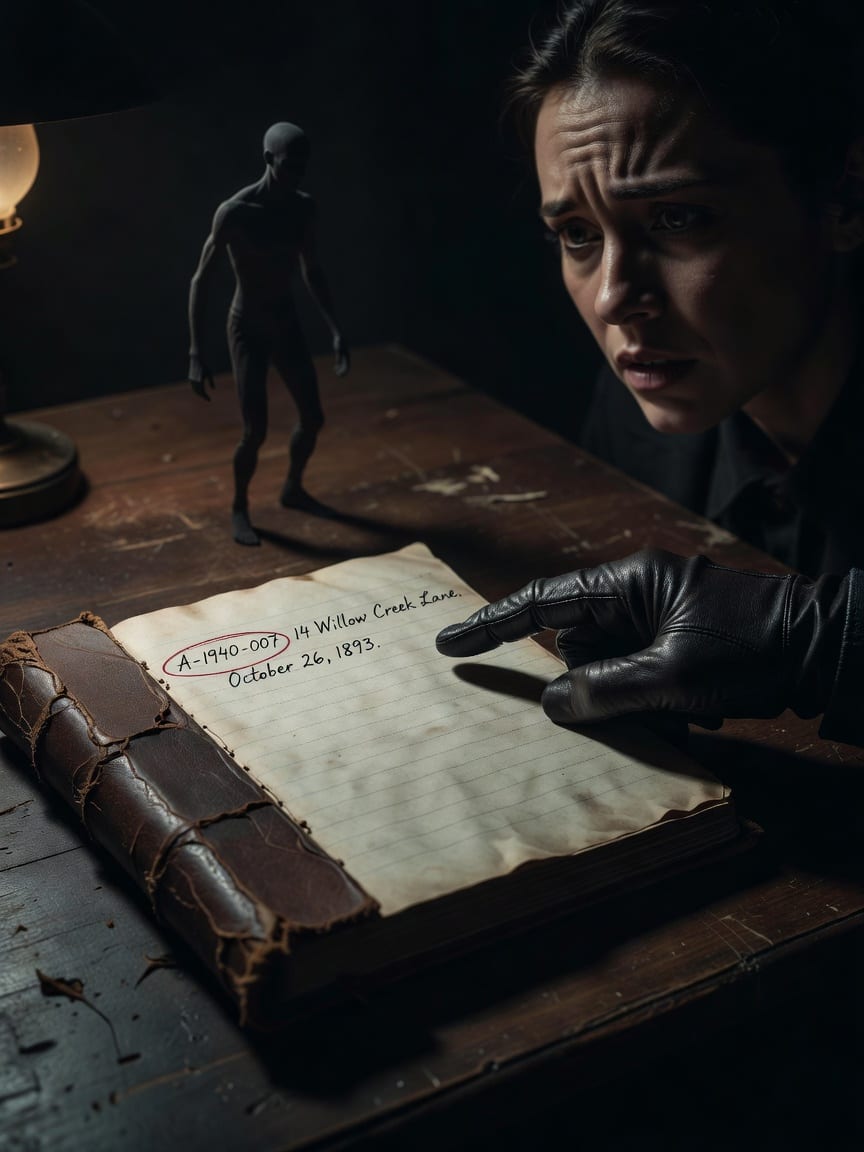
My dead relative's 1940 hospital record had a note: 'same admission number as reissued below.' Below it, decades later, was my home address, and 'hold, do not process new patient.'
As an archivist, I was researching my great-aunt Vera's 1940 psychiatric admission. Her microfiche file, however, contained a handwritten note about a reissued admission number. To my shock, this identical number was later assigned to a blank file listing my own home address, with a chilling directive to 'hold'.
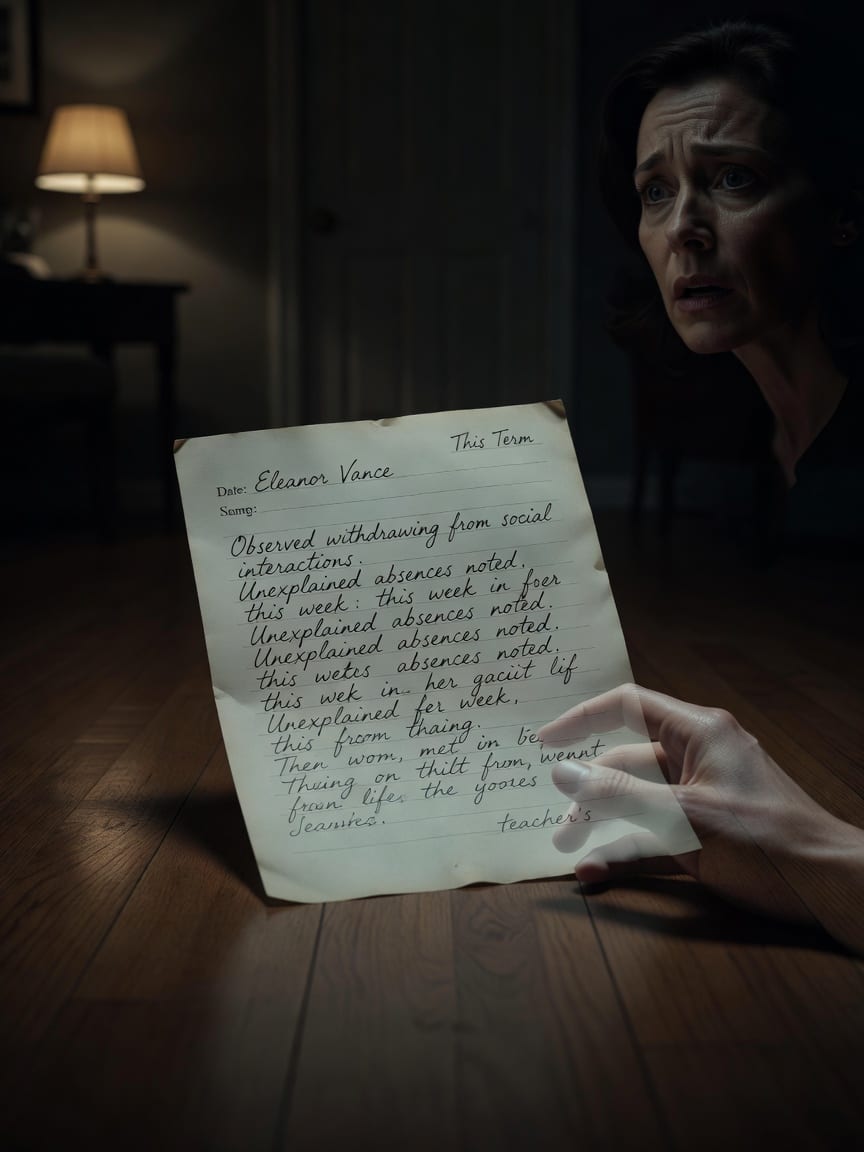
My school reports keep arriving, one a term, signed by teachers dead for decades. The latest describes something I'm doing *this week*.
My name is Eileen Caldwell, and my quiet life was upended by a school report from a place demolished decades before I was born. The report, signed by a long-dead teacher, eerily detailed my current habits. But the real shock arrived when I found my own name in a student register, dated 1968, with precise descriptions of my childhood—years before I existed.
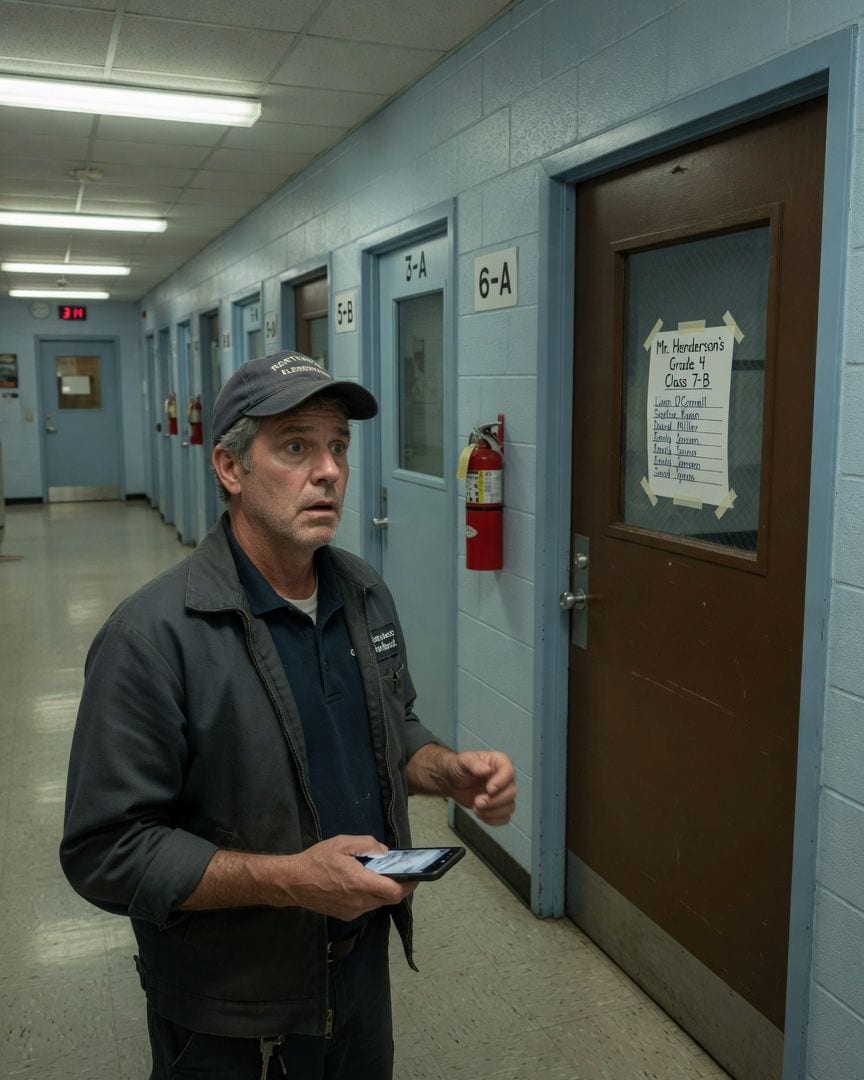
My classroom doors counted twenty-three last night. The extra one had a class list taped inside, names of children who've never been at this school.
My job as night caretaker at Northwood Elementary is routine: 22 classrooms, all accounted for. But one night, an impossible 23rd door appeared in the science block, nestled where only a wall should be. It bore a class list of students and a teacher who don't exist in any school record. Then, in an old logbook, I found that exact same list, dated 40 years ago.

My cottage is now outside the parish, says the vicar. I moved one boundary stone into my ditch, and now I'm outside the line.
I loved my new cottage, with its sprawling garden and ancient oak. But after I moved an old, mossy stone at the edge of my property, Vicar Vance arrived with grave news: my cottage was now outside the parish line, and he could no longer keep me 'on the right side.'
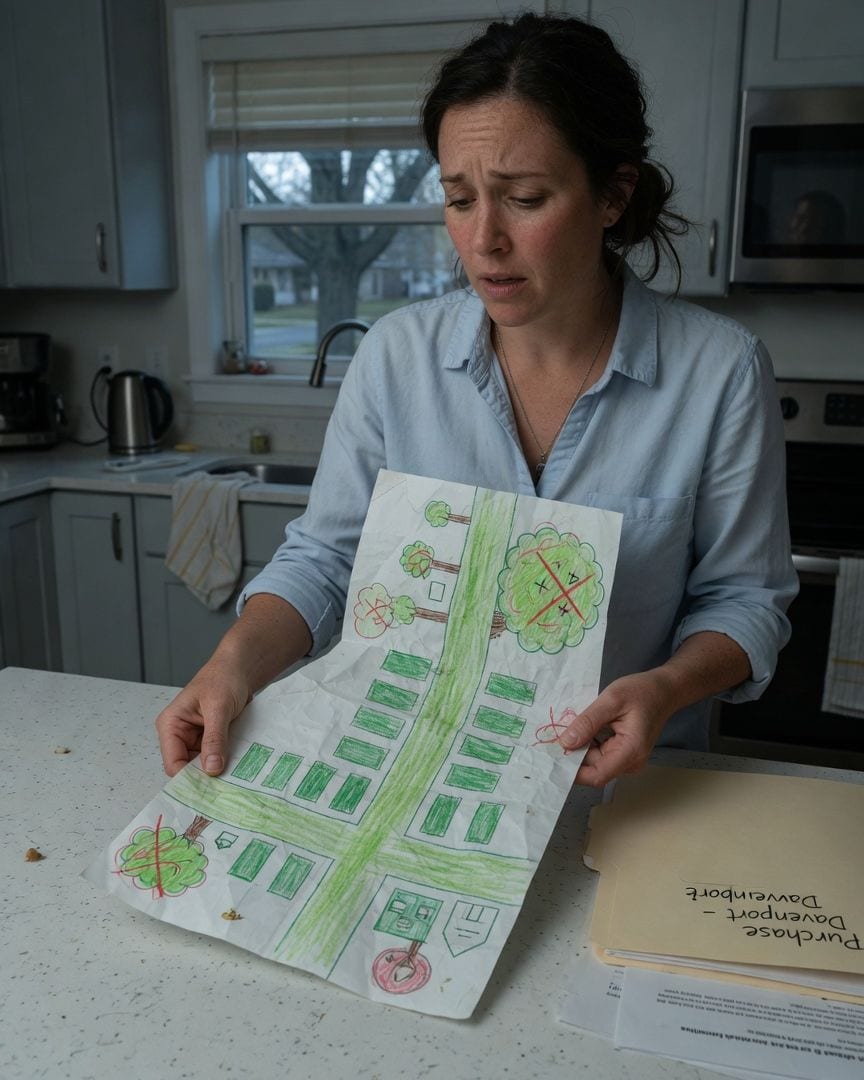
A hand-drawn map keeps arriving through our letterbox — every space on the lane marked green, except the one spot under the old lime tree, alone in red. The agent made us swear we'd never park there.
My new house came with a strange local quirk: weekly maps slipped through my letterbox, each one marking a specific parking spot with an angry red X. A legal addendum about the spot, and my neighbors' evasiveness, made me uneasy. But nothing prepared me for the ancient, identical map I found, which marked my own house with that terrifying red X.