My dairy's Tank 5 logged a full wash cycle at 4:33 AM under my initials, drawing water. Tank 5 was drained and tagged out for repair.
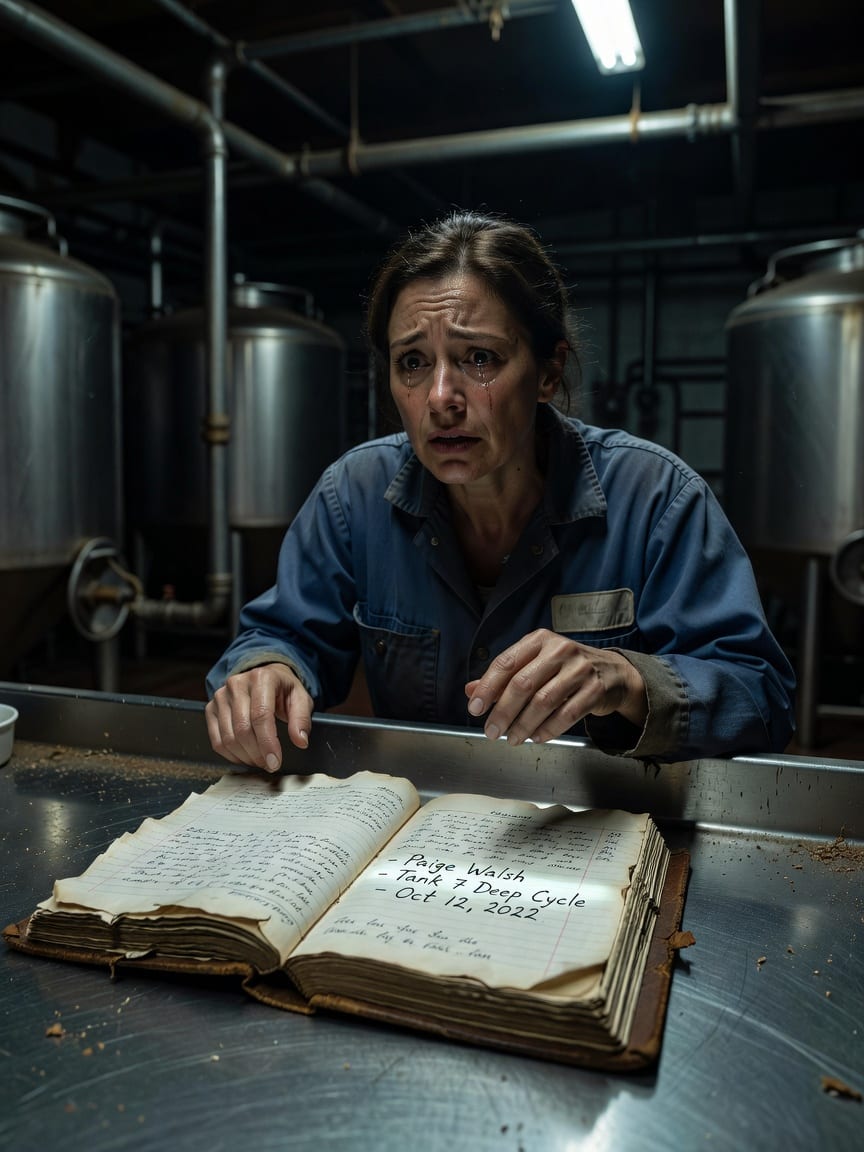
The fluorescent hum of the overnight shift at the Ashford Dairy was a familiar drone, a constant in Paige Walsh’s world. My hands, calloused and efficient, moved through the routine: checking gauges, monitoring temperatures, initialing the CIP wash log.
It was 3:45 AM, and Tank 5 was down, drained and tagged out for a valve repair that wouldn't be finished until the morning crew arrived. It had been like that all week.
So when my eyes swept over the printed batch report, the line for Tank 5, listing a full wash cycle at 4:33 AM, hit me like a sudden drop in air pressure.
The report even showed my initials, P.W., next to the completed cycle. I blinked, rereading, then walked over to the digital water meter display. The meter didn't lie.
At 4:33 AM, a significant draw had been logged, corresponding exactly to a full CIP wash. Tank 5 was a hollow, empty shell, yet the system insisted it had just been cleaned, on my watch, under my sign-off.
My mind raced through mundane explanations. A system glitch? An old, cached report mistakenly printed? I checked the internal network logs for any anomalies, any signs of a server hiccup or a phantom entry. Nothing.
The digital record was pristine, showing a clean, complete cycle. I pulled up the shift roster, my fingers flying across the keyboard. Maybe a relief operator had come in early, bypassed protocol, and somehow used my credentials?
But the roster was clear: I was the only one on the floor. No other operator was scheduled, no one had clocked in. The silence of the vast plant pressed in.
I pulled the physical logbook from its shelf, flipping to the current date. My own familiar scrawl for the earlier cycles was there, neat and precise.
I scanned down the page, past the 4:33 AM entry for Tank 5, which was indeed initialed P.W. But just two lines below it, an entry for Tank 7, also a full wash cycle, caught my eye.
Tank 7 was online, yes, but it wasn't scheduled for a CIP until tomorrow. And the initials next to it were not mine. They were a looping, unfamiliar script: 'J. Yates'.
My heart hammered a frantic rhythm against my ribs. J. Yates. I’d worked at the dairy for five years, knew every face, every name on the roster, current and past. J. Yates wasn't one of them.
The name hovered on the page, stark and impossible. I flipped through the employee directory on my tablet, searching. Nothing. No J. Yates. I searched old directories, archived lists. Still nothing.
The cold, sterile hum of the dairy was the only sound, but I felt a profound, silent wrongness pressing in.
The name, the signature, the wash cycle that shouldn't exist, all coalesced into a chilling, inexplicable fact, demanding an answer that wasn't there.
The next morning, I cornered Simon Hayes, the plant manager, by the coffee machine. He was a man of schedules and spreadsheets, not mysteries. 'Simon, who's J. Yates?' I asked, trying to keep my voice casual.
Simon frowned, stirring his coffee. 'J. Yates? Doesn't ring a bell. Why?'
I explained the log entry, watching his face. He dismissed it as a 'system ghost' or a 'prank from the night crew.' He even suggested someone might have forged my initials. 'It's a big plant, Paige. Things happen.'
But his eyes didn't quite meet mine. He was shutting me down, unwilling to look past the surface.
Undeterred, I spent my next night shift combing through old physical logbooks stored in a forgotten corner of the supervisor's office. Dust motes danced in the beam of my flashlight.
The air was stale, thick with the smell of old paper and something else, a faint, metallic tang.
I found more anomalies: impossible wash cycles on decommissioned tanks, entries for equipment that hadn’t been installed yet, all signed by various unfamiliar names – or sometimes, names of employees who had left the dairy abruptly, years ago, under vague circumstances.
A pattern emerged, a specific sequence of tanks, always deep cleans, always in the early hours. I felt a growing unease, a cold certainty that this wasn't a glitch, or a prank.
This was something else, something deeply ingrained in the very fabric of the dairy.
As I continued my clandestine investigation, the dairy itself seemed to take notice. A faint, almost imperceptible hum would emanate from the usually silent, decommissioned sections of the plant whenever I was near the old records.
Tools I’d left precisely placed would be subtly shifted, a wrench moved an inch to the left, a pen cap gone missing.
Once, I saw a flicker of movement at the end of a long, dark corridor, a shadow that seemed too solid to be just a trick of the light, too quick to be anything human.
I called out, but only the echoing silence answered, vast and empty.
One afternoon, my phone rang. It was Everett Harrington, the retired supervisor, a man known for his encyclopedic knowledge of the dairy’s history and his quiet, observational nature. 'Still checking the lines, Paige?' his voice was raspy, but clear.
'Heard you were digging into some old records.'
I felt a prickle of alarm. How did he know? 'Just curious about some maintenance logs,' I replied, trying to sound nonchalant.
'Some things are best left undisturbed, Paige,' Everett said, his tone shifting, turning grave. 'The dairy has its own rhythm, its own ways of keeping clean. Some things… they’re just part of the deep clean.
Been that way for as long as I can remember. Long before you or I were here. Don't go looking for answers where none are meant to be found.' The line went dead.
The warning, subtle yet potent, sent a chill down my spine. Someone, or something, was watching me.
I drove straight to Everett Harrington's small farmhouse that evening, the old logbooks clutched in my hands. I found him on his porch, whittling a piece of wood, the quiet click of his knife against the timber the only sound.
'Everett, we need to talk,' I said, my voice tight, demanding.
He slowly put down his knife, his eyes, rheumy with age, fixed on me. 'I told you, some things are best left alone.'
I opened the logbook to a page filled with impossible entries, pointing to 'J. Yates.' 'Who is this? Why are there records of washes that never happened, on tanks that were offline?' My voice cracked with frustration.
Everett sighed, a long, weary sound. 'The dairy… it has its own rhythm, Paige. Always has. Cycles that aren't on any official schedule. Processes that keep things running deep down.'
He paused, looking out at his fields, a distant, knowing look in his eyes. 'It's a living thing, in a way. Needs its own kind of purity. Its own deep clean.'
I pressed him, showing him names of former employees who'd vanished. 'What happened to them? Did they 'become part of the operation' too?'
Everett's gaze sharpened, a flicker of fear in his eyes, quickly masked. 'They got too curious. They understood the rhythm too well. The dairy… it ensures its own survival. And sometimes, it needs a… a hand. An operator.'
He pointed a gnarled finger at the 'J. Yates' entry. 'Those names. They're just… echoes. Reflections. The dairy needs to be clean, Paige. It always finds a way. And it finds those who understand.'
The implications settled on me like a shroud.
The impossible entries weren't mistakes; they were the actions of something ancient, something that had been orchestrating its own operations for decades, using the dairy and its people for its own unknowable purpose.
Everett's words echoed in my mind: 'It finds those who understand.'
Driven by a cold dread, I returned to the dairy, ignoring the subtle shifts in the air, the faint, deep hum that now seemed to follow me, resonating in my bones.
I remembered Everett mentioning a 'place where the old records sleep.'
Following his vague directions, I found a narrow, unmarked door behind a stack of rarely used crates in the oldest part of the plant, the air growing colder as I approached.
It led to a cramped, airless room, thick with dust and the smell of old paper, a stagnant pocket in the sprawling plant. This was it: the archive. Row upon row of forgotten ledgers, binders, and files.
I searched frantically, my flashlight beam cutting through the gloom, until my fingers brushed against a heavy, leather-bound book, tucked away on a bottom shelf, its spine almost dissolved by time.
It was a hand-written maintenance ledger, far older than any I’d seen. I pulled it out, blowing off the dust, and opened it.
Inside, the pages were filled with faded ink, impossible entries of 'deep cleans' on tanks that no longer existed, signed by names both familiar and unknown—names of former operators who, like J. Yates, had simply vanished.
My heart hammered a frantic rhythm. Then, halfway through the ledger, I saw it. My own name. Scrawled in what looked exactly like my own handwriting: 'Paige Walsh.'
Next to it, an entry for a 'Tank 7 deep cycle,' dated October 12th, exactly one year before I even applied to work at the dairy.
The cold, sterile hum of the dairy seemed to swell around me, a silent, knowing presence.
I returned to Everett's porch, the old ledger clutched in trembling hands, its impossible entry searing into my mind. 'My name,' I whispered, thrusting the book at him. 'A year before I even set foot in this plant.
What does it mean?'
Everett's face was grim. 'It means the dairy chose you, Paige. It's been here, living, breathing, through the hum of the machinery, for generations. It needs its cycles, its 'deep cleans,' to sustain itself.
And it needs operators who are… receptive. Those who notice the wrongness, who try to understand.' He explained that the presence didn't just manipulate records; it subtly influenced the operators themselves, drawing them in, making them part of its rhythm.
The 'J. Yates' and other names weren't just fabrications; they were previous operators, absorbed into the dairy's consciousness, their identities subsumed, their hands guided to perform its cycles. 'You're not just observing it, Paige. You're becoming it.
It's been preparing you, guiding your hand to sign its entries, making you one of the ones who were always here, ensuring its continued operation.'
Every impossible wash, every phantom signature, every warning from Everett, clicked into place with horrifying coherence. The dread wasn't just about what was happening, but what had already happened, and what was irrevocably becoming.
A cold, desperate resolve settled over me. I couldn't let it happen. I drove back to the dairy, the old ledger beside me, a heavy, cursed thing. This artifact, this impossible record, was the key.
If I could destroy it, perhaps I could break the cycle, sever my connection. I found an old incinerator in the back of the plant, rarely used, its metal casing stained with rust and neglect.
As I fumbled with the latch, the dairy began to hum, not the usual background drone, but a deep, resonant thrum that vibrated through the concrete floor, up into my bones, a living pulse.
Lights flickered erratically, casting long, dancing shadows that stretched and warped around me.
From the depths of the plant, I heard the unmistakable sound of massive pumps kicking on, the rush of water through pipes, the distant clanging of valves opening and closing—all from sections that should have been offline, dormant, dead.
The air grew frigid, biting at my exposed skin, making my breath mist.
I wrestled the incinerator door open, the metal groaning in protest, the sound swallowed by the intensifying hum. As I raised the ledger, a profound, chilling sense of being watched, surrounded, engulfed, washed over me.
It wasn't just the hum; it was a presence, vast and ancient, filling every corner of the plant, pressing in on me from every wall, every pipe. My hand froze.
The ledger wasn't just paper; it was a physical manifestation of the dairy's will, its history, its very being. I couldn't burn it. I was already part of it.
I dropped the ledger, the heavy book thudding to the ground, the sound strangely muffled. The plant's deep hum pulsed, a silent, knowing heartbeat.
I fled, scrambling out of the incinerator room, the impossible sounds of the dairy's 'deep clean' echoing behind me, a symphony of my own inescapable fate.
I returned to my shift, numb. I moved through the familiar routines, but my movements felt mechanical, my thoughts distant.
The impossible entries in the logbook continued to appear, now more frequently, some bearing my own initials, others with the looping script of 'J. Yates.'
Sometimes, I found my own handwriting on entries I had no memory of making, entries for cycles I never performed. Simon Hayes noticed my pale face and withdrawn demeanor, attributing it to the stress of overnight work.
He offered me a few days off, which I declined with a vacant stare, the words feeling foreign in my mouth.
The dairy continued its normal operations, a seamless, efficient machine, but I was no longer just an operator; I was something else, subtly changed, subtly integrated.
I finished my shift, my movements precise, unhurried.
The faint, familiar hum of the plant was no longer just background noise; it was a rhythm I now instinctively understood, a deep, resonant pulse that resonated within me, a part of me.
I initialed the final log entry for my shift, my signature a little too neat, a little too precise. I looked at the full log, then at the empty space for the next shift.
My own name, 'Paige Walsh,' was already penciled in for the following night, for a shift I hadn't signed up for. I felt no surprise, only a quiet, deep understanding. I was one of them now. I was always here.
I just hadn't known it.
Simon Hayes found the logbook the next morning. It was open to the final page of the week, signed off by Paige. He noticed the faint pencil mark, a familiar name, for a shift that didn't exist.
He just shook his head, thinking she must be exhausted, and erased it. The hum of the plant was particularly strong that day.
If this one got to you
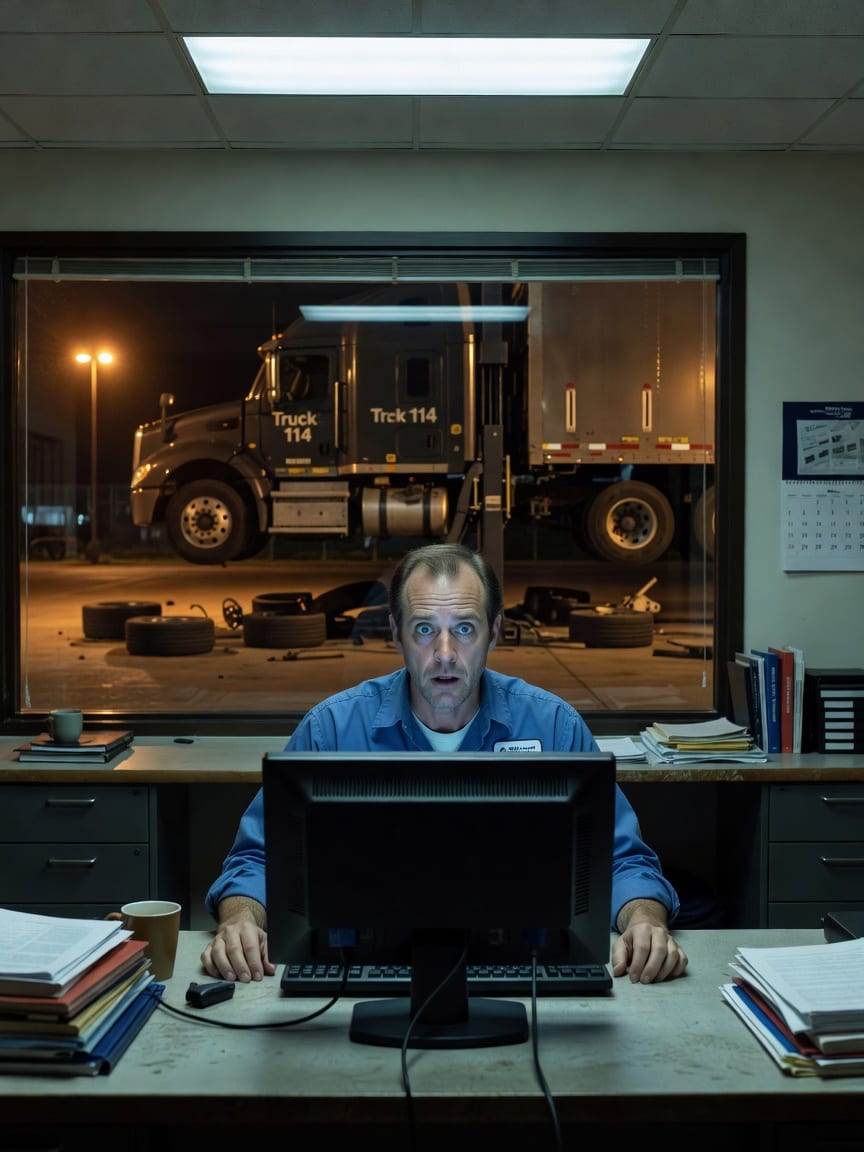
Truck 114 left the yard last night, CAD says. It burned forty miles of fuel. But my truck 114 was up on the lift, no wheels, all shift.
It was another quiet Wednesday overnight in the dispatch office until the CAD system pinged. My screen blared, showing Truck 114 logged outbound for forty miles and back, burning forty gallons of fuel. But I knew that very truck was immobile, suspended on a lift in Bay 4 with its drive wheels removed.
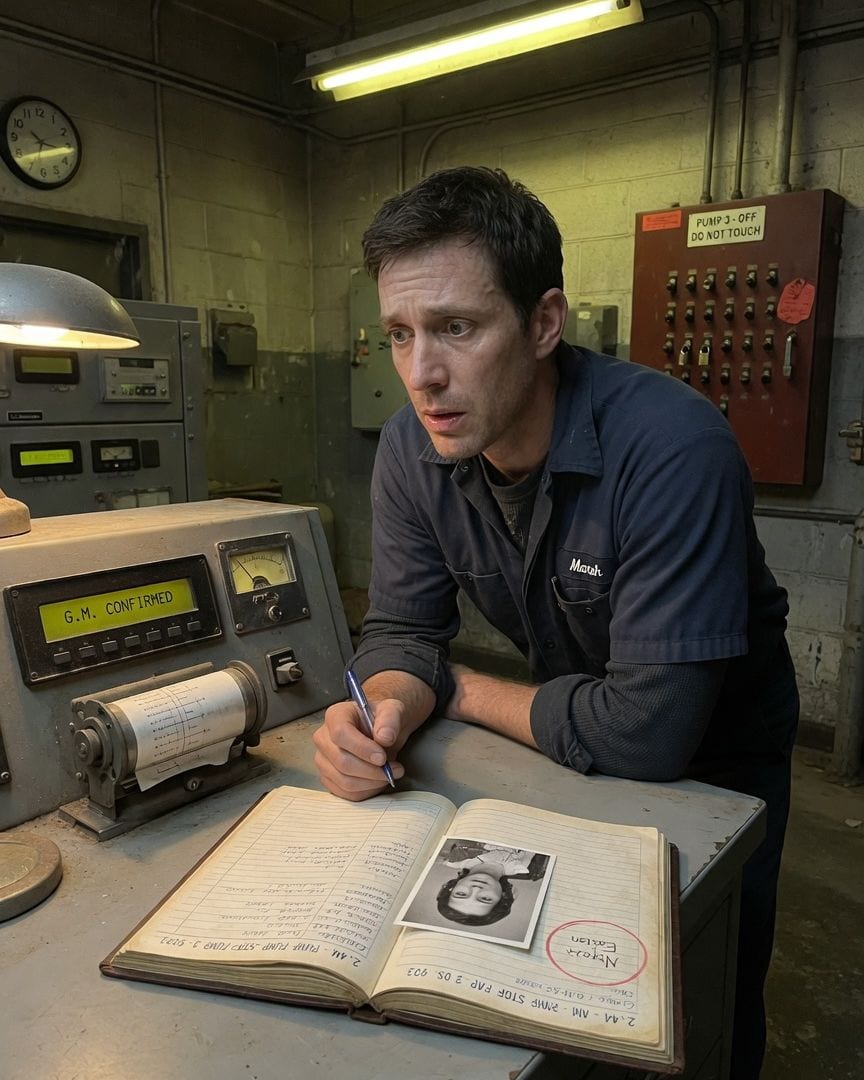
Pump 3 has been breakered off and padlocked for five years. At 2:44am it ran for ninety seconds — logged and confirmed with my own initials.
Gideon Marsh, on his usual night shift, paused at the hourly logbook. The entry for 2:44 AM showed Pump 3 cycling for 90 seconds, confirmed by his own initials. But Pump 3 had been offline, red-tagged and locked down, for five years now.
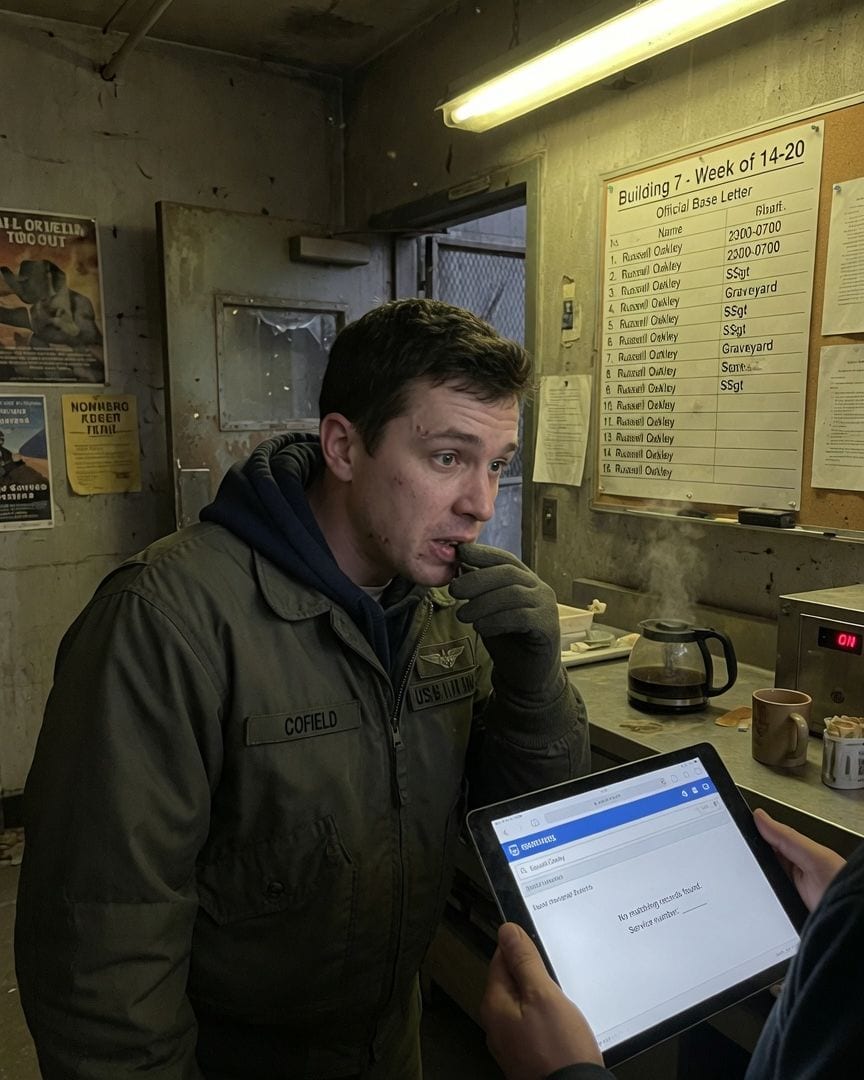
Airman Cofield, two weeks from transfer, found a warm coffee pot in a building without power for thirty years. Its new shift roster listed a name that didn't exist.
Senior Airman David Cofield, just two weeks from his long-awaited transfer, patrolled the perimeter of a decommissioned weapons storage area. Building 7, a concrete shell dark since 1992, suddenly showed a faint, warm light in its window. Inside, fluorescent lights hummed, and a coffee pot on the counter was still warm, defying the building's decades-long power shutdown. A freshly pinned shift roster for the coming week then revealed a name: 'Russell Oakley,' listed for Cofield’s own graveyard shift, yet completely absent from every official base record. Who was Russell Oakley, and how was he on shift in a dead building?
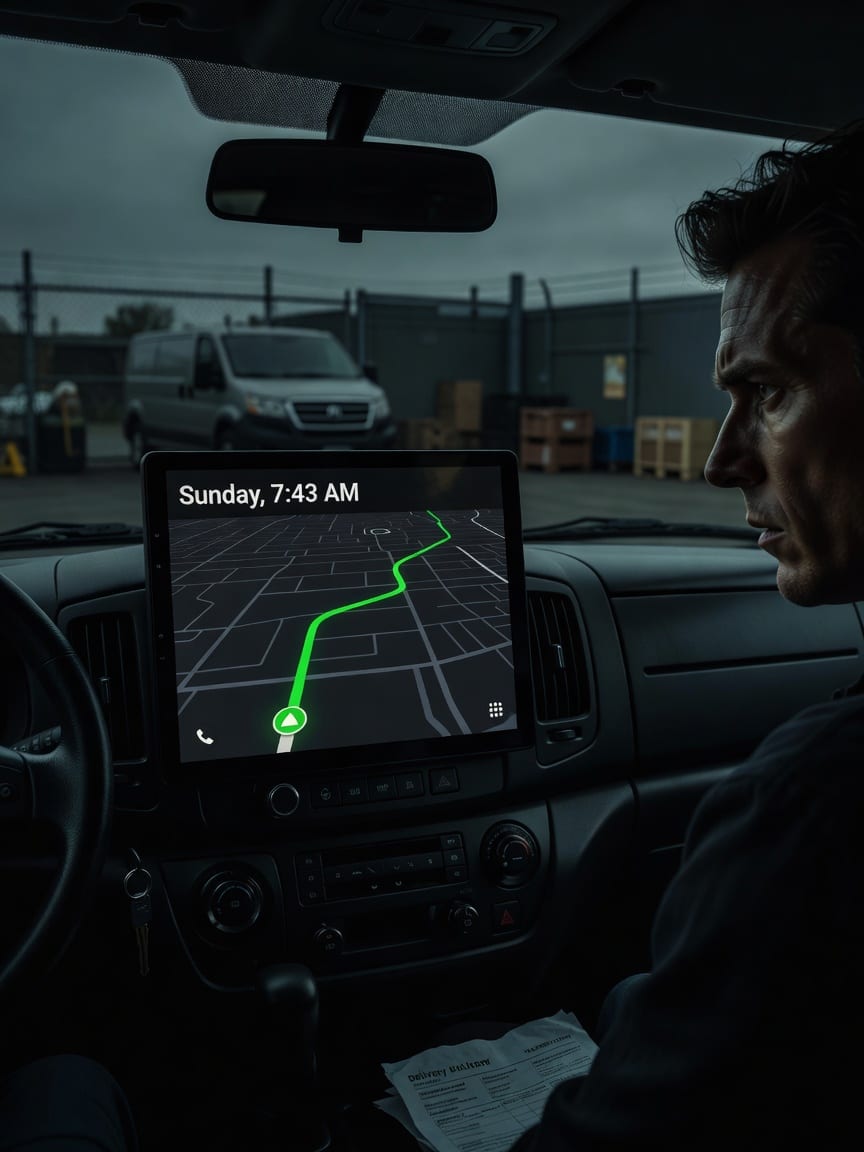
My delivery van drove 130 miles last Sunday, stopping for four hours in another state. It never left our locked yard. The GPS log drew the whole trip, timestamped to the minute.
I was just doing my job, sitting in the dispatch office with my manager Joel, when he pulled up the GPS log for my delivery van, Unit 74. It showed a 130-mile round trip to Delaware, engine on for four hours, with a distinct stop, all while my van was locked in the yard and I was home. The camera footage confirmed it hadn't moved an inch, yet the system insisted it had traveled hundreds of miles.
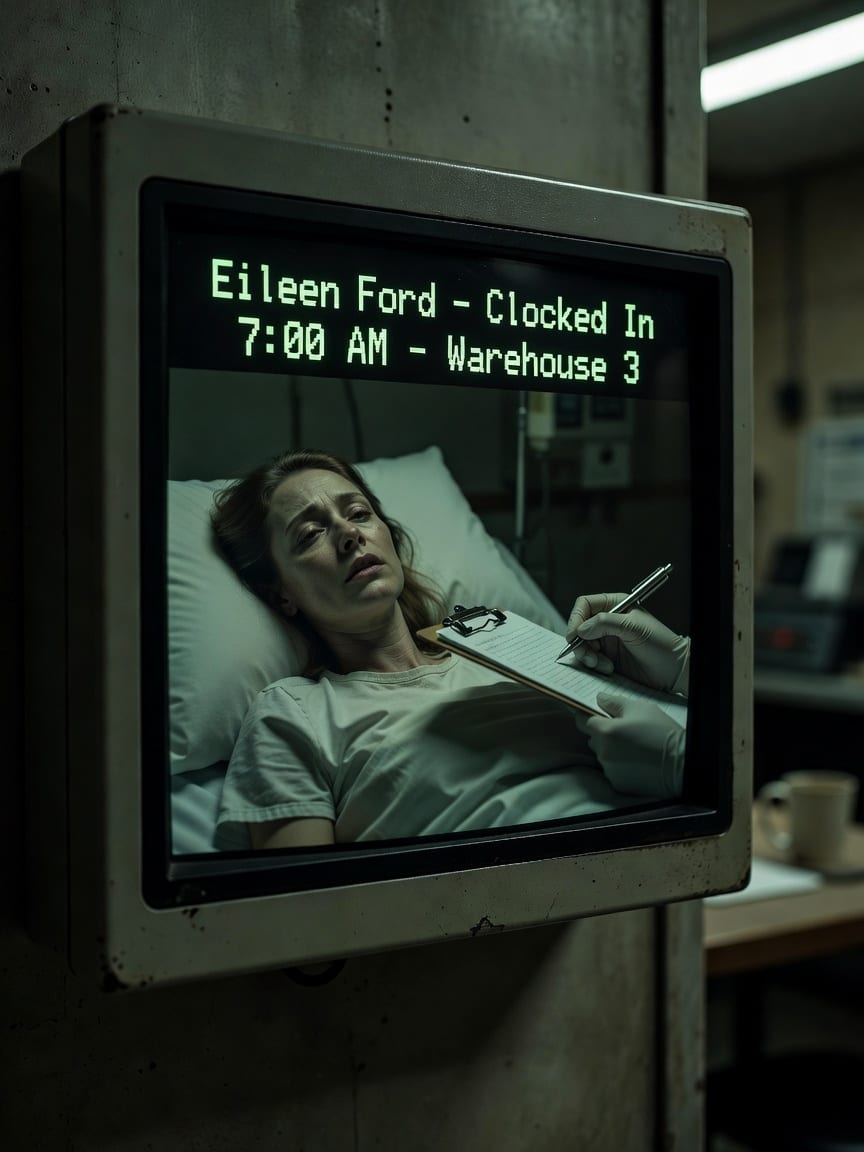
My clock-in card says I worked full shifts in Ohio all week. I was on medical leave in Florida, signed out by a nurse.
After two weeks recovering in a Florida hospital bed, my paycheck arrived significantly too high. My digital payslip claimed I’d worked full shifts at the company's Ohio warehouse every single day of my medical leave, hundreds of miles away. The system even showed my badge scans and supervisor's sign-off for work I simply could not have done.
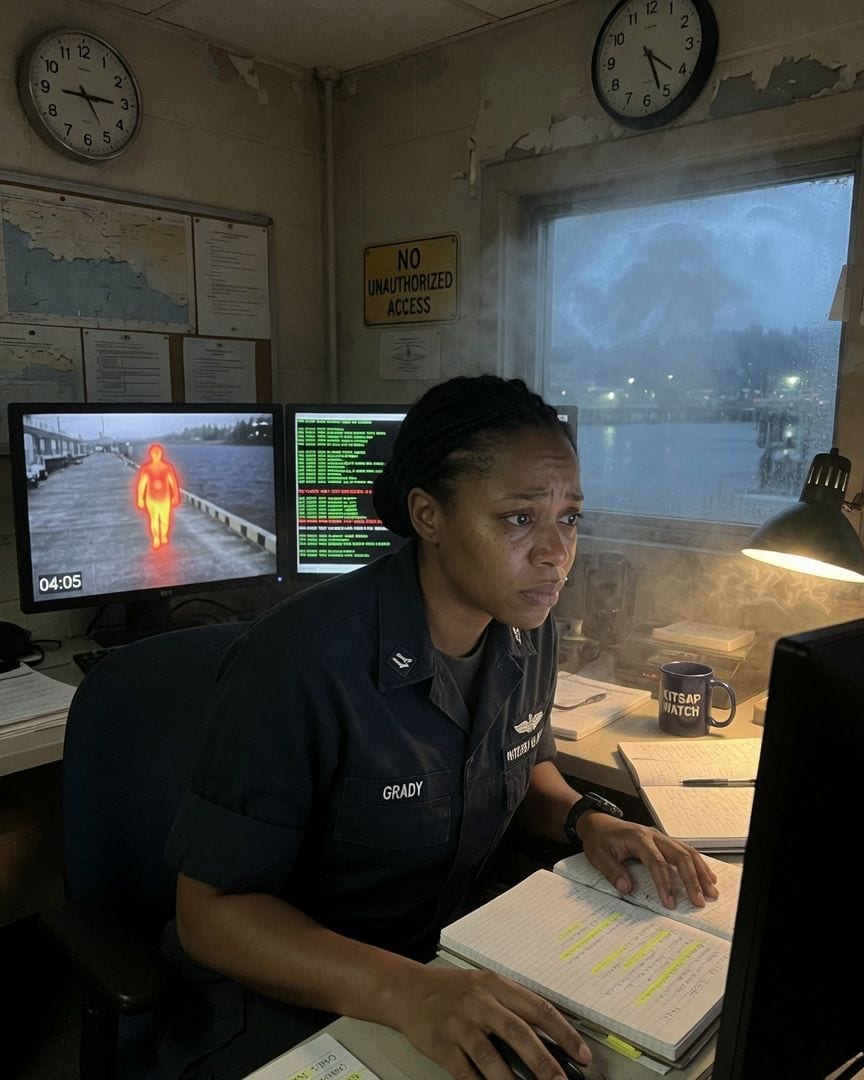
Petty Officer Olivia Grady found the base system logging impossible access at 0405. Every night for years, a blank ID walks Pier 7.
Petty Officer Olivia Grady stood her predawn watch on Pier 7, the cold mist of Puget Sound a familiar companion. Her routine scan of monitors at 0405 was shattered when an IR sensor flared with a man-sized heat bloom moving along the pier. Yet the camera feed showed only empty concrete and swirling mist. When historical logs confirmed the invisible presence had walked that exact path every night for years, Olivia dug deeper. She found a ghost "access log" entry with a unique ID but no name attached, meticulously aligned with the 0405 bloom. What impossible entity was the base system logging, night after night?