A decommissioned base's badge reader pings nightly with impossible activity from a building shut down for three years.
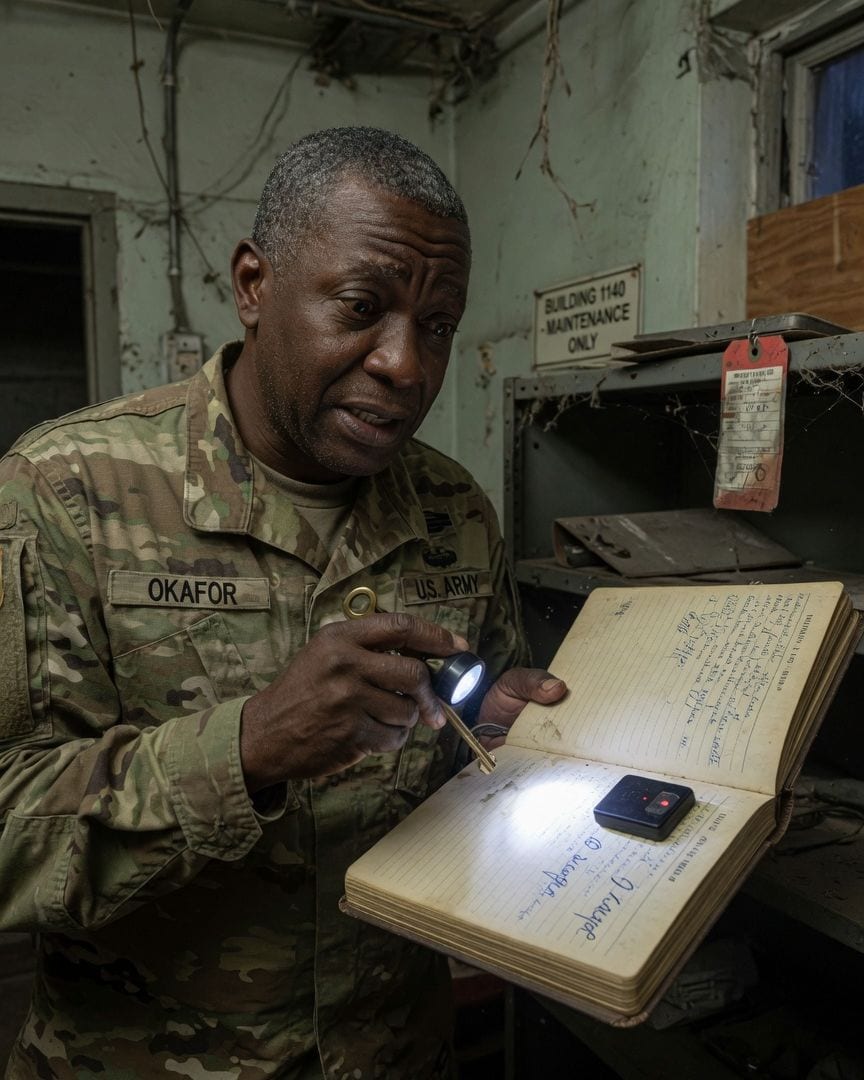
Master Sergeant Gideon Okafor arrived at Fort Selby, the late afternoon sun casting long shadows over the abandoned buildings. Three years after its BRAC closure, the base was a ghost town, save for the hum of Gerald Donovan’s utilities truck.
Donovan, a grizzled contractor whose uniform always seemed just a shade too clean for the work, met him at Building 1140, a squat concrete structure with boarded-up windows.
“Still getting hits, Sergeant,” Donovan said, tapping the dark, blank badge reader by the door with a calloused finger. “Six, eight times a night. Always after taps.”
Okafor tried the handle. Locked, as expected. He checked the main power pole nearby; the line had been cleanly cut in '09, a definitive severance.
The base locksmith, before his recent retirement, had confirmed the building’s unique keyway hadn't been cut by the Army since 1974. No power, no entry, but the system, somehow, still registered activity.
Okafor ran a hand over the cold metal of the badge reader. He leaned closer, a frown deepening the lines on his forehead.
As he stood there, a faint, almost imperceptible ping echoed from the dark reader, a sound that shouldn't exist, a ghostly echo in the quiet afternoon.
Okafor used his master key, a heavy brass piece that felt ancient in his palm, to unlock the Building 1140 door. The steel groaned open into absolute darkness, the stale air inside thick with the scent of dust and disuse.
He swept his tactical flashlight beam across stripped-out offices, empty conduits hanging like dead vines, and dust-covered floors. No squatters, no signs of forced entry, just the silent testament to abandonment.
He located the badge reader unit, tucked into a recess beside the inner doorframe. To his surprise, it wasn't dead.
A faint, impossible glow emanated from a hidden power indicator on its side, a tiny red eye drawing current from a source he couldn't trace. The air around it felt strangely cooler than the rest of the building.
He carefully extracted the unit’s internal data log, a small, black chip, and pocketed it.
Back at his temporary office, a prefab unit set up near the main gate, the log downloaded quickly. His laptop screen, usually filled with dry reports, now displayed a series of perplexing entries.
Six distinct badge IDs appeared on the screen, all logging in between 2300 and 0200. He cross-referenced them with the base’s personnel records: all active duty personnel, but none were assigned to Fort Selby, and two were currently deployed overseas.
Sergeant Renee Donovan, Gerald’s niece, was one of them, currently in Kuwait. It was impossible.
Okafor then turned to the building’s official maintenance logbook, which should have been empty, filed away with the base’s closure documents.
He found it tucked on a dusty shelf in the back of a small, unheated storage room, coated in a fine layer of grit. It felt heavy in his hands. It was not empty.
The maintenance logbook was filled. Page after page, precise entries detailed routine checks of Building 1140: HVAC inspections, fire extinguisher checks, even quarterly pest control. Each entry was dated for the past three years.
And each one, without exception, was signed. The signature was unmistakable, precise, rendered in a hand Okafor knew intimately. It read: “MSG G. Okafor.” He stared at his own name, in his own handwriting, documenting a ghost assignment.
For the past three years, Master Sergeant Gideon Okafor had been deployed in Afghanistan, then stationed at Fort Bragg, thousands of miles from the silent, decommissioned Fort Selby. Yet, here was the official record, swearing otherwise.
Gideon spent the next day making calls, the impossible logbook entries a persistent weight in his mind. The units of the six phantom badge IDs confirmed their personnel were accounted for, none ever having served at Fort Selby.
Sergeant Renee Donovan’s commanding officer in Kuwait confirmed her presence there, amused by the idea of her pulling night duty at a closed base in the States.
He even tried calling the base locksmith who had verified the 1974 keyway; the line was disconnected, the man having retired months ago, leaving no contact information. The ordinary explanations were dissolving.
Frustrated, Gideon sought out Dorothy Granger, a retired archivist who had worked at Fort Selby for over four decades.
She was a small woman, sharp-eyed behind thick, sensible glasses, perched on a stack of faded files in her cluttered home office off-base.
She initially dismissed the badge-ins as 'old base legends,' recalling vague stories of 'ghost pings' that happened occasionally even before the BRAC closure.
“This base always had its… quirks,” she said, her voice a dry rustle of paper, like the turning of old documents. Gideon pressed her, laying out the Building 1140 maintenance logbook and pointing to the entries signed with his name.
Her eyes widened behind the thick lenses, a flicker of something beyond dismissiveness, something closer to recognition, in their depths. The air in the room seemed to cool around them.
Gideon returned to Building 1140 that night, the unsettling note of recognition in Dorothy Granger's eyes nagging at him.
He installed a motion-activated camera pointed directly at the badge reader, its tiny red eye a counterpoint to the reader’s phantom glow.
He retreated to his temporary office, watching the live feed, the screen a window into the silent darkness of the abandoned building. The building remained dark, silent, an image of absolute stillness.
At 0117, the badge reader pinged. Gideon leaned forward, his breath held. The camera feed showed nothing—no shadow, no dust motes dancing in the infrared, just the empty doorway, the same stillness.
He reviewed the data log; Renee Donovan's ID had just registered. A cold knot tightened in his stomach. He tried to rationalize it—a delayed signal, a system hiccup—but the impossible ping and the empty screen contradicted him.
The next morning, a folded piece of paper was taped to his office door. It was a single sheet, thick bond paper, no envelope, no discernible fingerprints.
In neat, block letters, it read: “Some records are best left unread, Master Sergeant.” He scanned the empty hallway, the low hum of the fluorescent lights his only company. No one.
A chill that had nothing to do with the air conditioning crept down his spine. The digging was being noticed.
Gideon confronted Dorothy Granger again, the anonymous note clutched in his hand. “This isn’t a legend, Dorothy. Someone knows I’m looking. Someone knew I was going to be here.”
Her initial placid demeanor, a carefully constructed façade of an eccentric archivist, cracked. She wrung her hands.
She confessed her father, also an archivist at Fort Selby, had kept a 'black book'—a personal log of unexplained incidents tied to Building 1140, separate from official records. He’d called them 'echoes.'
She retrieved a worn leather-bound journal from a hidden compartment in her desk, tucked behind a stack of overdue library books. Its pages were brittle, its ink faded. “He believed the building… held on to things. Old identities. Old duties.
He said it was like a record keeper that remembered more than it should.” She opened it to a page from the 1980s, the paper yellowed and thin.
Tucked inside was a faded, sepia-toned photograph: a group of officers, including her father, stood smiling in front of Building 1140, a crisp blue sky behind them.
But behind them, partially obscured by a column, was a blurred figure in an old-style uniform, a model she confirmed hadn’t been standard issue since the 1970s.
Dorothy explained that these 'echoes' always intensified when the base was in transition or periods of low activity. Her father had noted a specific sequence of badge IDs that would appear and disappear, always culminating in one particular identifier.
“He never told anyone the full pattern,” she whispered, her voice barely audible, “said it was too dangerous to acknowledge. He worried it could… reach out.” The room felt suddenly heavy, the air thick with unspoken history.
Gideon painstakingly cross-referenced the historical pattern from Dorothy’s father's notes with the current phantom badge log and his own impossible maintenance log entries. The sequence, the dates, the specific IDs—it all matched perfectly, a chillingly consistent thread across decades.
The final identifier in the historical pattern, the one her father had warned about, was stark on the page: 'Okafor, G.' A cold dread washed over him, a sense of personal violation.
He pulled up his official service record, searching for any commendations or disciplinary actions that might align with the phantom log entries. His fingers trembled as he scrolled through the digital files. His eyes snagged on an entry.
There it was: a formal citation for 'Exceptional Vigilance,' dated November 12, 1998, at Fort Selby. It bore his full name, his rank as Sergeant, and his correct service number, signed by a commanding officer, complete with official seals.
Gideon was 12 years old in 1998, living in Ohio, miles from any military base, immersed in homework and little league. The record, unimpeachable military paperwork, solid and verifiable, swore he had been there.
Gideon returned to Building 1140, the 1998 citation for 'Exceptional Vigilance' clutched in his hand, the full horror of the pattern clicking into place.
The building wasn't just logging phantom entries; it was a conduit, a generator of phantom records that integrated seamlessly into the official military system.
It wasn't just a glitch; it was a deliberate, coherent rewriting of history, capable of manifesting physical proof.
The 'Okafor, G.' citation from 1998, complete with his service number and a commanding officer's signature, was the ultimate proof—a verifiable document for an impossible past, his impossible past.
The entity wasn't just mimicking; it was absorbing and projecting identities, creating a parallel, impossible history that left behind official, undeniable traces.
The recurring pattern across rotations and dates was its signature, a horrifying consistency that defied all logic, all linear time. As he walked through the silent corridors, the cold spots in the building seemed to intensify around him.
He noticed a faint seam in the wall near the old boiler room, too perfect to be structural, a hairline fracture in the concrete where there should have been none.
He ran his hand over it, feeling a slight give beneath his fingertips. It was a sealed storage locker, not on any blueprint, humming with a faint, almost imperceptible vibration.
With a pry bar from his truck, Gideon forced open the sealed locker. The concrete gave way with a sickening crunch, revealing a dark, cramped space. Inside, amidst thick dust and cobwebs, sat a single, pristine, standard-issue military footlocker.
It looked as if it had been placed there yesterday, untouched by the decades. Engraved on its lid, in period-appropriate font, were the words: 'SGT. G. OKAFOR, U.S. ARMY, FORT SELBY, 1998.'
His breath hitched, a cold tremor running through him.
He fumbled with the tarnished brass clasps and lifted the lid. Inside, neatly folded and perfectly preserved, was a complete uniform from the 1990s: dark green fatigues, scuffed but intact combat boots, a perfectly creased beret.
A name tape sewn above the breast pocket read 'OKAFOR.' Rank insignia for Sergeant was pinned to the collar. In a small, zippered pocket, he found a set of dog tags.
They bore his full name, his correct service number, and his actual blood type. But the issue date, clearly stamped, was 1998.
He held the cold metal in his palm, a physical manifestation of his impossible past, a uniform that never existed for him, yet was undeniably, horrifyingly, his own. It fit. All of it fit.
Master Sergeant Gideon Okafor submitted his report, detailing the findings from Building 1140. It was flagged, reviewed by a special investigations unit, and ultimately filed under 'unexplained phenomena,' with a recommendation for 'site remediation.'
Building 1140 was sealed, its doors welded shut, and then swiftly demolished, its concrete shell collapsing into dust. The entire site was paved over, designated a non-building area on all new base maps. The phantom badge pings stopped.
Gideon received a commendation for his thoroughness and transferred to a new post, far from Fort Selby, far from the echoes of that abandoned building.
He now wears a new set of dog tags, issued after his last deployment, polished bright. But he sometimes finds himself checking the issue date, just to be sure.
His wife, Isabella, asked him one evening, clearing the dinner plates, 'Did you ever serve at Fort Selby, Gideon?
I could swear I saw your name on an old roster from there, tucked inside a box of my dad's old military papers.' He looked up from his dinner, a faint, wrong little smile on his face. 'Is that so?'
If this one got to you
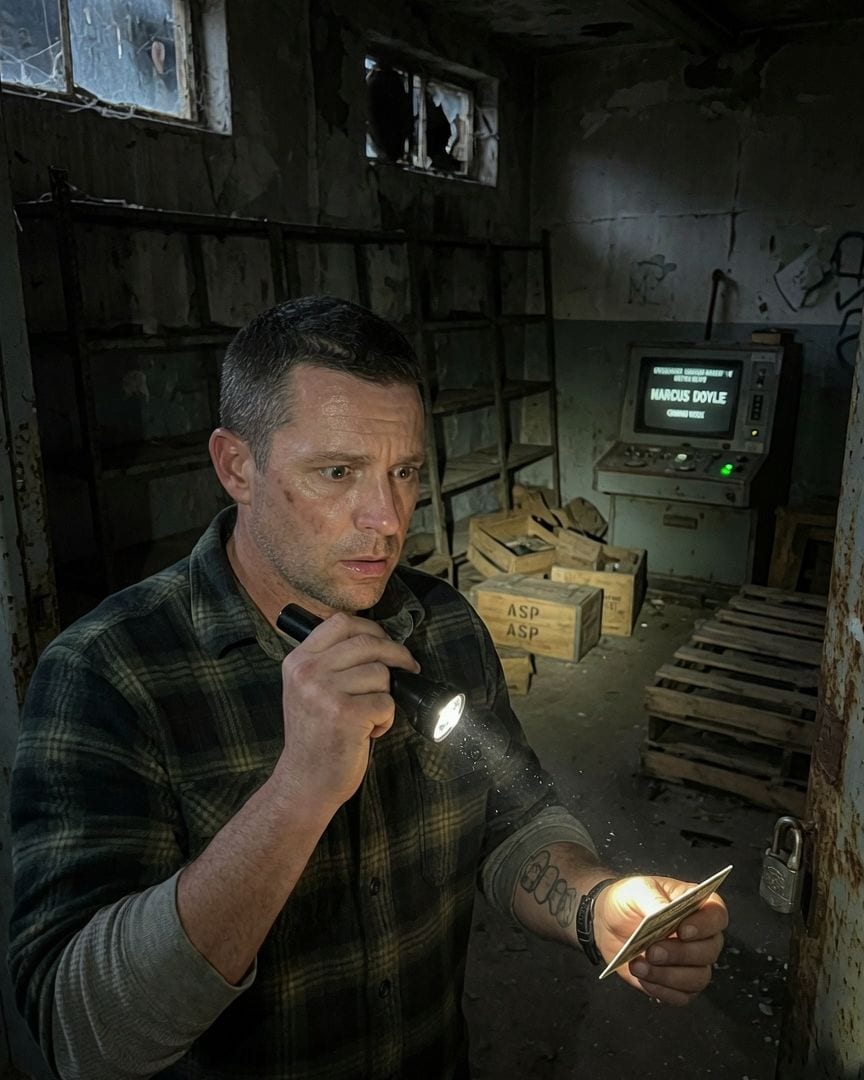
A former serviceman found his name on an active duty roster for a military base decommissioned in 2019. His access card had already logged three entries last month.
Six years after leaving the service, Marcus Doyle’s quiet suburban life was upended by an old access card notice. It came with a chilling printout: his badge number and name, logged entering Fort Crestwood’s Ammunition Supply Point three times last month, each at 0240. The former military base had been officially decommissioned in 2019, its buildings abandoned and gates chained. After discovering his own access card matched the log, Marcus returned to the derelict site, only to find a humming console displaying his name as current "personnel assignment" for the coming week. What could be happening at a base that no longer exists?
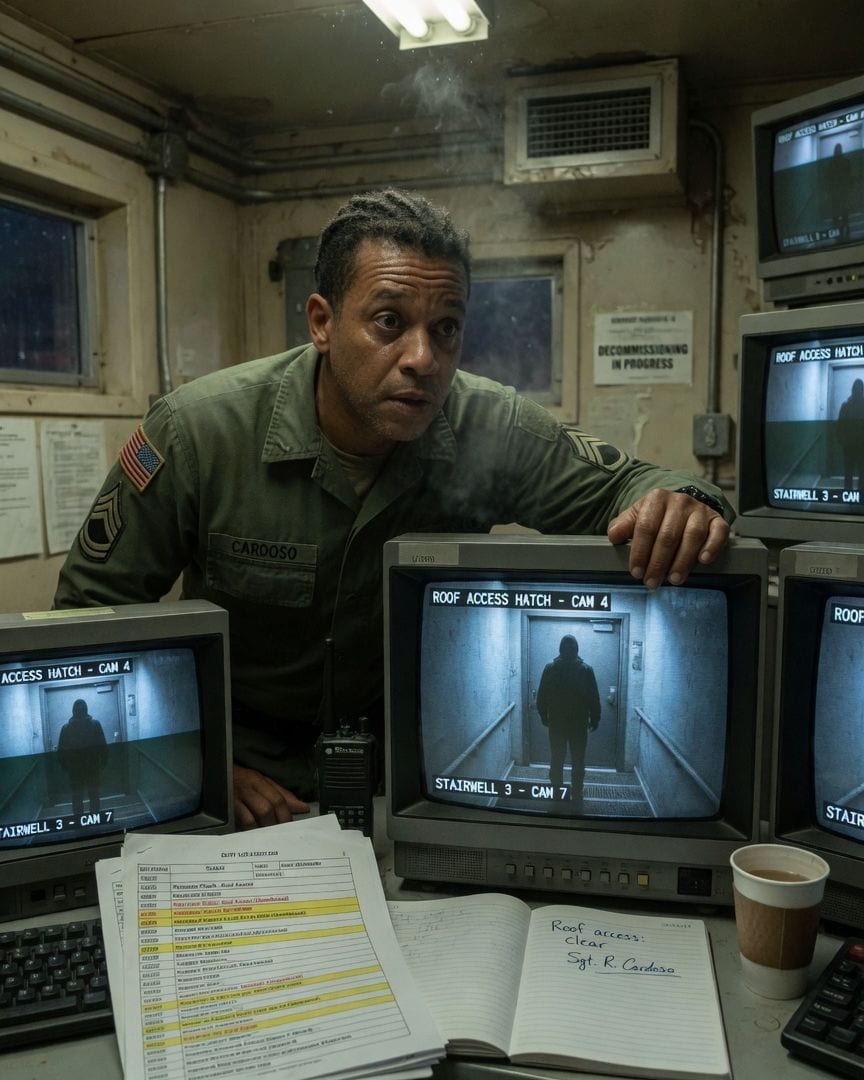
Sergeant Cardoso’s last tour log showed an unknown ‘Operator 73-Delta’ confirming a breach he had just cleared.
Sergeant Rui Cardoso stood his final interior post at Outpost 73, watching monitors through the dead hours, his tour almost over. At 0300, a dark figure flickered on the roof access camera, unmoving, only to appear closer, inside the sealed stairwell, after his team reported the area clear. Shaking off the glitch, he checked his digital duty log, where an entry from two nights prior, identical time, showed an unknown 'Operator 73-Delta' confirming an "unauthorized perimeter check" he had personally cleared. The system insisted on an operator and an event that simply could not exist, logged at the exact moment his own records verified an all-clear. Who was 'Operator 73-Delta,' and how could a sealed base's system confirm their actions?
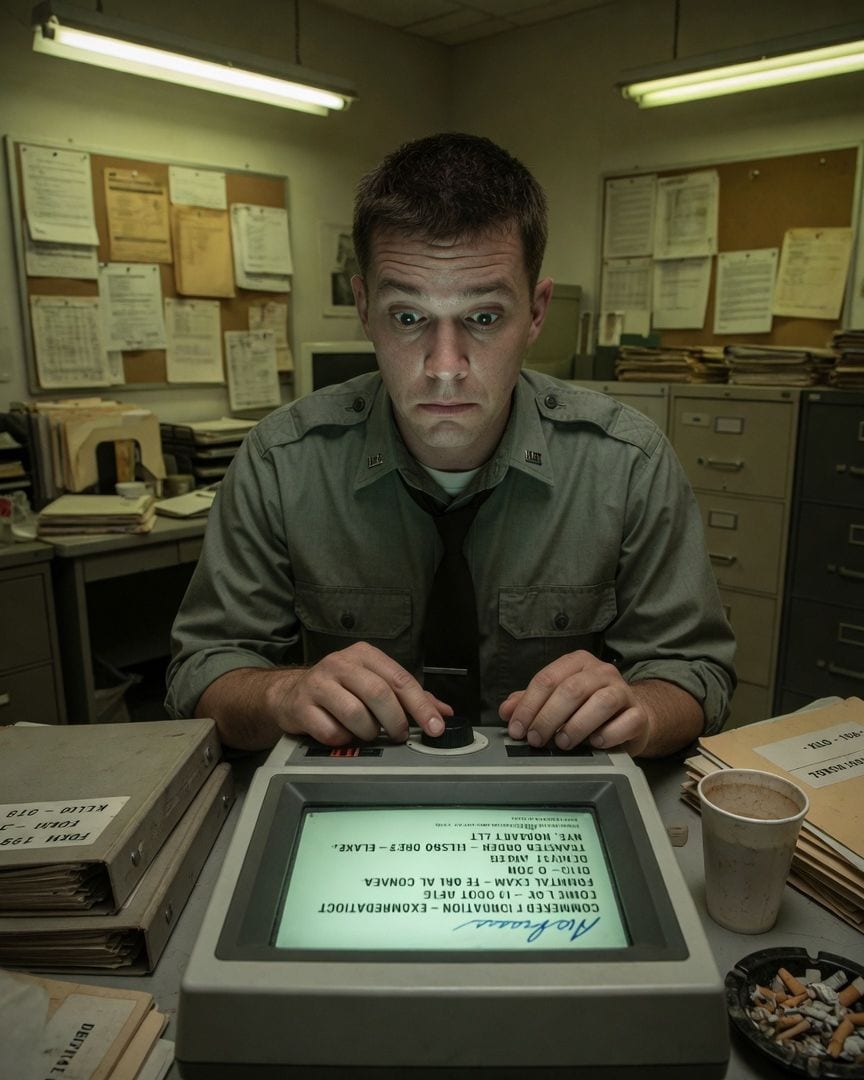
A missile commander watched his ten nuclear silos go dark. His own service record shows his signature on a future he's never lived.
Second Lieutenant Hobart Nye, a missile commander in Wyoming, had his quiet 0247 watch shattered by a security report: a massive, silent black triangle hovered over Launch Facility Kilo, casting a perfect shadow. Hobart watched his console's fault panel light up, signaling all ten nuclear missiles going dark in an impossible silence, followed by eleven minutes his security team could not remember. Official logs called it a "radio malfunction," but Hobart found a requisition for invisible-tracking sensors, signed by a base commander who was supposed to be off-base. The final, chilling discovery came when his own service record showed new entries—a dental check-up, a transfer to Alaska—all dated for a future he never lived, complete with his perfectly replicated signature.
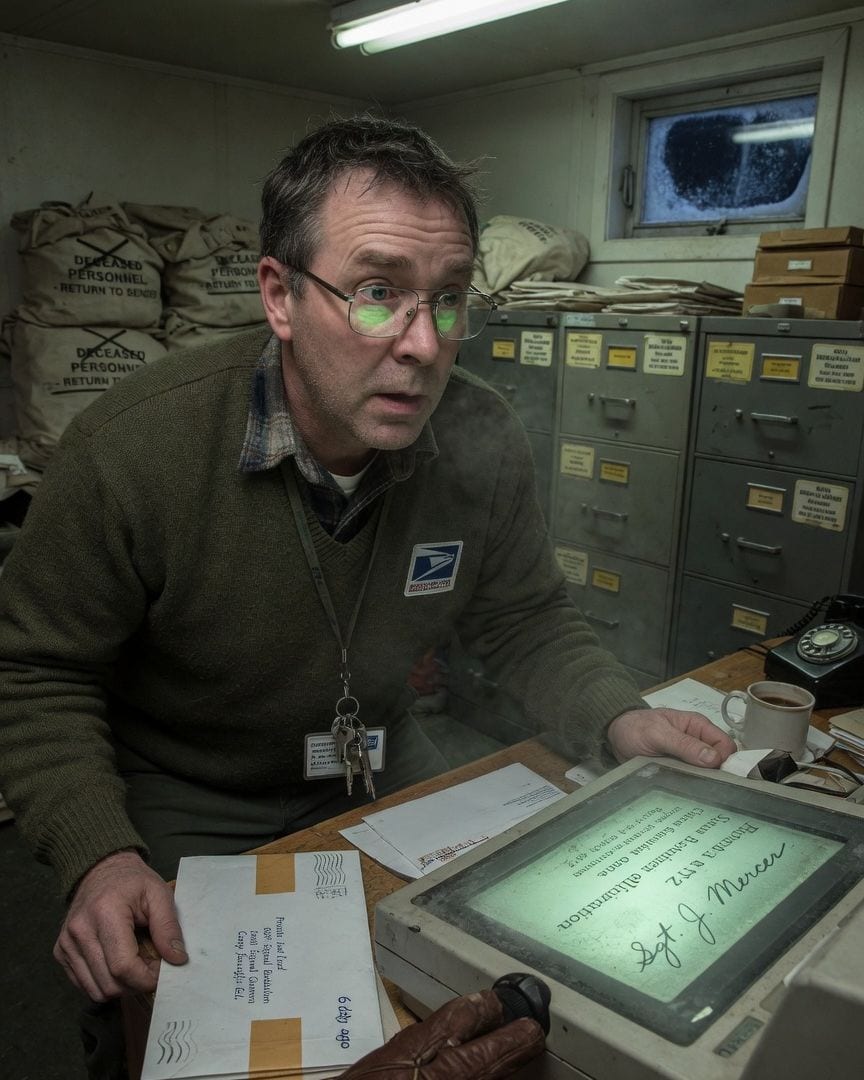
A postmaster at a Cold War Alaskan outpost still received mail for soldiers declared dead in 1969. Then he found their base was active three years later.
Postmaster Rowan Ashcroft had spent two decades watching the weekly mail plane land at Camp Bidwell Annex, a lonely outpost in the bitter Alaskan wind. His methodical mind, accustomed to order, was jolted when the latest mail sack contained forty-three letters for men officially declared dead in 1969. Each envelope, postmarked within days, was addressed to a soldier who wasn't coming back, and Rowan found one already opened and neatly resealed. Driven by duty, he began to sift through declassified Army archives, only to uncover a chilling maintenance log entry for the camp's equipment, dated three years after the base was officially shuttered. What was still happening at Camp Bidwell?
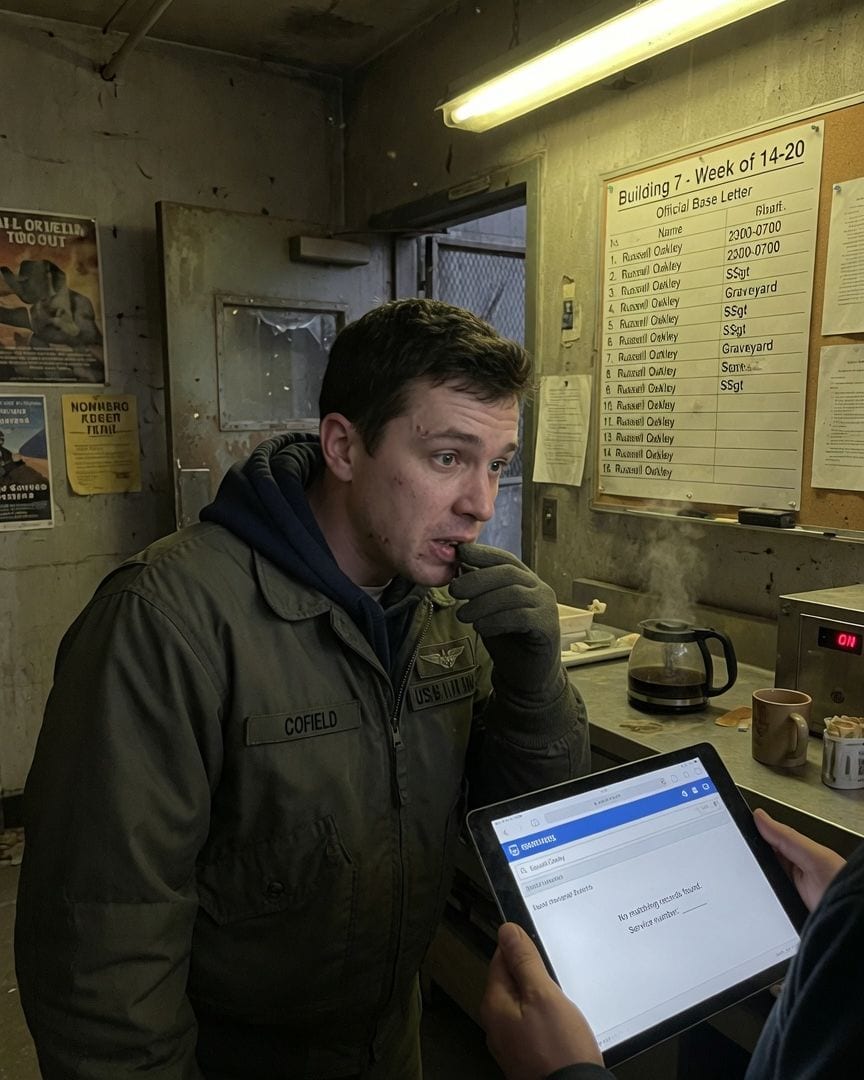
Airman Cofield, two weeks from transfer, found a warm coffee pot in a building without power for thirty years. Its new shift roster listed a name that didn't exist.
Senior Airman David Cofield, just two weeks from his long-awaited transfer, patrolled the perimeter of a decommissioned weapons storage area. Building 7, a concrete shell dark since 1992, suddenly showed a faint, warm light in its window. Inside, fluorescent lights hummed, and a coffee pot on the counter was still warm, defying the building's decades-long power shutdown. A freshly pinned shift roster for the coming week then revealed a name: 'Russell Oakley,' listed for Cofield’s own graveyard shift, yet completely absent from every official base record. Who was Russell Oakley, and how was he on shift in a dead building?
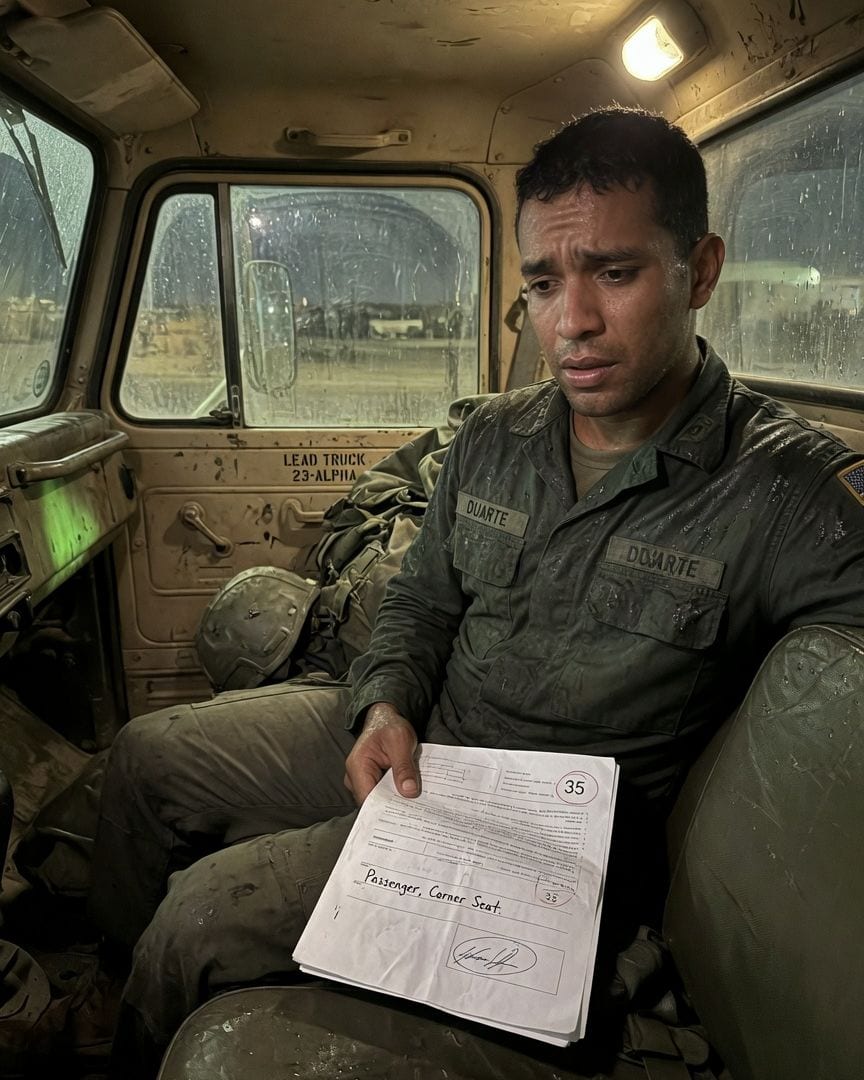
Specialist Duarte, two weeks from going home, found his empty truck seat warm and dented — then his service record showed a ghost deployment he never made.
Specialist Felix Duarte was just two weeks from going home, but a final convoy mission held an unsettling mystery. Soaked and running late, he squeezed into the lead truck's forbidden corner seat, a place every soldier knew to leave empty. Hours later, stepping out into the desert, he found the seat was strangely warm and distinctly dented, as if two unseen bodies had pressed in beside him. The official manifest then listed an extra soul for his truck, simply 'Passenger, Corner Seat,' signed by his own hand. What impossible presence had shared Specialist Duarte's ride, and what other records might it have altered?