Dr. Ashgrove's eight days to find his poison led him to a Cold War gamma plate showing a man and his shadow on a range officially locked and shadowless.
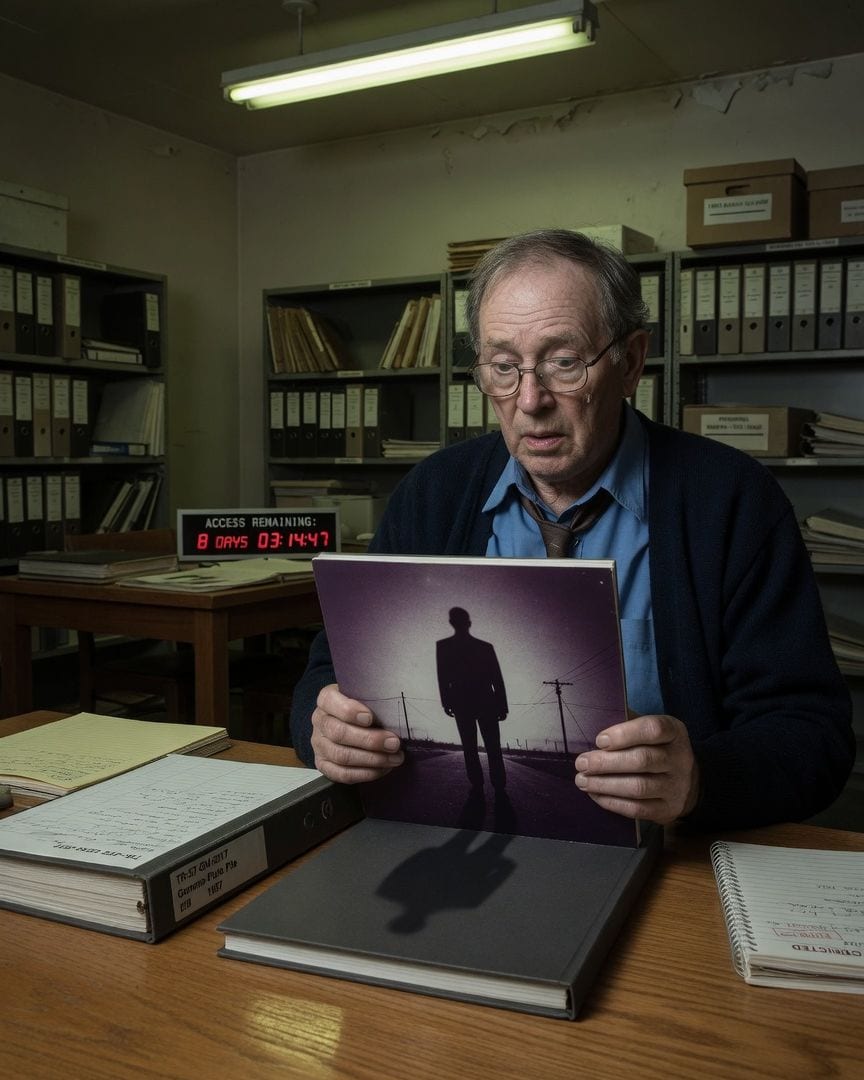
Dr. Wend Ashgrove, sixty-eight and riddled with an unnamed illness that gnawed at his reserves, sat at a polished oak table in the cool hush of the Trill Ridge declassified archive.
The digital clock on his limited eight days of access ticked down, each second a faint, persistent reminder of his fading time.
His one goal, the driving force behind his remaining strength, was singular: to pinpoint the exact moment, the specific ‘shot’ from 1957, that had poisoned him, that had set his slow, inexorable decline into motion.
He pulled the gamma-plate file from that year, a thick ledger filled with sterile exposures of test ranges and calibration grids. Most were inert, unremarkable, a monotonous record of a forgotten era.
But one plate, cataloged as TR-57-GM-0017, immediately drew his eye. Its official entry noted a Saturday when the Trill Ridge range, by all official accounts and schedules, was supposed to be cold and locked, entirely devoid of activity.
Ashgrove’s fingers paused, a familiar tightness blooming in his chest.
He slid the plate from its heavy, bespoke sleeve. Unlike the standard flimsy paper sleeves, this one was entirely unmarked, a thick, dark gray cardboard.
The plate itself was large, roughly the size of a hardback book, its emulsion a deep, bruised purple that seemed to absorb the dim archive light.
And on it, in stark negative, was the perfectly focused shape of a six-foot man, arms held stiffly at his sides, standing precisely where the tower cables crossed in the center of the range.
The figure was utterly clear, almost sculptural, defying the grainy nature of the medium.
Ashgrove’s fingers traced the sharp, almost too-perfect lines of the figure on the plate, a phantom etched in chemicals.
He laid it gently on the table and turned to the official Trill Ridge range usage logs for 1957, a bound volume dense with timestamps and technician initials.
Every other plate number was accounted for, every exposure justified by a test run or a routine calibration. But TR-57-GM-0017 was absent.
It wasn't just unlisted for that particular Saturday, the supposed cold and locked day; it wasn't listed at all, for any date. The number simply did not exist within the official record of deployed equipment.
He cross-referenced the catalog number against equipment maintenance records for the gamma plate processing lab. Nothing. No repair, no calibration, no special request that would explain its existence. He picked up the gamma plate again.
It felt subtly heavier than others he’d handled, its surface faintly different to the touch, as if an extra layer had been applied. He retrieved a standard plate from the same year, a routine exposure of a target array.
Holding them side by side, the emulsion on TR-57-GM-0017 indeed seemed thicker, almost layered, a darker, denser purple.
A technician named George Harrington was listed as responsible for 'gamma plate processing' in the latter half of 1957. Ashgrove searched the personnel roster for Harrington.
His name appeared consistently until late December of that year, then abruptly vanished, marked merely 'transferred without forwarding address.' No new assignment, no contact information, just a clean, sudden deletion.
The absence itself was a presence, a gap in the record that screamed, not whispered, that something had been deliberately, meticulously excised.
He held the large plate up to the archive's dim overhead lights, turning it slowly, letting the light play across its deep purple surface.
The man's form was so distinct, so undeniably human in its outline, a sharp silhouette against the negative space.
Then he saw it, a detail that made his breath catch in his throat, a sudden chill despite the still air of the room. A shadow.
A long, precise shadow, stretching dark and undeniable behind the figure, cast across the grainy emulsion.
But the official weather reports for that Saturday in 1957 indicated heavy overcast conditions over Trill Ridge, a flat, uniform, shadowless light that morning. And the range, by all official accounts, was locked, cold, and utterly empty.
The plate had captured something impossible: a perfectly focused man, and a distinct, precise shadow, standing where neither should have existed, under conditions that forbade both. The image was a lie, yet undeniably there.
Ashgrove, a tremor in his own hand, carefully placed the gamma plate back into its bespoke sleeve.
He requested immediate access to all maintenance logs for the gamma plate processing equipment from 1957, specifically looking for any modifications, repairs, or non-standard procedures.
His request, routed through Pamela Harrington, the archive supervisor, was met with polite but firm resistance. She cited 'resource allocation' and 'historical sensitivity' as reasons for delay. Her composure, Ashgrove noted, was almost too perfect.
He persisted, his voice gaining an edge he rarely used. He reminded her of his declassified access, the urgency of his research, and implicitly, the ticking clock of his own failing health.
The faint lines of impatience around her eyes finally deepened. After another day of quiet resistance, a slim, unofficial notebook surfaced from a dusty cabinet in the maintenance department.
It was a technician’s personal logbook, with handwritten entries by one Nathaniel Foster.
Foster had meticulously noted 'non-standard emulsion tests' conducted on modified equipment in late 1957, citing directives from something called 'Project Chimera.' Ashgrove felt a jolt. He’d never heard of Project Chimera. The name resonated with a cold, unsettling hum.
Official records showed Foster was retired, living in a quiet retirement community an hour north of Trill Ridge. Ashgrove didn't hesitate.
He wrapped the gamma plate carefully in his briefcase, the heavy object a tangible link to the past, and drove north immediately, the autumn landscape blurring outside his window.
He found Foster, a stooped man with a pronounced tremor in his hands, carefully tending a bed of late-season roses. The old man’s eyes, rheumy and distant, widened when Ashgrove mentioned 'Project Chimera' and the gamma plate.
A flicker of raw, unadulterated fear briefly animated them. Foster tried to dismiss it, his voice a reedy whisper, as a 'youthful indiscretion,' a 'misguided experiment with new film types.'
But his trembling hands, clenching and unclenching on the rose pruning shears, betrayed the casual lie.
Ashgrove’s inquiries, both official and unofficial, were clearly being noticed. Back at Trill Ridge, Pamela Harrington’s demeanor, once merely politely helpful, shifted. Now, her presence felt subtly watchful, like a shadow that didn't quite belong.
She’d appear at his table with unnecessary questions about his progress, her gaze lingering not on him, but on his open files, on the heavy briefcase where the gamma plate rested.
The air around him seemed to thicken, subtly, with unspoken scrutiny, and the quiet hum of the archive’s ventilation system seemed to pulse with a low, knowing thrum.
One afternoon, after a long, fruitless day in the archive, his phone rang at his small, unremarkable motel room.
He answered, and a low, distorted voice, barely intelligible, simply uttered his last name—'Ashgrove'—before the line clicked dead, leaving behind a silence colder than the autumn air.
A cold dread settled in his gut, a knot of unease that no amount of rationalization could loosen. It was not a threat, but a statement, a confirmation that he was being watched.
The next morning, as he walked into the archive, his eyes instinctively went to the ceiling. A small red light, usually dormant, blinked steadily on the lens of the closed-circuit camera mounted directly above his designated research table.
It hadn't been active before, not during his prior seven days.
Through a discreet inquiry with Judith Delaney, a sympathetic junior clerk who looked at him with a flicker of concern, he discovered his personal access logs were being reviewed daily by an 'internal security liaison' whose name, unlike all others in the system, was entirely redacted from the digital record.
He was no longer just an investigator, he realized with a sickening lurch, his blood running cold; he was becoming the subject of an investigation himself, his every move, every discovery, now actively monitored.
The archive, he understood, was not just a repository of forgotten secrets; it was an active sensor, a living eye, and he was squarely in its unblinking gaze.
Ashgrove drove back to Foster’s house, the gamma plate held tight in his hands, no longer wrapped in discretion.
He pressed Nathaniel Foster, laying the heavy plate on the old man’s weathered patio table, the bruised purple emulsion stark against the faded wood.
The old man, still tending his roses, flinched at the sight of it, his hands shaking even more pronouncedly than before.
'Mr. Foster,' Ashgrove said, his voice firm, edged with a desperation he rarely allowed to show, 'this is my life. This is what's killing me. What is Project Chimera?'
Foster finally broke, his voice a low, ragged whisper, laced with decades of fear and unspoken secrets. 'Project Chimera,' he confirmed, was a black-ops program, so deeply compartmentalized that even he, a participant, only saw fragments, small, terrifying pieces.
'We weren’t looking for men, Doctor,' Foster rasped, his gaze fixed on the spectral figure on the plate, then quickly away, as if it might burn him. 'We were looking for signatures. Energy. Something… else. Something that shouldn’t be there.'
He explained that the modified gamma plates, using a specific, experimental emulsion he helped develop, were designed to capture localized energy disturbances, anomalies that sometimes registered as distinct, almost human, forms.
'The man,' Foster shuddered, pulling his gaze from the plate, wiping a trembling hand across his brow, 'that wasn't a man. That was what it looked like when it… manifested. Briefly. A flicker in our reality, caught on film.'
He confirmed that 'exposure events' were a known side effect, an unavoidable consequence affecting any personnel in proximity during a manifestation.
'They were… filed,' Foster said, his voice trailing off, his gaze distant, haunted by old memories of lists and reports. 'Monitored. For their own good, they said. To track the effects. To understand what it did.'
Ashgrove felt the pieces click into place with a horrifying certainty, each revelation a cold shard of ice in his gut.
The missing logs, the special, unmarked sleeve for this particular plate, the 'cold' range status, the vanished technician—it was all a meticulously constructed cover for a covert detection system that operated in plain sight.
The 'man' on the plate was not a man at all, but the residual ghost of an energy anomaly, a brief, terrifying glimpse of something unseen that had touched the world.
And Ashgrove’s own illness, the slow, wasting disease that had begun subtly after 1957 and now threatened to consume him entirely, was the direct, delayed consequence of standing too close to that ghost, unknowingly caught in its wake.
He saw his younger self, a curious junior researcher, ambitious and naive, unknowingly caught in the wake of something the government desperately wanted to understand, and control.
His entire adult life, he realized, had been an experiment, ongoing since that day in 1957, his existence a data point in some unseen ledger.
Driven by Foster’s raw admission, Ashgrove returned to the Trill Ridge archive, his body aching with a sudden, profound fatigue, his mind racing with fragmented, terrifying clarity.
He searched for 'Project Chimera' in the classified indices, finding only dead ends, official silence.
But remembering Foster’s hushed mention of 'filing' and the gamma plate’s unique, unmarked sleeve, he began searching for anomalies in the physical layout of the archive itself, for things that defied conventional cataloging.
In a rarely accessed sub-level, a forgotten cavern of outdated records, behind a bank of innocuous-looking, rust-colored fireproof cabinets, he found it.
Tucked away on a shelf that measured longer than the building should have allowed, as if defying architectural logic, was a single, unlabelled, dull red box. It was, he instantly knew, 'The Box That Is Not on Any List.'
He pulled it down, his heart hammering against his ribs, the sound echoing in the silent sub-level.
Inside, beneath layers of blank, bureaucratic forms, was a single, thin medical file. His own. He read the summary aloud in a whisper, the words a cold shock: 'Ashgrove, Wend. Exposure Event: 1957. Status: Monitored.'
And beneath that, a recently dated addendum, stamped 1986. Ashgrove’s breath hitched, a strangled gasp escaping his lips. He wasn't just researching the past; he was still part of the present. He wasn't just a victim; he was a subject.
He looked up, a cold dread washing over him, deeper and more profound than any he had known, just as the small red light of the ceiling camera blinked, and its lens slowly swiveled, with an audible, deliberate click, to face him, clicking again as it locked into focus.
The clicking camera cemented the horrifying realization for Ashgrove: the archive was not a dusty repository of old secrets, a static testament to history, but a living, breathing monitoring system, designed for real-time observation.
The 'secrecy machine' hadn't just buried the truth about the Trill Ridge anomaly; it was actively managing its ongoing effects, a vast, insidious network of surveillance operating under the guise of historical preservation.
Ashgrove’s 'declassified access,' his limited eight-day pass, was a charade, a controlled experiment meticulously designed to observe his behavior as he approached his own 'file,' to see if he could piece together the very truth they had so carefully concealed.
The 'man' on the gamma plate wasn't just an image, a quirk of chemistry; it was a captured moment of an entity or phenomenon, a brief, terrifying manifestation that had caused his slow, wasting illness.
His symptoms, his relentless decline, his very search for answers, his desperate quest for knowledge – all of it was nothing more than data.
Data for an institution that had known about him, about his specific exposure and its consequences, for decades.
The red box wasn't an archive of the lost; it was a live register of the monitored, a meticulously updated ledger of human experiments.
Every clue clicked into place with a terrible, absolute clarity: the unlisted plate number, the vanished technician, Foster’s hushed confession, the subtle shift in Harrington’s watchful eyes, the distorted phone call, and now, the turning camera.
He was a specimen, his life a long-term study, every beat of his failing heart a recorded event.
His impending death would simply be the final data point in a file still being written, still being signed by hands he would never know, by people who watched his every breath. He was trapped.
Pamela Harrington entered the sub-level, her movements calm and deliberate, her footsteps strangely silent on the concrete floor. The air grew cold, sharp with the metallic tang of old files.
'Dr. Ashgrove,' she said, her voice devoid of inflection, a flat, practiced tone. 'We knew you would find it.' She didn't apologize; she simply explained. His access, his illness, his entire eight-day quest had been a 'controlled observation.'
They needed to see if a 'subject' could unravel their own monitoring, how close they'd get to their own truth, how predictable their patterns of inquiry were.
She offered him 'comfort,' a 'dignified end,' implying, without raising her voice, that he would not be leaving Trill Ridge alive. The horror was not in her menace, but in her detached, clinical compassion, a chilling indifference to his life.
Ashgrove, fueled by a surge of adrenaline and a desperate, dying defiance, saw his chance. He wasn't going to escape his death, that much was clear, but he could expose their truth.
He lunged for the small, emergency payphone mounted near the sub-level exit, a relic no one had bothered to remove, its rotary dial a testament to an earlier era.
Harrington moved, but he was faster, his dying body finding a desperate burst of energy he hadn't known he possessed.
He fumbled with the receiver, his fingers clumsy, punching in a number he’d memorized from a newspaper article about declassification oversight—a low-level clerk in Washington.
As Harrington’s hand closed on his arm, a grip like steel, he gasped out a fragmented message into the dead receiver: 'Gamma plate… TR-57-GM-0017… Ashgrove… monitored… Red Box… Trill Ridge…' The line went dead as she pulled him away, his last, desperate words echoing in the empty sub-level, swallowed by the silence.
Days later, a fragmented, garbled message arrived at the desk of Judith Delaney, a declassification clerk in a nondescript Washington office.
It was a fax, barely legible, referring to 'gamma plate TR-57-GM-0017' and 'Ashgrove, monitored,' with a return address for 'Trill Ridge Archive.'
Delaney, puzzled by the urgency and the odd phrasing, attempted to trace the number, but it led to a disconnected line. She searched for 'TR-57-GM-0017' in the official database, finding no record.
Dr. Wend Ashgrove's name was quietly removed from the Trill Ridge access roster, listed simply as 'completed research project.' His medical file, now updated, was returned to the 'Red Box' in the sub-level, its final entry sealed.
Pamela Harrington personally filed the final addendum to Dr. Ashgrove's medical record, updating his status to 'Case Closed. Subject Deceased.'
The file, thin and heavy with its decades of quiet observation, slipped back into the Red Box, nestled amongst others just like it, each containing a life meticulously documented.
Life in the Trill Ridge archive continued, undisturbed, its monitors silently active. Months passed. Judith Delaney, the declassification clerk who received the garbled fax, forgot about the strange message amidst the daily grind of paperwork.
Then, during a routine medical review for her own security clearance, she received a notification. It was a flag, an anomaly in her own health profile. The diagnosis was vague, the prognosis uncertain. A new file was opened.
Her name was now on it, alongside a new entry: 'Delaney, Judith. Exposure Event: Undetermined. Status: Monitored.'
The file, after all, was still being signed.
If this one got to you
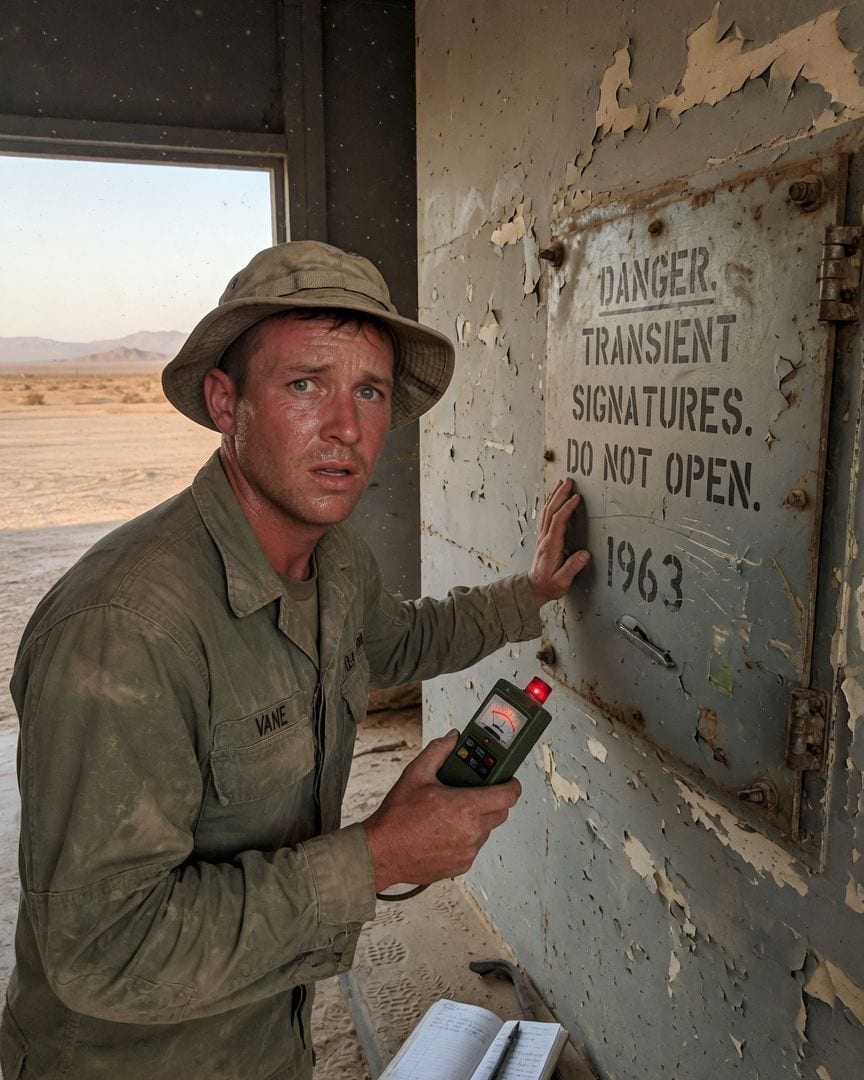
On Airman Purdy Vane's last survey of a Cold War testing range, hot footprints strode four hundred yards into a concrete wall with no door, and no prints leading out.
Airman Purdy Vane conducted his final, lonely survey of Sable Draw, a vast desert testing range slated for permanent closure. Under the relentless late summer sun, his Geiger counter, usually silent, suddenly shrieked. It led him to a perfect, four-hundred-yard track of intense radiation readings, like unhurried footprints, ending abruptly against the blank, doorless wall of a concrete instrument shed. Despite the range being officially cold for decades, Purdy later uncovered a hidden steel panel on that wall, bearing a stark, hand-painted warning: 'DANGER. TRANSIENT SIGNATURES. DO NOT OPEN. 1963.' How could something so dangerous remain hidden, decades after the desert was declared safe?
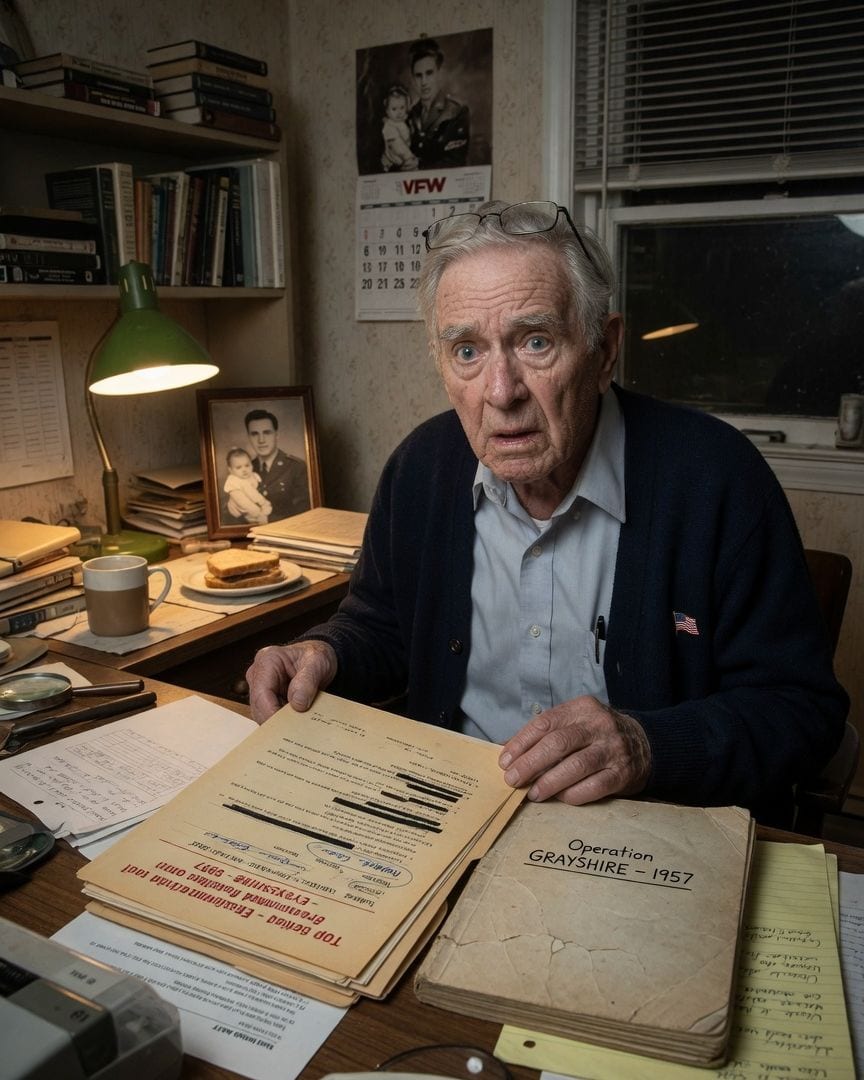
A Cold War Private Kell Hobarth saw a flash from a mission that didn't exist. Fifty years later, his own name was on a secret 'witness management' list.
Private Kell Hobarth, twenty-eight, stood in the dust of Vermey Flats, a letter in hand announcing his daughter Marie’s birth eleven days late. The next day, his name appeared on a roster for 'GRAYSHIRE,' a mission his range officer insisted never existed. Yet, at dawn, Hobarth alone witnessed a profound, silent flash of light, while his six tent-mates slept undisturbed. Fifty years later, Kell, now seventy-eight, still pursued the chill of that dawn, sifting through heavily redacted files. His relentless search led him to a forgotten archive room where he unearthed an unofficial logbook detailing 'Operation GRAYSHIRE – Target acquisition: non-terrestrial.' Deeper still, a sealed folder detailed 'Personnel Reassignment and Memory Debriefing Protocol' for a 'contact event,' listing his own name as 'Subject 001' for 'witness management.'
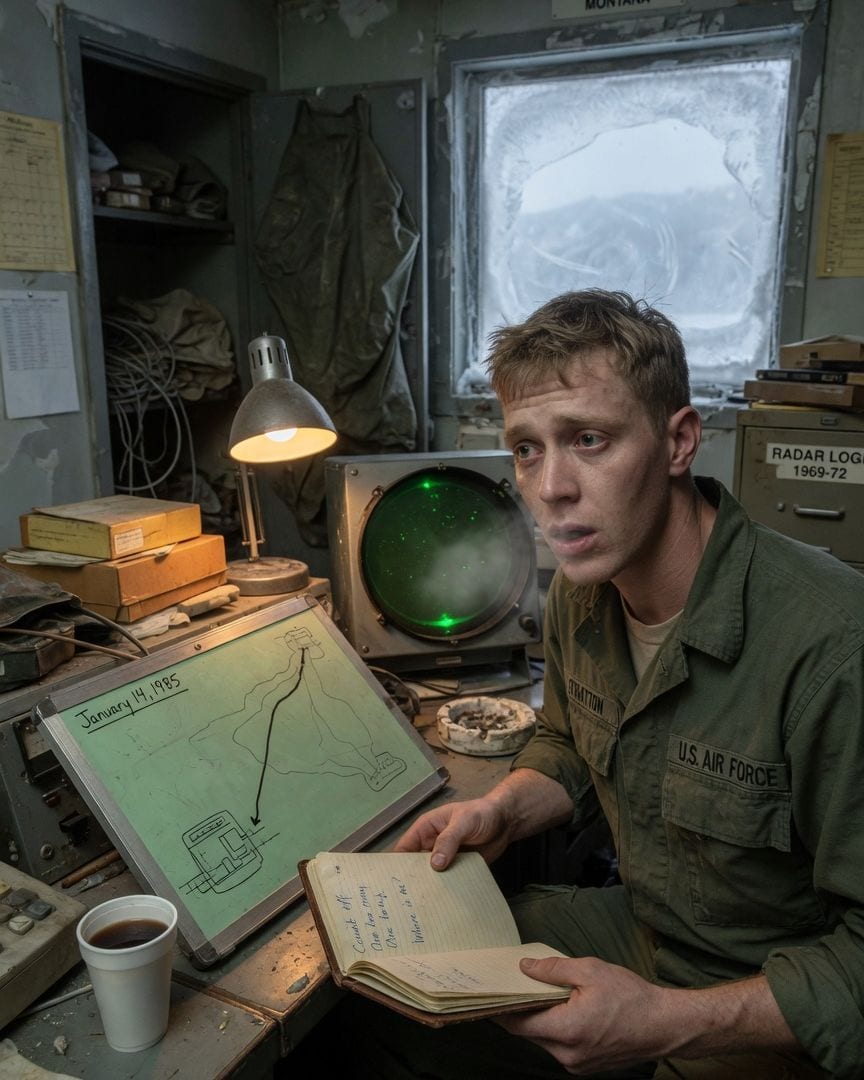
Airman Lars Stratton found an old Cold War manifest listing one name twice: 'Bernard Radcliffe' transferred and 'Bernard Radcliffe' still present.
Airman Second Class Lars Stratton was counting down his final weeks at Echo Station, a desolate Cold War outpost due for mothballing. He longed for home, far from the bitter Montana winds and the constant hum of static. Inside the dim radar shack, he logged the usual nightly ghost blip, a faint contact appearing at 2300, just as it had every winter since 1987. This night, a metallic tang like old blood lingered in the air, raising the hairs on his arms. Seeking distraction, Lars later discovered a leather-bound logbook from 1971, detailing the same 2300 contact, but with chilling notes and a manifest listing one airman's name, Bernard Radcliffe, twice—once transferred, once present. Was he truly alone in the silent, remote station?
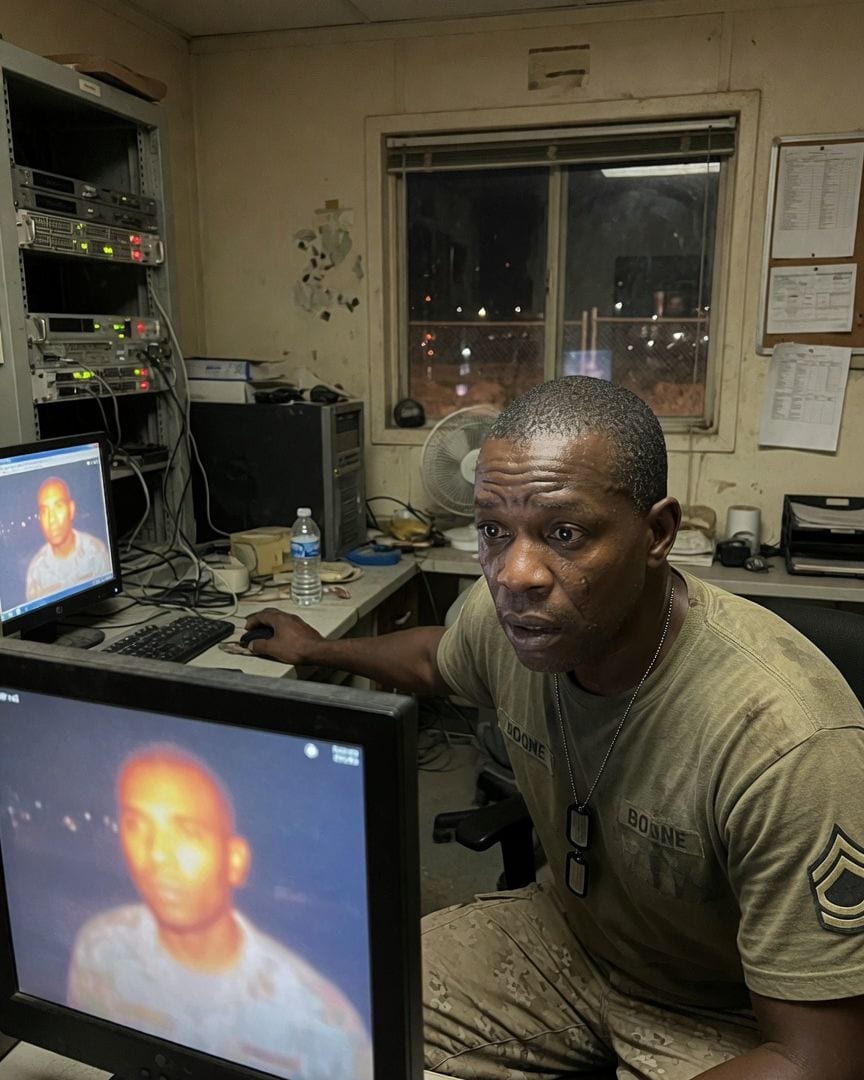
Sergeant Boone, two weeks from home, sees Corporal Whitfield in two places at once. One has a scar on his face. The other doesn't.
Sergeant Wayne Boone counted his last two weeks until deployment ended, sitting in his stifling security office at the Horn of Africa site. A minor scheduling error led him to chow-hall footage, where Corporal Richard Whitfield had an identical breakfast daily at 0530, complete with a distinct scar above his left eyebrow. Boone knew Whitfield was simultaneously radioing in status from Perimeter Tower 3 at that exact time, confirmed by logs and witnesses. The sergeant then checked the tower's thermal feed, hoping to dismiss the ghost, but the figure on the tower had no scar. How could two Corporal Whitfields exist, one scarred and one unblemished, both confirmed in different places at the same moment?
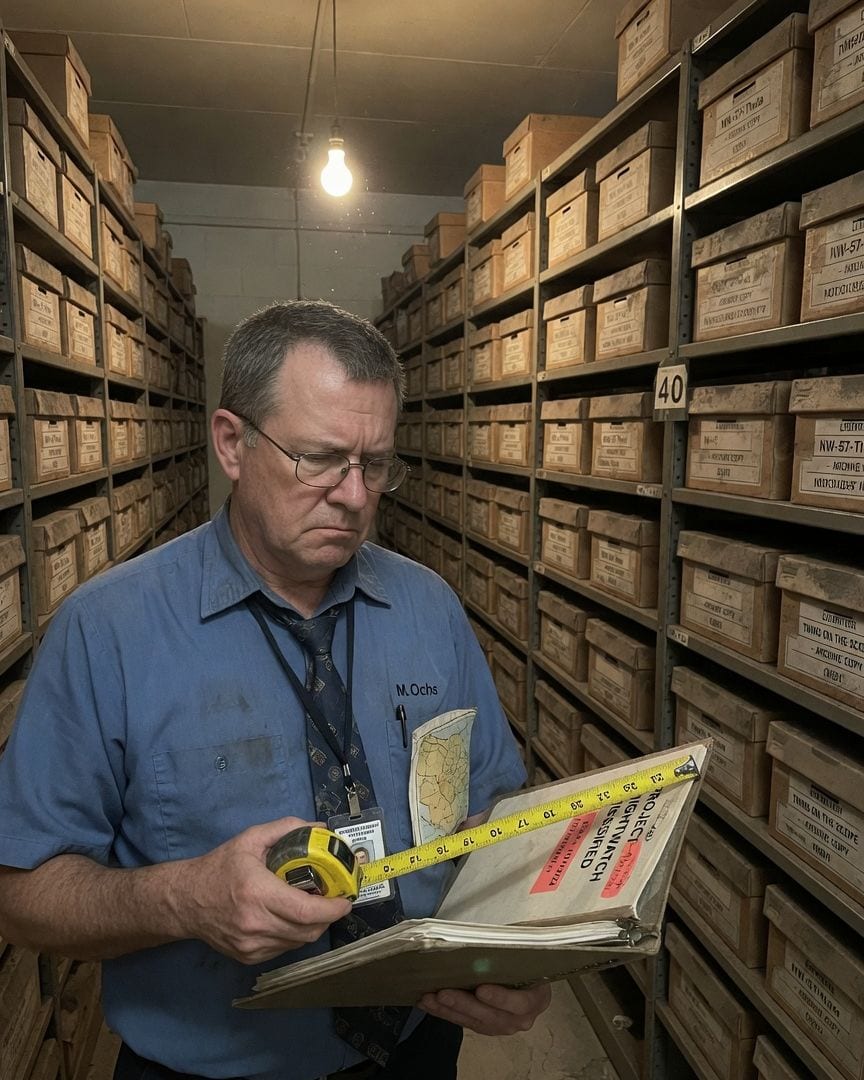
A Cold War records clerk on his final patrol found Aisle 40 stretched 61 feet longer, lined with unknown boxes. Inside one: 'PROJECT NIGHTWATCH - CLASSIFIED' with a fresh timestamp.
Marlin Ochs, a creature of habit after nineteen years at the St. Louis federal records depot, faced his final patrol through Aisle 40 before its scheduled pulping. His routine walk, usually 92 precise strides, suddenly stretched to an impossible 119, making the aisle 61 feet longer than its blueprint. The extra section felt colder, lined with dust-laden boxes bearing alien classification codes and no manifest. Inside one, he found a metal-bound file: 'PROJECT NIGHTWATCH - CLASSIFIED,' dated 1957, but with a timestamp just hours old.
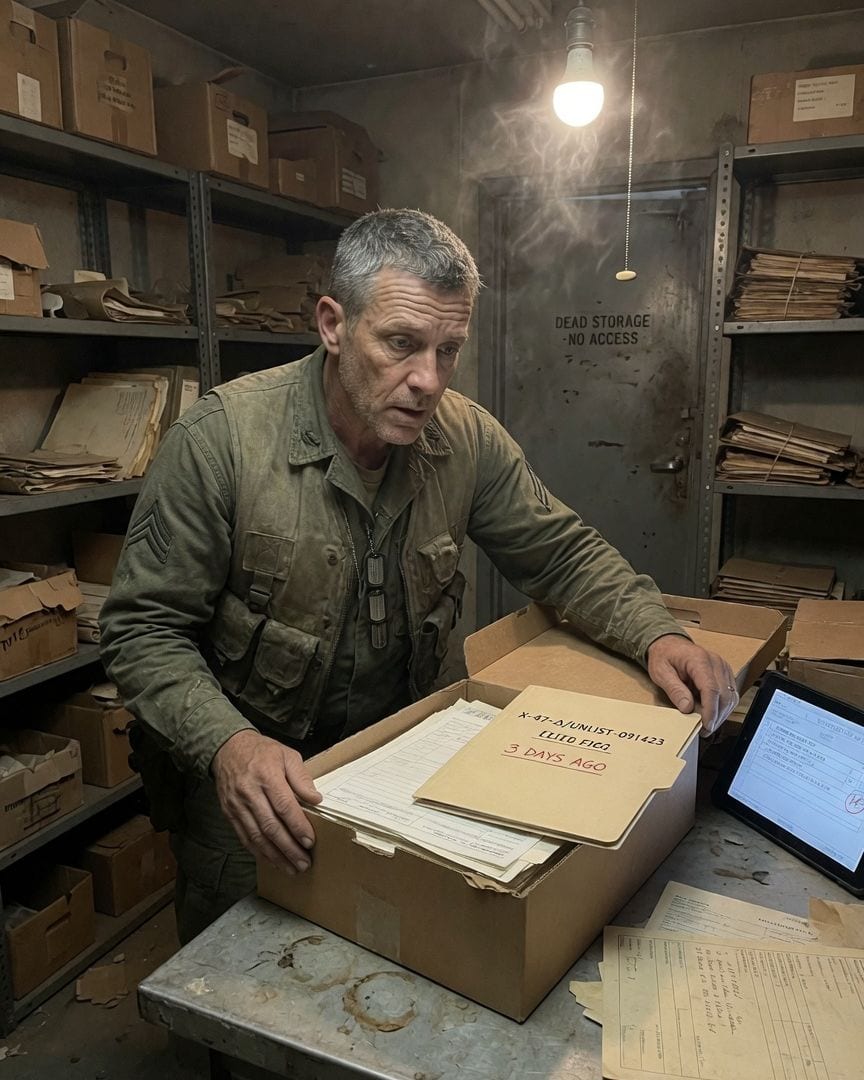
Sergeant Pryor, days from retirement, finds a four-hundred-foot crater. The desert floor is still warm, but no one remembers the blast.
Sergeant Alden Pryor, forty years old and just eleven days from retirement, drove the familiar Ranier Flats fence line for one of his final patrols. The desert stretched out, silent and vast, until he discovered a four-hundred-foot crater, dark and impossibly vast, where the sand had fused into slick glass. The ground within the crater was still faintly warm, a subtle heat defying the cool desert air. Yet, every official log confirmed the blast, while no one recalled a tremor or flash across three states.