On Airman Purdy Vane's last survey of a Cold War testing range, hot footprints strode four hundred yards into a concrete wall with no door, and no prints leading out.
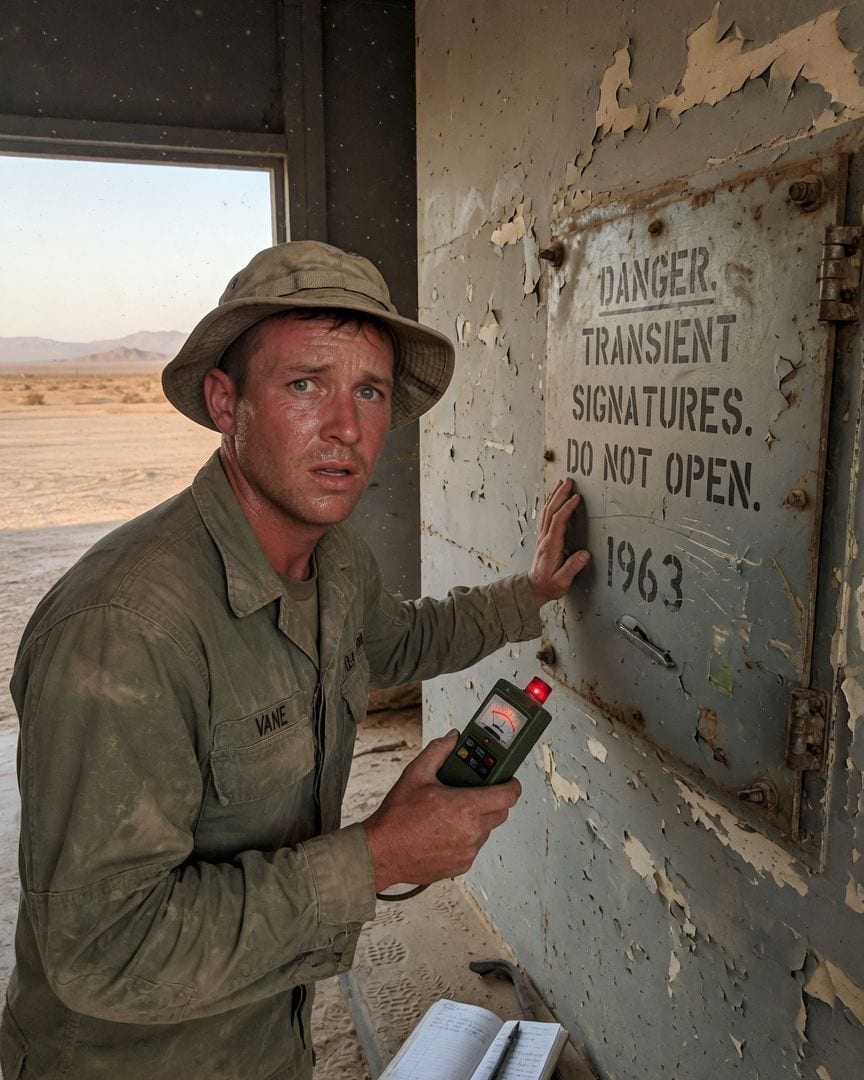
Purdy Vane, in dusty desert fatigues, walked a precise grid pattern across Sable Draw, the vast, desolate military testing range slated for permanent closure.
The late summer sun beat down on the cracked earth, making the heat shimmer above the distant mountains. His Geiger counter, a standard-issue AN/PDR-27, usually a quiet companion in the endless stretches of desolation, suddenly shrieked.
It was a sharp, insistent whine that cut through the silence. Purdy stopped, pulling the device closer. He checked his calibration, adjusted the settings, and swept the area where he stood. The meter remained silent.
He took a step forward, and the shriek returned, just as loud, just as sharp. He swept the ground carefully. The meter sang again, a precise, localized tone, covering an area exactly the size of a military boot print.
Six feet ahead, it sang again, identical in intensity and size. Then again.
A perfect, unhurried track of intense radiation readings stretched across four hundred yards of terrain. According to Army records, this entire range had been officially cold since 1958. Yet, the track did not fade or diminish.
It led directly to the featureless concrete wall of a small instrument shed, one side completely blank, no door, no window. Purdy followed the invisible trail, his Geiger counter whimpering like a wounded animal, until he reached the shed.
The radiation was strongest right where the last ‘print’ landed against the solid concrete. He walked the perimeter, sweeping every inch of the ground surrounding the structure. No other prints. Nothing leading away.
Just a hot track, striding confidently into a solid wall, and vanishing. He checked his own boots, then his equipment, then the ground where he stood. All clean. All cold. Only the track was hot.
He stood there, Geiger counter still whimpering, the sound too loud in the silent desert, staring at the concrete wall, trying to reconcile the impossible.
Purdy, methodical by nature and training, returned to the shed with his official logbook. He documented the precise GPS coordinates of each 'footprint,' noting the exact time and radiation levels.
His phone camera clicked, capturing the track, the shed wall, and his Geiger counter's display, each image a cold, hard fact. He called Commander Conrad Winslow, his voice calm, professional, but with an undercurrent of disbelief he fought to suppress.
Winslow, sounding weary from the endless logistics of the range's closure, suggested a faulty meter. He offered a buried isotope, or even a misguided prank by a departing airman. Purdy patiently insisted he had checked everything, multiple times.
The readings were consistent, localized, and undeniable. Winslow, after a long sigh that crackled over the satellite phone, reluctantly authorized Purdy to investigate further, but warned against 'unnecessary complications' given the range's imminent decommissioning.
"Just file it as anomalous," Winslow had said, "and don't go poking beehives."
Purdy spent the next hours meticulously examining the shed. It was a standard prefab structure, bolted to a concrete slab, its utilitarian gray paint peeling in the desert sun.
He found no obvious anomalies, no hidden seams, nothing to explain the phantom footprints. But then, on the blank wall where the prints had ended, beneath layers of paint and desert grime, he noticed a faint outline.
It wasn't a doorframe, nor a window. It was a panel. He scraped away the flaking paint with the blade of his utility knife.
It revealed a heavy steel plate, bolted shut with rusted, industrial-grade fasteners that seemed much older than the shed's visible construction. The bolts were unlike any standard issue he recognized, thick and crudely forged.
He tested the panel with his Geiger counter. It registered slightly higher than the surrounding concrete, but nothing like the intense readings from the 'footprints.'
He tried to pry it open with the knife, then with a crowbar he found in his jeep, but it was secured tight, unyielding.
As he worked, he noticed deeply etched, hand-stenciled letters on the lower corner, almost completely obscured by decades of dust and paint. He wiped away more grime with his sleeve, straining to read them.
Purdy finally deciphers the faint, stenciled warning on the old access panel. The letters are crude, hand-painted, uneven, and seem almost primitive compared to the shed's precise, military designation. They read: 'DANGER. TRANSIENT SIGNATURES. DO NOT OPEN.'
Below it, a date, painted in the same rough script: '1963.' He stares at the date, then back at his logbook, where his own handwritten entry reaffirmed the range was officially declared cold since 1958.
If the range was cold, why was a warning about 'transient signatures' painted on a hidden panel in 1963? And why was this panel so deliberately hidden, so aggressively secured?
The Geiger counter in his hand, which had quieted to a low hum, suddenly spikes again, not at a footprint, but directly from the warning panel itself, a brief, sharp burst, a violent static, then silence.
He freezes, his eyes fixed on the archaic warning, the desert wind picking up around him, rattling the dry scrub like a nervous whisper.
The next morning, Purdy attempted to report the warning panel and the 1963 date to Commander Winslow. Before he could even finish describing the stenciled words, Winslow cut him off.
His voice, usually gruff, had an edge of barely contained frustration. He reiterated that the range was closing, that all personnel were to focus on decommissioning, and any 'anomalies' were to be logged as 'unsubstantiated.'
"We have protocols for these things, Airman Vane," Winslow had said, his tone chillingly level. "Don't create unnecessary paperwork, and don't jeopardize your transfer." The implication was clear: pursue this further, and Purdy's career would suffer.
Undeterred, Purdy decided to go through official channels, albeit less directly. He requested access to the Sable Draw archives, citing the radiation anomaly as justification.
His request was routed to Kathleen Marsh, a declassification archivist at a regional records center hundreds of miles away. Kathleen, a meticulous woman with a dry wit that masked a deep intelligence, was initially skeptical.
"Everyone thinks they've found the X-Files when they stumble across a dusty file," she said over the phone, a faint smile audible in her voice.
But Purdy's precise, rational account of the hot footprints, the doorless shed, and the ancient warning, coupled with his detailed log entries and photographs, piqued her professional curiosity.
He didn't sound like a conspiracy theorist; he sounded like an airman reporting what he saw. Kathleen agreed to search for anything related to 'Sable Draw,' 'transient signatures,' or '1963 incidents.'
While he waited for Kathleen's findings, Purdy returned to the shed. This time, he brought a small tool kit he'd 'borrowed' from the motor pool.
He carefully tried to remove the rusted bolts from the access panel, making slow progress in the relentless heat. The metal groaned with each turn of the wrench, a long, drawn-out complaint that seemed to vibrate through the concrete.
He worked alone, under the vast, indifferent desert sky, feeling a growing sense of isolation, as if the silence itself was watching him.
He noticed faint, almost subliminal patterns in the rust on the bolts, intricate symbols that looked less like corrosion and more like deliberate markings. He carefully photographed them with his phone.
After hours of painstaking effort, he managed to get two of the six bolts loose. The heavy steel panel shifted a fraction of an inch, emitting a faint, metallic groan that seemed to echo in the silent air.
A week later, Purdy received an email from Kathleen. She had found a single, heavily redacted file on Sable Draw, labeled 'Project ECHO-OUT.' Most of it consisted of mundane decommissioning data, pages of bureaucratic drivel.
However, a single page, almost entirely blacked out with thick black marker, mentioned 'non-localized signatures' and a 'containment protocol' initiated in the early 1960s.
The file also contained a blurry, grainy photograph of the shed, taken from a distance, identical to its current state, but dated 1964. The shed had been there, looking exactly as it did now, sixty years ago.
Purdy replied immediately, pressing for more, specifically about the 'transient signatures' and the 1963 date.
The next morning, as Purdy prepared to drive back to Sable Draw, he found a flat tire on his jeep.
It wasn't a slow leak; it was a clean puncture, almost surgical, as if someone had deliberately driven a narrow, sharp object straight through the tread.
While changing it, he noticed a new, subtle crack on his windshield, directly over the passenger seat, a starburst fracture that looked like something had struck it from the inside.
He dismissed it as a coincidence, a consequence of driving on rough terrain, but a prickle of unease started to spread through him.
Later that day, at the shed, he was close to getting another bolt free when his phone rang. It was an unknown number, no caller ID. He answered.
A distorted, synthesized voice, almost mechanical, spoke a single sentence: "Some doors are meant to stay closed, Airman Vane." Then the line went dead. Purdy pulled the phone from his ear, staring at the 'CALL ENDED' notification.
The desert was utterly silent. He was alone, miles from anyone, and someone knew his name, his rank, and what he was doing.
He looked around, scanning the horizon, but saw nothing but the shimmering heat haze, the empty, endless sky. The silence felt heavier now, watchful, as if the desert itself was holding its breath.
Shaken, Purdy immediately called Kathleen, relaying the ominous phone call. Kathleen, her dry wit now entirely absent, admitted she had felt a similar subtle pressure.
Her access to 'ECHO-OUT' had been abruptly revoked, and she had received an internal memo 'reminding' her of data security protocols, subtly implying consequences.
She told him she had managed to download a handful of raw data files before her access was cut.
These files were not directly about Sable Draw, but referred to 'correlated energy patterns' observed across multiple 'decommissioned sites' from the 1950s to the 1970s.
The files included reports from a retired Army Corps of Engineers officer, Everett Vance, who oversaw the construction of several 'containment structures' at these sites.
Purdy, now realizing the scale of the cover-up might be far larger than just Sable Draw, asked Kathleen to find Vance.
It took two days, but Kathleen located an Everett Vance, now in his eighties, living in a quiet retirement community in rural Nevada. Purdy drove to meet him.
Vance, frail but sharp, initially dismissed Purdy's questions as "old war stories," waving a dismissive hand. Purdy, however, mentioned the 'transient signatures' and the 1963 date on the Sable Draw shed.
Vance's eyes, clouded by age, narrowed, focusing with an intensity that belied his years.
He finally admitted that the 'shed' at Sable Draw was not an instrument shed, but a 'containment shell' built over a known 'manifestation point' after a particularly aggressive series of 'signatures' in the late 1950s.
He confirmed the warning was authentic, painted by his own crew. He described the 'signatures' as not residual, but active, like "something moving through the air, leaving a wake."
He showed Purdy an old, faded blueprint for a similar 'containment structure' at a site called 'Juniper Flats,' dated 1955. On the blueprint, next to a diagram of a hidden access panel, were the words: 'Monitor internal activity.
Do NOT engage.' Vance explained that the government's protocol was not to understand, but to contain and conceal.
He referred to the 'secrecy machine' as a living entity in itself, designed to bury the impossible, to process these events as paperwork rather than confront their reality.
Purdy returned to Sable Draw, armed with Vance's confirmation and Kathleen's data. The cryptic phone call, the flattened tire, the crack in the windshield – they all fit a pattern of surveillance and warning.
He worked with renewed urgency, a cold determination settling in his chest. Finally, with a final, metallic shriek, the last bolts on the shed's access panel gave way.
The heavy steel plate swung inward, revealing not an empty interior, but a narrow, dark passage leading down.
The air inside was still, cool, and smelled faintly of ozone and something else, something metallic and organic, like old blood and new rain. He switched on his tactical flashlight.
The powerful beam cut through the gloom, revealing a short, concrete-lined tunnel. At the end of the tunnel, a small, reinforced door. On the door, a stenciled label, barely visible in the dust: 'INTERNAL LOGS - ACCESS RESTRICTED.'
His Geiger counter, which he'd clipped to his belt, began to tick, slowly at first, then accelerating, its rhythm matching his own pounding heart. He pushed the door open.
Inside, a cramped, dusty chamber. A single, heavy-duty data recorder, boxy and anachronistic, sat on a metal shelf, its indicator lights faintly glowing, still powered, still running. Next to it, a stack of bound, official logbooks.
He picked up the top one, its cover faded, dated 1960. He opened it, flipping through the meticulous, handwritten entries. '04/12/61 - Signature detected, Grid 7. Movement towards Sector 9. Confirmed entry at designated point. Containment holding.'
He flipped to another page, further in. '08/23/78 - Minor breach, Sector 9. Signature partial, exit confirmed. Resealed.' Then he saw it. On a page dated 1963, an entry about an unusually prolonged 'signature event' that caused 'local interference.'
Below it, a handwritten note, precise and detached: 'Civilian Witness: Vane, Thomas. Age 7. Relocated.' Purdy's breath hitched. Thomas Vane. His grandfather.
The same grandfather who never spoke of his childhood, who always had a strange, distant look in his eyes whenever the subject of old desert towns came up.
His own family name, staring back at him from a classified logbook, tying him directly to the decades-old secret, implying the pattern wasn't just external, but ran through his very blood.
Purdy stood frozen, the logbook open in his trembling hands. The name 'Vane, Thomas' was undeniable, a cold knot tightening in his stomach.
He quickly scanned other entries, finding a recurring pattern: 'signature events' often coinciding with unusual atmospheric conditions, and occasionally, with the presence of specific individuals noted as 'sensitives' or 'witnesses.'
The logs detailed the entity's movements not as random, but as a kind of patrol, a circuit it performed across designated points, leaving its radiation trace.
The 'footprints' he found weren't an echo of the past, but the entity's current passage. The shed was indeed a gateway, a fixed point where it entered or exited this dimension.
The data recorder, still humming softly on the shelf, confirmed this, its internal clock perfectly synchronized with his own.
He saw entries up to the present day, recording the 'transient signatures' with chilling regularity, often noting a subtle increase in intensity around the Sable Draw site in recent weeks, correlating precisely with his own observations.
The logs revealed that the 'secrecy machine' wasn't just covering up a single event, but an ongoing, active phenomenon. The entity itself was never described, only its 'signature' and 'movement,' a terrifying absence of detail.
The horror was in the meticulous, detached professionalism of the entries, documenting something utterly alien as if it were routine weather data.
He realized the crack in his windshield, the flat tire, the ominous phone call – they weren't just warnings to stop.
They were part of an automated, institutional response, triggered by his proximity and his discovery, designed to keep the secret buried, even from those it affected.
Purdy knew he couldn't leave the logbooks and the recorder here. This was the artifact that proved everything, the decades-long secret laid bare.
He began carefully documenting the recorder's current data, photographing every page of the logs, especially those pertaining to 'Vane, Thomas' and the recent spikes.
As he worked, a low hum began to emanate from deeper within the chamber, a sound almost too low to hear, vibrating subtly through the concrete floor.
The Geiger counter, which he'd set on the metal shelf, began to shriek, a continuous, deafening wail that pierced the stillness. The indicator lights on the data recorder flashed wildly, a chaotic strobe of red and amber.
He glanced at the recorder's screen: a real-time graph of radiation spikes, mirroring the 'footprints' he'd found, but now showing a massive, sustained surge, originating from the very back wall of the chamber. The 'entity' was here. It was moving.
He could feel a pressure, a cold, heavy weight pressing down on him, though nothing is visible. The air grew thick with the smell of ozone and that metallic, organic scent he’d noticed earlier.
He realized the shed wasn't just a cover; it was a trap, a monitoring station, and he was now inside the active manifestation zone.
He grabbed the logbooks, shoved his phone with its photos into his pocket, and scrambled back toward the hidden access panel. The hum intensified, becoming a deep, resonant thrum that vibrated in his bones, rattling his teeth.
He felt a sudden, intense chill, then a burning sensation on his skin, as if an invisible current was passing through him, raising every hair on his body. He glanced back.
In the flickering light of his flashlight, a subtle distortion shimmered in the air at the back of the chamber, like heat rising from a road, but impossibly cold and darkly opaque, an absence of light.
It wasn't a shape, but a warping of reality itself, a void pulling at the air around it. He fumbled with the access panel, pushing it open with a desperate shove, the Geiger counter still screaming in his hand.
He burst out into the desert, gasping for air, the cold, heavy pressure lifting the moment he crossed the threshold.
Behind him, the hum abruptly ceased, and the Geiger counter fell silent, leaving only the sound of his ragged breathing in the vast, empty landscape.
Purdy, shaking but alive, drove away from Sable Draw, the logbooks and his phone clutched to his chest. He contacted Kathleen, his voice raspy, telling her he had everything. Kathleen, having faced her own institutional pushback, understood the urgency.
She arranged for a secure meeting outside official channels.
Together, they compiled the evidence: Purdy's initial survey, the logbooks detailing decades of 'transient signatures' and 'containment protocols,' the real-time data he’d pulled from the recorder, and the chilling entry about Thomas Vane.
The evidence was irrefutable, meticulously documented by the very system designed to bury it. They submitted their findings through a secure, whistleblowing channel, anonymously.
The Army issued a terse, internal statement acknowledging 'anomalies at decommissioned sites' and announcing a 'review of historical containment procedures.' No public acknowledgement.
Sable Draw was finally, officially, closed and bulldozed, the shed and its secret chamber buried under tons of rock and concrete, erased from the landscape, as if it had never been there at all.
Months later, Purdy Vane was out of the service, having successfully transferred to a civilian role as a geological surveyor in a state hundreds of miles from the desert.
The desert sun still felt different to him now, heavier, even from memory. He still kept the logbooks, carefully stored in a waterproof safe, and checked his old Geiger counter weekly, ensuring it was always functional.
He never spoke of what he found, not even to Kathleen, with whom he maintained a distant, professional correspondence, an unspoken bond of shared, impossible knowledge. The incident had changed him, leaving a subtle, internal tremor that never quite fades.
Sometimes, late at night, a faint, metallic scent, like ozone and old blood, would drift through his apartment, even with the windows closed and the air conditioning humming. He attributed it to memory, to lingering psychological effects.
But then, one evening, while walking through a quiet park, his phone, an old model he kept for sentimental reasons and rarely used, vibrated in his pocket. It was a notification from an unknown number.
A single, encrypted text message, containing only two words: 'Welcome home, Airman.'
The phone, an old model Purdy had kept for sentimental reasons, lay on the park bench, its screen dark.
A stray dog, sniffing around the bench, suddenly whined, backing away from the phone with a low growl, its hackles raised, before bolting into the night.
If this one got to you
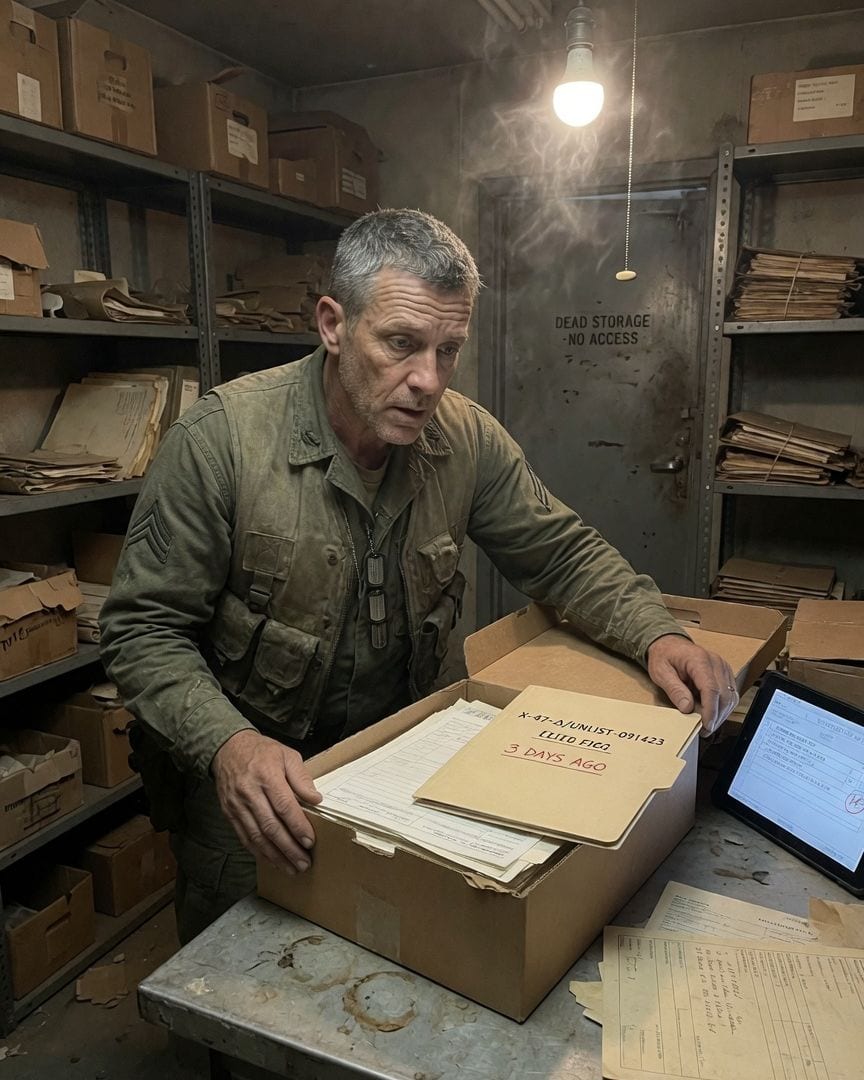
Sergeant Pryor, days from retirement, finds a four-hundred-foot crater. The desert floor is still warm, but no one remembers the blast.
Sergeant Alden Pryor, forty years old and just eleven days from retirement, drove the familiar Ranier Flats fence line for one of his final patrols. The desert stretched out, silent and vast, until he discovered a four-hundred-foot crater, dark and impossibly vast, where the sand had fused into slick glass. The ground within the crater was still faintly warm, a subtle heat defying the cool desert air. Yet, every official log confirmed the blast, while no one recalled a tremor or flash across three states.
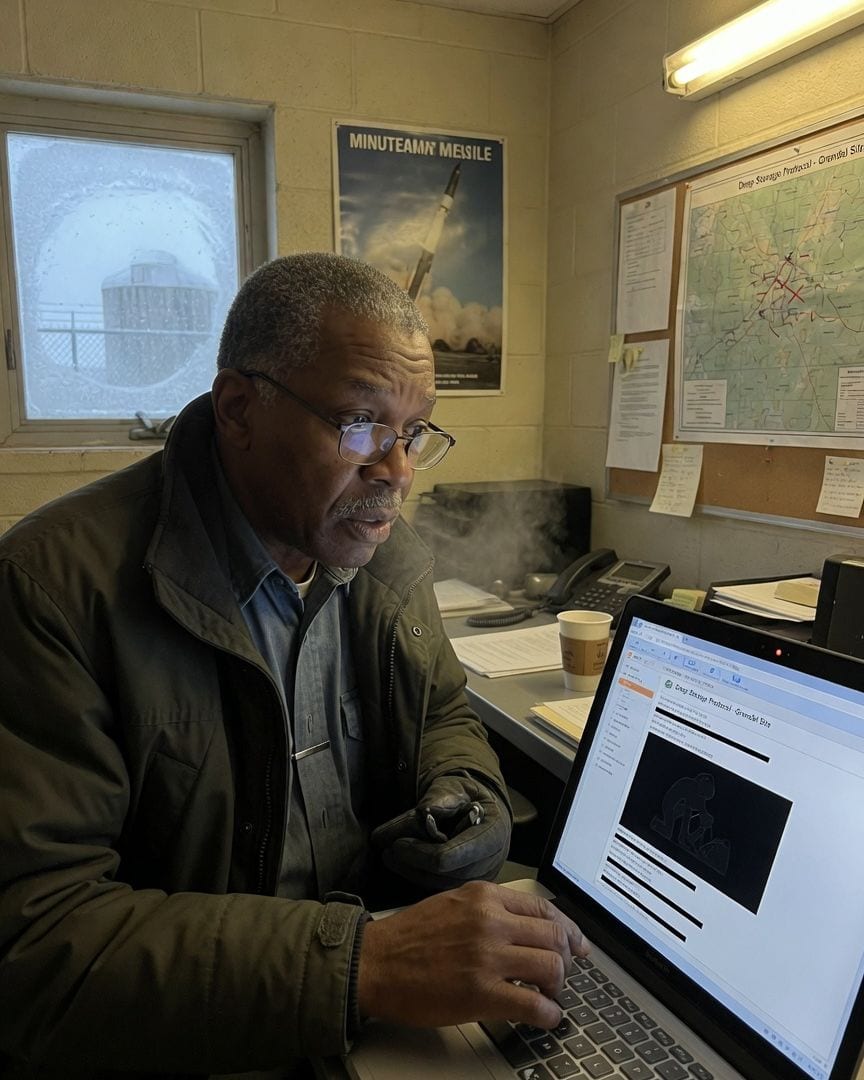
On his last cleanup before retirement, Colonel Marsalis found a dead Cold War missile silo's printer repeating: CREW STILL ON STATION.
Colonel Ren Marsalis, a career Air Force officer, faced his final administrative cleanup before retirement at the decommissioned Grendel Site in the biting North Dakota winter. He expected a sealed missile capsule, but Capsule 7's eight-ton door stood cracked open eleven impossible inches, its hydraulics removed in 1985. Inside, consoles glowed with static alerts from an unknown power source, while an old printer endlessly spooled paper repeating one chilling message: "CREW STILL ON STATION. ACKNOWLEDGE." This impossible communication, from a long-dead system, was no glitch; it hinted at a deliberate, hidden presence, a truth reinforced by a redacted document showing a hunched, humanoid shape.
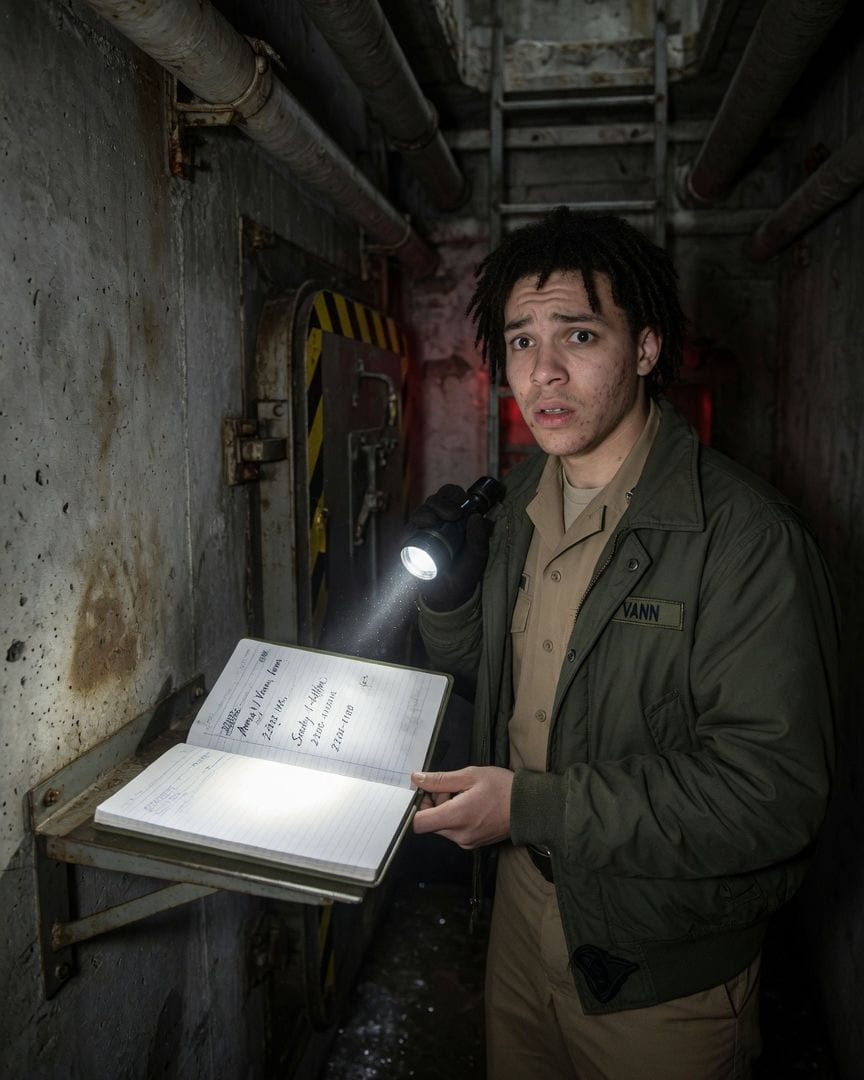
On his last patrol, Airman Vann sees a Cold War silo hatch light up from *inside*—it was welded shut a decade ago.
Airman Vincent Vann was on his last patrol across a vast, desolate Cold War missile field in the Dakotas, the cold, starless sky mirroring the emptiness of the landscape before his transfer. His routine check of eight hardened silo caps was shattered when a red fault light pulsed on Silo 4’s access panel, signaling an impossible breach from *inside* a hatch sealed for a decade. As more silos lit up, ignoring base orders, Vann found the hatch unlocked from within and descended into the dark shaft, where he discovered a pristine logbook bearing his own signature next to a chilling entry from a non-existent sentry, dated for *that very night*. Now, a steady *thump* echoed from deeper within the sealed concrete, leaving the Airman desperate for an explanation that simply wasn't there.
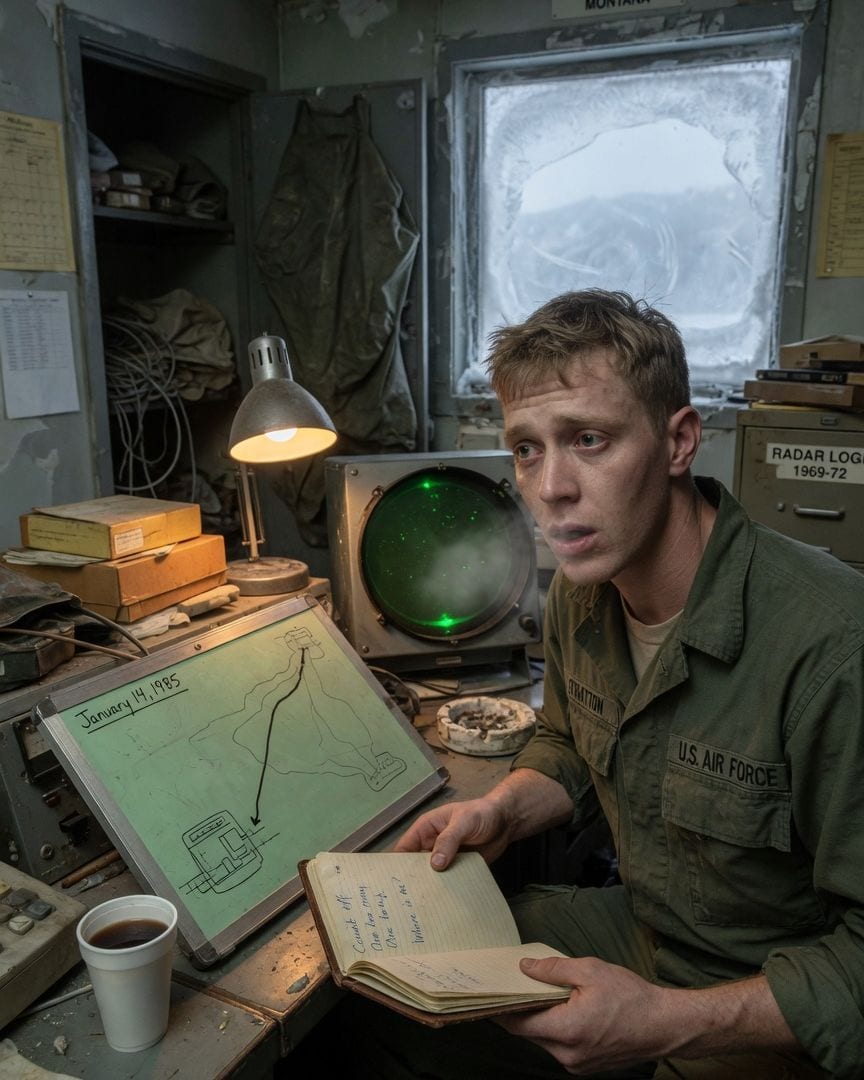
Airman Lars Stratton found an old Cold War manifest listing one name twice: 'Bernard Radcliffe' transferred and 'Bernard Radcliffe' still present.
Airman Second Class Lars Stratton was counting down his final weeks at Echo Station, a desolate Cold War outpost due for mothballing. He longed for home, far from the bitter Montana winds and the constant hum of static. Inside the dim radar shack, he logged the usual nightly ghost blip, a faint contact appearing at 2300, just as it had every winter since 1987. This night, a metallic tang like old blood lingered in the air, raising the hairs on his arms. Seeking distraction, Lars later discovered a leather-bound logbook from 1971, detailing the same 2300 contact, but with chilling notes and a manifest listing one airman's name, Bernard Radcliffe, twice—once transferred, once present. Was he truly alone in the silent, remote station?
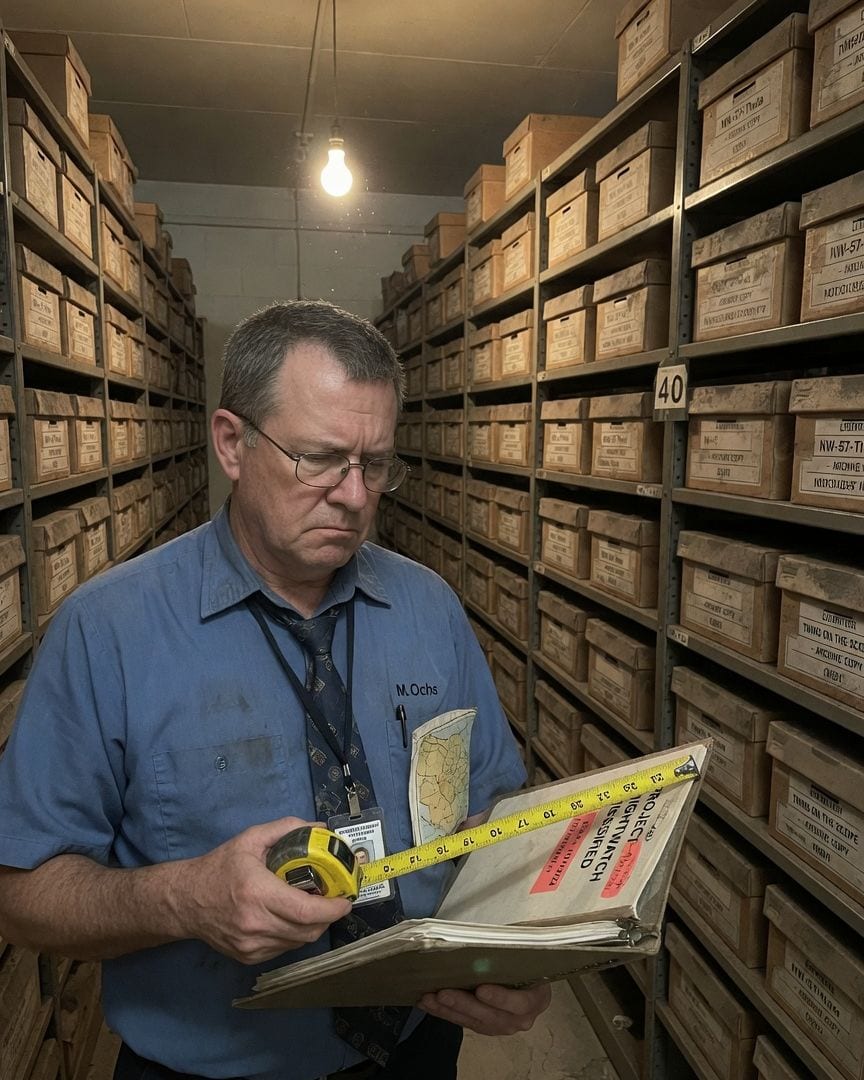
A Cold War records clerk on his final patrol found Aisle 40 stretched 61 feet longer, lined with unknown boxes. Inside one: 'PROJECT NIGHTWATCH - CLASSIFIED' with a fresh timestamp.
Marlin Ochs, a creature of habit after nineteen years at the St. Louis federal records depot, faced his final patrol through Aisle 40 before its scheduled pulping. His routine walk, usually 92 precise strides, suddenly stretched to an impossible 119, making the aisle 61 feet longer than its blueprint. The extra section felt colder, lined with dust-laden boxes bearing alien classification codes and no manifest. Inside one, he found a metal-bound file: 'PROJECT NIGHTWATCH - CLASSIFIED,' dated 1957, but with a timestamp just hours old.
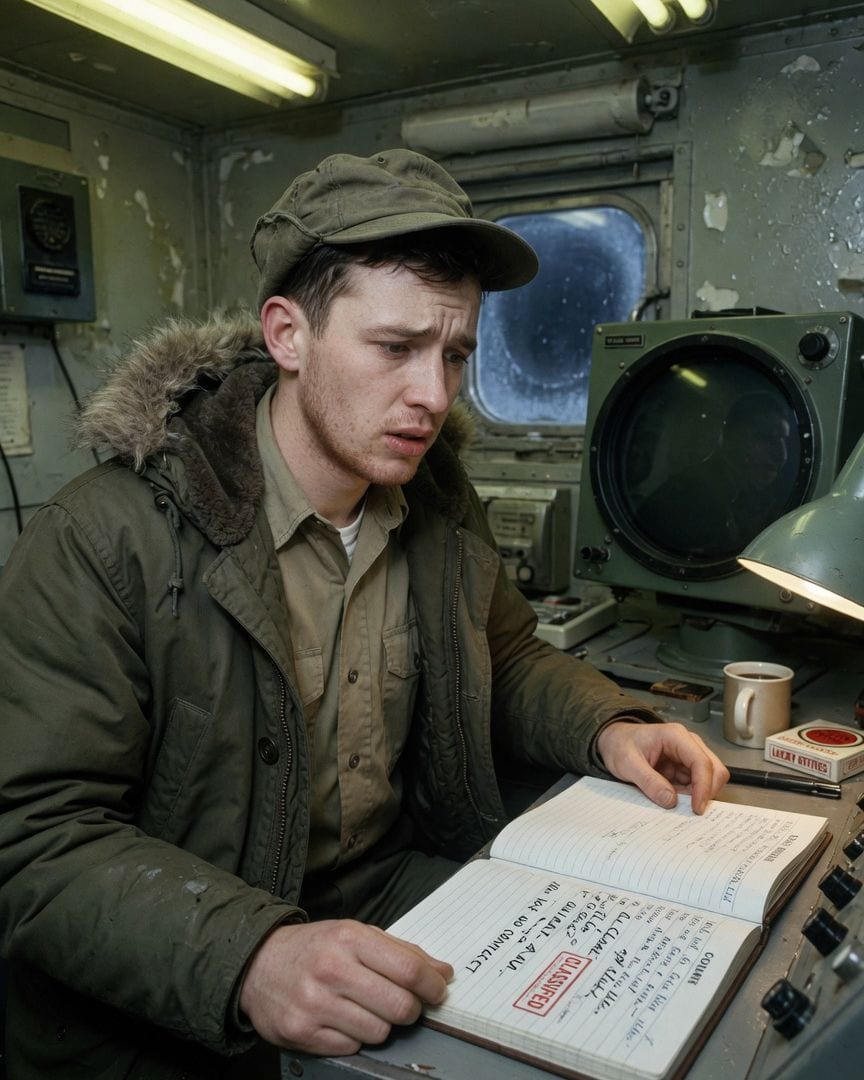
A Cold War airman logs an impossible radar contact on his last sweep. But his official logbook entry is stamped 'CLASSIFIED' and then contradicted by a hastily scrawled 'ALL CLEAR' dated moments before it.
Airman Ordway Vance, 22, manned the radar dome at Site Pellin in the biting North Atlantic dark of January 1962, running the last calibration sweep before its decommissioning. His scope picked up a faint, impossible return, growing closer with each pass, though the ocean remained empty to the eye. When Vance detailed the contact in his official logbook, a 'CLASSIFIED' stamp appeared, followed by a hastily scrawled 'ALL CLEAR' dated moments before his own entry, contradicting his every word. Commander Hartley dismissed it as equipment malfunction, but Vance sensed a chilling, official erasure behind the lie. He soon found a locked cabinet marked 'SITE PELLIN ANOMALIES,' hinting at a deeper truth buried within the base's final days.